

Global Ethylene Vinyl Acetate Market Analysis & Forecast 2026-2033
The Global Ethylene Vinyl Acetate Market size is estimated to be valued at USD 15,379.3 Mn in 2026 and is expected to reach USD 22,836.1 Mn by 2033, growing at a compound annual growth rate (CAGR) of 5.8% from 2026 to 2033.
Key Takeaways
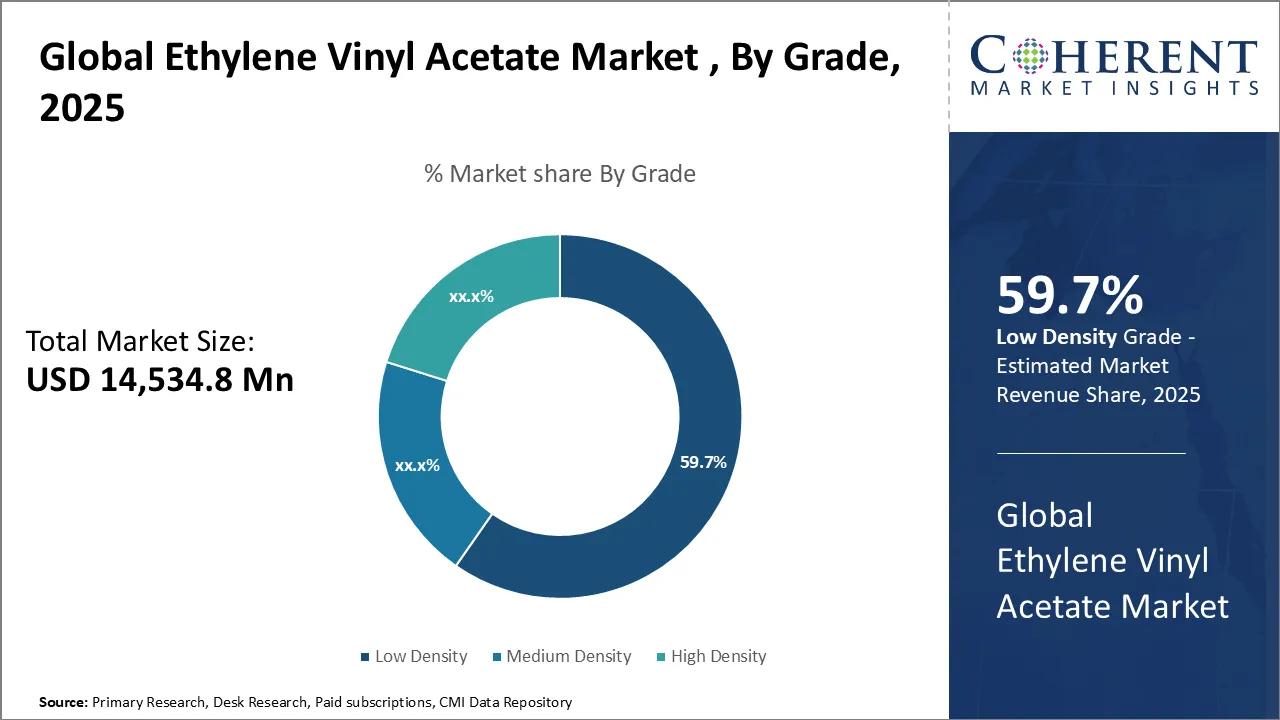
- By Grade, Low-Density segment is projected to account for 60.7% of the global ethylene vinyl acetate (EVA) market in 2026, driven by increasing demand in packaging films.
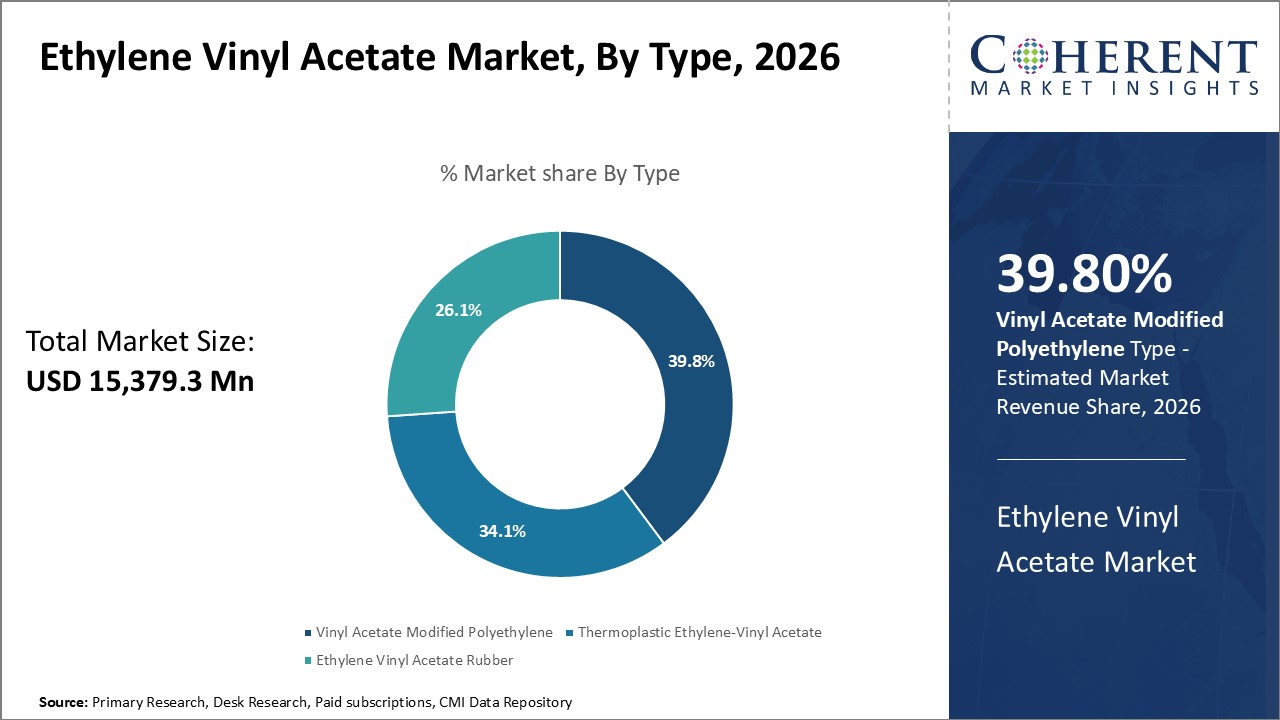
- By Type, Vinyl acetate modified polyethylene is projected to hold a 39.8% share of the global EVA market in 2026, due to the rising use in solar encapsulation.
- By Application, Photovoltaic cells are expected to account for 37.8% of EVA market share in 2026, fueled by favorable government incentives for renewable energy, and EVA’s proven efficiency as a solar encapsulant.
- By End-use Industry, the consumer goods segment is forecast to capture a 35% share of the EVA market in 2026, owing to growing demand for sportswear and footwear, lightweight flexible household materials, and e-commerce–driven protective packaging needs.
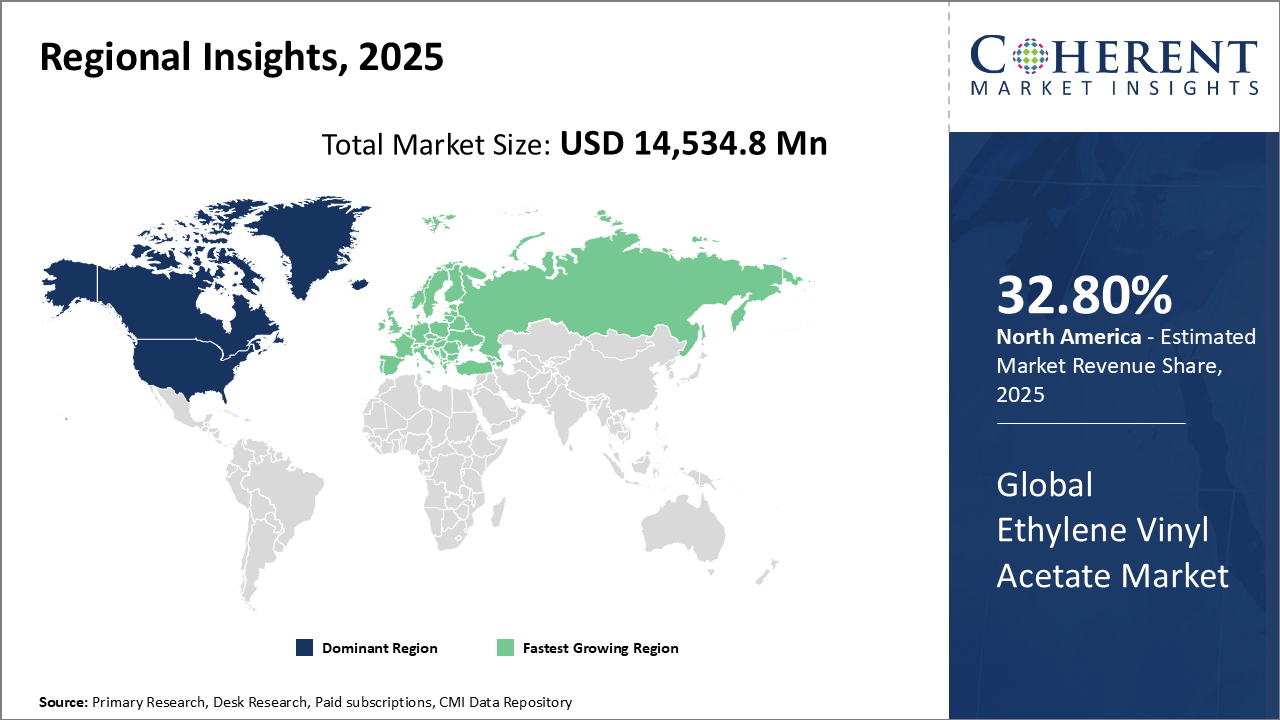
- By Region, North America is anticipated to dominate the EVA market with a 32.8% share in 2026, supported by and automotive demand, and investments in sustainable and bio-based EVA production.
Market Overview
The Global Ethylene Vinyl Acetate Market is growing at a steady clip, on account of its broad use in solar panels, shoe manufacturing, packaging, and everyday consumer items. A good illustration of this surge is Hanwha Solutions, which planned to boost its EVA output in 2024 in order to satisfy an ever-larger appetite for the polymer used in encapsulating photovoltaic cells for solar modules. EVA’s unique combination of flexibility, toughness, and stickiness consistently proves attractive to engineers, and the surge in renewable-energy programs, coupled with industrial investment in both North America and Europe, continues to power its ascent.
Current Events and its Impact on the Ethylene Vinyl Acetate Market
Current Event | Description and its impact |
Rising Demand from the Solar Energy Sector |
|
Supply Chain Volatility and Raw Material Price Fluctuations |
|
Growth in Footwear and Consumer Goods Industry |
|
Role of Advanced Technologies in the Ethylene Vinyl Acetate (EVA) Market
Advanced technologies are playing a pivotal role in shaping the growth and innovation trajectory of the Ethylene Vinyl Acetate (EVA) market. Innovations in polymerization techniques, such as high-pressure tubular and autoclave reactors, are enabling manufacturers to produce EVA with enhanced clarity, flexibility, and thermal stability. These technological advancements are crucial for applications in photovoltaic encapsulants, medical devices, and high-performance packaging.
For instance, LG Chem’s adoption of advanced high-pressure tubular reactor technology to produce EVA grades specifically tailored for solar photovoltaic encapsulants. By leveraging these innovations, the company has been able to deliver EVA with superior transparency, flexibility, and thermal resistance, meeting the stringent performance standards required for long-term reliability in solar panels.
- Current Industry Events of 2026
- Market Size Estimation
- Regional Breakdown
- Competitive Landscape
- Customer Intelligence
- Segmental Analysis
- Pricing Analysis
- Key Market Drivers, Challenges & Future Trends
- Customized Insights Section
Export Import Analysis
Global EVA trade is dominated by Vietnam, accounting for ~80% of imports (~5,285 shipments), largely sourced from China (65% of global exports). The U.S., however, saw a 64% decline in EVA imports (16 shipments), heavily reliant on South Korea (75%). Europe and Peru remain smaller but notable importers. This highlights Asia’s centrality in EVA supply chains, driven by footwear and solar industries. For instance, Vietnam’s Nike manufacturing hub significantly boosts EVA demand for midsoles, while China’s dominance in solar module production strengthens its position as both a top exporter and re-exporter.
Segmental Insights
Ethylene Vinyl Acetate Market Insights, By Grade: Low-Density EVA Acquires The Largest Market Share
The low-density segment is projected to account for 60.7% of the global ethylene vinyl acetate (EVA) market in 2026. This segment leads the market owing to its excellent processability, flexibility, and clarity, making it highly suitable for applications in packaging, foams, films, and wire & cable insulation. Its lightweight nature combined with strong mechanical properties enhances product performance while reducing material usage, which drives its preference across industries.
For instance, in September 2024, Dow-Mitsui Polychemicals (Tokyo) began marketing biomass EVA and biomass LDPE using the mass balance method, following ISCC PLUS certification at its Chiba Plant in May 2024. These biomass resins retain the same flexibility, clarity, and processability as conventional grades, making them easily substitutable in packaging, foams, films, and wire & cable insulation.
Ethylene Vinyl Acetate Market Insights, By Type: Dominance of Vinyl Acetate Modified Polyethylene in the EVA Market
Vinyl acetate modified polyethylene is projected to hold a 39.8% share of the global ethylene vinyl acetate (EVA) market in 2026. This segment leads due to the material's superior flexibility, resilience to impact, and thermal stability across varying temperature conditions. Its adaptability makes it highly preferred in industrial, automotive, and packaging applications where materials are exposed to mechanical stress and environmental changes. Its balance of strength and flexibility ensures long-term durability, further solidifying its dominance among EVA types.
Ethylene Vinyl Acetate Market Insights, By Application: Photovoltaic Cells Drive EVA Market Growth
Photovoltaic cells are expected to account for 37.8% of the global EVA market in 2026, owing to the material’s critical function as an encapsulant in solar panels. EVA films offer strong UV resistance, optical clarity, and bonding properties that are essential for protecting and sealing solar modules. The growing focus on renewable energy and expansion of solar infrastructure—especially in regions like Asia Pacific, North America, and Europe continues to fuel this segment’s upward trajectory.
For instance, Sumitomo Chemical has created a new grade of SUMITATE®, an ethylene vinyl acetate (EVA) copolymer, as an innovative encapsulant for photovoltaic cells. This new SUMITATE® offers the dual benefits of minimizing Potential Induced Degradation (PID) while maintaining high transparency.
Ethylene Vinyl Acetate Market Insights, By End-Use Industry: Rising Demand in Consumer Products Drives EVA Growth
The consumer goods segment is forecast to capture 35% of the EVA market in 2026. EVA’s lightweight, cushioning, and adhesive characteristics make it widely applicable in footwear soles, toys, mats, and lifestyle products. Increasing demand for comfort-oriented, flexible, and durable materials in both casual and performance consumer products particularly in Asia and Latin America supports the continued growth of this end-use segment.
For instance, in 2024, Nike increasingly used ethylene vinyl acetate (EVA) in the midsoles of its running shoes and casual footwear. EVA’s lightweight nature, cushioning properties, and flexibility allowed the shoes to provide comfort and durability for everyday use and athletic performance.
Regional Insights
North America Ethylene Vinyl Acetate Market Trends and Analysis
North America is anticipated to dominate the global ethylene vinyl acetate (EVA) market with a projected 32.80% share in 2026, with the United States being the primary contributor. For example, in 2024, Dow Inc. expanded its EVA production to support demand from packaging, footwear, automotive, and renewable energy sectors. The region's leadership is fueled by robust demand across packaging, footwear, automotive, and renewable energy sectors.
Strong industrial base, coupled with the presence of leading EVA manufacturers and well-developed R&D infrastructure, positions North America as a mature and innovation-driven market. Technological advancements and growing investments in solar energy applications further reinforce regional dominance.
Europe Ethylene Vinyl Acetate Market Trends and Analysis
Europe holds a significant position in the global EVA market, driven by its focus on sustainable manufacturing practices and strong demand in the automotive and construction industries. For example, in 2024, BASF expanded EVA production to support solar infrastructure projects in Germany, France, and Italy, where EVA is essential for photovoltaic module encapsulation. Additionally, the region benefits from established footwear and consumer goods sectors that contribute to consistent EVA consumption.
Ethylene Vinyl Acetate Market Outlook Country Wise
United States Canada Ethylene Vinyl Acetate Market Trend
The United States is the leading contributor to the global EVA market, backed by a mature industrial base and high demand across packaging, footwear, automotive, and solar energy sectors. For example, in 2024, Dow Inc. expanded its U.S. EVA production to support photovoltaic applications, while Celanese Corporation launched advanced EVA grades for high-performance packaging and automotive components. The country's advanced manufacturing infrastructure, robust R&D ecosystem, and supportive government policies on renewable energy drive consistent consumption of EVA, particularly in photovoltaic applications. Presence of major EVA manufacturers and extensive downstream industries further solidify the U.S. as a global hub for EVA production and innovation.
Canada Ethylene Vinyl Acetate Market Trend
Canada complements North America’s EVA market growth with strong demand in consumer goods, building materials, and green energy sectors. Increased adoption of EVA-based insulation and packaging materials, along with government emphasis on sustainable practices, boosts market activity. Additionally, the country’s expanding solar energy projects support the usage of EVA in photovoltaic encapsulants.
For instance, in 2024, Trina Solar, a leading global solar module manufacturer, supplied ethylene vinyl acetate (EVA) encapsulants for photovoltaic (PV) modules used in Canadian solar energy projects. These EVA encapsulants provided essential UV resistance, optical clarity, and durability, ensuring the longevity and efficiency of solar panels in Canada's diverse climatic conditions. This collaboration highlights the critical role of EVA in enhancing the performance and reliability of solar modules in the Canadian renewable energy sector.
Market Report Scope
Ethylene Vinyl Acetate Market Report Coverage
| Report Coverage | Details | ||
|---|---|---|---|
| Base Year: | 2025 | Market Size in 2026: | USD 15,379.3 Mn |
| Historical Data for: | 2020 To 2024 | Forecast Period: | 2026 To 2033 |
| Forecast Period 2026 to 2033 CAGR: | 5.8% | 2033 Value Projection: | USD 22,836.1 Mn |
| Geographies covered: |
| ||
| Segments covered: |
| ||
| Companies covered: | Exxon Mobil Corporation, Dow Inc., LyondellBasell Industries N.V., Celanese Corporation, E.I. du Pont de Nemours and Company, Hanwha Chemical Corporation, Braskem S.A. , LG Chem Ltd., Arkema S.A. , Saudi Basic Industries Corporation, BASF SE , Formosa Plastics Corporation , TotalEnergies SE , Eastman Chemical Company, Westlake Chemical Corporation, Tosoh Corporation , China Petrochemical Corporation, Borealis AG (Austria), China National Petroleum Corporation, and INEOS Group AG | ||
| Growth Drivers: |
| ||
| Restraints & Challenges: |
| ||
Ethylene Vinyl Acetate Market Trends
Expanding Packaging Industry
The packaging industry is rapidly expanding with e-commerce growth, boosting EVA demand in flexible packaging for food, beverages, personal care, and consumer goods. EVA’s flexibility and barrier properties make it vital for bags, pouches, shrink films, and food packaging. In May 2025, Reuters reported U.S. spot EVA prices rose modestly despite oversupply. Meanwhile, infrastructure growth in Asia Pacific and MEA is driving EVA use in roofing, flooring, insulation, and sealants. In March 2025, Reuters noted steady Indian EVA prices (₹120–128/kg) across major cities, reflecting sustained demand in footwear, packaging, and solar encapsulation. Additionally, the renewable energy sector is spurring EVA adoption in solar panel encapsulation, with installations rising sharply in China and India in 2025.
Analyst Viewpoint – Ethylene Vinyl Acetate Market
- Analysts maintain a favorable outlook on the global ethylene vinyl acetate (EVA) market, supported by its rising adoption across key sectors such as packaging, solar energy, footwear, and consumer goods. Growth is particularly driven by the material’s flexibility, durability, and superior adhesion properties, which make it a versatile choice in diverse industrial applications.
- Experts highlight the growing significance of sustainability and renewable energy in shaping market trends. The increasing use of EVA in photovoltaic cell encapsulation is seen as a major growth avenue, especially amid global initiatives promoting solar energy adoption. Technological advancements in EVA formulations with enhanced UV and heat resistance are further fueling its utility in green energy infrastructure.
- Regionally, North America continues to dominate the EVA market due to robust demand from established industries and advanced manufacturing capabilities. However, Asia Pacific is emerging as the fastest-growing region, fueled by rapid industrialization, expanding solar installations, and increasing consumer product manufacturing in countries like China and India.
Ethylene Vinyl Acetate Market: Key Development
- In March 2025, EVA Biosystems, a Scottish start up based in Edinburgh, successfully engineered a biodegradable EVA polymer that integrates enzyme-producing bacteria. This innovation triggers material breakdown under environmental conditions such as seawater while maintaining standard EVA performance during use.
- In July 2024, Sahara International Petrochemical Company (Sipchem) announced a USD 187 million expansion of its EVA plant to increase capacity by 70,000 tons/year. Sipchem revealed plans to expand its existing EVA production facility, boosting capacity from approximately 220,000 tons to 290,000 tons annually.
- In September 2024, Mitsui Chemicals introduced a next-gen EVA resin formulation with reduced VOC emissions and enhanced recyclability in late 2024. This innovation caters to rising regulatory pressure and customer demand for eco-friendly materials, reinforcing sustainability credentials among key suppliers.
Market Segmentation
- By Type (Revenue, USD Mn, 2021 - 2033)
- Vinyl Acetate Modified Polyethylene
- Thermoplastic Ethylene-Vinyl Acetate
- Ethylene Vinyl Acetate Rubber
- By Grade (Revenue, USD Mn, 2021 - 2033)
- Low Density
- Medium Density
- High Density
- By Application (Revenue, USD Mn, 2021 - 2033)
- Film
- Foam
- Hot Melt Adhesives
- Photovoltaic Cells
- By End-use Industry (Revenue, USD Mn, 2021 - 2033)
- Automotive
- Packaging
- Medical & healthcare
- Consumer Goods
- By Region (Revenue, USD Mn, 2021 - 2033)
- North America
- U.S.
- Canada
- Latin America
- Brazil
- Argentina
- Mexico
- Rest of Latin America
- Europe
- Germany
- U.K.
- Spain
- France
- Italy
- Russia
- Rest of Europe
- Asia Pacific
- China
- India
- Japan
- Australia
- South Korea
- ASEAN
- Rest of Asia Pacific
- Middle East
- GCC Countries
- Israel
- Rest of Middle East
- Africa
- South Africa
- North Africa
- Central Africa
- Company Profiles
- Exxon Mobil Corporation
- Dow Inc.
- LyondellBasell Industries N.V.
- Celanese Corporation
- E.I. du Pont de Nemours and Company
- Hanwha Chemical Corporation
- Braskem S.A.
- LG Chem Ltd.
- Arkema S.A.
- Saudi Basic Industries Corporation
- BASF SE
- Formosa Plastics Corporation
- TotalEnergies SE
- Eastman Chemical Company
- Westlake Chemical Corporation
- Tosoh Corporation
- China Petrochemical Corporation
- Borealis AG (Austria)
- China National Petroleum Corporation
- INEOS Group AG
- Arrmaz Products, Inc.
- DCC
Sources
The Stakeholders Consulted
- Polymer and plastic compound manufacturers
- EVA resin suppliers and compounders
- Solar panel and photovoltaic module manufacturers
- Footwear and sportswear OEMs and brand owners
- Packaging film producers and converters
- Adhesive and sealant formulators
- Automotive component manufacturers (interiors, bumpers, insulation)
- Government regulatory agencies (plastic use, packaging, renewable energy)
- Industry consultants specializing in polymers, renewables, and manufacturing
- R&D teams from universities and industrial labs focusing on polymer science
Databases Opened
- U.S. International Trade Commission (USITC) – Polymer Import/Export Statistics
- International Trade Centre (ITC) – EVA Resin and Derivatives Trade Data
- Ministry of Chemicals and Fertilizers (India) – Polymer Industry Reports
Magazines & Trade Publications
- Plastics Technology Magazine
- Polymer Update – Market Trends and Pricing Reports
- Packaging World – Flexible and Specialty Films
- Renewable Energy World – Solar Module Developments
- Chemical Week – Feedstock and Resin Pricing
- Automotive Plastics News
- Footwear Plus – Material Innovation in Soles and Uppers
Scientific and Industry Journals
- Polymer Testing
- Journal of Applied Polymer Science
- Solar Energy Materials & Solar Cells
- Journal of Adhesion Science and Technology
- International Journal of Plastics Technology
- Journal of Cleaner Production (focus on sustainable EVA applications)
Newspapers & Media Outlets
- The Wall Street Journal – Materials & Manufacturing
- Bloomberg – Commodity and Chemical Sector News
- Reuters – Energy and Renewables Coverage
- The Economic Times – Petrochemicals and Industrial Materials
- Business Standard – Solar Energy, Automotive, and Packaging Industries
Associations and Regulatory Bodies
- American Chemistry Council (ACC) – Plastics Division
- Plastindia Foundation
- Association of European Adhesive & Sealant Industry (FEICA)
- International Solar Energy Society (ISES)
- Bureau of Indian Standards (BIS) – Polymer and Material Standards
- ASTM International – EVA and Copolymer Standards
- U.S. Environmental Protection Agency (EPA) – Sustainable Packaging Guidelines
Public Domain Sources
- U.S. Energy Information Administration (EIA) – Polymers in Renewable Applications
- European Commission – Plastic Waste & Circular Economy Reports
- International Renewable Energy Agency (IRENA) – Solar PV and Encapsulation Trends
- World Bank – Industrial Development and Trade Reports
- India Brand Equity Foundation (IBEF) – Chemicals and Renewable Sector Reports
Proprietary Research Elements
- CMI Data Analytics Tool
- Proprietary CMI Repository of Market Data (covering past 8 years)
- CMI Expert Interviews and Transcripts (focused on polymer application trends, solar encapsulants, footwear materials, and packaging innovation)
Get access to 250+ pages report
Every segment, forecast, competitor profile and data table behind the analysis above — available for instant download.
- ESOMAR Member
- ISO 9001:2015 Certified
- D-U-N-S Registered
- GDPR & CCPA Compliant
Missing comfort of reading report in your local language? Find your preferred language:
Transform your Strategy with Exclusive Trending Reports
Frequently Asked Questions
The Ethylene Vinyl Acetate Market is estimated to be valued at USD 15,379.3 Mn in 2026, and is expected to reach USD 22,836.1 Mn by 2033.
The CAGR of the Ethylene Vinyl Acetate Market is projected to be 5.8% from 2026 to 2033.
Expanding packaging industry and infrastructure growth in developing nations are the major factors driving the growth of the global ethylene vinyl acetate market.
Fluctuating raw material prices and availability of alternatives are the major factors hampering the growth of the global ethylene vinyl acetate market.
In terms of type, vinyl acetate modified polyethylene is estimated to dominate the market revenue share in 2026.
Exxon Mobil Corporation, Dow Inc., LyondellBasell Industries N.V., Celanese Corporation, E.I. du Pont de Nemours and Company, Hanwha Chemical Corporation, Braskem S.A. , LG Chem Ltd., Arkema S.A. , Saudi Basic Industries Corporation, BASF SE , Formosa Plastics Corporation , TotalEnergies SE , Eastman Chemical Company, Westlake Chemical Corporation, Tosoh Corporation , China Petrochemical Corporation, Borealis AG (Austria), China National Petroleum Corporation , and INEOS Group AG are the major players.
North America is expected to lead the global ethylene vinyl acetate market.