

Solar Photovoltaic (PV) Market Analysis & Forecast: 2026 to 2033
Solar Photovoltaic (PV) Market is estimated to be valued at USD 2,570.8 Mn in 2026 and is expected to reach USD 10,678.6 Mn in 2033, exhibiting a compound annual growth rate (CAGR) of 22.6% from 2026 to 2033.
Key Takeaways
- Based on Type, the Mono-Si segment is expected to lead the 64.8% share of the market in 2026, due to efficiency and cost competitiveness.
- Based on End-User, the Utility segment is projected to acquire the largest share of the market in 2026, owing to large capacity and government backing.
- Based on Deployment, the Ground-mounted systems segment is expected to account for the highest share of the market in 2026, because of scalability and higher yields.
- Based on Region, Asia Pacific is set to lead the solar photovoltaic (PV) market with 59.19% share in 2026. While, Europe is anticipated to be the fastest growing region.
Market Overview
Growing focus on energy saving and reducing energy bills are expected to drive growth of solar PV market. As solar systems are able to produce around 50% of the energy that a typical household uses in a year, they’ll be able to reduce bills significantly. As a result, solar panels have the potential to help address issues like energy poverty worldwide and reduce the burden of fossil fuel dependency on the planet’s resources. This is a positive development for future generations, as well as the global economy. Shifting focus towards renewable source of energy due to growing environmental concern is another key factor propelling market growth. Using renewable energy technologies is an important step to combat climate change. Photovoltaic technology can generate electricity without emitting carbon dioxide into the air as it works, which is a huge reduction in impact on the environment.
Current Events and Its Impacts on the Solar Photovoltaic (PV) Market
Current Event | Description and its Impact |
Energy Storage Integration and Advanced Technology Commercialization |
|
Global Grid Infrastructure and Interconnection Capacity Crisis |
|
Regional Solar PV Capacity (2025)
Region | Capacity (approx.) | Key Highlights |
Asia | ~1.25 TW | China remains dominant, exceeding 1.1 TW cumulative capacity. India continues strong growth with large-scale projects. |
Europe | ~280 GW | EU climate policies and rooftop adoption drive expansion, especially in Germany, Spain, and Italy. |
North America | ~210 GW | The U.S. leads with utility-scale solar farms and residential rooftop programs, supported by tax credits. |
Oceania | ~45 GW | Australia maintains high rooftop penetration, contributing most of the region’s capacity. |
Africa | ~30 GW | Growth driven by projects in South Africa, Egypt, and Morocco, with rising off-grid adoption. |
Eurasia | ~32 GW | Includes Russia and neighboring countries, showing gradual but steady adoption. |
- Current Industry Events of 2026
- Market Size Estimation
- Regional Breakdown
- Competitive Landscape
- Customer Intelligence
- Segmental Analysis
- Pricing Analysis
- Key Market Drivers, Challenges & Future Trends
- Customized Insights Section
Segmental Insights
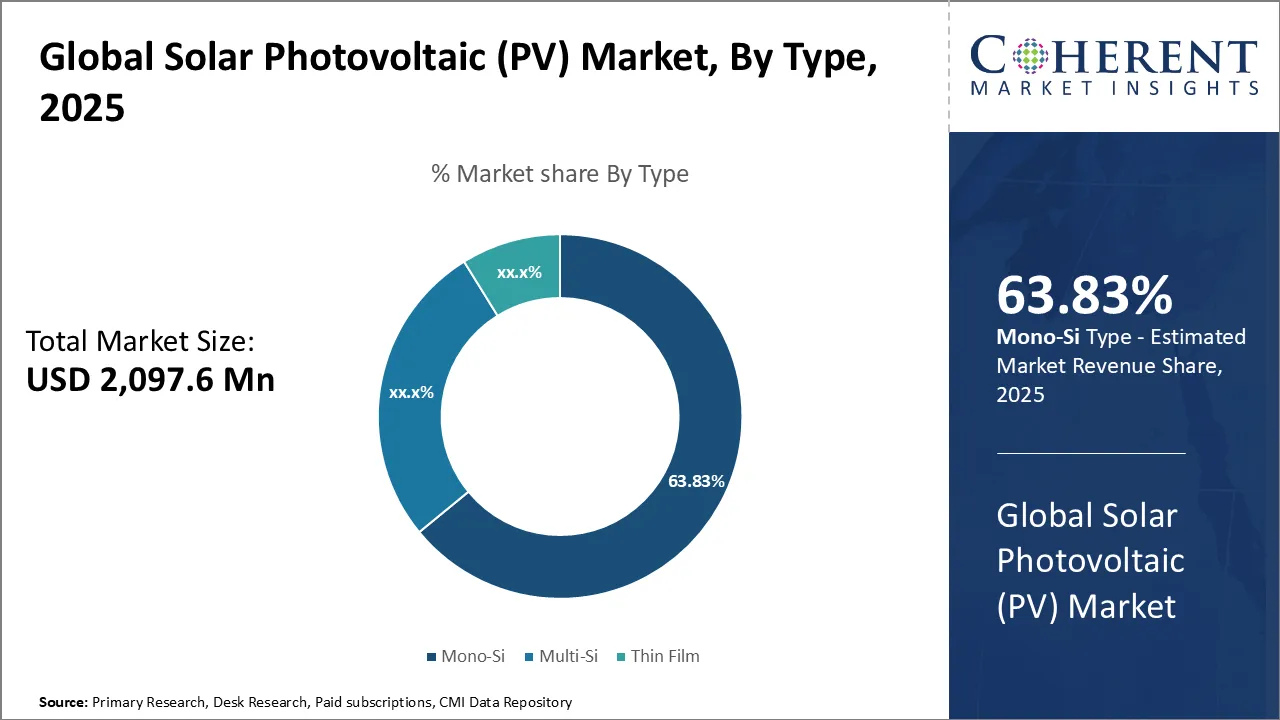
Global Solar Photovoltaic (PV) Market Insights, By Type: Mono-Si Dominates Due To Efficiency and Cost Competitiveness
In terms of type, the Mono-Si segment is expected to hold 64.8% share in 2026. They are perfect for both utility-scale and rooftop installations where space and performance are important because they are so efficient, often by more than 20%. Due to technological advances and economies of scale, the cost of making Mono-Si has gone down a lot in the last ten years. This has made them more affordable and available around the world.
For instance, in April 2026, LONGi's crystalline silicon-perovskite tandem solar cell set a world record for efficiency at 34.85%. This is a big step forward for photovoltaic technology. The company's advanced monocrystalline silicon (HIBC) cells also had an efficiency of 27.81%, which shows that Mono-Si is still the best and that tandem cells are the next big thing in solar technology.
-market-by-end-user.webp "Solar Photovoltaic (PV) Market, By End User")
Global Solar Photovoltaic (PV) Market Insights, By End User: Utility-scale Projects Lead Owing to Large Capacity and Government Backing
In terms of end user, the utility segment is expected to capture the largest share of the market in 2026. Government tenders, corporate power purchase agreements (PPAs), and national commitments to decarbonization are all driving the growth of large-scale solar farms around the world. Utility-scale projects can take advantage of economies of scale, which means that they can offer lower costs per watt than residential or commercial installations. They are also very important for keeping grids stable and meeting the growing demand for electricity in developing countries.
For instance, in November 2025, Cosmic PV Power made an important entry into the utility-scale solar market by getting a ₹600 crore order from Zetwerk for solar modules. The move shows that the company is growing beyond smaller projects and becoming a major player in India's rapidly growing utility-scale photovoltaic market.
Global Solar Photovoltaic (PV) Market Insights, By Deployment: Ground-Mounted Systems Dominate Because Of Scalability and Higher Yields
In terms of deployment, the ground-mounted segment is projected to account for the highest share of the market in 2026. These installations are usually used in big projects where there is a lot of land available for thousands of panels. People like ground-mounted systems because they let you get the best orientation and tracking systems, which increases energy output. Governments and businesses that want to build renewable energy infrastructure prefer them because they can grow and work well.
For instance, in November 2026, Ground-mounted solar projects in Visakhapatnam are becoming a new way for landowners to make money. Owners can make money by renting or using land for solar farms, which also helps the growth of renewable energy. The project shows how utility-scale, ground-mounted photovoltaic systems could help India's clean energy transition and boost the economy.
Regional Insights
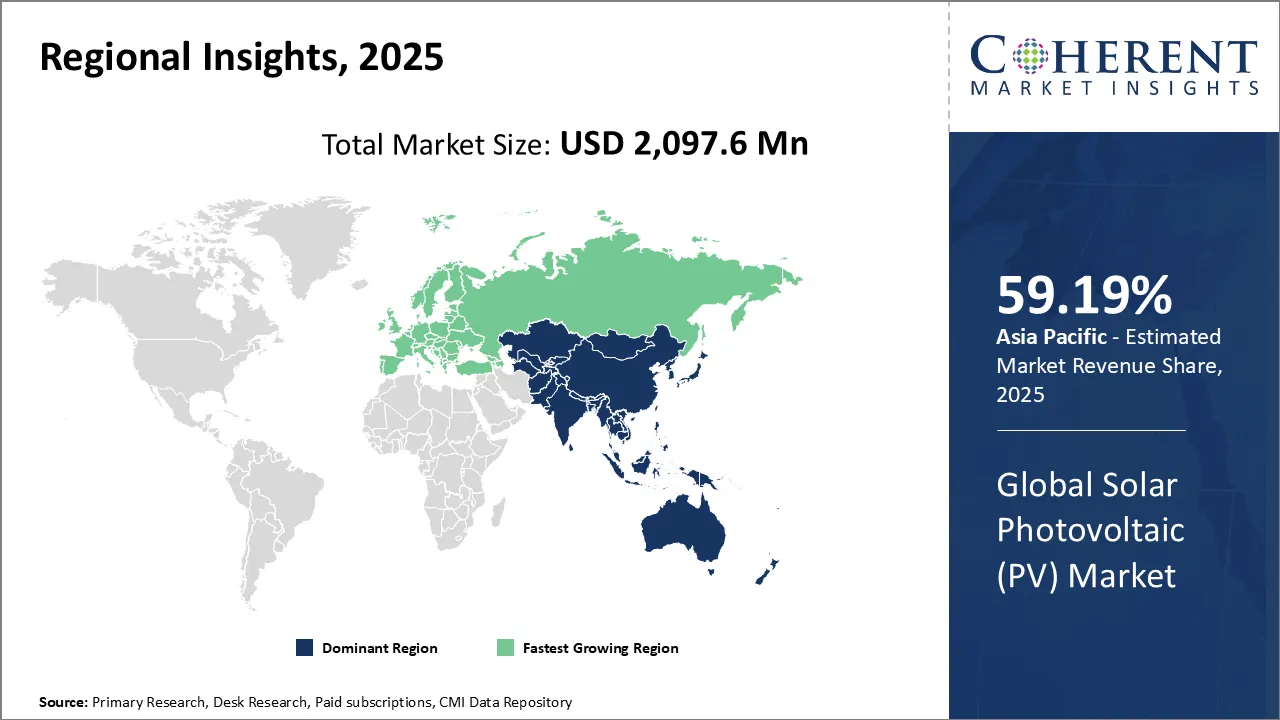
Asia Pacific Solar Photovoltaic (PV) Market Analysis & Trends
Asia Pacific is the largest market for solar PV at 59.19% share in 2026 and will grow at a strong pace during the forecast period. The region is witnessing a significant rise in the adoption of solar photovoltaic panels due to growing awareness about using clean energy. In addition, a number of governments in the Asia Pacific region have launched various policies to encourage the use of solar energy.
For instance, in October 2026, At the REI Expo 2026, Orient Solar showed off its new 650Wp N-type TOPCon photovoltaic modules, which have higher efficiency and performance. The launch shows how innovative the company's solar PV technology is, which shows how committed they are to providing next-generation solutions for utility, commercial, and residential projects in India's rapidly growing renewable energy market.
Europe Solar Photovoltaic (PV) Market Analysis & Trends
Europe is also a major market for solar PV and will continue to expand at a rapid pace during the forecast period. The region is characterized by high levels of sunshine and favorable policies for promoting solar energy. In addition, a number of European countries are offering incentives to promote the adoption of solar energy.
For instance, in November 2026, HoloSolis secured more than €220 million in funding to build the biggest solar panel factory in Europe in Sarreguemines-Hambach, France. The project makes it easier for Europe to make
Solar Photovoltaic (PV) Market Outlook Country-Wise
China Solar Photovoltaic (PV) Market Trends
China's solar PV market grows swiftly in 2026 due to strict government goals, big utility-scale projects, and strong domestic manufacturing. China's demand for energy security, cost-effective renewables, and leadership in the global clean energy transition is reflected in its more than 1 TW of cumulative capacity and nearly 60% of new global installations.
For instance, in November 2026, ChasingLight Technology, a Chinese company, launched out with indoor organic photovoltaic (OPV) modules. This means that solar power can now be used indoors as well as outdoors. The new technology is a big step toward making PV technology more diverse. It is meant to power IoT devices and low-energy electronics. The launch shows how China is becoming more important in next-generation solar solutions.
Germany Solar Photovoltaic (PV) Market Trends
Germany's Solar PV market is very competitive in 2026 because of strong policies for renewable energy, commitments to fighting climate change, and new technologies. The sector is growing quickly because of utility-scale projects, rooftop installations, and the integration of energy storage. Germany's push for carbon neutrality and less reliance on fossil fuels is driving the widespread use of solar PV solutions.
For instance, in October 2026, Sinn Power, a German company, started the innovative project on inland waters, which was a big step forward for renewable energy. The vertical design makes the most of space while using less land, making it a scalable solution for generating sustainable power and paving the way for wider use on water surfaces around the world.
Market Report Scope
Solar Photovoltaic (PV) Market Report Coverage
| Report Coverage | Details | ||
|---|---|---|---|
| Base Year: | 2025 | Market Size in 2026: | USD 2,570.8 Mn |
| Historical Data for: | 2020 To 2024 | Forecast Period: | 2026 To 2033 |
| Forecast Period 2026 to 2033 CAGR: | 22.6% | 2033 Value Projection: | USD 10,678.6 Mn |
| Geographies covered: |
| ||
| Segments covered: |
| ||
| Companies covered: | First Solar Inc., Suntech Power Holdings Co. Ltd, Sharp Corporation, JinkoSolar Holding Co. Ltd, JA Solar Holdings Co. Ltd, Trina Solar Ltd, Hanwha Q Cells Co. Ltd, Acciona SA, Canadian Solar Inc., SunPower Corporation, and LONGi Green Energy Technology Co. Ltd | ||
| Growth Drivers: |
| ||
| Restraints & Challenges: |
| ||
Global Solar Photovoltaic (PV) Market Drivers
Upcoming projects and favorable government policies to augment market growth
The solar photovoltaic (PV) market size is expected to grow significantly in 2025 because of new projects and good government policies. Large-scale installations, rooftop use, and incentives for clean energy are all helping to growth. Strong demand for solar PV is guaranteed by supportive rules and climate goals. This makes solar PV a key part of the global transition to renewable energy.
Reducing price and installation cost of PV to foster market growth
Reducing price and installation costs of photovoltaic systems is fostering rapid expansion of the solar photovoltaic (PV) market. Affordable technology and simplified deployment make solar energy accessible to households and businesses. These factors are driving adoption, boosting efficiency, and significantly increasing the overall solar photovoltaic (PV) market share worldwide.
Global Solar Photovoltaic (PV) Market Opportunities
A number of players have incorporated new technologies to improve the quality and performance of the solar panel. This is expected to hold bright market opportunities.
One of the most promising technologies to increase solar cell efficiencies is the development of multi-junction silicon cells. Advent of multi-junction silicon cells is expected to hold potential market opportunities. These solar cells absorb different parts of the sunlight spectrum, maximizing the amount of energy that can be converted into electricity. These cells have already reached a world record for efficiency, and are expected to continue to improve as technology progresses. In the future, scientists hope to use these cells on boat sails, drone wings, and tents, enabling solar energy to be used in places where there is no sun or where it is not possible to build conventional solar panels.
Global Solar Photovoltaic (PV) Market Trends
Ongoing research and development activities is a recent trend
Ongoing research and development activities are shaping the solar photovoltaic (PV) market by enhancing efficiency, durability, and storage integration. Innovations in panel technology and smart grid solutions are driving adoption across residential and commercial sectors. These advancements significantly boost solar photovoltaic (PV) market demand, supporting global renewable energy growth and sustainability.
Government support in the form of subsidiaries especially for residential sector
Government support in the form of subsidies, particularly for the residential sector, is accelerating adoption of solar energy solutions. Incentives lower upfront costs, making rooftop installations more accessible to households. This financial assistance is driving widespread adoption, fueling renewable energy expansion, and significantly contributing to overall solar photovoltaic (PV) market growth.
Analyst Opinion (Expert Opinion)
The global Solar Photovoltaic (PV) market value is growing quickly driven by record levels of installations and strong global investment. In 2024, annual additions were more than 590 GW, and by early 2025, they had already reached more than 380 GW. This shows that both utility-scale and distributed rooftop installations are happening faster. Solar power generation investments are still the most popular in the world, thanks to falling technology costs and strong policy support.
Manufacturing is still very concentrated, with China making up more than 80% of the capacity for polysilicon, wafers, cells, and modules. This scale advantage has kept module supplies high and prices low, but prices still go up and down in the short term because of changes in policy, shifting inventories, and the need to balance supply and demand.
Changes in technology are changing the mix of products and the costs of projects. High-efficiency cell technologies like n-type, TOPCon, and bifacial modules are quickly becoming popular because they produce more energy and make systems work better. Meanwhile, big global inventories, often thought to be in the 10-100 of gigawatts range, keep changing prices and how manufacturers plan their businesses.
The solar PV industry is set for long-term growth around the world, thanks to better efficiency, the ability to make large quantities of products, and strong deployment pipelines in many areas.
Speak to the analyst
Want personalized insights?
Take the findings above to one of our principal consultants, or have the report rebuilt around the segments, geographies and competitors you actually track.
Global Solar Photovoltaic (PV) Market: Key Developments
- In November 2025, Avaada Group plans to spend ₹1 lakh crore over the next five years, and its solar PV manufacturing division has filed for an IPO. The move shows that India is serious about expanding its use of renewable energy, increasing its production capacity, and helping the solar photovoltaic (PV) industry grow even faster.
- In November 2025, Solex Energy, which is based in Gujarat, started making profits from its 2.2 GW solar module line. This milestone makes India's renewable energy sector stronger by increasing the country's manufacturing capacity and helping it reach its solar expansion goals. The project is a big step toward making the solar photovoltaic (PV) industry more efficient, cutting down on imports, and encouraging growth.
- In November 2025, Coimbatore built a 154-kW floating solar plant at Ukkadam Periyakulam. The goal of the project is to increase the amount of clean energy produced by putting solar panels on water surfaces. This project shows Tamil Nadu's commitment to renewable energy and makes the region's role in the growth of the solar photovoltaic (PV) industry even stronger.
Market Segmentation
- Global Solar Photovoltaic (PV) Market, By Type (Revenue, USD Mn, 2021 - 2033)
- Thin Film
- Multi-Si
- Mono-Si
- Global Solar Photovoltaic (PV) Market, By End User (Revenue, USD Mn, 2021 - 2033)
- Residential
- Commercial
- Utility
- Deployment
- Ground-mounted
- Rooftop Solar
- Global Solar Photovoltaic (PV) Market, By Deployment (Revenue, USD Mn, 2021 - 2033)
- Ground-mounted
- Rooftop Solar
- Global Solar Photovoltaic (PV) Market, By Geography (Revenue, USD Mn, 2021 - 2033)
- North America
- U.S.
- Canada
- Latin America
- Brazil
- Argentina
- Mexico
- Rest of Latin America
- Europe
- Germany
- U.K.
- Spain
- France
- Italy
- Russia
- Rest of Europe
- Asia Pacific
- China
- India
- Japan
- Australia
- South Korea
- ASEAN
- Rest of Asia Pacific
- Middle East
- GCC Countries
- Israel
- Rest of Middle East
- Africa
- South Africa
- North Africa
- Central Africa
- North America
- Key Companies Insights (Revenue, USD Mn, 2021 - 2033)
- First Solar Inc.
- Suntech Power Holdings Co. Ltd
- Sharp Corporation
- JinkoSolar Holding Co. Ltd
- JA Solar Holdings Co. Ltd
- Trina Solar Ltd
- Hanwha Q Cells Co. Ltd
- Acciona SA
- Canadian Solar Inc.
- SunPower Corporation
- LONGi Green Energy Technology Co. Ltd
Sources
Primary Research Interviews
- Solar PV Module Manufacturers
- Inverter & Power Electronics Suppliers
- EPC (Engineering, Procurement & Construction) Contractors
- Solar Farm Developers & Asset Operators
- Grid Integration & Utility Engineers
- Renewable Energy Policy Consultants
- Others
Databases
- Bloomberg Terminal
- Thomson Reuters Eikon
- Others
Magazines
- PV Magazine
- Solar Power World
- Renewable Energy World
- Power Engineering Magazine
- Energy Storage News
- Others
Journals
- Progress in Photovoltaics
- Solar Energy Journal
- IEEE Journal of Photovoltaics
- Renewable & Sustainable Energy Reviews
- Energy & Environmental Science
- Others
Newspapers
- Financial Times
- The Wall Street Journal
- Reuters
- Bloomberg News
- Business Standard (for India-specific coverage)
- Others
Associations
- International Solar Energy Society (ISES)
- Solar Energy Industries Association (SEIA)
- International Renewable Energy Agency (IRENA)
- Global Solar Council (GSC)
- European Photovoltaic Industry Association (EPIA)
- Others
Public Domain Sources
- International Energy Agency (IEA) – Solar PV Reports
- U.S. Department of Energy (DOE) – Solar Energy Technologies Office (SETO)
- National Renewable Energy Laboratory (NREL)
- European Commission – Energy Directorate
- World Bank Open Data
- India Ministry of New and Renewable Energy (MNRE)
- Others
Proprietary Elements
- CMI Data Analytics Tool
- Proprietary CMI Existing Repository of Information for the Last 8 Years
Definition: Solar PV is a renewable source of energy that is environmentally friendly, accessible to the masses, and can be used in many areas where traditional transmission lines are costly. It is also relatively easy to assemble and install, making it an attractive choice for homeowners who want to cut their dependence on the utility company.
Get access to 250+ pages report
Every segment, forecast, competitor profile and data table behind the analysis above — available for instant download.
- ESOMAR Member
- ISO 9001:2015 Certified
- D-U-N-S Registered
- GDPR & CCPA Compliant
Missing comfort of reading report in your local language? Find your preferred language:
Transform your Strategy with Exclusive Trending Reports
Frequently Asked Questions
The Solar Photovoltaic (PV) Market is estimated to be valued at USD 2,570.8 Mn in 2026, and is expected to reach USD 10,678.6 Mn by 2033.
The CAGR of the Solar Photovoltaic (PV) Market is projected to be 22.6% from 2026 to 2033.
Upcoming projects and favorable government policies are fuelling market.
The Mono-Si segment is the leading component segment in the market.
Increasing adoption of alternate clean power sources is the major factors restraining market.
First Solar Inc., Suntech Power Holdings Co. Ltd, Sharp Corporation, JinkoSolar Holding Co. Ltd, JA Solar Holdings Co. Ltd, Trina Solar Ltd, Hanwha Q Cells Co. Ltd, Acciona SA, Canadian Solar Inc., SunPower Corporation, and LONGi Green Energy Technology Co. Ltd