

Mining Chemicals Market Analysis & Forecast 2026-2033
Mining Chemicals Market is estimated to be valued at USD 40.88 Bn in 2026 and is expected to reach USD 61.06 Bn in 2033, exhibiting a compound annual growth rate (CAGR) of 5.9% from 2026 to 2033.
Key Takeaways
- By Product Type, frothers are projected to dominate the mining chemicals market, accounting for approximately 34.2% of the global market share in 2026.
- Asia Pacific is expected to lead the global mining chemicals market in 2026, capturing approximately 48.2% of the total revenue share.
Market Overview
The Mining Chemicals Market is experiencing consistent growth, driven by increasing mineral extraction activities and rising demand for metal recovery agents and grinding aids. Growing focus on sustainable mining practices, technological advancements in chemical formulations, and regulatory compliance are fuelling innovation and expansion across the global mining chemicals industry.
Current Events and its Impact on the Mining Chemicals Market
Current Event | Description and its impact |
Innovation in Mining Chemical Formulations |
|
Strategic Investments and Regional Expansion |
|
Regulatory Developments and Sustainability Goals |
|
Pipeline Analysis: Mining Chemicals Market
The mining chemicals market is witnessing a robust pipeline of innovations aimed at enhancing efficiency, sustainability, and cost-effectiveness in mineral processing. Key players are investing in R&D to develop eco-friendly formulations such as biodegradable flocculants, non-toxic collectors, and low-emission frothers to align with evolving environmental regulations. Several pilot projects are underway across China, Australia, and South Africa, focusing on the application of green reagents in complex ore beneficiation processes.
Additionally, pipeline products include smart chemical solutions integrated with AI and IoT for real-time process monitoring and optimization. Companies are also expanding their product lines to cater to rare earth and lithium mining sectors seeing exponential growth due to electric vehicle and battery demand.
Strategic partnerships between chemical manufacturers and mining companies are accelerating the commercialization of these advanced solutions. The expanding pipeline indicates a strong push towards sustainable and performance-driven mining chemicals to support the future of global resource extraction.
- Current Industry Events of 2026
- Market Size Estimation
- Regional Breakdown
- Competitive Landscape
- Customer Intelligence
- Segmental Analysis
- Pricing Analysis
- Key Market Drivers, Challenges & Future Trends
- Customized Insights Section
Technological Advancement and Integration of AI: Mining Chemicals Market
Technological advancements are reshaping the mining chemicals market by improving precision, sustainability, and efficiency across mineral extraction and processing stages. Innovations in chemical engineering have led to the development of advanced reagents with higher selectivity, lower toxicity, and improved biodegradability addressing growing environmental concerns.
Meanwhile, the integration of Artificial Intelligence (AI) and machine learning is transforming operational dynamics in mining operations. AI-powered systems are being deployed to analyze vast datasets from sensors embedded in processing plants, enabling real-time optimization of reagent dosages, pH levels, and flotation conditions. This reduces chemical wastage, lowers energy consumption, and enhances recovery rates.
Predictive analytics also support proactive maintenance of mining equipment and early detection of process inefficiencies. Leading companies are investing in smart mining solutions, combining AI, automation, and next-gen chemical formulations to streamline operations and meet stringent environmental regulations. These advancements are positioning the mining chemicals sector for smarter, safer, and more sustainable growth.
Mining Chemicals Market Trends
- Growing mining operations in Mexico and Canada
Canada leads the globe in mining activities and is among the top five producers of 14 key metals and minerals globally. The value of mining projects planned and in development in Canada from 2020 to 2030 increased somewhat, year over year, by USD 8 billion in 2020. The majority of mining was done in Ontario. Additionally, for Instance, in March 31, 2020, there were about 252,876 operational mining sites in Canada. There are presently more than 200 mineral exploration projects under progress in Canada.
Numerous large mining companies are seeking exposure in Canada, and the nation is developing sophisticated procedures with feasibility assessments for capital expansion. The Canada government is also starting a number of efforts to persuade more investors to look into the untapped mineral wealth of the nation.
The Canada Minerals and Metals Plan (CMMP), a strategic plan for the Canada mining sector to retain its position as a worldwide leader in mining, was also launched by the federal, provincial, and territory governments of Canada. This program is driving the need for mining chemicals.
- Specialty chemicals are increasingly used in mining processes
Almost every stage of the mining process makes use of specialty chemicals. These compounds are employed to streamline the extremely complicated process of mining. With changes in production methods, such as the switch from tunnelling to open-pit mining, the mining industry is now able to mine ores with decreasing grades while paying less overall.
Additionally, specialty chemicals are employed in processes such as smelting, refining, manufacturing, and commodity trading in later stages of the production chain. Additionally, governments are taking steps to boost mining activities in their individual nations as well as in quickly developing regions like China, Africa, and Latin America.
This is anticipated to increase the use of mining chemicals throughout the anticipated period. For instance, in December 2020, Between December 16, 2020, AkzoNobel reacquired 462,075 of its common shares. With the sale of the Specialty Chemicals Company, a total of EUR 6.5 billion was distributed to shareholders, which completes a EUR 2.5 billion recovery program that was announced on February 13, 2019.
Segmental Insights
Global Mining Chemicals Market Insights, By Product Type
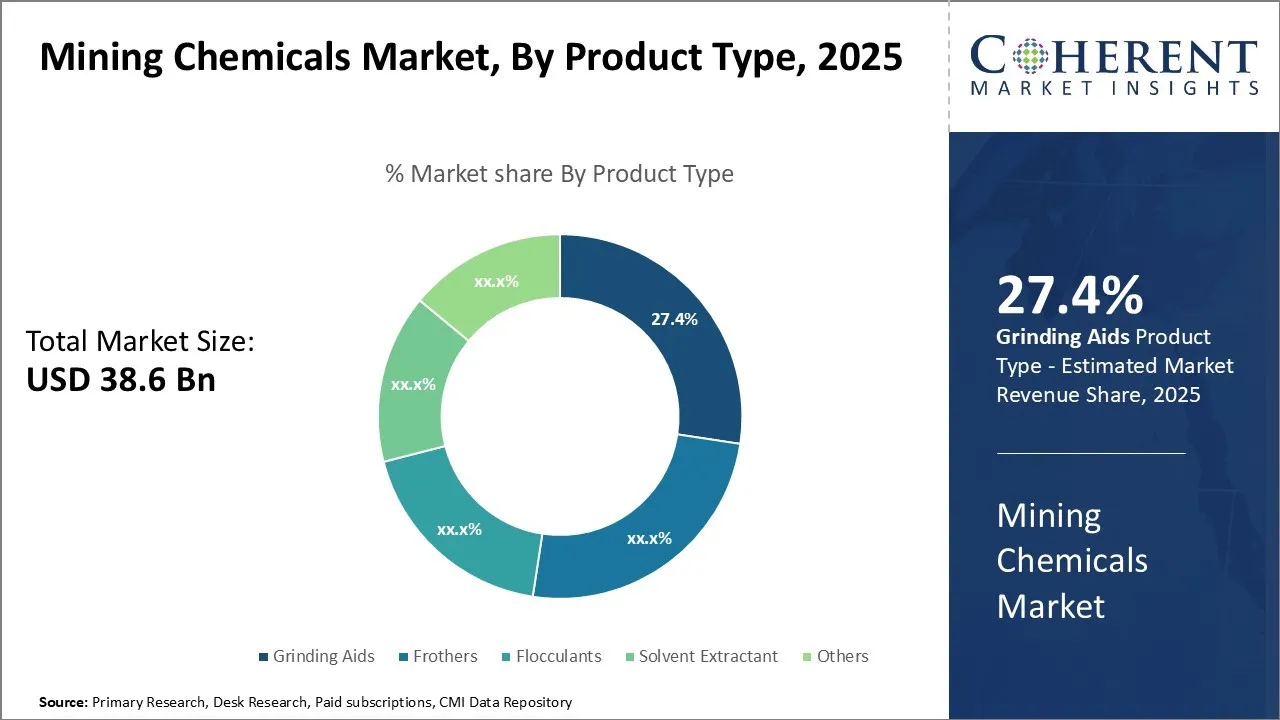
Frothers are projected to dominate the global mining chemicals market in 2026, capturing approximately 34.2% of the total market share. This significant lead stems from their extensive use in cement manufacturing, metal beneficiation, and mineral processing to optimize grinding performance and reduce overall energy consumption. These chemicals effectively improve mill throughput by minimizing particle agglomeration and enhancing dispersion, thereby increasing operational efficiency.
The growing emphasis on energy conservation, cost optimization, and throughput enhancement is driving their widespread adoption across large-scale mining and cement plants. Furthermore, the emergence of eco-friendly and non-toxic grinding aid formulations is gaining momentum, as companies aim to meet stringent environmental regulations and sustainability benchmarks.
Grinding aids also play a critical supporting role in the mining chemicals market for metal extraction, where efficient particle size reduction is essential for improving leaching and flotation processes. As the complexity of mineral extraction increases, the synergy between grinding aids and downstream chemical treatments is becoming more vital, enabling higher metal recovery rates and process efficiency.
Given these advancements and the industry’s shift toward sustainable practices, grinding aids are poised to retain their leading position in the product segment of the mining chemicals market.
Regional Insights
Asia Pacific Mining Chemicals Market Trends and Analysis
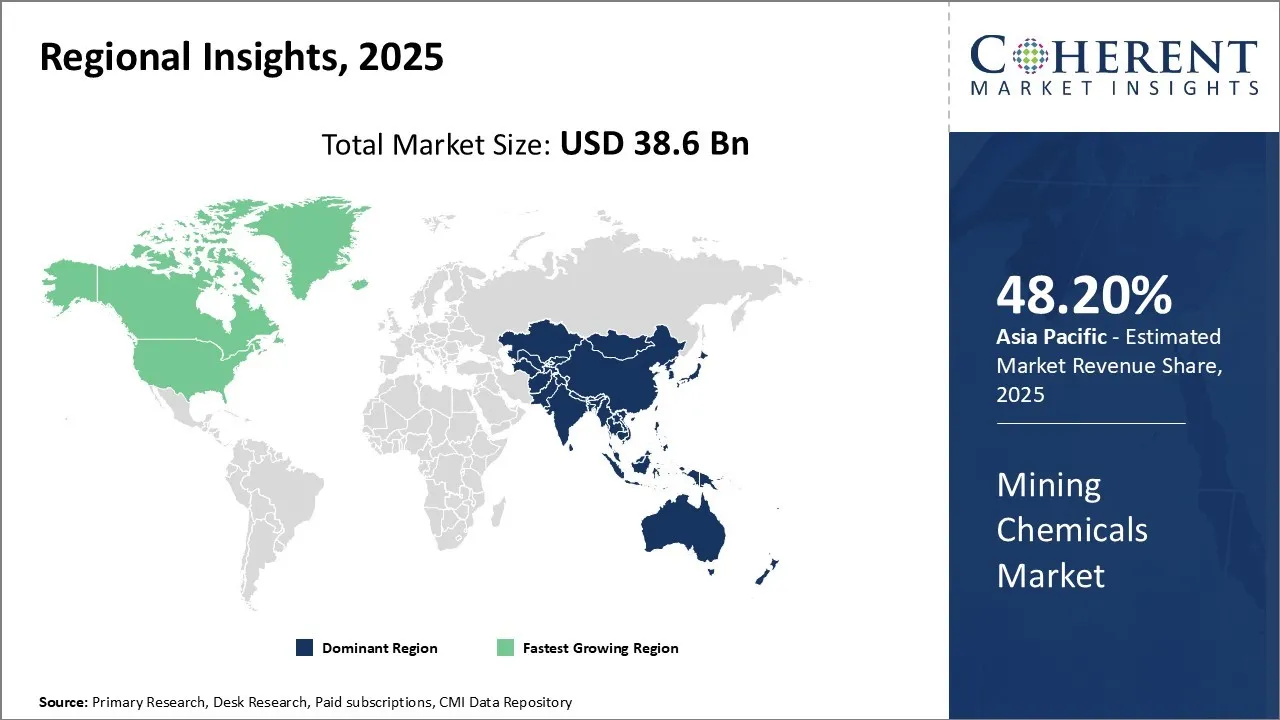
Asia Pacific is expected to lead the global mining chemicals market in 2026, capturing approximately 48.20% of the total revenue share. This regional dominance is primarily driven by rapid industrialization and robust mining activities across major economies like China, India, and Australia. The growing demand for base metals, rare earth elements, and coal in various end-use industries is significantly accelerating the need for advanced mining chemical solutions.
The region benefits from abundant mineral reserves, competitive labour costs, and supportive government policies aimed at boosting domestic mining output and attracting foreign investment. Furthermore, increasing infrastructure development and investment in mineral beneficiation plants have elevated the demand for high-performance chemicals such as grinding aids, flocculants, collectors, and frothers.
The presence of several large-scale mining enterprises and a heightened focus on process efficiency and environmental compliance solidify Asia Pacific’s position as the frontrunner in the mining chemicals market for 2026 and beyond.
Mining Chemicals Market Dominating Countries
China
China is the leading country in the global mining chemicals market, significantly contributing to Asia Pacific’s projected 48.30% revenue share in 2026. The country's dominance stems from its extensive mining operations for coal, iron ore, rare earth elements, and base metals.
With strong government support and investments in mineral processing infrastructure, China continues to adopt advanced chemical solutions to enhance extraction efficiency and meet stringent environmental norms. The presence of major domestic manufacturers and an increasing emphasis on sustainable mining practices further strengthen its market leadership.
India
India plays a vital role in the Asia Pacific mining chemicals landscape, supported by its vast mineral reserves and expanding industrial base. The country’s emphasis on infrastructure development, especially in sectors such as power, transportation, and construction, drives demand for metals and minerals, thereby increasing the usage of mining chemicals like flocculants and grinding aids.
The importance of mining chemicals in mining lies in their ability to enhance the efficiency, selectivity, and cost-effectiveness of key processes such as mineral separation, ore beneficiation, and metal extraction. In India, these chemicals are critical for optimizing operations across both large-scale and mid-tier mining projects, enabling better resource recovery and reduced environmental impact.
Government initiatives such as “Make in India” and the easing of mining regulations have attracted foreign investments, fostering innovation and capacity expansion in the domestic mining chemicals sector. As the industry continues to modernize and prioritize sustainable practices, mining chemicals will remain indispensable to the country’s evolving mining ecosystem.
Market Report Scope
Mining Chemicals Market Report Coverage
| Report Coverage | Details | ||
|---|---|---|---|
| Base Year: | 2025 | Market Size in 2026: | USD 40.88 Bn |
| Historical Data for: | 2020 To 2024 | Forecast Period: | 2026 To 2033 |
| Forecast Period 2026 to 2033 CAGR: | 5.9% | 2033 Value Projection: | USD 61.06 Bn |
| Geographies covered: |
| ||
| Segments covered: |
| ||
| Companies covered: | Ashland Inc., BASF SE, The Dow Chemical Company, Chevron Phillips Chemicals Company LP, Clariant AG, Cytec Industries, Nalco Company, Air Products and Chemicals, Inc., and AkzoNobel Performance Additives | ||
| Growth Drivers: |
| ||
| Restraints & Challenges: |
| ||
Analyst Viewpoint – Mining Chemicals Market
- The global mining chemicals market is poised for steady growth, primarily driven by increased mineral extraction activities and the rising demand for efficient, sustainable processing solutions. Analysts identify Asia Pacific as the dominant region, supported by large-scale mining operations in China, India, and Australia, abundant mineral reserves, and strong governmental backing for infrastructure and industrial expansion.
- Industry experts highlight a growing preference for eco-friendly and performance-enhancing chemicals, especially in flotation, grinding, and leaching processes. With stricter environmental regulations, companies are rapidly adopting non-toxic and biodegradable formulations. The integration of AI and automation technologies is enabling smarter chemical dosing and real-time process optimization, significantly boosting recovery rates and reducing operational costs.
- Despite challenges such as fluctuating raw material prices, environmental compliance hurdles, and supply chain constraints, the market outlook remains optimistic. Continued R&D investments, sustainable mining initiatives, and strategic partnerships between chemical suppliers and mining operators are expected to drive long-term market growth and innovation.
Mining Chemicals Market: Key Development
- In May 2025, BASF introduced biodegradable flotation chemicals targeting apatite and rare earth mineral beneficiation, addressing tailings inefficiencies and environmental regulations. Enhances yield in phosphate processing and lowers ecological footprint in mineral operations.
- In February 2025, Clariant showcased its specialty flotation reagents targeting lithium, nickel, copper, and rare earth minerals at SME Minexchange 2025 in Denver. Supports critical minerals processing, enabling more efficient extraction and tapping into growing battery materials demand.
- In February 2024, Australian miner Orica acquired U.S. cyanide supplier Cyanco for USD 640 million doubling sodium cyanide output for gold processing across North American operations.
- In January 2024, Solvay S.A. launched a new line of sustainable flotation reagents tailored for non-sulphide ores, boosting efficiency while reducing environmental impact in mineral processing applications.
Market Segmentation
- Global Mining Chemicals Market, By Product Type (Revenue, USD Bn, 2021 - 2033)
- Frothers
- Flocculants
- Collectors
- Solvent Extractant
- Grinding Aids
- Others
- Global Mining Chemicals Market, By Application (Revenue, USD Bn, 2021 - 2033)
- Minerals Processing
- Explosives & Drilling
- Water and Waste Treatments
- Others
- Global Mining Chemicals Market, By Region (Revenue, USD Bn, 2021 - 2033)
- North America
- U.S.
- Canada
- Europe
- U.K.
- Germany
- France
- Italy
- Spain
- Russia
- Rest of Europe
- Asia Pacific
- China
- India
- Japan
- ASEAN
- Australia
- South Korea
- Rest of Asia Pacific
- Latin America
- Brazil
- Mexico
- Rest of Latin America
- Middle East & Africa
- Middle East
- Africa
- North America
- Key Players Insights
- Ashland Inc.
- BASF SE
- The Dow Chemical Company
- Chevron Phillips Chemicals Company LP
- Clariant AG
- Cytec Industries
- Nalco Company
- Air Products and Chemicals, Inc.
- AkzoNobel Performance Additives.
Sources
The Stakeholders Consulted
- Procurement managers and process engineers from metal and mineral mining companies
- Manufacturers and distributors of mining reagents and flotation chemicals
- Geologists, metallurgists, and mineral processing specialists
- Environmental compliance officers and sustainability consultants
- Government departments and mining policy regulators
- Research institutions involved in metallurgy, hydrometallurgy, and geochemistry
- Industry experts specializing in mineral beneficiation, wastewater treatment, and ore recovery optimization
- End-users across sectors such as coal, base metals, precious metals, and rare earth mining
Databases Opened
- U.S. Geological Survey (USGS) – Mineral Commodity Summaries
- Indian Bureau of Mines – Mining Statistics & Trends
- Ministry of Mines (India) – Mineral Production Data
- OECD Stats – Mining and Chemicals Sector Indicators
- World Bank Open Data – Natural Resources and Mining Metrics
Magazines & Trade Publications
- Mining Magazine
- International Mining
- Engineering & Mining Journal (E&MJ)
- Chemical Engineering Magazine
- Process Engineering
- Materials World – Industrial Minerals and Metals Section
Scientific and Industry Journals
- Minerals Engineering
- Hydrometallurgy Journal
- International Journal of Mineral Processing
- Chemical Engineering Journal
- Journal of Cleaner Production – Mining & Resources Section
- Journal of Environmental Chemical Engineering
Newspapers & Media Outlets
- Bloomberg – Metals & Mining News
- Reuters – Commodity and Industrial Markets
- The Wall Street Journal – Mining & Chemicals Sector
- Business Standard – Mining & Minerals Section
- The Economic Times – Resources and Industrial Chemicals
- Mining Weekly – Industry Updates and Technology Trends
Associations and Regulatory Bodies
- U.S. Environmental Protection Agency (EPA) – Mine Waste Management Standards
- Indian Bureau of Mines (IBM)
- European Chemicals Agency (ECHA) – REACH Regulations
- International Council on Mining and Metals (ICMM)
- Federation of Indian Mineral Industries (FIMI)
- Occupational Safety and Health Administration (OSHA) – Chemical Handling Guidelines
- Ministry of Environment, Forest and Climate Change (MoEFCC), India
Public Domain Sources
- U.S. Energy Information Administration (EIA) – Industrial Chemicals & Energy Use
- European Commission – REACH & CLP Regulations for Mining Chemicals
- World Bank – Mining Sector Reports & Sustainability Metrics
- International Energy Agency (IEA) – Industrial Process Efficiency Insights
- UNIDO – Resource Efficiency and Cleaner Production in Mining
Proprietary Research Elements
- CMI Mining Data Intelligence Tool
- CMI Repository of Mining Chemicals Market Data (2016–2025)
- CMI Expert Interviews and Transcripts (covering reagent usage, flotation trends, and mineral processing technologies)
- Internal Technical Benchmarking on Process Chemistry Innovation and Regulatory Impact Assessment
Get access to 250+ pages report
Every segment, forecast, competitor profile and data table behind the analysis above — available for instant download.
- ESOMAR Member
- ISO 9001:2015 Certified
- D-U-N-S Registered
- GDPR & CCPA Compliant
Missing comfort of reading report in your local language? Find your preferred language:
Transform your Strategy with Exclusive Trending Reports
Frequently Asked Questions
The Mining Chemicals Market size is estimated to be valued at USD 40.88 Bn in 2026, and is expected to reach USD 61.06 Bn by 2033.
The Global market was valued at around USD 40.88 Bn in 2026.
The Growing Mining Operations in Mexico and Canada and specialty chemicals are increasingly used in mining processes.
Recycling of wastewater is a growing trend due to which the key manufacturers are introducing flocculant chemicals for treating wastewater.
High Logistic Cost is the main factor which is hampered the market.
The key players operating in the market are Ashland Inc., BASF SE, The Dow Chemical Company, Chevron Phillips Chemicals Company LP, Clariant AG, Cytec Industries, Nalco Company, Air Products and Chemicals, Inc., and AkzoNobel Performance Additives.
The CAGR of the global Market is projected to be 5.9% from 2026 to 2033.