

Global Notebook Market Size and Forecast — 2026 - 2033
The Global Notebook Market size is estimated to be valued at USD 125.8 billion in 2026 and is expected to reach USD 215.7 billion by 2033, exhibiting a compound annual growth rate (CAGR) of 8.3% from 2026 to 2033.
Overview
The notebook market is driven by increasing demand for portable computing devices across education, business, and personal use applications. The growth of remote work, hybrid learning, and digital transformation initiatives has significantly boosted notebook adoption worldwide. Rising demand for high-performance devices for gaming, content creation, and professional workloads is encouraging technological advancements in processors, displays, and battery life. Additionally, increasing internet penetration, expanding e-learning platforms, and growing investments in enterprise mobility solutions are supporting market growth. The introduction of AI-enabled notebooks, lightweight designs, enhanced connectivity features, and energy-efficient technologies further accelerates demand among consumers and businesse
Key Takeaways
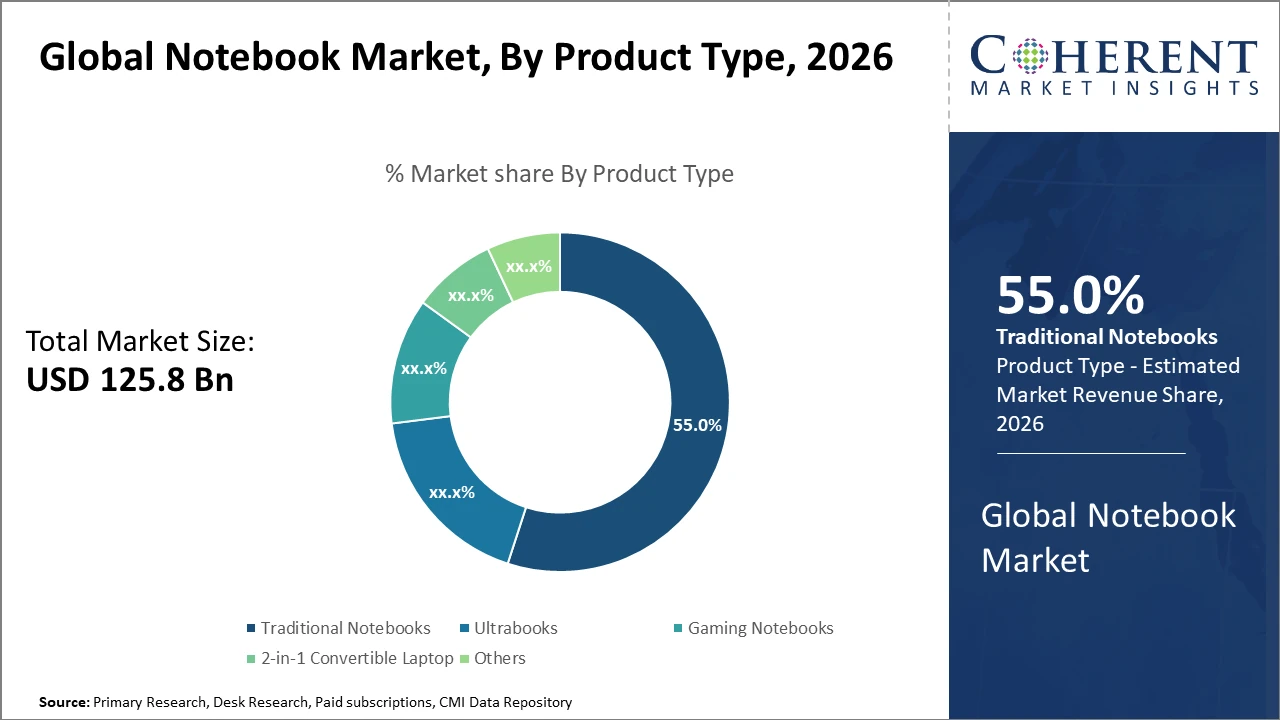
The traditional notebook segment dominates the market with around 55% share, driven by its versatility, affordability, and strong established user base across education, business, and personal computing applications.
The Windows operating system segment leads with approximately 68% market share, supported by its wide enterprise adoption, strong compatibility with business software, and extensive global ecosystem.
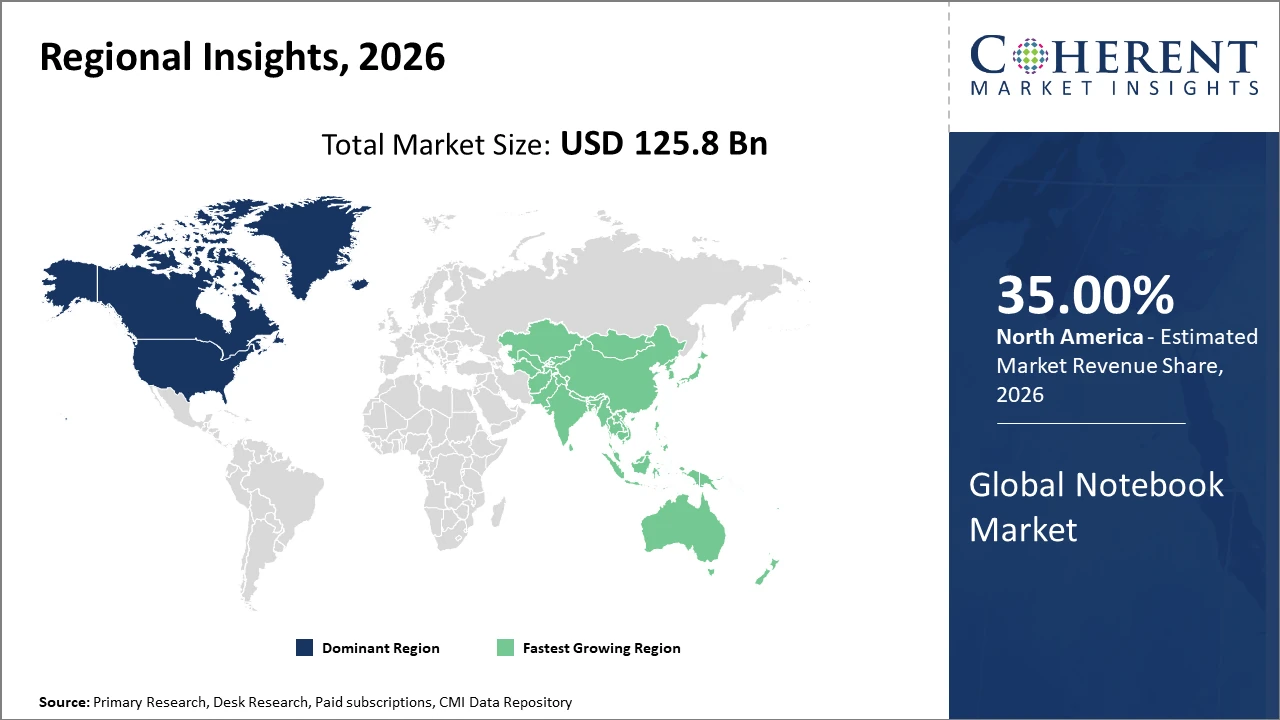
The enterprise end-user segment holds about 45% of total revenue, reflecting ongoing digital transformation initiatives, while North America leads overall market share and Asia Pacific remains the fastest-growing region due to strong policy support and rapid technology adoption.
Global Notebook Market Segmentation Analysis
Global Notebook Market Insights, By Product Type
Traditional notebooks dominate the global notebook market with a share of 55% due to their cost-effectiveness, balanced performance, and widespread adoption across enterprise and education sectors. Their reliability and compatibility with a broad range of software make them the preferred choice for large-scale deployments. Ultrabooks represent the fastest-growing subsegment, driven by rising demand for lightweight, high-performance devices with long battery life, especially among business professionals and mobile workers. Gaming notebooks continue to grow steadily, supported by the expanding e-sports industry and advancements in GPU performance. 2-in-1 convertible laptops are gaining popularity for their flexibility, while niche rugged notebooks serve specialized industrial, military, and field-based applications globally.
Global Notebook Market Insights, By Operating System
Windows OS dominates the global notebook market with the largest share, supported by its extensive software ecosystem, strong enterprise compatibility, and widespread user familiarity. Its leadership is reinforced by long-standing OEM partnerships and enterprise licensing agreements that make it the default choice for corporate and institutional users. Chrome OS is the fastest-growing segment, driven by strong adoption in education and developing markets due to its low cost, cloud-based architecture, and ease of management. macOS maintains a strong premium positioning, benefiting from Apple’s integrated hardware-software ecosystem. Linux continues to serve niche users, particularly developers and technical industries, while other emerging operating systems hold limited market presence globally.
Global Notebook Market Insights, By End User
The enterprise segment dominates the global notebook market due to large-scale adoption driven by digital transformation, hybrid work models, and the need for secure, high-performance computing solutions. Enterprises significantly influence vendor strategies through bulk procurement and long-term IT infrastructure investments. The education segment is the fastest-growing, supported by government-led digital learning initiatives and increasing deployment of affordable devices such as Chromebooks in schools and universities. The consumer segment caters to personal usage across budget and premium categories. Government demand focuses on secure and compliant devices, while other sectors like healthcare and industrial applications require specialized notebooks designed for durability, security, and domain-specific performance needs.
Global Notebook Market Trends
5G integration is a key emerging trend in the notebook market, with adoption rising by around 25% in 2026, improving connectivity, cloud computing access, and remote work efficiency across consumer and enterprise segments.
Sustainability is becoming a major focus, with manufacturers increasingly using eco-friendly and recyclable materials by 2025 in response to global environmental regulations and corporate ESG commitments.
AI-powered features are rapidly transforming user experience, with several leading companies introducing predictive performance optimization in 2025, improving battery efficiency by nearly 15% and driving stronger demand for smart, adaptive notebook devices.
Global Notebook Market Insights, By Geography
North America Global Notebook Market Analysis and Trends
In North America, the dominance of the notebook market is driven by strong enterprise IT infrastructure, high disposable income levels, and advanced research and development capabilities. The region accounted for over 35% of the global market share in 2026, with the United States acting as the primary growth engine due to widespread adoption across corporate, education, and government sectors. Strong demand for high-performance and premium notebooks further supports regional leadership. Additionally, the presence of major technology companies and innovation hubs accelerates product development and adoption of advanced computing solutions. Continuous investments in digital transformation and cloud-based ecosystems further reinforce North America’s leading position globally.
Asia Pacific Global Notebook Market Analysis and Trends
Asia Pacific is the fastest-growing region in the global notebook market, registering a CAGR exceeding 10%. This growth is driven by strong government initiatives promoting digital literacy, expanding e-learning infrastructure, and increasing adoption of hybrid work and remote education models. Major manufacturing hubs in China, India, and Southeast Asia are further strengthening supply chains and reducing production costs, supporting large-scale device availability. Rising disposable incomes and growing consumer electronics demand are also accelerating notebook penetration across both urban and semi-urban areas. Additionally, favorable trade policies and investments in digital infrastructure are making Asia Pacific a key growth engine for global notebook market expansion.
Global Notebook Market Outlook for Key Countries
USA Global Notebook Market Analysis and Trends
The USA notebook market demonstrates strong growth driven by robust enterprise demand, widespread hybrid work adoption, and federal initiatives focused on cybersecurity and digital resilience. In 2025, enterprise notebook shipments increased by approximately 12%, supported by advancements in AI-enabled processors, improved performance efficiency, and enhanced security features. Major players such as Dell Technologies and HP continue to lead innovation through significant R&D investments and strong OEM partnerships, shaping both product development and market competitiveness. Additionally, government support for digital transformation in education and public institutions further strengthens demand, reinforcing the U.S. as a key contributor to the global notebook market expansion.
Germany Global Notebook Market Analysis and Trends
Germany plays a key role in the global notebook market, driven by strong demand from enterprise, education, and engineering sectors. The country’s advanced industrial base and high digital adoption rate support steady notebook sales, particularly business and high-performance ultrabooks. Market trends show increasing preference for lightweight, energy-efficient devices with enhanced security features, reflecting Germany’s strict data protection standards. Demand is also rising for premium laptops used in automotive design, manufacturing, and IT services. Additionally, the shift toward hybrid work models and digital learning is boosting notebook penetration. German consumers and enterprises are increasingly adopting eco-friendly and recyclable laptop designs aligned with sustainability goals.
Analyst Opinion
The rapid adoption of hybrid and remote work models has significantly boosted enterprise notebook demand, with the corporate segment accounting for over 45% of global unit sales in 2025, driven by needs for mobile productivity, security, and seamless connectivity across developed IT markets like North America and Europe.
Supply chain constraints, particularly semiconductor shortages, have caused pricing fluctuations of up to 6% in 2024, highlighting the importance of resilient supply networks and efficient inventory management among manufacturers to maintain stability and competitiveness.
Education-focused demand has accelerated growth of low-cost and Chrome OS notebooks, with regions such as India and Southeast Asia recording over 30% year-on-year volume growth in 2025, driven by digital literacy initiatives and government programs.
Export growth from East Asia increased by around 12% in 2026, supported by manufacturing expansion and government incentives, strengthening global supply capacity and reinforcing the region’s dominance in notebook production.
- Current Industry Events of 2026
- Market Size Estimation
- Regional Breakdown
- Competitive Landscape
- Customer Intelligence
- Segmental Analysis
- Pricing Analysis
- Key Market Drivers, Challenges & Future Trends
- Customized Insights Section
Market Scope
| Report Coverage | Details | ||
|---|---|---|---|
| Base Year: | 2025 | Market Size in 2026: | USD 125.8 billion |
| Historical Data for: | 2020 To 2024 | Forecast Period: | 2026 To 2033 |
| Forecast Period 2026 to 2033 CAGR: | 8.3% | 2033 Value Projection: | USD 215.7 billion |
| Geographies covered: |
| ||
| Segments covered: |
| ||
| Companies covered: | Lenovo Group Limited, HP Inc., Dell Technologies, Apple Inc., Acer Inc., Samsung Electronics, Microsoft Corporation, MSI, Razer Inc., Google LLC | ||
| Growth Drivers: |
| ||
Global Notebook Market Growth Factors
The expansion of remote and hybrid work ecosystems is a key growth driver for the global notebook market, significantly increasing demand for powerful and flexible computing devices. In 2025, hybrid work adoption in developed economies exceeded 60%, strengthening enterprise notebook sales and overall market revenue. Government-led digital education initiatives, including reforms such as India’s National Education Policy, have further accelerated demand for affordable notebooks, expanding market penetration across Asia Pacific. Technological advancements like AI-enabled processors and extended battery life—now exceeding 12 hours in flagship models by 2026—are also driving consumer preference. Additionally, rising e-sports popularity is boosting demand for gaming notebooks, strengthening the premium segment globally.
Global Notebook Market Development
In May 2026, Boox announced the upcoming launch of the Note X6, a new E Ink device featuring a monochrome display and stylus support, expanding its portfolio of digital note-taking and reading solutions.
Key Players
Leading Companies of the Market
Lenovo Group Limited
HP Inc.
Dell Technologies
Apple Inc.
Acer Inc.
Samsung Electronics
Microsoft Corporation
MSI
Razor Inc.
Google LLC
Several leading companies in the global notebook market have intensified their focus on product differentiation through technological innovation and sustainability-driven strategies. For instance, Lenovo’s introduction of advanced Cortex-M powered ultrabooks in 2025 strengthened its position in the premium segment, increasing its market share by approximately 7% by aligning with rising demand for energy-efficient and high-performance devices. Similarly, Apple continued to enhance its M-series chipset lineup, delivering nearly 20% year-over-year performance improvements, further solidifying its dominance in the high-end notebook category. Additionally, HP’s strategic partnerships with cloud service providers in 2024 enabled more seamless hybrid work solutions, significantly boosting enterprise adoption and reinforcing its competitive position in global markets.
Global Notebook Market Future Outlook
The global notebook market is expected to witness steady growth driven by rising demand for portable computing devices across education, enterprise, and personal use segments. Future trends will be shaped by increasing integration of AI-powered processors, cloud-based computing, and enhanced battery technologies that improve performance and efficiency. Hybrid work and remote learning models will continue to sustain strong demand for lightweight and high-performance notebooks. Gaming and content creation laptops are also expected to expand rapidly due to rising digital entertainment consumption. Additionally, sustainability initiatives will push manufacturers toward eco-friendly materials and energy-efficient designs, while emerging markets will remain key growth contributors globally.
Global Notebook Market Historical Analysis
The global notebook market has evolved significantly over the past two decades, transitioning from bulky desktop replacements to highly portable and performance-optimized computing devices. In the early 2000s, notebooks primarily served business users, with limited processing power and battery life. The 2010s marked a major shift with the introduction of ultrabooks, SSD storage, and improved energy efficiency, expanding adoption across consumers and students. The rise of smartphones initially slowed growth, but demand rebounded with remote work and digital education trends in the 2020s. Continuous advancements in processors, lightweight materials, and connectivity features have transformed notebooks into essential devices for productivity, entertainment, and professional applications globally.
Sources
Primary Research Interviews:
Laptop and PC manufacturers, OEM suppliers, semiconductor chipmakers, and global IT hardware distributors involved in notebook production, design, and supply chain management.
IT infrastructure managers, enterprise procurement heads, educational technology consultants, software developers, and consumer electronics analysts specializing in computing devices and portable systems.
Magazines:
PCWorld – Coverage of notebook innovations, laptop reviews, and consumer technology trends.
Laptop Magazine – Insights into portable computing devices, performance benchmarks, and product launches.
TechRadar – Updates on ultrabooks, gaming laptops, and emerging notebook technologies.
Journals:
IEEE Transactions on Computers – Research on processor architectures, computing performance, and portable device innovations.
ACM Transactions on Computer Systems – Studies on system design, hardware optimization, and laptop computing efficiency.
Journal of Systems and Software – Research on software-hardware integration and performance optimization in computing devices.
Newspapers:
Financial Times – Coverage of global electronics supply chains, semiconductor demand, and PC market trends.
Reuters – Reporting on technology manufacturing, supply chain disruptions, and notebook demand cycles.
Bloomberg – Insights into consumer electronics markets, corporate strategies, and global IT hardware growth.
Associations:
International Data Corporation – Market intelligence on global PC and notebook shipments and trends.
Gartner – Analysis of enterprise IT hardware adoption and notebook lifecycle trends.
IEEE Computer Society – Standards, research, and advancements in computing technologies and hardware systems.
Get access to 250+ pages report
Every segment, forecast, competitor profile and data table behind the analysis above — available for instant download.
- ESOMAR Member
- ISO 9001:2015 Certified
- D-U-N-S Registered
- GDPR & CCPA Compliant
Missing comfort of reading report in your local language? Find your preferred language:
Transform your Strategy with Exclusive Trending Reports
Frequently Asked Questions
The global notebook market is led by Lenovo Group Limited, HP Inc., Dell Technologies, Apple Inc., and Acer Inc. These companies maintain strong market positions through continuous innovation, broad product portfolios, and global distribution networks.
The notebook market is projected to grow from USD 125.8 billion in 2026 to approximately USD 215.7 billion by 2033, driven by increasing demand for advanced computing devices and ongoing technological advancements.
The enterprise segment presents the largest growth opportunity, supported by widespread adoption of hybrid work models, digital transformation initiatives, and modernization of IT infrastructure across industries.
Market trends will increasingly focus on 5G-enabled devices, AI-powered computing features, sustainability-focused designs, and strong growth in premium and gaming notebook categories.
The market is highly competitive and innovation-driven, with key challenges including supply chain disruptions, component shortages, and pricing pressures impacting profitability.
Common strategies include product innovation, strategic partnerships, regional expansion, and sustainability initiatives aimed at differentiating offerings and strengthening global market presence.