

Rehabilitation Products Market Size and Forecast – 2026 – 2033
The Rehabilitation Products Market is projected to grow from about USD 15.9 Bn in 2026 to around USD 19.8 Bn by 2033, expanding at a CAGR of 5.7%, driven by rising chronic conditions, aging populations, and increasing adoption of assistive and home‑based rehabilitation solutions.
Key Takeaways
- Based on Product Type, the mobility equipment segment is expected to hold 37.2% share of the market in 2026, dominates with essential support for elderly and disabled patients worldwide
- Based on Technology, the electric or smart rehabilitation devices segment is expected to lead the market with 47.8% share in 2026, leads through robotics, sensors, and AI-driven recovery solutions.
- Based on End User, the hospitals & clinics segment is projected to account for 42.6% share in 2026, due to advanced infrastructure and high patient inflow.
- Based on Region, the North America rehabilitation products market dominates globally, holding about 40% of the total market. While, Asia Pacific is anticipated to be the fastest growing region.
Market Overview
Rehabilitation products are medical and assistive devices that help people regain or improve their physical, mental, and functional abilities after an injury, illness, or surgery. They include things like wheelchairs, walkers, physiotherapy equipment, prosthetics, orthotics, and tools for rehabilitation at home. A major driver is the rising prevalence of chronic diseases such as arthritis, stroke, and spinal cord injuries, which increase demand for mobility aids and therapy equipment.
Current Events and their Impacts
Current Event | Description and its Impact |
Aging Population Demographics and Healthcare Policy Changes |
|
Technological Innovation and AI Integration |
|
What Types of Rehabilitation Exist and Which Products Support Them?
Rehabilitation Type | Key Statistics | Products Required |
Physical Therapy | ~1.8M new stroke cases annually in India; 30–40% need long-term physical rehab | Exercise machines, robotic exoskeletons, therapy tables, resistance bands |
Occupational Therapy | 15% of India’s elderly population struggles with daily living activities | Adaptive seating, ergonomic tools, assistive devices for dressing/eating |
Speech & Language Therapy | 70% of stroke patients experience speech/swallowing issues | Communication boards, speech therapy software, voice-assistive devices |
Cognitive Rehabilitation | 8.8M dementia patients in India (2026) | Memory aids, VR/AR cognitive training systems, specialized software |
Vocational Rehabilitation | 2.68 crore (26.8M) persons with disabilities in India need workplace support | Ergonomic furniture, workplace adaptations, training kits |
Respiratory Rehabilitation | COPD affects ~390M globally; India has ~37M cases | Oxygen concentrators, spirometers, breathing trainers |
Cardiac Rehabilitation | Heart disease causes ~28% of deaths in India; rehab reduces mortality by 25% | ECG monitors, wearable heart trackers, exercise bikes |
- Current Industry Events of 2026
- Market Size Estimation
- Regional Breakdown
- Competitive Landscape
- Customer Intelligence
- Segmental Analysis
- Pricing Analysis
- Key Market Drivers, Challenges & Future Trends
- Customized Insights Section
Segmental Insights
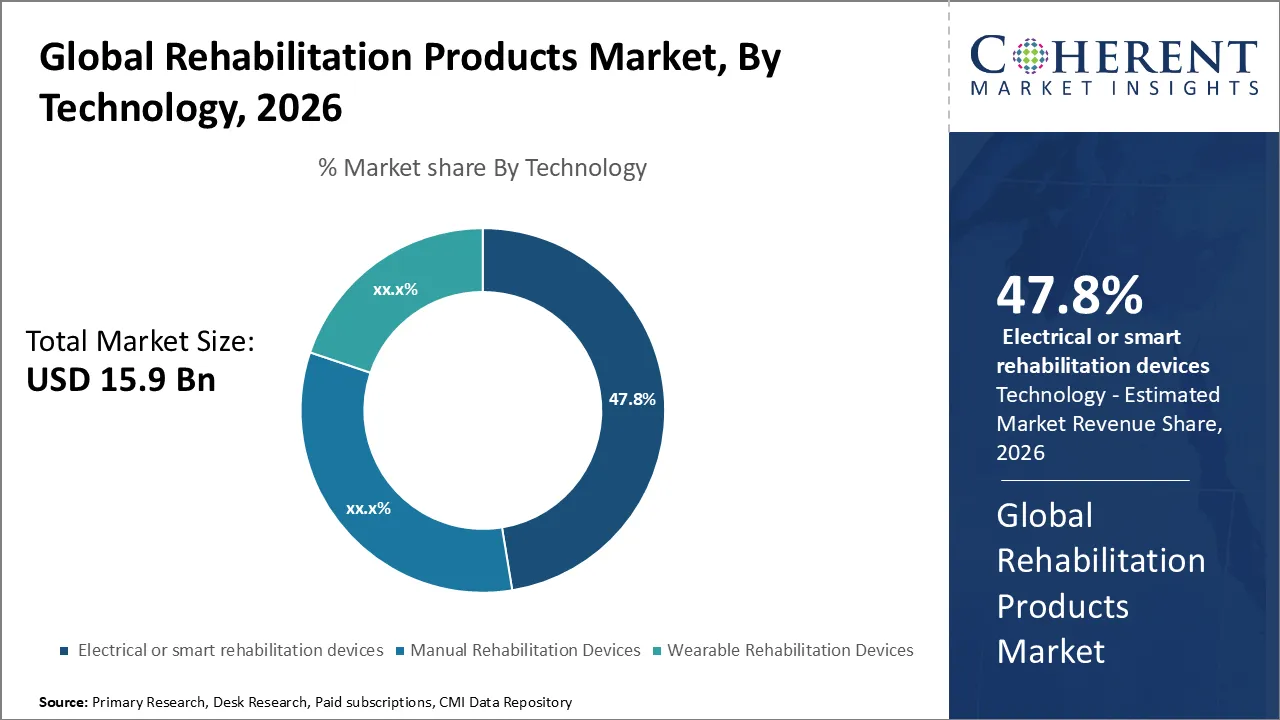
Which technology segment leads the rehabilitation products market with robotics, sensors, and AI solutions?
In terms of technology, the electric or smart rehabilitation devices segment is expected to lead the market with 47.8% share in 2026, because they use robotics, sensors, and AI to speed up patient recovery. These solutions offer real-time monitoring, customized therapy, and better results than manual devices. Their large market share is due to more use in advanced healthcare facilities and more funds being invested into new digital health technologies.
For instance, in January 2026, Baxter's release of the Dynamo Series smart stretcher shows how new electrical and smart rehab devices are being made. It has advanced technology, ergonomic features, and smart controls built in to help with patient handling problems. This puts the product in the smart rehabilitation category, which improves safety, efficiency, and patient care in clinical settings.
Which product type dominates the rehabilitation products market with essential support for elderly patients?
In terms of product type, the mobility equipment segment is expected to hold the dominant share of 37.2% of the market in 2026, as it is so important for helping elderly and disabled people move around every day. Wheelchairs, walkers, and patient lifts are essential for hospitals, clinics, and home care. The growing number of elderly people and the rising number of people with mobility problems mean that demand will stay high and the company will stay at the top of the market.
For instance, in July 2025, Thryv Mobility and IIT Madras worked together to make YD One, India's lightest active wheelchair, which weighs only nine kilograms. It is made with aerospace-grade materials, which makes it strong, energy-efficient, and fully customizable for users. This new idea makes things more affordable, accessible, and independent.
Which end-user segment dominates the rehabilitation products market with advanced infrastructure and patient inflow?
In terms of end user, the hospitals & clinics segment is projected to account for 42.6% share in 2026, due to their advanced infrastructure, high patient flow, and ability to use the latest rehabilitation technologies. They offer the best environment for effective rehabilitation by using multidisciplinary teams and providing comprehensive care. This keeps them at the top of the market.
For instance, in December 2025, Lumov, a startup based in Bengaluru, India, raised $1.2 million to help with orthopedic recovery and rehabilitation in the country. It works with top hospitals like Apollo and Manipal to make custom orthoses and devices that are perfect for Indian needs. This new idea makes rehabilitation products in hospitals and clinics stronger, which helps patients recover faster after surgery and get better care across the country.
Regional Insights
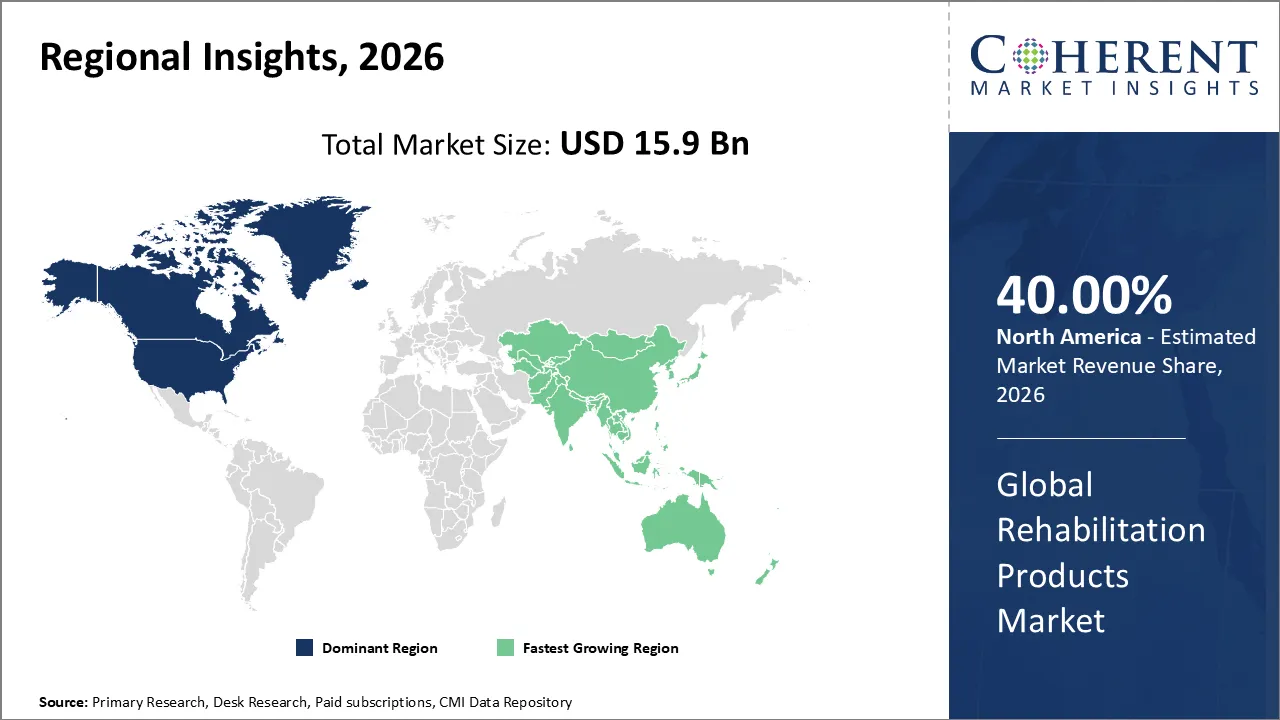
North America Rehabilitation Products Market Analysis and Trends
The North America rehabilitation products market dominates globally, holding about 40% of the total market share in 2026, driven by advanced healthcare infrastructure, a large aging population, and high prevalence of chronic conditions such as musculoskeletal and neurological disorders. Home rehabilitation and outpatient therapy services are rapidly growing, with tele‑rehabilitation adoption rising, while Canada and Mexico contribute smaller but expanding portions to regional growth.
For example, in March 2026, Beurer expanded its German-made, clinically proven, drug-free pain relief products easier to find in the U.S. These smart rehabilitation products help people get better and deal with pain without drugs. This makes the electrical and smart rehabilitation devices segment stronger. The move shows that North America is innovative, which makes patient care better in hospitals, clinics, and at home.
Asia Pacific Rehabilitation Products Market Analysis and Trends
The Asia Pacific rehabilitation products market accounts for about 22% of the global rehabilitation equipment market, driven by rapid healthcare infrastructure expansion, a growing geriatric population, and rising chronic disease prevalence. China leads the region (largest country share within APAC), followed by Japan and India, with India showing faster growth rates. The market is expanding due to increased adoption of advanced technologies such as robotic assisted devices and smart wearable systems, particularly in hospitals and outpatient settings. Home‑based rehabilitation solutions and tele‑rehabilitation are gaining traction, supported by government initiatives and rising awareness of rehabilitation benefits among patients.
For instance, in February 2206, in February 2026, Invacare Europe and Asia Pacific teamed up with Direct Healthcare Group to form DHCare, a company dedicated to assisting those with mobility challenges. DHCare is based in London and provides mobility, seating, pressure ulcer prevention, and safe handling solutions in 16 countries. This merger makes rehabilitation products for hospitals, clinics, and post-acute care around the world stronger.
Rehabilitation Products Market Outlook for Key Countries
USA Rehabilitation Products Market Analysis and Trends
The U.S. rehabilitation products market is a major contributor to the global rehabilitation equipment value, accounting for around 28% of the world market in 2026, driven by increasing chronic diseases and an aging population. Sales are largely driven by therapy and mobility equipment. Physical therapy devices and aids designed for daily living are experiencing significant growth. Adoption of home‑based rehabilitation and tele‑rehabilitation is rising, while regulatory support and reimbursement systems boost market demand.
For instance, in September 2025, Mount Sinai Morningside opened a cutting-edge inpatient rehab center in New York. Patient lifts, robotic exoskeletons, smart rooms, and digital scheduling all play a role in helping individuals regain their strength and independence after strokes, cancer, or other mobility issues. This new idea makes hospital-based rehabilitation products better, which improves patient care, safety, and research into new therapy technologies.
Germany Rehabilitation Products Market Analysis and Trends
The German rehabilitation products market is rapidly expanding, projected to grow at a 9.5% CAGR, driven by an aging population and rising chronic conditions demand. Mobility and therapy equipment lead with major share, while tele‑rehabilitation and smart devices are the fastest‑growing segments as digital health adoption increases. Hospitals and home‑care settings are key buyers, supported by strong health insurance reimbursement and government digital health initiatives that boost in‑home care solutions and innovative robotics integration.
For instance, in December 2025, FICUS Health got €3 million to use AI to automate paperwork in rehab clinics. Its solution reduces on paperwork by up to 70% when working with almost 100 German clinics, allowing medical teams to focus on taking care of patients. This new idea makes hospital rehabilitation processes, efficiency, and long-term viability stronger across all healthcare systems.
Market Report Scope
Rehabilitation Products Market Report Coverage
| Report Coverage | Details | ||
|---|---|---|---|
| Base Year: | 2025 | Market Size in 2026: | USD 15.9 Bn |
| Historical Data for: | 2020 To 2024 | Forecast Period: | 2026 To 2033 |
| Forecast Period 2026 to 2033 CAGR: | 5.7% | 2033 Value Projection: | USD 19.8 Bn |
| Geographies covered: |
| ||
| Segments covered: |
| ||
| Companies covered: | Invacare Corporation, Medline Industries, Inc., Dynatronics Corporation, Drive DeVilbiss Healthcare, Ekso Bionics | ||
| Growth Drivers: |
| ||
Market Dynamics
Rehabilitation Products Market Driver
Chronic Conditions
The growing number of strokes, arthritis, and neurological disorders around the world keeps the rehabilitation products market demand high. Patients recovering from these conditions often need long-term help with rehabilitation, such as therapy equipment, prosthetics, and assistive devices. An increasing number of individuals are getting diabetes and other diseases that are linked to their way of life, which makes more people disabled and increases demand. As healthcare systems focus on recovery and reintegration, rehabilitation products become essential. This leads to steady growth in demand in hospitals, clinics, and home-care settings.
Home-Based Rehabilitation
Patients are increasingly choosing to heal at home, which has greatly increased the demand for portable rehabilitation devices and digital monitoring tools. This method not only saves money on hospital bills, but it also makes things easier for patients by allowing them keep getting therapy without having to go to the hospital often. Telehealth platforms and smart rehabilitation devices, which let healthcare professionals oversee patients remotely, are further fueling this trend. This change is evolving the market, with companies focusing on making rehabilitation products that are small, easy to use, and affordable.
Analyst Opinion (Expert Opinion)
- Clinical Effectiveness: Research indicates that structured rehabilitation programs that include mobility aids and therapeutic equipment enhance functional independence by 30–40% in post-stroke patients and decrease hospital readmissions by 20–25%. In older adults, using walking aids and fall-prevention devices on a regular basis can reduce injuries from falls by up to 35%. When assistive devices are added to daily care routines, the burden on caregivers is reduced by about 30%.
- Trends in Adoption and Use: Numerous individuals are using therapy devices, slings, and rehabilitation beds at home and in hospitals. Physiotherapists and occupational therapists are the primary users of these tools. Rehabilitation centers have observed a 15–20% boost in therapy adherence when using smart rehabilitation devices equipped with monitoring capabilities, resulting in improved patient outcomes. The demand for rehabilitation equipment continues to climb, fueled by the increasing prevalence of chronic conditions such as arthritis and neurological disorders.
Speak to the analyst
Want personalized insights?
Take the findings above to one of our principal consultants, or have the report rebuilt around the segments, geographies and competitors you actually track.
Recent Developments
- In March 2026, At KIMES 2026 in Seoul, Longest Medical plans to showcase new ways to help people recover. Shockwave therapy, ultrasound electrotherapy, and TECAR therapy represent some of the most effective methods for alleviating pain, facilitating tissue repair, and promoting recovery. These advanced technologies are invaluable to hospitals and clinics, enhancing rehabilitation and improving patient outcomes globally.
- In January 2026, Enspire DBS Therapy secured $10.3 million in Series B1 funding, a move designed to advance stroke rehabilitation through deep brain stimulation. This capital infusion will support the critical RESTORE clinical trial, a study focused on aiding stroke survivors in regaining arm strength and functionality. The approach represents a novel fusion of structured rehabilitation protocols and neuromodulation devices, all with the goal of improving recovery outcomes.
Market Segmentation
- By Product Type (Revenue, USD Bn, 2026 - 2033)
- Mobility equipment
- Therapy or rehabilitation equipment
- Exercise and strength training equipment
- Daily living aids
- By End-User (Revenue, USD Bn, 2026 - 2033)
- Hospitals and clinics
- Rehabilitation centers
- Home‑care settings
- Physiotherapy/ specialty clinics and nursing care
- By Technology (Revenue, USD Bn, 2026 - 2033)
- Manual rehabilitation devices
- Electrical or smart rehabilitation devices
- Wearable rehabilitation devices
- By Region (Revenue, USD Bn, 2026 - 2033)
- North America
- U.S.
- Canada
- Latin America
- Brazil
- Argentina
- Mexico
- Rest of Latin America
- Europe
- Germany
- U.K.
- Spain
- France
- Italy
- Benelux
- Denmark
- Norway
- Sweden
- Russia
- Rest of Europe
- Asia Pacific
- China
- Taiwan
- India
- Japan
- South Korea
- Indonesia
- Malaysia
- Philippines
- Singapore
- Australia
- Rest of Asia Pacific
- Middle East & Africa
- Bahrain
- Kuwait
- Oman
- Qatar
- Saudi Arabia
- United Arab Emirates
- Israel
- South Africa
- North Africa
- Central Africa
- Rest of MEA
- North America
- Key Players
- Invacare Corporation
- Medline Industries, Inc.
- Dynatronics Corporation
- Drive DeVilbiss Healthcare
- Ekso Bionics
Sources
Primary Research Interview
- Rehabilitation Product Manufacturers
- Physical Therapy & Occupational Therapy Equipment Suppliers
- Mobility Aid Manufacturers & Distributors
- Prosthetics & Orthotics Solution Providers
- Rehabilitation Clinic Administrators & Procurement Managers
- Others
Databases
- Bloomberg Terminal
- Others
Magazines
- Rehab Management
- O&P Business News
- Mobility Management
- Medical Design & Outsourcing
- Healthcare Purchasing News
- Others
Journals
- Archives of Physical Medicine and Rehabilitation
- Journal of Rehabilitation Medicine
- Disability and Rehabilitation
- American Journal of Physical Medicine & Rehabilitation
- Journal of NeuroEngineering and Rehabilitation
- Others
Newspapers
- The Wall Street Journal
- Financial Times
- Reuters
- Bloomberg News
- The Economic Times
- Others
Associations
- American Physical Therapy Association (APTA)
- American Occupational Therapy Association (AOTA)
- International Society for Prosthetics and Orthotics (ISPO)
- Rehabilitation Engineering and Assistive Technology Society of North America (RESNA)
- World Federation for NeuroRehabilitation (WFNR)
- Others
Public Domain Sources
- World Health Organization (WHO)
- U.S. Food and Drug Administration (FDA)
- Centers for Medicare & Medicaid Services (CMS)
- National Institutes of Health (NIH)
- Centers for Disease Control and Prevention (CDC)
- Others
Proprietary Elements
- CMI Data Analytics Tool
- Proprietary CMI Existing Repository of Information for the Last 8 Years
Get access to 250+ pages report
Every segment, forecast, competitor profile and data table behind the analysis above — available for instant download.
- ESOMAR Member
- ISO 9001:2015 Certified
- D-U-N-S Registered
- GDPR & CCPA Compliant
Missing comfort of reading report in your local language? Find your preferred language:
Transform your Strategy with Exclusive Trending Reports
Frequently Asked Questions
Key players include Invacare Corporation and Medline Industries, Inc. (top market share holders), Dynatronics Corporation, Drive DeVilbiss Healthcare, Ekso Bionics—all driving innovation and broad product portfolios globally.
The Rehabilitation Products market is expected to grow significantly in the coming years, expanding from around USD 15.9 billion in 2026 to roughly USD 19.8 billion by 2033, representing a steady CAGR of 5.7% driven by aging populations, chronic disease prevalence, and rising demand for home based and tech integrated rehabilitation solutions.
The major factors hampering growth of the market include high cost of advanced devices and limited awareness in developing countries.
Mobility equipment segment is the leading category segment in the market.
Factors such as Chronic Conditions and Home-Based Rehabilitation are expected to drive growth of the market during forecast period.