

Global Time Temperature Indicator Labels Market Size and Forecast – 2026 To 2033
The global time temperature indicator labels market is expected to grow from USD 1,016.1 Mn in 2026 to USD 1,642.3 Mn by 2033, registering a compound annual growth rate (CAGR) of 7.1% from 2026 to 2033. The global time temperature indicator labels market is expanding steadily, driven by rising demand for effective temperature monitoring in cold chain logistics, particularly across food and pharmaceutical industries, to ensure product safety, quality, and compliance.
For instance, on November 4, 2025, Blackfrog Technologies launched a real-time refrigeration monitoring system, the EMON-25 that tracks temperature, power, and door activity with instant alerts. (Source: Blackfrog)
Key Takeaways of the Global Time Temperature Indicator Labels Market
- The irreversible TTI labels segment is expected to account for 32% of the global time temperature indicator labels market share in 2026. The growing use of irreversible time temperature indicator labels are driven by the introduction of modern highly developed technologies by market players. On December 23, 2025, Vitsab International AB introduced Freshtag, a color-changing smart label designed to monitor perishable foods for time and temperature, ensuring food safety and quality. Vitsab positions Freshtag as a cost-effective, easy-to-integrate solution for food safety and quality management systems. (Source: Vitsab)
- The photochemical segment is estimated to capture 41% of the market share in 2026. Photochemical tags are becoming common due to low cost and clarity. As they display whether goods remained within safe ranges, cold chains now depend on these indicators. Freshness of food and drugs stays verifiable through visible proof of heat history. Easier monitoring happens here - older approaches lacked such straightforward feedback. A study by National Library of Medicine showed that the smart indicator of photochromic time temperature indicator showed good reproducibility during the discoloring process in all the conditions investigated. The response was not only visibly interpretable but also well adaptable to measurement using appropriate equipment. For an activation configuration of 4 s of ultraviolet light (UV) per label, the time temperature indicator's rate of discoloration was similar to the quality loss of the meat samples analyzed. (Source: NCBI)
- The Critical Temperature Indicators (CTI) segment is projected to hold 49% of the global time temperature indicator labels market share in 2026. One reason for growing attention to critical temperature indicators are the move toward simple tools that reveal when temperature dangers occur during shipping of sensitive items, especially in pharmaceuticals and food supply chains.
- Asia Pacific is expected to dominate the time temperature indicator labels market in 2026 with a market share of 34.8 %. The introduction of strict guidelines in countries like China is a major driver for the market. On November 28, 2025, Chinese authorities have issued a new guideline aimed at strengthening food safety supervision across the entire supply chain. Key initiatives outlined in the guideline include enhanced inspection and quarantine certification procedures for meat products, a new permit system for the transportation of bulk liquid food items, improved collaborative mechanisms for campus food safety management, and strengthened integration of online and offline supervision for food delivery services. (Source: NCBI)
- North America is expected to account for 20.06 % share in 2026 and is projected to record the fastest growth over the forecast period. The introduction of innovative products in major countries like the U.S. and Canada is a major driver for the North America time temperature indicator labels market. The introduction of products like TempDot is a major example. TempDot Plus time-temperature indicator labels can be conveniently placed on outer cartons, secondary shipping boxes, or product packaging to continuously track temperature conditions at the pallet level, on single cartons, or individual units. (Source: Deltrak)
- Expansion of pharmaceutical and biologics cold chain distribution: With rising worldwide need for vaccines, insulin, and advanced biologics, interest grows in using TTI labels more widely. Greater focus falls on precise temperature control within healthcare distribution When shipments travel far, constant monitoring turns increasingly necessary. The longer the journey, the clearer the necessity for reliable condition tracking. Finally, delivery arrives, often accompanied by increased pressure. When transporting items internationally, compliance becomes the central concern.
- Growth in smart food packaging and global perishable exports: Far beyond earlier limits, fish, milk products, and animal flesh now cross more frontiers. With meals pre-assembled gaining favor, how food moves alter in quiet ways. When transport conditions waver, dependence on markers tracking time and cold increases without noise. These tools gain importance precisely when supply chain resilience face variation.
Segmental Insights
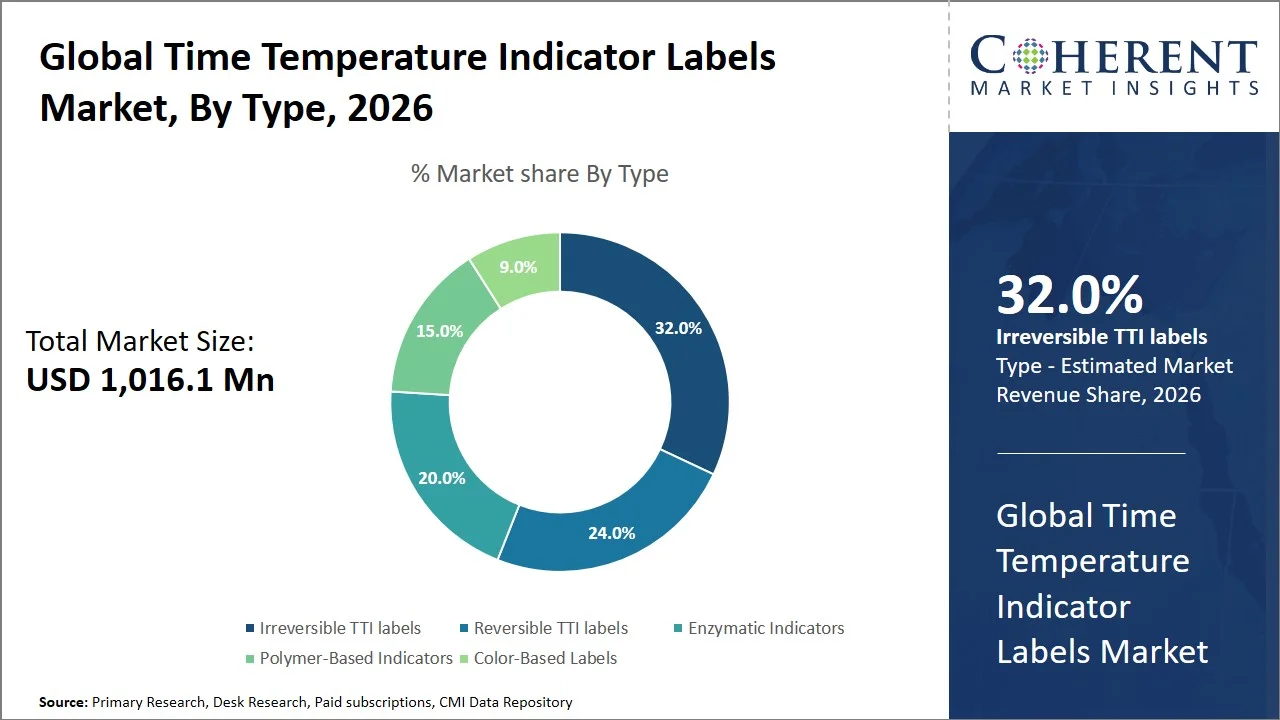
Why Does Irreversible TTI labels Segment Dominate the Global Time Temperature Indicator Labels Market?
The Irreversible TTI Labels segment is expected to account for 32% of the global time temperature indicator labels market share in 2026. Activation begins the process as changes appear immediately, never to reset. Once stability begins, trust grows within networks that move medicine and food. After change occurs, clarity stays constant; confusion about past conditions disappears completely. When small temperature changes matter, such markers stand apart by offering secure proof. What needs observing reveals itself through color transitions seen remotely. Out here, clarity emerges when tags shift, no queries required. Needed proof appears exactly there, on container surfaces. With images leading, rule-following turns effortless. Now visible, what stayed concealed shifts inspection methods. Inside never felt so far from reach.
In July 2025, Timestrip announced the introduction of new electronic time and temperature indicators, expanding its highly flexible and easy-to-use neo family. The new Timestrip neo DF and Timestrip neo DG offer unique flexibility and ease of use for monitoring sensitive goods such as pharmaceuticals and foodstuffs, supporting product integrity throughout the supply chain.
(Source: Timestrip)
- Current Industry Events of 2026
- Market Size Estimation
- Regional Breakdown
- Competitive Landscape
- Customer Intelligence
- Segmental Analysis
- Pricing Analysis
- Key Market Drivers, Challenges & Future Trends
- Customized Insights Section
Why is Photochemical the Most Preferred Technology?
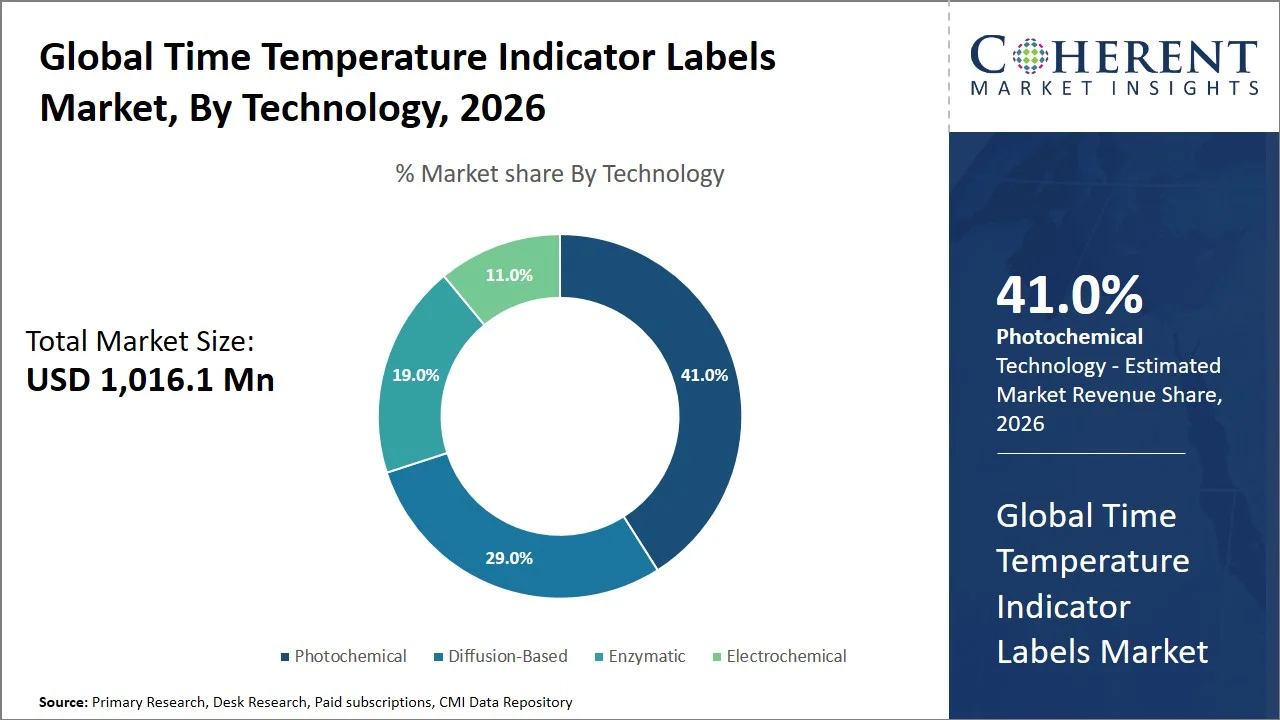
The photochemical segment is expected to account for 41% of the global time temperature indicator labels market share in 2026. One key factor behind the dominance of photochemical techniques in time-temperature labels are their simple chemical basis, producing consistent outcomes affordably by linking clear visual changes to total exposure conditions. Once triggered, gradual molecular alterations proceed without pause, ending in a permanent color shift, stable, irreversible, needing neither electronics nor external devices. Across cold chains for pharmaceuticals and fresh goods, such markers perform reliably, modifying response rates to match specific temperature limits set during manufacturing.
Critical Temperature Indicators (CTI) Segment Dominates the Global Time Temperature Indicator Labels Market
The Critical Temperature Indicators (CTI) segment is expected to account for 49% of the global time temperature indicator labels market share in 2026. Dominance within the global time temperature indicator label sector belongs to critical temperature indicators, given their straightforward method of revealing exposure to hazardous temperatures. A breach in safe ranges triggers an unchangeable visual response, this happens instantly, removing delays. No electronics are needed; understanding requires minimal training. Particularly useful in handling medicines and short-lived comestibles, where stability matters most. Widespread trust grows from performance under strict conditions such as vaccine transport networks. Cold storage tracking favors these indicators due to consistent results across vast operations. A recent study showed that Critical Temperature Indicator (CTI) and Radio Frequency Identification (RFID) technology are integrated to monitor and communicate the package status by combined visual and electronic detection. Hereby, this work presents the development of an intelligent label integrating a polyaniline (PANI)-based sensor and a RFID antenna, both fabricated using Aerosol Jet Printing (AJP). The label is specifically made of a CTI which changes color upon an external trigger, and an RFID antenna that allows verifying the status of the device electronically; both components are printed on a paper label toward the development of an intelligent label.
(Source: Wiley Advanced)
Currents Events and their Impact
Current Events | Description and its Impact |
U.S. DSCSA 2025 |
|
WHO Cold-Chain Guidance Expansion |
|
Global Time Temperature Indicator Labels Market Dynamics
Market Drivers
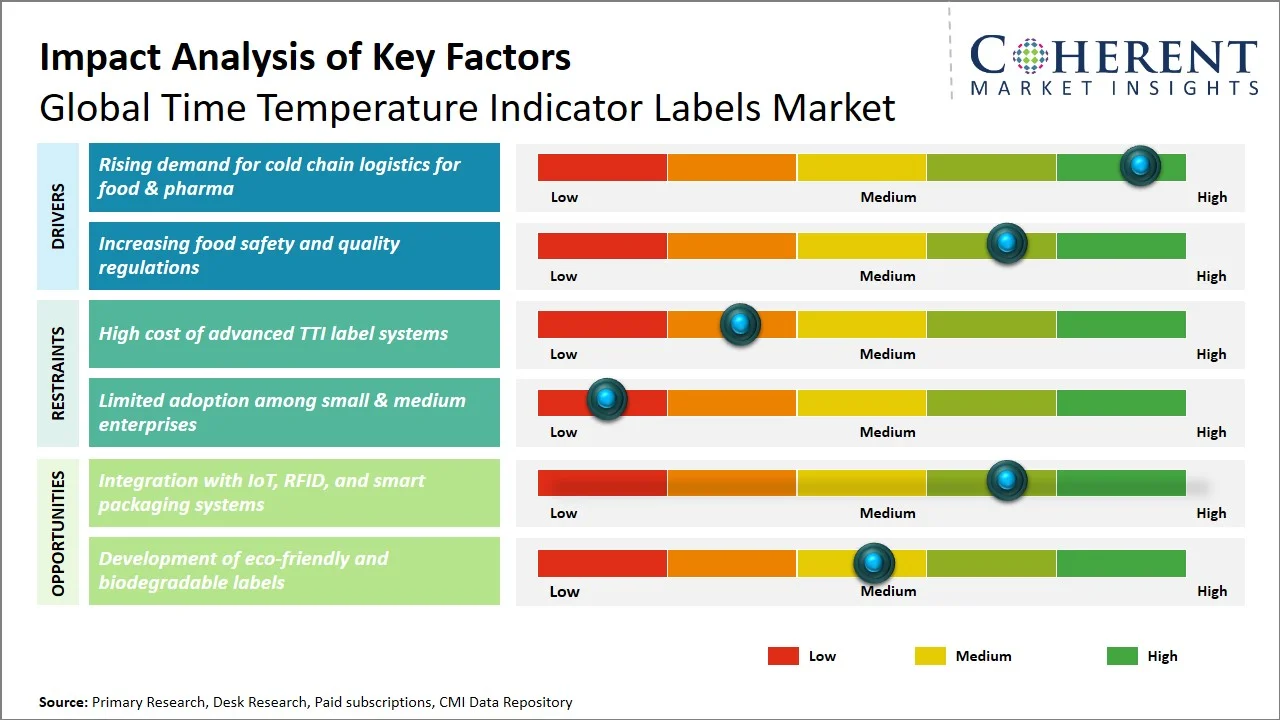
- Rising Demand for Cold Chain Logistics for Food & Pharma: Across international shipping routes, cool transit grows necessary with more time-sensitive products on the move. As vaccine distribution expands geographically, chilled transportation shifts from option to requirement. Online retail growth moves large volumes of frozen stock, pressing logistics networks to adopt stricter thermal oversight. Sensors capturing current conditions attract attention due to their ability to signal heat exposure instantly. Alerts emerge promptly when temperatures drift, aiding adherence to standards while limiting product loss. On February 19, 2026, DHL Group today announced major steps to strengthen its Life Sciences & Healthcare (LSH) logistics capabilities with an expanded dedicated Airfreight Cold Chain Network, a move designed to reshape how temperature-sensitive medicines, vaccines, pharmaceutical products and cell & gene therapies move across the world. (Source: DHL)
- Increasing Food Safety and Quality Regulations: Rules grow stricter as governments aim to lower illness tied to contaminated goods. With health goals becoming more defined, oversight bodies improve tracking during distribution stages. Because hazards differ, businesses adjust storage methods based on careful evaluation. Driven by fresh U.S. measures like new FDA requirements, along with revised European hygiene norms, companies update monitoring habits and records. On April 8, 2026, the U.S. FDA strengthened enforcement of the FSMA Food Traceability Rule, requiring detailed tracking for high-risk foods like seafood, dairy, and fresh produce. The U.S. FDA final rule on Requirements for Additional Traceability Records for Certain Foods (Food Traceability Final Rule) establishes traceability recordkeeping requirements, beyond those in existing regulations, for persons who manufacture, process, pack, or hold foods included on the Food Traceability List (FTL). (Source: U.S. FDA)
Emerging Trends
- Shift toward smart IoT-enabled TTI systems: With growing frequency, TTI labels link to cloud platforms, IoT networks, or RFID and barcode systems, enabling live updates across supply chains. Instead of standalone temperature markers, sectors now rely on interconnected tools that report conditions continuously.
- Rise of carbon removal and high-integrity credits: Temperature trackers now show up in medical deliveries, protecting sensitive products like vaccines or insulin. Because rules demand proof of proper conditions, these devices spread through worldwide supply chains. After companies start using them to meet standards, they tend to keep them in place. Since small changes matter greatly, monitoring runs constantly during every part of transit.
Regional Insights
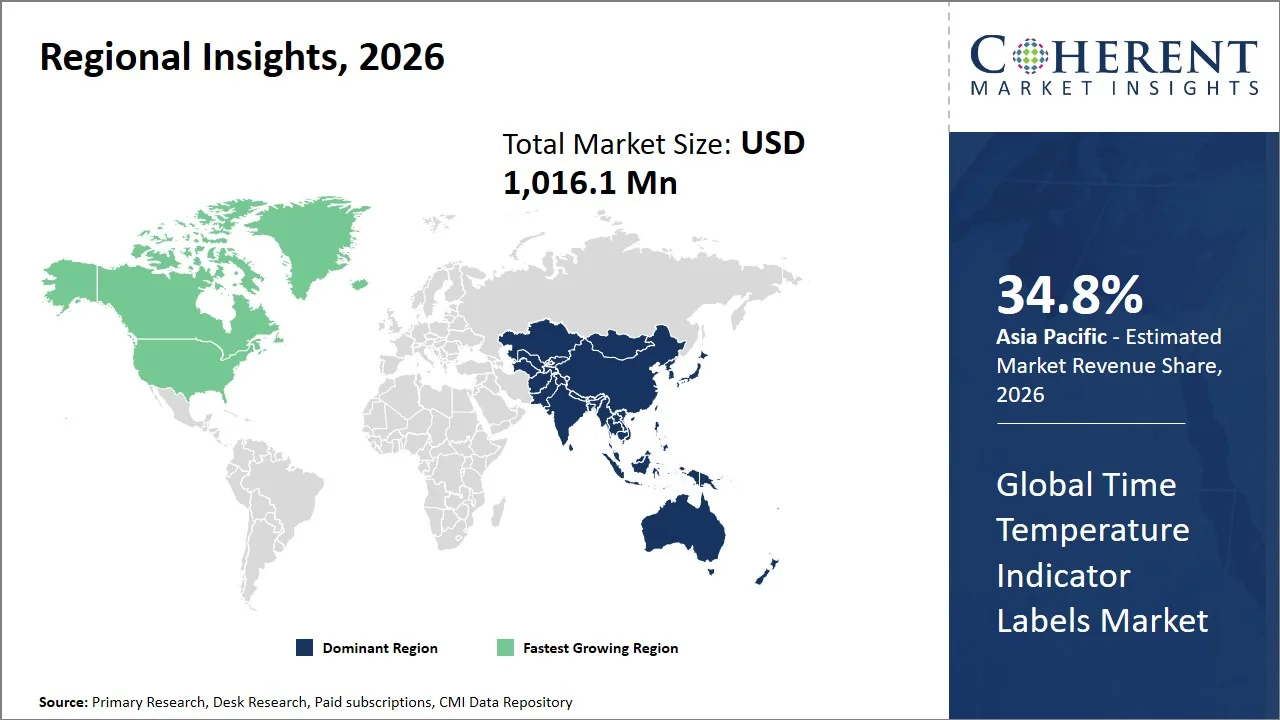
Why is Asia Pacific a Strong Market for Time Temperature Indicator Labels?
Asia Pacific is expected to account for a market share of 34.8% in 2026. Despite varied terrain, movement across land here depends heavily on consistent cooling systems. One reason lies in medicine production that grows faster than average. Seafood, milk items, and uncooked crops now move beyond borders more often. Such flows demand careful handling under set conditions. New transport networks stretch quickly within nations including India, China, and areas nearby. These developments call for tools able to track heat exposure accurately. Rules about clean eating gain tighter grip year after year.
On January 31, 2026, the FSSAI proposed a rule requiring food businesses to maintain daily records of raw materials, storage, and finished goods to improve traceability and contamination control. This rule aims to strengthen end-to-end visibility in the food supply chain so that authorities can quickly identify the source of contamination during food safety incidents. It also increases compliance accountability for manufacturers and processors by making detailed operational documentation a mandatory part of routine inspections and audits. (Source: Times of India)
Why Does North America Time Temperature Indicator Labels Market Exhibit High Growth?
North America is expected to account for a market share of 20.06% in 2026 and is expected to register the fastest growth rate over the forecast period. North America shows strong growth in the time temperature Indicator labels market due to strict regulatory enforcement of pharmaceutical cold-chain compliance (especially DSCSA serialization rollout in the U.S. by 2025) and rising adoption of advanced biologics that require continuous temperature integrity monitoring. Where food handlers track temperature shifts over time, chilled supply chains appear more frequently, especially useful for fragile goods such as seafood, milk-based products, or pre-cooked dishes. In different areas, medicine transport uses alike detection tools, built into electronic oversight systems that move past simple wrapping methods.
On January 8, 2025, UPS announced that it had completed the acquisition of Frigo-Trans and its sister company BPL. The acquisitions enhanced the end-to-end capabilities available to UPS Healthcare customers, who increasingly need temperature-controlled and time-critical logistics solutions globally. (Source: UPS)
Why is China Emerging as a Major Hub in the Time Temperature Indicator Labels Market?
China is emerging as a major hub in the time temperature Indicator labels market due to its massive pharmaceutical manufacturing base, strong vaccine and biologics distribution networks, and rapidly modernizing cold chain logistics infrastructure. Stricter oversight of drugs and broader food safety tracking now requires better tools to monitor cold chain conditions. As China ships vast amounts of perishable goods abroad, new methods gain importance. E-commerce growth in groceries adds pressure. Time-temperature indicators become more common under such conditions. Their role expands not only due to waste reduction but also because rules at home and overseas grow tighter. Quality checks evolve alongside these shifts.
Is the U.S. the Next Growth Engine for the Time Temperature Indicator Labels Market?
The U.S. is becoming a key growth engine for the time temperature indicator labels market due to the full enforcement of DSCSA 2025 serialization requirements, which are forcing pharmaceutical companies to strengthen end-to-end traceability of temperature-sensitive drugs. This is combined with rising adoption of biologics and specialty medicines, where distributors like UPS Healthcare and McKesson are integrating digital cold-chain platforms that increasingly incorporate real-time temperature monitoring and indicator technologies to ensure compliance and reduce liability risks from spoilage or shipment deviations.
India Time Temperature Indicator Labels Market Analysis and Trends
India time temperature Indicator labels market is gaining momentum due to specific regulatory and supply-chain shifts, particularly FSSAI’s stricter food traceability enforcement (including expanded record-keeping and compliance monitoring proposals in 2025–2026) and the rapid scaling of GDP-compliant pharmaceutical cold-chain logistics for vaccines, insulin, and biologics. At the same time, India’s growing seafood and dairy export sectors are increasingly adopting freshness and temperature monitoring solutions to meet EU and U.S. import standards, while logistics companies are integrating TTI labels with IoT-based cold-chain tracking systems to reduce spoilage during long-distance transport and last-mile delivery in e-commerce and healthcare distribution.
Beginning in 2025, packaging embedded with sensors grew more common within U.K. distribution networks and stores. Rising emphasis on food safety norms along with environmental responsibility fueled steady interest. Regulatory pressure played a role; so did requirements set by leading grocery chains. Attention turned toward tracking items sensitive to heat, especially where refrigerated transport and online shopping were involved. Reduction of spoiled inventory emerged as one objective behind these changes. Thermal-responsive labels started appearing more frequently on shipment units through 2026. On June 16, 2025, the UK Department for Environment, Food & Rural Affairs updated the Labelling requirements for certain products moving from Great Britain to retail premises in Northern Ireland under the Northern Ireland Retail Movement Scheme. (Source: GOVUK)
Global Time Temperature Indicator Labels Market - Regulatory Compliance & Monitoring Requirements
Regulation | Authority | Sector Coverage | Temperature Monitoring Requirement |
GDP (Good Distribution Practice) | EU, Global (EMA/WHO aligned) | Pharmaceuticals | Mandatory continuous temperature monitoring, mapping, calibration, and excursion reporting (typically 2°C–8°C for cold chain drugs) |
FDA cGMP (21 CFR 210/211) | U.S. | Pharma & Biologics | Requires validated temperature-controlled storage, continuous monitoring, and documentation of excursions |
FDA FSMA Rule (Food Safety Modernization Act) | U.S. | Food & Beverage | Requires preventive controls, hazard monitoring, and temperature control documentation for perishable foods |
HACCP (Hazard Analysis & Critical Control Points) | Global (Codex Alimentarius) | Food Industry | Requires temperature monitoring at critical control points (CCPs) with continuous recording and corrective actions |
EU GDP Guidelines (2013/C 343/01) | European Union | Pharmaceuticals | Requires validated temperature-controlled transport, storage systems, and documented excursion management |
IATA Temperature Control Regulations (TCR) | Global Air Cargo | Pharma Logistics | Requires real-time temperature monitoring, labeling, and documentation during air transport of temperature-sensitive goods |
EN 12830 Standard | EU | Food & Pharma Sensors | Requires accuracy-certified temperature recording devices for cold chain monitoring (-30°C to +70°C range typically) |
How is Integration with IoT, RFID, and Smart Packaging Systems Creating New Growth Opportunities in the Global Time Temperature Indicator Labels Market?
In the modern landscape, high-end cold chains evolve as devices link to RFID markers together with intelligent packaging, turning simple heat monitors into responsive systems. Beyond visual cues alone, such tags find function through networked data streams, joining continuous monitoring networks. While moving through key routes in North America and certain parts of Asia Pacific, drug shipments bear codes tied to distant detectors recording temperature shifts each minute. Data moves constantly; warnings arise during travel should environments shift outside thresholds. Rigorous environmental standards remain upheld - silent but steady throughout. Halfway along the journey, companies overseeing transport, such as specialized divisions of global couriers or local temperature-controlled carriers, access confirmation records immediately. Errors once common under human checks now diminish sharply due to enhanced accuracy. On October 30, 2025, UPS Healthcare launched an upgrade to its UPS Premier system, allowing integration of third-party real-time trackers with RFID-based Silver labels and sensor-based Gold labels. This enables pharmaceutical customers to combine their own monitoring devices with UPS’s digital cold-chain visibility platform for temperature-sensitive shipments.
(Source: UPS)
Market Players, Key Development, and Competitive Intelligence
Key Developments
- On February 25, 2026, Avery Dennison, a global leader in materials science and digital identification solutions, announced the launch of its AD IdentiFresh inlay series, advancing the use of RFID technology in fresh food categories including bakery, meat, deli and produce.
- On February 10, 2025, Reelables announced a new addition to its line of smart shipping labels, Reelables 5G Cellular Label for temperature monitoring, giving logistics providers, cargo forwarders, manufacturers, and retailers for the first time reliable temperature-controlled visibility at scale at a per piece level to trace each perishable shipment through the supply chain.
Competitive Landscape
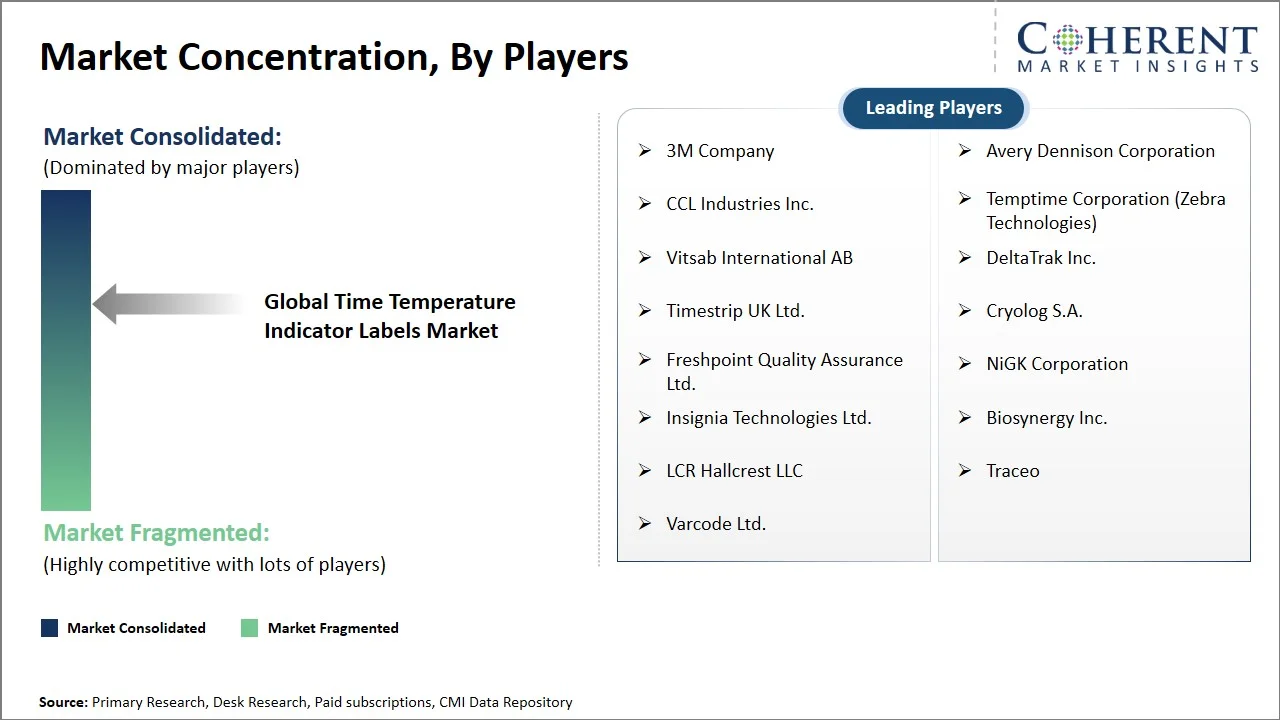
The global time temperature indicator labels market is moderately consolidated, with a few large multinational players such as 3M, Avery Dennison, Temptime (Zebra Technologies), CCL Industries, and DeltaTrak dominating the industry through strong R&D, advanced smart-label technologies, and global cold-chain distribution networks. At the same time, specialized companies like Vitsab, Timestrip UK, Insignia Technologies, and NiGK Corporation compete by offering niche innovations such as enzymatic indicators, electronic TTIs, and eco-friendly or application-specific solutions for food and pharmaceutical sectors. The competition is intensifying as firms shift toward IoT-enabled, RFID-integrated, and smart packaging-based TTI systems, while regional players in Asia Pacific are gaining share through cost-effective and scalable cold-chain solutions.
Market Report Scope
Time Temperature Indicator Labels Market Report Coverage
| Report Coverage | Details | ||
|---|---|---|---|
| Base Year: | 2025 | Market Size in 2026: | USD 1,016.1 Mn |
| Historical Data for: | 2020 To 2024 | Forecast Period: | 2026 To 2033 |
| Forecast Period 2026 to 2033 CAGR: | 7.1% | 2033 Value Projection: | USD 1,642.3 Mn |
| Geographies covered: |
| ||
| Segments covered: |
| ||
| Companies covered: | 3M Company, Avery Dennison Corporation, CCL Industries Inc., Temptime Corporation (Zebra Technologies), Vitsab International AB, DeltaTrak Inc., Timestrip UK Ltd., Cryolog S.A., Freshpoint Quality Assurance Ltd., NiGK Corporation, Insignia Technologies Ltd., Biosynergy Inc., LCR Hallcrest LLC, Traceo, and Varcode Ltd. | ||
| Growth Drivers: |
| ||
| Restraints & Challenges: |
| ||
Analyst Opinion (Expert Opinion)
- The global time temperature indicator labels market is increasingly being viewed by analysts as a transition market moving from passive packaging solutions to intelligent cold-chain compliance systems. Experts note that the core value of TTIs is shifting beyond simple spoilage indication toward integration with pharmaceutical traceability frameworks, food safety compliance systems, and digital logistics platforms. The strongest growth signal comes from the convergence of regulatory pressure (especially in pharma and food exports) and technological upgrades such as enzymatic indicators, RFID-enabled labels, and IoT-linked monitoring solutions.
- From a competitive standpoint, market leadership is no longer defined only by label manufacturers, but by companies that can build end-to-end cold-chain visibility ecosystems. Big companies like 3M, Avery Dennison, and Zebra Technologies now combine takeovers with alliances to include time-temperature indicators within wider digital tracking systems for packages. In contrast, smaller specialists attract notice through precision-focused offerings tailored to demanding fields (biological materials and fresh foods) showing how technological diversity expands.
- Machine learning could guide future TTI label designs by forecasting changes in surroundings, while smart packaging displays live status updates through sensors tied to combined IoT and RFID frameworks. Driven less by general market movements, advancement responds more directly to rules that tighten oversight. Pharmaceutical products needing exact temperature settings set part of the demand, as do global transport routes for perishable goods. Vaccine logistics further push system refinement, since traceability matters. Waste avoidance becomes a quiet priority under scrutiny from compliance standards. Gradually, these indicators might shift from single-use tags toward components of broader digital oversight systems operating across worldwide refrigerated supply chains.
Speak to the analyst
Want personalized insights?
Take the findings above to one of our principal consultants, or have the report rebuilt around the segments, geographies and competitors you actually track.
Market Segmentation
- Type Insights (Revenue, USD Million, 2021 - 2033)
- Irreversible TTI labels
- Reversible TTI labels
- Enzymatic Indicators
- Polymer-Based Indicators
- Color-Based Labels
- Technology Insights (Revenue, USD Million, 2021 - 2033)
- Photochemical
- Diffusion-Based
- Enzymatic
- Electrochemical
- Label Information Insights (Revenue, USD Million, 2021 - 2033)
- Critical Temperature Indicators (CTI)
- Time Temperature Indicators (TTI)
- Critical Time Temperature Indicators (CTTI)
- End User Insights (Revenue, USD Million, 2021 - 2033)
- Food & Beverages
- Pharmaceuticals
- Chemicals
- Logistics & Transportation
- Regional Insights (Revenue, USD Million, 2021 - 2033)
- North America
- U.S.
- Canada
- Latin America
- Brazil
- Argentina
- Mexico
- Rest of Latin America
- Europe
- Germany
- U.K.
- Spain
- France
- Italy
- Russia
- Rest of Europe
- Asia Pacific
- China
- India
- Japan
- Australia
- South Korea
- ASEAN
- Rest of Asia Pacific
- Middle East
- GCC Countries
- Israel
- Rest of Middle East
- Africa
- South Africa
- North Africa
- Central Africa
- North America
- Key Players Insights
- 3M Company
- Avery Dennison Corporation
- CCL Industries Inc.
- Temptime Corporation (Zebra Technologies)
- Vitsab International AB
- DeltaTrak Inc.
- Timestrip UK Ltd.
- Cryolog S.A.
- Freshpoint Quality Assurance Ltd.
- NiGK Corporation
- Insignia Technologies Ltd.
- Biosynergy Inc.
- LCR Hallcrest LLC
- Traceo
- Varcode Ltd.
Sources
Primary Research Interviews
- Pharmaceutical and Biotechnology Companies
- Cold Chain Logistics Providers
- Food and Beverage Manufacturers
- Medical Device Companies
Magazines
- Pharmaceutical Manufacturing Magazine
- Cold Chain Technologies Magazine
- Packaging World Magazine
- Food Logistics Magazine
- Supply Chain Management Review
Journals
- International Journal of Refrigeration
- Journal of Food Engineering
- Pharmaceutical Technology
Associations
- International Safe Transit Association (ISTA)
- Healthcare Distribution Alliance (HDA)
- Parenteral Drug Association (PDA)
- Global Cold Chain Alliance (GCCA)
Public Domain Sources
- U.S. Food and Drug Administration (FDA)
- World Health Organization (WHO)
- European Medicines Agency (EMA)
- International Air Transport Association (IATA)
Proprietary Elements
- CMI Data Analytics Tool
- Proprietary CMI Existing Repository of information for last 10 years
Get access to 250+ pages report
Every segment, forecast, competitor profile and data table behind the analysis above — available for instant download.
- ESOMAR Member
- ISO 9001:2015 Certified
- D-U-N-S Registered
- GDPR & CCPA Compliant
Missing comfort of reading report in your local language? Find your preferred language:
Transform your Strategy with Exclusive Trending Reports
Frequently Asked Questions
The global time temperature indicator labels market is expected to stand at USD 1,016.1 Mn in 2026 and is expected to reach USD 1,642.3 Mn by 2033.
The CAGR of the global time temperature indicator labels market is projected to be 7.1% from 2026 to 2033.
Rising demand for cold chain logistics for food & pharma and increasing food safety and quality regulations are the major factors driving the growth of the global time temperature indicator labels market.
High cost of advanced TTI label systems and limited adoption among small & medium enterprises are the major factors hampering the growth of the global time temperature indicator labels market.
In terms of type, irreversible TTI labels are estimated to dominate the market revenue share in 2026.
Most TTI labels are single-use and designed for irreversible temperature indication.
They provide visual proof of spoilage risk, helping retailers avoid unnecessary disposal of safe food.