

Agriculture Robots Market Size and Forecast – 2026 to 2033
The Agriculture Robots Market is anticipated to grow at a CAGR of 18.8% with USD 15.4 Bn share in 2026 and is expected to reach USD 43.8 Bn in 2033. Rising labor shortages, growing demand for precision farming, and the need to improve agricultural productivity are driving the Agriculture Robots market. As of 2025, 70% of U.S. employers reported labor shortages, five percentage points below the global average.
Key Takeaways
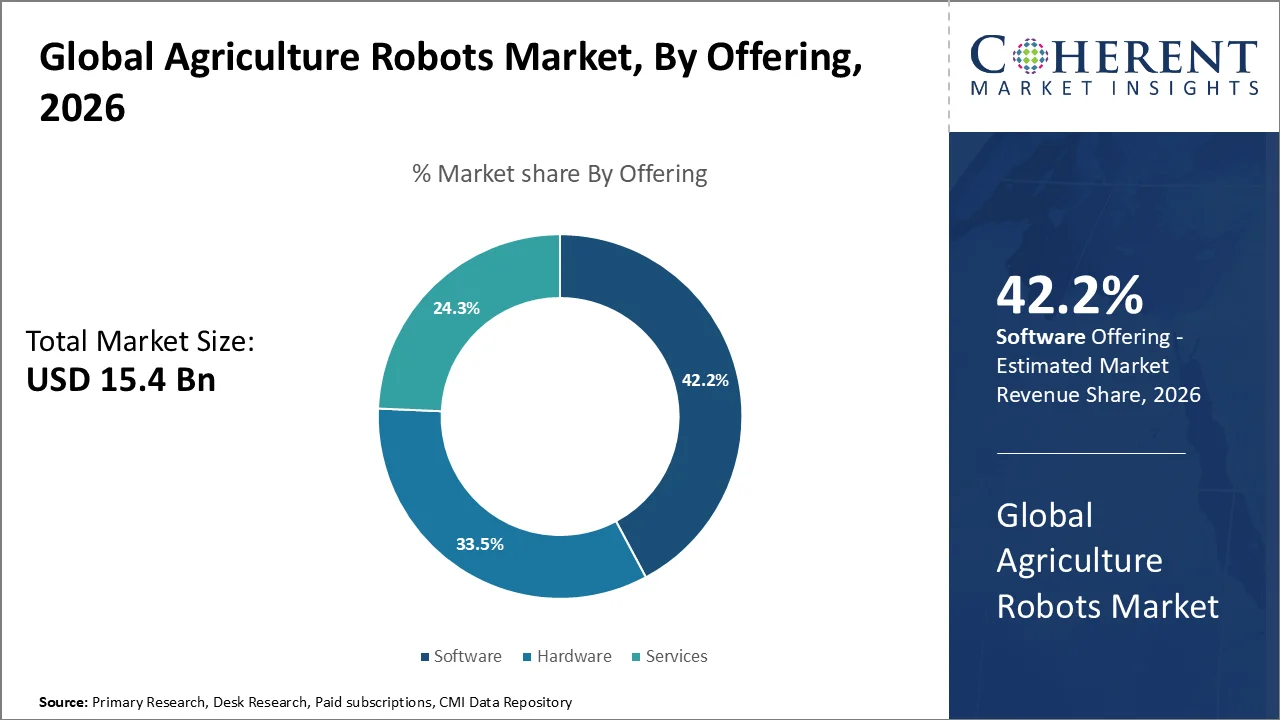
- Software holds the largest market share of 42.2% in 2026 owing to the growing adoption of precision agriculture. According to our research, the Global Precision Farming industry is estimated to surpass USD 32.05 Bn by 2033.
- Unmanned Aerial Vehicles (UAV)/Drones expected to hold largest market share of 38.8% in 2026 owing to its need for efficient crop monitoring. In July 2026, Corvus Drones and NoorAgri signed a Memorandum of Understanding (MoU) at GreenTech Amsterdam to accelerate the adoption of drone technologies for horticulture in Algeria and the broader region, focusing on deploying drone-based solutions for crop monitoring.
- Harvest Management acquired the prominent market share of 38.7% in 2026 owing to the advancements in AI and computer vision.
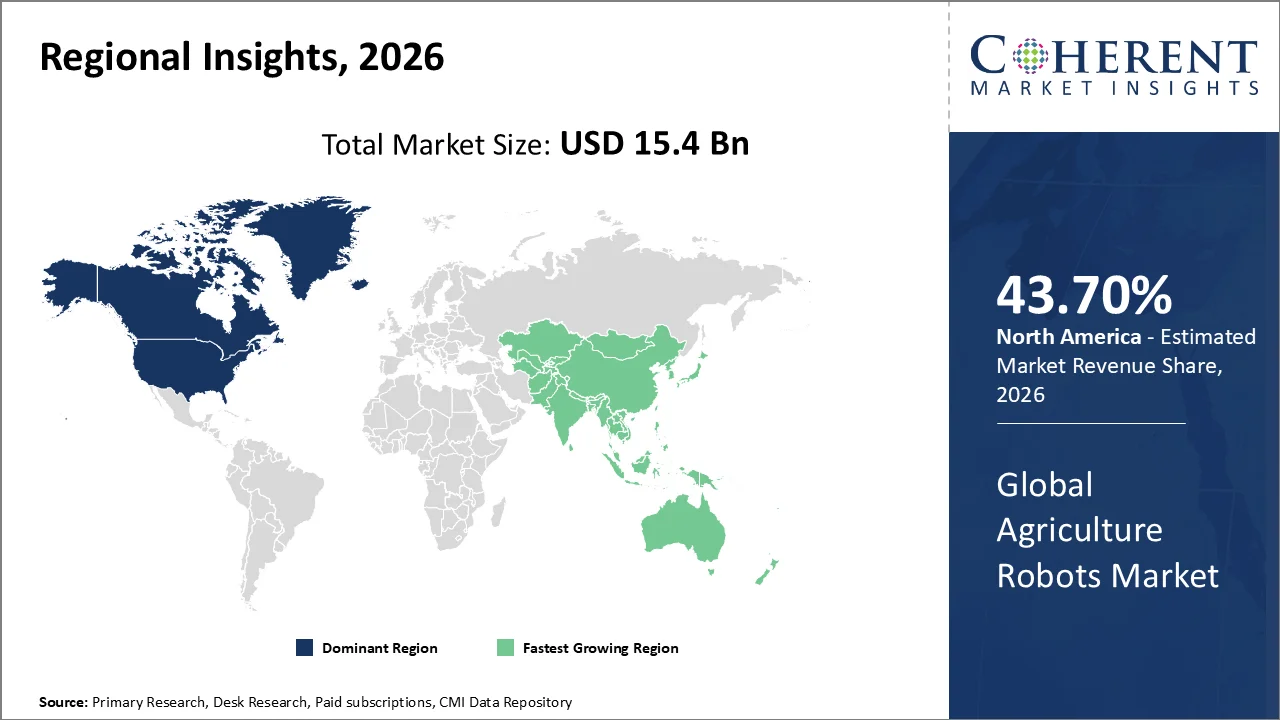
- North America is expected to acquire the dominant share of 43.7% in 2026 owing to the growing investment in AgTech. According to an article published by the USDA Economic Research Service, the United States continues to lead among high-income countries in public agricultural R&D spending.
Current Events and Their Impact on the Agriculture Robots Market
Current Event | Description and its Impact |
European Union Common Agricultural Policy (CAP) 2023–2027 Implementation |
|
U.S. Department of Agriculture (USDA) Precision Agriculture Initiatives |
|
Segmental Insights
- Current Industry Events of 2026
- Market Size Estimation
- Regional Breakdown
- Competitive Landscape
- Customer Intelligence
- Segmental Analysis
- Pricing Analysis
- Key Market Drivers, Challenges & Future Trends
- Customized Insights Section
Why is Software Acquiring the Largest Market Share?
Software holds the largest market share of 42.2% in 2026. Farmers are driving the growth of the software segment in the agricultural robots market by increasingly adopting precision farming and intelligent automation across agricultural operations. They use software platforms to operate autonomous machinery, analyze field data, and optimize planting, irrigation, fertilization, and harvesting processes. Artificial intelligence, machine learning, and computer vision enhance robotic capabilities, enabling them to perform complex tasks with greater accuracy. These technologies help farmers improve productivity, lower operational costs, optimize resource utilization, and reduce reliance on manual labor. For instance, Agroz Inc. launched Agroz Robotics with UBTECH Robotics to advance AI-powered automation in Controlled Environment Agriculture (CEA) vertical farms.
Unmanned Aerial Vehicles (UAV)/Drones expected to hold largest market share
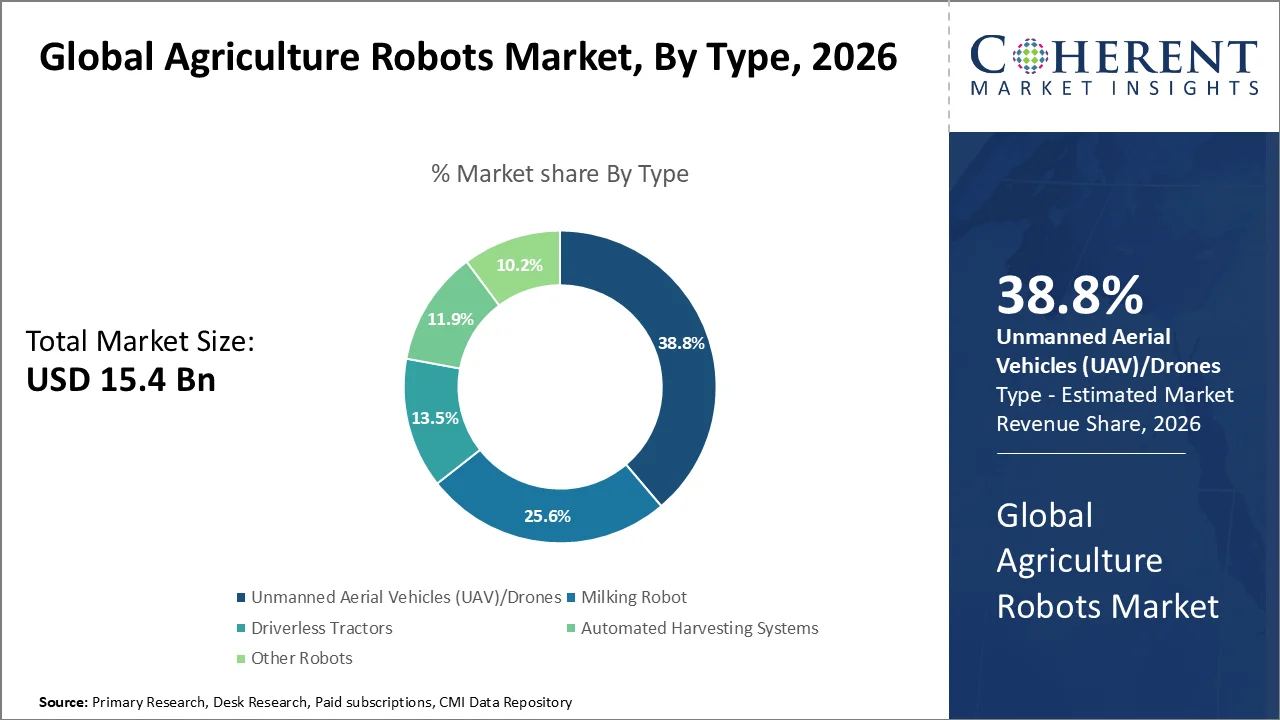
Unmanned Aerial Vehicles (UAV)/Drones expected to hold largest market share of 38.8% in 2026 owing to its growing demand for precision spraying. Farmers are driving UAV and drone adoption in the agricultural robots market through precision farming, crop monitoring, and data-driven decision-making. Farms adopting UAV-based crop management solutions typically achieve returns of 15–20% within the first two years through reduced input costs, improved crop yields, and more efficient resource management. Drones help capture aerial imagery, assess crop health, detect pests and diseases, and monitor irrigation needs. These capabilities enable timely actions, improve productivity, and optimize the use of fertilizers, pesticides, and water while reducing resource waste. For instance, in May 2026, ePropelled launched an integrated propulsion and power solution for agricultural UAVs, targeting the fast-growing commercial drone market.
Which Application segment dominates the market?
Harvest Management acquired the prominent market share of 38.7% in 2026. Farmers are driving growth in the harvest management segment of the agricultural robots market by adopting automation to address labor challenges and improve harvesting efficiency. They use robotic harvesting solutions to increase productivity, minimize crop damage, and complete harvesting activities on time. Advanced technologies, including artificial intelligence, computer vision, and robotic arms, help farmers identify crops accurately, perform selective picking, and handle delicate produce more effectively. In June 2026, Tokuiten Inc. began full-scale commercial deployment of its suction-type cherry tomato harvesting robot at its 2,000 m² greenhouse in Aichi Prefecture, marking one of Japan's first operational uses of the technology in commercial production.
Agriculture Robots Market Trends
- Rising adoption of precision agriculture technologies drives demand for agricultural robots, enabling farmers to improve productivity, optimize resource utilization, and enhance decision-making through automation, AI, and real-time field data analysis. According to the Food and Agriculture Organization (FAO), global food production will need to increase by approximately 50% by 2050 (relative to 2012 levels) to meet the needs of a growing population, increasing the importance of precision agriculture and farm automation.
- Government initiatives, subsidies, and investments in smart farming technologies improve access to agricultural robotics solutions, encouraging adoption among commercial farms and supporting the transition toward digital and automated farming systems. The European Union's Common Agricultural Policy (CAP) 2023–2027 provides €387 billion to support sustainable agriculture, digitalization, and modernization of the agricultural sector, including precision farming In addition, Japan continues to support autonomous farming through its Smart Agriculture Demonstration Project, while China promotes smart farming under its 14th Five-Year Plan (2021–2025).
- Increasing adoption of unmanned aerial vehicles (UAVs), autonomous tractors, robotic harvesters, and livestock management robots expands the scope of agricultural automation, enabling farmers to monitor crops, manage fields, and perform labor-intensive activities more efficiently. Farms adopting UAV-based crop management solutions typically achieve 15–20% returns within the first two years through reduced input costs, improved crop yields, and more efficient resource management.
Regional Insights
North America dominates owing to growing use of agricultural drones
North America is expected to acquire the dominant share of 43.70% in 2026. Farmers in North America are driving the growth of the agricultural robots market by adopting automation, precision farming, and advanced agricultural technologies. They use autonomous tractors, drones, robotic harvesters, and livestock management robots to enhance productivity, overcome labor shortages, and optimize resource use. Strong technology infrastructure, increased AgTech investments, and the integration of artificial intelligence, IoT, and data analytics are accelerating robotic adoption across the region. Government initiatives supporting smart farming and sustainable agriculture are further encouraging market expansion. For instance, TerraClear launched TerraScout, an autonomous robot that captures high-resolution field imagery and delivers actionable insights for precision farming.
Asia Pacific Agriculture Robots Market Trends
Farmers across the Asia Pacific region are adopting agriculture robots to boost productivity, overcome labor shortages, and implement precision farming practices. The increasing use of automation technologies, growing focus on food security, and advancements in artificial intelligence, sensors, and robotics are driving the adoption of robotic solutions. Governments are supporting smart agriculture initiatives, while agricultural modernization and efficient resource management efforts are further accelerating the expansion of the agriculture robots market throughout the region. The Government of India is promoting smart farming through the Digital Agriculture Mission (DAM), which encompasses the India Digital Ecosystem of Agriculture (IDEA), Farmers Database, Unified Farmers Service Interface (UFSI), Digital Agriculture projects under NeGPA, modernization of the Mahalanobis National Crop Forecast Centre (MNCFC), and soil health and fertility mapping. Under the NeGPA program, funding is provided to states to implement digital agriculture projects using technologies such as artificial intelligence (AI), machine learning (ML), the Internet of Things (IoT), blockchain, and drone-based solutions. Source: PIB
United States Agriculture Robots Market Trends
The United States agriculture robots market is expanding as farmers seek advanced solutions to enhance efficiency, address workforce challenges, and automate farming operations. Agricultural producers are deploying robots for planting, harvesting, field monitoring, and precision agriculture activities to optimize yields and streamline processes. Innovations in artificial intelligence, sensor technology, and autonomous equipment are enabling smarter farming methods. Additionally, the increasing focus on sustainable agriculture and effective resource utilization is accelerating the adoption of robotic technologies throughout the U.S. farming sector. For instance, John Deere partnered with Tarter USA to manufacture American-made Frontier flex wing cutters in 10- and 12-foot widths, enhancing product quality and reliability for operators.
China Agriculture Robots Market Trends
China’s agriculture robots market grows as farmers seek higher productivity, overcome labor shortages, and adopt modern farming methods. Farmers are increasingly using automation, artificial intelligence, and smart farming technologies to deploy robots for planting, harvesting, crop monitoring, and precision agriculture. The Chinese government supports agricultural modernization initiatives, while rising food security needs and advancements in robotics and sensor technologies drive market expansion. Large-scale farming operations are also adopting automated agricultural equipment to improve efficiency and enhance overall farm management. For instance, in May 2026, Magilan launched its next-generation Layer-Guard Robot 7 poultry inspection robot at the China Animal Husbandry Expo (CAHE).
Who are the Major Companies in Agriculture Robots Industry
Some of the major key players in Agriculture Robots are Deere & Company, Trimble, Inc., Agco Corporation, Agjunction, Inc., Boumatics Robotics B.V., Lely holding S.a.r.l, Ag Leader Technology, AgEagle Aerial Systems, Inc., Agribotix LLC and Naio Technologies
Key News
- In February 2026, Kioti Europe and French robotics company Naio formed a strategic alliance to develop next-generation autonomous agricultural robots, with the first commercial product underway.
Market Report Scope
Agriculture Robots Market Report Coverage
| Report Coverage | Details | ||
|---|---|---|---|
| Base Year: | 2025 | Market Size in 2026: | USD 15.4 Bn |
| Historical Data for: | 2020 To 2024 | Forecast Period: | 2026 To 2033 |
| Forecast Period 2026 to 2033 CAGR: | 18.8% | 2033 Value Projection: | USD 43.8 Bn |
| Geographies covered: |
| ||
| Segments covered: |
| ||
| Companies covered: | Deere & Company, Trimble, Inc., Agco Corporation, Agjunction, Inc., Boumatics Robotics B.V., Lely holding S.a.r.l, Ag Leader Technology, AgEagle Aerial Systems, Inc., Agribotix LLC and Naio Technologies | ||
Analyst Opinion
- Agriculture robots are shifting from a niche automation tool to a necessity as farms face structural labor and productivity challenges. The global agricultural workforce continues to decline, with the United Nations reporting that the share of people employed in agriculture has fallen from around 40% of global employment in 2000 to less than 30% in recent years. This labor pressure makes robotics less of a technology upgrade and more of an operational requirement, especially for labor-intensive activities such as harvesting, weeding, and crop monitoring.
- Precision farming is becoming the strongest catalyst for agriculture robot adoption because farmers are increasingly focused on input optimization rather than only increasing output. Studies show that AI-enabled robots and autonomous equipment can reduce chemical usage by targeting weeds and applying treatments only where required. For example, John Deere has integrated autonomous tractors and computer vision-based technologies to improve field efficiency, demonstrating that robotics is moving toward data-driven farm management rather than simple mechanization.
- Specialized agricultural robots are gaining traction as high-value crops demand greater accuracy and consistency. Robotic harvesting systems are being tested and deployed for crops such as strawberries, tomatoes, and apples, where manual labor remains costly and difficult to scale. For instance, companies such as Agrobot have developed robotic strawberry harvesting solutions, highlighting that the future of agriculture robotics will be shaped by crop-specific automation rather than one-size-fits-all machines.
- China and other major agricultural economies are accelerating robotics adoption because food security has become a strategic priority. China’s push toward smart agriculture includes the deployment of autonomous farming equipment, AI-based crop monitoring, and robotic machinery to improve productivity across large farming regions. With an aging rural workforce and increasing demand for efficient food production, agriculture robots are expected to become a critical component of next-generation farming systems rather than an optional technology investment.
Speak to the analyst
Want personalized insights?
Take the findings above to one of our principal consultants, or have the report rebuilt around the segments, geographies and competitors you actually track.
Market Segmentation
- By Offering (Revenue, USD Bn, 2021-2033)
- Hardware
- Software
- Services
- By Type (Revenue, USD Bn, 2021-2033)
- Unmanned Aerial Vehicles (UAV)/Drones
- Milking Robot
- Driverless Tractors
- Automated Harvesting Systems
- Other Robots
- By Application (Revenue, USD Bn, 2021-2033)
- Harvest Management
- Field Farming
- Dairy Farm Management
- Soil Management
- Irrigation Management
- Weather Tracking & Monitoring
- Pruning
- Others (Fruit picking, Inventory Management)
- By Region (Revenue, USD Bn, 2021-2033)
- North America
- U.S.
- Canada
- Latin America
- Brazil
- Mexico
- Argentina
- Rest of Latin America
- Europe
- Germany
- U.K.
- France
- Italy
- Spain
- Russia
- Rest of Europe
- Asia Pacific
- China
- India
- Japan
- Australia
- South Korea
- ASEAN
- Rest of Asia Pacific
- Middle East
- GCC
- Israel
- Rest of Middle East
- Africa
- South Africa
- Central Africa
- North Africa
- North America
Sources
Primary Research Interviews
- Agricultural robot manufacturers and technology developers
- Robotics engineers and automation specialists
- Precision agriculture solution providers
- Farmers, farm operators, and agricultural technology adopters
- System integrators and distributors of agricultural machinery
- Academic researchers and professionals involved in agricultural robotics projects
- Industry experts specializing in AI, IoT, sensors, autonomous systems, and smart farming technologies
Databases
- Government agriculture databases and statistical repositories
- Food and Agriculture Organization (FAO) agricultural information databases
- USDA National Agricultural Library databases, including AGRICOLA, PubAg, and Ag Data Commons
- FAO AGRIS (International System for Agricultural Science and Technology) database for agricultural research publications and technical information
- Patent databases for agricultural robotics, autonomous machinery, sensors, and AI-based farming technologies
- Scientific and technical literature databases
- Trade and customs databases for agricultural machinery and robotics components
Magazines
- Precision agriculture and smart farming technology magazines
- Agricultural machinery and equipment publications
- Robotics and automation industry magazines
- Farm technology and digital agriculture publications
- Engineering and technology innovation magazines
Journals
- Journals covering agricultural robotics, automation, precision farming, AI, machine vision, and autonomous systems
- Peer-reviewed publications on agricultural engineering and smart farming technologies
- Robotics and control systems journals
- Agricultural technology research publications
- Publications indexed through agricultural science platforms such as FAO AGRIS and USDA agricultural research resources
- Research articles on agricultural robotics applications such as harvesting, crop monitoring, navigation, and autonomous field operations
Newspapers
- Global agriculture and technology news publications
- Business newspapers covering automation, robotics investments, and farming innovations
- Technology news platforms reporting developments in AI, robotics, and autonomous machinery
- Agricultural sector news sources covering adoption trends and policy developments
Associations
- Agricultural engineering associations
- Robotics and automation associations
- Precision agriculture organizations
- Smart farming technology networks
- Farming and agricultural machinery associations
- Research and innovation organizations working on sustainable agriculture technologies
Public Domain Sources
- Government agriculture departments and ministries
- International agricultural organizations and open research platforms
- FAO publications and agricultural knowledge resources
- USDA agricultural research and data repositories
- University research publications and institutional repositories
- Open-access scientific papers and conference proceedings
- Regulatory filings, technology standards, and policy documents related to agricultural automation
Proprietary Elements
- CMI Data Analytics Tool
- Proprietary CMI Existing Repository of Information for the last 10 years
Get access to 250+ pages report
Every segment, forecast, competitor profile and data table behind the analysis above — available for instant download.
- ESOMAR Member
- ISO 9001:2015 Certified
- D-U-N-S Registered
- GDPR & CCPA Compliant
Missing comfort of reading report in your local language? Find your preferred language:
Transform your Strategy with Exclusive Trending Reports
Frequently Asked Questions
The Agriculture Robots Market is anticipated to grow at a CAGR of 18.8% with USD 15.4 Bn share in 2026 and is expected to reach USD 43.8 Bn in 2033.
Agriculture robots are automated machines designed to perform farming tasks such as planting, harvesting, crop monitoring, weeding, spraying, and soil analysis.
Agriculture robots are mainly used for crop harvesting, autonomous tractors, robotic milking, precision farming, weed control, crop inspection, and automated spraying.
The market is driven by increasing labor shortages, the need for higher agricultural productivity, growing adoption of precision farming, and rising demand for sustainable farming methods.
Artificial intelligence enables agriculture robots to analyze field conditions, identify crops and weeds, make real-time decisions, and perform tasks with greater accuracy.
Agriculture robots can perform tasks including planting seeds, monitoring crop health, detecting diseases, removing weeds, and managing livestock operations.