

Global Harvesting Robot Market Size and Forecast – 2026-2033
The Global Harvesting Robot Market is estimated to be valued at USD 3.13 Bn in 2026 and is expected to reach USD 12.81 Bn by 2033, exhibiting a compound annual growth rate (CAGR) of 22.3% from 2026 to 2033.
Key Takeaways of the Harvesting Robot Market
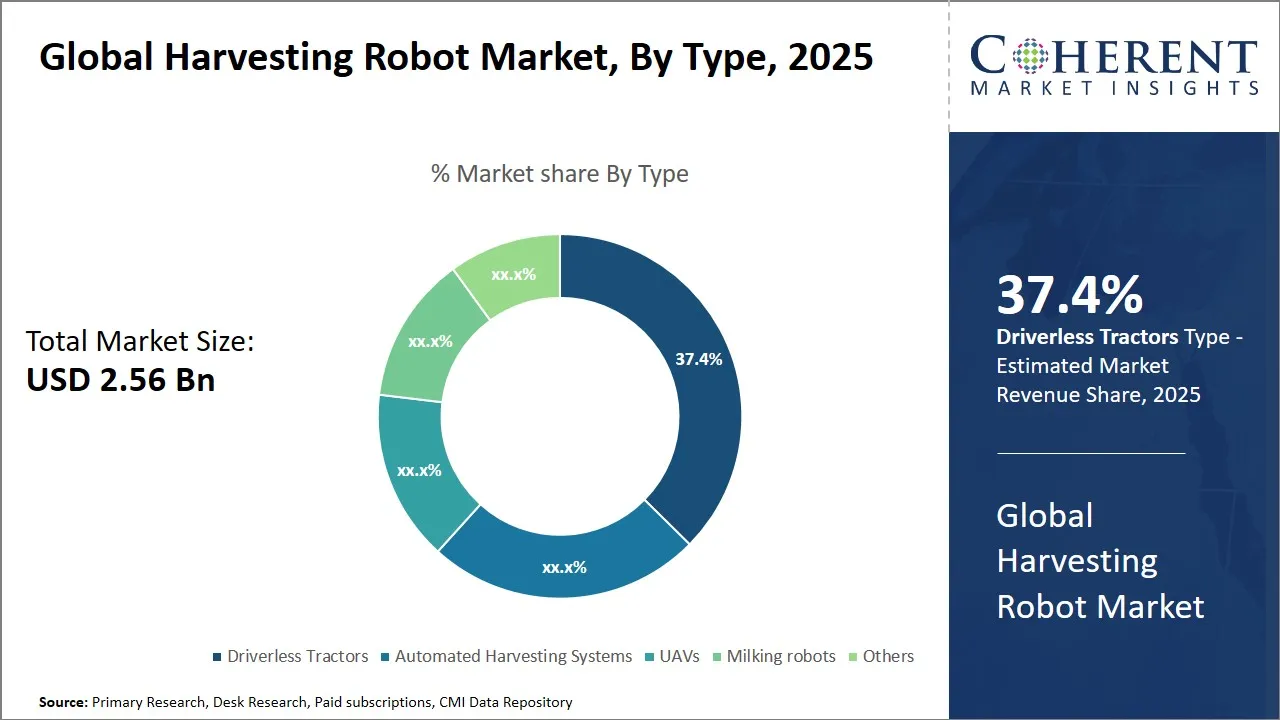
- The driverless tractors segment leads the market holding an estimated share of 38.4 % in 2026.
- The semi-autonomous segment leads the market holding an estimated share of 64.5 % in 2026.
- North America is estimated to lead the market with a share of 35.2 % in 2026.
- Asia Pacific, holding a share of 28.3 % in 2026, is projected to be the fastest growing region.
Market Overview
The market is seeing advancements in AI and machine learning that improve robot precision and adaptability in different crop harvesting. Also, rising investment in sustainable farming and the integration of IoT-enabled sensors are creating demand for smart harvesting robots. These innovations are making possible higher productivity, reducing crop damage, and pushing eco-friendly agricultural practices.
Current Events and Its Impact
Current Events | Description and Impact |
Geopolitical and Trade Developments |
|
Climate and Environmental Regulations |
|
Economic and Infrastructure Trends |
|
Regional Agricultural Expansion |
|
Technological Shifts |
|
Segmental Insights
- Current Industry Events of 2026
- Market Size Estimation
- Regional Breakdown
- Competitive Landscape
- Customer Intelligence
- Segmental Analysis
- Pricing Analysis
- Key Market Drivers, Challenges & Future Trends
- Customized Insights Section
Global Harvesting Robot Market Insights, by Type - Driverless Tractors Contribute the Highest Share of the Market Owing to Advanced Automation and Operational Efficiency
Driverless tractors, holding an estimated share of 38.4% in 2026, have emerged as a dominant segment within the global harvesting robot market. A big factor responsible for the segment's high market share is the use of advanced sensors, GPS technologies, and AI-powered navigation systems that allow these tractors to operate autonomously in different terrains with precision.
Also, driverless tractors add to sustainable farming practices by optimizing resource use such as fuel, seeds, and fertilizers through precise route planning and soil monitoring. This reduces waste and minimizes environmental impact, adding to the global push toward more eco-friendly agricultural methods.
The continuous evolution of autonomous technology and the decreasing costs of hardware components also make these tractors more accessible to small and medium-scale farms. To add, government incentives and subsidies supporting smart agriculture solutions in several key farming economies help farmers invest in driverless tractors to increase output while managing costs efficiently. Lastly, the scalability and adaptability of driverless tractors across various crop types and farming conditions contribute to their dominant market position.
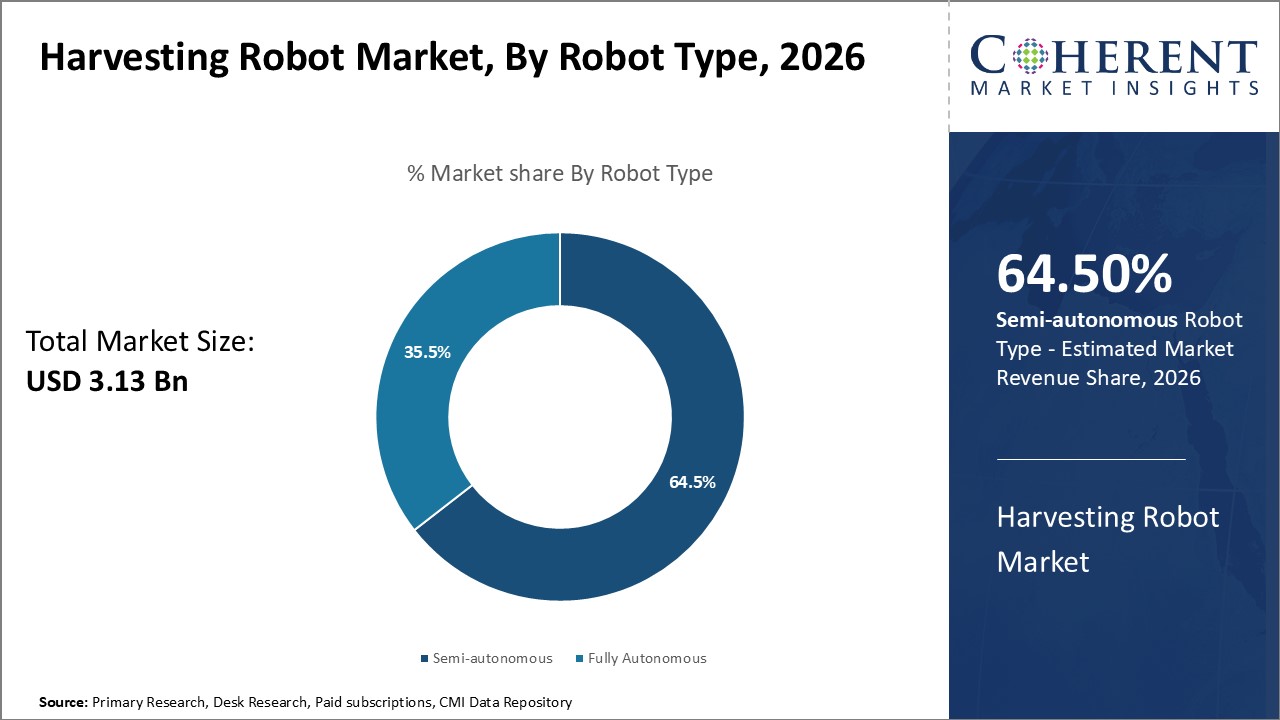
Global Harvesting Robot Market Insights, by Robot Type - Semi-autonomous Systems Lead the Market Due to Balance Between Automation and Human Control
The semi-autonomous segment is expected to command the largest share of 64.5% in 2026. This segment's growth is propelled by farmers’ preference for retaining control over critical farming decisions while leveraging automation to enhance operational efficiency and reduce physical strain.
Semi-autonomous systems provide significant advantages in complex and variable farming environments where certain tasks require human judgment and intervention, such as navigating uneven terrain, handling unexpected obstacles, or managing crop variability. By automating routine tasks like navigation, speed regulation, and basic harvesting functions while allowing farmers to intervene when necessary, these systems enhance both reliability and safety.
Furthermore, semi-autonomous robots are generally more affordable and easier to implement than fully autonomous alternatives, making them attractive to a broader range of agricultural operators, including small to mid-sized farms that may lack the capital or infrastructure to fully embrace full autonomy. The ongoing improvements in human-machine interfaces, including intuitive controls and real-time feedback mechanisms, also support the appeal of semi-autonomous robots. These features enhance operators’ confidence and effectiveness, making the technology more user-friendly and accelerating its adoption.
Impact of AI on the Harvesting Robot Market
Artificial Intelligence (AI) is revolutionizing the harvesting robot market by enabling machines to perform complex, labor-intensive tasks with human-like precision and efficiency. AI-powered robots are increasingly equipped with computer vision, deep learning, and sensor fusion technologies that allow them to identify ripe fruits, avoid damaging crops, and navigate uneven terrain autonomously. These capabilities significantly improve yield quality, reduce harvest losses, and minimize the need for manual intervention, especially in labor-scarce regions. For instance, advanced AI algorithms help distinguish between ripe and unripe produce in real-time, ensuring only optimal fruits are picked—an innovation particularly crucial in soft fruit harvesting where timing and delicacy are key.
Fieldwork Robotics’ raspberry-picking robot uses AI-driven computer vision and soft grippers to autonomously detect and harvest ripe raspberries without bruising them. Initially trialed in the U.K., the robot has demonstrated commercial potential by reducing dependency on seasonal labor and operating efficiently in greenhouse environments.
Regional Insights
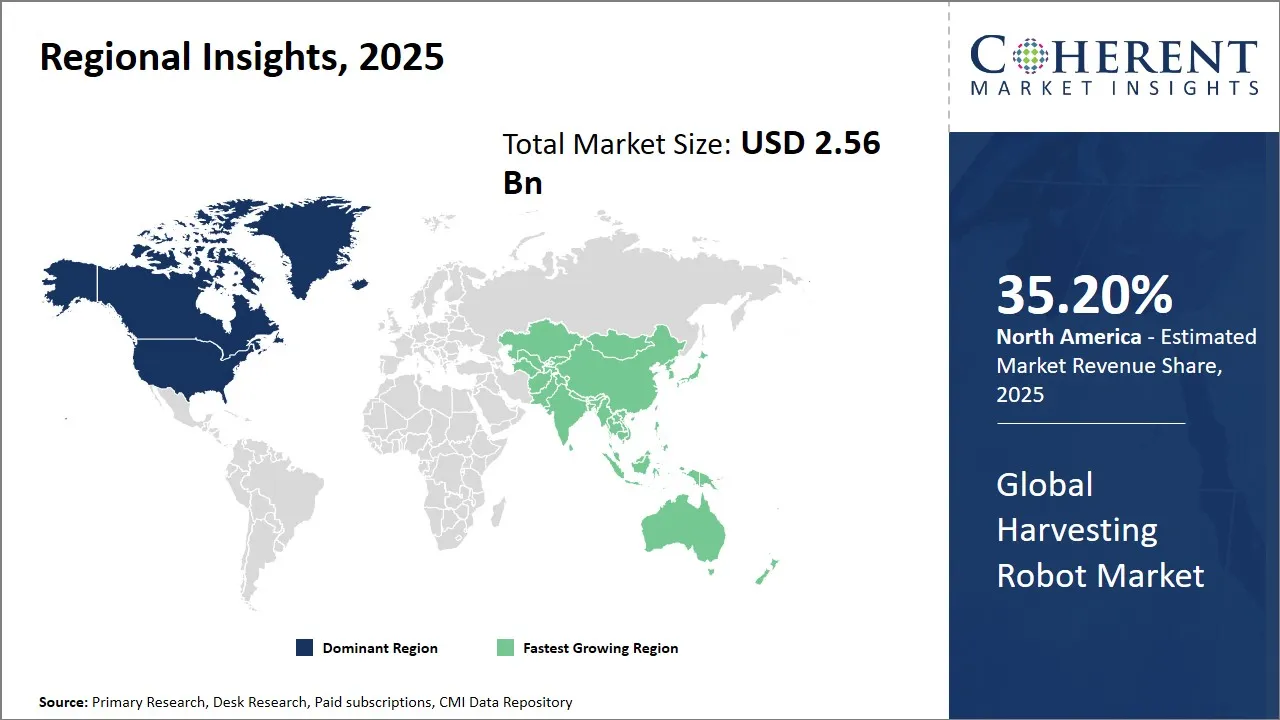
North America Harvesting Robot Market Analysis and Trends
North America, holding a share of 35.2% in 2026, is expected to dominate the global harvesting robot market, stemming from a well-established ecosystem that seamlessly integrates advanced agricultural technologies with robotics innovation. The presence of leading agritech companies, strong venture capital funding, and robust research institutions drives continuous development and adoption of harvesting robots. For instance, Blue River’s See & Spray uses AI and computer vision to detect and differentiate between crops and weeds in real time. While originally applied to pesticide use, the same core technology is being adapted for selective harvesting, particularly in high-value crops like lettuce and broccoli.
U.S. government initiatives focusing on precision agriculture and automation, coupled with subsidies and favorable trade policies, amplify market growth. The region hosts notable players such as John Deere, Harvest CROO Robotics, and Blue River Technology (a Deere subsidiary), which contribute significantly through cutting-edge solutions that enhance productivity and reduce labor dependency.
Asia Pacific Harvesting Robot Market Analysis and Trends
The Asia Pacific region, holding a share of 28.3% in 2026, is expected to exhibit the fastest growth in the harvesting robot market due to the burgeoning demand for automation in agriculture driven by labor shortages, increasing labor costs, and the shift toward sustainable farming practices. Government policies across countries like China, Japan, and Australia promote modernization of agriculture through subsidies, grants, and the establishment of innovation hubs. For instance, Kubota’s X Tractor is a fully autonomous and AI-powered electric tractor designed for precision farming, including harvesting applications. The tractor uses GPS, onboard sensors, and AI to navigate fields, assess crop conditions, and execute tasks like harvesting with minimal human input.
In addition, the region is marked by a dynamic mix of small-scale and commercial farms that seek cost-effective and scalable robotic solutions. Major companies such as Panasonic in Japan, Xiaomi Agricultural Tech, and FFRobotics in China are actively expanding their footprint by tailoring harvesting robot technologies to regional crop varieties and farming conditions. Enhanced trade relations and investments in smart farming infrastructure further accelerate growth.
Global Harvesting Robot Market Outlook for Key Countries
U.S. Harvesting Robot Market Analysis and Trends
The U.S. is characterized by strong integration of AI and machine learning with harvesting robots, thanks to leading technology firms like John Deere and startups such as Harvest CROO Robotics. These companies emphasize developing autonomous systems for fruit and vegetable harvesting, addressing labor shortages. Supportive USDA programs and partnerships between academia and industry foster innovation and deployment, positioning the U.S. as a technological leader in automated harvesting solutions.
China Harvesting Robot Market Analysis and Trends
China is rapidly expanding its harvesting robot market under government initiatives aimed at modernizing the vast agricultural sector. Companies like FFRobotics and XAG Technology are developing robots tailored for rice, fruit, and vegetable harvesting, leveraging AI and IoT connectivity. Large-scale government investments and programs such as "Smart Agriculture" promote adoption among both industrial farms and cooperatives, while domestic manufacturing drives cost-competitive innovations suitable for diverse crop types.
Japan Harvesting Robot Market Analysis and Trends
Japan continues to lead in precision harvesting robot technology with a focus on labor-saving innovations suited for high-value crops such as berries and leafy greens. Panasonic and Kubota are noteworthy contributors, integrating robotics with sensor technology and autonomous navigation. The country's aging farming population and government subsidies targeting technology-driven farming solutions underpin strong market demand and rapid implementation of sophisticated harvesting robots.
India Harvesting Robot Market Analysis and Trends
India's harvesting robot market is emerging, fueled by the need to address labor scarcity and improve operational efficiency in agriculture. Though adoption is currently limited, initiatives by companies like TartanSense and CropIn emphasize deploying affordable robots tailored for small and medium-scale farms growing diverse crops. Government programs supporting digital agriculture and rural innovation ecosystems encourage pilot projects and partnerships, which are slowly expanding market acceptance.
Australia Harvesting Robot Market Analysis and Trends
Australia harvesting robot market benefits from large-scale farming operations and a strong emphasis on precision agriculture to optimize yields and conserve resources. Companies such as Agerris and SwarmFarm Robotics specialize in versatile robotic platforms capable of harvesting a variety of crops under diverse climatic conditions. Backed by government innovation grants and export-oriented agritech clusters, the country fosters rapid development and commercialization of harvesting robots suited for grazing and broad-acre cropping systems.
Market Players, Key Development, and Competitive Intelligence
Key Developments
- In August 2024, Solinftec, a global leader in artificial intelligence solutions and sustainable agricultural practices, announced its newest development in the field of agricultural robotics: the docking station. This new development allows Solix Ag Robotics to operate 100% autonomously throughout the season, without the need for a manual refill.
- In June 2024, France-based company, SIZA Robotics, launched its commercial pre-series of an autonomous robot for vegetable and beet crops, named TOOGO
- In August 2023, harvesting robot developer, Fieldwork Robotics, secured USD 1.98 million (€1.7 million) from Elbow Beach Capital, a decarbonization, sustainability and social impact investor. Family office Frontier IP, and other existing investors also followed on in this round. Initially focusing on soft fruits, such as raspberries, Fieldwork Robotics has developed advanced, AI-supported harvesting robots to help solve the problem of worker shortages, increase farm efficiency and reduce food wastage in the U.K. and beyond.
- In June 2022, Apex.AI, a company developing safety-certified software for mobility and autonomous applications, announced that AGCO added new capabilities to Fendt Xaver, its autonomous farming robot concept, using Apex.OS, an easy-to-use software development kit (SDK).
Top Strategies Followed by Harvesting Robot Market Players
- Established players, often industry giants, heavily invest in research and development to innovate and introduce high-performance, efficient, and reliable harvesting robots. Their R&D efforts focus on enhancing automation, precision, and adaptability of their products to meet the evolving needs of diverse agricultural environments.
- John Deere invested in the integration of AI and robotics through its acquisition of Blue River Technology, enabling advanced vision systems in autonomous harvesting and spraying machinery.
- Mid-level players in the harvesting robot market primarily focus on delivering cost-effective solutions that strike a balance between quality and affordability. Targeting price-sensitive consumers—especially small to medium-sized farms in developing economies—these companies tailor their product offerings to meet essential functionality requirements without the premium pricing associated with high-end models.
- Agrobot (Spain/Global) developed affordable strawberry-picking robots that can be scaled across medium-sized farms, especially targeting markets in Latin America and Southeast Asia.
- Small-scale players, typically startups or niche manufacturers, carve out their market presence by focusing on specialized features or innovative product designs that address very specific agricultural challenges. By leveraging cutting-edge technologies such as AI-driven monitoring systems, advanced sensors, or modular robotic components, these companies differentiate themselves in a crowded marketplace.
- Fieldwork Robotics (UK) specializes in AI-powered raspberry-picking robots, uniquely tailored for delicate fruit harvesting in greenhouses and vertical farming.
Market Report Scope
Harvesting Robot Market Report Coverage
| Report Coverage | Details | ||
|---|---|---|---|
| Base Year: | 2025 | Market Size in 2026: | USD 3.13 Bn |
| Historical Data for: | 2020 To 2024 | Forecast Period: | 2026 To 2033 |
| Forecast Period 2026 to 2033 CAGR: | 22.3% | 2033 Value Projection: | USD 12.81 Bn |
| Geographies covered: |
| ||
| Segments covered: |
| ||
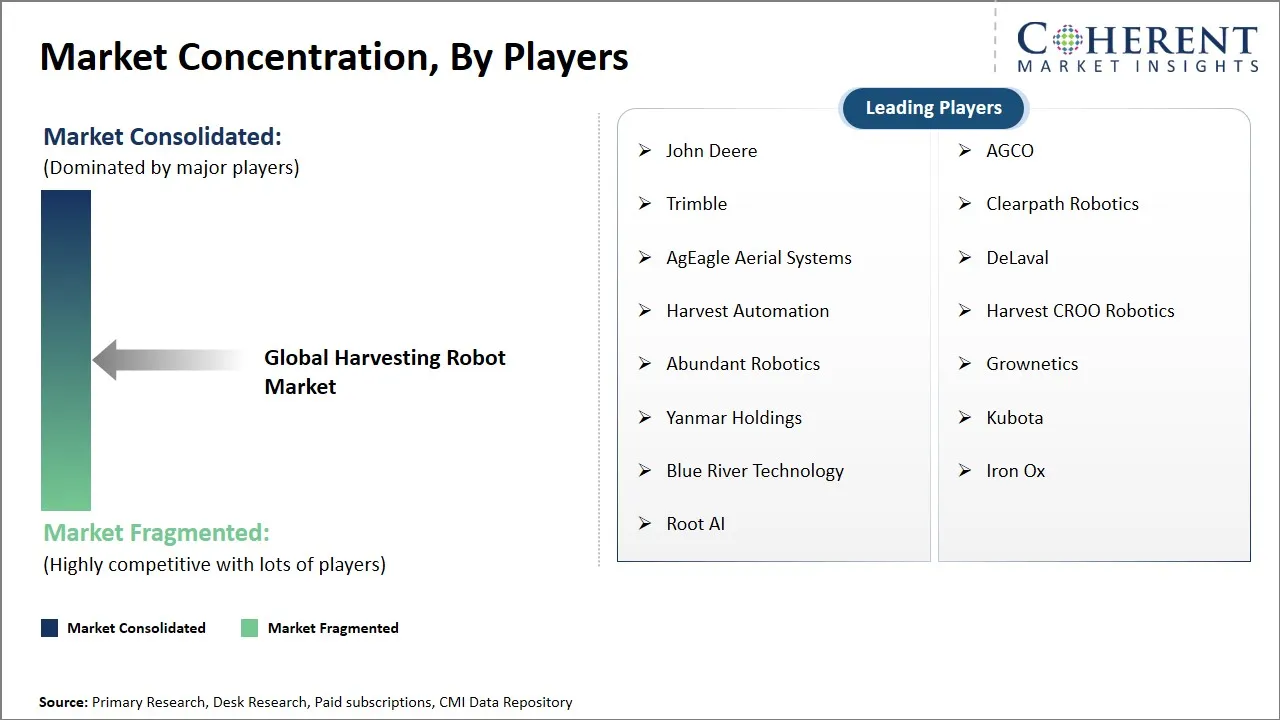
| Companies covered: | John Deere, AGCO, Trimble, Clearpath Robotics, AgEagle Aerial Systems, DeLaval, Harvest Automation, Harvest CROO Robotics, Abundant Robotics, Grownetics, Yanmar Holdings, Kubota, Blue River Technology, Iron Ox, and Root AI | ||
| Growth Drivers: |
| ||
| Restraints & Challenges: |
| ||
Market Dynamics
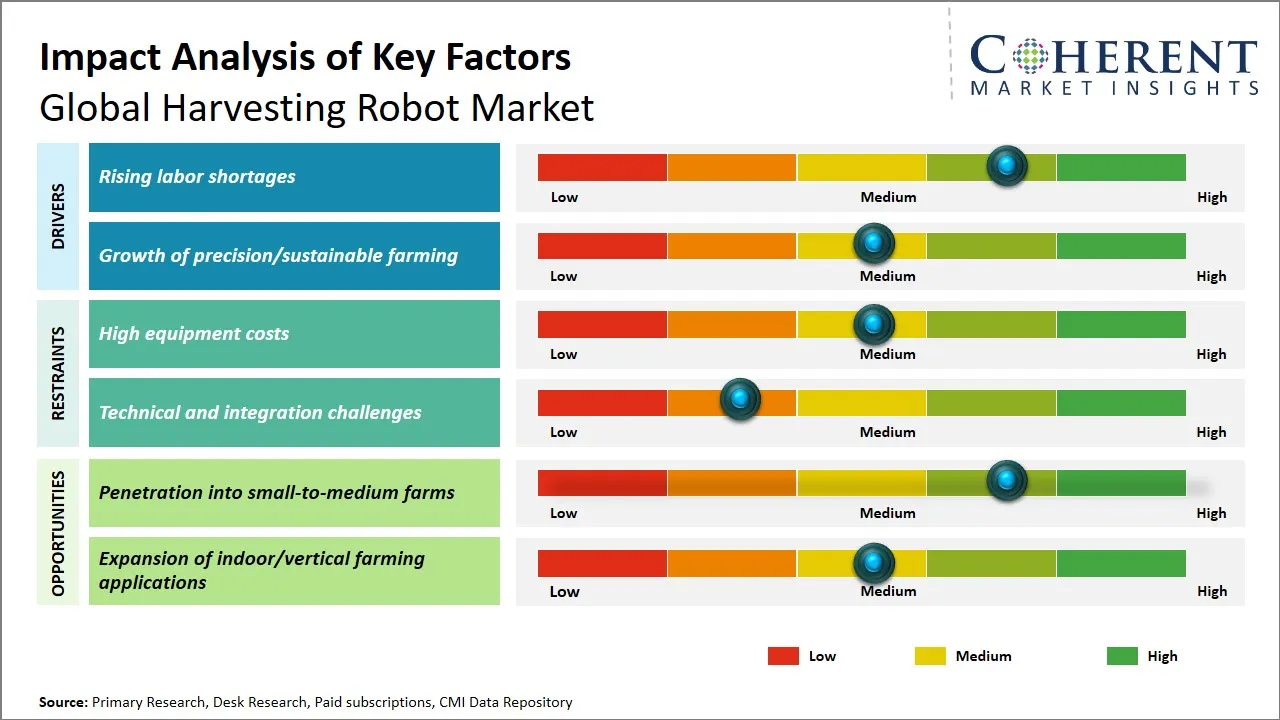
Global Harvesting Robot Market Driver - Rising Labor Shortages
Many farms, especially those dependent on seasonal and manual labor, face chronic difficulties in recruiting and retaining workers due to factors like urban migration, aging workforce, and increasing wage demands. This scarcity of farm labor disrupts timely harvesting, causing considerable crop losses and impacting overall operational efficiency.
Harvesting robots offer a practical solution by delivering consistent performance irrespective of labor market fluctuations, ensuring that crops are picked promptly and reducing dependency on human workers. Companies like Abundant Robotics (before its IP acquisition) and Advanced.Farm have deployed robotic apple and strawberry pickers to reduce reliance on seasonal labor. These robots operate with minimal human intervention, directly addressing labor scarcity while maintaining harvest efficiency. Additionally, these robots help alleviate the challenges posed by labor costs and stringent immigration policies affecting farmworkers.
Global Harvesting Robot Market Opportunity – Penetration into Small-to-Medium Farms for Market Expansion
Historically, harvesting robots have been primarily adopted by large-scale agricultural operations due to the high upfront costs and technological complexities involved. However, advancements in automation technology, coupled with decreasing production costs, are enabling the development of more affordable and scalable robotic solutions tailored for smaller farms. Small-to-medium farms, which constitute a majority of global agricultural producers, often face challenges related to labor shortages, rising operational costs, and the need for increased efficiency to remain competitive.
Harvesting robots designed with adaptability and ease of use can address these pain points by automating labor-intensive tasks such as picking, sorting, and packaging across a variety of crops, thereby enhancing productivity and reducing reliance on seasonal labor. Iron Ox, a U.S.-based agri-robotics company, is developing compact, modular harvesting systems designed specifically for indoor and small-scale farms. Moreover, government initiatives and subsidies aimed at modernizing agriculture in developing regions are further incentivizing medium and small-scale farmers to adopt robotic technologies.
Analyst Opinion (Expert Opinion)
- Emerging technologies in AI and computer vision are redefining precision harvesting. Real-time fruit detection, ripeness analysis, and adaptive gripper control are enabling robots to handle delicate crops like berries and tomatoes with unprecedented accuracy—reducing post-harvest losses and manual oversight.
- Innovations in compact, lightweight robotic platforms are making harvesting automation viable for small and medium-sized farms. Companies are shifting from bulky, capital-heavy machines to modular units that offer flexibility, scalability, and affordability—unlocking a large underserved market segment globally.
- With rising environmental regulations and fuel costs, energy-efficient harvesting robots—powered by electric or solar systems—are gaining traction. These platforms not only reduce emissions but also enable continuous, autonomous operation, particularly suited for controlled environments and remote fields.
Speak to the analyst
Want personalized insights?
Take the findings above to one of our principal consultants, or have the report rebuilt around the segments, geographies and competitors you actually track.
Market Segmentation
- Type Insights (Revenue, USD Bn, 2021 - 2033)
- Driverless Tractors
- Automated Harvesting Systems
- UAVs
- Milking robots
- Others
- Robot Type Insights (Revenue, USD Bn, 2021 - 2033)
- Semi-autonomous
- Fully Autonomous
- Regional Insights (Revenue, USD Bn, 2021 - 2033)
- North America
- U.S.
- Canada
- Latin America
- Brazil
- Argentina
- Mexico
- Rest of Latin America
- Europe
- Germany
- U.K.
- Spain
- France
- Italy
- Russia
- Rest of Europe
- Asia Pacific
- China
- India
- Japan
- Australia
- South Korea
- ASEAN
- Rest of Asia Pacific
- Middle East
- GCC Countries
- Israel
- Rest of Middle East
- Africa
- South Africa
- North Africa
- Central Africa
- North America
- Key Players Insights
- John Deere
- AGCO
- Trimble
- Clearpath Robotics
- AgEagle Aerial Systems
- DeLaval
- Harvest Automation
- Harvest CROO Robotics
- Abundant Robotics
- Grownetics
- Yanmar Holdings
- Kubota
- Blue River Technology
- Iron Ox
- Root AI
Sources
Primary Research Interviews
Stakeholders
- Agri-Tech Companies and Automation Startups (e.g., Product Engineers, CTOs)
- Robotics Component Manufacturers (e.g., Sensor and Vision System Suppliers)
- Commercial Growers and Horticulture Farmers (e.g., Fruit & Vegetable Farm Operators)
- Agricultural Equipment Dealers and Distributors
- Greenhouse Technology Integrators and Controlled Environment Agriculture Experts
- Precision Farming Consultants and Digital Agriculture Specialists
Databases
- Farm Equipment Technology Archive (FETA)
- Global Agricultural Robotics Consortium (GARC)
- Asian Smart Farming Index (ASFI)
- National Center for Agricultural Intelligence (NCAI)
Magazines
- AgTech Innovator
- Future Farming & Robotics Digest
- Smart Agriculture Today
- Harvest Robotics Monthly
Journals
- Journal of Precision Agriculture & Automation
- International Journal of Smart Farming Technologies
- Journal of Agricultural Robotics and AI Integration
- Advances in Agri-Mechatronics
Newspapers
- The AgTech Times
- FarmTech News Network
- Harvesting Today India
- North America Ag Robotics Daily
Associations
- Global Agricultural Robotics Alliance (GARA)
- International Federation for Automated Farming (IFAF)
- Asia-Pacific AgriTech Council (APACATC)
- North American Association of Smart Farming (NAASF)
- Robotics in Agriculture Society (RAS)
Public Domain Sources
- U.S. Census Bureau
- EUROSTAT
- United Nations Food and Agriculture Organization (FAO)
- World Bank
- ResearchGate
Proprietary Elements
- CMI Data Analytics Tool, Proprietary CMI Existing Repository of Information for Last 8 Years
Get access to 250+ pages report
Every segment, forecast, competitor profile and data table behind the analysis above — available for instant download.
- ESOMAR Member
- ISO 9001:2015 Certified
- D-U-N-S Registered
- GDPR & CCPA Compliant
Missing comfort of reading report in your local language? Find your preferred language:
Transform your Strategy with Exclusive Trending Reports
Frequently Asked Questions
The global harvesting robot market is estimated to be valued at USD 3.13 billion in 2026 and is expected to reach USD 12.81 billion by 2033.
The CAGR of global harvesting robot market is projected to be 22.3% from 2026 to 2033.
Rising labor shortages and growth of precision/sustainable farming are the major factors driving the growth of the global harvesting robot market.
High equipment costs and technical and integration challenges are the major factors hampering the growth of the global harvesting robot market.
In terms of type, driverless tractors are estimated to dominate the market revenue share in 2026.
Robotic harvesting is best suited for high-value, labor-intensive crops like strawberries, apples, tomatoes, lettuce, grapes, and cucumbers. These crops require precision picking and are often grown in environments—like greenhouses or orchards—where automation can be effectively deployed.
Harvesting robots commonly use RGB cameras, LiDAR, hyperspectral sensors, ultrasonic sensors, and infrared sensors. These enable fruit detection, ripeness analysis, obstacle avoidance, and spatial mapping for accurate and damage-free harvesting.