

Global Smart Workplace Market Size and Forecast — 2026-2033
The Global Smart Workplace Market size is estimated to be valued at USD 42.74 billion in 2026 and is expected to reach USD 98.69 billion by 2033, exhibiting a compound annual growth rate (CAGR) of 12.7% from 2026 to 2033.
Overview
Smart workplace products encompass integrated technologies designed to enhance productivity, safety, and comfort in office environments. Core product categories include IoT-enabled lighting, smart HVAC systems, occupancy sensors, digital signage, and wireless collaboration tools. These systems interconnect through centralized platforms that collect and analyze workplace data for energy optimization and space management.
Smart desks, AI-driven environmental controls, and cloud-based communication hubs support hybrid work and flexible scheduling.
Key Takeaways
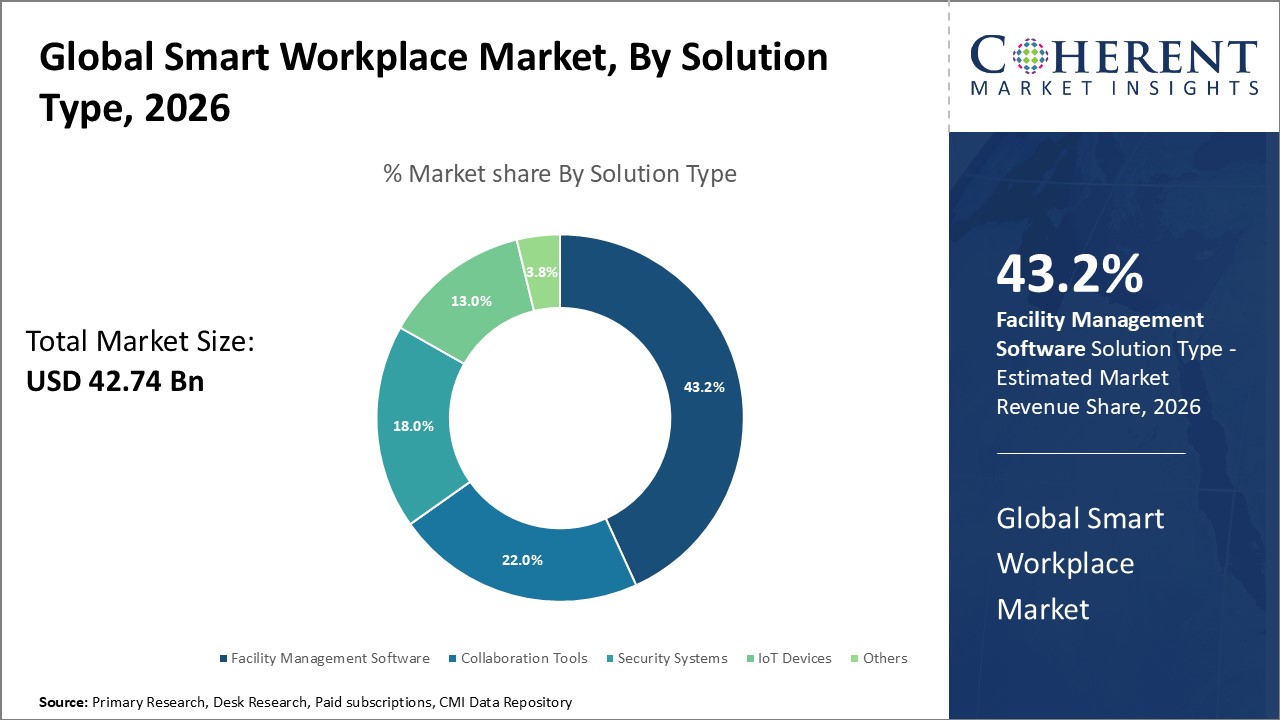
Early evidence suggests facility management software dominates solution-based growth, offering approximately 43.2% of the market share by facilitating automated building operations.
Cloud-based deployment is rapidly gaining traction due to scalability advantages, with hybrid cloud models enabling flexible adoption.
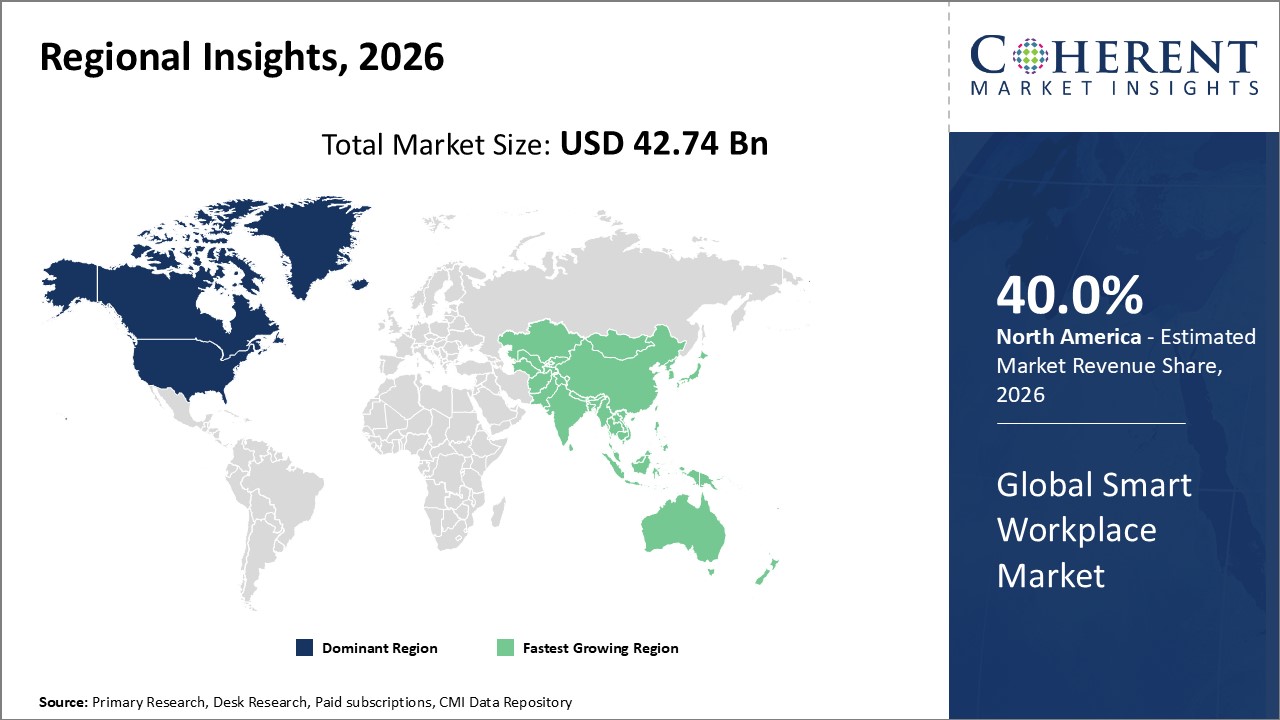
Geographically, North America remains the dominant region, commanding over 40% market share due to strong tech infrastructure and regulatory support for smart building initiatives.
Meanwhile, Asia Pacific emerges as the fastest-growing region, exhibiting a CAGR above 14% propelled by rapid urbanization and government-backed smart city projects in China and India.
Global Smart Workplace Market Segmentation Analysis
Global Smart Workplace Market Insights, By Solution Type
Facility Management Software dominates the market share, commanding approximately 43.2%. This segment benefits from the high demand for automated building operations, energy optimization, and integration of multiple workplace functions into centralized platforms. For example, Fortune 500 companies have accelerated deployments, driving segment revenue growth due to facility management’s capacity to lower operational costs. Collaboration Tools represent the fastest-growing subsegment, fueled by the hybrid work model’s permanence, pushing investments in cloud-based conferencing, virtual meeting rooms, and digital whiteboards.
Global Smart Workplace Market Insights, By Deployment Mode
Cloud-based solutions have captured growing market share thanks to their scalability, ease of updates, and lower upfront cost, positioning them as the dominating segment. Many enterprises report improved agility and reduced IT overhead by embracing cloud deployments, which accelerates their adoption rate. The Hybrid deployment mode is the fastest-growing segment, blending on-premise control with cloud flexibility to meet diverse organizational requirements and security policies. On-premise solutions maintain relevance primarily in regulated industries requiring stringent data controls.
Global Smart Workplace Market Insights, By End-User Industry
IT & Telecom dominate this segment, driven by the sector’s intrinsic reliance on digital collaboration and networked workplace infrastructure. Companies in this vertical are early adopters of smart workplace solutions, leveraging them to support dispersed teams and complex operational needs. The Healthcare segment is the fastest-growing due to increasing demands for asset tracking, sanitation monitoring, and remote patient care systems enabled by smart workplace innovations.
Global Smart Workplace Market Trends
Recent market trends in the smart workplace space include a marked pivot towards AI-enabled automation and seamless hybrid collaboration tools.
For example, workplace AI assistants facilitating scheduling and space booking increased adoption by 29% among Fortune 100 companies in early 2026.
Sustainability remains central, with smart energy management solutions enabling companies to reduce carbon footprints in alignment with global climate goals.
Global Smart Workplace Market Insights, By Geography
North America Global Smart Workplace Market Analysis and Trends
In North America, the dominance in the Global Smart Workplace Market is primarily driven by robust IT infrastructure, significant corporate investments, and progressive regulatory frameworks for smart buildings. This region accounts for over 40% of the market share, with the United States as the largest contributor. Notable players such as Microsoft and Cisco have leveraged advanced technologies and partnerships to expand smart workplace adoption in commercial real estate and technology-driven sectors.
Asia Pacific Global Smart Workplace Market Analysis and Trends
Meanwhile, the Asia Pacific exhibits the fastest growth with a CAGR exceeding 14% due to rapid urbanization, government smart city initiatives, and increasing awareness of employee well-being. China and India lead this surge with aggressive adoption of IoT and AI-driven workplace solutions. This expansion is complemented by local companies adapting cost-effective smart workplace systems tailored to emerging market needs.
Global Smart Workplace Market Outlook for Key Countries
USA Global Smart Workplace Market Analysis and Trends
The U.S. market is characterized by large-scale digital transformation efforts across enterprises and government sectors, which fuel the continuous adoption of smart workplace technologies. In 2025, the maturity of cloud infrastructure and AI-enabled solutions led to a 25% increase in market revenue. Leading companies such as IBM and Johnson Controls invested heavily in R&D to develop predictive analytics and energy-smart integrations, reinforcing the U.S. position as a global innovation hub.
China Global Smart Workplace Market Analysis and Trends
China’s smart workplace market benefits from active government policies promoting smart city projects and infrastructure modernization. Local firms, alongside multinational corporations, propelled the market through tailored IoT solutions and collaboration platforms, driving a market share of approximately 18%. Investments by technology giants and rapid tech adoption rates contributed to over 15% year-over-year growth in enterprise deployments during 2026.
Analyst Opinion
Rising demand-side indicators highlight the expansion of smart workspace adoption across multiple industries. Corporate real estate investments surged by 16% in 2025, reflecting strategic moves to retrofit facilities with IoT-enabled solutions. For instance, Fortune 500 companies in the financial sector increased their spend on occupancy sensors and smart conferencing tools by over 21% year-over-year, underscoring the growing market revenue driven by enhanced user experience.
Supply-side analysis shows a robust rise in the production capacity of smart workplace hardware, including sensor devices and smart lighting systems. In 2026, manufacturing output for these components grew at an annual rate of 19%, driven by advancements in semiconductor technologies and energy-efficient materials. These improvements help reduce costs and facilitate widespread deployment, directly influencing market size.
Pricing trends suggest increased competitiveness, with average selling prices (ASP) for integrated workplace management systems declining by approximately 9% between 2023 and 2026. This drop stems from scale economies and software-as-a-service (SaaS) subscription models, which lower entry barriers for medium-sized enterprises, thereby broadening the market scope and fueling industry share growth.
Export dynamics also impact market growth strategies; for example, the Asia Pacific region's exports of smart workplace components to North America increased by 22% in 2025. This trade flux enhances cross-regional technology diffusion and capitalizes on regional strengths, strengthening market analysis related to global supply chains and competitive landscapes.
- Current Industry Events of 2026
- Market Size Estimation
- Regional Breakdown
- Competitive Landscape
- Customer Intelligence
- Segmental Analysis
- Pricing Analysis
- Key Market Drivers, Challenges & Future Trends
- Customized Insights Section
Market Scope
| Report Coverage | Details | ||
|---|---|---|---|
| Base Year: | 2025 | Market Size in 2026: | USD 42.74 billion |
| Historical Data for: | 2020 To 2024 | Forecast Period: | 2026 To 2033 |
| Forecast Period 2026 to 2033 CAGR: | 12.7% | 2033 Value Projection: | USD 98.69 billion |
| Geographies covered: |
| ||
| Segments covered: |
| ||
| Companies covered: | Siemens AG, Honeywell International Inc., Cisco Systems, Johnson Controls International, Schneider Electric SE, Microsoft Corporation, IBM Corporation, ABB Ltd., Cisco Meraki, Salesforce, Google LLC, SAP SE. | ||
| Growth Drivers: |
| ||
Global Smart Workplace Market Growth Factors
The accelerating adoption of hybrid work models drives smart workplace investments, as organizations seek seamless collaboration tools and flexible office management solutions. In 2025, hybrid work technologies witnessed a 30% growth in deployment across multinational corporations. Increased regulatory pressure for sustainable buildings propels demand for energy-efficient smart workplace systems, with LEED-certified buildings integrating smart energy monitoring devices rising by 22% worldwide. Advancements in AI and machine learning improve predictive maintenance and space utilization analytics, reducing operational costs by up to 15% for early adopters in 2026. Moreover, employee well-being gaining strategic importance fuels demand for smart environmental controls and wellness monitoring, which companies reported as reducing absenteeism rates by 10% on average.
Global Smart Workplace Market Development
In February 2025, Huawei Technologies Co., Ltd. launched its new smart office product series, including the flagship collaborative display/interface IdeaHub ES2 Plus and the large-format IdeaPresence LED display, aimed at enhancing enterprise collaboration and communication. The IdeaHub ES2 Plus was unveiled at MWC Barcelona and features video, audio, and connectivity upgrades: an intelligent triple-lens camera system (“Galileo’s Eyes”), 12-meter sound pickup with noise cancellation, dual-mirroring and control from personal devices, 4K60 video support, and BYOM (Bring Your Own Meeting) capabilities.
In May 2026, Schneider Electric announced a partnership with Google Cloud to integrate Google Workspace with its EcoStruxure platform. This collaboration allows employees and facility managers to gain better access to building data and analytics directly within their Google Workspace applications, aiming to improve efficiency and sustainability.
Key Players
Key market players include Siemens AG, Honeywell International Inc., Cisco Systems, Johnson Controls International, Schneider Electric SE, Microsoft Corporation, IBM Corporation, ABB Ltd., Cisco Meraki, Salesforce, Google LLC, and SAP SE.
Competitive strategies prominently observed among these companies involve strategic partnerships and acquisitions. For instance, Johnson Controls’ acquisition of a leading IoT startup in 2025 enhanced its smart building portfolio, resulting in a 26% increase in contract wins in commercial real estate. Cisco Systems’ integration of AI-driven analytics within its collaboration platforms improved customer retention by 19% in 2026, emphasizing how market players leverage innovation to consolidate market share
Global Smart Workplace Market Future Outlook
In the future, smart workplace technologies will evolve toward hyper-personalized, data-driven ecosystems. Artificial intelligence will optimize energy use, workspace allocation, and employee comfort in real time. Integration with wearable tech and biometric sensors will further enhance health and productivity monitoring. The fusion of digital twins, 5G, and AR/VR collaboration tools will enable immersive hybrid environments. Sustainability and wellness-focused designs will dominate product innovation, with smart workplaces increasingly serving as testbeds for net-zero building concepts and next-gen corporate experience management.
Global Smart Workplace Market Historical Analysis
The smart workplace market emerged in the mid-2010s as organizations began integrating IoT and automation technologies to enhance operational efficiency. Early adoption centered around smart lightingand HVAC systems, evolving into fully connected ecosystems that manage energy, occupancy, and collaboration. By 2023, widespread deployment of cloud-based management systems, employee well-being tools, and AI-powered analytics had redefined corporate infrastructure globally.
Sources
Primary Research Interviews:
Facility Managers
HR Directors
IoT Solution Architects
Corporate IT Managers
Databases:
BSRIA Building Data
Magazines:
Smart Buildings Magazine
Work Design Magazine
Fast Company
Wired
Journals:
Journal of Corporate Real Estate
Building and Environment
Facilities Journal
Computers in Industry
Newspapers:
The Guardian (Business)
The Wall Street Journal (Workplace)
The Hindu (Tech)
Business Standard (Corporate)
Associations:
International Facility Management Association (IFMA)
Building Owners and Managers Association (BOMA)
IoT World Alliance
WELL Building Institute
Get access to 250+ pages report
Every segment, forecast, competitor profile and data table behind the analysis above — available for instant download.
- ESOMAR Member
- ISO 9001:2015 Certified
- D-U-N-S Registered
- GDPR & CCPA Compliant
Missing comfort of reading report in your local language? Find your preferred language:
Transform your Strategy with Exclusive Trending Reports
Frequently Asked Questions
Major market companies include Siemens AG, Honeywell International, Cisco Systems, and Johnson Controls, which lead through a combination of technology innovation and market expansion strategies.
The market size is projected to reach USD 98.69 billion by 2033 from USD 42.74 billion in 2026, maintaining a CAGR of approximately 12.7%.
The IT & Telecom sector offers the largest growth opportunity, driven by the demand for advanced collaboration and security solutions amid hybrid work trends.
Market trends will emphasize AI integration, environmental sustainability, and cybersecurity, alongside increased adoption of cloud-based and hybrid deployment models.
The market is highly competitive with innovation-driven competition and consolidation activities; challenges include data privacy concerns and interoperability issues.
Market players commonly adopt strategic partnerships, mergers and acquisitions, and technology collaborations to enhance product portfolios and expand market reach.