

Cooling Towers Market Size and Forecast
The global cooling towers market is estimated to be valued at USD 3.84 Bn in 2026 and is expected to reach USD 5.63 Bn by 2033, exhibiting a compound annual growth rate (CAGR) of 5.6% from 2025 to 2032.
Key Takeaways
- By Product type, the Open Cooling Tower segment is expected to contribute 59.8% of the market share in 2026 owing to its strength and durability.
- By Heat Transfer Method, the Evaporative Cooling segment is expected to contribute 42.6% of the market share in 2026 owing to its high efficiency in heat transfer.
- By Application, the Manufacturing Industry segment is expected to contribute 53.2% share of the market in 2026 owing to cooling towers' crucial role in various production processes.
- By Region, North America acquires the prominent market share of 41.6% in 2026 owing to industrial & power‑generation expansion.
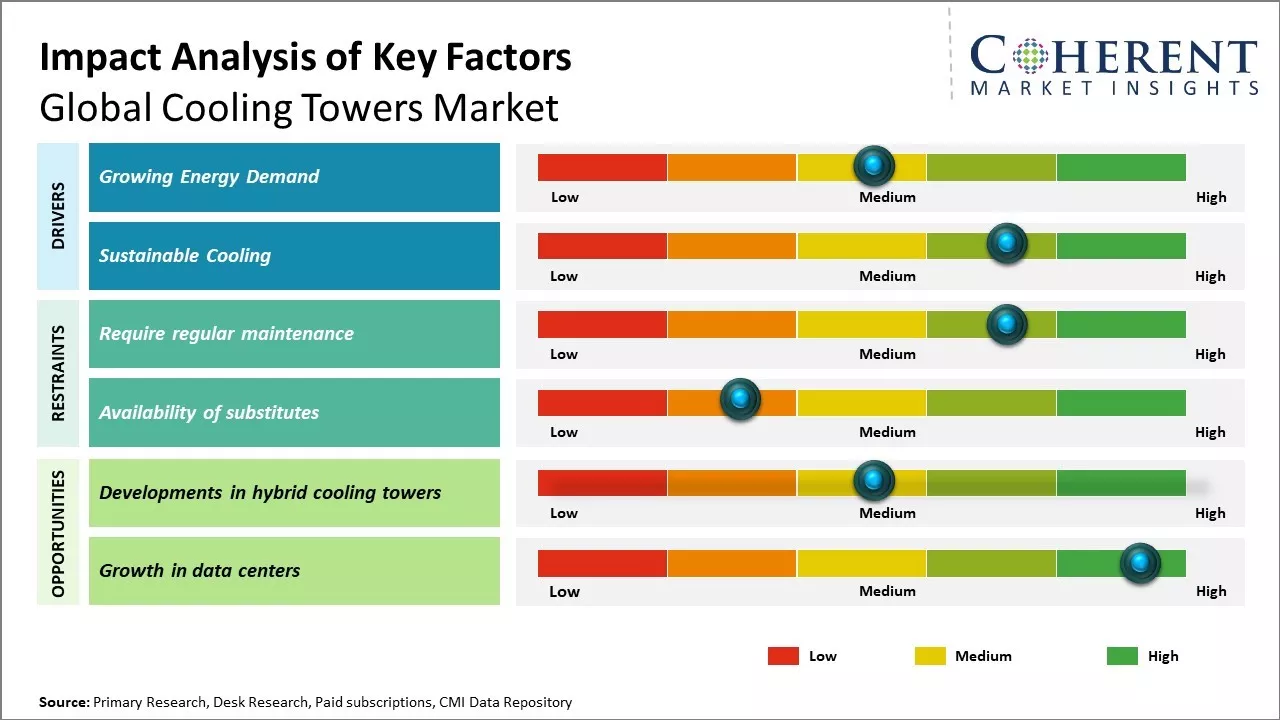
Market Overview
The rising demand for energy efficient cooling systems from industries like oil & gas, metal manufacturing, pharmaceuticals, etc. is driving the cooling towers market demand. Additionally, rapid industrialization and urbanization in developing countries have significantly increased the requirement for efficient cooling systems. Also, advancements in designs to develop more eco-friendly and sustainable cooling towers will provide new opportunities for manufacturers.
Current Events and their Impact on the Cooling Towers Market
Current Events | Description and its impact |
Regulatory Policy Shifts |
|
Extreme Weather Events |
|
Supply Chain and Industrial Dynamics |
|
End-user Feedback and Unmet Needs in the Cooling Towers Market
End-user Feedback and Unmet Needs
- Demand for Water-Efficient Solutions: End-users are actively raising concerns about excessive water consumption, particularly in water-scarce regions. They are seeking cooling tower systems that incorporate efficient water reuse, advanced drift eliminators, and lower blowdown rates. This highlights a significant gap in the availability of affordable, widely accessible water-saving technologies for industrial and commercial use.
- Need for Lower Maintenance and Downtime: Users frequently experience high maintenance expenses and unexpected downtime. They are calling for systems built with corrosion-resistant materials, improved filtration, and self-cleaning capabilities. Many emphasize the urgent need for durable, low-maintenance cooling towers that can operate continuously in critical infrastructure and process-intensive environments.
- Lack of Smart Integration and Real-Time Monitoring: Users in mid-tier and developing facilities are struggling to adopt smart cooling tower technologies due to cost and complexity. They actively seek real-time monitoring, remote diagnostics, and predictive maintenance tools to reduce manual checks. However, most smart solutions on the market remain unaffordable or difficult to implement for smaller operators.
- Current Industry Events of 2026
- Market Size Estimation
- Regional Breakdown
- Competitive Landscape
- Customer Intelligence
- Segmental Analysis
- Pricing Analysis
- Key Market Drivers, Challenges & Future Trends
- Customized Insights Section
Import Export of Cooling Towers
Between October 2023 and September 2024 (TTM), India exported 2,649 shipments of cooling towers. These exports involved 508 Indian exporters and reached 975 international buyers, reflecting an 8% increase compared to the previous 12-month period.
In September 2024 alone, India recorded 253 cooling tower export shipments. This represents a 4% year-on-year increase from September 2023 and a 19% rise compared to August 2024.
Segmental Insights
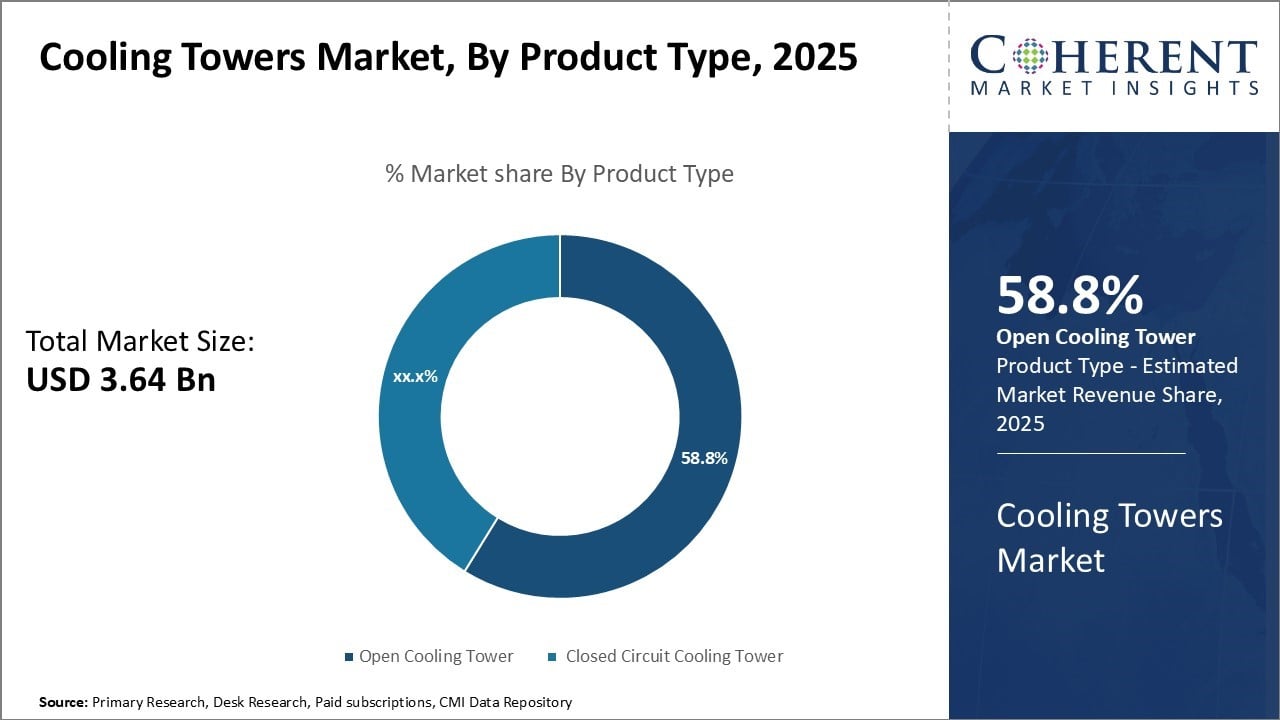
Cooling Towers Market Insights, by Product Type
Open Cooling Tower contributes the highest share of the market owing to its robust thermal performance & durability
The open cooling tower segment is expected to contribute 59.8% of the market share in 2026. Open cooling towers offer robust construction able to withstand varied climatic conditions without impairment to performance. Their open design allows for higher heat dissipation compared to enclosed towers. This ability to handle heavy duty applications like power generation and petrochemical plants boosts their popularity. Open towers are also preferred where space is not a constraint as they have a smaller footprint. Being more straightforward in design, open towers tend to have lower maintenance needs. Their long operational lifespan and resistance to corrosion keeps operating costs low over extended usage. In March 2025, Tower Tech Inc., a member of the Creative Composites Group, announced the expansion of its modular cooling tower product line by introducing closed-circuit models alongside its existing open-circuit options.
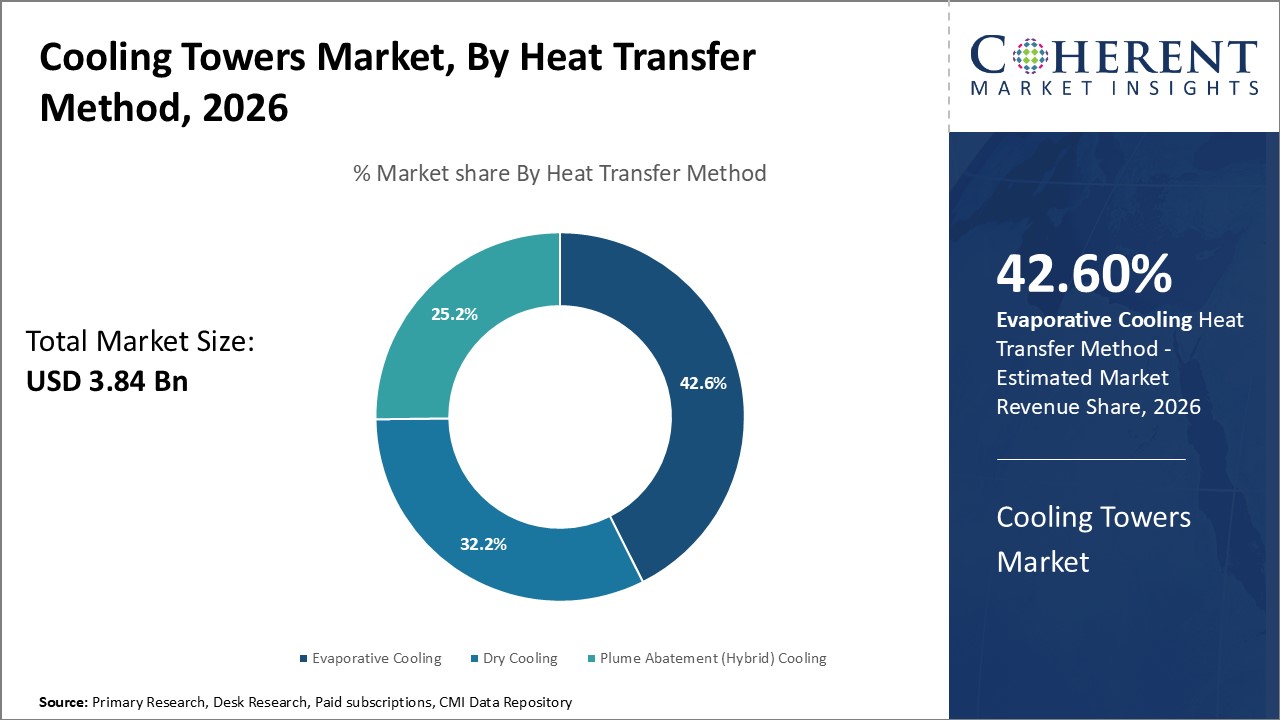
Cooling Towers Market Insights, by Heat Transfer Method
Evaporative Cooling contributes the highest share of the market owing to its industrial and power sector demand
The evaporative cooling segment is expected to contribute 42.6% of the market share in 2026. Evaporative cooling towers excel at dissipating large volumes of heat by leveraging the natural cooling effect of water evaporation. They make use of ambient air passing through a water spray system, where a portion of the water vaporizes and takes the rejected heat with it. This leads to very high cooling rates even in warm climates. Evaporative towers are about 90% efficient in heat rejection, far surpassing dry cooling systems. They offer cost-effective thermal management for applications requiring removal of process heat loads and provision of chilled water. Their small footprint and compact design further enhance their appeal. These thermal performance and economic benefits have cemented evaporative cooling as the preferred approach where water availability is not a constraint.
For instance, in May 2025, The Polar Cooling Portable AC launched as a compact, energy-efficient solution for targeted cooling without the high energy costs or installation challenges of traditional units. This explores the science behind evaporative cooling, the rising demand for compact air coolers, and how Polar Cooling effectively meets these evolving demands.
Cooling Towers Market Insights, by Application
Manufacturing Industry contributes the highest share of the market owing to its focus on energy and water efficiency
The manufacturing industry segment is expected to contribute 53.2% share of the market in 2026 owing to cooling towers' crucial role in various production processes. Thermal management is indispensable across manufacturing sectors like petrochemicals, power generation, oil & gas, automotive, and industrial machinery. Cooling towers allow continuous operation of heat-intensive industrial facilities by reliably rejecting waste heat to the atmosphere. They prevent overheating of steam condensers, chillers, and other equipment used in manufacturing. The consistent thermal control delivered by cooling towers safeguards product and process quality. Their ability to handle high heat loads smoothly around the clock boosts output levels. The segmentation also thrives from ongoing capacity expansions and plant construction globally. Such dependence of manufacturing activity on temperature control makes cooling towers an integral part of industrial infrastructure.
Regional Insights
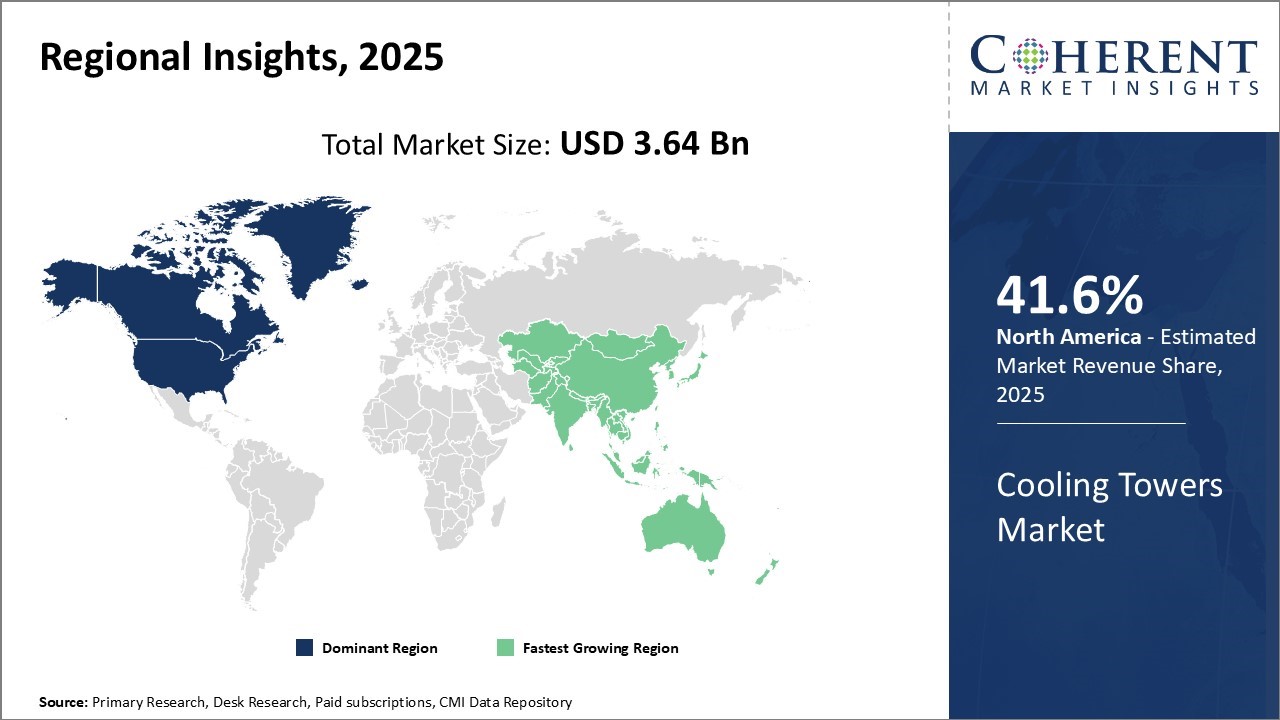
North America Cooling Towers Market Trends
Growing demand from the data center, petrochemical, and power generation industries is significantly boosting the cooling tower market in North America. A strong focus on energy efficiency and environmental compliance is encouraging the adoption of closed-circuit and hybrid cooling towers. Manufacturers are increasingly incorporating smart controls, water-saving technologies, and corrosion-resistant materials to enhance performance. Moreover, the expansion of HVAC systems in commercial buildings and ongoing infrastructure development are propelling market growth, with companies prioritizing cost-effective and sustainable cooling solutions. For instance, in March 2026, At the AHR Expo in Florida, Delta Cooling Towers unveiled its High-Density Polyethylene (HDPE) cooling tower, expanding its HDPE lineup. The new TMX series features a seamless, single-piece, 20-foot sump molded from engineered plastic, eliminating the joints and seams of traditional metal-clad towers and significantly reducing maintenance issues. This is further proliferating the cooling towers market demand.
Asia Pacific Cooling Towers Market Trends
Hyperscale data center expansion and accelerating industrialization in China, India, Japan, and Southeast Asia have positioned Asia Pacific as the global leader in cooling tower installations. This growth fuels demand across manufacturing, commercial HVAC, petrochemical, and power sectors. Strict environmental regulations and rising water scarcity concerns are driving industries to adopt hybrid (wet-dry) cooling towers, which offer high efficiency with reduced water usage. These systems are increasingly gaining popularity alongside open-circuit towers, particularly in water-stressed regions. For instance, in August 2024, Trane, a global climate solutions provider, unveiled its new GEN Elite C Series Cooling-Only VRF system in India. This innovative system delivers high efficiency, precise temperature control, and flexible design—making it an ideal choice for offices, hospitals, retail stores, and other commercial buildings.
United States Cooling Towers Market Trends
Driven by automation and smart controls, U.S. companies are increasingly adopting hybrid (wet-dry) cooling towers to cut water consumption and eliminate visible plume. These systems use high-performance materials and integrated sensors to optimize energy and water use. Smart IoT-enabled technologies and advanced composites like FRP and concrete enhance energy efficiency, extend tower lifespan, and reduce maintenance costs, aligning with strict environmental regulations and corporate sustainability goals.
For instance, in June 2026, U.S.-based Ecolab Inc., a global sustainability leader and provider of water, hygiene, and infection prevention solutions, has unveiled a groundbreaking technology designed to drive high-performance cooling in data centers.
China Cooling Towers Market Trends
Chinese industries are increasingly adopting hybrid (wet-dry) cooling towers and IoT-enabled smart systems in response to strict environmental regulations and rising water conservation demands. These technologies boost operational efficiency, minimize water usage, and support predictive maintenance. Manufacturers are actively choosing corrosion-resistant materials like FRP and HDPE to extend tower lifespan, reduce maintenance needs, and achieve sustainability objectives, despite higher initial investments. Hunan Yuanheng, located in China, is a specialized company engaged in the research, development, production, sales, and service of cooling towers and central air-conditioning systems.
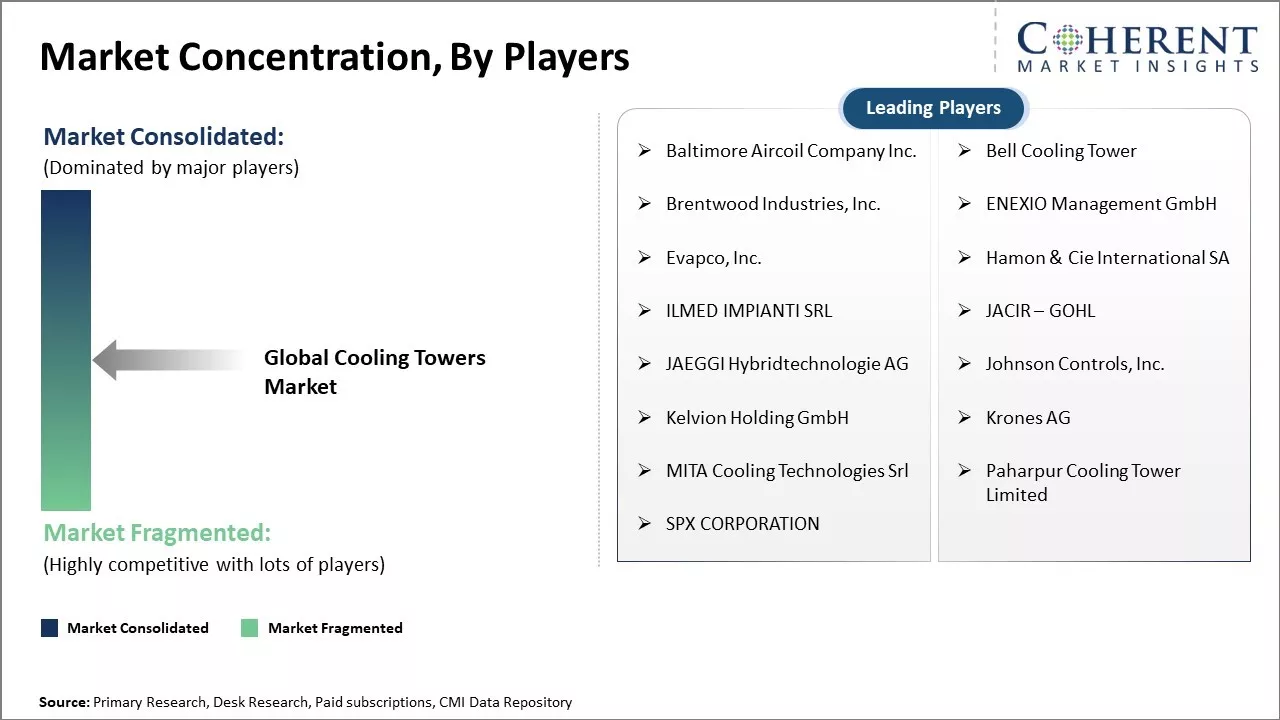
Market Concentration and Competitive Landscape
Cooling Towers Market News
- In May 2025, Mainstream Fluid and Air, a leading U.S. manufacturer of advanced HVAC retrofit solutions, introduced Modular Cooling Tower Fan Arrays. This innovative alternative to traditional single-fan systems is already making a significant impact across the industry.
- In February 2025, Kenstar, a leading brand in India, launched the "Kenstar BLDC Maxx," a revolutionary cooling system. By integrating this advanced technology into its newly introduced range of air coolers, Kenstar enhances the efficiency, durability, and reliability of cooling solutions for Indian households.
- In March 2025, SharkNinja, Inc., a global product design and technology company, is transforming the home cooling market with the launch of TurboBlade™, its most powerful bladeless fan*. Designed to deliver 360-degree cooling coverage and ultra-quiet performance, TurboBlade™ sets a new standard in residential cooling solutions.
- In May 2024, Carrier Midea India Pvt Ltd, a key player in the air conditioning solutions industry, launched its first Midea Cooling Solutions ProShop in India.
Market Report Scope
Cooling Towers Market Report Coverage
| Report Coverage | Details | ||
|---|---|---|---|
| Base Year: | 2025 | Market Size in 2026: | USD 3.84 Bn |
| Historical Data for: | 2020 To 2024 | Forecast Period: | 2026 To 2033 |
| Forecast Period 2026 to 2033 CAGR: | 5.6% | 2033 Value Projection: | USD 5.63 Bn |
| Geographies covered: |
| ||
| Segments covered: |
| ||
| Companies covered: | Baltimore Aircoil Company Inc., Bell Cooling Tower, Brentwood Industries, Inc., ENEXIO Management GmbH, Evapco, Inc., Hamon & Cie International SA, ILMED IMPIANTI SRL, JACIR – GOHL, JAEGGI Hybridtechnologie AG, Johnson Controls, Inc., Kelvion Holding GmbH, Krones AG, MITA Cooling Technologies Srl, Paharpur Cooling Tower Limited, and SPX CORPORATION | ||
| Growth Drivers: |
| ||
| Restraints & Challenges: |
| ||
Cooling Towers Market Trend
Rising Focus on Energy Efficiency and Sustainability
Manufacturers in the cooling tower market are actively shifting toward energy-efficient and environmentally friendly technologies. They are incorporating variable frequency drives (VFDs), high-efficiency fans, and heat recovery systems to reduce energy consumption. Hybrid cooling towers are also gaining traction for their ability to save water without compromising performance. Regulatory mandates, rising environmental consciousness, and the growing need to lower operating expenses—particularly in power, petrochemical, and commercial sectors—are driving these technological advancements and sustainable practices.
Growing Adoption of Smart and IoT-Enabled Systems
The cooling tower industry is undergoing a digital transformation as manufacturers and operators adopt IoT-enabled systems. These smart technologies provide real-time performance monitoring, automated fault detection, and predictive maintenance, which enhance reliability and minimize downtime. Data centers and process-heavy industries especially benefit from these systems, as they help prevent costly failures. Although initial costs remain a concern, end-users are increasingly investing in smart cooling towers to gain long-term advantages such as better energy management, lower maintenance expenses, and improved operational oversight.
Cooling Towers Market Opportunity
Developments in hybrid cooling towers
Developments in hybrid cooling towers present a significant opportunity in the global cooling towers market. Hybrid towers integrate traditional cooling tower technologies with new methods to provide more efficient and environmentally friendly operation. For example, many new hybrid designs combine evaporative cooling with dry cooling technologies. This allows plants to conserve water in dry or arid regions where water availability is limited, while still achieving the high heat rejection performance of wet cooling towers.
Analyst Opinion (Expert Opinion)
- The cooling towers market is at a decisive inflection point, driven less by incremental demand and more by regulatory disruption, water stress, and digital inertia. In my view, the traditional cooling tower OEMs are lagging behind when it comes to delivering next-generation, intelligent, and water-efficient solutions—despite clear demand signals from end-users.
- On the digital front, the adoption of IoT-integrated cooling towers remains abysmally low—estimated at less than 15% of total installations globally. This is despite strong ROI from predictive maintenance and remote diagnostics. For instance, a major refinery in Texas reported a 20% drop in unscheduled maintenance after retrofitting its legacy towers with real-time monitoring and control systems. But these successes are isolated. Most tower systems still rely on outdated, reactive maintenance models, causing inefficiencies and unplanned shutdowns.
- Material innovation also remains underexploited. FRP and HDPE towers offer up to 5x the service life compared to conventional galvanized steel, especially in corrosive environments such as coastal areas or chemical facilities. Yet, OEMs continue to push steel-based options, prioritizing volume sales over long-term value creation. This misalignment not only affects operational resilience but also leaves end-users exposed to higher lifecycle costs.
- In summary, the cooling towers market needs a strategic shift—from commodity-driven supply to outcome-driven engineering. Players that prioritize smart automation, regulatory foresight, and material durability will lead. Those clinging to legacy designs and cost-first procurement models will become obsolete. The winners will be OEMs that embed digital intelligence, minimize environmental externalities, and offer modular, low-maintenance systems tailored to tomorrow’s infrastructure—not yesterdays.
Speak to the analyst
Want personalized insights?
Take the findings above to one of our principal consultants, or have the report rebuilt around the segments, geographies and competitors you actually track.
Market Segmentation
- Product Type Insights (Revenue, USD Bn, 2021 - 2033)
- Open Cooling Tower
- Closed Circuit Cooling Tower
- Heat Transfer Method Insights (Revenue, USD Bn, 2021 - 2033)
- Evaporative Cooling
- Dry Cooling
- Plume Abatement (Hybrid) Cooling
- Application Insights (Revenue, USD Bn, 2021 - 2033)
- Air-Conditioning
- Power Generation
- Manufacturing Industry
- Regional Insights (Revenue, USD Bn, 2021 - 2033)
- North America
- U.S.
- Canada
- Latin America
- Brazil
- Argentina
- Mexico
- Rest of Latin America
- Europe
- Germany
- U.K.
- Spain
- France
- Italy
- Russia
- Rest of Europe
- Asia Pacific
- China
- India
- Japan
- Australia
- South Korea
- ASEAN
- Rest of Asia Pacific
- Middle East
- GCC Countries
- Israel
- South Africa
- Rest of Middle East
- Africa
- South Africa
- North Africa
- Central Africa
- North America
- Key Players Insights
- Baltimore Aircoil Company Inc.
- Bell Cooling Tower
- Brentwood Industries, Inc.
- ENEXIO Management GmbH
- Evapco, Inc.
- Hamon & Cie International SA
- ILMED IMPIANTI SRL
- JACIR – GOHL
- JAEGGI Hybridtechnologie AG
- Johnson Controls, Inc.
- Kelvion Holding GmbH
- Krones AG
- MITA Cooling Technologies Srl
- Paharpur Cooling Tower Limited
- SPX CORPORATION
Sources
Primary Research interviews
- Plant engineers and facility managers in thermal power plants
- Operations heads in petrochemical and data center companies
- Product development leads at cooling tower OEMs
- Sustainability officers in industrial HVAC firms
Databases
- U.S. Department of Energy (DOE) Industrial Technologies Program
- China National Energy Administration (NEA) energy statistics portal
- Eurostat – Cooling-related energy and water usage
- India Central Electricity Authority (CEA) thermal plant reports
Magazines
- Cooling India
- Plant Engineering
- HPAC Engineering
- Industrial WaterWorld
Journals’
- Applied Thermal Engineering
- International Journal of Refrigeration
- Energy and Buildings
- Journal of Heat Transfer
Newspapers
- The Wall Street Journal – Energy & Infrastructure section
- The Economic Times (India) – Industry & Sustainability news
- South China Morning Post – Regional industrial trends
- The Guardian – Environmental regulations and industrial policy coverage
Associations
- Cooling Technology Institute (CTI)
- American Society of Heating, Refrigerating and Air-Conditioning Engineers (ASHRAE)
- Association of Energy Engineers (AEE)
- Eurovent Certification for cooling and HVAC
- Bureau of Energy Efficiency (India)
Public Domain sources
- U.S. Environmental Protection Agency (EPA) – WaterSense & Clean Air programs
- International Energy Agency (IEA) – Cooling demand projections
- California Energy Commission – Title 20 & water use data
- National Renewable Energy Laboratory (NREL) reports on industrial cooling
- World Bank – Infrastructure and climate data for cooling needs
Proprietary Elements
- CMI Data Analytics Tool, and Proprietary CMI Existing Repository of information for last 8 years
Get access to 250+ pages report
Every segment, forecast, competitor profile and data table behind the analysis above — available for instant download.
- ESOMAR Member
- ISO 9001:2015 Certified
- D-U-N-S Registered
- GDPR & CCPA Compliant
Missing comfort of reading report in your local language? Find your preferred language:
Transform your Strategy with Exclusive Trending Reports
Frequently Asked Questions
The Cooling Towers Market is estimated to be valued at USD 3.84 Bn in 2026, and is expected to reach USD 5.63 Bn by 2033.
The CAGR of the Cooling Towers Market is projected to be 5.6% from 2026 to 2033.
Growing energy demand and sustainable cooling are the major factors driving the growth of the global cooling towers market.
Require regular maintenance and availability of substitutes are the major factors hampering the growth of the global cooling towers market.
In terms of product type, open cooling tower is estimated to dominate the market revenue share in 2026.
Baltimore Aircoil Company Inc., Bell Cooling Tower, Brentwood Industries, Inc., ENEXIO Management GmbH, Evapco, Inc., Hamon & Cie International SA, ILMED IMPIANTI SRL, JACIR – GOHL, JAEGGI Hybridtechnologie AG, Johnson Controls, Inc., Kelvion Holding GmbH, Krones AG, MITA Cooling Technologies Srl, Paharpur Cooling Tower Limited, and SPX CORPORATION are the major players.
North America is expected to lead the global cooling towers market in 2026.