

Smart Beacon Market Size and Forecast — 2026-2033
The Smart Beacon Market size is estimated to be valued at USD 3.26 billion in 2026 and is expected to reach USD 9.44 billion by 2033, exhibiting a compound annual growth rate (CAGR) of 16.4% from 2026 to 2033.
Overview
A smart beacon is a proximity device, which transmits a signal with the help of Bluetooth low energy proximity sensing Application by using compatible End-User Industry or operating system. When a smartphone or tablet is in the beacon’s range, it detect the physical location of the device and tracks customer, then triggers allocation based notification on the device. For example, smart beacons are used in brick and mortar retail stores for mobile commerce to send notification regarding special offers to the customers.
iBeacon and Eddystone are two most significant protocols used in smart beacon. iBeacon is developed by Apple, Inc. and is iOS compatible. iBeacon functions in iPhones and iPads. For instance, in 2013 Apple, Inc. activated iBeacon across 254 stores in the U.S. Eddystone was launched by Google LLC in 2015 and it is now highly adopted in the market. It is specially developed for Android users.
Key Takeaways
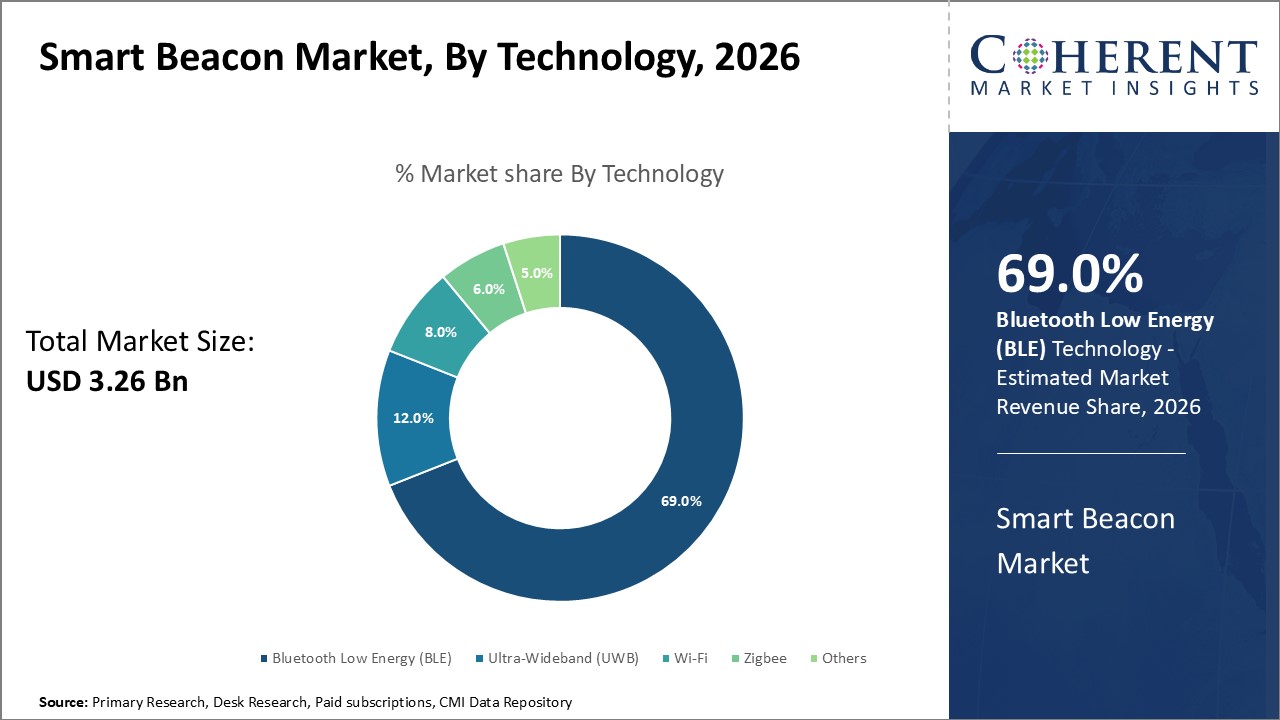
Bluetooth Low Energy (BLE) dominates the technology segment, occupying 69% market share, supported by widespread adoption and cost-effectiveness. Ultra-Wideband (UWB) emerges as the fastest-growing Application segment due to demand for precision tracking.
Retail and Marketing leads the application segment, capitalizing on consumer engagement opportunities, while Healthcare shows robust growth propelled by asset tracking and patient monitoring use cases.
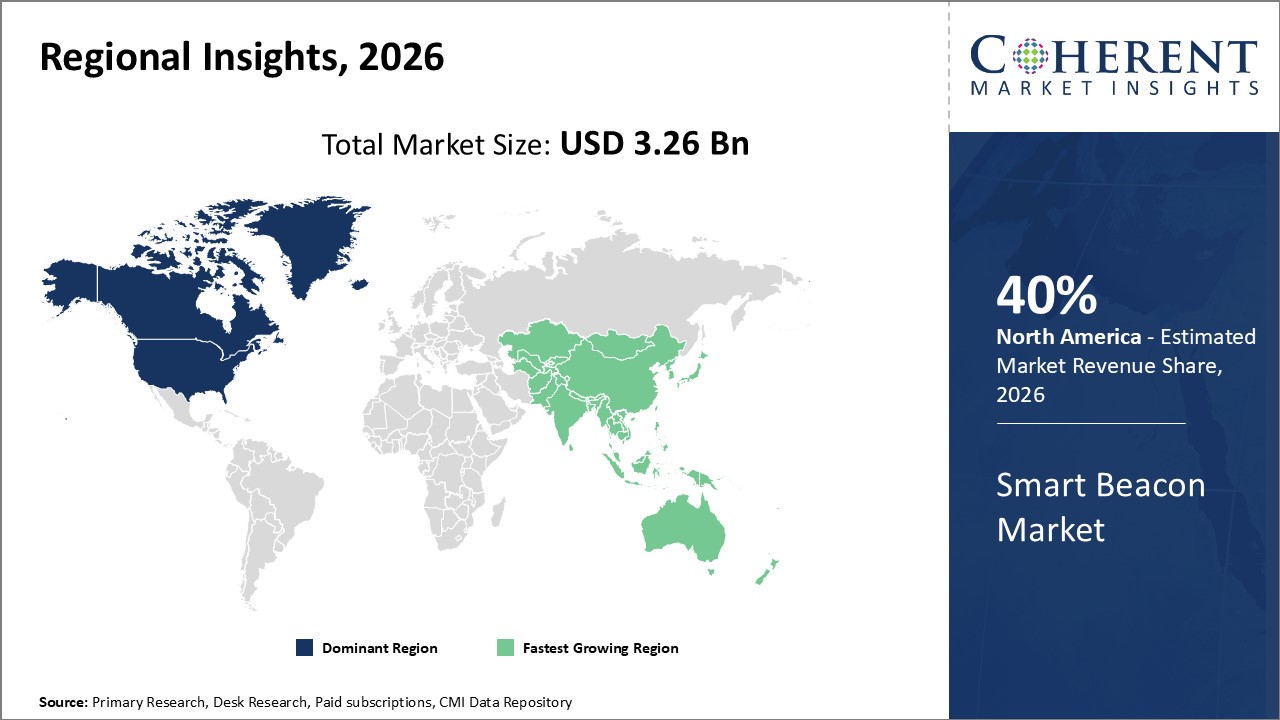
North America holds the largest market share regionally due to technological maturity and significant investment in smart infrastructure. Asia Pacific exhibits the fastest CAGR, credited to rapid urbanization, government smart city initiatives, and expanded manufacturing ecosystems.
Smart Beacon Market – Segmentation Analysis
Smart Beacon Market Insights, By Technology
In terms of technology, Bluetooth low energy (BLE) dominates the market share with 69%. BLE remains favored due to its low power consumption and strong compatibility with smartphones, making it the backbone of most smart beacon deployments in retail and consumer electronics. The segment is widely adopted across industries such as retail, healthcare, transportation, and smart buildings, enhancing operational efficiency and customer engagement.
Smart Beacon Market Insights, By Application
By application, retail and marketing dominate with the largest market share, driven by extensive deployment for personalized consumer engagement, promotional alerts, and in-store analytics. Retailers use smart beacons to track customer behavior, send location-based notifications about special offers, discounts, and product recommendations, and improve store navigation. This proximity marketing enables physical stores to compete with online retailers by providing real-time, targeted promotions and loyalty program enhancements.
Smart Beacon Market Insights, By End-User Industry
Based on end-user industry, consumer electronics lead in market share due to integration in smart homes, wearables, and mobile devices, reflecting mature ecosystem demand. Smart beacons in consumer electronics facilitate communication between devices such as smartphones, wearables, and other Bluetooth-enabled gadgets, allowing location-based notifications, targeted marketing, and enhanced user engagement.
Smart Beacon Market Trends
Market dynamics indicate a strong shift towards ultra-wideband (UWB) technology as a complement to BLE for higher-precision localization, with UWB smart beacon shipment volumes increasing by 27% in 2026 versus the previous year.
Additionally, the integration of AI algorithms for data analytics and predictive insights is opening new frontiers in proactive asset management, evident in logistics firms improving delivery accuracy by 15%. Cross-industry collaborations are reshaping market scope, such as telecom operators partnering with smart beacon providers to accelerate 5G-enabled indoor positioning solutions. Sustainability is also emerging as a vital market driver, with manufacturers adopting eco-friendly materials to meet tightening regulatory requirements, driving innovation in market segments with a future-forward approach.
Smart Beacon Market Insights, By Geography
North America Smart Beacon Market Analysis and Trends
In North America, the dominance in the Smart Beacon market with market share of 40%, is attributed to widespread technology adoption, established infrastructure, and heavy investments in smart retail and healthcare sectors. The U.S. particularly fuels this growth through extensive use of smart beacons in retail, transportation, and logistics, supported by strong broadband networks and significant government investments in smart city and connected infrastructure projects. Proximity marketing in malls, airports, and public venues is a major application area.
Asia Pacific Smart Beacon Market Analysis and Trends
Meanwhile, the Asia Pacific exhibits the fastest growth with a CAGR exceeding 20%, driven by rapid urbanization, expanding smart city initiatives in countries like China, India, and Singapore, and increased manufacturing capacity. Aggressive governmental backing and improving digital infrastructure position this region for exponential market growth.
Smart Beacon Market Outlook for Key Countries
United States Smart Beacon Market Analysis and Trends
The USA's Smart Beacon market has benefited from aggressive adoption across retail, healthcare, and logistics sectors. Notably, Walmart’s deployment of beacons across 1,000+ stores increased customer dwell time by 18% in 2025, exemplifying successful application.
China Smart Beacon Market Analysis and Trends
The growing expansion of the Chinese smart beacon business is a prime example, bolstered by significant government investments in Industry 4.0 frameworks and smart city initiatives. Shanghai's metro system saw a 30% boost in commuter satisfaction in 2025 as a result of smart beacon deployments that improved passenger guidance services.
Analyst Opinion
The integration of Bluetooth Low Energy (BLE) technology remains a pivotal market driver. Recent adoption data from consumer electronics firms shows BLE-enabled smart beacon shipments increased by 23% in 2025 compared to 2023, demonstrating the surging adoption in retail and indoor navigation applications. This widespread deployment directly impacts market size and revenue growth projections.
Supply chain expansion and localization have been pivotal in catering to the surge in demand across Asia Pacific. For instance, manufacturers in China and Taiwan increased production capacities by 35% in 2025 to meet escalating orders from smart city projects, showcasing a tangible supply-side indicator influencing market share distribution.
Data-driven use cases, particularly in healthcare asset tracking and patient monitoring, reveal strong demand-side momentum. A 2026 report from several large hospital networks indicates a 29% improvement in operational efficiency attributed to smart beacon integrations, underlining the vital role of application diversification in market dynamics.
Price sensitivity analysis reflects an 9% average cost reduction in smart beacon modules from 2023 to 2026, enabling broader adoption in small and medium enterprises. This pricing trend efficiently expands market scope, especially in emerging economies where cost constraints influence purchasing decisions substantially.
- Current Industry Events of 2026
- Market Size Estimation
- Regional Breakdown
- Competitive Landscape
- Customer Intelligence
- Segmental Analysis
- Pricing Analysis
- Key Market Drivers, Challenges & Future Trends
- Customized Insights Section
Market Scope
| Report Coverage | Details | ||
|---|---|---|---|
| Base Year: | 2025 | Market Size in 2026: | USD 3.26 billion |
| Historical Data for: | 2020 To 2024 | Forecast Period: | 2026 To 2033 |
| Forecast Period 2026 to 2033 CAGR: | 16.4% | 2033 Value Projection: | USD 9.44 billion |
| Geographies covered: |
| ||
| Segments covered: |
| ||
| Companies covered: | Estimote Inc., Kontakt.io, BlueCats, Radius Networks, Aruba Networks, Hexagon AB, Cisco Systems Inc., Zebra Technologies, Sony Corporation, Samsung Electronics | ||
| Growth Drivers: |
| ||
Smart Beacon Market Growth factors
The rapid proliferation of IoT devices has been instrumental in increasing smart beacon demand, with over 14 billion connected devices globally projected by 2026.
Smart beacons serve as an invaluable connective tissue for seamless device interoperability, directly driving market revenue.
Expanding use cases in omnichannel retail, especially personalized marketing and customer engagement, remain strong contributors to market growth, with several U.S. retailers reporting customer dwell-time increases of 18% after deploying beacon-based campaigns.
Government initiatives fostering smart city infrastructure, particularly in the Asia Pacific region, stimulate market dynamics by enabling large-scale deployments, exemplified by smart beacon projects launched in Singapore’s public transit hubs in 2025.
Lastly, decreased hardware pricing and advances in battery life are lowering entry barriers for mid-tier enterprises, widening the market scope significantly across emerging markets.
Smart Beacon Market Development
In June 2026, Blecon, in collaboration with MOKO SMART, unveiled the L02S-BCN, a next-generation Smart Beacon co-designed by Blecon and MOKO SMART to meet the growing demands of sensing and connectivity in industrial and commercial environments. The L02S-BCN demonstrates what's possible when established and trusted beacon design meets Bluetooth cloud connectivity.
In May 2026, Nokia launched two new Wi-Fi 7 gateways designed to deliver, reliable, ultra-fast broadband to every corner of the home. Nokia’s entry level Beacon 4 and mid-tier Beacon 9 offer gigabit speeds over Wi-Fi – essential for supporting the expanding demands of streaming, online gaming, video, smart home, and security applications in the home.
Key Players
Estimote Inc.
Kontakt.io
BlueCats
Radius Networks
Aruba Networks
Hexagon AB
Cisco Systems Inc.
Zebra Technologies
Sony Corporation
Samsung Electronics
Among these market companies, leading smart beacon manufacturers such as Estimote have successfully deployed enhanced SDK platforms boosting integration capabilities, resulting in 19% increased client retention in 2025. Similarly, Radius Networks adopted a channel expansion strategy targeting healthcare facilities in North America, consequently elevating their market share by 13% within one year. Aruba Networks leveraged strategic partnerships within supply chain logistics to optimize deployment scalability, reflecting a revenue surge of 21% in recent quarters.
Smart Beacon Market Future Outlook
The future perspective of the Smart Beacon Market will emphasize its transformative role in connecting physical environments with digital experiences, driving next-generation customer engagement and intelligent spatial analytics. The market will expand rapidly as organizations across industries will adopt smart beacons for location-based services, proximity marketing, asset tracking, and indoor navigation. Integration with technologies such as the Internet of Things (IoT) and artificial intelligence (AI) will enhance beacon functionalities, enabling predictive analytics, dynamic geofencing, and hyper-personalized consumer interactions.
Smart beacons will increasingly become critical components in smart city infrastructures, public safety systems, and retail environments, where they will improve operational efficiency and user experience through real-time communication and precise data insights. Emerging markets, especially in Asia-Pacific, the Middle East, and Latin America, will represent significant growth opportunities due to urbanization and investments in smart infrastructure projects. The market trend also will highlight a strong focus on energy efficiency, data security, and interoperability to meet regulatory requirements and consumer privacy concerns. Overall, the Smart Beacon Market will witness continual innovation and broad adoption, reshaping how businesses and public institutions will interact with their environments and audiences.
Historical Developments
In 2013 Apple, Inc. activated iBeacon across 254 stores in the U.S. Eddystone was launched by Google LLC in 2015 and it was highly adopted in the market. It was developed specially for Android users.
According to SITA, an air transport provider, announced that at Miami International Airport, around 450 beacons and at Schiphol 1,500 beacons had been deployed. Simon Property Group announced that in 2015 it installed about 4,800 beacons across 192 malls and shopping centers. Hence, it was expected that in North America around 200 million Android and Apple smartphones would be using smart beacon technology by 2026.
Sources
Primary Research interviews:
Airport operations managers
Museum & exhibition center directors
Healthcare facility IT managers
Databases:
SpringerLink
ProQuest
Statista
Magazines:
CIO Review
TechCrunch
IoT Now
Journals:
International Journal of Information Management
Journal of Business Research
Computers in Human Behavior
Newspapers:
The Economic Times (Tech & Retail)
The Wall Street Journal (Technology & Business)
Business Standard
Associations:
GSMA (Mobile Industry Association)
Consumer Technology Association (CTA)
National Retail Federation (NRF)
Get access to 250+ pages report
Every segment, forecast, competitor profile and data table behind the analysis above — available for instant download.
- ESOMAR Member
- ISO 9001:2015 Certified
- D-U-N-S Registered
- GDPR & CCPA Compliant
Missing comfort of reading report in your local language? Find your preferred language:
Transform your Strategy with Exclusive Trending Reports
Frequently Asked Questions
The dominant market players include Estimote, Kontakt.io, Radius Networks, and Aruba Networks, noted for their robust product portfolios and strategic market expansions.
The market size is forecasted to grow from USD 3.26 billion in 2026 to USD 9.44 billion by 2033, showing strong revenue and market share expansion driven by IoT adoption and diversified applications.
Retail and Marketing sectors offer the largest growth opportunity, leveraging smart beacon technology for personalized customer engagement and improved shopper analytics.
Trends point toward integration of Ultra-Wideband technology, AI-driven analytics, and sustainability-focused designs, shaping segmentation and competitive market dynamics.
Competitive landscape remains intense with leading companies focusing on innovation and partnerships, while market challenges involve pricing pressures and technological standardization.
Common strategies include channel diversification, strategic partnerships with industry players, technological advancements, and targeted industry vertical focus, enhancing competitive positioning.