

Global Digital Logistics Market Size and Forecast
The Global Digital Logistics Market is estimated to be valued at USD 50.05 Bn in 2026 and is expected to reach USD 177.26 Bn by 2033, exhibiting a compound annual growth rate (CAGR) of 19.8% from 2026 to 2033.
Key Takeaways of the Digital Logistics Market
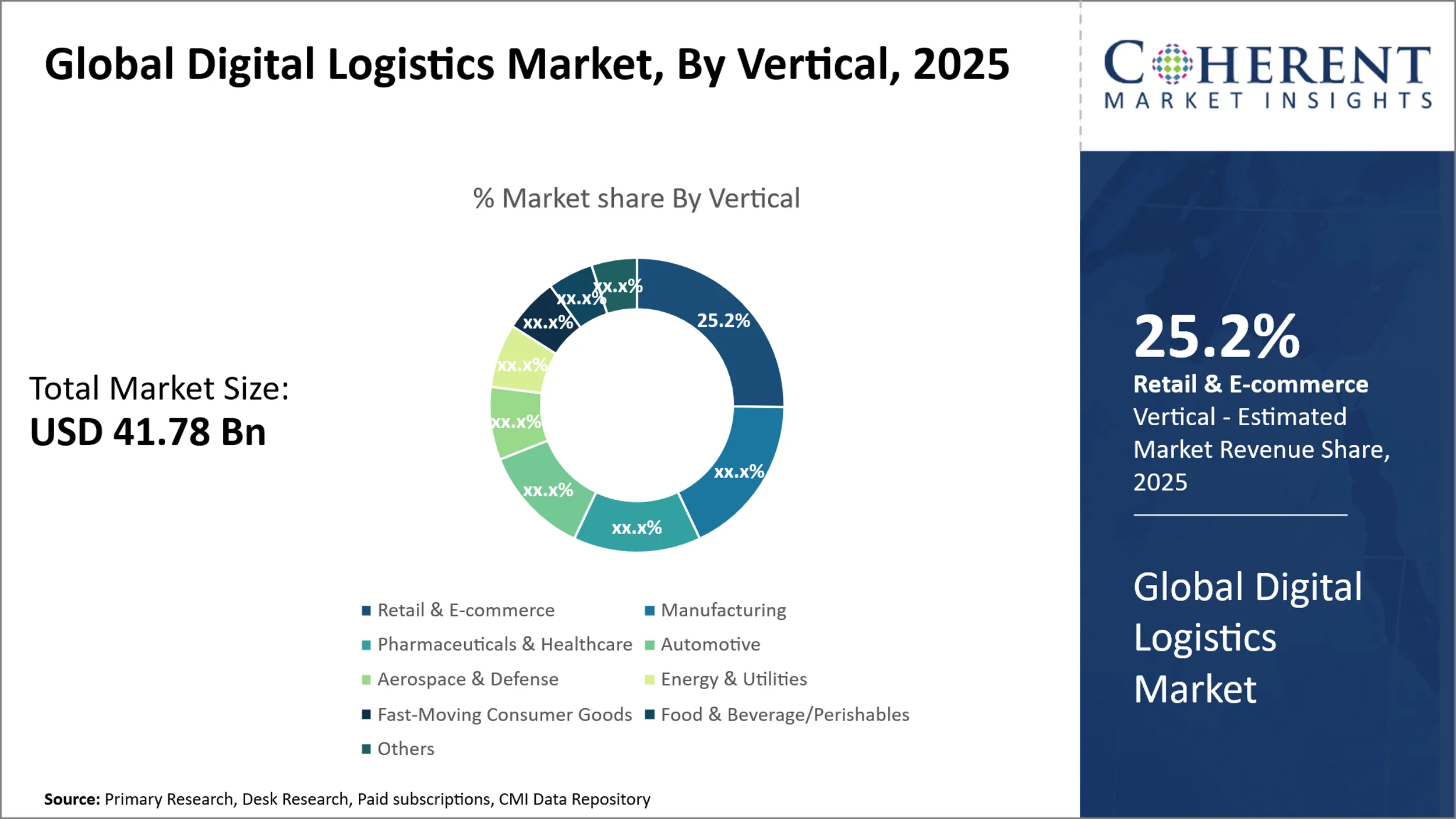
- The retail & e‑commerce segment leads the market, holding an estimated share of 26.2% in 2026.
- Manufacturing is the second leading segment, with a share of 18.8%.
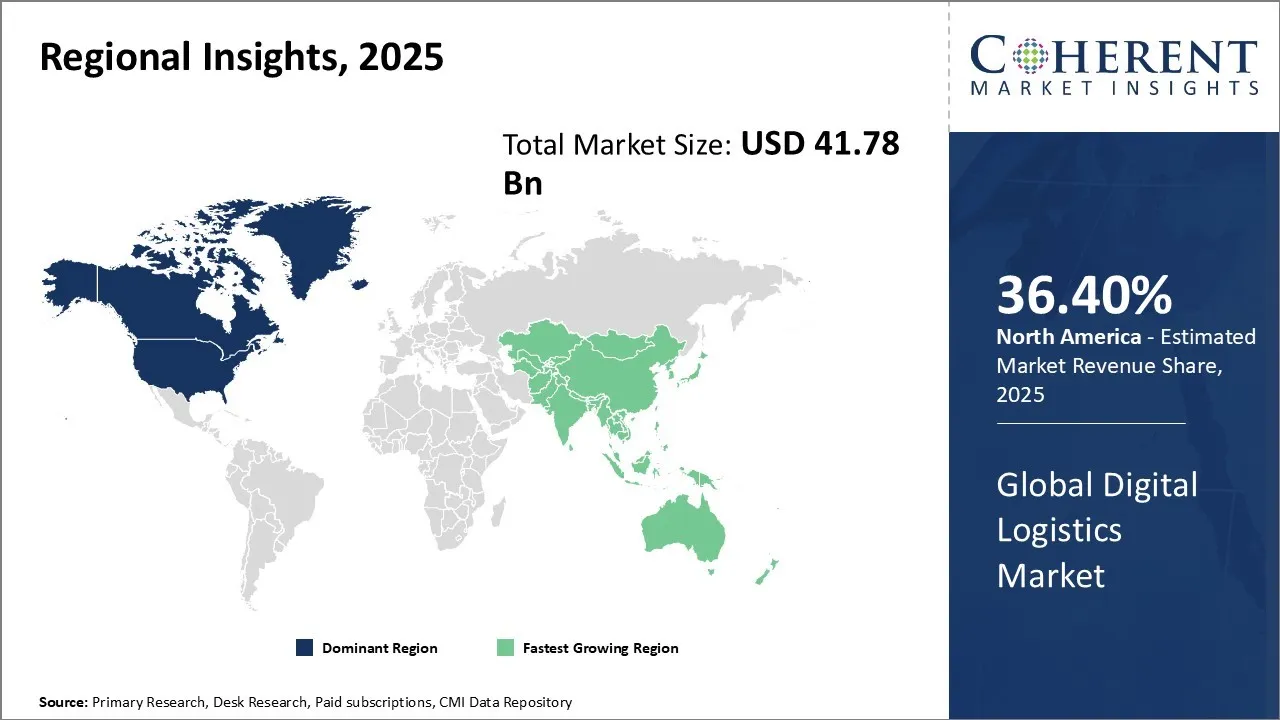
- North America is estimated to lead the market, with a share of 36.4% in 2026.
- Asia Pacific, holding a share of 30.5% in 2026, is projected to be the fastest growing region.
Market Overview
Market trends indicate a strong shift towards the integration of artificial intelligence, Internet of Things (IoT), and blockchain technologies within digital logistics frameworks. These innovations make possible real-time tracking, predictive analytics, and secure data sharing, resulting in improved transparency and operational agility. Additionally, the rising demand for automation and smart warehousing solutions is reshaping the logistics landscape, enabling companies to meet growing consumer expectations for faster, more reliable delivery services.
Current Events and their Impact
Current Events | Description and its impact |
Geopolitical Shifts Impacting Supply Chains |
|
Technological Advancements and Integration |
|
Segmental Insights
- Current Industry Events of 2026
- Market Size Estimation
- Regional Breakdown
- Competitive Landscape
- Customer Intelligence
- Segmental Analysis
- Pricing Analysis
- Key Market Drivers, Challenges & Future Trends
- Customized Insights Section
Global Digital Logistics Market Insights, By Vertical - E-commerce Expansion and Consumer Demand are Fueling Retail & E-commerce Segment Growth
Retail & e‑commerce segment is expected to contribute the highest share of 26.2% in the market in 2026. The surge in online shopping, accelerated by changing consumer behaviors and lifestyle preferences, has created the demand for advanced digital logistics solutions to make possible smooth order fulfillment and last-mile delivery. Retailers and e-commerce platforms are investing a lot in technologies like real-time shipment tracking and automated warehousing to streamline operations and reduce delivery times.
Also, customers now expect a consistent shopping experience across online and offline channels, which requires integrated logistics infrastructure supported by digital platforms. These platforms enhance inventory visibility, enable efficient returns management, and optimize supply chain responsiveness, thereby enhancing overall customer satisfaction.
The rise of smaller, faster delivery windows such as same-day or next-day delivery has also intensified demand for sophisticated digital logistics tools. E-commerce companies are increasingly adopting route optimization software, drone deliveries, and autonomous vehicles to meet these expectations while controlling operational costs. Additionally, data analytics plays a pivotal role in improving route efficiency, reducing transit times, and minimizing fuel consumption, making logistics operations more sustainable.
Furthermore, the proliferation of mobile commerce has led to increased order volumes and more frequent deliveries, simultaneously increasing complexity and the need for scalable logistics networks. Retailers are leveraging cloud-based digital logistics solutions to manage this complexity and maintain high service levels despite fluctuating demand patterns.
Impact of Artificial Intelligence (AI) on the Digital Logistics Market
Artificial Intelligence (AI) is transforming the digital logistics landscape by enabling smarter, faster, and more autonomous supply chain operations. AI algorithms optimize route planning, predict demand fluctuations, detect anomalies in delivery timelines, and even preemptively resolve bottlenecks. For instance, AI-powered predictive analytics helps logistics providers adjust delivery schedules based on weather forecasts, traffic patterns, or geopolitical risks—minimizing disruptions and reducing fuel costs. AI also enhances warehouse operations through robotics and automated inventory systems that learn and adapt over time, boosting both accuracy and throughput.
An example is DHL’s partnership with IBM Watson, where they integrated AI to improve global supply chain forecasting and risk management. The system analyzes over 8 million data points daily—ranging from news feeds to port closures—to proactively alert shippers about possible delays.
Regional Insights
North America Digital Logistics Market Analysis and Trends
North America, holding a share of 36.40% in 2026, is expected to dominate the global digital logistics market. The growth can be attributed to the presence of highly advanced technological ecosystem, extensive industry infrastructure, and progressive government policies promoting digital transformation within supply chains. The region benefits from a mature logistics sector supported by robust digital infrastructure including widespread adoption of IoT, AI, and Blockchain technologies. In North America, Amazon continues to push the boundaries of digital logistics with its AI-based forecasting models and robotic fulfillment centers. The company uses machine learning algorithms to predict what customers will order, enabling inventory to be pre-positioned closer to demand centers.
The presence of major global logistics companies like FedEx, UPS, and C.H. Robinson, who are actively investing in innovative digital solutions, further consolidates the region’s leadership. Additionally, North America’s trade dynamics, characterized by extensive import-export activities, necessitate efficient digital logistics frameworks, fostering rapid adoption of smart logistics platforms and real-time tracking systems. Government initiatives focusing on enhanced transportation security and smart infrastructure investments also fuel market growth.
Asia Pacific Digital Logistics Market Analysis and Trends
The Asia Pacific region, holding a share of 30.5% in 2026, is expected to exhibit the fastest growth in the global digital logistics market due to rapid urbanization, expanding e-commerce activities, and increasing government focus on upgrading logistics infrastructure. Countries within this region are experiencing substantial investments in digital infrastructure to support logistics efficiency, such as smart ports and digital warehouses. The growth is further enhanced by a large base of domestic logistics providers integrating digital tools to improve supply chain visibility and operational agility.
Governments in countries like China, India, and Southeast Asian nations have launched incentives and reforms to modernize logistics by leveraging technologies including big data analytics and automation. Notable companies such as JD Logistics, Alibaba’s Cainiao Network, and Panasonic are making significant contributions by pioneering innovative solutions tailored to the diverse and complex logistics requirements of this region. For instance, JD Logistics has deployed AI-powered autonomous delivery vehicles and drones across urban campuses and remote rural areas.
Digital Logistics Market Outlook for Key Countries
U.S. Digital Logistics Market Analysis and Trends
The U.S. is marked by widespread use of advanced digital logistics tools driven by strong e-commerce demand and complex supply chains. Key players like FedEx and UPS lead innovation by incorporating AI-driven route optimization, autonomous vehicles, and Blockchain-based cargo tracking to enhance transparency and reduce delivery times. Government policies such as those promoting intelligent transportation systems help integrate digital logistics into national infrastructure. Additionally, the presence of diverse industries from retail to manufacturing stimulates high demand for customized digital logistics solutions.
China Digital Logistics Market Analysis and Trends
China digital logistics market thrives due to extensive government support and rapid digital adoption in logistics ecosystems. The push toward smart cities and smart transportation infrastructure, coupled with the dominance of e-commerce giants like Alibaba and JD.com, drives the commercialization of digital logistics technologies. Companies like Cainiao Network have revolutionized the last-mile delivery landscape through cloud computing and IoT solutions. The government's focus on the "Digital Silk Road" initiative also promotes cross-border logistics digitization, enhancing international trade connectivity.
Germany Digital Logistics Market Analysis and Trends
Germany leverages its strong industrial base and logistics infrastructure. Major companies such as DHL and DB Schenker invest heavily in digital warehouse management, automated freight forwarding, and real-time data analytics to optimize supply chains across numerous sectors. The country’s government supports digital innovation through various grants and research programs focusing on Industry 4.0 integration. Germany’s strategic location in Europe also makes it a key hub for cross-border logistics, increasing the demand for sophisticated digital logistics systems.
India Digital Logistics Market Analysis and Trends
India is propelled by rapid digitization across its vast logistics sector, supported by increasing government initiatives like the Logistics Ease Across Different States (LEADS) and Digital India campaign. A growing start-up ecosystem specializing in logistics tech (such as Delhivery and Rivigo) is innovating in areas like automated warehousing, fleet management, and AI-powered analytics. The rising middle class and expanding e-commerce market create substantial demand for efficient, digitally-enabled logistics solutions that reduce delivery times and improve tracking accuracy.
Market Players, Key Development, and Competitive Intelligence
Key Developments
- On July 3, 2025, all-electric parcel delivery company, Hived, secured USD 42 million (£31m) in a Series B funding round led by NordicNinja. The funding will accelerate Hived’s U.K. rollout, grow its engineering and data team, and scale the development of its proprietary logistics intelligence platform.
- In June 2025, Amazon introduced a new generative AI foundation model called DeepFleet. This AI technology will coordinate the movement of robots across the company's fulfillment network, improving the travel time of its robotic fleet by 10%.
- In May 2025, Evri, one of the U.K.'s largest dedicated parcel delivery companies, and DHL eCommerce, the e-commerce logistics specialist of DHL Group, announced a strategic transaction that will see the merger of DHL eCommerce UK with Evri. The merged Evri business will deliver over 1 billion parcels and a further 1 billion business letters annually.
- In May 2025, WiseTech Global, a developer of logistics execution software CargoWise, acquired U.S.-based E2open Parent Holdings, Inc., a provider of SaaS-based solutions in the global logistics value chain. This move adds a strong complementary product suite to the CargoWise ecosystem, especially in adjacent areas of domestic logistics, carrier integration, global trade and supply chain management.
Top Strategies Followed by Digital Logistics Market Players
- Established market leaders, often multinational corporations with vast resources, heavily invest in research and development (R&D) to drive continuous innovation. Their focus is on creating high-performance products that incorporate the latest technological advancements such as artificial intelligence, Internet of Things (IoT), and Blockchain to enhance supply chain transparency, efficiency, and security.
- IBM invested significantly in enhancing its Watson Supply Chain platform, integrating advanced AI and Blockchain capabilities. The solution offers real-time visibility and predictive insights across logistics networks.
- Mid-level players in the digital logistics market adopt more cost-conscious yet strategic approaches to compete effectively. Their primary focus lies in offering solutions that strike a balance between quality and affordability, catering specifically to price-sensitive customers who require reliable digital logistics services without incurring premium costs.
- FarEye, an India-based logistics SaaS company, provides low-cost last-mile delivery optimization platforms tailored for companies in retail, FMCG, and e-commerce.
- Small-scale players navigate the competitive global digital logistics arena by focusing on niche segments and innovative product offerings. By specializing in unique features—such as tailored solutions for specific industries, customizable software platforms, or specialized tracking technologies they differentiate themselves from larger, more generalized providers.
- Hived, a U.K.-based startup (also expanding into APAC), is building a zero-emission parcel delivery network using only electric vehicles.
Market Report Scope
Digital Logistics Market Report Coverage
| Report Coverage | Details | ||
|---|---|---|---|
| Base Year: | 2025 | Market Size in 2026: | USD 50.05 Bn |
| Historical Data for: | 2020 To 2024 | Forecast Period: | 2026 To 2033 |
| Forecast Period 2026 to 2033 CAGR: | 19.8% | 2033 Value Projection: | USD 177.26 Bn |
| Geographies covered: |
| ||
| Segments covered: |
| ||
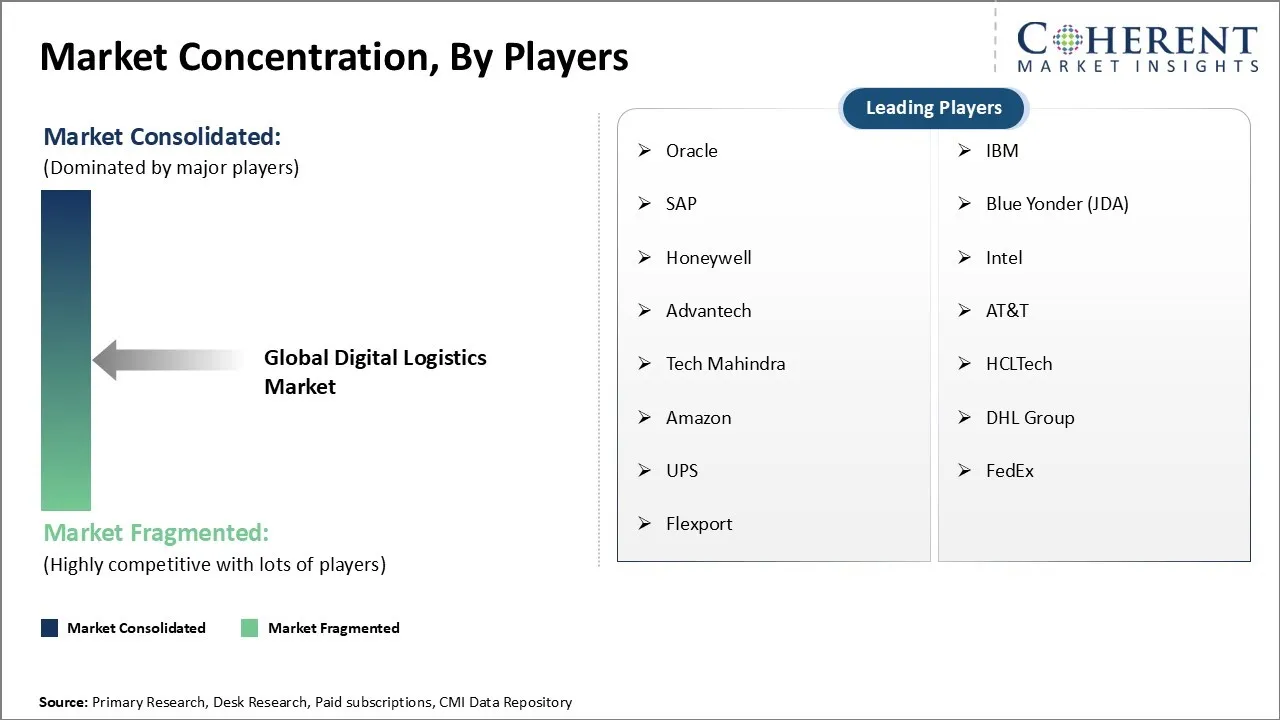
| Companies covered: | Oracle, IBM, SAP, Blue Yonder (JDA), Honeywell, Intel, Advantech, AT&T, Tech Mahindra, HCLTech, Amazon, DHL Group, UPS, FedEx, and Flexport | ||
| Growth Drivers: |
| ||
| Restraints & Challenges: |
| ||
Market Dynamics
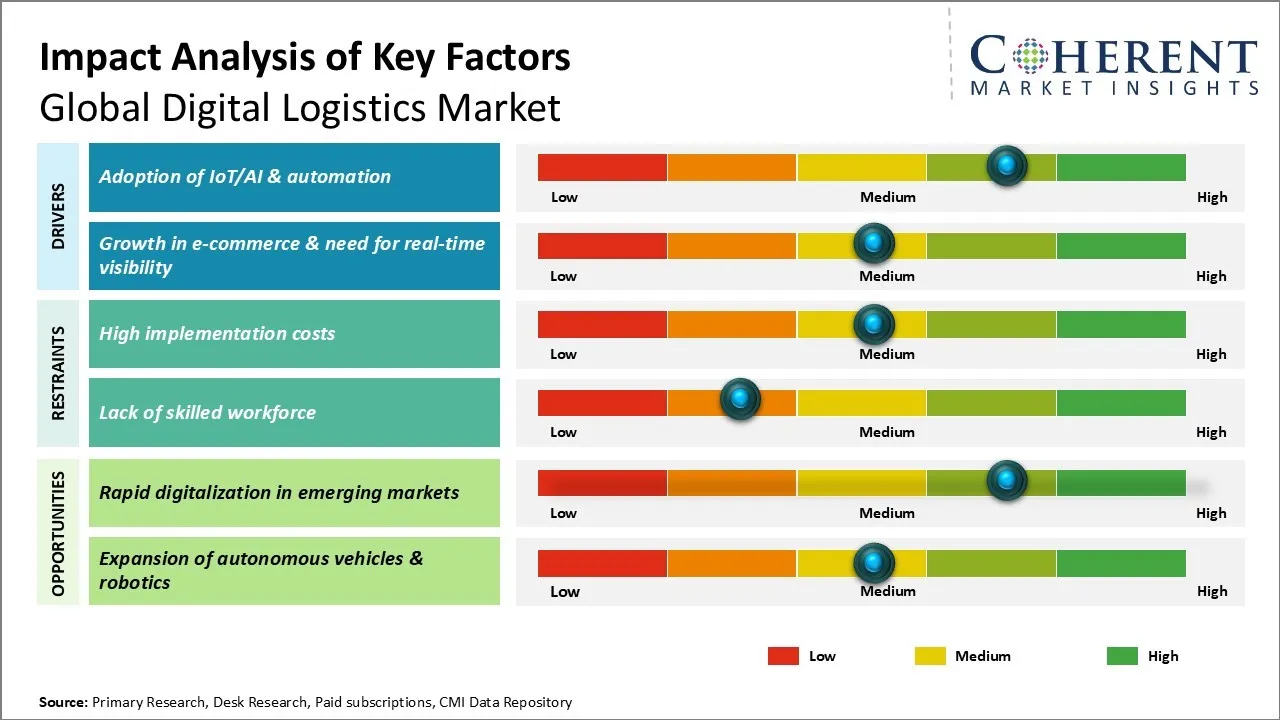
Global Digital Logistics Market Driver - Adoption of IoT/AI & Automation
IoT-enabled devices provide real-time tracking, enhanced supply chain visibility, and predictive maintenance, allowing companies to optimize inventory management and reduce operational inefficiencies. FedEx has deployed its SenseAware IoT platform to track high-value and sensitive shipments (e.g., medical supplies) in real-time. The system monitors environmental factors like temperature, humidity, and light exposure. AI algorithms facilitate intelligent route planning, demand forecasting, and anomaly detection, helping logistics providers to minimize costs and improve delivery accuracy. Automation, including the use of autonomous vehicles, drones, and robotic process automation (RPA), further streamlines warehouse operations and last-mile delivery, boosting overall productivity.
Together, these technologies enable seamless data exchange across the logistics ecosystem, fostering smarter decision-making and agility in response to changing market demands. As companies continue to prioritize digitization to maintain competitiveness and meet escalating customer expectations for speed and transparency, the adoption of IoT, AI, and automation remains a pivotal driver propelling advancements in digital logistics solutions worldwide.
Global Digital Logistics Market Opportunity - Rapid Digitalization in Emerging Markets
With increasing internet penetration, smartphone adoption, and government initiatives promoting digital infrastructure in regions such as Southeast Asia, Latin America, and Africa, these markets are witnessing transformative changes in their supply chain and logistics operations. The integration of advanced technologies like IoT, AI, Blockchain, and cloud computing is enabling real-time tracking, enhanced transparency, and improved operational efficiency even in traditionally underserved areas. Additionally, the rise of e-commerce platforms and growing demand for expedited delivery in these regions are driving the need for sophisticated logistics solutions that leverage digital technology.
Local logistics providers are increasingly adopting digital tools to optimize route planning, inventory management, and last-mile delivery, which not only reduces costs but also elevates customer satisfaction. Moreover, emerging market governments are actively encouraging digital transformation through policy frameworks and investments in smart transportation systems. As part of its National Logistics Policy, in 2022, the government of India launched ULIP, a digital initiative that connects over 30 logistics systems across ports, shipping, railways, customs, and road transport into one interface. This evolving landscape opens avenues for global digital logistics vendors to partner with local players, customize solutions for regional challenges, and tap into large, underserved customer bases.
Analyst Opinion (Expert Opinion)
- Digital logistics is transforming traditional supply chains across industries by embedding intelligence, automation, and real-time visibility into every stage of product movement. In the pharmaceutical and life sciences sector, it is enabling real-time temperature tracking, route optimization, and predictive maintenance across cold chain networks. These capabilities are critical for maintaining the integrity of sensitive products such as vaccines, biologics, and transplant organs—where even minor deviations can compromise patient safety. Regulatory agencies are increasingly treating AI-integrated cold chain platforms as compliance requirements rather than technological add-ons.
- Meanwhile, in retail and e-commerce, the surge in hyperlocal and same-day delivery expectations is driving rapid investments in micro-fulfillment centers, AI-driven last-mile routing, and autonomous delivery vehicles. Retailers across urban hubs in Southeast Asia and the Middle East are leveraging predictive inventory management and location-aware logistics systems to enhance customer satisfaction while managing costs efficiently.
- In manufacturing, digital logistics is becoming a core pillar of Industry 4.0. Manufacturers are using IoT sensors to monitor material flow and AI algorithms to align logistics with just-in-time production schedules. This is particularly impactful in automotive and electronics sectors, where agility and precision are crucial to competitiveness.
Speak to the analyst
Want personalized insights?
Take the findings above to one of our principal consultants, or have the report rebuilt around the segments, geographies and competitors you actually track.
Market Segmentation
- Vertical Insights (Revenue, USD Bn, 2021 - 2033)
- Retail & E‑commerce
- Manufacturing
- Pharmaceuticals & Healthcare
- Automotive
- Aerospace & Defense
- Energy & Utilities
- Fast-Moving Consumer Goods
- Food & Beverage/Perishables
- Others
- Regional Insights (Revenue, USD Bn, 2021 - 2033)
- North America
- U.S.
- Canada
- Latin America
- Brazil
- Argentina
- Mexico
- Rest of Latin America
- Europe
- Germany
- U.K.
- Spain
- France
- Italy
- Russia
- Rest of Europe
- Asia Pacific
- China
- India
- Japan
- Australia
- South Korea
- ASEAN
- Rest of Asia Pacific
- Middle East
- GCC Countries
- Israel
- Rest of Middle East
- Africa
- South Africa
- North Africa
- Central Africa
- North America
- Key Players Insights
- Oracle
- IBM
- SAP
- Blue Yonder (JDA)
- Honeywell
- Intel
- Advantech
- AT&T
- Tech Mahindra
- HCLTech
- Amazon
- DHL Group
- UPS
- FedEx
- Flexport
Sources
Primary Research Interviews
Stakeholders
- 3PL & 4PL Logistics Providers (e.g., regional managers, operations heads)
- Digital Freight Platforms (e.g., platform architects, software leads)
- E-commerce Logistics Managers and Omnichannel Fulfillment Heads
- Transport Management System (TMS) & Warehouse Management System (WMS) Vendors
- Fleet Telematics Providers and IoT Integration Specialists
- Cold Chain Logistics Providers and Life Sciences Logistics Coordinators
- Sustainability Officers and Green Supply Chain Consultants
Databases
- Asia-Pacific Freight Index (APFI)
- North American Supply Chain Benchmark (NASCB)
- Global Transport Connectivity Dataset (GTCD)
- Smart Freight Tracker Database (SFTD)
Magazines
- Smart Logistics Quarterly
- Digital Freight Journal
- Connected Supply Chain Magazine
- NextGen Logistics World
Journals
- Journal of Intelligent Logistics Systems
- AI & Robotics in Transport and Warehousing
- Global Journal of Freight & Digitization
- Urban Mobility & Smart Delivery Studies
Newspapers
- The Logistics Times (UK)
- Supply Chain Daily (USA)
- The Asia Transport Chronicle
- Digital Freight Dispatch (India)
Associations
- Global Smart Logistics Alliance (GSLA)
- Asia-Pacific Logistics Technology Forum (APLTF)
- North American Digital Freight Council (NADFC)
- International Association of Logistics Automation (IALA)
- Green Supply Chain Consortium (GSCC)
Public Domain Sources
- U.S. Census Bureau
- EUROSTAT
- United Nations Economic Commission for Europe (UNECE)
- World Bank
- ResearchGate
Proprietary Elements
- CMI Data Analytics Tool, Proprietary CMI Existing Repository of information for the last 8 years
Get access to 250+ pages report
Every segment, forecast, competitor profile and data table behind the analysis above — available for instant download.
- ESOMAR Member
- ISO 9001:2015 Certified
- D-U-N-S Registered
- GDPR & CCPA Compliant
Missing comfort of reading report in your local language? Find your preferred language:
Transform your Strategy with Exclusive Trending Reports
Frequently Asked Questions
The global digital logistics market is estimated to be valued at USD 50.05 Bn in 2026 and is expected to reach USD 177.26 Bn by 2033.
The CAGR of global digital logistics market is projected to be 19.8% from 2026 to 2033.
Adoption of IoT/AI & automation and growth in e‑commerce & need for real‑time visibility are the major factors driving the growth of global digital logistics market.
High implementation costs and the lack of skilled workforce are the major factors hampering the growth of global digital logistics market.
In terms of Vertical, Retail & E‑commerce subsegment isestimated to dominate the market revenue share in 2026.
Oracle, IBM, SAP, Blue Yonder (JDA), Honeywell, Intel, Advantech, AT&T, Tech Mahindra, HCLTech, Amazon, DHL Group, UPS, FedEx, and Flexport are the major players in the global digital logistics market.
North America is expected to lead the global digital logistics market in 2026.