

Smart Meter Market Size and Share Analysis- 2026 To 2033
The Smart Meter Market size is anticipated to grow at a CAGR of 10.0%, with a market value of USD 31.6 Bn in 2026, and is expected to reach USD 61.58 Bn by 2033. The main factors driving market growth are the increasing use of advanced metering infrastructure (AMI), investments in smart grid upgrades, growing demand for real-time energy monitoring, and greater use of renewable energy. According to India’s Ministry of Power, smart metering projects worth around INR 1.31 lakh crore had been approved under the Revamped Distribution Sector Scheme (RDSS) as of March 2026.
Key Takeaways
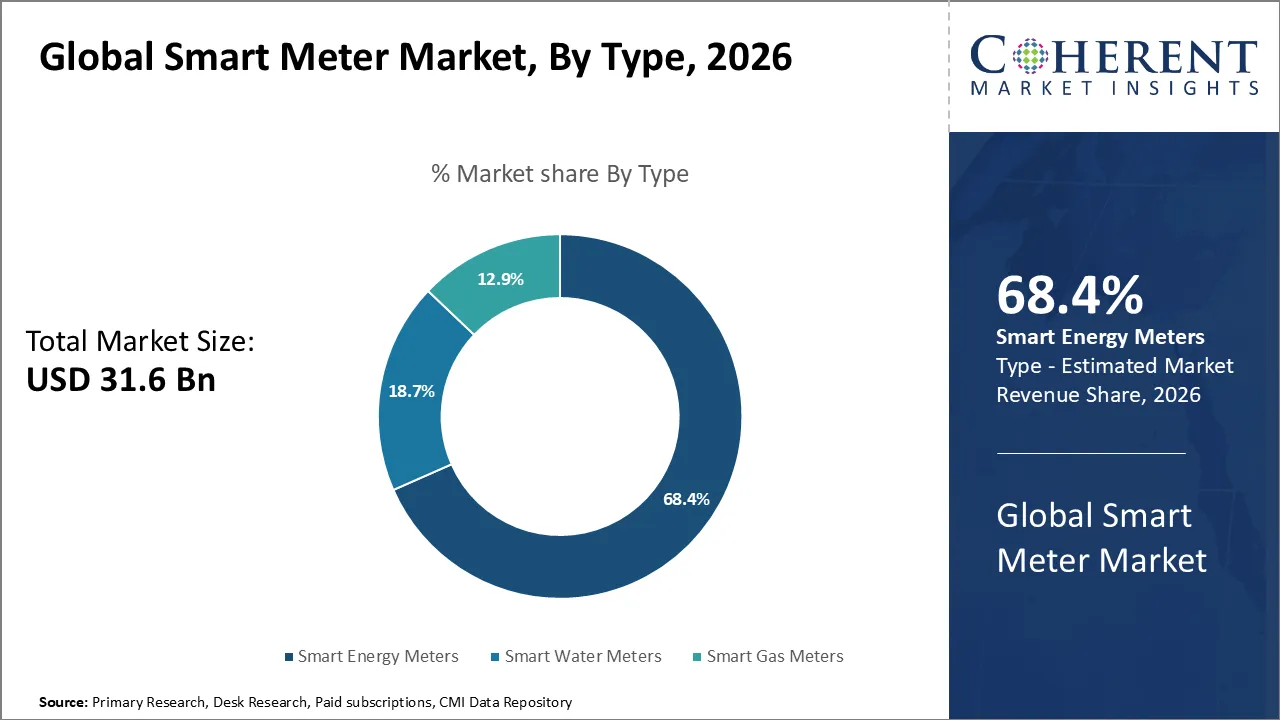
- The smart energy meters segment is likely to dominate the market with 68.4% in 2026. The segment’s growth is owing to the large-scale replacement of conventional electricity meters, increasing deployment of smart electricity infrastructure, greater billing accuracy, and rising utility focus on digital distribution networks. According to the European Commission, around 60% of European households had smart electricity meters by the end of 2024, and the share was above 80% in 15 EU countries.
- The residential segment is expected to dominate with 64.8% in 2026. The segment’s growth is owing to the large household electricity consumer base, increasing deployment of prepaid smart meters, growing demand for near-real-time consumption visibility, and greater consumer participation in energy management.
- The Advanced Metering Infrastructure (AMI) segment is set to lead with 71.6% in 2026. The segment’s growth is owing to the increasing need for two-way communication, automated meter data collection, remote connection and disconnection, outage detection, and real-time distribution network monitoring. According to India’s Ministry of Power, smart metering works covering 19.79 crore consumers, 52.53 lakh distribution transformers, and 2.05 lakh feeders had been sanctioned under the RDSS as of December 2025, demonstrating the large-scale expansion of advanced metering infrastructure.
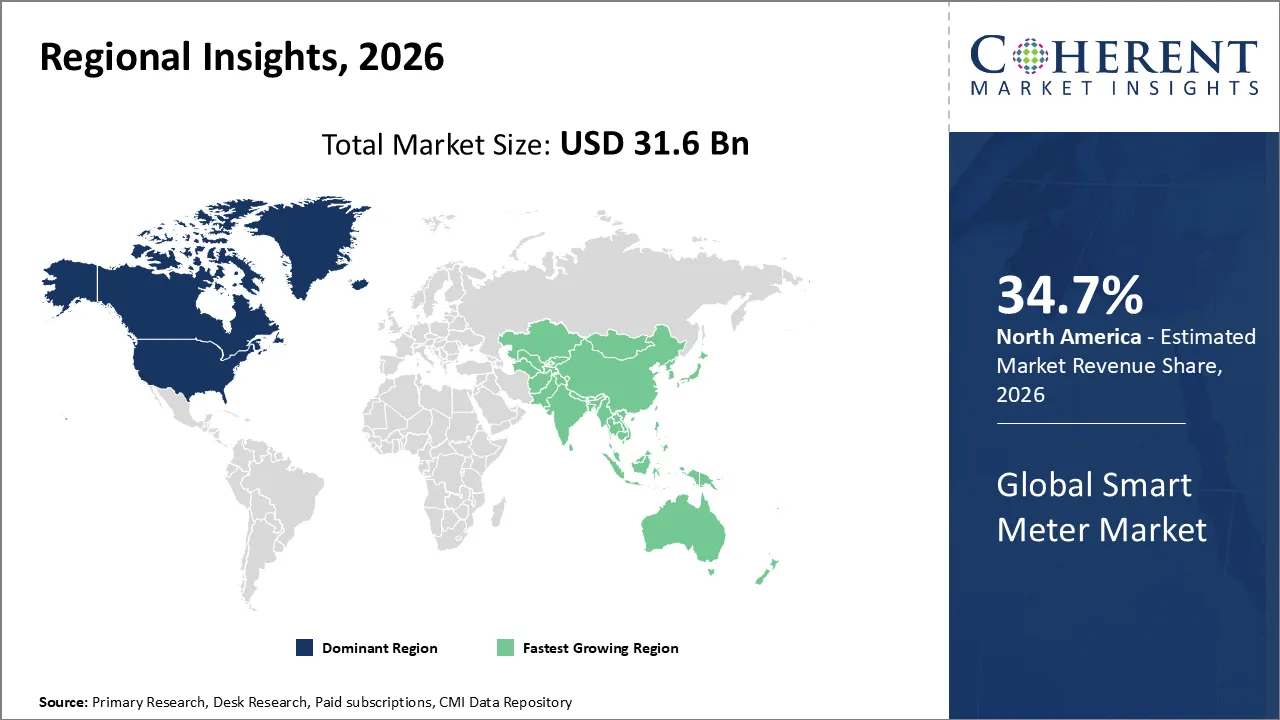
- North America is expected to acquire the prominent share of 34.7% in 2026. The region’s growth is owing to the mature smart-grid ecosystem, high digital-meter penetration, ongoing grid modernization, and increasing utility investment in intelligent distribution infrastructure. The European Commission’s smart-meter deployment assessment, used as an international benchmark, estimates that smart metering investment can generate average savings of around EUR 270 per electricity metering point and energy savings of approximately 2–10%, reinforcing the economic rationale for continued smart-meter investment in mature markets such as North America.
Market Drivers
Rising Electricity Demand and Need for Demand-Side Flexibility are Driving Smart Meter Adoption
Rapid electrification of transport, heating, cooling, industrial processes, and digital infrastructure is increasing pressure on electricity networks. Smart meters are becoming increasingly important because interval-level consumption data and two-way communication allow utilities to better understand demand patterns, introduce flexible tariffs, and encourage consumers to shift electricity consumption away from periods of peak demand.
According to the International Energy Agency (IEA), global electricity demand increased by around 3% in 2025, nearly twice the average pace of overall energy-demand growth observed during the previous decade. The IEA further expects global electricity demand could double by 2035, while requirements for short-term power-system flexibility could increase by approximately two to seven times, depending on the region.
Digitalization of Electricity Networks is Strengthening the Business Case for Smart Metering
Utilities are increasingly using digital technologies to monitor power grids, reduce energy losses, manage outages, and improve network efficiency. Smart meters form an important edge component of this digitalized electricity ecosystem by continuously generating consumption and operational data from customer premises.
The IEA's Digital Demand-Driven Electricity Networks (3DEN) initiative reported that its digital-energy pilot projects helped defer almost USD 60 million in infrastructure investment, digitized more than 60 GWh of industrial energy consumption, and avoided approximately 3,800 tonnes of CO₂ emissions annually through renewable-energy integration, loss reduction, and demand-side flexibility.
Current Events and Their Impact on the Smart Meter Market
Current Event | Description and its Impact |
U.K. Government Introduces Post-2025 Smart Metering Policy Framework (2026) |
|
India Continues Large-Scale Smart Metering Support Under RDSS (2026) |
|
- Current Industry Events of 2026
- Market Size Estimation
- Regional Breakdown
- Competitive Landscape
- Customer Intelligence
- Segmental Analysis
- Pricing Analysis
- Key Market Drivers, Challenges & Future Trends
- Customized Insights Section
Segmental Insights
Why are Smart Energy Meters Acquiring the Largest Share?
On the basis of type, the smart energy meters segment is projected to account for the largest Smart Meter Market share of 68.4% in 2026. The segment’s growth is owing to the substantially larger electricity-meter installed base, accelerating replacement of conventional electricity meters, growing adoption of time-based electricity tariffs, and increasing need for automated consumption monitoring across utility networks. In August 2026, the U.K. government reported that 75% of properties in Great Britain had smart electricity meters, compared with 57% with smart gas meters.
In September 2026, Itron, Inc. launched its Riva S and Riva T IEC electricity meters across the Asia Pacific region. The new meters combine advanced metrology, high-frequency sampling, modular communications, and grid-edge intelligence to improve low-voltage network visibility, outage awareness, transformer loading analysis, and integration of distributed energy resources.
Why is the Residential Segment Acquiring the Largest Share?
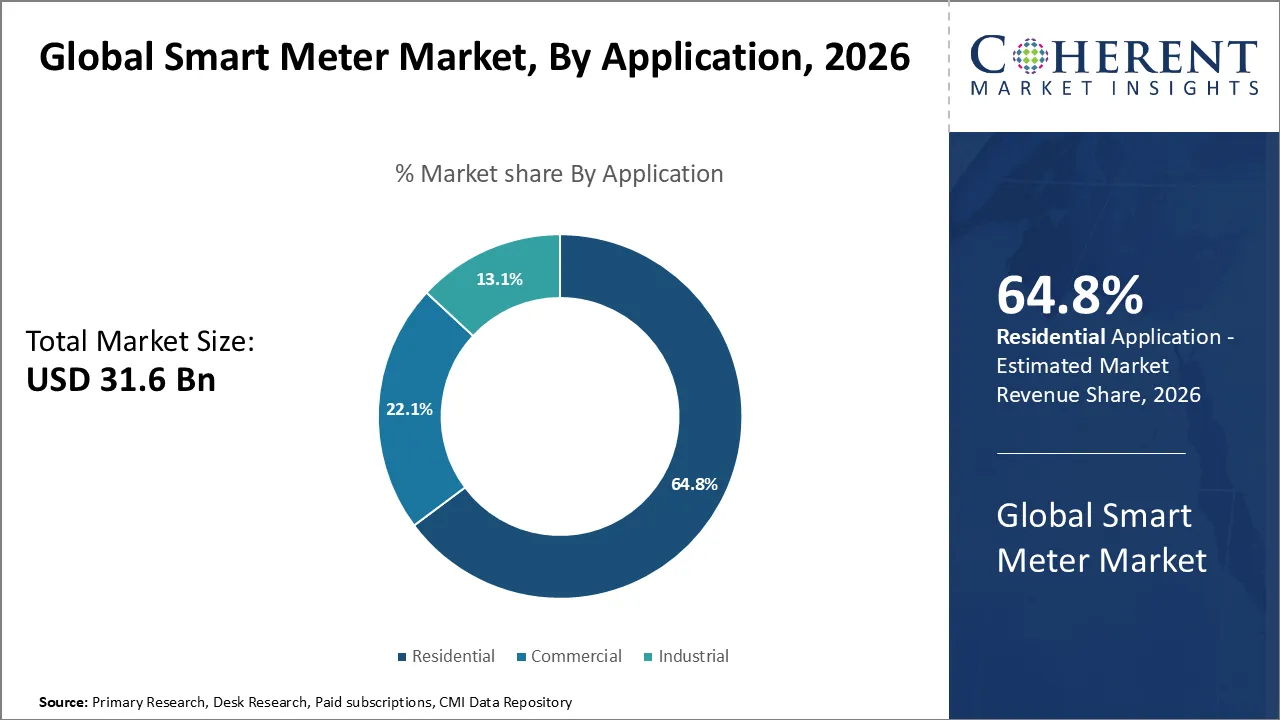
On the basis of application, the residential segment is projected to account for the largest Smart Meter Market share of 64.8% in 2026. The segment’s dominance is owing to the very large number of household metering points, government-backed residential rollout programs, increasing adoption of smart tariffs, and consumer demand for automated billing and better visibility of household electricity consumption.
According to DESNZ, large energy suppliers operated approximately 39 million smart meters in domestic properties across Great Britain at the end of June 2026, with 92% operating in smart mode. Smart meters represented approximately 73% of all domestic meters operated by large suppliers.
In February 2026, Adani Energy Solutions Limited announced that it had installed 1 crore smart electricity meters across several power distribution utilities in India.
Why is Advanced Metering Infrastructure (AMI) Acquiring the Largest Share?
On the basis of technology, the Advanced Metering Infrastructure (AMI) segment is projected to lead the Smart Meter Market with 71.6% in 2026. The segment’s growth is owing to its ability to provide interval consumption data, two-way communication, remote meter management, automated outage detection, demand-response support, and integration with dynamic electricity pricing programs, capabilities that conventional AMR systems cannot fully provide.
According to the U.S. Federal Energy Regulatory Commission (FERC), the number of advanced meters operating in the U.S. increased by approximately 8 million in one year to 119.3 million, representing annual growth of 7.3%. Advanced meters consequently represented more than 72% of the approximately 165 million electricity meters operating across all U.S. customer classes.
Smart Meter Market Trends
- The increasing integration of grid-edge intelligence is transforming smart meters from billing devices into real-time grid-monitoring assets. In September 2026, Itron launched its Riva S and Riva T IEC electricity meters in Asia Pacific with high-frequency sampling, grid-edge intelligence, outage awareness, transformer-loading analysis, and distributed-energy-resource monitoring capabilities. The meters are also built on open DLMS/COSEM standards to support multi-vendor interoperability.
- The transition from 2G/3G to 4G smart-meter communications is emerging as a major technology-upgrade trend. The U.K. government confirmed in March 2026 that smart-meter communications must transition to 4G before 2G and 3G networks are switched off by the end of 2033. The Data Communications Company has already introduced 4G communications in northern regions and is preparing Virtual WAN connectivity for premises without conventional smart-meter WAN coverage.
- The growing shift toward smart-meter data platforms and high-volume digital energy transactions is increasing the strategic value of metering infrastructure. According to the U.K. Department for Energy Security and Net Zero, the country’s smart metering system now handles around 3 billion messages each month, including meter readings, remote commands, tariff updates, and energy data exchanges.
Regional Insights
North America Dominates Owing to Mature AMI Infrastructure and Continued Utility Modernization
North America is expected to account for the prominent 34.7% share of the Smart Meter Market in 2026. The region’s dominance is owing to its mature advanced metering infrastructure, continued replacement of legacy electricity and gas meters, strong utility investment in grid digitalization, and increasing adoption of smart meters for outage management, demand response, and distributed-energy integration.
In September 2026, FortisBC announced that it had installed and connected 500,000 wireless advanced gas meters to its private network in British Columbia, compared with 100,000 meters in November 2025. The utility is upgrading meters for more than 1.1 million gas customers, with deployment scheduled to continue through 2028.
In January 2026, Wasion Americas, Inc. launched the Aventa electric meter, an advanced AMI 2.0 metering platform developed for investor-owned, cooperative, and municipal utilities across the U.S. and Canada.
Asia Pacific Smart Meter Market Trends
Asia Pacific is expected to be the fastest-growing region in the Smart Meter Market over the forecast period, supported by large-scale meter replacement programs, second-generation smart-meter deployments, growing electricity consumption, distributed-energy integration, and government initiatives to digitalize electricity networks. The region is estimated to account for approximately 25.8% of the market in 2026.
As of July 2026, SP Group reported that over 90% of homes and businesses in Singapore had smart meters, with more than 1.72 million units installed. Nationwide rollout is expected to be completed by the end of 2026.
In September 2026, Linyang Energy showcased its end-to-end smart metering and Advanced Metering Infrastructure (AMI) portfolio at Enlit Asia 2026 in Jakarta, Indonesia.
Grid Modernization and Rising Electricity Demand are Accelerating the Smart Meter Market in the United States
The U.S. Smart Meter Market is growing due to grid modernization, increasing digitalization, and rising electricity demand. Smart meters help utilities monitor the grid in real time and manage renewable energy, electric vehicles, and changing electricity demand more efficiently.
In March 2026, the U.S. Department of Energy announced around USD 1.9 billion to upgrade critical power-grid infrastructure, improve grid reliability and efficiency, and support rising electricity demand.
In September 2026, the U.S. Department of Energy announced USD 11.5 million for the GridFM 2.0 project to develop AI-based grid planning tools that can analyze up to 1 billion grid scenarios within 24 hours and significantly speed up key grid calculations.
China Smart Meter Market Trends
China is expected to remain a major Smart Meter Market owing to the scale of its electricity network, centralized utility procurement, continued meter replacement cycles, and deployment of increasingly advanced smart-metering and data-collection technologies.
In March 2026, Wasion Group Limited secured contracts from the State Grid Corporation of China to supply around 462,000 smart meters, valued at approximately RMB 97.66 million. The contracts were awarded through State Grid's special 2026 procurement tender for metering equipment.
Who are the Major Companies in Smart Meter Industry
Some of the major key players in Smart Meter Market are Landis+Gyr, Itron Inc., Siemens AG, Schneider Electric SE, Honeywell International Inc., General Electric Company, ABB Ltd., Kamstrup A/S, Badger Meter, Inc., Sensus (Xylem Inc.), Diehl Metering GmbH, Aclara Technologies LLC, Holley Technology Ltd., Wasion Group Holdings Limited, Jiangsu Linyang Energy Co., Ltd.
Key News
- In February 2026, Aclara Meters Philippines signed a two-year smart-meter supply agreement with Meralco for approximately 72,000 smart meters. This forms the initial phase of Meralco’s broader 10-year AMI program covering around 12 million endpoints in the Philippines, strengthening Aclara’s position in large-scale utility digitalization.
- In August 2026, Kamstrup, Netmore, and Aarhus Vand announced deployment of approximately 69,000 digitally connected water meters across Aarhus Municipality in Denmark. The commercial rollout followed a successful pilot covering around 1,000 households and uses Kamstrup metering technology connected through a LoRaWAN network.
Market Report Scope
Smart Meter Market Report Coverage
Report Coverage | Details | ||
Base Year: | 2025 | Market Size in 2026: | USD 31.6 Bn |
Historical Data for: | 2020 to 2024 | Forecast Period: | 2026 to 2033 |
CAGR: | 10.0% | 2033 Value Projection: | USD 61.58 Bn |
Geographies covered: |
| ||
Segments covered: |
| ||
Companies covered: | Landis+Gyr, Itron Inc., Siemens AG, Schneider Electric SE, Honeywell International Inc., General Electric Company, ABB Ltd., Kamstrup A/S, Badger Meter, Inc., Sensus (Xylem Inc.), Diehl Metering GmbH, Aclara Technologies LLC, Holley Technology Ltd., Wasion Group Holdings Limited, Jiangsu Linyang Energy Co., Ltd. | ||
Growth Drivers: |
| ||
Restraints & Challenges: |
| ||
Analyst Opinion
- The Smart Meter Market is increasingly moving beyond basic meter replacement toward data-driven energy management and flexible electricity pricing. In January 2026 domestic smart time-of-use tariff penetration in Great Britain had reached 2.8%, with customer adoption rising 68% over the previous 12 months from 497,000 to 835,000. The gradual rollout of Market-wide Half-Hourly Settlement during 2026 is expected to further increase the use of actual half-hourly smart-meter consumption data, strengthening demand for advanced metering and meter-data platforms.
- The market is also entering a phase in which smart-meter performance and restoration of connectivity are becoming as important as new installations. Regulatory action involving nine energy suppliers helped restore more than 900,000 previously non-functioning smart meters to smart operation since July 2024.
- Smart-meter infrastructure is increasingly becoming part of a broader digital energy-data ecosystem rather than a standalone utility asset. In September 2026, Ofgem proposed a new Smart Data Repository under the Market-wide Half-Hourly Settlement program that would allow electricity settlement data to be shared with authorized third parties through consumer consent.
Speak to the analyst
Want personalized insights?
Take the findings above to one of our principal consultants, or have the report rebuilt around the segments, geographies and competitors you actually track.
Market Segmentation
- By Type (Revenue, USD Bn, 2021-2033)
- Smart Energy Meters
- Smart Water Meters
- Smart Gas Meters
- By Application (Revenue, USD Bn, 2021-2033)
- Industrial
- Commercial
- Residential
- By Technology (Revenue, USD Bn, 2021-2033)
- Automatic Meter Reading (AMR)
- Advance Metering Infrastructure (AMI)
- By Region (Revenue, USD Bn, 2021-2033)
- North America
- U.S.
- Canada
- Latin America
- Brazil
- Mexico
- Argentina
- Rest of Latin America
- Europe
- Germany
- U.K.
- France
- Italy
- Spain
- Russia
- Rest of Europe
- Asia Pacific
- China
- India
- Japan
- Australia
- South Korea
- ASEAN
- Rest of Asia Pacific
- Middle East
- GCC
- Israel
- Rest of Middle East
- Africa
- South Africa
- Central Africa
- North Africa
- North America
Sources
Primary Research Interviews
- Smart meter manufacturers and technology providers
- Advanced Metering Infrastructure (AMI) solution providers
- Electric, gas, and water utility companies
- Meter data management and communication technology providers
- Smart grid and distribution network engineers
- Utility procurement and operations managers
- Energy regulators and smart grid industry experts
- Key opinion leaders (KOLs) in smart metering and grid digitalization
Databases
- U.S. Energy Information Administration (EIA)
- International Energy Agency (IEA)
- World Bank
- Eurostat
- U.S. Federal Energy Regulatory Commission (FERC)
- U.S. Department of Energy (DOE)
- European Commission – Directorate-General for Energy
- Government energy and electricity databases
Magazines
- Smart Energy International
- POWER Magazine
- Utility Dive
- T&D World
- Electrical Review
- Power Engineering International
Journals
- IEEE Transactions on Smart Grid
- IEEE Transactions on Power Systems
- International Journal of Electrical Power & Energy Systems
- Electric Power Systems Research
- Applied Energy
- Energy Reports
Newspapers
- The Wall Street Journal
- Financial Times
- Reuters
- The Guardian
- The Economic Times
- Nikkei Asia
Associations
- Smart Energy Consumer Collaborative (SECC)
- Utilities Technology Council (UTC)
- International Electrotechnical Commission (IEC)
- DLMS User Association
- European Smart Metering Industry Group (ESMIG)
- GridWise Alliance
- Edison Electric Institute (EEI)
Public Domain Sources
- Company Annual Reports and Investor Presentations
- Utility Smart Meter Rollout and Procurement Documents
- Government Smart Grid and Metering Program Publications
- Regulatory Commission Filings and Tariff Documents
- Smart Meter Tender and Contract Award Documents
- Grid Modernization and AMI Deployment Reports
- Electricity Distribution and Energy Policy Publications
- Smart Meter Standards and Interoperability Guidelines
Proprietary Elements
- CMI Data Analytics Tool
- Proprietary CMI Existing Repository of Information for the Last 10 Years
Get access to 250+ pages report
Every segment, forecast, competitor profile and data table behind the analysis above — available for instant download.
- ESOMAR Member
- ISO 9001:2015 Certified
- D-U-N-S Registered
- GDPR & CCPA Compliant
Missing comfort of reading report in your local language? Find your preferred language:
Transform your Strategy with Exclusive Trending Reports
Frequently Asked Questions
The Smart Meter Market is expected to reach USD 61.58 Bn in 2033, up from USD 31.6 Bn in 2026
Major players operating in the global Smart Meter Market include Landis+Gyr, Itron Inc., Siemens AG, Schneider Electric SE, Honeywell International Inc., General Electric Company, ABB Ltd., Kamstrup A/S, Badger Meter, Inc., Sensus (Xylem Inc.), Diehl Metering GmbH, Aclara Technologies LLC, Holley Technology Ltd., Wasion Group Holdings Limited, and Jiangsu Linyang Energy Co., Ltd.
High initial installation and infrastructure costs, cybersecurity risks, and data privacy concerns are among the key factors hampering growth of the Smart Meter Market.
Increasing deployment of Advanced Metering Infrastructure (AMI), rising investments in smart grid modernization, growing demand for real-time energy monitoring, and increasing integration of renewable energy and distributed energy resources are driving growth of the Smart Meter Market.
The Smart Meter Market is anticipated to grow at a CAGR of 10.0% between 2026 and 2033.
Among regions, North America is expected to hold the largest share of the global Smart Meter Market, accounting for approximately 34.7% in 2026.
Asia Pacific is expected to be the fastest-growing region over the forecast period, supported by large-scale meter replacement programs, second-generation smart-meter deployments, rising electricity consumption, and government-led grid digitalization initiatives.