

Global Gas Meter Market Size and Forecast – 2026 To 2033
The global gas meter market is expected to grow from USD 4 Bn in 2026 to USD 5.65 Bn by 2033, registering a compound annual growth rate (CAGR) of 3.7% from 2026 to 2033. The global gas meter market is driven by growing adoption of smart gas metering systems. On August 19, 2025, Flonidan announced the debut of its SciFlo Smart Gas Meter, the first standalone gas smart meter of its kind to be installed in the U.K.
Key Takeaways of the Global Gas Meter Market
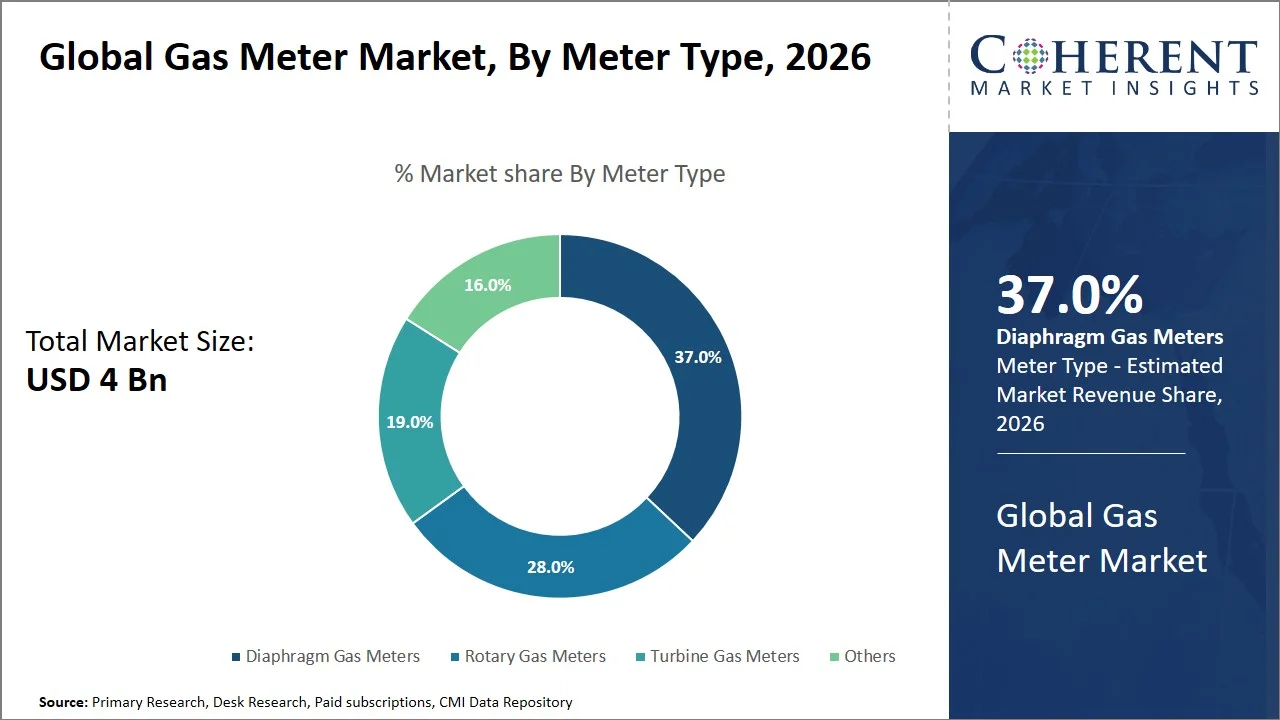
- The Diaphragm Gas Meters segment is expected to account for 37.0 % of the global gas meter market share in 2026. Expansion of Advanced Metering Infrastructure is driving the growth of the segment. On May 5, 2025, Itron introduced a solar-powered access point for difficult utility communication environments.
- The Conventional Gas Meters segment is estimated to capture 41.0 % of the market share in 2026. Government programs supporting energy efficiency is majorly driving the growth of the segment. On March 11, 2026, The United Kingdom government introduced a new smart metering framework. Energy suppliers must take reasonable steps toward completing domestic smart meter deployment by December 2030.
- The Wired segment is estimated to capture 32.0 % of the market share in 2026. Rising demand for automated meter reading is driving the growth of the segment. On May 13, 2026, Liberty New York Gas began installing an automated meter reading system across its service territory. The rollout uses Encoder Receiver Transmitter devices attached to existing gas meters.
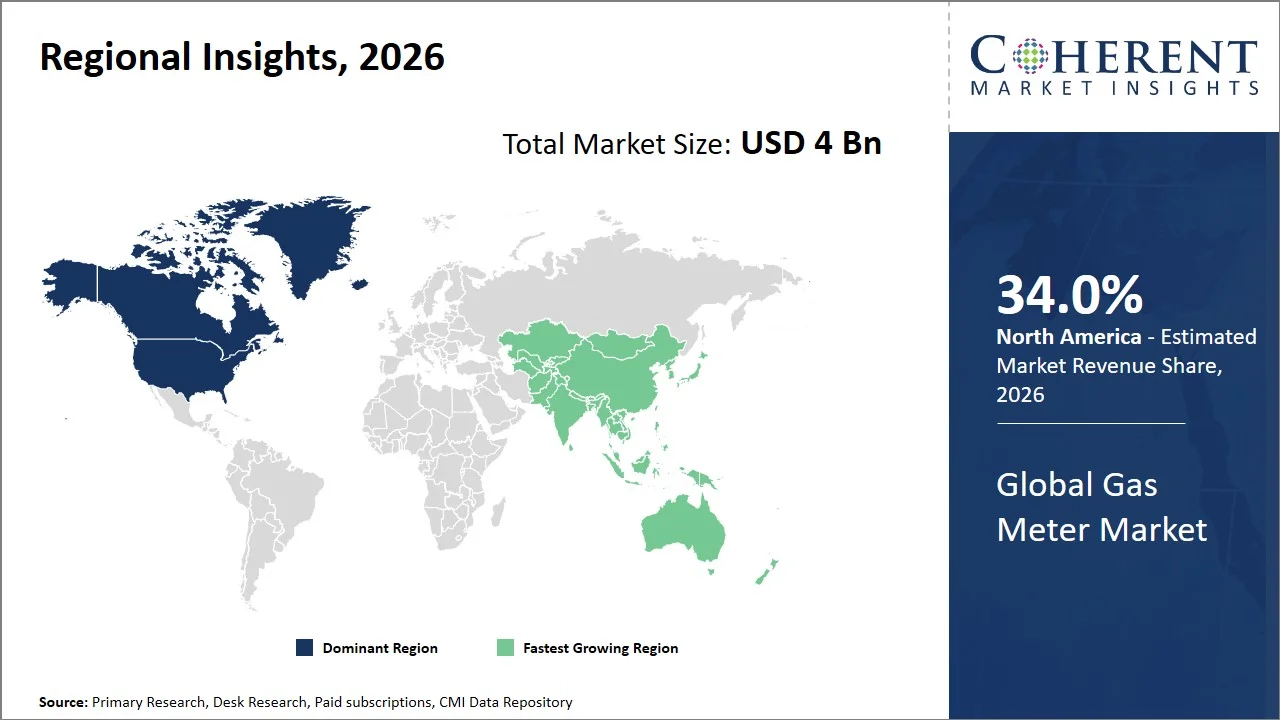
- North America is expected to dominate the gas meter market in 2026 with a market share of 34.0 %. Increasing integration of gas meters with Internet of Things platforms in North America is driving the growth of the regional market. By September 2025, National Grid installed approximately 132,000 gas smart meters and 919,000 electric smart meters across upstate New York.
- Asia Pacific is expected to account for 23.0 % share in 2026. Increasing deployment of low power wireless technologies in Asia Pacific is driving the growth of the regional market. In October 2025, NTT West expanded LoRaWAN-based smart gas metering in Japan. The solution connects gas meters and remotely controlled valves through LoRaWAN Class B communication.
Segmental Insights
Why Does Diaphragm Gas Meters Dominate the Global Gas Meter Market?
The diaphragm gas meters segment is expected to account for 37.0% of the global gas meter market share in 2026. Diaphragm gas meters are generally selected because they provide dependable measurement for variable residential gas flow situations. The mechanical design provides accurate measurement at low and variable flow rates. These meters have also proved to be robust during long periods of operation and with relatively low maintenance requirements. They have a proven manufacturing environment that allows them to deploy at low-cost for a big base of residential customers. Utilities are also encouraged to continue to embrace them because of their compatibility with existing gas distribution infrastructure. On August 21, 2026, Bharat Petroleum Corporation Limited floated a tender for purchase of home diaphragm gas meters. The tender is specific for G1.6 regular diaphragm gas meters for a municipal gas distribution project. This acquisition indicates the sustained utility need for proven residential diaphragm technology in India’s increasing piped-gas infrastructure.
- Current Industry Events of 2026
- Market Size Estimation
- Regional Breakdown
- Competitive Landscape
- Customer Intelligence
- Segmental Analysis
- Pricing Analysis
- Key Market Drivers, Challenges & Future Trends
- Customized Insights Section
Why is Conventional Gas Meters the Most Preferred Technology Type?
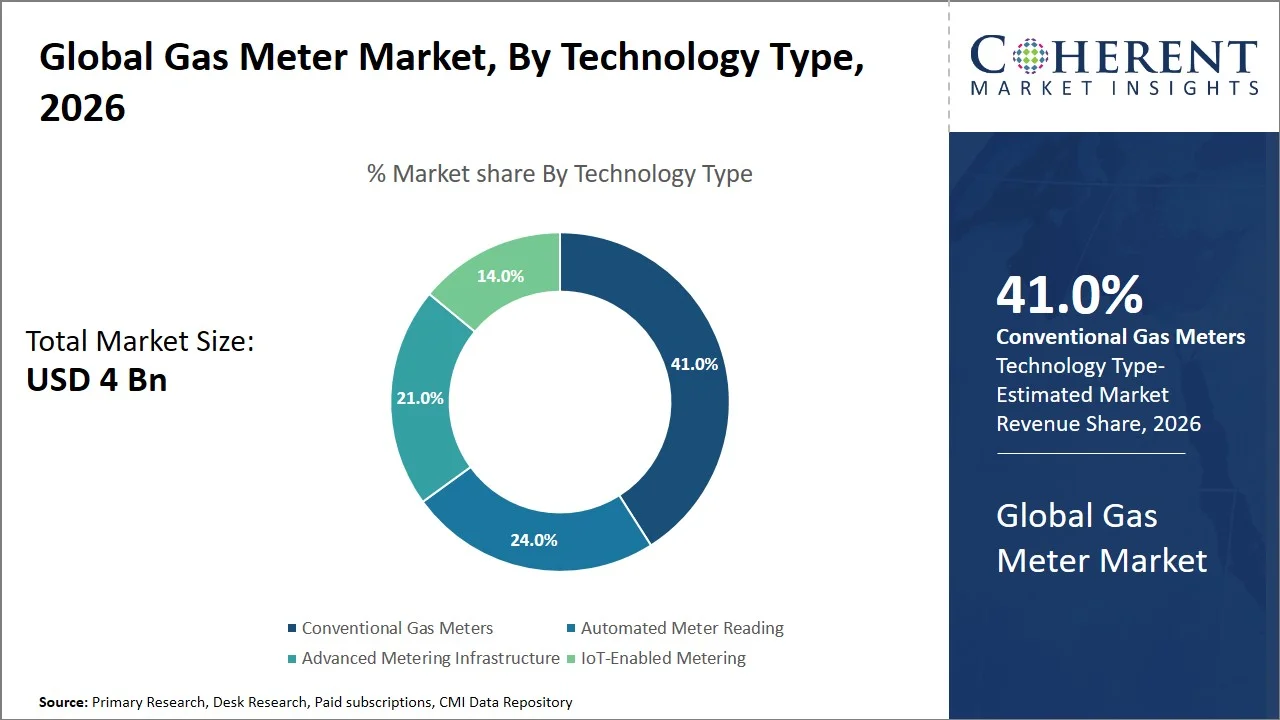
The conventional gas meters segment is expected to account for 41.0% of the global gas meter market share in 2026. Conventional gas meters are still largely used due to comparatively inexpensive installation and maintenance cost. Their tested mechanical designs enable reliable performance in household and commercial applications. Utilities can install them without requiring large communication infrastructure or complex digital integration. Their long history of operation has also led to a high degree of familiarity among utility operators and technicians. These features make conventional systems viable where advanced metering infrastructure is inadequate. In September 2025, MWA Technology renewed the cooperation with Metrix for conventional diaphragm meters. The company highlighted Metrix UG-G G4 and G10 diaphragm meters for United Kingdom utility and commercial applications. The products maintain BS746 compliance and Measurement Instruments Directive certification.
Wired Dominates the Global Gas Meter Market
The wired segment is expected to account for 32.0% of the global gas meter market share in 2026. Wired communication provides stable data transmission across established gas distribution infrastructure. It provides reliable communication without relying on wireless signal or network coverage. Utilities can connect wired systems to existing communications networks and central monitoring platforms. This also allows for accurate data collecting in areas when the signal is disrupted. That means cable connectivity is still a good fit for utilities that need reliable, continuous meter communication. For example, in 2025 and 2026 Itron still supported wired M-Bus connectivity for gas meters. Its Cyble M-Bus module permits remote reading of compatible gas meters on M-Bus networks. It offers a number of fixed date readings and can be integrated with utility management systems. It is also useful for wired communication setups that require structured meter data gathering and centralized monitoring.
Current Events and their Impact
Current Events | Description and its Impact |
European Union Energy Efficiency Directive 2023/1791 |
|
European Union Implementing Regulation 2023/1162 |
|
United Kingdom Ofgem Smart Meter Standards Rules 2026 |
|
Gas Meter Market Dynamics
Market Drivers
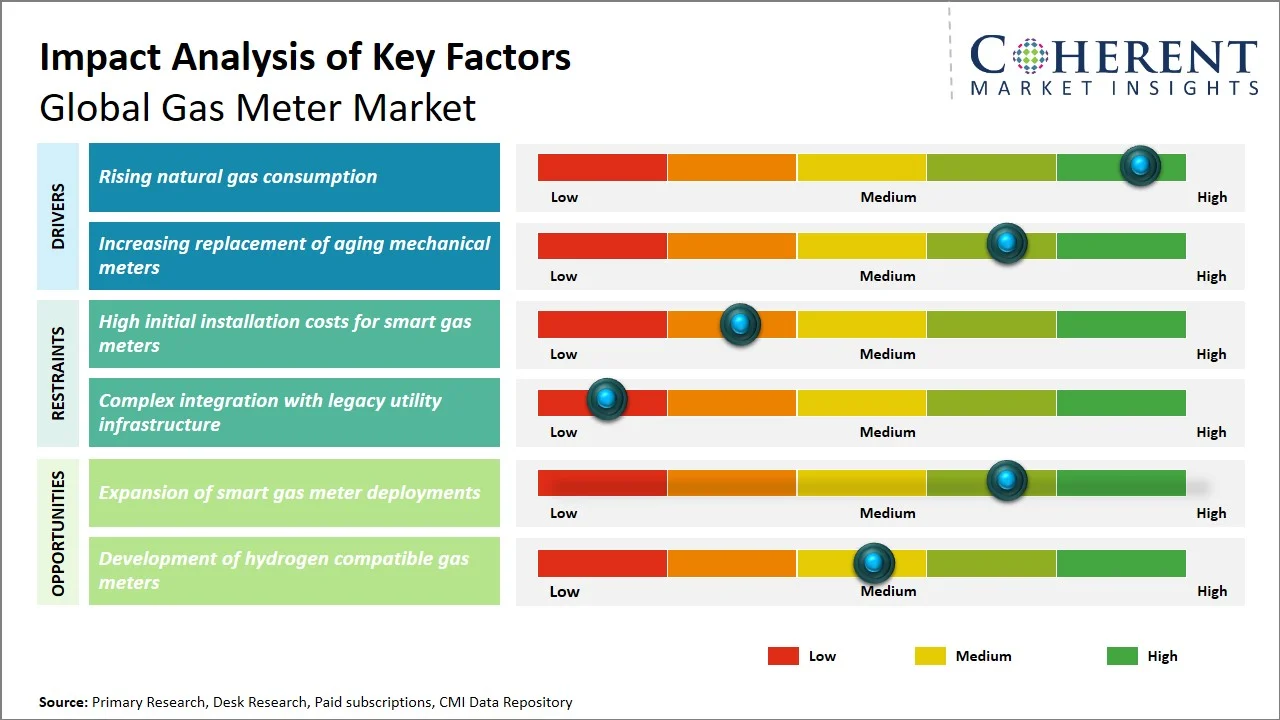
- Rising natural gas consumption: Growing natural gas consumption is increasing the need for reliable gas measurement throughout residential, commercial and industrial networks. The expansion of city gas distribution systems, especially in developing economies, is adding new consumer connections. Utilities need reliable meters to monitor consumption precisely and to bill customers transparently. The use of industrial gas is on the rise, as is the demand for metering solutions that have increased capacity. The expansion of gas infrastructure thus offers ongoing business prospects for makers of gas meters and technology providers. For example, Bharat Petroleum Corporation Limited forecasts LNG sales to increase almost thrice by 2030. The company plans to sell about 6.5-6.6 million tons of LNG a year. This growth is being supported by rising demand from industrial customers, city gas networks and transit.
- Increasing replacement of aging mechanical meters: Growing replacement of aging mechanical meters is producing recurring demand in established gas distribution networks. Measurement mistakes can result from long-term operation and wear of mechanical components in older meters. So, utilities are replacing old equipment with new meters that are more accurate and more reliable to operate. Replacement projects also provide opportunity to add automated reading and remote monitoring capability. This upgrading trend supports an ongoing need for meters in mature gas markets with large installed meter bases. Greer Commission of Public Works reported 28,419 natural gas meters installed by July 2026. The project had reached 85% completion at that point. The utility is replacing existing gas meters as part of a broader upgrade program covering multiple utility services.
Emerging Trends
- Growing Smart Gas Meter Deployment: Utilities are progressively using smart gas meters to automate usage monitoring and provide remote meter administration. Advanced communication capabilities provide more frequent data gathering, improved billing accuracy, operational insight and the ability to detect anomalous consumption trends in residential and business networks.
- Increasing Hydrogen Compatible Meter Development: Gas meter manufacturers are developing measuring technologies compatible with hydrogen and hydrogen-natural gas mixes. These technologies address varying gas compositions whilst retaining measurement precision, enabling utility decarbonization programs and preparing the existing distribution infrastructure for the future adoption of low carbon gasses.
- Expansion of Ultrasonic Metering Technologies: Increasing popularity of ultrasonic gas meters due to its accurate measurement without any mechanical moving components. Their digital architecture allows for better diagnostics, remote monitoring, longer operating lifetimes and integration with new utility management systems which require specific consumption information.
- Integration with Internet of Things Platforms: Gas meters are increasingly being integrated with Internet of Things platforms for centralized monitoring and automated analysis of data. Connected architectures allow utilities to detect anomalies, track network performance, enhance maintenance planning, and boost consumer energy management
Regional Insights
Why is North America a Strong Market for Gas Meter?
North America is expected to account for a market share of 34.0% in 2026. Gas metering is being implemented using modernized and upgraded wireless communications from utilities in North America. U.S. utilities are increasingly using RF mesh networks for gas and electricity metering. Wireless RF communication dominates many North American smart metering installations. Utilities are also progressing toward second generation Advanced Metering Infrastructure programs. Private cellular networks are gaining attention for applications requiring stronger communication flexibility. These developments are encouraging replacement of conventional gas meters with connected devices offering remote monitoring and diagnostics.
Why Does Asia Pacific Gas Meter Market Exhibit High Growth?
Asia Pacific is expected to register the fastest growth with a CAGR of 4.8% over the forecast period. Asia Pacific is projected to account for 23.0% of the global gas meter market in 2026. Strong demand for gas meters in Asia Pacific is being driven by urban gasification and increasing household connections. China is ramping up its smart gas meter implementation as part of its digital utility transformation. Japan is pushing remote meter reading to offset labor shortages and enhance emergency response capabilities. Osaka Gas Network began gradual smart meter operations in May 2025. The system was jointly developed with Tokyo Gas Network and Toho Gas Network. Regional manufacturers are also developing connected meters supporting remote data collection and operational monitoring. These developments are strengthening demand for digital gas metering across densely populated urban networks.
Global Gas Meter Market Outlook for Key Countries
Why is U.S. Emerging as a Major Hub in the Gas Meter Market?
The U.S. gas meter market is underpinned by aging gas infrastructure and utility safety priorities. In May 2025, Peoples Natural Gas got Itron’s 3 millionth Intelis gas meter. The Intelis meter is designed to automatically close the valve under high pressure, high flow or high temperature conditions Itron has also introduced Gen6 networking capabilities for Intelis gas meter platforms. These capabilities support battery mesh communication and over-the-air upgrades. Large investor-owned utilities are driving second generation metering investments across mature service territories. Remote diagnostics and reducing the number of field trips are becoming a major procurement concern.
Is China the Next Growth Engine for the Gas Meter Market?
China is stepping up the rollout of smart gas metering along with urbanization and rising use of residential natural gas. Municipal gas suppliers are replacing traditional meters with prepaid, remotely-managed systems. Smart meters enable remote billing and monitoring of use, and automated supply management. Chinese firms are also adding Internet of Things connectivity to household gas meters. With the digital platform, utilities may track client usage and detect aberrant demand. Large metropolitan gas systems offer significant prospects for introduction of connected metering technologies. Digital utility programs and the developing city gas infrastructure are enabling ongoing technology changes.
Japan Gas Meter Market Analysis and Trends
Japan is leading the way in remote operations, safety monitoring and labor productivity increases in gas metering. Osaka Gas Network started gradual remote meter reading activities utilizing smart meters from May 2025. The supporting smart meter technology was created collaboratively by Tokyo Gas Network and Toho Gas Network. Smart meters allow remote reading, remote operation and remote data collection. They can also shut off gas in emergency situations. These services decrease the need for physical meter reading appointments for the consumer. As Japan’s workforce ages, automated meter operations are growing in importance to gas distribution businesses.
Australia Gas Meter Market Analysis and Trends
Australia is transitioning selected gas customers toward digital metering while maintaining a targeted replacement strategy. Australian Gas Networks is implementing digital metering programs in Victoria and South Australia. Its Victorian program builds on a South Australian proof of concept completed during 2022-23. The program targets inaccessible meters and industrial and commercial customers. Digital data eliminates meter reader attendance and supports more accurate billing information. Australian Gas Networks has also developed scalable information technology infrastructure for wider deployment. This approach addresses difficult meter access while improving operational efficiency across selected customer groups.
India Gas Meter Market Analysis and Trends
India is expanding gas metering alongside rapid city gas distribution development and household conversion from liquefied petroleum gas. In August 2026, the government established incentives for city gas providers to expand household piped gas connections. The effort assists in building infrastructure in residential markets. Some of the companies which are likely to benefit from the rising household connections include Indraprastha Gas and Mahanagar Gas. With the increasing use of piped gas, there are further demands on household diaphragm and smart gas meters. As coverage increases to more cities, distribution companies are also increasing network monitoring. The infrastructure expansion is producing new metering needs across the developing metropolitan gas ecosystem of India.
Global Gas Meter Market - Artificial Intelligence for Gas Consumption Anomaly Detection (2025)
Artificial Intelligence Application | Estimated Adoption Among Connected Gas Meter Deployments |
Consumption Anomaly Detection | 34% |
Gas Leakage Detection | 27% |
Meter Tampering Detection | 19% |
Unaccounted Gas Detection | 12% |
Predictive Meter Fault Detection | 8% |
How is Expansion of Smart Gas Meter Deployments Creating New Growth Opportunities in the Gas Meter Market?
The growth of smart gas meter deployments is providing opportunities for suppliers offering integrated measurement, communications and safety capabilities. By May 2025 Itron claimed three million shipped Intelis gas meters. Peoples Natural Gas deploys these meters across Pennsylvania and Kentucky to provide remote shutdown and safety monitoring. Osaka Gas Network is replacing traditional meters with smart meters during installation and during certification-period replacements. Its system allows for remote readings, and emergency remote shut off. Itron also announced Gen6 networking, which can be used to create a battery-powered mesh for gas devices. This opens new potential for communication modules, software platforms, ultrasonic meters and remote safety applications. On December 11, 2025, Vodafone Idea Business expanded smart gas metering systems in India. The company launched Internet of Things and Advanced Metering Infrastructure solutions for City Gas Distribution companies. The product is aimed at digital gas metering and operational modernization across Indian gas networks.
Market Players, Key Development, and Competitive Landscape
Key Developments
- On April 10, 2026, FLONIDAN, a leading provider of smart gas metering solutions, announced it has been awarded a major contract to supply potentially millions of next-generation gas meters to the Dutch Distribution System Operators (DSOs) Netbeheer Nederland. The agreement marks the largest contract in FLONIDAN’s history, reinforcing its position as a long-standing and trusted partner in the Netherlands’ energy transition.
- On October 28, 2025, Sensirion announced the launch of its new SGM5304 gas meter module. Building on the proven success of previous versions, the SGM5304 combines a low-power consumption mode, future-ready compatibility and seamless integration, all within the same compact form factor.
Competitive Landscape
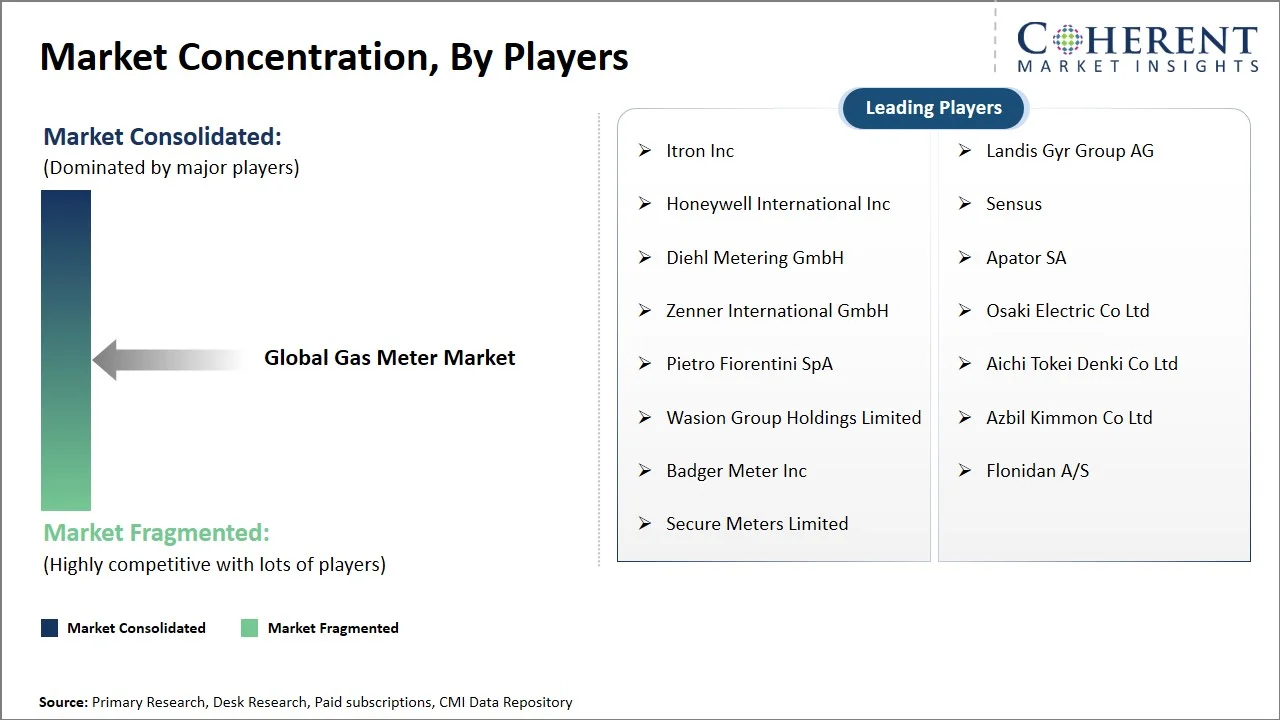
The global gas meter market is led by Itron, Landis+Gyr, Honeywell, Diehl Metering, and Apator. Itron focuses on solid-state metering, safety controls, and connected gas networks. In May 2025, the Intelis platform hit three million shipments. The milestone meter went to Peoples Natural Gas’ Pennsylvania and Kentucky businesses. Landis+Gyr is expanding its autonomous safety and ultrasonic measurement capabilities. It has a G480 platform with cellular connectivity, remote cutoff and a 20-year battery life. Landis+Gyr is also incorporating cybersecurity into gas devices through its 2025 SEALSQ collaboration. Competition is therefore shifting toward integrated measurement, communications, safety, cybersecurity, and utility software capabilities.
Market Report Scope
Gas Meter Market Report Coverage
| Report Coverage | Details | ||
|---|---|---|---|
| Base Year: | 2025 | Market Size in 2026: | USD 4 Bn |
| Historical Data for: | 2020 To 2024 | Forecast Period: | 2026 To 2033 |
| Forecast Period 2026 to 2033 CAGR: | 3.7% | 2033 Value Projection: | USD 5.65 Bn |
| Geographies covered: |
| ||
| Segments covered: |
| ||
| Companies covered: | Itron Inc, Landis Gyr Group AG, Honeywell International Inc, Sensus, Diehl Metering GmbH, Apator SA, Zenner International GmbH, Osaki Electric Co Ltd, Pietro Fiorentini SpA, Aichi Tokei Denki Co Ltd, Wasion Group Holdings Limited, Azbil Kimmon Co Ltd, Badger Meter Inc, Flonidan A/S, Secure Meters Limited | ||
| Growth Drivers: |
| ||
| Restraints & Challenges: |
| ||
Analyst Opinion (Expert Opinion)
- The industry's future is expected to center increasingly on smart gas meters with embedded safety intelligence. Ultrasonic platforms should gain stronger attention because they eliminate mechanical moving components. Landis+Gyr's G480 demonstrates this direction through solid-state measurement and autonomous shutoff functions. Retrofit communication modules should also remain important where utilities cannot replace complete installed meter bases.
- The strongest geographic opportunity is expected in India and China because expanding city gas networks create new meter installations. Japan offers another specialized opportunity through remote meter reading and emergency remote operations. Osaka Gas Network launched smart-meter operations in May 2025. Its system may be read remotely, operated remotely and collected remotely. North America should continue to be attractive for replacement-focused prospects with safety-enabled residential meters.
- Players looking for an edge should combine accurate measurement with remote diagnostics and automated safety functions. An example of the importance of automatic valve closing for abnormal pressure, flow or temperature conditions is Itron’s Intelis. Manufacturers should also focus on interoperable communication architectures and enhanced device cybersecurity. Landis+Gyr’s North American gas devices cybersecurity implementation is an example of this increasing competitive requirement.
Speak to the analyst
Want personalized insights?
Take the findings above to one of our principal consultants, or have the report rebuilt around the segments, geographies and competitors you actually track.
Market Segmentation
- Meter Type Insights (Revenue, USD Billion, 2021 - 2033)
- Diaphragm Gas Meters
- Rotary Gas Meters
- Turbine Gas Meters
- Others
- Technology Type Insights (Revenue, USD Billion, 2021 - 2033)
- Conventional Gas Meters
- Automated Meter Reading
- Advanced Metering Infrastructure
- IoT-Enabled Metering
- Communication Technology Insights (Revenue, USD Billion, 2021 - 2033)
- Wired
- Wireless
- Narrowband Internet of Things
- Long Range Wide Area Network
- Cellular
- Application Insights (Revenue, USD Billion, 2021 - 2033)
- Residential
- Commercial
- Industrial
- Regional Insights (Revenue, USD Billion, 2021 - 2033)
- North America
- U.S.
- Canada
- Latin America
- Brazil
- Argentina
- Mexico
- Rest of Latin America
- Europe
- Germany
- U.K.
- Spain
- France
- Italy
- Russia
- Rest of Europe
- Asia Pacific
- China
- India
- Japan
- Australia
- South Korea
- ASEAN
- Rest of Asia Pacific
- Middle East
- GCC Countries
- Israel
- Rest of Middle East
- Africa
- South Africa
- North Africa
- Central Africa
- North America
- Key Players Insights
- Itron Inc
- Landis Gyr Group AG
- Honeywell International Inc
- Sensus
- Diehl Metering GmbH
- Apator SA
- Zenner International GmbH
- Osaki Electric Co Ltd
- Pietro Fiorentini SpA
- Aichi Tokei Denki Co Ltd
- Wasion Group Holdings Limited
- Azbil Kimmon Co Ltd
- Badger Meter Inc
- Flonidan A/S
- Secure Meters Limited
Sources
Primary Research Interviews
- Gas Meter Manufacturers & Suppliers
- Utility Companies & Gas Distribution Network Operators
- Government & Regulatory Bodies (Energy Sector)
- End-Use Industry Representatives (Industrial, Commercial & Residential)
Magazines
- Gas Technology Magazine
- Metering International Magazine
- Energy & Utilities Magazine
- Pipeline & Gas Journal
Journals
- Journal of Natural Gas Science and Engineering
- International Journal of Energy Research
- Journal of Energy Resources Technology
Associations
- American Gas Association (AGA)
- International Gas Union (IGU)
- European Gas Research Group (GERG)
- Gas Technology Institute (GTI)
Public Domain Sources
- U.S. Energy Information Administration (EIA)
- International Energy Agency (IEA)
- World Bank Energy Data
- European Commission – Energy Statistics
Proprietary Elements
- CMI Data Analytics Tool
- Proprietary CMI Existing Repository of Information for Last 10 Years
Get access to 250+ pages report
Every segment, forecast, competitor profile and data table behind the analysis above — available for instant download.
- ESOMAR Member
- ISO 9001:2015 Certified
- D-U-N-S Registered
- GDPR & CCPA Compliant
Missing comfort of reading report in your local language? Find your preferred language:
Transform your Strategy with Exclusive Trending Reports
Frequently Asked Questions
The global gas meter market is expected to stand at USD 4 Bn in 2026 and is expected to reach USD 5.65 Bn by 2033.
The CAGR of the global gas meter market is projected to be 3.7% from 2026 to 2033.
A gas meter measures the volume of natural gas consumed by residential, commercial, or industrial customers.
Advanced Metering Infrastructure connects meters with communication networks and utility systems for automated data exchange.
Yes, connected meters can identify unusual consumption patterns and communicate alerts to utility operators.
Certain advanced meters include remotely controlled valves for emergency isolation and operational management.
Residential meters enable accurate billing across large customer bases using piped natural gas.