

UV Lamps Market Size and Share Analysis - Growth Trends and Forecast (2026 - 2033)
The global UV lamps market size is estimated to reach USD 596.5 Mn in 2026 and is projected to grow at a CAGR of 11.3% during the forecast period (2026-2033), surpassing USD 1,302 Mn by 2033. This growth is mostly due to rising demand for non-chemical disinfection technologies across municipal water treatment plants, healthcare facilities, commercial buildings, industrial processing units, and residential environments.
Key Takeaways from the UV Lamps Market Report
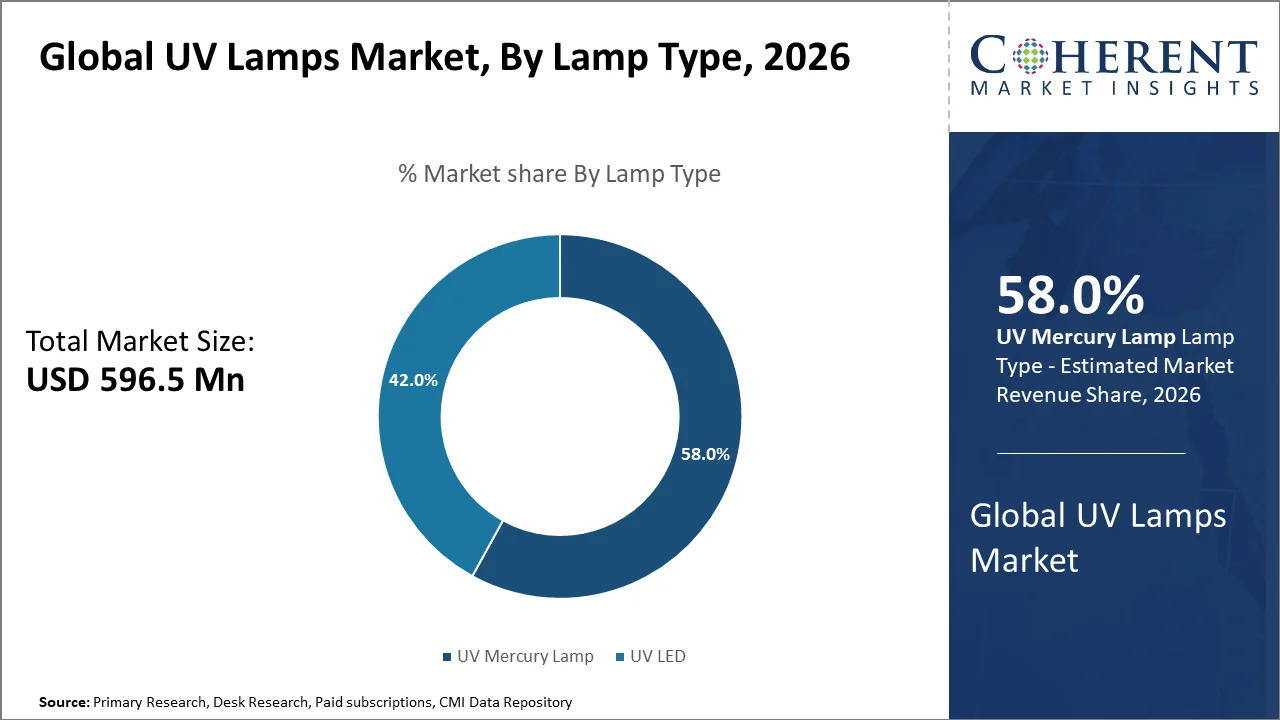
- UV mercury lamps are expected to account for nearly 58% of global market revenue in 2025. Their leadership stems from a vast installed base across municipal water and wastewater treatment facilities, where operators rely on their proven germicidal performance as well as high irradiation output and established compliance with regulatory standards.
- Water treatment is expected to lead the market with a 42% share in 2026. This is due to the rising need for safe drinking water, stricter water quality rules, and ongoing investment in water infrastructure. According to the WHO/UNICEF JMP, about 2.1 billion people lacked safely managed drinking water in 2024, increasing the need for better treatment technologies like UV disinfection.
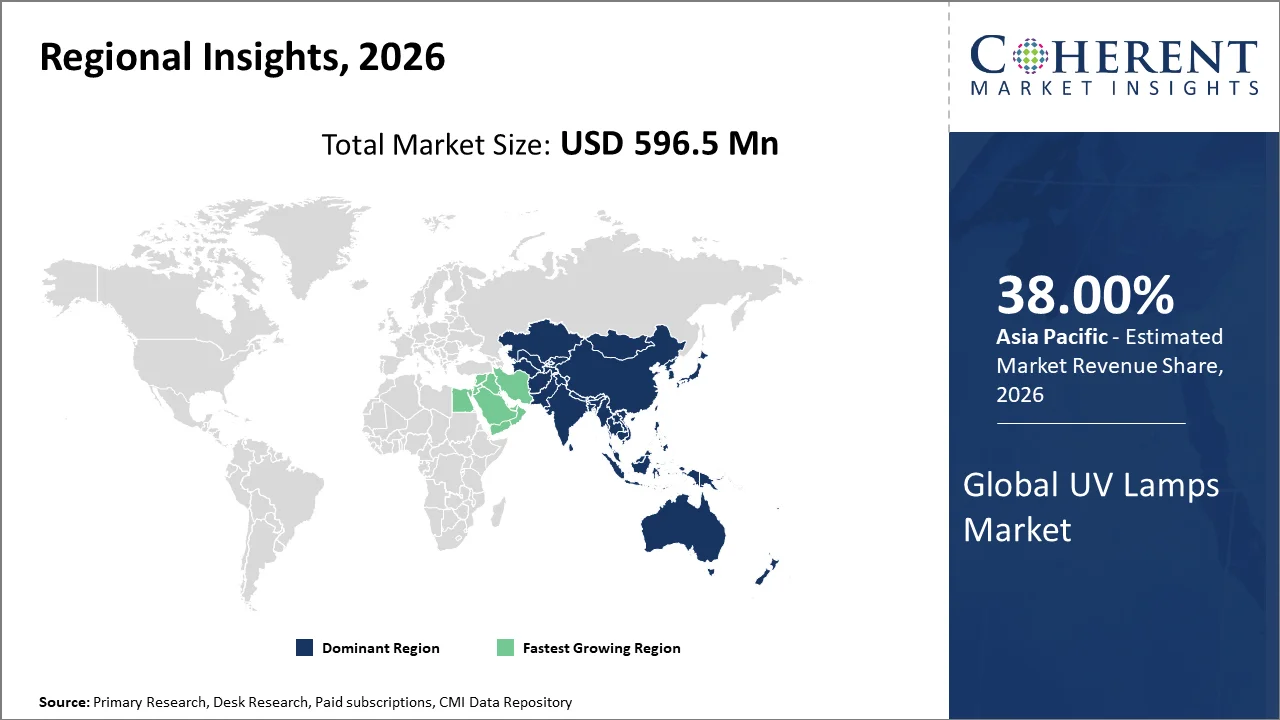
- Asia Pacific is expected to lead the ultraviolet lamps market with a 38% share in 2026, owing to rapid urbanization, industrial growth, and large-scale investments in water infrastructure. For example, India increased funding for the Jal Jeevan Mission to INR67,000 crore in 2025 and extended the programme through 2028, supporting long-term demand for UV-based disinfection systems.
- Middle East and Africa is anticipated to emerge as a highly lucrative market for UV lamp manufacturers during the forecast period, registering a CAGR of nearly 12%. Water scarcity, population growth, urban development, and rising investments in desalination infrastructure are creating strong demand for advanced treatment technologies in the region.
UV Lamps Market Overview
The global UV lamps market is poised to exhibit robust growth during the forecast period. This is primarily due to rising demand for effective, chemical-free disinfection technologies across water and wastewater treatment facilities, healthcare environments, and industrial applications. Increasing concerns over waterborne diseases and stringent government regulations on water quality and environmental safety are also fueling adoption of ultraviolet (UV) disinfection systems.
Ultraviolet lamps are artificial light sources that produce ultraviolet light ranging between 100 and 400 nanometers. According to the wavelength range of ultraviolet radiation, there are three categories of UV light: UV-A (315–400 nm), UV-B (280–315 nm), and UV-C (100–280 nm). These have different uses in industry and commerce, but UV-C is the most effective when it comes to disinfection because it inhibits the replication of microbial cells.
Innovation within the UV-LED segment is also gaining momentum. Nichia Corporation recently launched a mercury-free LED light source in 2025 that can be used in large water purification units. On the other hand, Signify, among other market leaders, continues its diversification strategy by launching new products related to UV-C in the domains of air purification, surface sterilization, and sterilization of objects.
As water security, infection prevention, and environmental sustainability move higher on government and corporate agendas, UV technologies are increasingly being viewed not only as disinfection tools but also as critical infrastructure for safeguarding public health and supporting resilient treatment systems.
Segmental Insights
Which Mercury-Based UV Lamps Continue to Lead the Global Market?
Proven Performance and Large Installed Base Keep Mercury UV lamps in the Lead
According to Coherent Market Insights’ latest UV lamps market analysis, UV mercury lamps are set to account for the largest market revenue share of 58% in 2026. This dominance is attributable to their well-established installed base, relatively low upfront cost, and proven high-intensity UV output.
Despite increasing popularity of UV-LED technology, mercury-based UV lamps continue to form the foundation of the global ultraviolet disinfection industry. UV Mercury-based systems are widely used in municipal and industrial water and wastewater treatment applications due to their reliable UV output as well as consistent pathogen inactivation performance under a range of operating conditions. Large existing installed infrastructure across global treatment facilities is a key factor supporting their continued use.
UV Mercury-based systems are widely used in municipal as well as industrial water and wastewater treatment applications due to their reliable UV output and consistent pathogen inactivation performance under a range of operating conditions. A significant factor supporting their continued use is the large existing installed infrastructure across global treatment facilities.
Trojan Technologies states that there are over 11,000 municipal UV systems installed in over 100 countries. This is a significant amount of water treated daily through the installation of such systems. More than 2,000 municipalities employ TrojanUV wastewater disinfection systems, which are still utilizing traditional UV systems despite the introduction of new UV-LED systems.
- Current Industry Events of 2026
- Market Size Estimation
- Regional Breakdown
- Competitive Landscape
- Customer Intelligence
- Segmental Analysis
- Pricing Analysis
- Key Market Drivers, Challenges & Future Trends
- Customized Insights Section
Which End Use Application Dominates the UV Lamps Market?
Water Treatment Set to Lead the Market with Over Two-Fifths Share in 2026
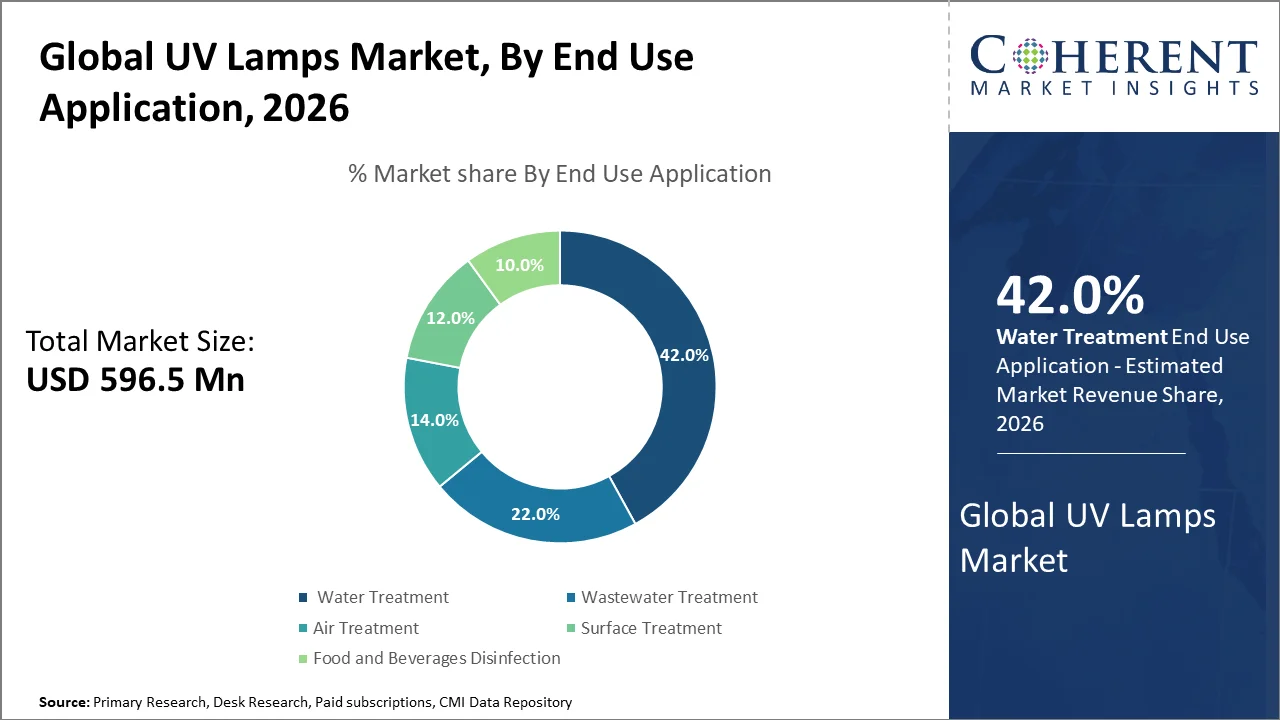
By end-use application, water treatment is projected to lead the market, accounting for a share of 42% in 2026. This is mostly due to rapid expansion of municipal and industrial water treatment infrastructure as well as implementation of stringent regulations governing microbial contamination and drinking water safety across both developed and emerging economies.
UV disinfection is gaining strong traction as a complementary treatment technology within modern water purification systems, particularly in applications where chemical-free or low-chemical disinfection is preferred. Its ability to inactivate bacteria, viruses, and protozoa without generating disinfection by-products supports its growing adoption in regulatory-compliant treatment frameworks.
Unlike the process involving chlorine, the ultraviolet technology deactivates the microorganisms by interfering with the DNA structure of the organisms, thus preventing them from reproducing. As such, UV technology is very efficient against microorganisms that cannot be inactivated by chlorine, such as Cryptosporidium and Giardia. In addition, UV treatment does not alter water taste, odor, or chemical composition, making it highly suitable for municipal upgrades and advanced treatment stages.
UV Lamps Market Growth Drivers
Rising Investment in Water and Wastewater Infrastructure
Expansion of water and wastewater infrastructure is providing a strong impetus for the growth of UV lamps market. Growing pressure on water resources, increasing urbanization, and tightening environmental regulations are driving significant investments in water and wastewater treatment infrastructure around the world. More than 4 billion people, over half of the global population, live in urban areas. Municipal authorities in the contemporary world are under increasing pressure to improve drinking water quality, expand sanitation coverage, and meet stricter discharge standards. As a result, utilities are modernizing treatment facilities as well as adopting advanced disinfection technologies capable of delivering consistent microbial control while minimizing environmental impact.
UV disinfection has become an important element of these modernization efforts. Its ability to achieve high pathogen log-reduction rates without chemical additives makes it particularly attractive for municipal and industrial treatment applications, often as a secondary or complementary disinfection step. The challenge remains considerable. According to the WHO/UNICEF Joint Monitoring Programme, more than 2 billion people globally still lack access to safely managed drinking water services. Addressing this gap will require substantial investment in treatment infrastructure, creating long-term opportunities for UV disinfection equipment manufacturers and technology providers.
Growing Adoption of UV Disinfection for Air and Surface Sterilization
The application of UV technology is expanding well beyond water treatment. Rising awareness of infection prevention, indoor air quality, and workplace health standards is accelerating adoption across healthcare facilities, transportation networks, commercial buildings, educational institutions, and industrial environments.
UV-C systems are increasingly being integrated into air handling units (AHUs), HVAC networks, cleanrooms, laboratories, and hospital environments to reduce airborne pathogen transmission and improve environmental hygiene. Unlike chemical disinfectants, ultraviolet germicidal irradiation (UVGI) provides continuous microbial control without leaving residues or requiring extensive manual intervention. This makes it particularly attractive for high-occupancy environments where maintaining clean air and sterile surfaces is a priority.
ASHRAE recognizes UV-C as a supplemental technology for improving indoor air quality and infection control. As organizations place greater emphasis on indoor environmental quality and infection control, deployment of UV-based sterilization systems is expected to increase significantly.
UV Lamps Market Opportunities
Rising Popularity of UV-LED Technologies
Rapid development of UV LED technology is expected to create lucrative growth opportunity for the UV lamps market during the forecast period. Growing regulatory scrutiny of mercury-containing products, combined with increasing demand for energy-efficient disinfection systems, is creating favourable conditions for the adoption of mercury-free alternatives.
Compared with traditional mercury lamps, UV-LED systems offer several technical advantages, including lower energy consumption, longer service life, compact form factors, instant start-up capability, precise wavelength targeting, and reduced maintenance requirements. The technology is gaining increasing interest across water treatment, air purification, healthcare, food processing, pharmaceutical manufacturing, and consumer electronics applications.
Improvements in optical efficiency, thermal management, and semiconductor design are also helping to overcome many of the performance limitations that previously restricted adoption. For example, in 2024, ams OSRAM launched the OSLON UV 3535, a high-performance mercury-free UV-C LED designed for efficient disinfection and treatment applications. As manufacturing costs continue to decline and UV-C output levels improve, UV-LED systems are expected to become one of the fastest-growing segments within the broader ultraviolet disinfection market during the forthcoming period.
Current Events and Their Impact on the UV Lamps Market
Current Event | Description and its Impact |
EPA validation of UV disinfection effectiveness in drinking water systems |
|
CDC guidance supporting UVGI as a supplemental air disinfection method in healthcare |
|
Regional Insights
Asia Pacific Remains at the Epicenter of UV Lamps Market Growth
Asia Pacific is expected to account for around a 38% share of the global UV lamps market in 2026. This dominance is attributable to expanding healthcare infrastructure, rising adoption of UV disinfection systems in hospitals and water treatment facilities, and increasing industrialization. Growing government investments in safe drinking water and infection prevention are also supporting market expansion.
The increasing focus on improving water quality and healthcare hygiene is expected to drive demand for UV lamps across Asia Pacific during the forthcoming period. According to the This is indicative of investments made in healthcare and water facilities, which have paved way for the use of sophisticated disinfection technologies like UV systems.
Middle East Becoming a Highly Lucrative Market for UV Lamp Manufacturers
Middle East is anticipated to emerge as a highly lucrative market for manufacturers of UV lamps during the forecast period, registering a CAGR of 12%. This is mostly due to increasing investments in water treatment infrastructure as well as rising awareness of infection prevention and expanding healthcare facilities.
Rising demand for safe water and better healthcare hygiene is expected to increase use of UV disinfection technologies in ME during the forthcoming period. For example, Saudi Water Authority is expanding wastewater treatment and water reuse projects under the country's water strategy, where UV disinfection is widely used as a chemical-free treatment method. This is expected to create significant opportunities for UV lamp manufacturers.
UV Lamps Market Outlook – Country-wise
U.S. UV Lamps Market Forecast
The United States is forecast to remain a key market for UV lamps during the projection period. This is due to rising adoption of UV-C disinfection technologies in healthcare facilities, stringent water treatment regulations, and increasing use of UV systems in HVAC and air purification applications. Growing investments in infection prevention and sustainable water treatment solutions are also supporting ultraviolet lamps market growth in the nation. The CDC is collaborating with partners in Georgia and Kazakhstan to develop a regional infection prevention and control (IPC) training program for healthcare workers.
China UV Lamps Market Trends
The UV lamps market in China is projected to grow rapidly during the forecast period. This can be attributed to rapid expansion of municipal water and wastewater treatment infrastructure, increasing industrial demand for UV curing systems, and rising adoption of UV disinfection technologies in healthcare and public facilities. Government initiatives promoting clean water, environmental protection, and advanced manufacturing are also boosting sales of UV lamp technologies across the country.
Who are the Major Companies in the UV Lamps Market?
Some of the major players in UV Lamps Market are Xylem Inc., Atlantic Ultraviolet Corporation, Calgon Carbon Corporation, Halma PLC, Trojan Technologies Inc., Heraeus Holding Gmbh, Xenex Disinfection Services LLC, Severn Trent PLC, OSRAM Gmbh, and Koninklijke Philips N.V.
Key Strategies Adopted by Industry Players
Top manufacturers of UV lamps are adopting various organic and inorganic strategies to boost their sales as well as gain a competitive edge over the industry. These include new product launches, investments in R&D, partnerships, mergers, acquisitions, distribution agreements, collaborations, and joint ventures.
- In October 2024, ams OSRAM expanded its UV-C LED portfolio with the launch of the OSLON UV 3535. The mercury-free UV-C LED is designed for efficient disinfection and treatment applications.
- In March 2024, Nichia launched UV-B (308 nm) and UV-A (330 nm) LEDs. These products are expected to speed up transition from UV mercury lamps to LED-based solutions across a wide range of applications.
- In June 2024, Silanna UV launched its new 235 nm Quad High-Power Far-UVC LED at the CFUST 2024 in Scotland. The mercury-free LED is designed for applications like surface disinfection, air purification as well as home appliance sterilization, liquid chromatography, and medical device sterilization.
Market Report Scope
UV Lamps Market Report Coverage
| Report Coverage | Details | ||
|---|---|---|---|
| Base Year: | 2025 | Market Size in 2026: | USD 596.5 Mn |
| Historical Data for: | 2020 To 2024 | Forecast Period: | 2026 To 2033 |
| Forecast Period 2026 to 2033 CAGR: | 11.3% | 2033 Value Projection: | USD 1,302 Mn |
| Geographies covered: |
| ||
| Segments covered: |
| ||
| Companies covered: | Xylem Inc., Atlantic Ultraviolet Corporation, Calgon Carbon Corporation, Halma PLC, Trojan Technologies Inc., Heraeus Holding Gmbh, Xenex Disinfection Services LLC, Severn Trent PLC, OSRAM Gmbh, and Koninklijke Philips N.V. | ||
| Growth Drivers: |
| ||
| Restraints & Challenges: |
| ||
Analyst Opinion (Expert Opinion)
- Demand is expanding beyond healthcare. UV lamps are being increasingly used in water treatment, HVAC systems, food processing, and industrial manufacturing as organizations prioritize better hygiene, cleaner air, and safer production environments.
- There is increasing interest in UV-C LED technology. Compared to traditional mercury lamps, UV-C LEDs offer longer lifespans, instant operation, compact designs, and lower environmental impact. This encourages product innovation, opens new application areas, and supports premium product sales.
- Investments in indoor air quality are ongoing, both from government organizations and businesses. Germicidal UV (GUV/UVGI) is acknowledged by health professionals as an additional technology that can reduce airborne microbes in buildings when applied along with ventilation systems.
- Using UV light for disinfection has been successful for decades. Upper-room germicidal UV systems have been used for over 70 years to aid in the prevention of airborne illnesses. Rising adoption of this technology across various industries is expected to boost growth of UV lamps market during the forthcoming period.
Speak to the analyst
Want personalized insights?
Take the findings above to one of our principal consultants, or have the report rebuilt around the segments, geographies and competitors you actually track.
Market Segmentation
- By Lamp Type Insights ( Revenue, USD Mn, 2021 - 2033)
- UV Mercury Lamp
- UV LED
- By End Use Application Insights ( Revenue, USD Mn, 2021 - 2033)
- Wastewater Treatment
- Water Treatment
- Air Treatment
- Surface Treatment
- Food and Beverages Disinfection
- By Region Insights ( Revenue, USD Mn, 2021 - 2033)
- North America
- U.S.
- Canada
- Latin America
- Brazil
- Argentina
- Mexico
- Rest of Latin America
- Europe
- Germany
- U.K.
- Spain
- France
- Italy
- Russia
- Rest of Europe
- Asia Pacific
- China
- India
- Japan
- Australia
- South Korea
- ASEAN
- Rest of Asia Pacific
- Middle East
- GCC
- Israel
- Rest of Middle East
- Africa
- North Africa
- Central Africa
- South Africa
- North America
Sources
Primary Research Interviews
- UV lamp manufacturers
- UV LED technology providers
- Raw material and component suppliers
- OEMs and system integrators
- Healthcare and laboratory professionals
- Water and wastewater treatment companies
- Air purification and HVAC solution providers
- Electronics and semiconductor manufacturers
- Industry experts and consultants
- Distributors and channel partners
Databases
- World Bank Data
- International Monetary Fund (IMF)
- UN Comtrade Database
- OECD Data
- United States Census Bureau
- U.S. Energy Information Administration (EIA)
- National Center for Biotechnology Information (NCBI)
Magazines
- LEDs Magazine
- Photonics Spectra
- Water & Wastes Digest
- Pollution Engineering
- Cleanroom Technology
- Laser Focus World
Journals
- Journal of Photochemistry and Photobiology
- Applied Optics
- Optics Express
- Journal of Hazardous Materials
- Water Research
- Environmental Science & Technology
Newspapers
- The Wall Street Journal
- Financial Times
- The New York Times
- The Guardian
- The Economic Times
- Nikkei Asia
Associations
- International Ultraviolet Association (IUVA)
- Illuminating Engineering Society (IES)
- International Commission on Illumination (CIE)
- Water Environment Federation (WEF)
- American Water Works Association (AWWA)
- International Society for Optics and Photonics (SPIE)
Public Domain Sources
- World Health Organization (WHO)
- U.S. Environmental Protection Agency (EPA)
- U.S. Food and Drug Administration (FDA)
- Centers for Disease Control and Prevention (CDC)
- European Commission
- International Energy Agency (IEA)
- United Nations Environment Programme (UNEP)
- National Institute of Standards and Technology (NIST)
Proprietary Elements
- CMI Data Analytics Tool
- Proprietary CMI Existing Repository of Information for Last 10 Years
Get access to 250+ pages report
Every segment, forecast, competitor profile and data table behind the analysis above — available for instant download.
- ESOMAR Member
- ISO 9001:2015 Certified
- D-U-N-S Registered
- GDPR & CCPA Compliant
Missing comfort of reading report in your local language? Find your preferred language:
Transform your Strategy with Exclusive Trending Reports
Frequently Asked Questions
The global UV Lamps Market size is estimated to reach USD 596.5 Mn in 2026.
The global UV Lamps Market value is expected to reach USD 1,302 Mn by 2033.
The global UV Lamps Market is poised to exhibit a CAGR of 11.3% from 2026 to 2033.
Major growth factors include rising demand for chemical-free disinfection technologies and expansion of water and wastewater treatment infrastructure.
UV mercury lamps are expected to account for nearly 58% of global market revenue in 2025.
Some major companies in the UV Lamps Market include Xylem Inc., Atlantic Ultraviolet Corporation, Calgon Carbon Corporation, Halma PLC, Trojan Technologies Inc., Heraeus Holding Gmbh, Xenex Disinfection Services LLC, Severn Trent PLC, OSRAM Gmbh, and Koninklijke Philips N.V.
Asia Pacific, with a 38% share in 2026, is set to lead the market during the forecast period.