

Water Purifier Market Analysis & Forecast: 2026-2033
Water Purifier Market is estimated to be valued at USD 113.55 Bn in 2026 and is expected to reach USD 197.13 Bn in 2033, exhibiting a compound annual growth rate (CAGR) of 8.2% from 2026 to 2033.
Key Takeaways
- By Technology Segment, RO Purifiers dominated the global water purifier market in 2026, accounting for 38.7% of the total market share.
- By region, Asia Pacific led the global water purifier market in 2026, capturing a significant 43.70% share in terms of volume.
Market Overview
The water purifier market is witnessing significant growth, driven by rising concerns over waterborne diseases and increasing awareness of the health benefits of safe drinking water. Growing urbanization, deteriorating water quality, and the prevalence of industrial pollutants have accelerated the demand for advanced water purification technologies. Water purifiers are now widely adopted across residential, commercial, and industrial sectors due to their ability to effectively remove contaminants such as bacteria, viruses, heavy metals, and chemicals. Market growth is further supported by technological innovations like UV, RO, and smart purifiers with IoT connectivity, which enhance convenience and efficiency.
For instance, in June 2022, Eureka Forbes launched a new range of advanced RO + UV water purifiers with enhanced filtration systems tailored to urban households. Such product launches by leading players underline the market’s strong growth trajectory and the increasing emphasis on safe and sustainable water purification solutions worldwide.
Current Events and Its Impact on the Water Purifier Market
Event | Description and Impact |
Global Water Contamination Crisis and Quality Concerns |
|
Climate Change and Water Scarcity Events |
|
Technological Advancement and Innovation Disruption |
|
Pricing Analysis
The global water purifier market, valued at over $45 billion in 2023, exhibits a tiered pricing structure catering to varied consumer needs. Entry-level residential systems ($50–$200), such as Tata Swach ($25–$60) and Livpure Glo ($90–$160), target price-sensitive buyers in emerging markets. Mid-range systems ($200–$800) dominate market share, offering advanced RO+UV+UF features from brands like Kent Grand Plus ($220–$320) and Eureka Forbes ($300–$450).
The premium residential segment ($800–$3,000) appeals to affluent consumers, with high-end RO systems like A.O. Smith Z9 ($800–$1,200) and Kinetico K5 ($1,500–$2,500) integrating smart features and superior build quality. Commercial water purifiers fall in the $500–$2,500 range for offices and restaurants (e.g., Culligan Bottle-Free $500–$1,200), while industrial systems extend from $2,500 to $50,000+, led by Pentair X-Flow and GE Power & Water.
Regional pricing disparities reflect income levels and regulations: North America’s average residential premium units cost $1,500–$4,000, nearly double emerging market equivalents. Overall, mid-range systems remain the fastest-growing segment, balancing affordability and advanced technology, while premium smart purifiers are gaining traction in urban, health-conscious markets.
- Current Industry Events of 2026
- Market Size Estimation
- Regional Breakdown
- Competitive Landscape
- Customer Intelligence
- Segmental Analysis
- Pricing Analysis
- Key Market Drivers, Challenges & Future Trends
- Customized Insights Section
Role of Technologies like AI and Blockchain in the Water Purifier Market
The Water Purifier market is advancing rapidly, moving from a growth to a market maturity stage as companies adopt artificial intelligence (AI) and blockchain technologies. AI-driven systems are reshaping operations by enabling real-time water quality monitoring, predictive maintenance, and adaptive filtration.
Products like Kent RO’s AI-driven TDS control and Eureka Forbes’ AquaSure use machine learning to ensure consistent water quality, making them among the best Water Purifiers for hard water areas. These innovations also create low-maintenance Water Purifier units by reducing filter replacement frequency and optimizing energy consumption.
In parallel, blockchain is being explored to strengthen the water purifier regulatory framework, ensuring transparent data logging and compliance. Blockchain-backed platforms can verify supply chain integrity and maintain tamper-proof records of water quality, critical in regions with rising global water purifier consumption statistics.
Major players, including A.O. Smith, are increasing R&D investment in Water Purifier tech, establishing AI research centers and partnerships with tech firms. These efforts are fostering advanced smart purifier ecosystems that balance consumer convenience with sustainability. Overall, AI and blockchain adoption is accelerating product innovation, building consumer trust, and redefining industry standards worldwide.
Consumer Feedback and Unmet Demand
Consumer feedback in the Water Purifier market highlights a growing preference for low-maintenance water purifier units that deliver consistent performance with minimal service requirements. Users frequently praise AI-driven models with predictive maintenance, yet express concerns about the high cost of filter replacements and inconsistent after-sales support, especially in rural and emerging markets.
A major unmet demand lies in affordable options for the best Water Purifier for hard water areas, as consumers in such regions often face rapid filter clogging and increased maintenance costs. Similarly, there is a need for compact, energy-efficient purifiers that suit smaller urban households without compromising filtration quality.
Consumers are also calling for greater transparency in the water purifier regulatory framework, including clear certification labels and real-time water quality data. Blockchain-based tracking is seen as a potential solution to verify product authenticity and water safety.
Additionally, feedback points to a demand for enhanced digital integration, enabling better user insights through mobile apps. Addressing these gaps through increased R&D investment in Water Purifier tech could strengthen customer satisfaction and support the industry’s transition into a more mature, consumer-centric market stage.
Segmental Insights
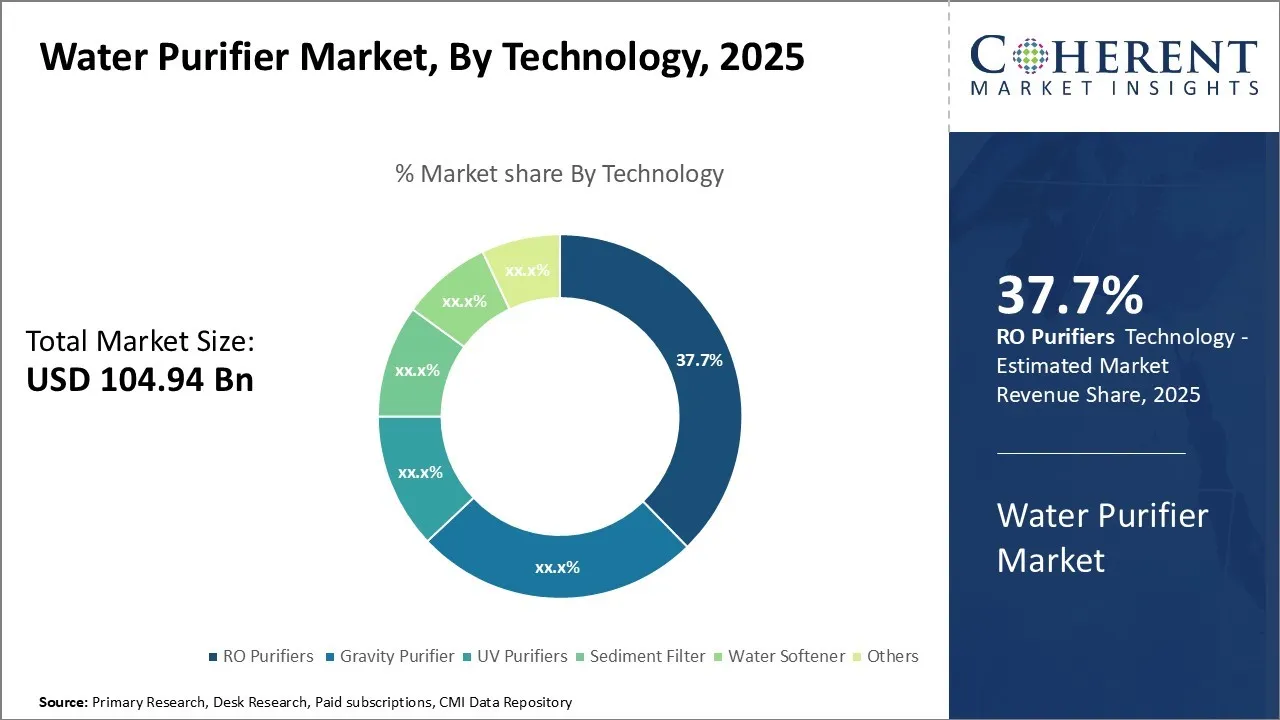
Global Water Purifier Market Insights, By Technology
The RO (Reverse Osmosis) Purifiers segment held the dominant position in the global water purifier market in 2026, commanding a significant 38.7% share. This strong market presence is largely due to the RO technology’s effectiveness in removing heavy metals and other impurities from drinking water, ensuring safer and healthier consumption. RO purifiers are also favored for their additional health benefits, including improved metabolism, enhanced digestion, and support in weight management.
Other water purification technologies, while holding smaller shares, continue to play important roles by catering to diverse consumer needs and regional water quality challenges. Together, these technologies contribute to a comprehensive market ecosystem focused on delivering clean and safe drinking water worldwide.
Regional Insights
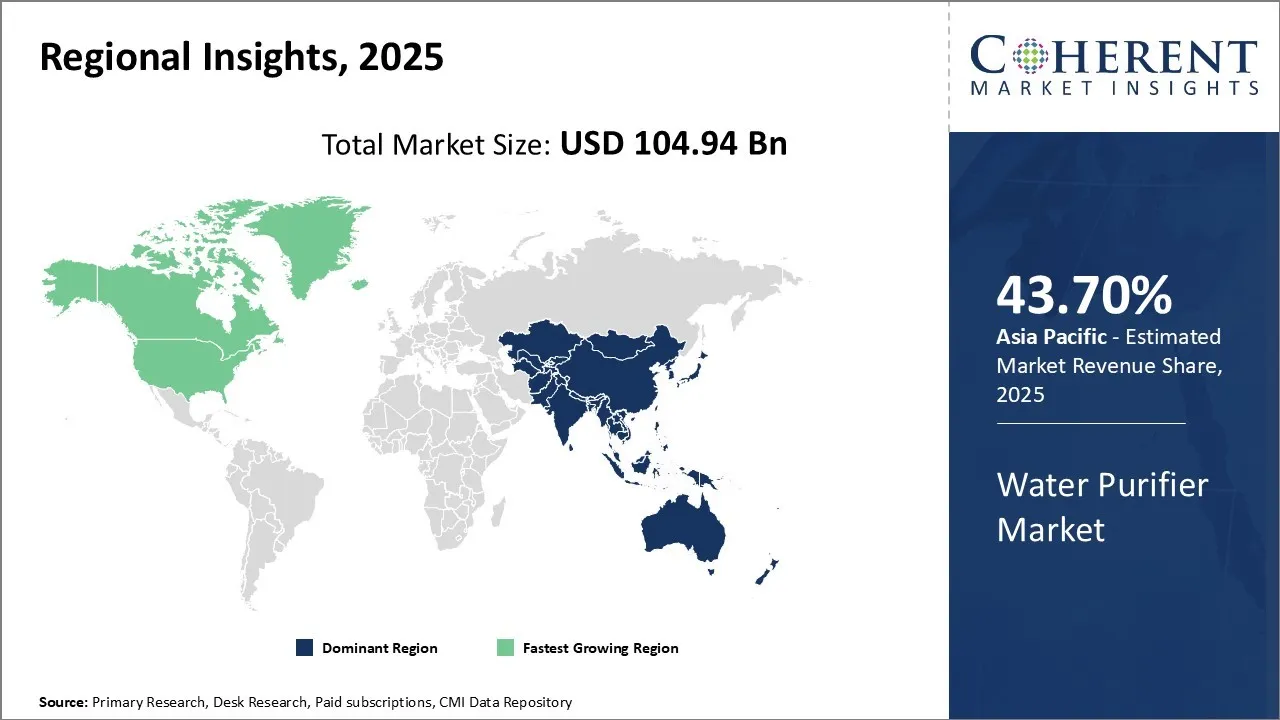
Asia Pacific Water Purifier Market Analysis and Trends
Asia Pacific held the dominant position in the global water purifier market in 2026, accounting for approximately 43.70% of the market share in terms of volume. The region’s leadership is driven by rapid urbanization, rising awareness of waterborne diseases, and increasing investments in clean water infrastructure.
Countries such as China, India, Japan, and South Korea are fueling demand with expanding residential and commercial sectors. Additionally, the growing middle-class population and government initiatives promoting safe drinking water contribute to the strong adoption of water purifiers across the region.
North America Water Purifier Market Analysis and Trends
North America ranks second in the global water purifier market, supported by high consumer awareness regarding water quality and a preference for advanced purification technologies. The region benefits from strong regulatory standards on water safety, widespread distribution channels, and significant investments in innovative filtration systems. Increasing health consciousness and demand for home and commercial water purification units continue to drive steady growth.
Europe, Middle East & Africa (EMEA) Water Purifier Market Analysis and Trends
The Europe, Middle East, and Africa (EMEA) region holds a substantial share of the global water purifier market. In Europe, stringent regulations on water quality and environmental sustainability fuel demand for efficient purification systems. Meanwhile, in the Middle East and Africa, increasing concerns over water scarcity and contamination drive adoption, supported by government programs to improve access to clean water.
Latin America Water Purifier Market Analysis and Trends
Latin America is emerging as a growing market for water purifiers, driven by rising urban populations, increasing health awareness, and investments in water infrastructure. Countries like Brazil and Mexico are key contributors to regional growth, with expanding retail channels and affordable purification solutions supporting market penetration.
Dominating Countries in the Water Purifier Market
China Water Purifier Market Analysis and Trends
China leads the Asia Pacific market with strong government initiatives to improve water quality, expanding urban centers, and rising disposable incomes, which encourage widespread adoption of water purification devices.
India Water Purifier Market Analysis and Trends
India’s market growth is propelled by increasing awareness of waterborne diseases, growing urbanization, and enhanced distribution networks for purification products in both rural and urban areas.
United States Water Purifier Market Analysis and Trends
The United States is a key player in the North American market, supported by high consumer demand for advanced purification technologies and stringent water quality regulations.
Brazil Water Purifier Market Analysis and Trends
Brazil contributes significantly to Latin America’s growth, driven by rising health awareness and government efforts to improve water sanitation infrastructure.
Market Report Scope
Water Purifier Market Report Coverage
| Report Coverage | Details | ||
|---|---|---|---|
| Base Year: | 2025 | Market Size in 2026: | USD 113.55 Bn |
| Historical Data for: | 2020 To 2024 | Forecast Period: | 2026 To 2033 |
| Forecast Period 2026 to 2033 CAGR: | 8.2% | 2033 Value Projection: | USD 197.13 Bn |
| Geographies covered: |
| ||
| Segments covered: |
| ||
| Companies covered: | A.O. Smith Corporation, Aquatech International LLC, BWT Aktiengesellschaft, Brita, GmbH, Coway Co., Ltd., Culligan International Company, EcoWater Systems LLC, Eureka Forbes Ltd., Evoqua Water Technologies LLC, and GE Appliances | ||
| Growth Drivers: |
| ||
| Restraints & Challenges: |
| ||
Market Drivers
- Increasing concerns over water safety
Growing concerns over water safety are expected to boost the global water purifier market growth. For instance in 2022, according to the World Health Organization (WHO), eight billion people use a feces-contaminated drinking-water source and around 502,000 people die of diarrhea. In order to tackle this, government bodies are adopting various measures to overcome these issues. Thus, rising concerns over water safety are expected to drive the global water purifier market growth.
- Growing prevalence of water borne diseases
Increasing adoption of advanced technologies for water purification systems to ensure the effective elimination of impurities from water is driving the market growth. Some of the latest developments in water purification technology are acoustics nanotube technology, potable products, photo catalytic water purification technology, water filtration with nanotechnology, euglena bio filtration system, sun spring system, sunlight, and high tech materials.
Market Opportunities
- Increasing population
Rising disposable income has increased the purchasing power of consumers, which is expected to raise the demand for water purifiers. Improving living standards coupled with rising concerns over water safety in developing countries and growing health-conscious people around the globe is further expected to accelerate the market growth.
The rising number of wastewater treatment plants around the globe is projected to foster the global pipeline water purifier market growth. For instance, in May 2022, Eureka Forbes Ltd. presented its current advertising campaign with Madhuri Dixit as its brand representative. The advertising highlights the Aqua guard line's one-of-a-kind copper and zinc cartridge capabilities. The concept was developed by Taproot Dentsu India Communications Pvt. Ltd.
Market Trends
- Developing new designs
The rising trend of introducing unique design-based products such as discreet passive model, faucet mount design, under sink design, and multi-stage filter model. Moreover, the adoption of specifically membrane systems especially in Europe is further expected to propel the market growth over the forecast period.
Rising demand for UV and gravity-based purifiers is gaining traction in the market. A UV water purifier is used to treat contaminated water with germicidal ultraviolet light. UV light prevents the spread of disease by killing the bacteria present in the water and makes it safe for drinking.
Key Developments
- In October 2022, HUL’s Pureit released a new series of RO + UV + Minerals-based water purifiers with Filtra Power Technology to provide clean drinking water. This method eliminates harmful chemicals such as pathogens, industrial pollutants, and pesticides.
- In January 2021, Samsung Electronics, a South Korea-based company that produces electronic devices, introduced its first-ever water purifier and entered the fast-growing home water purifier market.
- In August 2021, QNET, a Hong Kong-based Multi-level Marketing (MLM) company, partnered with South Korea-based brand, Cuckoo to launch two new water purifiers, My Home Plus DELIGHT and My Home Plus KNIGHT.
- In February 2020, Havells India Limited, a Fast-Moving Electrical Goods (FMEG) and consumer durable company, launched a new water purifier named Havells Delite Alkaline RO in Hyderabad, India.
Market Segmentation
- Global Water Purifier Market, By Technology (Revenue, USD Bn, 2021 - 2033)
- Gravity Purifier
- RO Purifiers
- UV Purifiers
- Sediment filter
- Water Softener
- Others
- Global Water Purifier Market, By End User (Revenue, USD Bn, 2021 - 2033)
- Industrial
- Commercial
- Household
- Global Water Purifier Market, By Accessories (Revenue, USD Bn, 2021 - 2033)
- Pitcher Filter
- Under Sink Filter
- Shower Filter
- Faucet Mount
- Water Dispenser
- Replacement filters
- Counter Top
- Whole House
- Others
- Global Water Purifier Market, By Regions (Revenue, USD Bn, 2021 - 2033)
- North America
- U.S.
- Canada
- Latin America
- Brazil
- Argentina
- Mexico
- Rest of Latin America
- Europe
- Germany
- U.K.
- Spain
- France
- Italy
- Russia
- Rest of Europe
- Asia Pacific
- China
- India
- Japan
- Australia
- South Korea
- ASEAN
- Rest of Asia Pacific
- Middle East
- GCC Countries
- Israel
- Rest of Middle East
- Africa
- South Africa
- North Africa
- Central Africa
- North America
- Company Profiles
- O. Smith Corporation
- Aquatech International LLC
- BWT Aktiengesellschaft
- Brita, GmbH
- Coway Co., Ltd.
- Culligan International Company
- EcoWater Systems LLC
- Eureka Forbes Ltd.
- Evoqua Water Technologies LLC
- GE Appliances
Sources
Primary Research Interviews
- Water purifier manufacturers and suppliers
- E-commerce platform managers and retailers
- End-users and consumers
- Technology providers and component suppliers
- Others
Databases
- Statista Market Database
- IBISWorld Industry Reports
- Euromonitor International
- Global Trade Atlas
- Others
Magazines
- Water Technology Magazine
- Appliance Design Magazine
- Home & Garden Magazine
- Consumer Reports Magazine
- Others
Journals
- Journal of Water Supply Research and Technology
- International Journal of Environmental Science and Technology
- Water Research Journal
- Others
Newspapers
- The Wall Street Journal
- Financial Times
- Economic Times
- Business Standard
- Reuters
- Others
Associations
- Water Quality Association (WQA)
- International Water Association (IWA)
- Consumer Electronics Association (CEA)
- Home Appliance Manufacturers Association
- Others
Public Domain Sources
- World Health Organization (WHO) reports
- Environmental Protection Agency (EPA) publications
- Government statistical offices
- Trade and commerce ministry reports
- Others
Proprietary Elements
- CMI Data Analytics Tool
- Proprietary CMI Existing Repository of information for last 8 years
*Definition: A water purifier is an advanced device used to clean water by removing unwanted and hazardous substances from it. It effectively removes suspended particles, undesirable materials, chemicals, and gases from water. These purifiers are classified into gravity purifier, RO purifiers, UV purifiers, sediment filters, and water softeners. Rising water pollution due to various environmental factors, such as industrialization around the globe, have boosted the demand for water purifiers. Water purifiers are available in different types such as a wall-mounted, tabletop, countertop, and faucet-mounted. They are widely used across the industrial, commercial, as well as household applications.
Get access to 250+ pages report
Every segment, forecast, competitor profile and data table behind the analysis above — available for instant download.
- ESOMAR Member
- ISO 9001:2015 Certified
- D-U-N-S Registered
- GDPR & CCPA Compliant
Missing comfort of reading report in your local language? Find your preferred language:
Transform your Strategy with Exclusive Trending Reports
Frequently Asked Questions
The Water Purifier Market size is estimated to be valued at USD 113.55 Bn in 2026, and is expected to reach USD 197.13 Bn by 2033.
The CAGR of the global Market is projected to be 8.2% from 2026 to 2033.
Increasing population and growing concerns over water safety are fueling the market growth.
The RO water purifier segment is the leading component segment in the market.
The high cost of water purifier systems is expected to hinder the market growth.
A.O. Smith Corporation, Aquatech International LLC, BWT Aktiengesellschaft, Brita, GmbH, Coway Co., Ltd., Culligan International Company, EcoWater Systems LLC, Eureka Forbes Ltd., Evoqua Water Technologies LLC, GE Appliances.
Water purifiers require regular filter replacements, cleaning of storage tanks, and periodic servicing to ensure optimal performance and water quality.