

Photocatalytic Coating Market Size and Trends
The Global Photocatalytic Coating Market is estimated to be valued at USD 1,161.6 Mn in 2026 and is expected to reach USD 2,043.0 Mn by 2033, exhibiting a compound annual growth rate (CAGR) of 8.4% from 2026 to 2033.
Key Takeaways
- By Material type, the titanium dioxide segment is expected to contribute 62.8%share of the market in 2026, owing to its proven record of self-cleaning and pollutant degradation properties.
- By Application, construction is expected to contribute 38.2%share of the market in 2026, owing to the increasing demand for self-cleaning and anti-microbial building materials.
- By Region, Asia Pacific is projected to lead the photocatalytic coating market, holding 43.8%of the market share in 2026 driven by the region's thriving construction industry and an increasing emphasis on sustainable building practices.
- North America region exhibits the fastest growth with 24.2% share in 2026, driven by surging construction activities and industrialization.
Market Overview
The photocatalytic coating market is growing steadily, driven by increasing demand for self-cleaning, anti-microbial, and air-purifying surfaces in construction, automotive, and healthcare sectors. Rising environmental concerns and stricter air quality regulations are boosting adoption. Advancements in nanotechnology and sustainable materials further support the photocatalytic market demand, making these coatings a key solution for eco-friendly, low-maintenance surface protection.
Current Events and Its Impact on the Global Photocatalytic Coating Market
Event | Description and Impact |
Global Environmental Regulations and Sustainability Mandates |
|
Health and Hygiene Awareness Revolution |
|
China’s Industrial Policy Shifts and Supply Chain Disruptions |
|
Role of Artificial intelligence (AI) in the Photocatalytic Coating Market
Artificial intelligence is revolutionizing the photocatalytic coating market by optimizing formulations, enhancing performance, and reducing development costs. For instance, in June 2025, Bhattacharjee, Roy, and Shaikh demonstrated the use of machine learning (ML) and artificial intelligence (AI) to optimize photocatalytic materials for hydrogen production and pollutant degradation. Their study highlighted ML models predicting reaction pathways, optimizing catalyst-to-substrate ratios, temperature, and pH, and identifying synergistic material combinations These AI applications enable faster innovation, real-time performance optimization, and more sustainable urban solutions, reducing maintenance costs and improving air quality across construction and infrastructure projects.
- Current Industry Events of 2026
- Market Size Estimation
- Regional Breakdown
- Competitive Landscape
- Customer Intelligence
- Segmental Analysis
- Pricing Analysis
- Key Market Drivers, Challenges & Future Trends
- Customized Insights Section
End-user Feedback and Unmet Needs in the Photocatalytic Coating Market
- Demand for Enhanced Durability and Performance: End-users, including construction companies and building owners, seek photocatalytic coatings that maintain long-term self-cleaning, air-purifying, and antimicrobial properties. Many report that current coatings degrade over time under harsh environmental conditions, highlighting the need for more robust, weather-resistant formulations.
- Desire for Faster and Easier Application: Contractors and applicators express the need for coatings that are easier to apply, dry quickly, and integrate seamlessly with existing building materials. Simplified application processes can reduce labor costs, minimize project delays, and enhance adoption across large-scale construction projects.
- Regulatory Compliance and Safety Assurance: End-users are increasingly concerned with compliance to environmental and safety standards. There is a need for coatings that are certified low-VOC, non-toxic, and environmentally friendly while delivering effective photocatalytic performance.
Segmental Insights
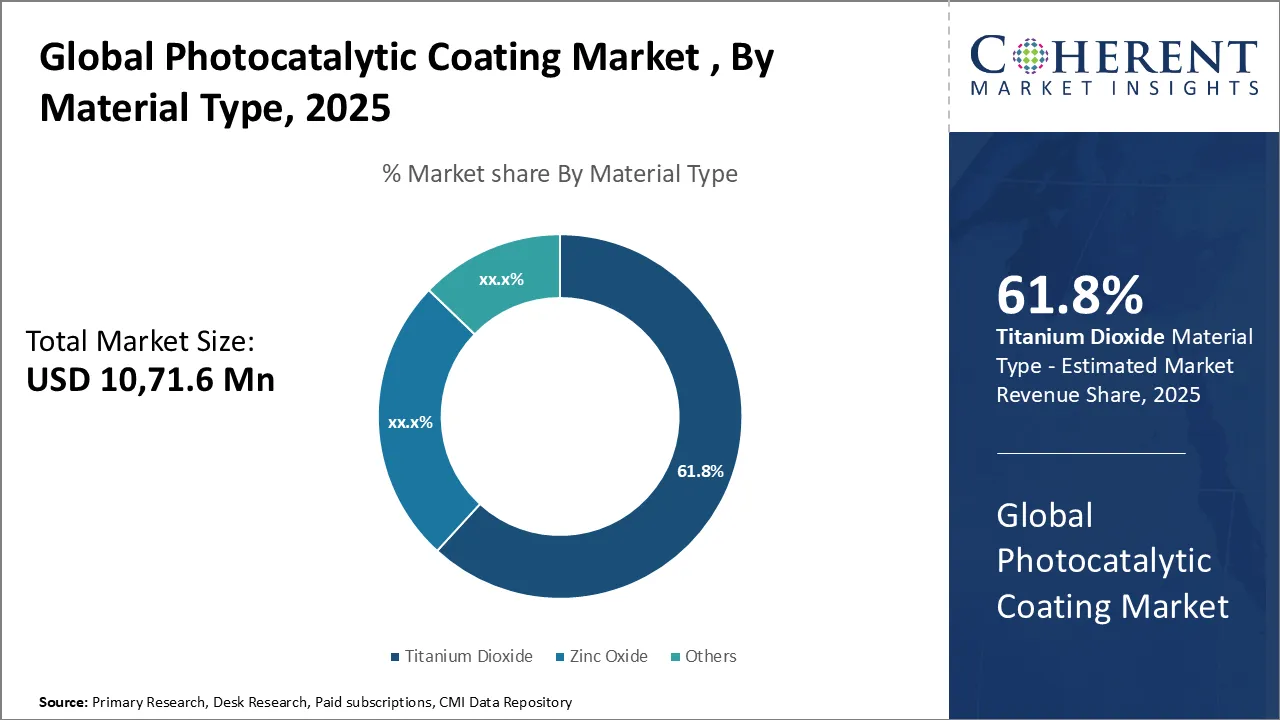
Global Photocatalytic Coating Market Insights, By Material Type: Titanium Dioxide is the Leading Material for Photocatalytic Coatings
In terms of Material type, the titanium dioxide segment is expected to contribute 62.8% share of the market in 2026, owing to its proven record of self-cleaning and pollutant degradation properties. Titanium dioxide has emerged as the most popular choice for photocatalytic coatings due to its excellent photocatalytic activity under UV light irradiation. When titanium dioxide is exposed to UV light, it generates electron-hole pairs on its surface that can initiate the breakdown of organic pollutants such as nitrogen oxides and decompose them into simpler and less noxious compounds.
For instance, in January 2024, researchers in Madrid, Spain, developed a concrete-based material incorporating titanium dioxide (TiO₂)/silver heterojunctions for use in urban construction. This innovative material demonstrated enhanced photocatalytic self-cleaning and antibacterial properties, highlighting the potential of TiO₂-based coatings to reduce maintenance costs and improve hygiene by preventing the accumulation of pollutants and bacteria on building surface, further accelerating the photocatalytic coatings market demand.
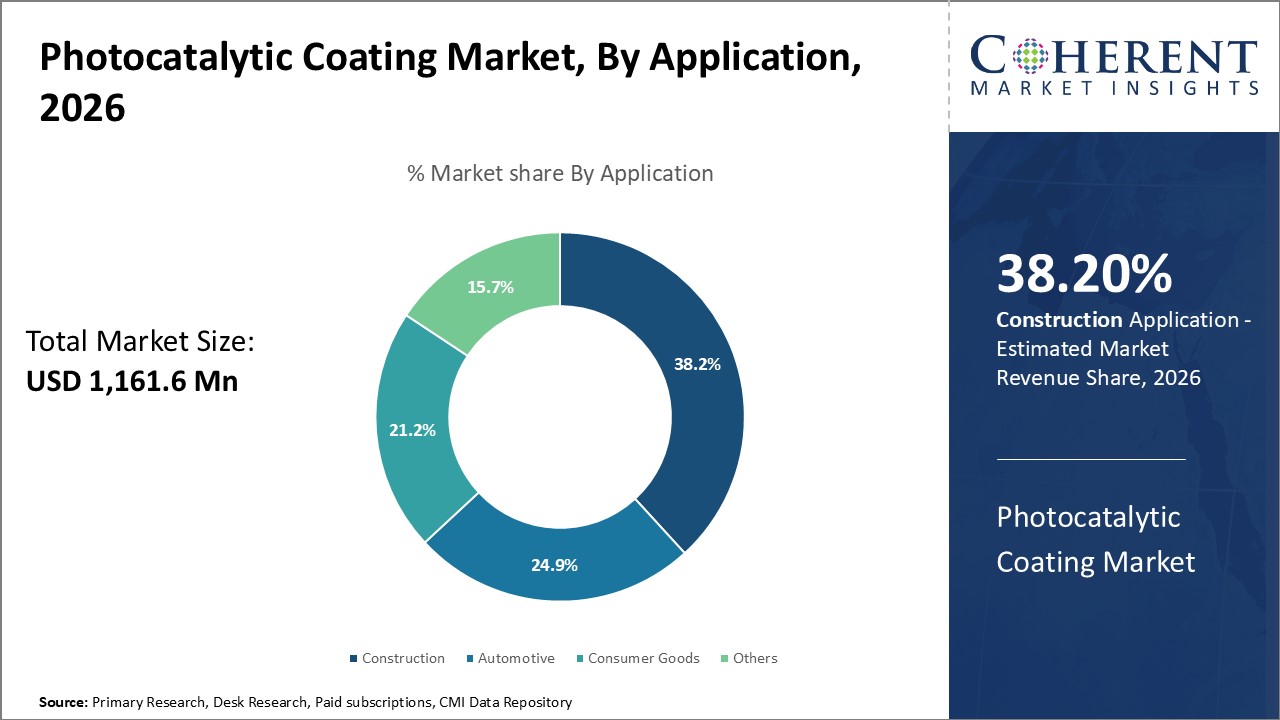
Global Photocatalytic Coating Market Insights, By Application: Role of Photocatalytic Coatings in the Construction Industry
In terms of application, construction is expected to contribute 38.2% share of the market in 2026, owing to the increasing demand for self-cleaning and anti-microbial building materials. The construction industry has emerged as the largest end user of photocatalytic coatings mainly due to the growing need for self-cleaning building materials that reduce maintenance costs and improve hygiene. Photocatalytic coatings are increasingly being applied on exterior wall surfaces, roofing tiles, glass facades, and other construction parts to impart self-cleaning and anti-microbial properties.
For instance, in August 2024, a study conducted by the Eduardo Torroja Institute for Construction Science (IETcc), CSIC, Spain reported that TiO₂-based photocatalytic coatings on construction materials effectively provide self-cleaning and anti-graffiti properties, as their photocatalytic redox reactions and hydrophilicity help decompose graffiti paint and prevent adhesion, highlighting their growing use in building exteriors to reduce maintenance costs and improve hygiene.
Regional Insights
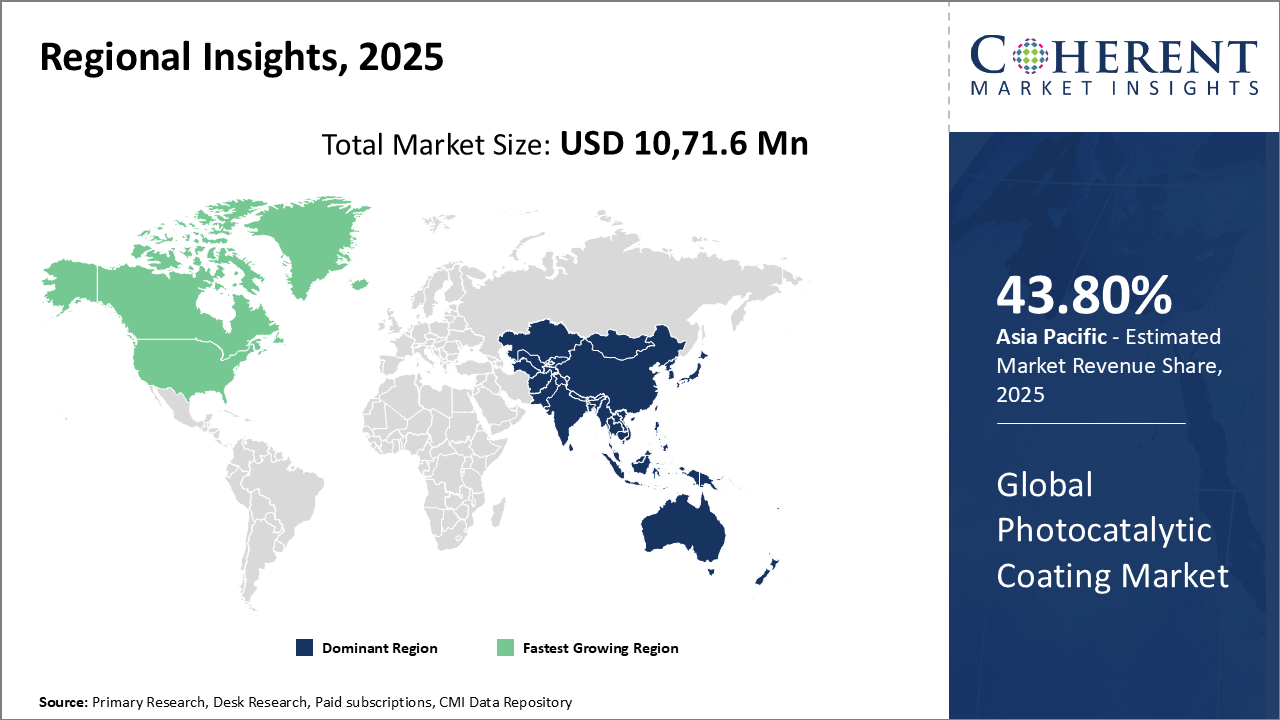
Asia Pacific Photocatalytic Coating Market Trends
Asia Pacific is projected to lead the photocatalytic coating market, holding 43.80% of the market share in 2026. This dominance is driven by the region's thriving construction industry and an increasing emphasis on sustainable building practices. Strong economic growth in countries like China, India, and South Korea has spurred significant investments in infrastructure development. For instance, Nippon Paint (China) Co., Ltd., East China University of Science and Technology (ECUST), and East China Normal University (ECNU) have jointly launched the “Photocatalytic Purification Coating Technology Innovation Platform” to drive innovation and application of this technology through industry-academia collaboration. Additionally, government policies such as Leadership in Energy and Environmental Design are encouraging the adoption of green building technologies and materials, further boosting the photocatalytic coatings market growth.
North America Photocatalytic Coating Market Trends
North America region exhibits the fastest growth with 24.2% share in 2026, driven by surging construction activities and industrialization. Countries seek to address air and water pollution through regulatory push for advanced coatings. Local players are expanding product portfolios to tap into the burgeoning demand.
For instance, in February 2024, Neolith opened a new distribution center and showroom in Los Angeles, USA, expanding its footprint in the region. This move enables broader availability of its crystalline silica-free “Neolith for a New Era” surfaces and the innovative Neolith Atmosphere range, meeting the rising demand for sustainable, air-purifying, and self-cleaning coatings in construction and industrial projects.
Photocatalytic Coating Market Outlook Country-Wise
U.S. Photocatalytic Coating Market Trends
In the U.S., the adoption of photocatalytic coatings is growing, particularly in urban areas focused on improving air quality and reducing pollution. The construction industry's increasing emphasis on sustainable materials and green building practices has been a significant driver for this market. Photocatalytic coatings, with their ability to purify the air, break down pollutants (such as nitrogen oxides and volatile organic compounds), and reduce maintenance needs for building surfaces, align well with the country's efforts to promote eco-friendly technologies and improve public health outcomes. For example, Evonik has made significant contributions to the photocatalytic coating market in the U.S., particularly with its TiO₂-based (titanium dioxide) coatings.
Japan Photocatalytic Coating Market Trends
Japan's manufacturing sectors—including automotive, chemicals, appliances, and electronics—are significant consumers of photocatalytic coatings, which are valued for their self-cleaning and air-purifying properties. The nation's commitment to technological innovation and environmental sustainability further propels the demand for these coatings. As Japan's largest chemical corporation, Mitsubishi Chemical offers a diverse range of products, including photocatalytic coatings, to support various industries. For instance, Mitsubishi Chemical Corporation, Japan’s largest chemical company, launched ALPOLIC/fr Photocatalytic Coating, an aluminum composite material featuring self-cleaning properties. This product utilizes a fluororesin coating film enhanced with photocatalytic technology, enabling oxidative decomposition effects from sunlight and hydrophilic effects from rainwater.
India Photocatalytic Coating Market Trends
In India, the photocatalytic coatings market demand is growing rapidly, driven by the country’s urbanization and industrialization. These coatings are gaining popularity in construction and infrastructure projects, especially in cities grappling with air pollution and environmental challenges. Photocatalytic coatings offer a range of benefits, including self-cleaning properties, air purification, and antimicrobial effects, all of which align with India’s National Action Plan on Climate Change (NAPCC) and its focus on improving air quality and promoting sustainable development.
Market Report Scope
Photocatalytic Coating Market Report Coverage
| Report Coverage | Details | ||
|---|---|---|---|
| Base Year: | 2025 | Market Size in 2026: | USD 1161.6 Mn |
| Historical Data for: | 2020 To 2024 | Forecast Period: | 2026 To 2033 |
| Forecast Period 2026 to 2033 CAGR: | 8.4% | 2033 Value Projection: | USD 2,043.0 Mn |
| Geographies covered: |
| ||
| Segments covered: |
| ||
| Companies covered: | Mitsubishi Chemical Group Corporation, BASF SE, PPG Industries, Sika AG, and Kronos Worldwide, Inc. | ||
| Growth Drivers: |
| ||
| Restraints & Challenges: |
| ||
Market Driver - Increasing demand for self-cleaning surfaces and air purification technologies
The photocatalytic coating market is experiencing substantial growth due to the rising adoption of self-cleaning and air purification technologies across various end-use industries such as automotive. Photocatalytic coatings have the ability to break down organic materials like dust, dirt, and pollutants into non-toxic substances when exposed to sunlight. This property makes them ideal for self-cleaning applications. Traditional cleaning methods require time, labor, water, and cleaning chemicals which can be eliminated through the use of photocatalytic coatings.
Market Challenge - High production costs of photocatalytic coatings compared to conventional coatings
One of the key challenges faced by the global photocatalytic coating market is the relatively high production costs of photocatalytic coatings compared to conventional coatings. Producing photocatalytic coatings involves more complex manufacturing processes and the use of advanced materials like titanium dioxide which increases their costs. Traditional paints and coatings have much lower production costs since their formulation and application methods are more standardized and simpler. This price differential makes photocatalytic coatings less competitive and viable for widespread adoption.
Market Opportunity - Expanding applications in various industries, including healthcare and textiles
One major opportunity for the global photocatalytic coating market is the expanding range of potential applications it can address across diverse industries. Photocatalytic coatings are finding increasing usage in areas like healthcare facilities for their ability to degrade bacteria, viruses, and other pollutants from indoor air and surfaces. Their self-cleaning and decontamination properties make them suitable for sanitary and hygienic applications in hospitals, medical equipment and devices. The textiles industry is another promising area as photocatalytic coatings can impart stain-resistant and deodorizing attributes to fabrics.
Global Photocatalytic Coating Market News
- In August 2025, Saint-Gobain announced the launch of its latest photocatalytic coating technology, designed to enhance air purification and self-cleaning properties in urban infrastructure. This innovation aims to meet the growing demand for sustainable building materials and address environmental concerns in metropolitan areas.
- In July 2025, PPG Industries introduced a new line of photocatalytic coatings tailored for the automotive sector. These coatings are engineered to provide self-cleaning and anti-fogging functionalities, aligning with the industry's focus on enhancing vehicle aesthetics and functionality.
- In June 2025, AkzoNobel N.V. unveiled a range of photocatalytic coatings for healthcare facilities. These coatings are formulated to offer antimicrobial properties, contributing to improved hygiene standards in medical environments and supporting the company's commitment to public health.
Analyst Viewpoint
- Major drivers for the market growth include stringent environmental regulations regarding air and water pollutants across various countries. Photocatalytic coating helps in purifying air and water by decomposing organic pollutants using light energy. High demand from the construction industry for self-cleaning and anti-bacterial surfaces will also propel the market forward. Rapid urbanization and infrastructure development activities are expanding the application purview of photocatalytic coatings.
- However, the high initial costs of photocatalytic coating applications and the requirement of specific lighting conditions for optimal performance can restrain the market growth to some extent. Additionally, the lack of awareness about the benefits of these coatings, especially in developing nations acts as a hurdle in market growth.
- Key players must focus on expanding their footprint in the Asia Pacific region through product innovation, partnerships, and acquisitions. The Asia Pacific region is likely to dominate the global photocatalytic coating market in the coming decade owing to increasing construction spending, rising environmental concerns, and rapid economic development in countries like China and India. Manufacturers could also tap opportunities in Europe and North America through extensive marketing campaigns showcasing the health and monetary benefits of these coatings.
Market Segmentation
- Type Insights (Revenue, USD Mn, 2021 - 2033)
- Titanium Dioxide
- Zinc Oxide
- Others
- Application Insights (Revenue, USD Mn, 2021 - 2033)
- Construction
- Automotive
- Consumer Goods
- Others
- Regional Insights (Revenue, USD Mn, 2021 - 2033)
- North America
- U.S.
- Canada
- Latin America
- Brazil
- Argentina
- Mexico
- Rest of Latin America
- Europe
- Germany
- U.K.
- Spain
- France
- Italy
- Russia
- Rest of Europe
- Asia Pacific
- China
- India
- Japan
- Australia
- South Korea
- ASEAN
- Rest of Asia Pacific
- Middle East
- GCC Countries
- Israel
- Rest of Middle East
- Africa
- South Africa
- North Africa
- Central Africa
- North America
- Key Players Insights
- Mitsubishi Chemical Group Corporation
- BASF SE
- PPG Industries
- Sika AG
- Kronos Worldwide, Inc.
Sources
Primary Research Interviews
- Photocatalytic Coating Manufacturers and Suppliers
- Construction Industry Professionals and Architects
- Automotive Industry Coating Specialists
- Environmental Technology Consultants
- Others
Databases
- Global Trade Atlas
- Others
Magazines
- Coating World Magazine
- Paint & Coatings Industry Magazine
- European Coatings Journal
- Surface & Coatings Technology Magazine
- Others
Journals
- Journal of Photochemistry and Photobiology
- Applied Catalysis B: Environmental
- Catalysis Today
- Others
Newspapers
- Chemical & Engineering News
- The Wall Street Journal (Chemical Industry Section)
- Financial Times (Industrial Materials Coverage)
- Bloomberg Industry Reports
- Others
Associations
- International Association of Color Manufacturers (IACM)
- Powder Coating Institute (PCI)
- National Association of Chemical Distributors (NACD)
- European Coatings Association (ECA)
- Others
Public Domain Sources
- Environmental Protection Agency (EPA) Reports
- European Chemicals Agency (ECHA) Database
- World Health Organization (WHO) Publications
- International Energy Agency (IEA) Reports
- Others
Proprietary Elements
- CMI Data Analytics Tool
- Proprietary CMI Existing Repository of Information for Last 8 Years
Get access to 250+ pages report
Every segment, forecast, competitor profile and data table behind the analysis above — available for instant download.
- ESOMAR Member
- ISO 9001:2015 Certified
- D-U-N-S Registered
- GDPR & CCPA Compliant
Missing comfort of reading report in your local language? Find your preferred language:
Transform your Strategy with Exclusive Trending Reports
Frequently Asked Questions
The Photocatalytic Coating Market is estimated to be valued at USD 1,161.6 Mn in 2026, and is expected to reach USD 2,043.0 Mn by 2033.
The CAGR of the Photocatalytic Coating Market is projected to be 8.4% from 2026 to 2033.
Increasing demand for self-cleaning surfaces and air purification technologies and growing awareness about environmental benefits associated with photocatalytic coatings are the major factor driving the growth of the global photocatalytic coating market.
High production costs of photocatalytic coatings compared to conventional coatings and Limited awareness and understanding about photocatalytic technology among end users are the major factors hampering the growth of the global photocatalytic coating market.
In terms of material type, titanium dioxide is estimated to dominate the market revenue share in 2026.
Mitsubishi Chemical Group Corporation, BASF SE, PPG Industries, Sika AG,Kronos Worldwide, and Inc.are the major players.
Asia Pacific is expected to lead the global photocatalytic coating market in 2026.