

Polyphenylene Sulfide (PPS) Market Size and Forecast — 2026 - 2033
The Global Polyphenylene Sulfide Market size is estimated to be valued at USD 960 million in 2026 and is expected to reach USD 1,560 million by 2033, exhibiting a compound annual growth rate (CAGR) of 7.0% from 2026 to 2033.
Overview
The Polyphenylene Sulfide (PPS) comprises high-performance thermoplastic polymers known for exceptional chemical resistance, thermal stability, and dimensional integrity. PPS is widely used in injection-molded, extruded, and reinforced products for industries such as automotive, electronics, aerospace, and industrial machinery. Key product types include unreinforced PPS for general applications, glass fiber-reinforced PPS for enhanced mechanical strength, and mineral-filled PPS for improved stiffness and heat resistance. Specialty grades, including flame-retardant and conductive PPS, cater to niche applications. The material’s versatility, combined with growing demand for lightweight, high-performance components and resistance to harsh environments, drives broad adoption across multiple industrial sectors globally.
Key Takeaways
The homopolymer PPS segment leads market share, driven primarily by broad-based applications in automotive and electronics industries requiring high purity and thermal resistance.
Automotive & Transportation remains the largest application segment, attributed to strict emission norms and EV proliferation enhancing polyphenylene sulfide market growth.
Asia Pacific emerges as the dominating region with a commanding market share exceeding 40%, driven by rapid industrialization in China and India alongside investment-friendly manufacturing policies.
North America holds the fastest CAGR, attributed to robust innovation ecosystems and strategic collaborations among market players accelerating technology adoption.
Polyphenylene Sulfide (PPS) Market Segmentation Analysis
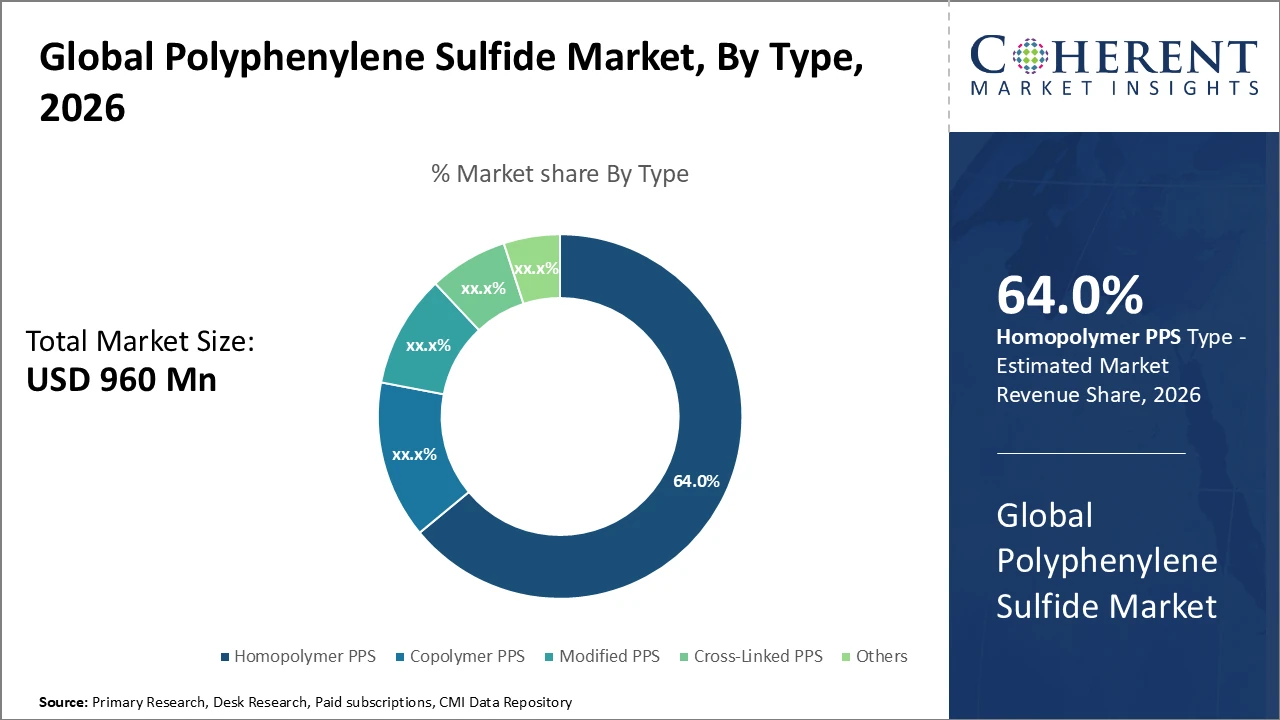
Polyphenylene Sulfide (PPS) Market Insights, By Type
Homopolymer PPS dominates the market with a 64% share, favored for its high thermal and chemical resistance, making it the preferred material for automotive engine components and electrical insulation applications. Its superior purity ensures consistent performance in demanding environments. Copolymer PPS, the fastest-growing subsegment, offers enhanced toughness and impact resistance, making it particularly valuable in consumer electronics and industrial machinery. Modified PPS variants are designed for niche applications requiring compatibility with reinforcement fillers, while cross-linked PPS, though smaller in market share, provides excellent creep resistance for structural aerospace components. Remaining subsegments serve specialty applications requiring tailored properties.
Polyphenylene Sulfide (PPS) Market Insights, By Application
Automotive & Transportation is the dominant application segment, driven by increasing demand for lightweight and durable polymer components in passenger vehicles and electric vehicles. PPS is extensively used in fuel systems, under-the-hood components, and EV battery assemblies, reinforcing its strong market position. The Electrical & Electronics segment is the fastest-growing subsegment, supported by rising electronics manufacturing that requires high-performance insulating and connector materials with exceptional thermal stability. Industrial Machinery and Chemical Processing sectors leverage PPS for its corrosion resistance and mechanical strength in equipment components. Other applications, including aerospace and consumer goods, further expand the overall market footprint.
Waterproofing Admixture Market Insights, By End-Use Industry
Automotive holds a dominant position in the polyphenylene sulfide market, driven by electrification trends and stringent emission regulations that demand advanced materials for powertrain and electrical components. Aerospace is the fastest-growing subsegment, as PPS’s lightweight nature and high-temperature performance become increasingly essential for airframe and engine applications. The Electrical & Electronics sector continues to expand steadily, fueled by the proliferation of IoT devices requiring reliable insulation materials. In the chemical industry, PPS is used for corrosion-resistant components in processing plants, while consumer goods manufacturers adopt it for durable, heat-resistant household products, further broadening market applications.
Polyphenylene Sulfide (PPS) Market Trends
Recent market trends highlight innovation in PPS composites, focusing on carbon and glass fiber reinforcement to improve mechanical properties essential for automotive lightweighting.
In 2026, the use of carbon fiber reinforced PPS in electric vehicle battery components increased by 25%, driven by durability and thermal management requirements.
Automotive applications increasingly rely on PPS composites for under-the-hood parts and structural components to meet emission and efficiency standards.
The electronics industry adopted ultrathin PPS films for miniaturized, multilayered circuit components, resulting in a 30% volume increase in 2025.
Advancements in PPS composite technology are supporting broader adoption across high-performance applications in aerospace, industrial machinery, and consumer electronics.
Polyphenylene Sulfide (PPS) Market Insights, By Geography
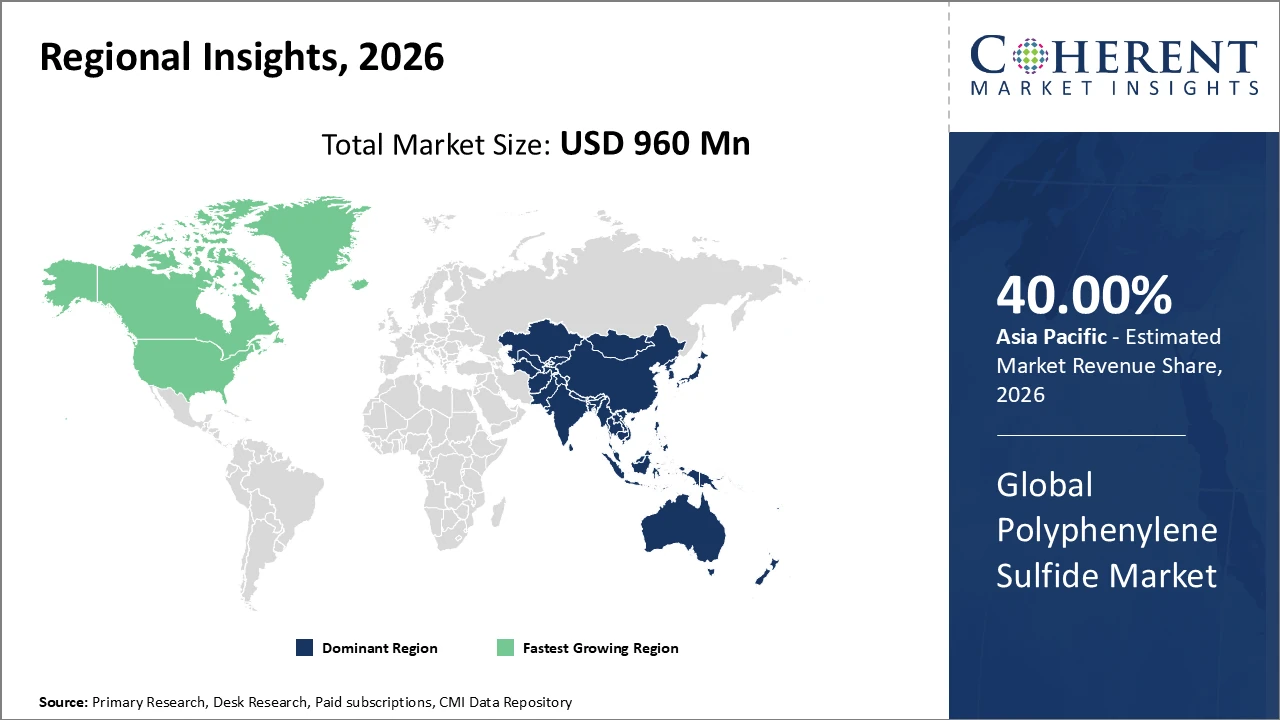
North America Polyphenylene Sulfide (PPS) Market Analysis and Trends
North America exhibits the fastest growth in the polyphenylene sulfide market, with a CAGR exceeding 8.0%, driven by innovation-led manufacturing and stringent regulatory frameworks that promote the use of advanced polymer materials. Strong technical collaborations among industry players, coupled with significant investments in R&D for specialty PPS grades tailored to aerospace and electric vehicle applications, are accelerating market adoption and supporting the region’s rapid expansion.
Asia Pacific Polyphenylene Sulfide (PPS) Market Analysis and Trends
In Asia Pacific, the polyphenylene sulfide market is dominated by expansive industrial ecosystems in China and India, representing over 40% of global market share. Supportive government policies promoting local manufacturing and infrastructure development have boosted high-volume PPS applications in automotive and consumer electronics sectors. Leading global and regional companies have established production hubs in the region, enabling efficient supply to domestic markets while supporting exports. Rapid industrialization and growing demand for high-performance polymers continue to reinforce Asia Pacific’s market leadership and growth trajectory.
Polyphenylene Sulfide (PPS) Market Outlook for Key Countries
USA Polyphenylene Sulfide (PPS) Market Analysis and Trends
The U.S. polyphenylene sulfide market plays a significant role in global revenue, driven by widespread automotive electrification and advancements in aerospace applications. In 2025, demand for PPS-based electric vehicle components increased by 18% as leading OEMs adopted lightweight polymer solutions to comply with stringent emission regulations and improve fuel efficiency. Major manufacturers have invested heavily in capacity expansions and research and development, focusing on high-performance, specialty PPS grades tailored for EVs, aerospace, and industrial applications. These strategic initiatives have reinforced the U.S. as a technology and innovation hub, enabling rapid adoption of advanced PPS solutions across multiple high-value sectors.
Germany Polyphenylene Sulfide (PPS) Market Analysis and Trends
The Germany polyphenylene sulfide market demonstrates steady growth, supported by stringent environmental regulations and increasing demand for high-performance polymers in automotive, electrical, and industrial sectors. Low-GWP and high-temperature-resistant PPS grades are increasingly adopted in lightweight automotive components, electrical connectors, and industrial machinery. Regulatory incentives under the EU F-Gas Regulation and energy efficiency initiatives drive sustainable polymer usage, while R&D investments focus on advanced composite developments, including carbon and glass fiber-reinforced PPS. Germany’s strong manufacturing base and collaborations between domestic and multinational companies enhance production capabilities and technology transfer, positioning the country as a key hub for high-quality PPS solutions in Europe and global markets.
Analyst Opinion
The rising demand for PPS in automotive applications is a key market driver. In 2025, PPS-profiled parts accounted for over 38% of total industry volume, driven by their effectiveness in reducing vehicle weight and improving fuel efficiency. Stricter global emission regulations prompted automotive manufacturers to increase investments in PPS-based components by 12% between 2024 and 2026, supporting market share growth.
Supply-side dynamics optimized production capacity through improved catalyst systems and polymerization techniques. In 2026, Asia Pacific reported a 15% increase in PPS polymer output compared to 2024, aided by new manufacturing sites in China and India, enhancing accessibility and cost competitiveness.
Electronics and electrical appliances represent a high-growth segment, using PPS for connectors and insulating components due to superior dielectric properties. In 2025, shipments of PPS components for electronic devices rose by 22%, fueled by the expansion of IoT and 5G technologies requiring materials with excellent thermal and dimensional stability.
Market restraints include fluctuating raw material prices and competition from cheaper alternative polymers. Targeted innovations in PPS composites and blends help maintain pricing power; for example, in 2026, nylon-PPS hybrid materials were introduced, delivering a 10% cost reduction while preserving key properties for industrial applications.
- Current Industry Events of 2026
- Market Size Estimation
- Regional Breakdown
- Competitive Landscape
- Customer Intelligence
- Segmental Analysis
- Pricing Analysis
- Key Market Drivers, Challenges & Future Trends
- Customized Insights Section
Market Scope
| Report Coverage | Details | ||
|---|---|---|---|
| Base Year: | 2025 | Market Size in 2026: | USD 960 million |
| Historical Data for: | 2020 To 2024 | Forecast Period: | 2026 To 2033 |
| Forecast Period 2026 to 2033 CAGR: | 7.0% | 2033 Value Projection: | USD 1560 million |
| Geographies covered: |
| ||
| Segments covered: |
| ||
| Companies covered: | Solvay SA, Tosoh Corporation, DIC Corporation, Bayer AG, BASF SE, SABIC, Daicel Corporation, Celanese Corporation, Polyplastics Co., Ltd., SK Global Chemicals Co., Ltd. | ||
| Growth Drivers: |
| ||
Polyphenylene Sulfide (PPS) Market Growth Factors
The advancement of electric vehicles and the growing need for lightweight, heat-resistant components have emerged as key drivers of PPS market growth, significantly boosting consumption in 2025 and 2026. Additionally, the adoption of automated and smart manufacturing systems has increased demand for PPS in electrical connectors, sensor housings, and other high-performance components, supporting industry expansion. Rapid development in high-end consumer electronics, leveraging PPS for its insulating and flame-retardant properties, has further contributed to market revenue. Rising industrialization in Asia Pacific, along with supportive government policies promoting manufacturing innovation, has accelerated market share growth, particularly in automotive and electronics hubs.
Polyphenylene Sulfide (PPS) Market Development
In 2025, Solvay expanded its PPS production capacity at its European facility by 20% to meet rising demand from the automotive and electronics sectors, focusing on high-purity and glass fiber-reinforced grades. This expansion aimed to support lightweighting initiatives in electric vehicles and high-performance applications in consumer electronics.
Key Players
Leading Companies of the Market
Solvay SA
Tosoh Corporation
DIC Corporation
Bayer AG
BASF SE
Celanese Corporation
SABIC
Daicel Corporation
SK Global Chemical Co., Ltd.
Polyplastics Co., Ltd.
Notably, Solvay S.A. expanded its PPS production capacity in 2025 by 20% in response to a surge in demand from high-performance automotive and electronics sectors, resulting in a 15% increase in revenue. Meanwhile, Tosoh Corporation strategically intensified its R&D efforts on modified PPS grades for aerospace applications, capitalizing on the growing need for lightweight, high-strength polymers and securing new contracts with leading aircraft OEMs, strengthening its market position in the specialized high-performance polymer segment.
Polyphenylene Sulfide (PPS) Market Future Outlook
The polyphenylene sulfide (PPS) market is poised for robust growth, driven by increasing demand for lightweight, high-performance polymers across automotive, aerospace, electronics, and industrial sectors. Rising adoption of electric vehicles and energy-efficient components will continue to boost PPS consumption, while technological advancements in composites, including carbon and glass fiber reinforcement, enhance mechanical and thermal properties. Asia Pacific is expected to maintain strong expansion due to rapid industrialization and supportive government policies, while North America and Europe focus on specialty grades and innovation-led growth. Ongoing R&D in bio-based and flame-retardant PPS will further diversify applications, ensuring long-term market resilience.
Polyphenylene Sulfide (PPS) Market Historical Analysis
The polyphenylene sulfide (PPS) market has experienced steady growth over the past decade, driven by increasing demand for high-performance, heat- and chemical-resistant polymers across automotive, electronics, and industrial applications. Early market reliance on standard PPS grades shifted toward reinforced and modified variants to meet evolving mechanical and thermal requirements. Regulatory pressures and the push for lightweight materials in vehicles further accelerated adoption, particularly in Asia Pacific and North America. By 2023, innovations in composite technologies, such as carbon and glass fiber-reinforced PPS, and expanding applications in EV components and electronics set the stage for rapid growth, establishing a foundation for the current high-performance polymer market.
Sources
Primary Research Interviews:
PPS and high-performance polymer manufacturers
Automotive component and EV parts producers
Electronics and electrical appliance engineers
R&D managers and polymer process specialists
Magazines:
Plastics News
Polymer Engineering & Science Magazine
Electronics Manufacturing Journal
Insulation & Advanced Materials Review
Journals:
Journal of Applied Polymer Science
Polymer Engineering & Science
Journal of Materials Science
Materials Today: Proceedings
Journal of Polymers and the Environment
Newspapers:
The New York Times – Business & Chemicals
Financial Times – Industrial Materials
The Guardian – Manufacturing & Environment
Reuters – Chemicals & Engineering
The Hindu – Industry & Technology
Associations:
American Chemical Society (ACS)
European Chemical Industry Council (CEFIC)
Polyurethane Manufacturers Association (PMA)
Society of Plastics Engineers (SPE)
International Polymer Processing Society (IPPS)
Get access to 250+ pages report
Every segment, forecast, competitor profile and data table behind the analysis above — available for instant download.
- ESOMAR Member
- ISO 9001:2015 Certified
- D-U-N-S Registered
- GDPR & CCPA Compliant
Missing comfort of reading report in your local language? Find your preferred language:
Transform your Strategy with Exclusive Trending Reports
Frequently Asked Questions
Leading companies include Solvay S.A., Tosoh Corporation, DIC Corporation, Chevron Phillips Chemical Company, and SK Global Chemical Co., Ltd., all driving innovations across automotive and electronics segments.
The PPS market size is projected to reach USD 1,560 million by 2033 with a CAGR of 7.0% from 2026 to 2033, reflecting strong demand growth across end-use industries.
The automotive holds the largest growth opportunity, supported by weight reduction and emission control mandates boosting PPS demand.
Market trends indicate increased adoption of PPS composite materials, growth in electrification applications, and advancements in sustainable PPS varieties aligned with circular economy goals.
The competitive landscape is characterized by innovation-driven companies focusing on capacity expansion and product differentiation to overcome raw material price volatility and competition from alternative polymers.
Market players utilize strategic partnerships, capacity enhancements, and technological innovation to expand industry share and capitalize on emerging business growth opportunities.