

PEDOT Market Size and Forecast — 2026-2033
PEDOT Market is estimated to be valued at USD 5.5 Mn in 2026 and is expected to reach USD 9.9 Mn in 2033, exhibiting a compound annual growth rate (CAGR) of 8.7% from 2026 to 2033.
This polymer is manufactured using oxidation. PEDOT is both an electrically- and ionically-conductive polymer, owing to this property it has various applications in energy, healthcare, and electronics industry in the form of sensors, capacitors, smart windows, and antistatic packaging, among others. Furthermore, increasing use of PEDOT polymers is due to its chemical stability and good conductivity.
Global PEDOT Market: Drivers
Demand for lightweight materials
Increasing demand for lightweight materials is expected to drive growth of the global PEDOT market. In electronics industry, PEDOT is used in development of advanced technological products such as wearables, flexible electronics displays, and semiconductors. The technological products are manufactured using PEDOT polymers for its electrical, optical, and physical and mechanical properties.
Electronic devices require high conductivity and stability
Electronic devices require high conductivity and stability which leads to increase in demand for PEDOT (Poly(3,4-ethylenedioxythiophene)). The low bandgap of PEDOT that is formed by the effect of the electron donor ethylene dioxy group on the energies of the frontier group of the π systems, offers high level of conductivity. Moreover, PEDOT is also used in antistatic packaging and smart windows, owing to its stability that is achieved by electron-donating effect within oxygen bombs and the effective ring geometry.
- Current Industry Events of 2026
- Market Size Estimation
- Regional Breakdown
- Competitive Landscape
- Customer Intelligence
- Segmental Analysis
- Pricing Analysis
- Key Market Drivers, Challenges & Future Trends
- Customized Insights Section
PEDOT Market Report Coverage
| Report Coverage | Details | ||
|---|---|---|---|
| Base Year: | 2025 | Market Size in 2026: | USD 5.5 Mn |
| Historical Data for: | 2020 To 2024 | Forecast Period: | 2026 To 2033 |
| Forecast Period 2026 to 2033 CAGR: | 8.7% | 2033 Value Projection: | USD 9.9 Mn |
| Geographies covered: |
| ||
| Segments covered: |
| ||
| Companies covered: | Heraeus Holding, Ossila Limited, Nanoshel LLC, Nagase ChemteX Corporation, Suzhou Yacoo Science Co., Ltd., Agfa-Gevaert N.V., and Qingdao Topwell Chemical Materials Co., Ltd. | ||
| Growth Drivers: |
| ||
| Restraints & Challenges: |
| ||
Global PEDOT Market: Restraints
High production cost
High production cost increases the overall price of pedot polymers, and this is expected to restrain the market growth. Pedot manufacturing companies have to bear huge costs, due to lower stability during the production process. This results in a capacitance drop after a particular number of charge-discharge cycles. Limited capacitance is hampering the adoption of pedot in industrial applications. Therefore, high cost of pedot is expected to hamper growth of the pedot market over the forecast period.
Global PEDOT Market: Market Segmentation
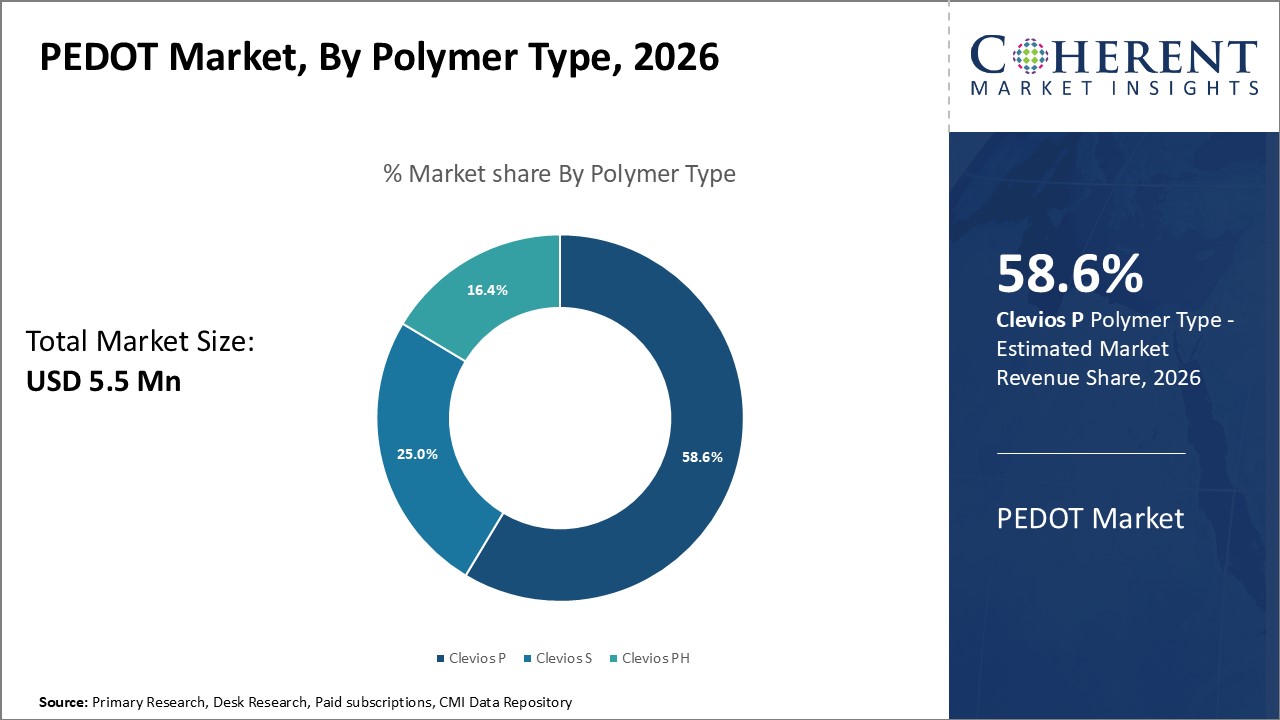
Among polymer type, the Clevois P segment accounted for the largest market share in 2026, owing to increasing applications in the manufacturing of antistatic packaging trays, antistatic coatings, and organic thin film transistor (OTFT) backplanes. Moreover, the Clevios S segment is used in the manufacturing of electrochromic displays.
Among application, the Flexible Displays/OTFT Backplanes segment accounted for a significant market share in the global PEDOT market in 2026, owing to increasing demand for Flexible Displays/OTFT Backplanes in the automotive industry. Rising demand for Flexible Displays/OTFT Backplanes is due to technological advancements in the automotive industry such as self-driving cars, and adoption of artificial intelligence for manufacturing of electric vehicles.
Figure 1. Global PEDOT Market Share (%), By Segment Type
Global PEDOT Market: Regional Analysis
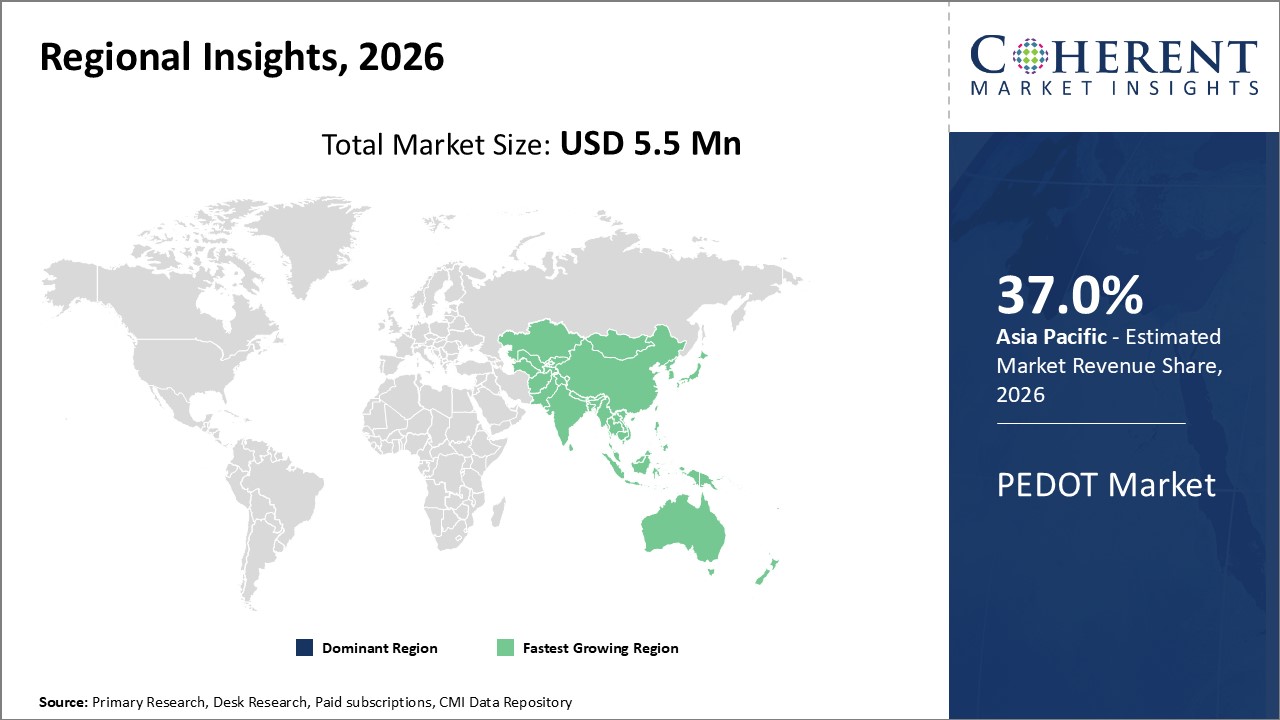
Asia Pacific accounted for a significant market share in the global PEDOT market in 2026, and is expected to witness significant growth over the forecast period, owing to increasing adoption of portable speakers, tablets, smart phones, along with AI-assisted electronics due to increasing disposable income. Increasing research and development activities in the region is expected to drive growth of the PEDOT market. Moreover, new product launches, government initiatives, and investments in the automotive sector is also expected to boost demand for conductive polymers such as PEDOT in Asia Pacific automotive industry.
Figure 2. Global PEDOT Market Share (%), By Region
Global PEDOT Market: Recent Developments
In 2021, Heraeus, a Germany-based technology company, announced that it has developed a new process for producing high quality PEDOT films with improved conductivity and stability. The company’s new process involves usage of novel solvent and a proprietary polymerization methodthat allows better control over the film’s properties.
In 2021, Agfa, a Belgium-based multinational corporation, launched a new PEDOT-based conductive ink. The ink is designed for usage in printed electronics applications such as sensors and antennas. Agfa’s new ink is highly conductive, and has excellent adhesion to a variety of substrates.
Global PEDOT Market: Key Companies
Major players operating in the global PEDOT market include Heraeus Holding, Ossila Limited, Nanoshel LLC, Nagase ChemteX Corporation, Suzhou Yacoo Science Co., Ltd., Agfa-Gevaert N.V., and Qingdao Topwell Chemical Materials Co., Ltd.
Sources
Primary Research Interviews
- PEDOT/PSS and conductive polymer producers (e.g., Heraeus (Clevios), Agfa-Gevaert, Sun Chemical)
- Organic photovoltaics, OLED and flexible electronics developers
- Antistatic coating and capacitor manufacturers
Databases
- Eurostat advanced materials data
- UN Comtrade specialty chemicals trade data
- ECHA REACH registrations
Magazines
- Printed Electronics World
- OLED-Info
Journals
- Advanced Materials (Wiley)
- Synthetic Metals (Elsevier)
- Organic Electronics (Elsevier)
Newspapers
- Reuters Technology
- Financial Times – Technology
Associations
- Society for Information Display (SID)
- OE-A (Organic and Printed Electronics Association)
- Materials Research Society (MRS)
Public Domain Sources
- U.S. DOE and NIST flexible electronics programs
- European Commission Horizon Europe photonics programs
- ResearchGate publications on PEDOT:PSS
Proprietary Elements
- CMI Data Analytics Tool, Proprietary CMI Existing Repository of information for last 10 years.
*Definition: PEDOT (Poly(3,4-ethylenedioxythiophene)) is a conductive polymer. This polymer offers several advantages such as optical transparency in the conducting stage, low redox potential, and moderate band gap.
Get access to 250+ pages report
Every segment, forecast, competitor profile and data table behind the analysis above — available for instant download.
- ESOMAR Member
- ISO 9001:2015 Certified
- D-U-N-S Registered
- GDPR & CCPA Compliant
Missing comfort of reading report in your local language? Find your preferred language:
Transform your Strategy with Exclusive Trending Reports
Frequently Asked Questions
The PEDOT Market is estimated to be valued at USD 5.5 Mn in 2026, and is expected to reach USD 9.9 Mn by 2033.
Global PEDOT market is estimated to surpass US$ 7.81 Mn by 2033.
Major players operating in the market include Heraeus Holding, Ossila Limited, Nanoshel LLC, Nagase ChemteX Corporation, Suzhou Yacoo Science Co., Ltd., Agfa-Gevaert N.V., and Qingdao Topwell Chemical Materials Co., Ltd.
High production cost that increases the price of PEDOT polymers is one of the major factors that is expected to hamper growth of the market.
Demand for lightweight materials and electronic devices require high conductivity and stability are the major factors that is expected to propel growth of the market.
The CAGR of the PEDOT Market is projected to be 8.7% from 2026 to 2033.
Among polymer type, Clevois P segment accounted for the largest market share in 2026.