

Aerospace Coating Market Size And Share Analysis- 2026-2033
Global aerospace coating market is estimated to be valued at USD 3.90 Bn in 2026 and is expected to reach USD 6.60 Bn by 2033, exhibiting a compound annual growth rate (CAGR) of 7.8% from 2026 to 2033.
Key Takeaways
- By Resin Type, the polyurethanes segment is projected to dominate the global aerospace coating market with a 62.7% share in 2026.
- By Technology, the liquid-coating segment is estimated to lead the market with a 44.6% share in 2026.
- By End-User, the commercial aviation segment is anticipated to hold the largest share of 41.6% in 2026.
- North America is expected to retain its dominant position in the global aerospace coating market with a 38.6% share in 2026.
Market Overview
The global Aerospace Coating Market is witnessing robust growth, driven by increasing air travel, rising demand for fuel-efficient aircraft, and stringent safety regulations. The market is expanding rapidly due to advancements in coating technologies, growing defence budgets, and the need for corrosion resistance and improved durability. Commercial aviation dominates the market, while military and space applications are gaining momentum.
Current Events and Its Impact on The Aerospace Coating Market
Current Event | Description and its impact |
Technological Advancements in Coating Application Systems |
|
Shifting Preferences Toward Sustainability and Durability |
|
Evolving Regulatory Landscape and Environmental Compliance |
|
Integration of New Technologies in the Aerospace Coating Market
The aerospace coating market is witnessing a transformative shift through the integration of advanced technologies aimed at improving efficiency, performance, and sustainability. One of the key innovations is the adoption of automated robotic spray systems, which ensure precision, reduce coating wastage, and lower labor dependency. These systems are particularly beneficial for applying uniform coatings on complex aircraft geometries, improving both aesthetics and aerodynamic efficiency.
Another breakthrough is the use of nanotechnology-based coatings, which offer enhanced durability, thermal resistance, and self-healing properties. These coatings extend the lifespan of aircraft components, especially in harsh environments. Additionally, smart coatings integrated with sensor capabilities are being developed to detect corrosion or structural damage in real time, enabling predictive maintenance and reducing operational downtime.
AI and digital twin technology are also making significant inroads. By simulating real-world conditions, digital twins help optimize coating performance and reapplication schedules. Furthermore, eco-friendly, low-VOC formulations are gaining traction due to stringent environmental regulations, prompting a shift toward sustainable coating solutions.
- Current Industry Events of 2026
- Market Size Estimation
- Regional Breakdown
- Competitive Landscape
- Customer Intelligence
- Segmental Analysis
- Pricing Analysis
- Key Market Drivers, Challenges & Future Trends
- Customized Insights Section
Aerospace Coating Market Trends
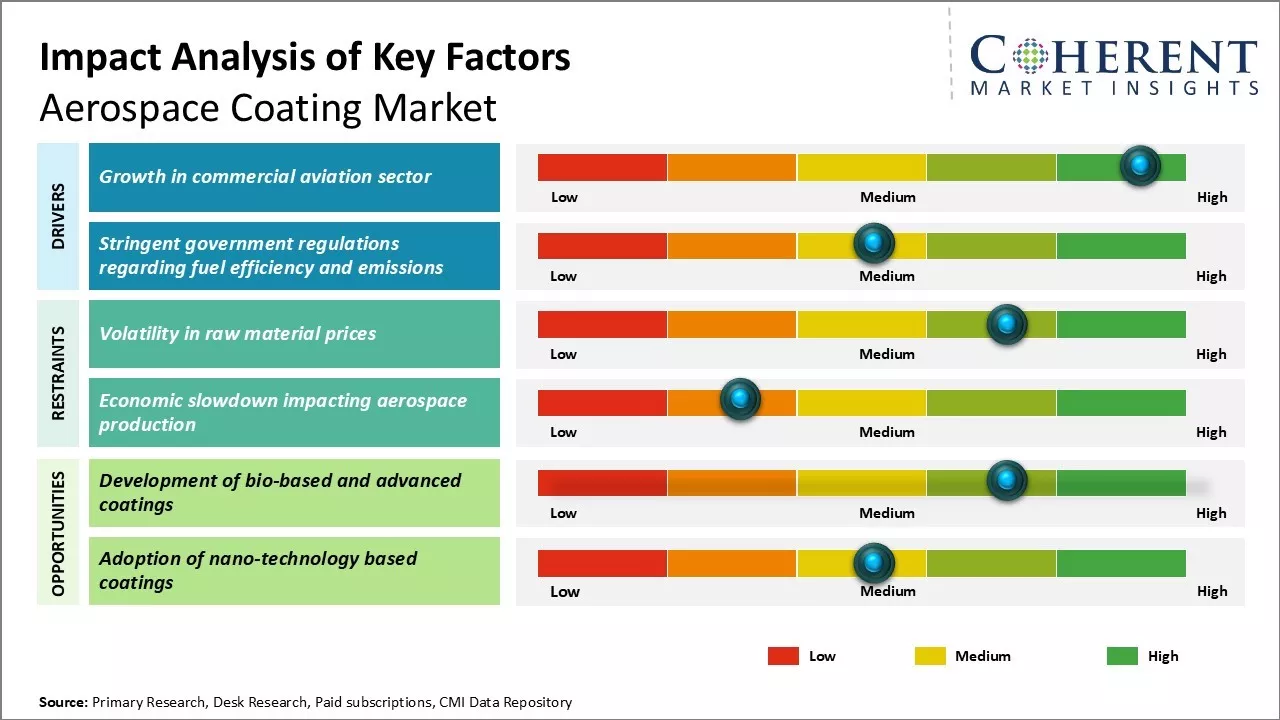
- Growth in commercial aviation sector
Growth of the global commercial aviation industry is boosting demand for aerospace coatings. As more people are opting for air travel over other modes of transportation for both domestic and international travel, airline companies are expanding their fleet sizes at a rapid pace.
Airbus reported a record-breaking year in 2023, delivering over 700 commercial aircraft, driven by the resurgence in global air travel post-pandemic. The company also announced plans to increase production capacity by 20% to meet rising demand from airlines like Indigo and Delta Air Lines, which are expanding their fleets to address passenger traffic growth.
Challenges in the Aerospace coating market
- Volatility in raw material prices
Aerospace coating manufacturers rely heavily on crude oil and its derivatives for producing various resin and solvent-based formulations. However, international crude oil prices have witnessed wild fluctuations in recent years.
In 2022, the aerospace coating industry saw major disruptions as crude oil prices surged over USD 120 per barrel due to geopolitical tensions. This led to a 15% hike in the cost of solvent-based coatings, forcing manufacturers like PPG Industries to renegotiate contracts and pass on price increases to customers, straining relationships.
Opportunities In the Aerospace Coating Market
- Development of bio-based and advanced coatings
Aerospace coating market is expected to witness new growth opportunities through the development of bio-based and advanced formulations. Rising environmental awareness boosts demand for sustainable coating options produced from renewable plant-based resources like vegetable oil, starch and bio-resins.
Leading coating manufacturers have started extensive R&D initiatives to create bio-derived resins, pigments, and solvents which can match performance of conventional petrochemical-based equivalents. AkzoNobel unveiled its bio-based aerospace coating line in 2023, leveraging renewable resources like linseed oil and bio-derived resins.
The product, developed in partnership with Airbus, offers the same durability and UV resistance as traditional coatings while reducing VOC emissions by 30%, gaining traction among eco-conscious airline operators.
Segmental Insights
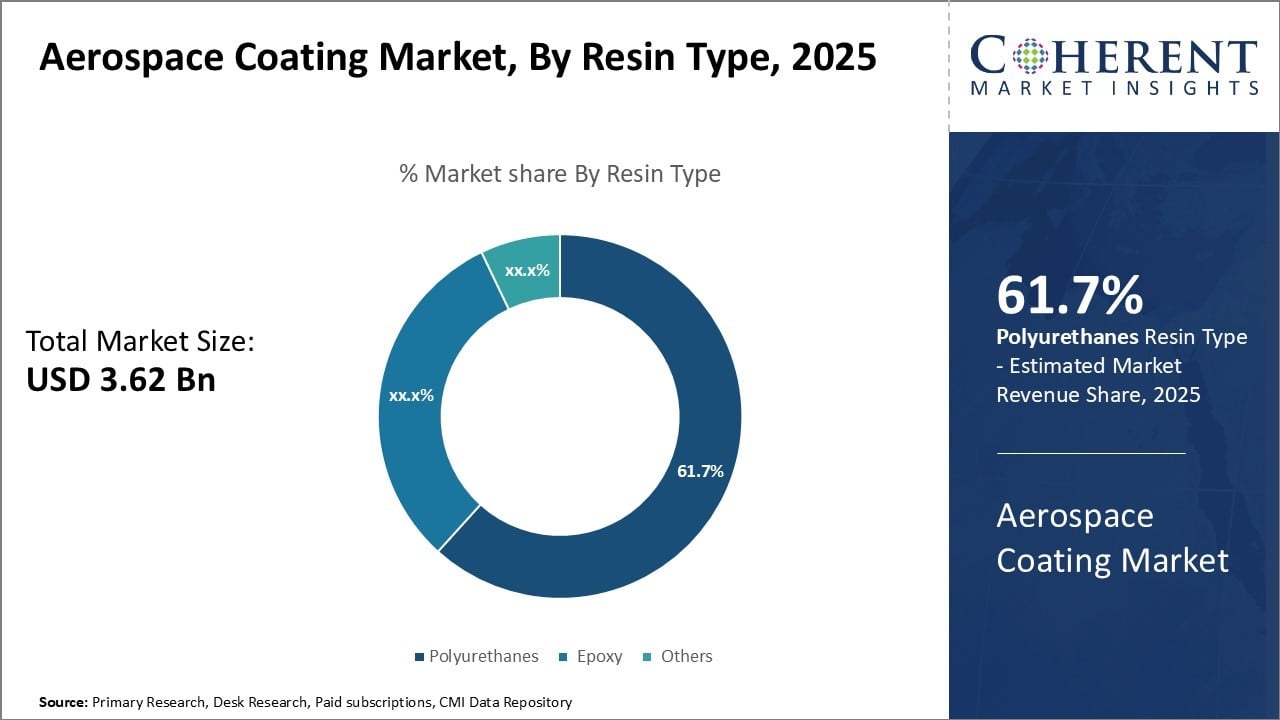
Aerospace Coating Market Insights, By Resin Type
The polyurethanes segment is projected to dominate the global aerospace coating market, commanding a substantial 62.7% share in 2026. This strong position is driven by the resin’s superior protective characteristics, including high resistance to UV radiation, chemicals, and corrosion. These properties make polyurethane coatings ideal for exterior aircraft applications, ensuring long-lasting protection and reduced maintenance costs.
Additionally, its lightweight nature supports enhanced fuel efficiency, aligning with the industry’s increasing focus on sustainability and performance. This dominance reflects rising demand for durable and compliant coatings across both commercial and defence aviation sectors.
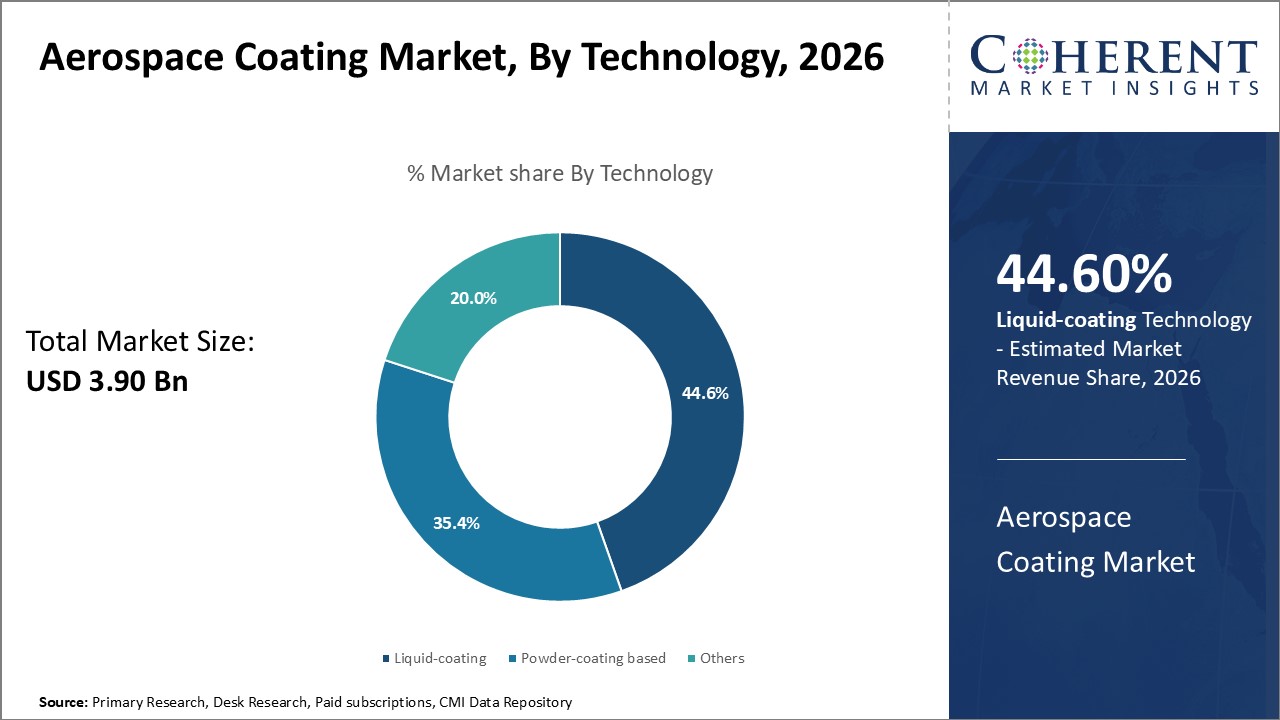
Aerospace Coating Market Insights, By Technology
The liquid-coating segment is estimated to lead the aerospace coating market with a 44.6% share in 2026. This growth is attributed to the technology’s ability to produce uniform, defect-free finishes on complex aircraft geometries. Liquid coatings offer versatility in application methods, superior adhesion, and excellent surface aesthetics, making them highly suitable for both interior and exterior use.
As airlines seek smoother finishes to reduce drag and improve aerodynamics, demand for liquid coatings is rising. The segment benefits from continuous innovation in solvent and water-based formulations tailored to environmental regulations and performance standards.
Aerospace Coating Market Insights, By End-User
The commercial aviation segment is anticipated to capture the largest share of 41.6% in the aerospace coating market by 2026. This dominance is fuelled by the ongoing surge in global air passenger traffic, prompting airlines to expand and upgrade their fleets. Coatings play a vital role in enhancing aircraft appearance, extending lifecycle, and improving fuel efficiency through weight and drag reduction.
Military aviation and general aviation also remain crucial segments, supported by increased defence spending, modernization programs, and the growing use of private and business jets. Each sub-sector contributes to a robust and diversified demand landscape.
Regional Insights
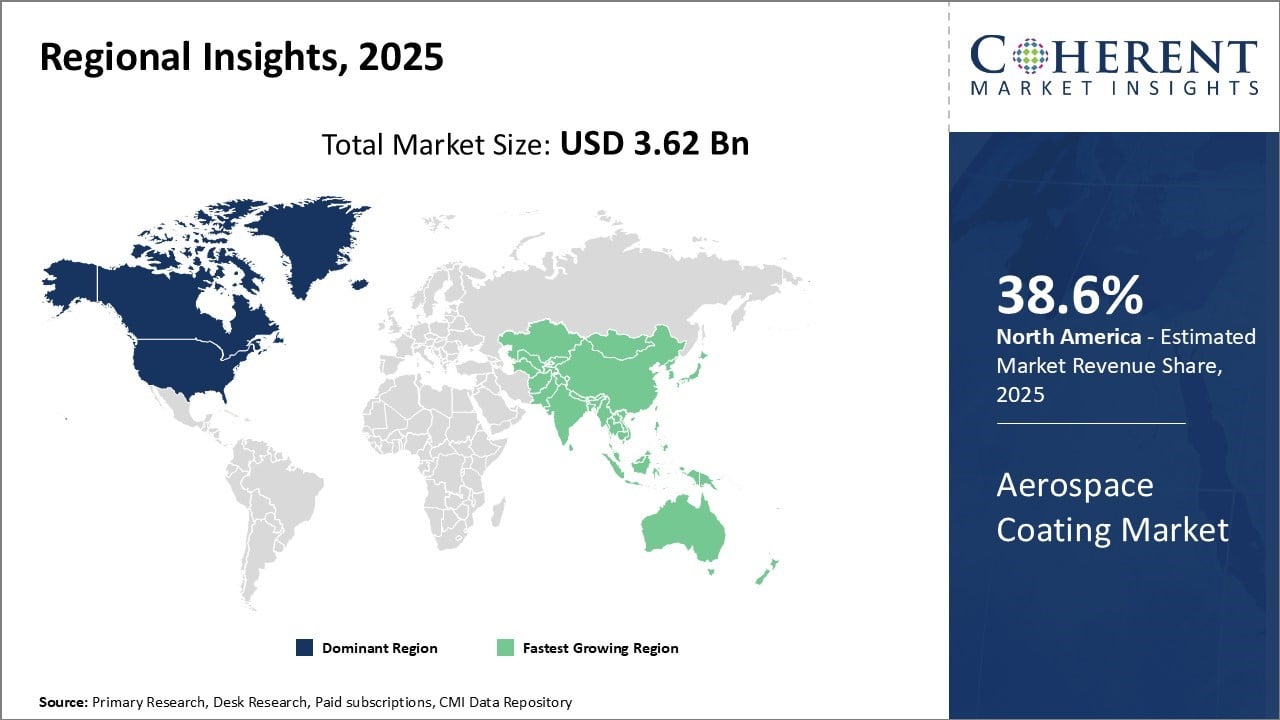
North America Aerospace Coating Market Trends and Analysis
North America is expected to retain a dominant position in the global aerospace coating market, holding a substantial 38.6% share in 2026. This regional leadership is driven by the presence of major aircraft OEMs and tier-1 suppliers, including Boeing and Lockheed Martin, along with a robust defence sector and high R&D investments.
Advanced technological infrastructure, combined with strict regulatory standards, supports the widespread adoption of high-performance coatings. The region’s focus on sustainability and innovation continues to foster demand across both commercial and military aviation sectors, making it a mature and competitive market.
Europe Aerospace Coating Market Trends and Analysis
Europe follows with strong growth in the global aerospace coating market, fuelled by its well-established aerospace manufacturing hubs in countries like France, Germany, and the UK. The region benefits from strategic initiatives supporting green aviation and aircraft modernization programs. Increasing investment in lightweight and eco-friendly coating technologies is driving innovation.
With Airbus headquartered in the region and numerous MRO facilities spread across Europe, demand for advanced coatings for both new aircraft and aftermarket services remains consistently high, contributing to Europe’s significant market share.
Aerospace coating market Dominating Countries
United States and Canada
The United States holds a dominant position in the North American aerospace coating market, which is projected to account for 38.6% of the global share in 2026. The country benefits from the presence of leading aircraft manufacturers like Boeing, advanced defence programs, and robust R&D infrastructure. Its focus on innovation, sustainability, and strict regulatory compliance drives continuous demand for high-performance aerospace coatings across both commercial and military aviation sectors.
Canada also plays a vital role in North America's aerospace coating market, supported by a strong aerospace manufacturing base in Quebec and Ontario. The country has seen increased investment in eco-friendly coating technologies, driven by its commitment to green aviation initiatives. With a focus on MRO services and the production of regional and business jets, Canada contributes significantly to market expansion in North America.
Market Report Scope
Aerospace Coating Market Report Coverage
| Report Coverage | Details | ||
|---|---|---|---|
| Base Year: | 2025 | Market Size in 2026: | USD 3.90 Bn |
| Historical Data for: | 2020 To 2024 | Forecast Period: | 2026 To 2033 |
| Forecast Period 2026 to 2033 CAGR: | 7.8% | 2033 Value Projection: | USD 6.60 Bn |
| Geographies covered: |
| ||
| Segments covered: |
| ||
| Companies covered: | The Sherwin-Williams Company, Socomore, AkzoNobel N.V., PPG Industries, Hentzen Coatings, Inc, Axalta Coating Systems, KC Jones Plating Company, IHI Ionbond AG, BASF SE, Saint-Gobain SA, Mapaero, Bryocat, and Zircotec | ||
| Growth Drivers: |
| ||
| Restraints & Challenges: |
| ||
Analyst Opinion (Expert Opinion)
- Analysts hold a positive and forward-looking perspective on the global aerospace coating market, noting its crucial role in enhancing aircraft performance, longevity, and aesthetics. The market is seen as an essential component of the broader aerospace industry, with demand consistently supported by rising commercial air travel, defence modernization, and growing maintenance, repair, and overhaul (MRO) activity. The increasing importance of coatings in improving fuel efficiency and reducing environmental impact is also widely emphasized.
- Experts highlight technological advancements as a key driver of innovation in the market. Developments such as nanotechnology-based coatings, AI-assisted application systems, and smart coatings with sensor capabilities are expected to significantly elevate product performance and operational efficiency. Additionally, the growing emphasis on eco-friendly, low-VOC formulations is viewed as a strategic shift, aligning with tightening environmental regulations and sustainability goals.
- Regionally, North America remains the leading market due to its concentration of aerospace OEMs and high defence spending, while Asia Pacific is projected to witness the fastest growth, propelled by expanding airline fleets and infrastructure development. Analysts believe the future of the aerospace coating market will be shaped by material innovation, regulatory compliance, and increased customization to meet diverse end-user needs.
Speak to the analyst
Want personalized insights?
Take the findings above to one of our principal consultants, or have the report rebuilt around the segments, geographies and competitors you actually track.
Aerospace Coating Market: Key Development
- In April 205, International Aerospace Coating announces its plan to construct a new widebody hangar at Rick Husband Amarillo International Airport.
- In January 2024, Sherwin-Williams announced the launch of its new 2024 Aerospace calendar that features outstanding paint offers on different types of aircraft. It includes small kit planes, large business jets, and unique aircrafts.
Market Segmentation
- Resin Type Insights (Revenue, USD Bn, 2026 - 2033)
- Polyurethanes
- Epoxy
- Others
- Technology Insights (Revenue, USD Bn, 2026 - 2033)
- Liquid-coating
- Powder-coating based
- Others
- End User Insights (Revenue, USD Bn, 2026 - 2033)
- Commercial Aviation
- Military Aviation
- General Aviation
- Others
- Application Insights (Revenue, USD Bn, 2026 - 2033)
- Interior
- Exterior
- Regional Insights (Revenue, USD Bn, 2026 - 2033)
- North America
- U.S.
- Canada
- Latin America
- Brazil
- Argentina
- Mexico
- Rest of Latin America
- Europe
- Germany
- U.K.
- Spain
- France
- Italy
- Russia
- Rest of Europe
- Asia Pacific
- China
- India
- Japan
- Australia
- South Korea
- ASEAN
- Rest of Asia Pacific
- Middle East
- GCC Countries
- Israel
- Rest of Middle East
- Africa
- South Africa
- North Africa
- Central Africa
- Key Players Insights (Revenue, USD Bn, 2021 - 2033)
- The Sherwin-Williams Company
- Socomore
- AkzoNobel N.V.
- PPG Industries
- Hentzen Coatings, Inc.
- Axalta Coating Systems
- KC Jones Plating Company
- IHI Ionbond AG
- BASF SE
- Saint-Gobain SA
- Mapaero
- Bryocat
- Zircotec
Sources
The Stakeholders Consulted
- Aerospace OEM procurement managers and coatings specialists
- Coating manufacturers and raw material suppliers (resins, pigments, additives)
- MRO (Maintenance, Repair, and Overhaul) facility managers and engineers
- Aviation regulatory and safety compliance officers (FAA, EASA)
- Research institutions specializing in aerospace materials and surface engineering
- Defense ministry procurement divisions and military aviation technical advisors
- Commercial airline operators and fleet maintenance directors
Databases Opened
- U.S. Federal Aviation Administration (FAA) – Coating Regulations and Aircraft Maintenance Data
- European Union Aviation Safety Agency (EASA) – Aerospace Coating Compliance Guidelines
- International Air Transport Association (IATA) – Fleet Expansion and Aircraft Usage Statistics
- Ministry of Civil Aviation (India) – Aerospace Manufacturing and MRO Growth Metrics
- World Bank Open Data – Aviation Infrastructure and Industrial Innovation Indicators
Magazines & Trade Publications
- Aviation Week & Space Technology
- MRO Network – Coating and Maintenance Segment
- Paint & Coatings Industry Magazine
- Aerospace Manufacturing Magazine
- Composites World – Aerospace Coating Applications Section
Scientific and Industry Journals
- Progress in Organic Coatings
- Journal of Coatings Technology and Research
- Surface and Coatings Technology
- Aerospace Science and Technology Journal
- Journal of Materials Science Materials in Electronics
Newspapers & Media Outlets
- The Wall Street Journal – Aerospace & Manufacturing Section
- Bloomberg – Aviation and Defense Market Insights
- Reuters – Global Aerospace and Coating Industry Coverage
- The Economic Times – Aviation and Industrial Materials Section
- Business Standard – Defense and Coating Sector Developments
Associations and Regulatory Bodies
- U.S. Federal Aviation Administration (FAA)
- European Union Aviation Safety Agency (EASA)
- International Air Transport Association (IATA)
- American Coatings Association (ACA)
- Bureau of Indian Standards (BIS) – Aerospace Coating Guidelines
Public Domain Sources
- European Commission – REACH and Aerospace Coating Chemical Compliance Reports
- U.S. Department of Transportation – Aerospace and Coating Supply Chain Reports
- International Civil Aviation Organization (ICAO) – Aircraft Maintenance and Emission Norms
- International Trade Centre – Global Aerospace Coating Exports and Imports
- NASA Technical Reports Server (NTRS) – Advanced Aerospace Materials Research
Proprietary Research Elements
- CMI Aerospace Coating Market Analytics Tool
- CMI Repository of Historical Aerospace Coating Market Data (2016–2024)
- CMI Expert Interviews with aerospace engineers, coating chemists, and MRO professionals
Get access to 250+ pages report
Every segment, forecast, competitor profile and data table behind the analysis above — available for instant download.
- ESOMAR Member
- ISO 9001:2015 Certified
- D-U-N-S Registered
- GDPR & CCPA Compliant
Missing comfort of reading report in your local language? Find your preferred language:
Transform your Strategy with Exclusive Trending Reports
Frequently Asked Questions
The Aerospace Coating Market size is estimated to be valued at USD 3.90 Bn in 2026, and is expected to reach USD 6.60 Bn by 2033.
The CAGR of the global Market is projected to be 7.8% from 2026 to 2033.
Growth in commercial aviation sector and stringent government regulations regarding fuel efficiency and emissions are the major factors driving the growth of aerospace coating industry.
Volatility in raw material prices and economic slowdown impacting aerospace production are the major factor hampering the growth of global market.
By resin type, polyurethanes segment is estimated to dominate the market in 2026.
The Sherwin-Williams Company, Socomore, AkzoNobel N.V., PPG Industries, Hentzen Coatings, Inc, Axalta Coating Systems, KC Jones Plating Company, IHI Ionbond AG, BASF SE, Saint-Gobain SA, Mapaero, Bryocat, and Zircotec are the major players.
North America is expected to lead the aerospace coating industry in 2026.