

Airborne Weapon Systems For Rotorcraft Market Size and Forecast — 2026 - 2033
The Global Airborne Weapon Systems for Rotorcraft Market size is estimated to be valued at USD 4.6 billion in 2026 and is projected to reach USD 7.8 billion by 2033, registering a compound annual growth rate (CAGR) of 7.8% from 2026 to 2033.
Overview
The airborne weapon systems market for rotorcraft is driven by rising defense modernization programs and the growing need for precision strike capabilities in asymmetric warfare. Increasing procurement of advanced helicopters such as the AH-64 Apache and UH-60 Black Hawk is boosting demand for integrated weapon systems, including guided missiles, rockets, and machine guns. Technological advancements in targeting systems, sensors, and fire-control solutions are enhancing operational efficiency and accuracy. Additionally, escalating geopolitical tensions and higher defense budgets across emerging economies are encouraging investments in advanced airborne combat capabilities, further supporting sustained market growth.
Key Takeaways
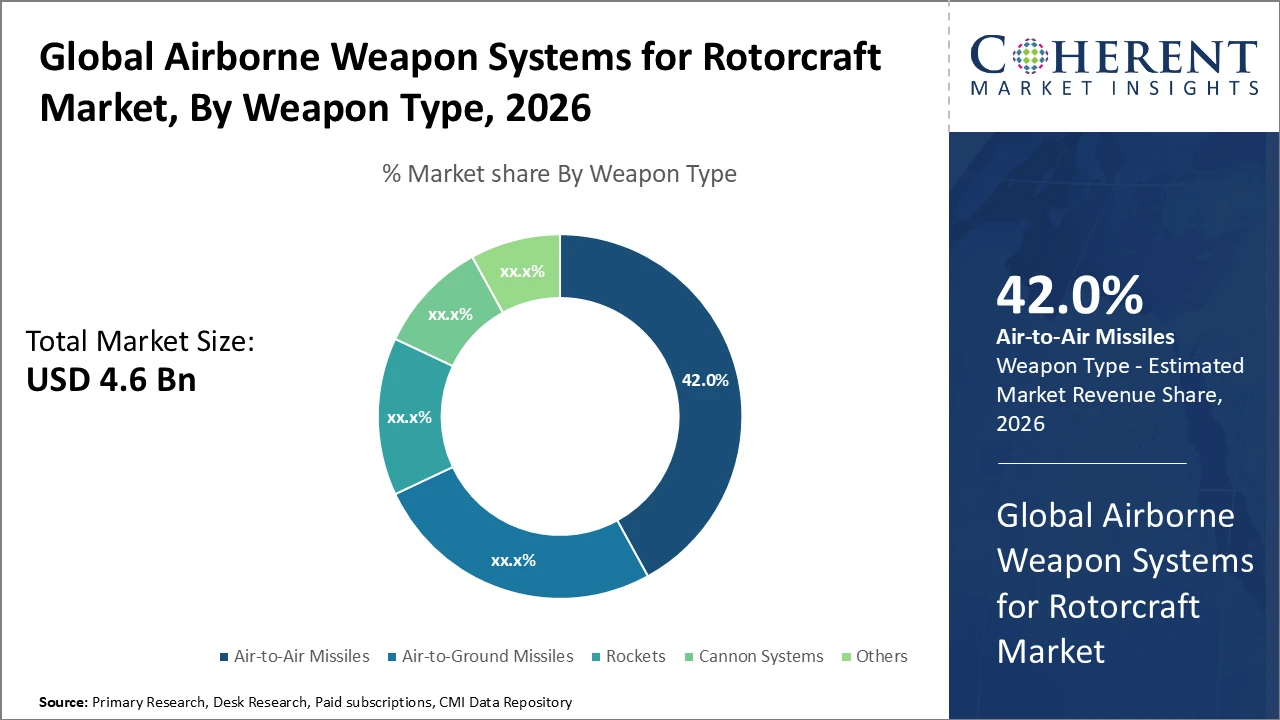
Air-to-Air Missiles dominate with a 42% market share, driven by growing demand for precision engagement capabilities over hostile airspace. The rocket subsegment is emerging rapidly due to its cost-effective deployment in asymmetric conflicts.
The Attack Helicopters subsegment in the Rotorcraft Type segment holds the largest industry share at 54%, supported by increasing procurement for offensive missions by global defense forces. Utility helicopters are seeing growing adoption through integration with multi-use weapon systems.
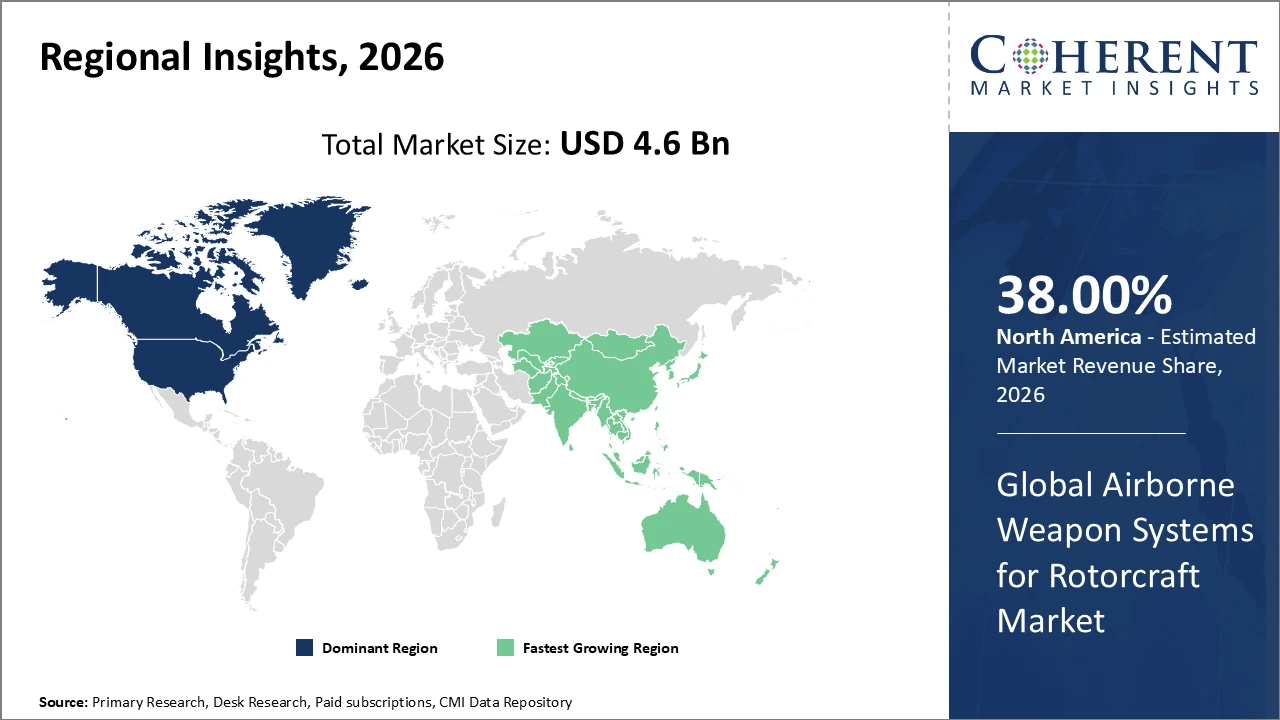
North America leads the market with over 38% of global revenue, supported by significant military investments and established aerospace infrastructure. Asia Pacific is the fastest-growing region, with a CAGR of 9.2%, fueled by rising defense expenditures, modernization programs in India, China, and Australia, and government policies promoting domestic defense manufacturing.
Airborne Weapon Systems for Rotorcraft Market Segmentation Analysis
Airborne Weapon Systems for Rotorcraft Market Insights, By Weapon Type
Air-to-Air Missiles dominate the market with a 42% share, driven by the growing need for long-range, precise aerial engagement, particularly in modern attack helicopter operations across North America and Europe. The Air-to-Ground Missiles subsegment is the fastest-growing, benefiting from expanding use in close air support and asymmetric warfare missions. Rockets provide a cost-effective option for smaller utility rotorcraft, enabling rapid target saturation. Cannon Systems are utilized for precision fire support in urban and tactical environments. The ‘Others’ category, including emerging directed energy weapons, remains limited but holds significant future growth potential as research and development efforts advance globally.
Airborne Weapon Systems for Rotorcraft Market Insights, By Rotocraft Type
The Attack Helicopters segment leads the market with a 54% share, driven by their strategic role in frontline combat and special operations. Their capability to integrate advanced airborne weapon systems provides superior firepower, precision, and agility in hostile environments. The Utility Helicopters segment is the fastest-growing, supported by expanding missions such as armed reconnaissance and limited offensive operations enabled by modular weapon payloads. Transport Helicopters focus mainly on troop and cargo movement, offering minimal weapon integration. The ‘Others’ category includes specialized platforms like electronic warfare helicopters, which feature adaptive weapon systems for mission-specific requirements, contributing to diversified market demand.
Airborne Weapon Systems for Rotorcraft Market Insights, By Platform Range
Long Range platforms drive market growth, fueled by rising operational demands for extended mission endurance and standoff strike capability, particularly amid escalating border tensions and power projection needs in Asia Pacific and the Middle East. Medium Range systems sustain steady adoption due to their suitability for rapid deployment and flexible engagement across diverse theaters. Short Range platforms are primarily deployed in confined tactical environments, including urban combat and border patrol missions. The ‘Others’ category encompasses experimental hybrid-range systems that blend fuel efficiency with versatile payload delivery, reflecting an industry trend toward multi-mission adaptability and innovative solutions in rotorcraft airborne weapon capabilities.
Airborne Weapon Systems for Rotorcraft Market Trends
The market is advancing with a strong focus on digital integration and next-generation materials in airborne weapon systems for rotorcraft.
Increasing governmental funding is accelerating the development of smart and autonomous targeting solutions, enhancing operational precision.
North America and Europe remain key innovation hubs, driving technological advancements and system modernization.
Geopolitical instability in Asia Pacific is intensifying rotorcraft acquisition programs, boosting demand for advanced airborne weapon systems.
Overall market growth is shaped by the convergence of technology innovation, defense modernization, and strategic military requirements globally.
Airborne Weapon Systems for Rotorcraft Market Insights, By Geography
North America Airborne Weapon Systems for Rotorcraft Market Analysis and Trends
In North America, the airborne weapon systems for rotorcraft market is dominated by major defense contractors and substantial government spending, accounting for 38% of the global market share. Extensive R&D investments and a well-established military infrastructure foster innovation in advanced rotorcraft weapon systems, including precision-guided missiles, turreted guns, and integrated targeting solutions. The United States maintains leadership through large-scale procurement programs, modernizing attack helicopter fleets and enhancing airborne missile capabilities. Continuous upgrades and adoption of autonomous targeting technologies further strengthen market growth. This robust defense ecosystem ensures North America remains a key driver of technological advancement and industry expansion in the rotorcraft weapons sector.
Asia Pacific Airborne Weapon Systems for Rotorcraft Market Analysis and Trends
The Asia Pacific region demonstrates the fastest growth in the airborne weapon systems for rotorcraft market, with a CAGR of 9.2%, propelled by extensive defense modernization programs in India, China, and Australia. Rising investments in indigenous defense manufacturing capabilities support domestic production of advanced rotorcraft and weapon systems. The strategic need to safeguard expansive maritime zones and contested border areas further drives procurement. Additionally, governments are prioritizing integrated weapon platforms, networked battlefield solutions, and cyber-physical systems to enhance operational effectiveness. These factors collectively underpin the region’s rapid market expansion and highlight Asia Pacific as a critical growth hub globally.
Airborne Weapon Systems for Rotorcraft Market Outlook for Key Countries
USA Airborne Weapon Systems for Rotorcraft Market Analysis and Trends
The USA’s airborne weapon systems for rotorcraft market is driven by significant government spending aimed at modernizing rotorcraft fleets with advanced and lethal weaponry. Between 2024 and 2026, Department of Defense investments increased by 8% annually, focusing on enhancing air-to-air and air-to-ground capabilities. Leading defense companies, including Boeing and Lockheed Martin, have deployed next-generation missile systems and autonomous targeting modules, improving operational efficiency and contributing over USD 1.7 billion in annual market revenue. Large-scale contracts for multi-role attack helicopters equipped with integrated advanced weapons underscore the USA’s central role in shaping global market growth and technological leadership.
Germany Airborne Weapon Systems for Rotorcraft Market Analysis and Trends
Germany’s airborne weapon systems for rotorcraft market is driven by the modernization of its military rotorcraft fleet and strategic emphasis on NATO interoperability. The government has invested in upgrading attack and utility helicopters with precision-guided missiles, rocket pods, and advanced targeting systems to enhance combat readiness. Indigenous defense manufacturers are increasingly contributing to system integration and production, supported by policies promoting domestic defense capabilities. Emerging trends include digital fire-control systems, lightweight materials, and modular weapon payloads enabling multi-mission flexibility. Additionally, Germany is focusing on joint European defense initiatives, fostering technology collaboration and exports, which collectively strengthen the country’s position in the rotorcraft weapons market.
Analyst Opinion
Enhanced production capacity for advanced weapon systems has driven market growth, with 2025 contract awards for rotorcraft weapon upgrades rising by 12% over previous years, reflecting intensified production schedules.
Diversification in demand-side applications, including battlefield surveillance and rapid strike missions, has increased imports of precision-guided munitions for rotorcraft. For example, Asia Pacific reported a 15% rise in such imports in 2024 due to defense modernization programs focused on asymmetric warfare.
Pricing pressures from raw material inflation in 2024-2025 temporarily affected profit margins, but R&D investments in lightweight composite munitions enabled cost-efficient manufacturing, reducing costs by 9% for leading suppliers in 2025.
Micro-indicators such as the growing number of active rotorcraft platforms worldwide have boosted demand for compatible weapon systems, exemplified by the U.S. Department of Defense expanding its attack helicopter fleet by 8% between 2024 and 2026.
- Current Industry Events of 2026
- Market Size Estimation
- Regional Breakdown
- Competitive Landscape
- Customer Intelligence
- Segmental Analysis
- Pricing Analysis
- Key Market Drivers, Challenges & Future Trends
- Customized Insights Section
Market Scope
| Report Coverage | Details | ||
|---|---|---|---|
| Base Year: | 2025 | Market Size in 2026: | USD 4.6 billion |
| Historical Data for: | 2020 To 2024 | Forecast Period: | 2026 To 2033 |
| Forecast Period 2026 to 2033 CAGR: | 7.8% | 2033 Value Projection: | USD 7.8 billion |
| Geographies covered: |
| ||
| Segments covered: |
| ||
| Companies covered: | Bell Textron Inc., Saab AB, Airbus Helicopters, Leonardo S.p.A., Thales Group, MBDA, Denel Dynamics, Elbit Systems, Textron Systems, Rostec Corporation | ||
| Growth Drivers: |
| ||
Airborne Weapon Systems for Rotorcraft Market Growth Factors
Market growth is primarily driven by rising defense budgets among leading military powers investing in rotorcraft modernization programs. In 2026, the U.S. defense budget saw a 9% increase dedicated to upgrading airborne weapon systems for rotorcraft. Technological advancements, including improved targeting systems and lightweight missile designs, have enhanced operational effectiveness, stimulating demand across multiple conflict theaters. Geopolitical tensions in Asia Pacific and the Middle East further amplify the need for versatile airborne attack platforms. Additionally, the emphasis on multi-role rotorcraft combining offensive, surveillance, and reconnaissance capabilities, as observed in 2024 NATO procurement cycles, continues to broaden market scope and revenue potential.
Airborne Weapon Systems for Rotorcraft Market Development
In February 2026, Hanwha Aerospace and Korea Aerospace Industries partnered to develop advanced airborne weapon systems, including a new long-range air-to-air missile, for integration into domestically produced aircraft.
Key Players
Leading Companies of the Market
Bell Textron Inc.
Saab AB
Airbus Helicopters
Leonardo S.p.A.
Elbit Systems
Thales Group
MBDA
Denel Dynamics
Textron Systems
Rostec Corporation
Competitive efforts in the airborne weapon systems for rotorcraft market have centered on strategic partnerships and joint ventures to expand and enhance product offerings. For instance, Bell Textron partnered with a missile systems manufacturer to integrate next-generation air-to-ground munitions into its attack rotorcraft, resulting in a 10% increase in orders in 2025. Similarly, Lockheed Martin’s focused R&D investment in stealth-compatible weaponry generated over $150 million in additional revenue in 2024, reinforcing its market position and providing a competitive edge against emerging players. These strategies highlight the industry’s emphasis on collaboration and technological advancement to drive growth.
Airborne Weapon Systems for Rotorcraft Market Future Outlook
The airborne weapon systems for rotorcraft market is expected to grow steadily, driven by increasing defense budgets, modernization of military fleets, and rising demand for precision strike capabilities. Advances in guided munitions, autonomous targeting, and networked weapons integration will enhance operational efficiency and battlefield effectiveness. Emerging trends include lightweight, modular systems that can be rapidly configured for multiple mission types, and the integration of electronic warfare and countermeasure technologies. Growth is particularly anticipated in North America and Asia-Pacific, where strategic military investments are rising. Overall, future market expansion will be shaped by technological innovation, geopolitical tensions, and the ongoing emphasis on rotorcraft combat versatility.
Airborne Weapon Systems for Rotorcraft Market Historical Analysis
The airborne weapon systems for rotorcraft market has evolved significantly over the past decade, driven by military modernization programs and rising demand for multi-role rotorcraft capabilities. Early developments focused on mounting conventional machine guns, rocket pods, and unguided munitions on helicopters for close air support. Over time, precision-guided missiles, turreted weapon stations, and integrated targeting systems became standard to enhance accuracy and operational effectiveness. Key historical drivers included global conflicts, rising defense expenditures, and the need for rapid response capabilities. Additionally, advances in lightweight materials, avionics integration, and digital fire-control systems have historically enabled rotorcraft to carry more versatile and effective weapon systems.
Sources
Primary Research Interviews:
R&D managers, engineers, and project leaders from companies developing rotorcraft weapon systems, including missiles, machine guns, and turreted stations.
Technical specialists from manufacturing firms focusing on production, quality control, targeting systems, and avionics integration.
Defense and military experts involved in procurement, operational testing, and tactical deployment of airborne weapons.
Magazines:
Jane’s Defence Weekly – Market trends, technology updates, and defense equipment news.
Aviation Week & Space Technology – Developments in rotorcraft systems, weapon integration, and defense innovation.
Defense News – Updates on global military programs, procurement strategies, and tactical advancements.
Journals:
Journal of Defense Modeling and Simulation – Research on weapon system performance and operational effectiveness.
Defense Technology – Studies on rotorcraft armaments, precision-guided systems, and military avionics.
Military Technology – Insights on rotorcraft weapon innovations, integration, and field testing.
Newspapers:
The Wall Street Journal – Corporate developments, defense contracts, mergers, and investments.
Financial Times – Global defense market trends, procurement policies, and strategic investments.
Reuters – News on military technology deployment, defense agreements, and international security initiatives.
Bloomberg – Company strategies, revenue trends, and market forecasts for airborne weapons.
Associations:
North Atlantic Treaty Organization (NATO) – Standards, operational guidelines, and defense technology reports.
Defense Advanced Research Projects Agency (DARPA) – Research programs, innovations, and defense system development.
U.S. Department of Defense (DoD) – Procurement data, operational reports, and rotorcraft weapon system specifications.
Get access to 250+ pages report
Every segment, forecast, competitor profile and data table behind the analysis above — available for instant download.
- ESOMAR Member
- ISO 9001:2015 Certified
- D-U-N-S Registered
- GDPR & CCPA Compliant
Missing comfort of reading report in your local language? Find your preferred language:
Transform your Strategy with Exclusive Trending Reports
Frequently Asked Questions
The market is primarily led by Bell Textron Inc., Rostec Corporation, Airbus Helicopters, Saab AB, who collectively hold a significant share through extensive product offerings and R&D investments.
Projected to grow from USD 4.6 billion in 2026 to USD 7.8 billion by 2033, the market will exhibit a CAGR of 7.8%, driven by modernization and expanding rotorcraft fleets globally
Attack Helicopters focusing on attack and utility rotorcraft represent the largest growth opportunity due to evolving combat requirements and increased operational scope.
Trends indicate increasing adoption of modular and AI-integrated weapon systems, enhanced interoperability, and emerging unmanned rotorcraft platforms setting new dynamics in airborne weapon deployment.
Competition is marked by innovation-centered strategies with challenges including high development costs, stringent regulatory compliance, and market entry barriers created by established players.
Leading companies emphasize strategic alliances, localization of production, and continuous technological upgrades to maintain competitive advantage and expand market presence.