

Uav Jammers Market Size and Forecast — 2026 - 2033
The Global UAV Jammers Market size is estimated to be valued at USD 1.2 billion in 2026 and is expected to reach USD 2.8 billion by 2033, exhibiting a compound annual growth rate (CAGR) of 12.6% from 2026 to 2033.
Overview
The UAV jammers market comprises electronic devices designed to detect, disrupt, and neutralize unauthorized or hostile unmanned aerial vehicles (UAVs). Key product types include portable handheld jammers, vehicle-mounted systems, and fixed-site installations, each catering to different operational needs. Portable jammers offer flexibility for security personnel, while vehicle-mounted units provide mobile protection for convoys and critical infrastructure. Fixed-site systems are deployed around sensitive facilities such as airports, government buildings, and military bases to ensure continuous surveillance and interference. Advanced products integrate multiple frequency bands, GPS/GNSS disruption, and real-time monitoring, enhancing counter-drone capabilities across defense, law enforcement, and commercial sectors.
Key Takeaways
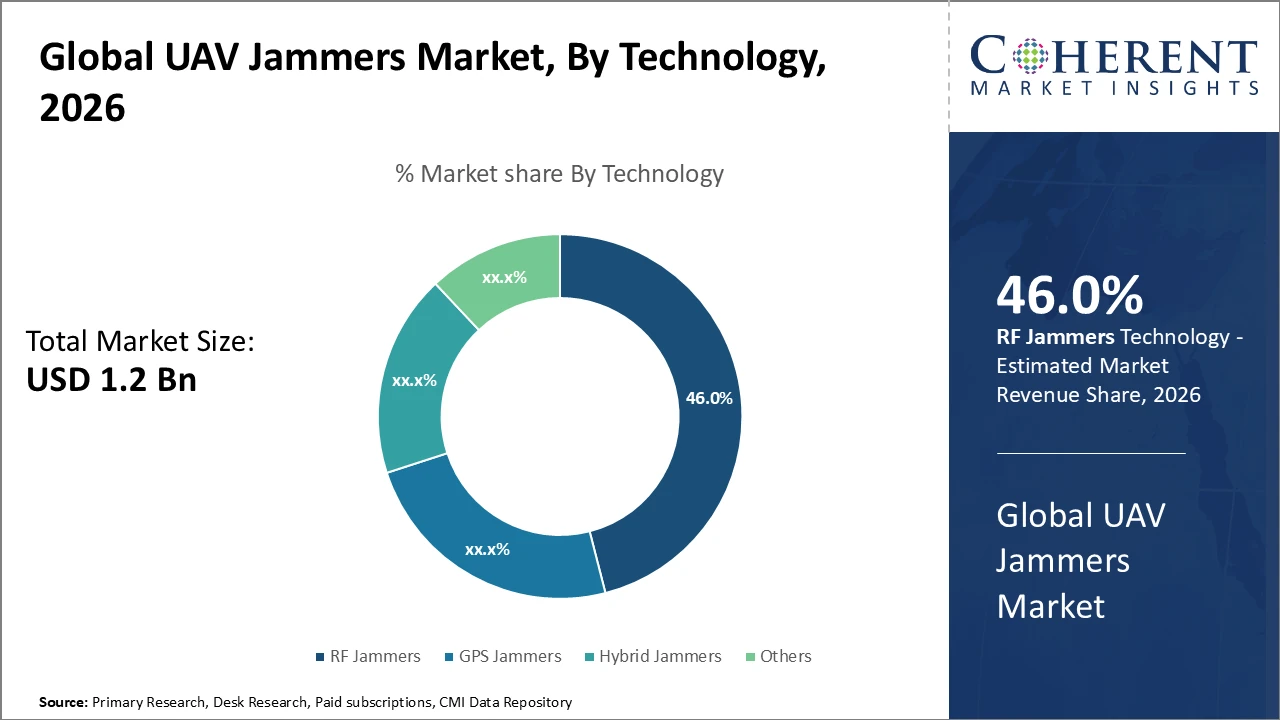
The RF jammers segment leads the UAV jammers market with a 46% share, driven by broad applicability and effectiveness against multiple drone communication protocols.
Military and defense is the dominant application segment, supported by increasing defense budgets and strategic counter-UAV deployments globally.
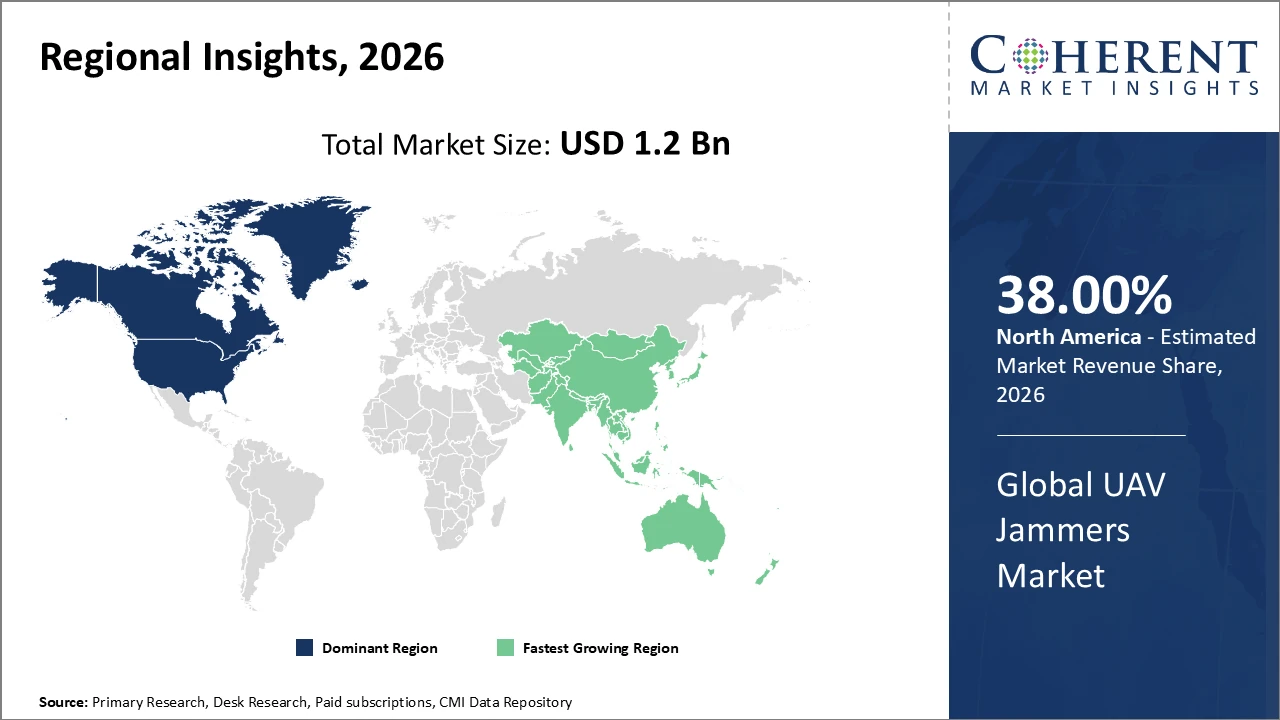
North America generates the largest market revenue of 38%, fueled by government initiatives and technology-focused defense contractors driving innovation and adoption.
Asia Pacific is the fastest-growing regional market, with a CAGR exceeding 14%, due to rising security concerns and expanding drone surveillance activities.
Advanced technologies, including AI-enhanced jamming and hybrid systems, are shaping the market landscape and creating new growth opportunities.
UAV Jammers Market Segmentation Analysis
UAV Jammers Market Insights, By Technology
RF jammers lead the UAV jammers market with a 46% share, due to their ability to interfere across multiple drone communication frequencies. They effectively disrupt command-and-control signals, making them suitable for both military and commercial applications. The hybrid jammers segment is the fastest-growing, combining RF and GPS jamming to provide enhanced coverage in complex threat environments requiring multi-layered drone neutralization. GPS jammers specifically target satellite-based navigation signals and are typically used in localized protection zones. The ‘Others’ category includes emerging technologies like infrared and acoustic jamming systems, which serve niche applications but currently hold a marginal share of the market.
UAV Jammers Market Insights, By Components
Hardware commands the largest share of the UAV jammers market, driven by the capital-intensive nature of system procurement and installation. This includes transmitters, antennas, and signal processors engineered for durability and reliable performance across diverse operational environments. The software segment is the fastest-growing, fueled by AI-driven innovations in jam signal optimization, frequency management, and threat detection algorithms, which enhance effectiveness while minimizing false activations. Services encompass maintenance, system integration, and consulting, ensuring long-term operational readiness and compliance with evolving airspace regulations. Combined, hardware, software, and services form integrated solutions that maximize market revenue and support sustained business growth.
UAV Jammers Market Insights, By Application
Military and defense dominate the UAV jammers market, driven by ongoing investments in counter-UAV capabilities. This segment benefits from strategic defense programs, procurement of integrated electronic warfare systems, and heightened awareness of drone threats. The commercial sector, covering industries such as energy, transportation, and event security, is the fastest-growing subsegment, fueled by increased drone activity and regulatory requirements for aerial safety. Critical infrastructure protection focuses on safeguarding airports, power plants, and government facilities, relying on advanced jamming solutions for fixed-site deployment. The ‘Others’ category includes law enforcement and private property applications, showing steady but limited market expansion.
UAV Jammers Market Trends
Significant advancements in AI-driven jamming systems enable adaptive and autonomous neutralization of rogue drones, improving operational control at critical sites.
In 2025, global deployments of AI-powered UAV jammers increased by 35%, reflecting rising adoption of intelligent counter-drone solutions.
Integration of radar-based detection with jamming technologies provides seamless protection, reducing false alarms and enhancing response efficiency.
Modular UAV jammers allow rapid redeployment across different environments, supporting flexible and dynamic security operations.
The trend toward smart, connected jamming systems facilitates real-time monitoring, threat analysis, and coordinated defense strategies in both military and commercial sectors.
UAV Jammers Market Insights, By Geography
North America UAV Jammers Market Analysis and Trends
North America dominates the UAV jammers market, contributing approximately 38% of global revenue. This leadership is driven by substantial federal and defense investments in counter-drone technologies, as governments prioritize securing critical infrastructure, military installations, and airspace from unauthorized UAV activity. The region benefits from the presence of leading market players, advanced research and development capabilities, and well-established defense procurement processes. High adoption rates in military and commercial sectors, combined with supportive regulatory frameworks, further reinforce market growth. Continuous innovation in AI-driven and modular jamming systems ensures North America maintains a strategic advantage in UAV countermeasure solutions.
Asia Pacific UAV Jammers Market Analysis and Trends
The Asia Pacific region is emerging as the fastest-growing UAV jammers market, with a CAGR exceeding 14%, driven by rising security concerns and increasing drone utilization across both civil and military applications. Government initiatives promoting indigenous defense manufacturing in India have accelerated domestic production of counter-UAV systems, while heightened border security measures in China and South Korea have boosted demand for advanced jamming solutions. Expanding infrastructure projects, critical facility protection, and growing awareness of aerial threats further contribute to market growth. Combined with regional investments in AI-enabled and modular jamming technologies, Asia Pacific is poised to become a key driver of global UAV jammers market expansion.
UAV Jammers Market Outlook for Key Countries
USA UAV Jammers Market Analysis and Trends
The USA leads the UAV jammers market, driven by advanced technology development and substantial defense spending, which reached $800 billion in 2025. Major players such as Lockheed Martin, L3Harris Technologies, and Raytheon Technologies dominate the market with sophisticated RF and hybrid jammer systems deployed across military fleets and critical infrastructure. Government funding for counter-UAV programs increased 22% in 2026, accelerating adoption at bases and urban security sites. Additionally, regulatory requirements compel commercial drone operators to implement jammer-based solutions near airports and sensitive zones. These factors collectively reinforce the U.S. market’s leadership and support continued growth and technological innovation.
Germany UAV Jammers Market Analysis and Trends
The Germany UAV jammers market is shaped by strong defense expenditure, advanced engineering capabilities, and strategic focus on homeland security. The country’s robust defense industry drives demand for high‑performance RF and hybrid jamming systems deployed to protect critical infrastructure, military bases, and public events. Increasing concerns over unauthorized drone activities have prompted investments in integrated counter‑UAV solutions that combine radar detection, AI‑assisted response, and electronic warfare capabilities. Collaboration between defense contractors and research institutions accelerates innovation, particularly in modular and AI‑enabled systems. Regulatory emphasis on airspace safety and secure operations around airports further supports market expansion, positioning Germany as a key contributor to the European UAV jammers landscape.
Analyst Opinion
The increasing sophistication of drones drives demand for advanced jamming solutions, reflected in an 18% year-over-year rise in strategic defense budgets for counter-UAV technologies in 2024. Government mandates for no-fly zones near sensitive infrastructure boost the need for high-frequency radio jammers capable of engaging multiple UAV types simultaneously.
Commercial adoption is surging, particularly in energy and critical infrastructure sectors, where drone incursions could disrupt operations. UAV jammer installations at power plants increased by 23% in 2025, highlighting market diversification beyond military applications.
Global production capacity for multi-band jamming devices grew by around 15% between 2024 and 2025, with unit costs declining 5% due to economies of scale while maintaining performance standards.
Import data from Asia-Pacific show a 30% increase in UAV jammer procurement in 2026, driven by geopolitical tensions and proactive aerial threat mitigation, positioning the region as a key growth hub.
- Current Industry Events of 2026
- Market Size Estimation
- Regional Breakdown
- Competitive Landscape
- Customer Intelligence
- Segmental Analysis
- Pricing Analysis
- Key Market Drivers, Challenges & Future Trends
- Customized Insights Section
Market Scope
| Report Coverage | Details | ||
|---|---|---|---|
| Base Year: | 2025 | Market Size in 2026: | USD 1.2 billion |
| Historical Data for: | 2020 To 2024 | Forecast Period: | 2026 To 2033 |
| Forecast Period 2026 to 2033 CAGR: | 12.6% | 2033 Value Projection: | USD 2.8 billion |
| Geographies covered: |
| ||
| Segments covered: |
| ||
| Companies covered: | Leonardo S.p.A., Thales Group, Saab AB, Liteye Systems, Inc., Hensoldt AG, Boeing Company, Rheinmetall AG, BAE Systems plc, Dedrone Holding GmbH, Elbit Systems Ltd. | ||
| Growth Drivers: |
| ||
UAV Jammers Market Growth Factors
The UAV jammers market is driven by the growing threat of rogue drones targeting sensitive military and civilian infrastructure. Rising geopolitical tensions and asymmetric warfare strategies compel governments to invest in advanced aerial countermeasures. Strict regulations in North America and Europe mandating protection of no-fly zones around airports, stadiums, and public spaces further stimulate demand. Expanding commercial drone use for deliveries, inspections, and industrial applications increases adoption of jamming solutions in critical infrastructure. Technological advancements, including multi-spectrum jamming, GPS spoofing, and AI-enhanced systems, improve operational effectiveness, support innovation, and enable broader market penetration across defense, commercial, and infrastructure sectors worldwide.
UAV Jammers Market Development
In May 2025, the United Kingdom introduced StormShroud, a new jammer drone designed to fly ahead of F-35 Lightning II and Eurofighter Typhoon jets to disrupt enemy radar systems. The drone is based on the AR3 drone, which has a range of about 100 km and was developed by Tekever, a British-Portuguese firm whose drones have been used in the Russo‑Ukrainian War.
Key Players
Leading Companies of the Market
Leonardo S.p.A.
Saab AB
Boeing Company
BAE Systems plc
Rheinmetall AG
Liteye Systems Inc.
Elbit Systems Ltd.
Dedrone Holding GmbH
HensoldtAG
Several key players in the UAV jammers market have pursued aggressive growth strategies through strategic partnerships and product innovation to strengthen their competitive positioning. For instance, Lockheed Martin’s collaboration with Israel Aerospace Industries in late 2025 led to the development of a joint counter-UAV system integrating advanced radar and jamming technologies, significantly enhancing detection accuracy and response times. Similarly, L3Harris Technologies expanded its portfolio by launching adaptive RF jammer systems capable of real-time frequency hopping, which contributed to a 12% increase in market revenue in 2026, reinforcing its leadership in the rapidly evolving counter-drone market.
UAV Jammers Market Future Outlook
The UAV jammers market is expected to witness robust growth driven by escalating drone threats across military, commercial, and critical infrastructure sectors. Future developments will focus on AI-enhanced and autonomous jamming systems capable of multi-spectrum interference, real-time threat analysis, and adaptive responses. Integration with radar, GPS spoofing, and networked defense platforms will enable faster detection and neutralization of unauthorized UAVs. Increasing global defense budgets, stricter regulations on airspace security, and rising commercial drone adoption will further expand market demand. Additionally, modular and portable solutions will cater to dynamic operational requirements, positioning the market for sustained innovation and expansion through 2033.
UAV Jammers Market Historical Analysis
The UAV jammers market has grown steadily over the past decade, driven initially by military and defense applications aimed at protecting sensitive installations and airspace from unauthorized drones. Early adoption focused on RF and GPS jamming technologies, with deployments concentrated in North America and Europe. Rising drone incidents in commercial and critical infrastructure sectors gradually expanded demand beyond defense. Between 2018 and 2023, technological advancements such as hybrid jammers and modular systems improved operational flexibility and coverage, while AI integration enhanced threat detection and response. Historical investments in R&D and counter-UAV initiatives laid the foundation for the current market expansion and innovation trajectory.
Sources
Primary Research Interviews:
Defense contractors and UAV jammer product managers
Military and homeland security procurement officers
Critical infrastructure operators and facility security managers
Electronic warfare and communication system manufacturers
Industry consultants and defense technology analysts
Magazines:
Jane’s Defence Weekly – UAV Threats & Countermeasure Updates
Defense News – Electronic Warfare and Drone Countermeasures
Military Technology – UAV Detection and Jamming Innovations
C4ISRNET – Airspace Security & Counter-UAV Systems
Journals:
Journal of Electronic Defense – UAV Countermeasure Research
International Journal of Advanced Military Technologies – Drone Neutralization Studies
Defence Studies – Counter-UAV Strategy and Technology Analysis
Newspapers:
The Wall Street Journal – Defense Technology & UAV Security
Financial Times – Global Defense Procurement and Drone Threats
Reuters – Military Electronics and Counter-UAV Developments
Bloomberg – Defense Industry and Drone Countermeasure Markets
Associations:
Association of Old Crows (AOC) – Electronic Warfare Professionals
International Counter-UAS Coalition (ICUAC)
Society of American Military Engineers (SAME)
NATO Science & Technology Organization – UAV Defense Research
Get access to 250+ pages report
Every segment, forecast, competitor profile and data table behind the analysis above — available for instant download.
- ESOMAR Member
- ISO 9001:2015 Certified
- D-U-N-S Registered
- GDPR & CCPA Compliant
Missing comfort of reading report in your local language? Find your preferred language:
Transform your Strategy with Exclusive Trending Reports
Frequently Asked Questions
The market is dominated by key companies such as Leonardo S.p.A., L3Harris Technologies, Thales Group, and Saab AB, which lead through advanced product innovation, strategic partnerships, and regional expansions.
The UAV Jammers market is projected to grow from USD 1.2 billion in 2026 to USD 2.8 billion by 2033, reflecting a CAGR of 12.6% driven by rising drone threats and defense investments.
The Military & Defense segment holds the largest growth opportunity due to increasing investments in aerial countermeasures, border security, and critical infrastructure protection.
Trends such as AI-enabled jammers, modular systems, hybrid RF-GPS solutions, and combined detection-jamming platforms will dominate, enhancing operational efficiency and driving wider adoption.
The market is highly competitive, driven by rapid technological innovation, product differentiation, and strategic alliances, while challenges include regulatory compliance, standardization issues, and high R&D costs.
Companies focus on strategic collaborations, customized solutions for defense and commercial sectors, product portfolio expansion, and regional market penetration to increase revenue and market share.