

Aircraft Communication Systems Market Size and Forecast – 2026 to 2033
The Aircraft Communication Systems Market is anticipated to grow at a CAGR of 11.6% with USD 8.2 Bn in 2026 and is expected to reach USD 16.6 Bn in 2033. The Aircraft Communication Systems Market grows as airlines and defense organizations increase global air traffic operations, expand commercial and military aircraft fleets, and demand secure, reliable, and real-time communication solutions. According to IATA, passenger traffic is projected to grow by 2.1% in 2026.
Key Takeaways:
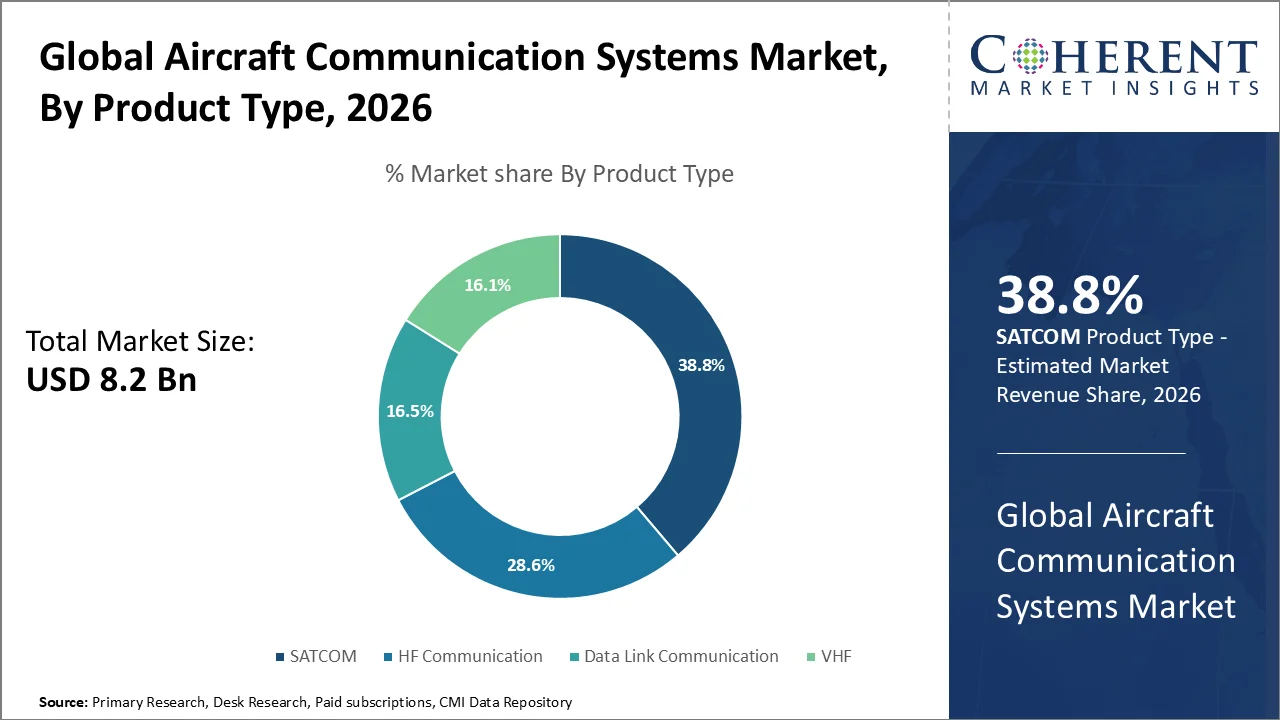
- SATCOM hold the largest market share of 38.8% in 2026 owing to its growing demand for in-flight connectivity (IFC).
- Receivers expected to hold largest market share of 39.4% in 2026 owing to the increasing demand for advanced aircraft navigation systems.
- Commercial Aircraft acquired the prominent market share of 52.8% in 2026 owing to its growth in global air passenger traffic. The FAA's Air Traffic Organization (ATO) manages over 44,000 flights and serves more than 3 million airline passengers daily across 29 million square miles of airspace.
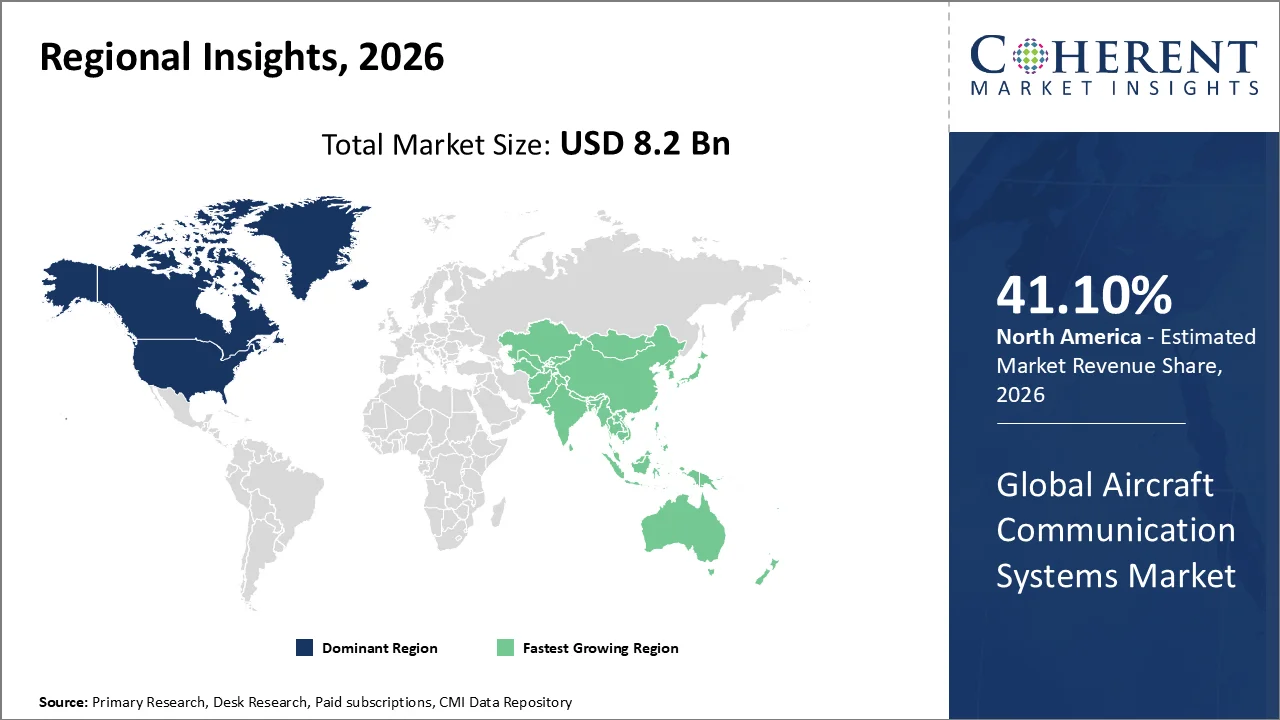
- North America is expected to acquire the dominant share of 41.1% in 2026 owing to its strong presence of major aircraft manufacturers and aviation companies.
Current Events and Their Impact on the Aircraft Communication Systems Market
Current Event | Description and its Impact |
ICAO adopts new global air navigation standards (April 2025) |
|
Expansion of Controller–Pilot Data Link Communications (CPDLC) regulations in Europe |
|
Segmental Insights
- Current Industry Events of 2026
- Market Size Estimation
- Regional Breakdown
- Competitive Landscape
- Customer Intelligence
- Segmental Analysis
- Pricing Analysis
- Key Market Drivers, Challenges & Future Trends
- Customized Insights Section
Why is SATCOM Acquiring the Largest Market Share?
SATCOM hold the largest market share of 38.8% in 2026. The SATCOM segment in the Aircraft Communication Systems Market is growing as airlines and operators demand high-speed in-flight connectivity, seamless global communication, and real-time data transmission. Airlines are implementing SATCOM solutions to improve passenger experiences, optimize flight operations, and enable connected aircraft functions. Technological advancements in high-throughput satellites, low Earth orbit networks, and lightweight antenna systems are driving wider adoption. Increasing commercial aviation activities, expanding defense applications, and the need for dependable communication across remote areas are further strengthening SATCOM market growth. For instance, in July 2026, Nelco, a Tata Group company and a leading VSAT and SatCom provider in India, has expanded its partnership with BSNL by launching specialized satellite handsets, targeting high-value connectivity segments such as maritime, defense, and disaster management with hardware priced at ₹1.34 lakh.
Receivers expected to hold largest market share
Receivers expected to hold largest market share of 39.4% in 2026 owing to the increasing focus on aircraft safety and reliable communication. The Receivers segment in the Aircraft Communication Systems Market is expanding as airlines and operators seek reliable communication, precise navigation, and seamless avionics integration. They are adopting advanced receiver systems to improve flight safety, facilitate real-time data exchange, and support connected aircraft operations. Manufacturers are enhancing receiver performance through innovations in digital signal processing, software-defined radio technology, and compact designs. Growing aircraft deliveries, fleet upgrade initiatives, and increasing demand from defense aviation sectors are also driving the adoption of advanced receiver systems.
Commercial Aircraft acquired the prominent market share
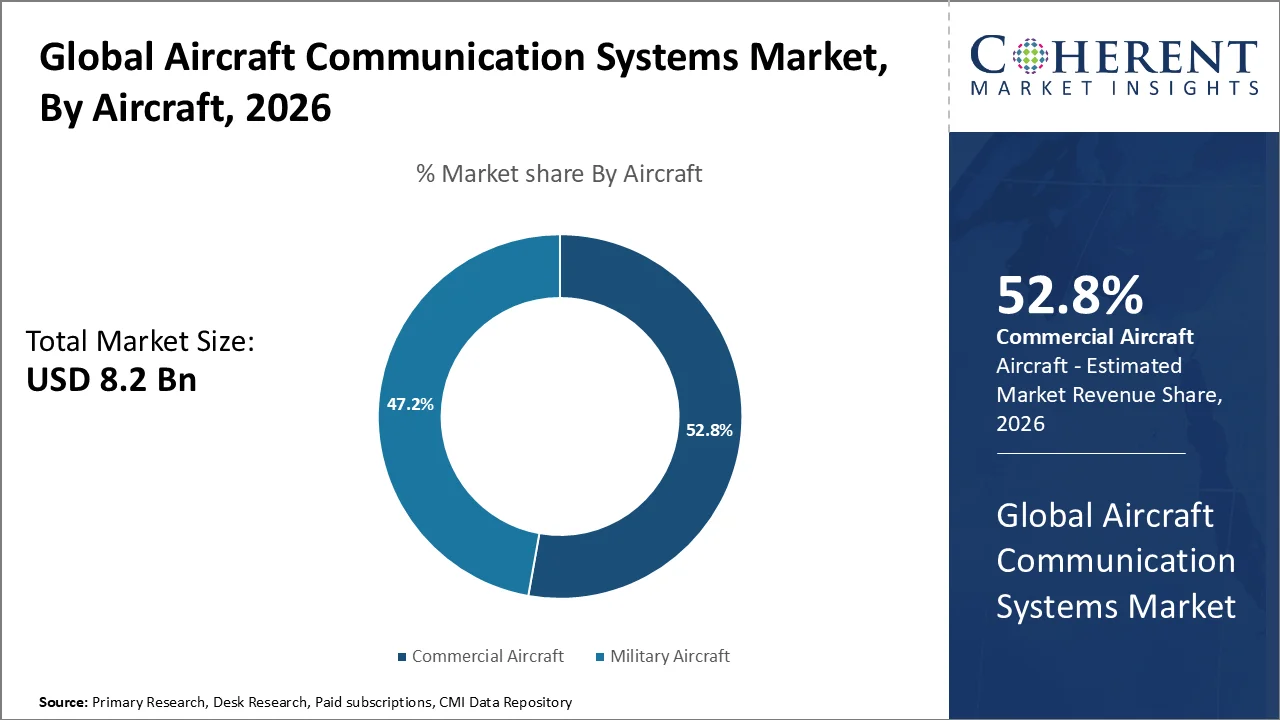
Commercial Aircraft acquired the prominent market share of 52.8% in 2026. The Commercial Aircraft segment in the Aircraft Communication Systems Market is growing as rising air travel demand and fleet expansion encourage airlines to adopt advanced connectivity solutions. Airlines are integrating modern communication systems to enhance passenger experiences, optimize operational efficiency, and enable real-time aircraft data transmission. The adoption of connected aircraft technologies, in-flight connectivity services, and advanced avionics continues to drive market expansion. According to Novaspace, connected aircraft are projected to exceed 70,000 by 2035, with IFC penetration increasing from 48% to 72% in commercial aviation and from 67% to 88% in business aviation. Fleet modernization initiatives, evolving regulatory standards, and the growth of commercial aviation networks further increase demand for aircraft communication systems. For instance, Embraer and Strata Manufacturing have signed a Memorandum of Agreement at the Farnborough International Airshow 2026 to expand their collaboration in advanced commercial aircraft aerostructure manufacturing.
Aircraft Communication Systems Market Trends
- Rising adoption of advanced connectivity solutions such as SATCOM, air-to-ground communication, and broadband systems enhances aircraft connectivity, operational efficiency, and real-time data exchange. Global connected aircraft fleet to exceed 70,000 by 2035, driven by increasing adoption of satellite-based connectivity solutions.
- Increasing integration of next-generation communication systems, including high-throughput satellites (HTS), low Earth orbit (LEO) networks, and software-defined radios, improves bandwidth availability, reduces latency, and enhances communication reliability. The FAA's Air Traffic Organization (ATO) manages over 44,000 flights and more than 3 million airline passengers daily across 29 million square miles of airspace, highlighting the growing need for advanced, high-capacity communication infrastructure.
- Growing focus on aircraft safety, tracking, and regulatory compliance drives the adoption of reliable communication systems that support air traffic management, flight monitoring, and continuous aircraft-ground connectivity. ICAO forecasts global passenger traffic growth of 3.6% in 2025, while IATA projects passenger traffic to grow by 2.1% in 2026, increasing the importance of reliable communication systems for safe and efficient air traffic management.
- Increasing defense and military aviation investments accelerate demand for secure communication systems, including encrypted SATCOM, tactical communication networks, and mission-critical connectivity solutions. According to NATO, 31 Allies are expected to spend at least 2% of GDP on defense in 2025, with many members increasing investments in military aviation modernization, including secure airborne communication capabilities.
Regional Insights
North America dominates owing to strong defense and military aviation spending
North America is expected to acquire the dominant share of 41.10% in 2026. North America’s Aircraft Communication Systems Market is expanding as the region leverages its advanced aerospace infrastructure, robust commercial aviation sector, and rapid adoption of next-generation communication technologies. Airlines and operators are modernizing fleets by integrating SATCOM, data link, and connectivity solutions to enhance operational efficiency and passenger experiences. The region prioritizes connected aircraft development, defense modernization initiatives, and aviation safety standards, which drive demand for advanced communication systems. A strong aftermarket ecosystem and increasing aircraft upgrade activities further encourage the adoption of these technologies. For instance, in March 2026, Russia is providing Iran with intelligence on the locations of U.S. forces in the Middle East, potentially helping Tehran identify American military assets and communication systems.
Asia Pacific Aircraft Communication Systems Market Trends
The Asia Pacific aircraft communication systems market grows as rising air passenger traffic, expanding commercial aviation fleets, and increased airport infrastructure investments create strong demand. Airlines are adopting advanced communication technologies to improve connectivity, enable real-time data exchange, and enhance flight safety. Aviation modernization initiatives, defense upgrades, and the development of next-generation aircraft further drive market expansion. The growing use of satellite communication, digital platforms, and connected aviation solutions also strengthens demand across the region. For instance, Adani Group launched a new airline, a move that could reshape competition in India's aviation market, currently dominated by IndiGo and Air India.
United States Aircraft Communication Systems Market Trends
The United States Aircraft Communication Systems Market grows as airlines and defense organizations demand advanced aviation connectivity, modernize aircraft fleets, and adopt next-generation communication technologies. Increasing air passenger traffic and rising military aviation investments encourage the development of reliable air traffic management systems. Global military spending increased by 74% between 2001 and 2020, reaching nearly US$2 trillion in 2020. Airlines and defense sectors prioritize enhanced safety, real-time data exchange, satellite communication, and operational efficiency, which drive the adoption and deployment of advanced aircraft communication solutions across the country.
Japan Aircraft Communication Systems Market Trends
Japan’s Aircraft Communication Systems Market grows as commercial aviation expands, airports modernize, and aviation authorities seek advanced air traffic management solutions. The country prioritizes flight safety, operational efficiency, and real-time connectivity, which drives the adoption of next-generation communication technologies. Airlines upgrade aircraft fleets, increasing passenger demand stimulates market development, and investments in unmanned aerial systems create new opportunities. Japan’s strong aerospace sector and commitment to technological innovation further accelerate the development of secure, reliable, and efficient aircraft communication systems. For instance, Japan, the U.K., and Italy announced new Global Combat Air Programme (GCAP) industry consortiums at DSEI UK 2025 to develop the future fighter’s propulsion system and avionics.
Who are the Major Companies in Aircraft Communication Systems Industry
Some of the major key players in Aircraft Communication Systems are Rockwell Collins, Inc., Northrop Grumman Corporation, Raytheon, Thales Group, Honeywell international Inc., and the manufacturers of different types of aircraft communication systems are Harris Corporation, Cobham Plc., General Dynamics Corporation, L3 Technologies, and Iridium.
Key News
- In June 2026, Airbus Defence and Space has signed an OCCAR contract to upgrade the A400M with advanced sensors, communication systems, and capabilities to operate drones and missiles from its cargo hold.
Market Report Scope
Aircraft Communication Systems Market Report Coverage
| Report Coverage | Details | ||
|---|---|---|---|
| Base Year: | 2025 | Market Size in 2026: | USD 8.2 Bn |
| Historical Data for: | 2020 To 2024 | Forecast Period: | 2026 To 2033 |
| Forecast Period 2026 to 2033 CAGR: | 11.6% | 2033 Value Projection: | USD 16.6 Bn |
| Geographies covered: |
| ||
| Segments covered: |
| ||
| Companies covered: | Rockwell Collins, Inc., Northrop Grumman Corporation, Raytheon, Thales Group, Honeywell international Inc., Harris Corporation, Cobham Plc., General Dynamics Corporation, L3 Technologies, and Iridium. | ||
Analyst Opinion
- Aircraft communication systems have shifted from being a supporting avionics function to becoming mission-critical infrastructure. Modern commercial aircraft generate and exchange vast amounts of operational data during every flight, making high-bandwidth, low-latency communication essential for predictive maintenance, flight optimization, and real-time operational decision-making rather than simple voice communication.
- Regulatory pressure remains one of the strongest long-term demand drivers. According to the International Civil Aviation Organization (ICAO), global air traffic is expected to exceed 10 billion passengers annually by 2042, requiring more efficient airspace management. At the same time, programs such as FAA NextGen and SESAR in Europe increasingly depend on digital communication technologies, including Controller–Pilot Data Link Communications (CPDLC) and satellite-based connectivity, making communication system upgrades a necessity rather than an option.
- The rapid expansion of connected aircraft is transforming market priorities. For example, leading airlines including Delta Air Lines, United Airlines, Emirates, and Qatar Airways continue expanding fleet-wide satellite connectivity to support cockpit operations, aircraft health monitoring, and passenger broadband services simultaneously. Analysts believe future competitive advantage will depend less on standalone communication hardware and more on integrated, cybersecurity-enabled communication platforms capable of supporting autonomous operations, unmanned aircraft integration, and next-generation air traffic management.
Speak to the analyst
Want personalized insights?
Take the findings above to one of our principal consultants, or have the report rebuilt around the segments, geographies and competitors you actually track.
Market Segmentation
- By Product Type (Revenue, USD Bn, 2021-2033)
- SATCOM
- HF Communication
- Data Link Communication
- VHF
- By Component (Revenue, USD Bn, 2021-2033)
- Antennas
- Receivers
- Transmitters
- Transceivers
- Others
- By Aircraft (Revenue, USD Bn, 2021-2033)
- Commercial Aircraft
- Military Aircraft
- By Region (Revenue, USD Bn, 2021-2033)
- North America
- U.S.
- Canada
- Latin America
- Brazil
- Mexico
- Argentina
- Rest of Latin America
- Europe
- Germany
- U.K.
- France
- Italy
- Spain
- Russia
- Rest of Europe
- Asia Pacific
- China
- India
- Japan
- Australia
- South Korea
- ASEAN
- Rest of Asia Pacific
- Middle East
- GCC
- Israel
- Rest of Middle East
- Africa
- South Africa
- Central Africa
- North Africa
- North America
Sources
Primary Research Interviews
- Aircraft communication system manufacturers
- Commercial aircraft OEM executives
- Avionics engineers and system integrators
- Airline fleet and operations managers
- Air traffic management specialists
- Aerospace technology experts
- Defense aviation procurement professionals
- Maintenance, Repair, and Overhaul (MRO) service providers
- Aviation regulatory and certification professionals
- Satellite communication solution providers
Databases
- Federal Aviation Administration (FAA) Database
- European Union Aviation Safety Agency (EASA) Database
- International Civil Aviation Organization (ICAO) Database
- International Air Transport Association (IATA) Statistics
- World Bank Data
- International Monetary Fund (IMF) Database
- United Nations Comtrade Database
- Eurostat
- OECD Data
- SIPRI Military Expenditure Database
Magazines
- Aviation Week & Space Technology
- Aerospace America
- Air Transport World
- Flight International
- Aviation Today
- Business Airport International
- Aircraft Interiors International
- Rotor & Wing International
Journals
- Journal of Air Transport Management
- IEEE Aerospace and Electronic Systems Magazine
- Aerospace Science and Technology
- Journal of Aerospace Information Systems
- CEAS Aeronautical Journal
- International Journal of Aerospace Engineering
- Progress in Aerospace Sciences
- Aerospace
Newspapers
- Financial Times
- The Wall Street Journal
- The New York Times
- The Guardian
- The Economic Times
- Business Standard
- Nikkei Asia
- South China Morning Post
Associations
- International Civil Aviation Organization (ICAO)
- International Air Transport Association (IATA)
- Aerospace Industries Association (AIA)
- Airlines for America (A4A)
- Civil Air Navigation Services Organisation (CANSO)
- Aircraft Electronics Association (AEA)
- General Aviation Manufacturers Association (GAMA)
- Royal Aeronautical Society (RAeS)
Public Domain Sources
- U.S. Federal Aviation Administration (FAA)
- European Union Aviation Safety Agency (EASA)
- International Civil Aviation Organization (ICAO)
- National Aeronautics and Space Administration (NASA)
- U.S. Department of Transportation (DOT)
- Eurocontrol
- U.S. Department of Defense
- Civil Aviation Administration of China (CAAC)
- UK Civil Aviation Authority (CAA)
- Transport Canada Civil Aviation (TCCA)
Proprietary Elements
- CMI Data Analytics Tool
- Proprietary CMI Existing Repository of Information for Last 10 Years
Get access to 250+ pages report
Every segment, forecast, competitor profile and data table behind the analysis above — available for instant download.
- ESOMAR Member
- ISO 9001:2015 Certified
- D-U-N-S Registered
- GDPR & CCPA Compliant
Missing comfort of reading report in your local language? Find your preferred language:
Transform your Strategy with Exclusive Trending Reports
Frequently Asked Questions
The aircraft communication systems market refers to the global industry involved in the design, manufacturing, integration, and maintenance of communication technologies used in aircraft.
Market growth is primarily driven by increasing air passenger traffic, rising aircraft production and deliveries, modernization of aging aircraft fleets, and growing investments in advanced avionics.
Aircraft communication systems commonly include Very High Frequency (VHF) radios, High Frequency (HF) radios, satellite communication (SATCOM), aircraft communications addressing and reporting systems (ACARS), data link communication, and secure military communication technologies.
North America is expected to maintain a leading position due to its established aerospace industry, significant defense spending, and continuous investment in advanced aviation technologies.
The primary end users include commercial airlines, military aviation organizations, business jet operators, cargo carriers, and aircraft manufacturers.