

North America Aircraft Parts Market Size and Forecast – 2026 to 2033
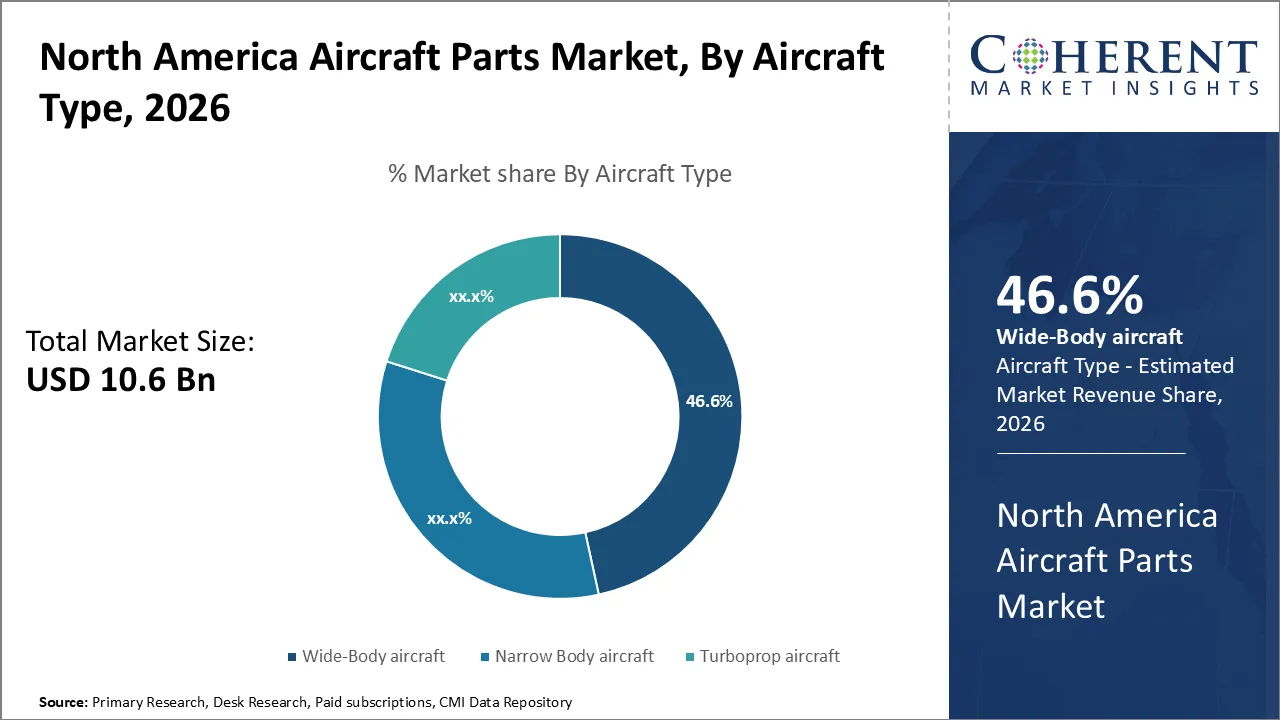
The North America Aircraft Parts Market is estimated to be valued at USD 10.6 Bn in 2026 and is expected to reach USD 16.3 Bn by 2033, exhibiting a compound annual growth rate (CAGR) of 6.8% from 2026 to 2033.
Key Takeaways
- By Parts, Engines hold the largest market share of 41.1% in 2026 owing to the growth in commercial air travel.
- By Material Type, Carbon Fibers expected to hold largest market share of 37.7% in 2026 owing to its demand for lightweight aircraft.
- By Aircraft Type, Wide-body aircraft acquired the prominent market share of 46.6% in 2026 owing to its growth in long-haul international travel.
- By Application, Commercial Aircraft captures the largest market share of 46.7% in 2026 owing to the fleet expansion and aircraft deliveries.
- By Country, United States dominates the overall market with an estimated share of 53.8% in 2026 owing to the strong aerospace manufacturing industry.
Market Overview
The well-established aerospace industry, extensive airline networks, and strong defense aviation programs support the North America aircraft parts market. Increasing air travel, fleet modernization, and the growing need for maintenance, repair, and overhaul activities drive demand for aircraft components. Major aerospace manufacturers such as Boeing and Lockheed Martin strengthen the regional supply chain through continuous production and innovation. Advancements in lightweight materials, avionics, and aircraft systems further expand the market. Moreover, rising cargo aviation operations and ongoing modernization of aging aircraft fleets continue to increase demand for aircraft parts across North America.
Current Events and their Impact on the North America Aircraft Parts Market
Current Events | Description and its impact |
Geopolitical Developments |
|
Economic & Supply Chain Dynamics |
|
Regulatory & Safety Standards Updates |
|
Segmental Insights
- Current Industry Events of 2026
- Market Size Estimation
- Regional Breakdown
- Competitive Landscape
- Customer Intelligence
- Segmental Analysis
- Pricing Analysis
- Key Market Drivers, Challenges & Future Trends
- Customized Insights Section
North America Aircraft Parts Market Insights, By Aircraft Type: Wide-body aircraft contribute the highest share of the market owing to its rising maintenance, repair, and overhaul (MRO) activities.
Wide-body aircraft acquired the prominent market share of 46.6% in 2026. Rising demand for long-haul and high-capacity flights pushes airlines to operate more wide-body aircraft, driving growth in the North America aircraft parts market. Airlines equip these planes to enhance passenger comfort and operational efficiency, which increases the need for engines, avionics, landing gear, and structural components. Fleet modernization and expanding cargo operations further raise maintenance and replacement requirements. Leading manufacturers such as Boeing and Airbus produce and supply advanced parts, promoting wider adoption of wide-body aircraft in commercial and cargo operations. For instance, in May 2025, Alaska Airlines unveiled daily nonstop flights between Seattle and Tokyo Narita, operated with Hawaiian Airlines’ long-haul aircraft, marking a new era of widebody international service for the airline.
North America Aircraft Parts Market Insights, By Parts: Engines contribute the highest share of the market owing to its increasing defense spending.
Engines hold the largest market share of 41.1% in 2026. Increasing aircraft utilization and the growing need for efficient propulsion systems drive demand for aircraft engines in the North America aircraft parts market. Airlines prioritize fuel efficiency and operational reliability, which encourages them to adopt advanced engine technologies and replace older components. Maintenance providers also perform regular inspections and overhauls that increase the demand for engine parts. Major manufacturers such as GE Aerospace and Pratt & Whitney contribute to market growth through continuous innovation and production. Expanding commercial fleets and cargo aviation operations further increase demand for engine-related aircraft parts across the region.
North America Aircraft Parts Market Insights, By Material Type: Carbon Fibers contribute the highest share of the market owing to its strong aerospace manufacturing base in North America.
Carbon Fibers expected to hold largest market share of 37.7% in 2026. Manufacturers increasingly use carbon fiber materials in the North America aircraft parts market to create lightweight aircraft structures. Aircraft producers incorporate carbon fiber components to boost structural strength while lowering overall weight and fuel consumption. Rising production of modern aircraft and continuous design improvements drive the use of composites in wings, fuselage sections, and interior parts. Leading companies such as Hexcel Corporation and Toray Industries supply advanced carbon fiber solutions, further promoting their adoption across the region.
In May 2024, Hexcel Corporation launched HexTow IM9 24K, a continuous carbon fiber designed to deliver lightweight strength and durability, offering enhanced value for advanced aerospace composite applications.
North America Aircraft Parts Market Insights, By Application: Commercial Aircraft contribute the highest share of the market owing to its increasing air cargo and e-commerce logistics.
Commercial Aircraft captures the largest market share of 46.7% in 2026. The growth of commercial aviation in North America drives airlines to expand their fleets to handle increasing passenger and cargo traffic, boosting demand for aircraft parts. Airlines focus on fleet modernization and operational efficiency, which raises the need for engines, avionics, landing gear, and structural components. Ongoing maintenance, repair, and overhaul activities further sustain parts consumption. Leading aerospace manufacturers such as Boeing and Airbus produce and supply advanced components, supporting commercial aircraft operations and aftermarket needs across the region.
Regional Insights
United States Aircraft Parts Market Trends
United States dominates the overall market with an estimated share of 53.8% in 2026. Rising air travel, fleet modernization, and expanding defense aviation activities drive strong growth in the United States aircraft parts market. Airlines and cargo operators actively purchase advanced engines, avionics, and structural components to enhance efficiency and safety. Technological innovations, such as lightweight materials, composites, and digital monitoring systems, are transforming aircraft design and maintenance processes. Leading manufacturers like Boeing and GE Aerospace produce these components, while growing MRO operations ensure continuous replacement and aftermarket support. For instance, in June 2025, Angels Aircraft unveiled a pre-seed funding round to develop Archangel, a fully autonomous, high-endurance unmanned aerial vehicle (UAV) designed for intelligence, surveillance, reconnaissance (ISR), and light strike missions.
Canada Aircraft Parts Market Trends
Airlines and defense operators in Canada are expanding their fleets and investing in modern aircraft, driving growth in the aircraft parts market. Increasing domestic and international air travel boosts demand for engines, avionics, landing gear, and structural components. Manufacturers adopt advanced technologies, including lightweight composites, digital monitoring systems, and efficient propulsion solutions, to innovate aircraft parts production. Leading companies such as Bombardier and Magellan Aerospace produce and maintain these components, ensuring reliable supply and support for commercial and defense aviation across the country. For instance, in February 2026, ChartrightGO addresses the challenge Canadian-registered aircraft face in accessing Transport Canada–approved maintenance in the U.S., making Chartright the first Canadian private management company to offer mobile, licensed maintenance directly on U.S. aircraft.
North America Aircraft Parts Market Trend
Growth of Aftermarket and MRO Services
The market is witnessing strong growth in aftermarket services as airlines focus on fleet maintenance and operational efficiency. Maintenance, Repair, and Overhaul (MRO) providers are expanding capabilities to meet the rising demand for timely replacements of engines, landing gear, and avionics. This trend highlights the importance of extended service contracts, predictive maintenance technologies, and reliable supply chains to minimize aircraft downtime and enhance operational safety across commercial, cargo, and defense fleets.
Adoption of Advanced Materials
Aircraft manufacturers increasingly integrate lightweight composites, carbon fibers, and high-performance alloys in structural and interior components. These materials reduce aircraft weight, improve fuel efficiency, and extend the lifespan of parts. The trend also drives innovation in design, manufacturing processes, and component customization. Airlines and defense operators are prioritizing parts made with advanced materials to enhance efficiency, comply with environmental standards, and reduce long-term maintenance costs, reshaping the material landscape in North America’s aircraft parts market.
North America Aircraft Parts Market Opportunity
Adoption of Advanced and Lightweight Materials
The increasing use of carbon fiber composites, titanium alloys, and high-strength polymers opens opportunities for component innovation. Manufacturers can develop lighter, stronger, and more fuel-efficient parts for wings, fuselage, and interiors. Airlines prioritize efficiency, reduced maintenance, and compliance with environmental standards, driving demand for advanced material solutions. Suppliers focusing on R&D, customization, and integration of next-generation materials can gain a competitive advantage in North America’s evolving aircraft parts market.
Market Report Scope
North America Aircraft Parts Market Report Coverage
| Report Coverage | Details | ||
|---|---|---|---|
| Base Year: | 2025 | Market Size in 2026: | USD 10.6 Bn |
| Historical Data for: | 2020 To 2024 | Forecast Period: | 2026 To 2033 |
| Forecast Period 2026 to 2033 CAGR: | 6.8% | 2033 Value Projection: | USD 16.3 Bn |
| Geographies covered: |
| ||
| Segments covered: |
| ||
| Companies covered: | Airbus Group, Alcoa Corporation, Arconic Corporation, Boeing, Bombardier Inc., Collins Aerospace, Elbit Systems Ltd, Teijin, Lockheed Martin Corporation and Triumph Group, Inc | ||
| Growth Drivers: |
| ||
| Restraints & Challenges: |
| ||
North America Aircraft Parts Market News
- In January 2026, Gogo, a U.S. inflight connectivity provider, has completed flight testing and validation of its next-generation ATG 5G network, enabling commercial service across the contiguous U.S. and parts of southern Canada.
- In April 2025, Lufthansa Technik launched a dedicated used serviceable material (USM) business for airlines and operators, targeting North American customers and addressing the constrained parts market beyond just selling surplus parts.
Analyst Opinion (Expert Opinion)
- The North America aircraft parts market currently reflects the industrial muscle of the region’s aerospace ecosystem, where OEM backlogs and extensive maintenance networks underpin sustained aftermarket demand. With the Federal Aviation Administration overseeing more than 21,000 registered aircraft, the operational intensity of commercial and general aviation fleets alone ensures a constant requirement for certified parts and overhaul cycles. Regulatory confidence in advanced manufacturing techniques — evidenced by the FAA certifying hundreds of 3D‑printed components — is shifting production toward lightweight, precision‑engineered solutions that improve performance while trimming turnaround times.
- However, the market’s competitive dynamics are increasingly defined by MRO bottlenecks and supply chain exposures. The densest concentration of MRO facilities in the United States absorbs a high proportion of demand, but technicians and tooling capacity are stretched by simultaneous life‑extension programs across legacy military platforms and commercial narrow‑body fleets, pushing some work to independent shops. Meanwhile, cyber vulnerabilities in digitalized supply chain and maintenance systems pose quantifiable risk to parts traceability and operational continuity, complicating certification and compliance.
- Strategic consolidations illustrate how industry leaders are repositioning to capture aftermarket value: recent acquisitions by TransDigm of proprietary parts suppliers highlight the premium placed on alternative parts and PMA strategies as airlines extend aircraft lifecycles amid delivery delays. As such, while demand fundamentals remain robust, the market’s near‑term trajectory will hinge on supply chain resilience, talent availability, and the pace of technological adoption.
Speak to the analyst
Want personalized insights?
Take the findings above to one of our principal consultants, or have the report rebuilt around the segments, geographies and competitors you actually track.
Market Segmentation
- By Parts
- Engines
- Cabin Interiors
- Fuselage
- Empennage
- Landing Gear
- Wings and Flaps
- Propeller
- By Material Type
- Carbon Fibers
- Composite Material
- Steel Alloy
- Aluminum Alloy
- Titanium Alloy
- By Aircraft Type
- Narrow Body aircraft
- Wide-Body aircraft
- Turboprop aircraft
- By Application
- Commercial Aircraft
- Business Aircraft
- Military Aircraft
- By Region
- U.S.
- Canada
- Key Players Insights
- Airbus Group
- Alcoa Corporation
- Arconic Corporation
- Boeing
- Bombardier Inc.
- Collins Aerospace
- Elbit Systems Ltd
- Teijin
- Lockheed Martin Corporation
- Triumph Group, Inc
Sources
Primary Research interviews
- Aircraft manufacturers and suppliers (OEMs and Tier 1/Tier 2 suppliers)
- Maintenance, Repair, and Overhaul (MRO) service providers
- Airlines operating in North America
- Aviation component distributors and logistics providers
- Industry experts and technical engineers
Databases
- FAA Aircraft Registry Database
- North American Aerospace Database (e.g., Bombardier, Boeing, Lockheed Martin public filings)
- U.S. Department of Transportation (DOT) Aviation Statistics
- Transport Canada Civil Aviation Database
Magazines
- Aviation Week & Space Technology
- Air Transport World
- Flight International
- Aerospace Manufacturing and Design
Journals
- Journal of Aerospace Engineering
- International Journal of Aircraft Engineering and Aerospace Technology
- Aerospace Science and Technology
- Journal of Air Transport Management
Newspapers
- The Wall Street Journal – Aerospace Section
- The New York Times – Aviation & Defense
- Aviation Daily
- The Washington Post – Transportation
Associations
- Aerospace Industries Association (AIA)
- General Aviation Manufacturers Association (GAMA)
- Experimental Aircraft Association (EAA)
- National Business Aviation Association (NBAA)
Public Domain sources
- Federal Aviation Administration (FAA) reports and datasets
- Transport Canada Civil Aviation publications
- U.S. Census Bureau – Transportation Statistics
- NASA Technical Reports Server (NTRS)
- National Transportation Safety Board (NTSB) reports
Proprietary Elements
- CMI Data Analytics Tool
- Proprietary CMI Existing Repository of information for last 8 years
Get access to 250+ pages report
Every segment, forecast, competitor profile and data table behind the analysis above — available for instant download.
- ESOMAR Member
- ISO 9001:2015 Certified
- D-U-N-S Registered
- GDPR & CCPA Compliant
Missing comfort of reading report in your local language? Find your preferred language:
Transform your Strategy with Exclusive Trending Reports
Frequently Asked Questions
The North America Aircraft Parts Market is estimated to be valued at USD 10.6 Bn in 2026 and is expected to reach USD 16.3 Bn by 2033.
The market is expected to witness a CAGR of 6.8% during the forecast period.
The increasing expenditure on air travel is expected to drive growth of the market during the forecast period.
The Wide-body aircraft segment held the largest market share among aircraft type.
U.S held the largest share in the market.
Key players operating in the market include Airbus Group, Alcoa Corporation, Arconic Corporation, Boeing, Bombardier Inc., Collins Aerospace, Elbit Systems Ltd, Teijin, Lockheed Martin Corporation and Triumph Group, Inc