

Ammunition Market Size and Trends: 2026-2033
The global ammunition market is estimated to be valued at USD 33,194.9 Mn in 2026 and is expected to reach USD 41,948.4 Mn by 2033, exhibiting a compound annual growth rate (CAGR) of 3.4% from 2026 to 2033.
Key Takeaways
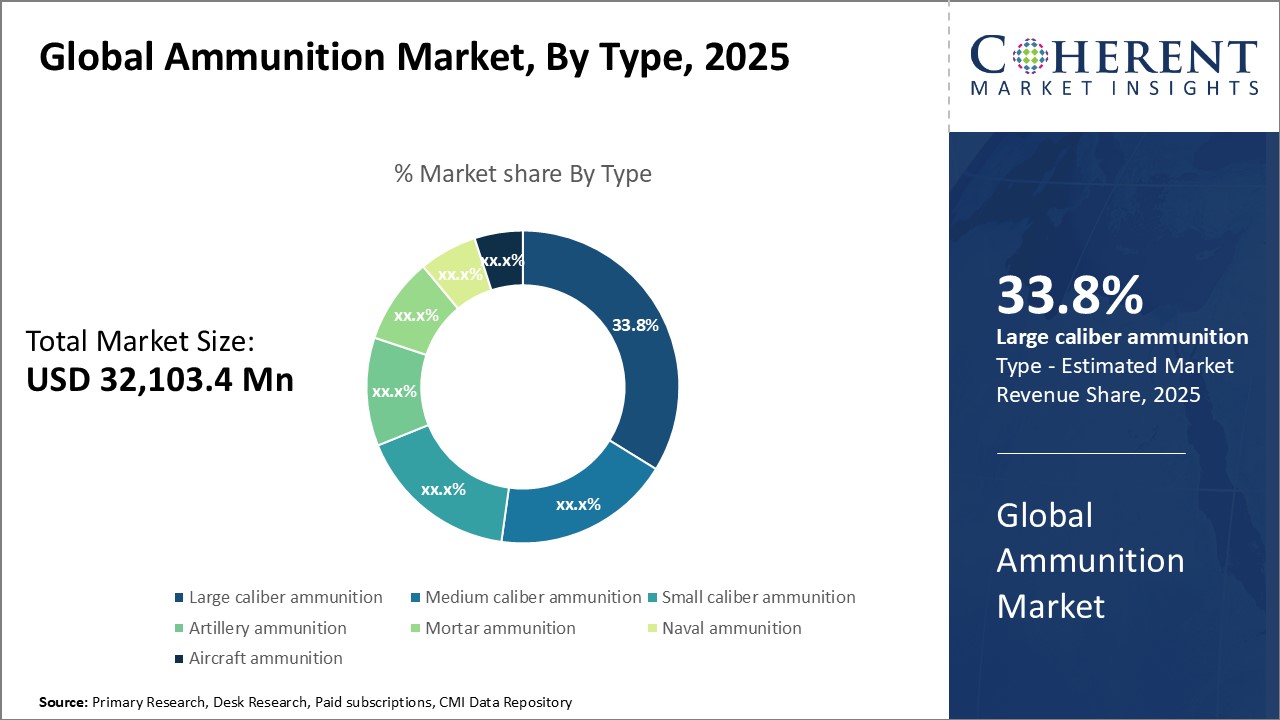
- Based on Type, the Large Caliber Ammunition segment is projected to account for 34.8% share of the market in 2026, owing to modern warfare with long-range, high-impact firepower.
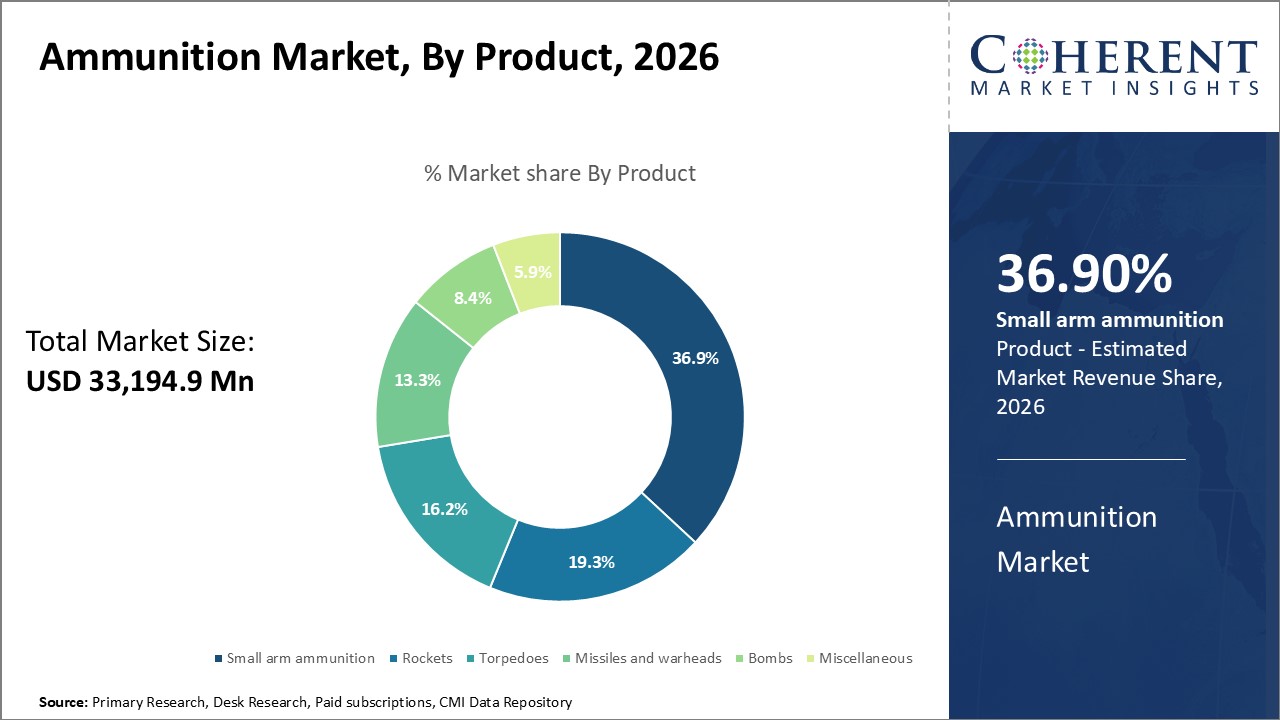
- Based on Product, the Small Arm Ammunition segment is expected to hold 36.9% share of the market in 2026, due to its affordability, versatility, and widespread military use.
- Based on Application, the Defense segment is expected to lead the market with 40.1% share in 2026, due to geopolitical conflicts and military stockpiling needs.
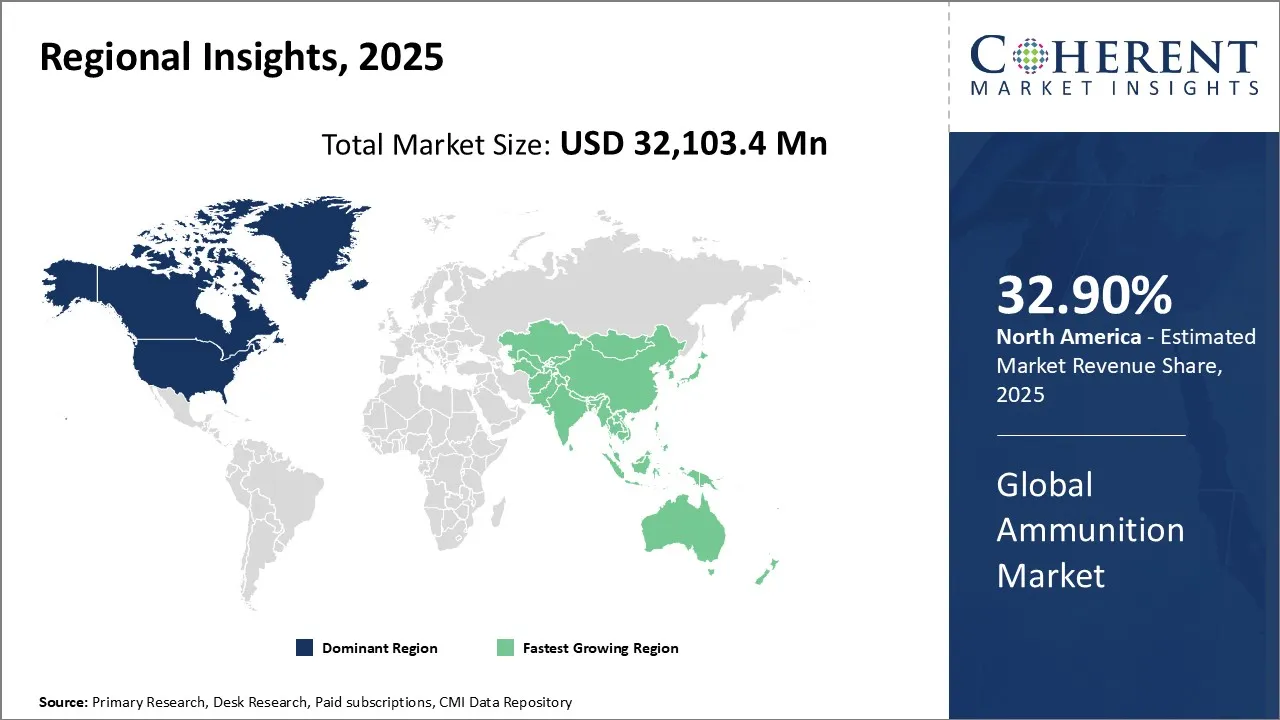
- Based on Region, North America is set to lead the ammunition market with 32.90% share in 2026. While, Asia Pacific is anticipated to be the fastest growing region.
Market Overview
The global ammunition market has witnessed a rise over the past decade due to increasing defense expenditures of countries and growing internal security threats. Law enforcement agencies and national militaries across both developed and developing nations have boosted their ammunition stocking to deal with issues like terrorism, border conflicts, and political instability. Additionally, the popularity of recreational shooting and hunting has expanded the consumer segment of this industry. Innovations in ammunition design have allowed manufacturers to develop more effective and high-performance bullets. However, strict regulations on ammunition trade and sales to civilian users in some parts of the world may moderately challenge market growth going forward.
Current Events and its Impacts on the Ammunition Market
Current Event | Description and its Impact |
Technological Advancements in Ammunition Manufacturing |
|
U.S. Regulatory and Legislative Changes |
|
Price Analysis
Category | Price Range | Key Drivers |
Small Caliber Ammunition | USD 0.20 – USD 1 per round | Civilian + military training demand; caliber size; casing material (brass vs. steel). |
Medium Caliber Ammunition | USD 2 – USD 50 per round | Used in machine guns, vehicle-mounted weapons; influenced by modernization programs. |
Large Caliber Ammunition | USD 10,000 – USD 50,000 per shell | Guided shells cost more due to GPS/laser systems; advanced electronics & materials. |
Artillery Ammunition | USD 5,000 – USD 20,000 per shell | High demand in conflict zones; prices spike during wars. |
Mortar Ammunition | USD 500 – USD 5,000 per round | Widely used in infantry support; cost varies by caliber. |
Naval Ammunition | USD 1,000 – USD 15,000 per round | Specialized for warships; smaller market share but strategic importance. |
Aircraft Ammunition | USD 2,000 – USD 25,000 per round | Includes guided bombs (> USD 40,000); critical for air superiority missions. |
- Current Industry Events of 2026
- Market Size Estimation
- Regional Breakdown
- Competitive Landscape
- Customer Intelligence
- Segmental Analysis
- Pricing Analysis
- Key Market Drivers, Challenges & Future Trends
- Customized Insights Section
Segmental Insights
Ammunition Market Insights, By Type - Superior firepower drives demand for large caliber ammunitions
In terms of type, large caliber ammunitions segment is estimated to hold the highest share of the market of 34.8% in 2026 owing to its vital role in modern warfare. These munitions are used in various artillery systems and provide long-range and highly destructive fire support against targets. Their ability to deliver heavy payloads over extended distances makes them a preferred choice for military forces seeking strategic dominance on the battlefield.
For instance, in December 2024, ZVS Holding, which is part of the Czechoslovak Group, started making high-quality large-caliber ammunition and declared that Tatra vehicles would be made in Slovakia. The move comes after a record contract award, which strengthens Slovakia's defense industry and illustrates that CSG is becoming more important as a supplier of advanced artillery and armored vehicle solutions across Europe.
Ammunition Market Insights, By Product - Widespread small arms usage drives small arm ammunition market share
In terms of product, small arm ammunition segment is estimated to hold the highest share of the market of 36.9% in 2026 owing to its ubiquitous role across the military and commercial sectors. These munitions are used extensively by infantry forces worldwide in weapons like rifles, pistols, sub-machine guns, and combat shotguns. Their affordability and versatility make them a default choice for frontline troop weaponry.
For instance, in June 2026, A small arms ammunition unit is going to be set up in Amravati, Maharashtra, by TEMBO Defence, a subsidiary of TEMBO Global. The plant will make bullets for rifles and pistols with an investment of ₹1,000 crore and 100 acres of land. It is Vidarbha's first bullet-making factory, and it is working with a European company to do so. This will help India make more defense products.
Ammunition Market Insights, By Application - Strategic defense spending drives defense sector ammunition demand
In terms of application, defense segment is estimated to hold the highest share of the market of 40.1% in 2026owing to continuous geopolitical conflicts and territorial disputes worldwide. Military forces remain the largest end-user of all types of ammunition due to strategic operational needs. Most national defense budgets allot highest funding for ammunition stockpiling.
Escalating India-Pakistan tensions, South China Sea conflicts and renewed Sino-American rivalry fuel ammunition procurement. With threats of war ever-present, defense agencies prioritize maintaining ample strategic reserves. Meanwhile recent tensions in East Europe and Middle East have seen arsenal replenishment across the said regions. Unpredictable crises thus drive governments to expand ammunition manufacturing/import capacity.
For instance, in November 2025, The US provided India permission to receive missiles and ammunition, which are going to assist them get ready for war. This approval makes military stockpiles stronger and makes them more ready to act. The move shows how much India and the US are working together on defense, making sure that India has the supplies it needs to keep its capabilities up and its strategic position strong in the face of changing security threats in the region.
Regional Insights
North America Ammunition Market Analysis & Trends
North America is expected to account for the greatest revenue share, with 32.9% in 2026 In North America, the dominance in the ammunition market can be attributed to the presence of leading global players like Vista Outdoor and Olin Corporation. The region's advance defense capabilities further boost demand. With pro-gun laws and large shooting community, countries like the U.S. provide a fertile ground for market growth.
For instance, in December 2026, The US granted Canada the go-ahead for purchasing $2.68 billion worth of aerial weapons, such as advanced air-to-air and air-to-ground weapons. The deal makes Canada's defense stronger, makes it easier for Canada to work with its allies, and shows how well the US and Canada work together in NATO. It also strengthens regional security and military readiness by providing important ammunition.
Asia Pacific Ammunition Market Analysis & Trends
The Asia Pacific region exhibits the fastest growth, driven by increasing defense spending of major economies like China and India. Growing geopolitical risks and modernization of armed forces is prompting governments to strengthen their ammunition stockpiles. Rapid economic development in Southeast Asian nations has also fueled the demand for sporting ammunition.
For instance, in December 2026, the US provided Taiwan a huge arms package that included missiles, ammunition, and defense systems. The deal makes Taiwan's military stronger, makes it harder for regional threats to happen, and shows that the US is committed to Taiwan's security. Ammunition is an essential element of the package that makes defenses stronger and more flexible.
Ammunition Market Outlook for Key Countries
The U.S. Ammunition Market Trends
The U.S. market continues to be leading global force underpinned by Second Amendment rights and new product innovations from key suppliers. Companies such as Remington Outdoor are enhancing their product lines to leverage opportunities. For instance, in December 2026, Through CBC USA, CBC Global Ammunition sells small, medium, and large-caliber ammunition to the military, police, and civilians. It makes NATO and SAAMI-standard rounds and sells them in 100 countries around the world. This makes it a top international maker of defense and commercial ammunition solutions.
China Ammunition Market Trends
China's market is expanding rapidly in line with the country's assertive defense policies. Domestic player, Norinco, is investing heavily to localize production and supply military programs. For instance, in August 2026, The PHL-16 multiple rocket launcher from China is similar to the US HIMARS and gives China more long-range strike power. It makes China's regional deterrence in East Asia stronger by using large-caliber rockets and guided munitions. The system shows that Beijing is focused on getting ready for modern warfare with advanced artillery platforms and ammunition.
India Ammunition Market Trends
Indian continues to lead ammunition procurement in South Asia supported by large-scale defense modernization drives. Companies like OFB and Solar are stepping up activities to fulfill requirements of security forces. For instance, in October 2026, India's Defense Ministry permitted private companies make missiles and ammunition, which is going to assist the country make more defense products. The move makes South Asia's defense system stronger, encourages new ideas, and makes the region less dependent on imports. India wants to improve its capabilities, readiness, and strategic manufacturing base by working with private businesses.
Germany Ammunition Market Trends
Germany's market is fueled by demand from law enforcement and export opportunities in Europe. Major players like Rheinmetall and Ruagare leveraging their engineering capabilities. For instance, in August 2026, Germany's Rheinmetall has opened a new factory to make more artillery shells and other weapons. The facility helps fill gaps in supplies caused by the war in Ukraine, makes NATO's supply chains stronger, and makes Europe's defenses stronger. It is a strategic step toward getting reliable ammunition for security needs in the area.
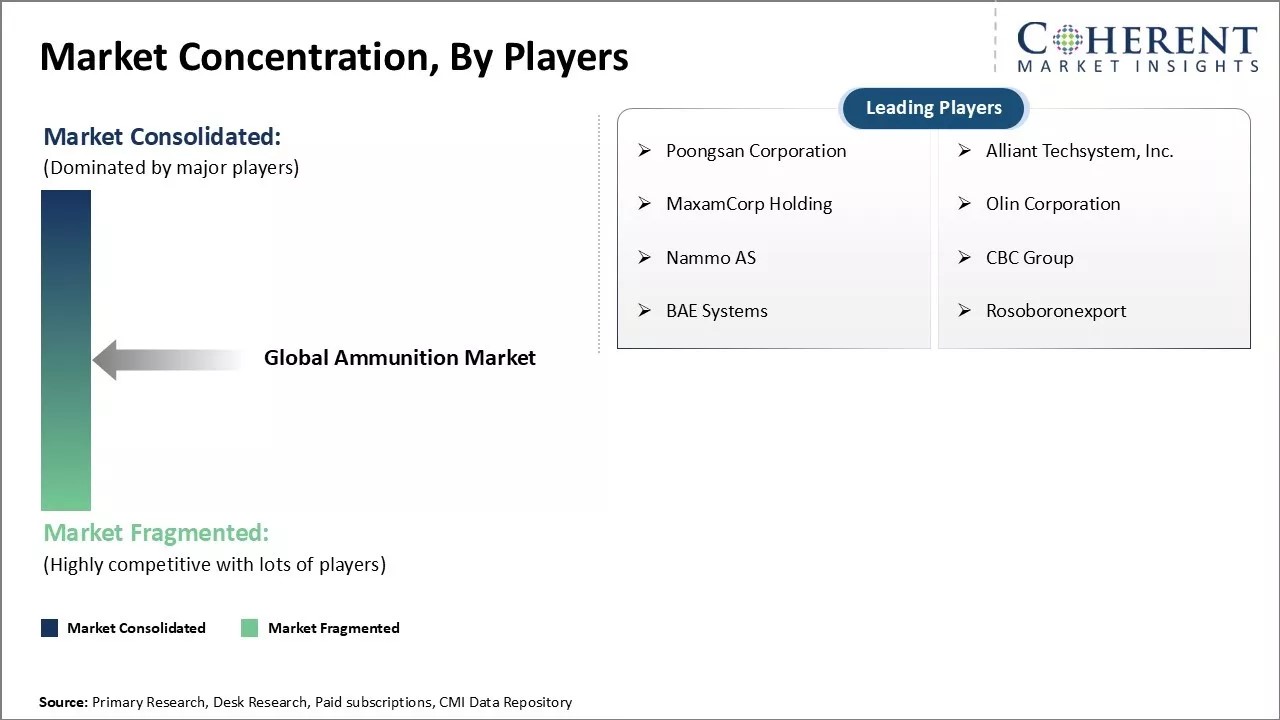
Market Concentration and Competitive Landscape
Market Report Scope
Ammunition Market Report Coverage
| Report Coverage | Details | ||
|---|---|---|---|
| Base Year: | 2025 | Market Size in 2026: | USD 33,194.9 Mn |
| Historical Data for: | 2020 To 2024 | Forecast Period: | 2026 To 2033 |
| Forecast Period 2026 to 2033 CAGR: | 3.4% | 2033 Value Projection: | USD 41,948.4 Mn |
| Geographies covered: |
| ||
| Segments covered: |
| ||
| Companies covered: | Poongsan Corporation, Alliant Techsystem, Inc., MaxamCorp Holding, Olin Corporation, Nammo AS, CBC Group, BAE Systems, and Rosoboronexport | ||
| Growth Drivers: |
| ||
| Restraints & Challenges: |
| ||
Ammunition Market Driver
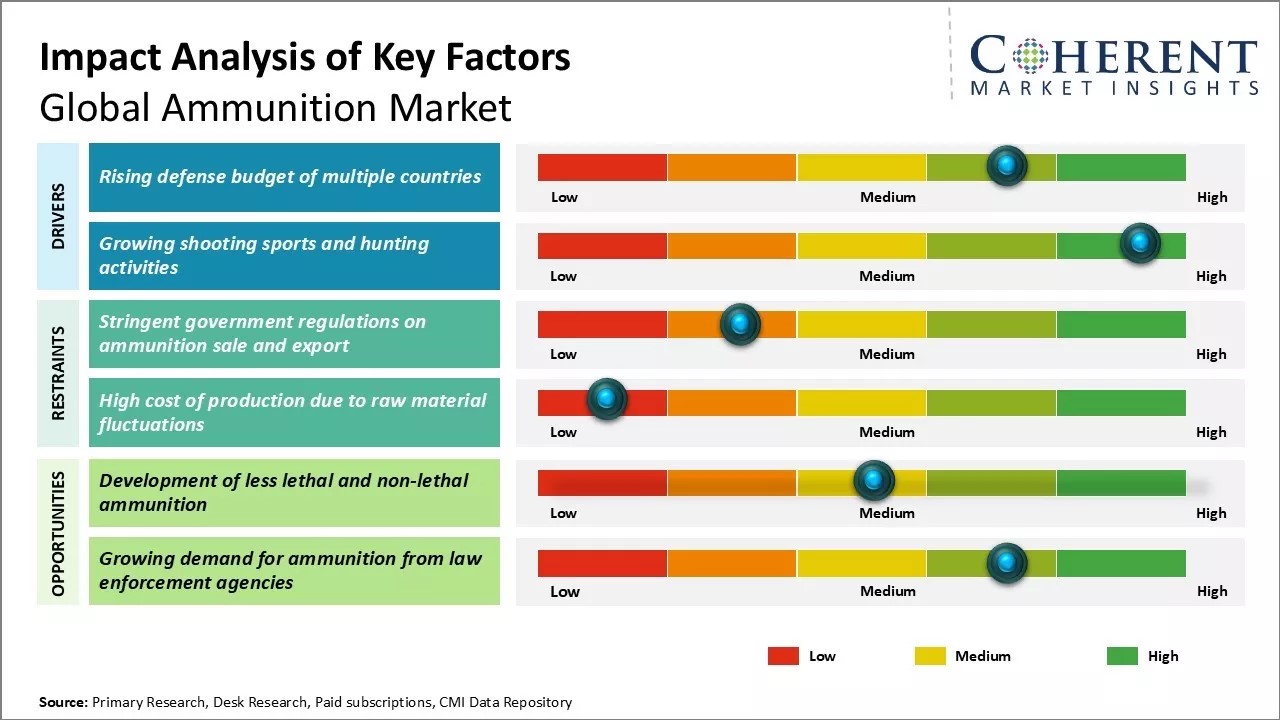
How do rising defense budgets impact the ammunition market?
With rising geopolitical tensions and security threats across various regions, many countries are significantly ramping up their defense spending in recent years. The focus on modernizing armed forces with latest weapons and platforms has led to growing demand for ammunition. The U.S., for instance, has witnessed steady growth in its defense budget over the past decade due to lengthy military campaigns in West Asia and renewed strategic competition with China and Russia. It is expected to remain one of the largest ammunition importers globally to sustain ammunition stockpiles of its army units.
How do shooting sports and hunting boost the ammunition market?
Shooting sports and hunting significantly boost ammunition market demand by driving consistent consumption of cartridges and rounds. Enthusiasts and hunters require regular supplies for practice, competitions, and seasonal activities. This sustained usage fuels growth, encourages innovation in specialized ammunition, and strengthens the commercial sector of the global defense industry.
Ammunition Market Opportunity
How will less lethal and non-lethal ammunition develop for the market?
The global ammunition market has a huge untapped opportunity in the development of less lethal and non-lethal ammunition. With growing emphasis on safety and restraint, military and law enforcement agencies are showing interest in adopting alternative ammunition that can temporarily incapacitate a target without risk of serious injury or death. Leading manufacturers can gain a competitive edge by investing in R&D to create innovative ammunition like rubber bullets, tear gas shells, acoustic hailing devices, etc. catering to this niche segment.
Analyst Opinion (Expert Opinion)
- The ammunition market is a strategically important and high-volume part of the global defense and security ecosystem. This is due to there is an extensive amount of buying and selling going on and a wide range of end-use demand. Every year, the world makes tens of billions of rounds of ammunition. Most of these rounds are small-caliber due to there are used a lot by the military, police, and civilians for shooting sports. The most popular calibers are 5.56 mm, 7.62 mm, and 9 mm. Medium- and large-caliber munitions make up a larger share of overall contract values because they are more complicated and are used in defense-critical situations.
- North America, Europe, and Asia-Pacific continue to be the main places where demand is high. More than a third of the world's demand comes from the Asia-Pacific region. This is result of defense modernization programs, the growth of domestic manufacturing capabilities, and large standing armed forces. North America has remained a major market for guns owing to military stockpiling, training needs, and a large number of civilian gun users. Europe is seeing an increase in procurement volumes because of the need to restock and the need for allied forces to work together.
- The market is changing because more and more people are using precision-guided munitions, polymer-cased ammunition, and primers that are less toxic. These new ideas make things more accurate, make logistics easier, and follow environmental rules. Overall, the ammunition market is still structurally strong. This is because it has high barriers to entry, long procurement cycles, and steady replacement demand from both defense and civilian customers.
Speak to the analyst
Want personalized insights?
Take the findings above to one of our principal consultants, or have the report rebuilt around the segments, geographies and competitors you actually track.
Recent Developments
- In December 2025, Through the JUMPSTART program, Norway is going to provide Ukraine F-16 ammunition, laser-guided missiles, and help with air defense. This package, which is worth NOK 3.2 billion, strengthens Ukraine's defenses against Russian attacks, speeds up the process of buying things, and shows Norway's commitment to improving European security through the Nansen Support Programme.
- In November 2025, India's SMPP and Germany's KNDS have teamed up to make Katana artillery shells. This cutting-edge partnership brings together advanced shells that are made for accuracy, safety, and effectiveness. The partnership makes India's defense manufacturing stronger, increases the global supply of ammunition, and shows how Indo-German cooperation is driving growth in the ammunition market.
Market Segmentation
- Type Insights (Revenue, USD Mn, 2026 - 2033)
- Large caliber ammunitions
- Medium caliber ammunitions
- Small caliber ammunitions
- Artillery ammunitions
- Mortar ammunitions
- Naval ammunitions
- Aircraft ammunitions
- Product Insights (Revenue, USD Mn, 2026 - 2033)
- Small arm ammunition
- Rockets
- Torpedoes
- Missiles and warheads
- Bombs (grenade and rocket bombs)
- Miscellaneous (mines and other explosives)
- Application Insights (Revenue, USD Mn, 2026 - 2033)
- Defense
- Homeland Security
- Others (Personal, R&D, entertainment, and fire services)
- Regional Insights (Revenue, USD Mn, 2026 - 2033)
- North America
- U.S.
- Canada
- Latin America
- Brazil
- Argentina
- Mexico
- Rest of Latin America
- Europe
- Germany
- U.K.
- Spain
- France
- Italy
- Russia
- Rest of Europe
- Asia Pacific
- China
- India
- Japan
- Australia
- South Korea
- ASEAN
- Rest of Asia Pacific
- Middle East
- GCC Countries
- Israel
- Rest of Middle East
- Africa
- South Africa
- North Africa
- Central Africa
- Key Players Insights (Revenue, USD Mn, 2021 - 2033)
- Poongsan Corporation
- Alliant Techsystem, Inc.
- MaxamCorp Holding
- Olin Corporation
- Nammo AS
- CBC Group
- BAE Systems
- Rosoboronexport
Sources
Primary Research Interviews
- Ammunition Manufacturers (Small, Medium & Large Caliber)
- Defense & Law Enforcement Procurement Officials
- Military Logistics & Supply Chain Officers
- Ballistics & Weapons System Engineers
- Raw Material & Component Suppliers (Propellants, Primers, Casings)
- Distributors & Authorized Defense Dealers
- Others
Databases
- Bloomberg Terminal
- Thomson Reuters Eikon
- S&P Global Market Intelligence
- Jane’s Defence & Security Intelligence
- SIPRI Arms Industry Database
- Others
Magazines
- Defense News
- Jane’s Defence Weekly
- Small Arms Defense Journal
- Military Technology Magazine
- Army Technology Magazine
- Others
Journals
- Defence Technology Journal
- Journal of Ballistics
- International Journal of Impact Engineering
- Materials & Design (Defense Applications)
- Propellants, Explosives, Pyrotechnics Journal
- Others
Newspapers
- Financial Times
- The Wall Street Journal
- Reuters
- Bloomberg News
- The Economist
- Others
Associations
- National Shooting Sports Foundation (NSSF)
- Sporting Arms and Ammunition Manufacturers’ Institute (SAAMI)
- Aerospace Industries Association (AIA)
- European Defence Agency (EDA)
- International Ammunition Association (IAA)
- Others
Public Domain Sources
- U.S. Department of Defense (DoD) Procurement & Budget Documents
- NATO Standardization Office (STANAG Publications)
- Stockholm International Peace Research Institute (SIPRI)
- U.S. Bureau of Alcohol, Tobacco, Firearms and Explosives (ATF)
- European Commission – Defence Industry & Space
- Others
Proprietary Elements
- CMI Data Analytics Tool
- Proprietary CMI Existing Repository of Information for the Last 8 Years
Get access to 250+ pages report
Every segment, forecast, competitor profile and data table behind the analysis above — available for instant download.
- ESOMAR Member
- ISO 9001:2015 Certified
- D-U-N-S Registered
- GDPR & CCPA Compliant
Missing comfort of reading report in your local language? Find your preferred language:
Transform your Strategy with Exclusive Trending Reports
Frequently Asked Questions
The Ammunition Market is estimated to be valued at USD 33,194.9 Mn in 2026, and is expected to reach USD 41,948.4 Mn by 2033.
The CAGR of the Ammunition Market is projected to be 3.4% from 2026 to 2033.
Rising defense budget of multiple countries and growing shooting sports and hunting activities are the major factors driving the growth of the global ammunition market.
Stringent government regulations on ammunition sale and export and high cost of production due to raw material fluctuations are the major factors hampering the growth of the global ammunition market.
In terms of type, large caliber ammunitions are estimated to dominate the market revenue share in 2026.
Poongsan Corporation, Alliant Techsystem, Inc., MaxamCorp Holding, Olin Corporation, Nammo AS, CBC Group, BAE Systems, and Rosoboronexport are the major players.
North America is expected to lead the global ammunition market in 2026.