

Hybrid Electric Jet Market Size and Forecast – 2026 to 2033
The global hybrid electric jet market is estimated to be valued at USD 17.39 Bn in 2026 and is expected to grow at a compound annual growth rate (CAGR) of 18.4% from 2026 to 2033, reaching USD 56.73 Bn by 2033.
Key Takeaways from the Hybrid Electric Jet Market Report
- Commercial sector is expected to remain the leading end user of hybrid electric jets, accounting for 62% of the global market share in 2026.
- Europe is slated to dominate the global hybrid electric jet industry, accounting for 45% of the market share in 2026.
- North America is expected to emerge as a highly lucrative market for hybrid electric jet manufacturers during the forthcoming period.
Hybrid Electric Jet Market Overview
The global hybrid electric jet market is expected to experience strong growth during the forecast period. This is mostly due to increasing demand for environmentally friendly aviation solutions, rising fuel costs, and stringent government regulations on carbon emissions.
Technological advancements in hybrid propulsion systems are also making hybrid electric jets more popular. Moreover, increasing investments in sustainable air travel from both commercial airlines and defense organizations are supporting market expansion.
Hybrid electric jets are aircraft powered by electric motors that draw energy from batteries, fuel cells, or turbogenerators. These aircraft are cleaner and more efficient than traditional models. This is leading to their increased adoption across various sectors.
The aviation industry’s focus on lightweight design, efficient propulsion, and hybrid-electric integration supports the transition toward low-emission air travel. As a result, the hybrid electric jet market is expected to expand rapidly throughout the forecast period.
Major companies and aerospace organizations are expanding their portfolios to meet evolving needs of end-use industries as well as stay ahead of the competition. For instance, NASA and GE recently collaborated on their HyTEC (Hybrid Thermally Efficient Core) project. This seeks to create a “mild hybrid” jet engine (fuel‐burning core + electric motors/generators) targeting 5-10% fuel burn reduction initially.
Current Events and Their Impact on the Hybrid Electric Jet Market
Current Event | Description and its Impact |
Global Aviation Decarbonization Initiatives and Regulatory Changes |
|
Breakthrough Battery Technology Developments and Energy Density Improvements |
|
Segmental Insights
- Current Industry Events of 2026
- Market Size Estimation
- Regional Breakdown
- Competitive Landscape
- Customer Intelligence
- Segmental Analysis
- Pricing Analysis
- Key Market Drivers, Challenges & Future Trends
- Customized Insights Section
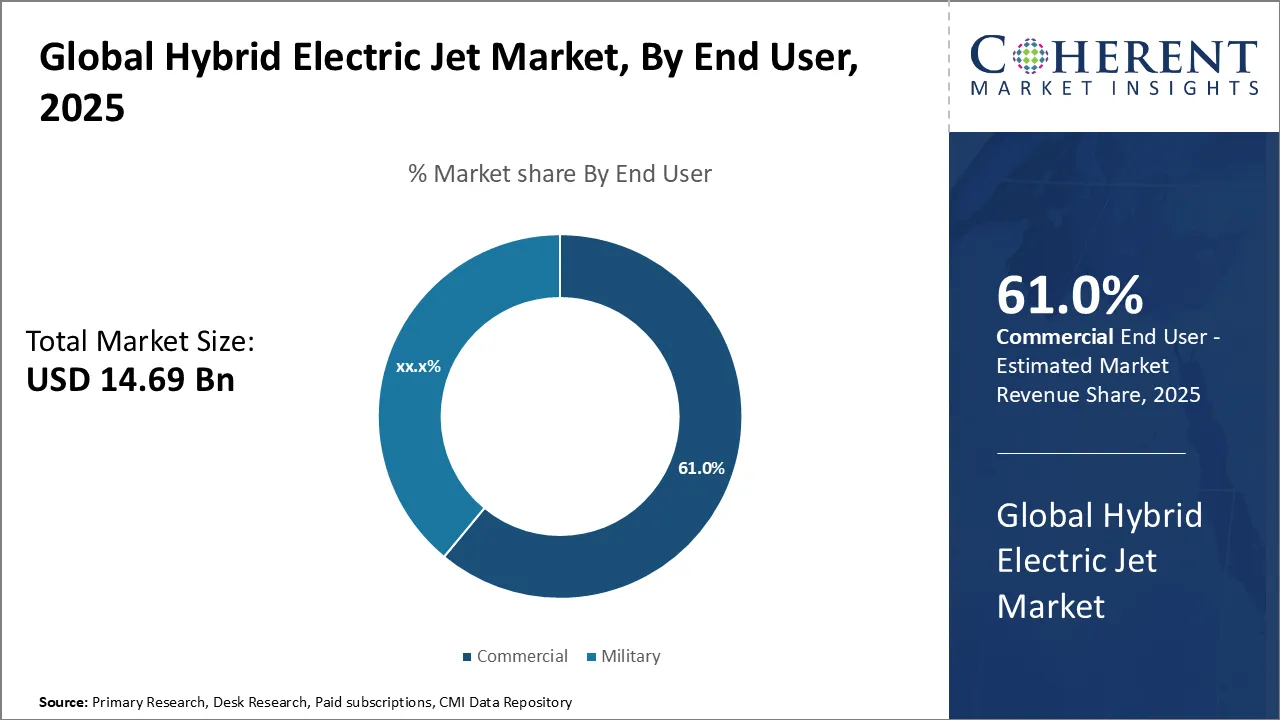
Hybrid Electric Jet Market Insights, By End User: Hybrid Electric Jet Adoption Remains High in Commercial Sector
As per Coherent Market Insights’ latest analysis, commercial segment is expected to dominate the market, accounting for 62% of the market share in 2026. This can be attributed to increasing use of hybrid electric jets by airlines looking to reduce fuel costs and meet carbon emission targets.
The aviation industry is under immense pressure to adopt cleaner technologies. This is putting hybrid electric jets into the spotlight because they offer a practical solution for short- and medium-distance flights. Many commercial airlines are investing in these aircraft to cut operational costs as well as enhance their sustainability image among eco-conscious passengers.
Moreover, advancements in battery technology and electric propulsion systems are making hybrid aircraft more efficient as well as reliable for commercial use. As a result, major aviation companies and aircraft manufacturers are actively testing and introducing hybrid models to their fleets, signaling a strong shift toward greener air travel.
For instance, in May 2025, Ampaire received FAA approval for the certification basis of its hybrid-electric propulsion system, called AMP-H570. This was the first time the FAA approved a certification basis for a hybrid-electric system.
Regional Insights
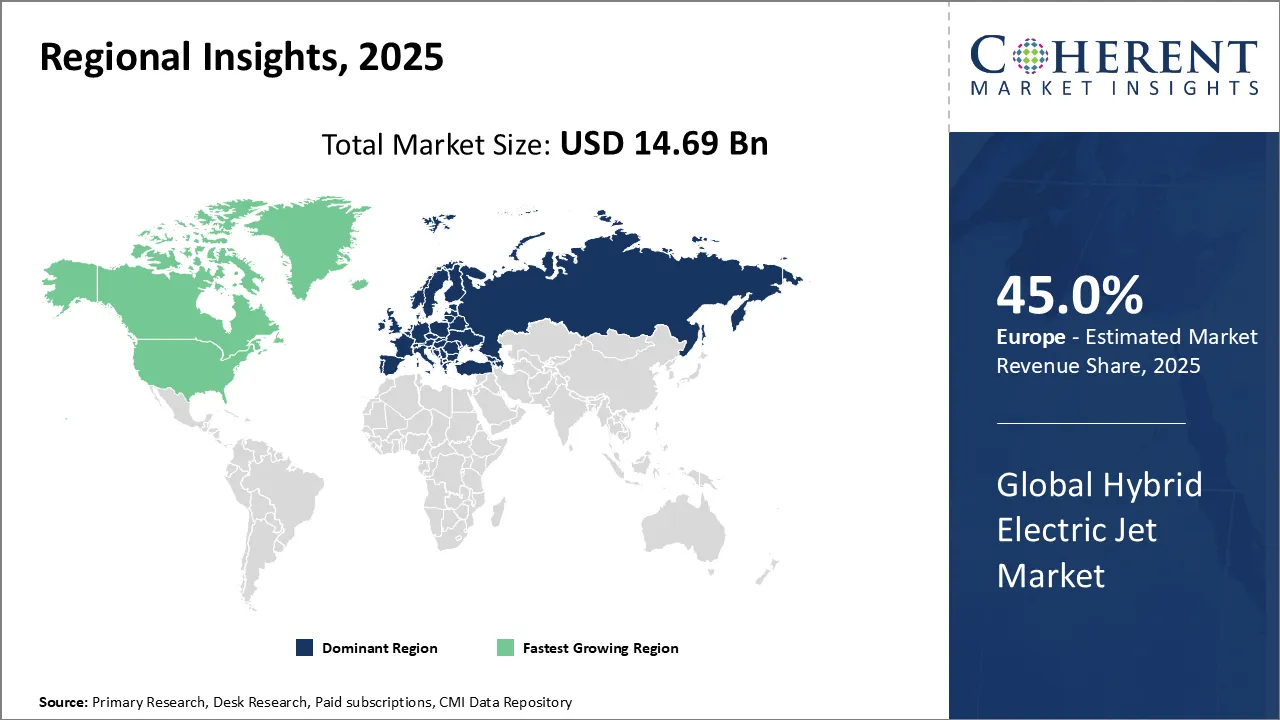
Europe Dominates the Hybrid Electric Jet Market
Europe, with a share of 45% in 2026, is expected to dominate the global market during the forthcoming period. Favorable government support for sustainable aviation initiatives and implementation of strict carbon emission regulations by European Union are fueling this growth.
Top aircraft manufacturers like Airbus are increasingly investing in hybrid and electric propulsion technologies. In addition, presence of advanced aerospace infrastructure and ongoing research projects across nations like Germany and the U.K. are set to boost regional growth during the forthcoming period.
Many Europe-based start-ups are launching new solutions to meet evolving needs of customers. For example, French startup Aura Aero recently started construction of its ERA hybrid-electric regional airliner prototype. The aircraft has received more than 650 pre-orders, showing that many people are very interested in it.
North America Becoming a Hub for Hybrid Electric Jet Companies
North America hybrid electric jet market is poised to exhibit strong growth during the forecast period. This is mostly due to increasing investments by private aerospace startups and defense organizations in next-generation electric propulsion systems.
The U.S., in particular, is seeing rapid innovation through companies such as Boeing and Ampaire, which are testing hybrid-electric aircraft for both commercial and regional travel. For example, in September 2026, Delta Air Lines teamed up with Maeve Aerospace to create the MAEVE Jet, a hybrid-electric plane for short trips that can use up to 40% less fuel and produce fewer emissions than current regional planes.
Likewise, in September 2026, GE Aerospace partnered with BETA Technologies to advance hybrid electric flight. Together, GE Aerospace and BETA planned to develop a hybrid electric turbogenerator for Advanced Air Mobility (AAM) applications, including future BETA aircraft and long-range Vertical Takeoff and Landing (VTOL) aircraft.
Hybrid Electric Jet Market Outlook – Country-wise
U.S. Hybrid Electric Jet Market Trends
The United States is becoming a major hub for hybrid electric jets. This is attributable to strong government support for green aviation, increasing investments from leading aircraft manufacturers, and rising interest from commercial airlines to reduce fuel costs and carbon emissions.
Research and development in hybrid propulsion technologies are also helping the U.S. stay ahead in this market. Major aerospace companies, both local and foreign ones, are investing in hybrid-electric propulsion technologies.
For instance, in May 2024, Heart Aerospace opened a new US R&D hub to develop hybrid-electric airplane. This move highlights the company’s dedication to developing hybrid-electric propulsion technology.
China Hybrid Electric Jet Market Forecast
The hybrid electric jet market is expected to grow rapidly during the assessment period. This is mostly due to rising air travel demand, government initiatives promoting sustainable aviation, and increasing investments by domestic aerospace companies.
The country is focusing on developing advanced hybrid aircraft to meet both environmental goals and commercial aviation needs. For instance, the 6T H-VTOL aircraft was unveiled at the 7th China Helicopter Exposition in Tianjin in October 2026.
Market Concentration and Competitive Landscape
Top manufacturers of hybrid electric jets are spending more on research and development to create better technologies. For example, Rolls-Royce is working on hybrid-electric engines for regional planes to use less fuel as well as produce less carbon emissions.
Many players are partnering with commercial airlines for the development and supply of hybrid electric jets. There is also increase in acquisitions, facility expansions, mergers, and collaborations as companies look to boost their sales as well as expand their footprint.
Hybrid Electric Jet Industry News
- In October 2025, Air New Zealand conducted its first electric aircraft test flights in New Zealand using BETA Technologies’ ALIA CX300. The flight marked an important step toward the airline’s goal of reducing carbon emissions from regional air travel.
- In May 2025, Vertical Aerospace developed a hybrid-electric variant of its VX4 aircraft. This new model aims to significantly enhance the aircraft's range and payload capabilities, targeting markets such as defense, logistics, and broader commercial applications
- In August 2025, Joby Aviation, Inc. and L3Harris Technologies partnered to develop a new aircraft class for defense applications. The gas turbine hybrid VTOL aircraft is designed for low-altitude missions and can be piloted by a crew or fly autonomously
Market Report Scope
Hybrid Electric Jet Market Report Coverage
| Report Coverage | Details | ||
|---|---|---|---|
| Base Year: | 2025 | Market Size in 2026: | USD 17.39 Bn |
| Historical Data for: | 2020 To 2024 | Forecast Period: | 2026 To 2033 |
| Forecast Period 2026 to 2033 CAGR: | 18.4% | 2033 Value Projection: | USD 56.73 Bn |
| Geographies covered: |
| ||
| Segments covered: |
| ||
| Companies covered: | Pipistrel Group, Airbus, Bye Aerospace, Aerospace Limited, Yuneec Holding Limited, Leonardo S.p.A., Faradair Aerospace Limited, Boeing, Digisky S.R.L., Groupe Gorge, Eve Air Mobility, Joby Aviation, Vertical Aerospace, and Lilium N.V., others. | ||
| Growth Drivers: |
| ||
| Restraints & Challenges: |
| ||
Hybrid Electric Jet Market Drivers
Reduction in Greenhouse Gas Emissions
The growing need to reduce greenhouse gas (GHG) emissions is one of the primary factors driving growth of the global hybrid electric jet market. Conventional jet engines emit significant amounts of carbon dioxide (CO₂), methane (CH₄), and nitrous oxide (N₂O), contributing to global warming and air pollution.
According to the European Commission’s Flightpath 2050 initiative, the aviation industry aims to reduce CO₂ emissions by 75%, nitrogen oxide (NOₓ) emissions by 90%, and perceived noise levels by 65% compared to year 2000 levels. Hybrid and electric propulsion technologies play a key role in achieving these sustainability targets.
Beyond environmental benefits, hybrid electric jets can also help airlines lower fuel costs and reduce noise pollution. Their quieter operation allows for increased flight frequency during night hours, especially at airports located near city centers. This will likely further support market expansion during the forecast period.
Growth of Air Traffic
Global air passenger traffic is projected to rise rapidly due to increasing disposable incomes and expanding global travel activity. According to ACI World, global passenger traffic is expected to reach 19.5 billion by 2042. This strong growth is likely to boost demand for sustainable aviation solutions, including hydrogen aircraft, over the assessment period.
Hybrid Electric Jet Market Opportunities
Growing Use in Logistics
The demand for fast, efficient, and eco-friendly air transport is rising as global trade grows. According to the International Air Transport Association (IATA), airlines carry over 52 million metric tons of goods every year. Although air cargo makes up only 0.5% of global trade by weight, it represents about 35% of world trade by value, worth nearly US$6 trillion.
Air transport is very important for moving high-value and time-sensitive goods such as medicines, electronics, and fresh foods. For example, vaccines and other temperature-sensitive medicines are mostly shipped by air to ensure quick and safe delivery. The World Health Organization (WHO) reports that vaccines help prevent more than 3 million child deaths each year, and reliable air delivery plays a key role in making this possible.
To improve its logistics network, Amazon launched “Amazon Air” in India on January 23, 2023, using two Boeing 737-800 cargo aircraft operated by Quikjet Cargo Airlines. This shows the growing demand for fast e-commerce deliveries.
As online shopping and air cargo needs increase, hybrid-electric aircraft are expected to play a bigger role in regional logistics. These aircraft can reduce fuel costs and carbon emissions while offering efficient short-distance transport for goods.
Emergence of Futuristic Air Mobility
The rise of advanced air mobility (AAM) is creating new opportunities for the hybrid electric jet market. AAM focuses on developing safe, convenient, and affordable air transport using highly automated aircraft that fly at lower altitudes to move people and goods. This includes services such as air taxis, intercity travel, cargo delivery, emergency response, and private air travel. The goal is to make short-distance flying more accessible and efficient, especially in busy urban areas.
As cities face growing traffic congestion, hybrid and electric aircraft offer a cleaner and faster alternative for transportation. Major aerospace companies are investing heavily in this technology to support sustainable air travel. Although large-scale adoption is still in its early stages, the demand for eco-friendly and time-saving travel options is expected to create strong growth opportunities for hybrid electric jet manufacturers.
Hybrid Electric Jet Market Trends
Increasing Investment in Electric Aviation
The aviation industry aims to achieve net-zero carbon emissions by 2050. Electric and hybrid-electric aircraft can play an important role in cutting emissions, reducing noise, and lowering operating costs. Governments and private companies around the world are increasing investments in this field.
For example, in January 2023, the U.S. Air Force selected Electra Aero, Inc. for a US$85 million Strategic Funding Increase (STRATFI) partnership to develop a full-scale prototype of its electric short takeoff and landing (eSTOL) aircraft.
In August 2020, the U.S. Department of Energy (DOE) announced US$33 million in funding through its ARPA-E programs to support projects working on carbon-neutral and hybrid-electric aviation technologies.
Driving Aviation Towards Net-Zero Emissions
The aviation industry is working to reduce its carbon emissions in several ways. This includes making airport operations more efficient, using sustainable aviation fuels (SAF) made from renewable sources, and developing new technologies like hybrid-electric and hydrogen-powered aircraft. By combining these efforts, the industry can make real progress toward cleaner air travel.
For example, in November 2022, Airbus and Renault Group signed an agreement to work together on electric aircraft technology and speed up the development of hybrid-electric planes.
Analyst Opinion (Expert Opinion)
- The hybrid electric jet industry is moving from concept to reality as leading aerospace companies focus on cutting emissions without compromising range. Europe remains at the center of this transformation thanks to strong regulatory pressure from the EU’s “Fit for 55” initiative and heavy R&D investments by Airbus and Rolls-Royce.
- Hybrid architecture is gaining ground as a practical bridge between conventional fuel and full-electric aircraft. Pure battery-electric jets face major limits due to low energy density—batteries store about 60 times less energy per kilogram than jet fuel—making hybrids the only viable near-term path for regional and short-haul flights. Pratt & Whitney’s collaboration with RTX and Collins Aerospace on hybrid-electric propulsion systems demonstrates that traditional engine makers see hybrids as the next major propulsion shift.
- Commercial aviation is taking the lead in using hybrid aircraft. Airlines are testing hybrid planes for regional flights to save money as well as reduce carbon emissions. For example, Ampaire flew its hybrid-electric “Eco Caravan” in the U.S. and U.K., cutting fuel use by 70% on regional routes. This supports airlines’ global goal of reaching net-zero emissions by 2050 as well as encourages them to invest more in hybrid technology in the coming years.
- Engineering and certification challenges are still a major hurdle. Adding electric systems to turbine engines makes aircraft more complex as well as heavier, which slows down the certification process. About one-third of current hybrid aircraft projects have been delayed because of regulatory and testing issues. However, as aviation authorities like EASA and FAA create clearer rules for hybrid aircraft, the market is expected to grow much faster after 2030.
Speak to the analyst
Want personalized insights?
Take the findings above to one of our principal consultants, or have the report rebuilt around the segments, geographies and competitors you actually track.
Market Segmentation
- Type Insights (Revenue, USD Bn, 2021 - 2033)
- Ultralight Aircraft
- Light Jets
- End User Insights (Revenue, USD Bn, 2021 - 2033)
- Military
- Commercial
- Regional Insights (Revenue, USD Bn, 2021 - 2033)
- North America
- U.S.
- Canada
- Latin America
- Brazil
- Argentina
- Mexico
- Rest of Latin America
- Europe
- Germany
- U.K.
- Spain
- France
- Italy
- Russia
- Rest of Europe
- Asia Pacific
- China
- India
- Japan
- Australia
- South Korea
- ASEAN
- Rest of Asia Pacific
- Middle East
- GCC Countries
- Israel
- Rest of Middle East
- Africa
- South Africa
- North Africa
- Central Africa
- North America
- Key Players Insights
- Pipistrel Group, Airbus
- Bye Aerospace
- Aerospace Limited
- Yuneec Holding Limited
- Leonardo S.p.A.
- Faradair Aerospace Limited
- Boeing
- Digisky S.R.L.
- Groupe Gorge
- Eve Air Mobility
- Joby Aviation
- Vertical Aerospace
- Lilium N.V.
- Others.
Sources
Primary Research interviews
- Interviews with engineering leads of hybrid-electric propulsion programmes (e.g., NASA Electrified Aircraft Propulsion team)
- Interviews with aerospace OEM technical specialists in hybrid propulsion architecture (e.g., project leads referenced in academic papers)
Databases
- Technical publication databases covering aerospace propulsion (e.g., MDPI “Energies” journal database)
- Patent and technology-demonstrator databases for hybrid-electric aircraft systems (e.g., NASA technology transfer listings)
Magazines
- Aviation Week & Space Technology – feature articles on hybrid-electric aircraft progress (e.g., hybrid test-flights)
- Aerospace magazine coverage of hybrid-electric propulsion innovations (e.g., major engine manufacturers’ R&D)
Journals’
- “Energies” — research article “Research on Large Hybrid Electric Aircraft Based on Battery and Turbogenerator”
- “Aircraft Hybrid-Electric Propulsion: Development Trends and Challenges” (PMC/NCBI)
- “Review of hybrid electric powered aircraft, its conceptual design and architecture” (ScienceDirect)
Newspapers
- Newspaper/online news coverage of aerospace firm announcements (e.g., development of hybrid-electric engines for jets)
- General-interest business newspapers reporting on aviation emission-reduction technology paths
Associations
- International Air Transport Association (IATA) – aviation industry emission-reduction targets referenced in hybrid-electric aircraft papers.
- National Aeronautics and Space Administration (NASA) Aeronautics Research Mission Directorate – as an association/institution promoting hybrid-electric propulsion technologies.
Public Domain sources
- NASA’s Electrified Aircraft Propulsion web pages
- MIT Energy Initiative article “Concept for a hybrid-electric plane may reduce aviation’s air-pollution problem”
- University of Arkansas news release on hybrid-electric aircraft motor drive test flight.
Proprietary Elements
- CMI Data Analytics Tool
- Proprietary CMI Existing Repository of information for last 8 years
Get access to 250+ pages report
Every segment, forecast, competitor profile and data table behind the analysis above — available for instant download.
- ESOMAR Member
- ISO 9001:2015 Certified
- D-U-N-S Registered
- GDPR & CCPA Compliant
Missing comfort of reading report in your local language? Find your preferred language:
Transform your Strategy with Exclusive Trending Reports
Frequently Asked Questions
The global market is estimated to be valued at USD 17.39 Bn in 2026.
The global hybrid electric jet market size is expected to reach USD 56.73 Bn by 2033.
The global market is poised to exhibit a CAGR of 18.4% from 2026 to 2033.
Major players operating in the global hybrid electric jet market include Pipistrel Group, Airbus, Bye Aerospace, Aerospace Limited, Yuneec Holding Limited, Leonardo S.p.A., Faradair Aerospace Limited, Boeing, Digisky S.R.L., Groupe Gorge, Eve Air Mobility, Joby Aviation, Vertical Aerospace, and Lilium N.V., others.
High costs and battery constraints.
Stringent environmental regulations and rising demand for sustainable aviation solutions.
Europe dominates the global market with a share of 45% in 2026.