

Advanced Biofuel Market Analysis & Forecast - 2026 to 2033
Advanced Biofuel Market size is estimated to be valued at USD 253.03 Bn in 2026 and is expected to reach USD 2,856.83 Bn in 2033, exhibiting a compound annual growth rate (CAGR) of 41.4% from 2026 to 2033.
Key Takeaways
- By Feedstock, the Algae segment is expected to lead the advanced biofuel market outlook with a projected 31% share in 2026, driven by its high oil yield, rapid growth, and sustainable cultivation on non-arable land.
- The Camelia segment follows with an estimated 26% share, favored for its high oil content and adaptability to marginal soils, supporting lower greenhouse gas emissions.
- By Region, North America is projected to dominate the advanced biofuel market with a 35% share in 2026, supported by strong technological adoption and favorable policy frameworks.
Market Overview
The global demand for energy is increasing with the increasing consumption owing to the rising population. The growing consumption has increased the need for more renewable and sustainable sources of energy. Advanced biofuel, which are known as second-generation biofuel, are used as a substitute for gasoline and diesel in the automotive industry. The low carbon emission has been the driving factor for the utilization of advanced biofuel in the automotive sector. The advanced biofuel mostly utilize the lignocellulose mass for their production.
Current Events and Its Impact on the Advanced Biofuel Market
Event | Description and Impact |
US Inflation Reduction Act Biofuels Funding |
|
European Union Renewable Energy Directive III (RED III) Implementation |
|
Brazil’s Fuels of the Future Law |
|
Role of Artificial Intelligence (AI) in the Advanced Biofuel Market
The emergence of artificial intelligence is changing the advanced biofuel industry by enhancing efficiency, scalability, and sustainability throughout the entire production lifecycle. From feedstock cultivation to conversion processes, AI technologies are adressing key challenges and innovating across the entire value chain.
In the US, government entities like the Department of Energy (DOE) is facilitating the adoption of AI and machine learning in bioenergy research, targeting genomics, automated experimentation, as well as other streamlined processes. With this kind of focus, he next generation biofuels are developed faster thanks to Artificial Intelligence and high performance computing models. Enhancing critical production stages such as bioreactor optimizationAI algorithms improves yield.
Real-time data like temperature and pH readings alongside enzyme concentration are dynamically polled for conditional operation adjustments resulting in maximized yield with reduced energy consumption and waste during maintenance intervals artificially intelligent sensor networks provide real time monitoring feeding predictive models allowing for up 30% reduction in predicted downtime improving operational reliability.
A notable industry example is Datavault AI’s use of supercomputing to optimize rapeseed (Brassica napus) feedstock through comparative genomics and multi-omics data. By refining metabolic pathways with AI, the company improves biomass consistency and yield, lowering production costs and helping advanced biofuels better compete against fossil fuels.
Overall, AI is a key enabler of enhanced efficiency, cost reduction, and environmental sustainability in the advanced biofuel market, driving the sector closer to a renewable energy future.
- Current Industry Events of 2026
- Market Size Estimation
- Regional Breakdown
- Competitive Landscape
- Customer Intelligence
- Segmental Analysis
- Pricing Analysis
- Key Market Drivers, Challenges & Future Trends
- Customized Insights Section
Segmental Insights
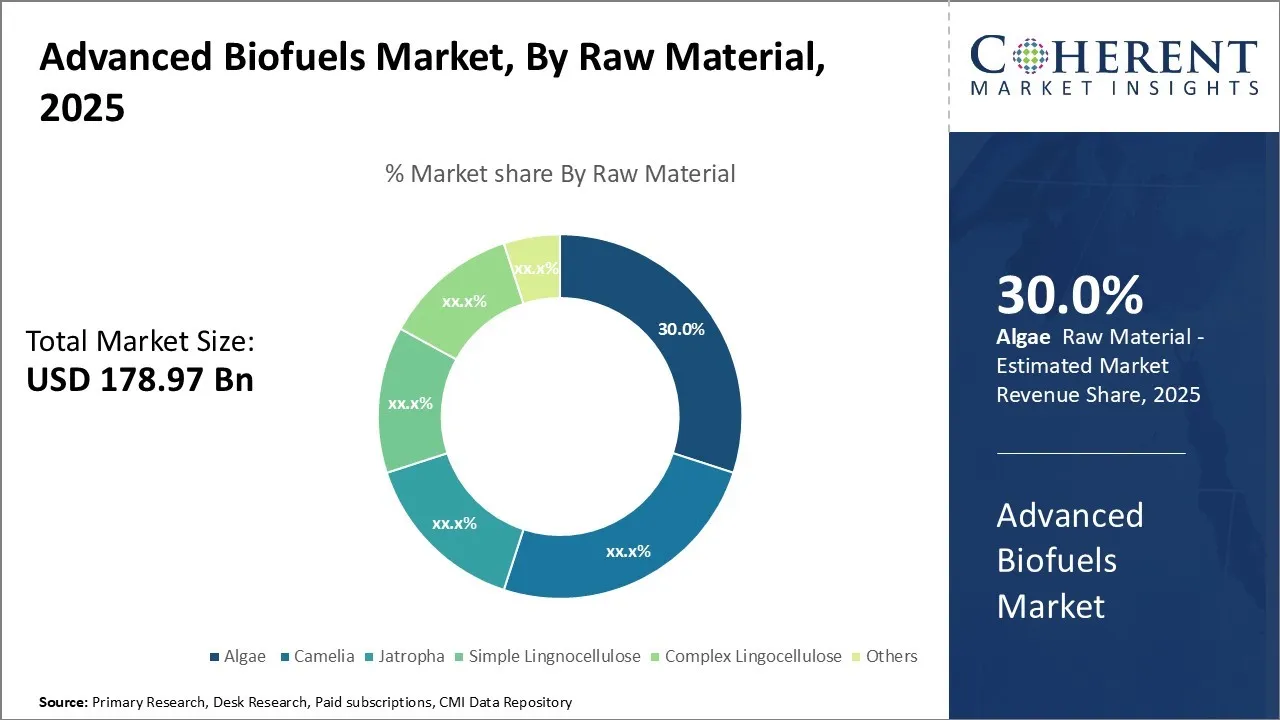
Advanced Biofuel Market Insights, By Raw Material
In terms of raw material, the algae segment is projected to hold the largest market share of 31% in 2026, owing to its high oil yield potential, rapid growth rate, and non-dependence on arable land. Algae biofuels has the potential to achieve environmental benefits by cultivating algae in saline, wastewater, or non-arable lands which would not compete with other food crops. This is why they are famous for scalable and eco-friendly biofuel production technologies. The camelia segment follows closely with a projected share of 25% due to high oil content and ability to grow in marginal soils.
Camelia based biofuels are gaining favor because of their lower greenhouse gas emissions as compared to fuels produced from other plants along with low cost of cultivation in subtropical regions. As jatropha is expected to contribute 15% of the market share, its long standing use in biodiesel diversification along with development of influence over semi-arid climates helps fulfill prediction.
Though there is tempered wide spread adoption due to issues regarding seed yield consistency and land use. Simple lignocellulose and complex lignocellulose parts are estimated to capture 12% and 13% of the market respectively due feeding off agricultural wastes, forestry waste or other biomass materials. While these have strong sustainability benefits, their conversion technologies still require significant capital investment along with process innovation making them far from commercial viability.
The others segment, which consists of less common feedstocks, is expected to contribute the remaining 5%. Even though they have less market share, niche feedstocks are being investigated for local and specialized uses in biofuel development. With growing attention on achieving carbon neutrality and securing energy resources around the world, biofuel producers are broadening their range of feedstocks. Algae and lignocellulosic feedstocks are receiving more investment due to advances in bioconversion technology as well as policies supporting next-generation biofuels.
Regional Insights
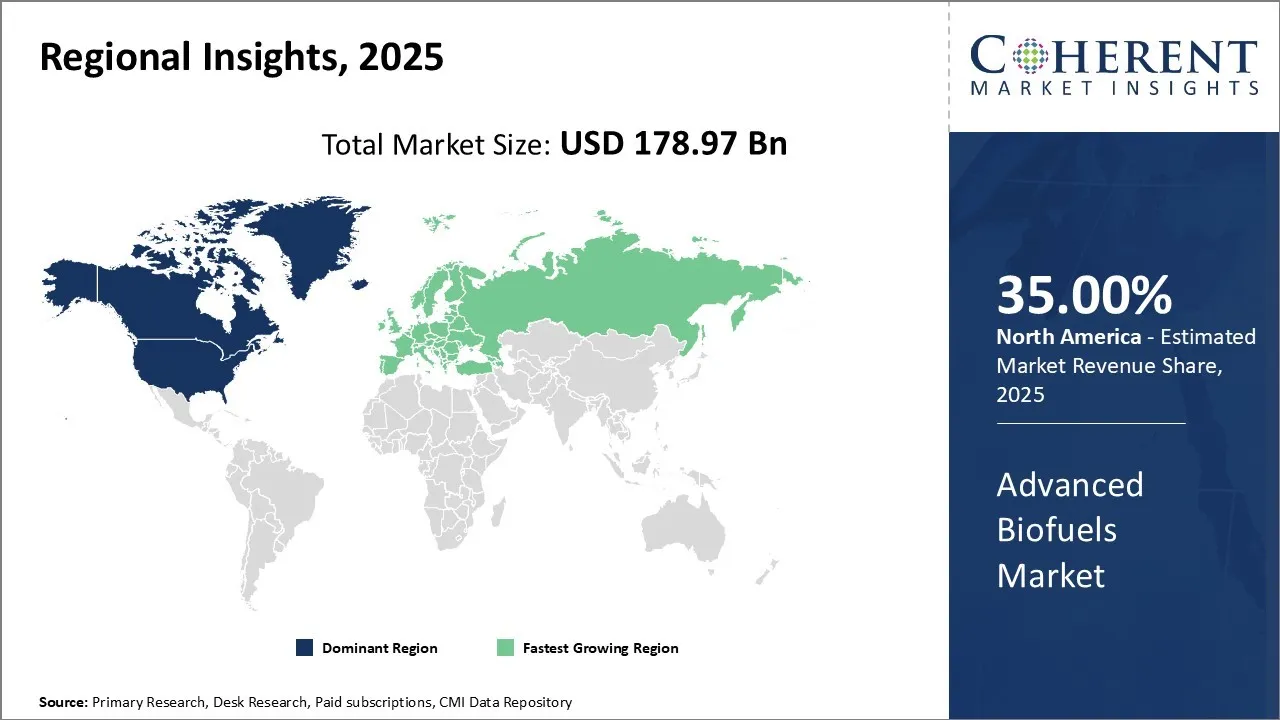
North America Advanced Biofuel Market Analysis and Trends
North America is projected to dominate the global advanced biofuel market with a market share of 35.00% in 2026, driven by robust regulatory frameworks, advanced biorefinery infrastructure, and widespread adoption of algae and lignocellulosic-based biofuels. The U.S. Renewable Fuel Standard (RFS) and California's Low Carbon Fuel Standard (LCFS) have accelerated investment in second-generation biofuel technologies, positioning the region at the forefront of global biofuel innovation.
Asia Pacific Advanced Biofuel Market Analysis and Trends
Asia Pacific is anticipated to be the fastest growing region, capturing 17% of the market in 2026, fueled by rising energy demand, government-led biofuel initiatives, and abundant availability of biomass feedstocks. Countries like India, China, and Indonesia are actively developing infrastructure for lignocellulosic and algae-based fuel production to reduce fossil fuel dependency and meet clean energy targets.
Dominating Countries in the Advanced Biofuel Market
United States Advanced Biofuel Market Analysis and Trends
The United States leads the North American market, backed by strong policy support, a mature biofuel industry, and active R&D in next-generation technologies. The country is home to several large-scale algae and lignocellulosic fuel projects, with major industry players collaborating with government and research institutions to drive commercialization and scalability.
India Advanced Biofuel Market Analysis and Trends
India stands out in the Asia Pacific region as a rapidly growing market, driven by national bioenergy policies such as the National Bio-Energy Mission and SATAT initiative. Government incentives, public-private partnerships, and investments in agricultural residue-based biofuel production are accelerating the country's transition to sustainable energy.
Market Report Scope
Advanced Biofuel Market Report Coverage
| Report Coverage | Details | ||
|---|---|---|---|
| Base Year: | 2025 | Market Size in 2026: | USD 253.03 Bn |
| Historical Data for: | 2020 To 2024 | Forecast Period: | 2026 To 2033 |
| Forecast Period 2026 to 2033 CAGR: | 41.4% | 2033 Value Projection: | USD 2,856.83 Bn |
| Geographies covered: |
| ||
| Segments covered: |
| ||
| Companies covered: | Abengoa Bioenergy, S.A., A2BE Carbon Capture, LLC, Algenol Biofuel, Chemtex group, Bankchak Petroleum, Clariant Produkte GmbH, Fiberight LLC, DuPont Industrial Biosciences, Fujian Zhongde Energy Co., Ltd, Inbicon, GranBio, INEOS Bio, POET-DSM Advanced Biofuel LLC, KiOR Inc., ZeaChem Inc., and Sundrop Fuels, Inc. | ||
| Growth Drivers: |
| ||
| Restraints & Challenges: |
| ||
Global Advanced Biofuel Market- Growth Drivers
- Initiatives taken by the Government and its applications
The key market drivers for the global advanced biofuel market is the rise in demand for cleaner Energy sources to reduce the carbon emissions. The initiatives taken by various governments have further helped the market of advanced biofuel to grow. The application of biofuel in the automotive industry has also impacted the growth of the advanced biofuel market.
- Versatility and Sustainability of the Biofuel market
Global advanced biofuel market is driven by factors such as supportive government regulations promoting the usage of second-generation biofuel in different end- use sectors, including manufacturing and energy sectors, and growing concern regarding sustainability of first-generation biofuel among stakeholders. Moreover, depleting carbon based fossil fuel is also promoting the usage of second generation biofuel among users.
Global Advanced Biofuel Market Trends
Globally, the transportation industry is the largest emitter of green gases, due to the combustion of fossil fuels used in internal combustion engines. The transportation industry has a large proportion of private vehicles, such as four- and two-wheelers, as well as commercial vehicles.
Personal vehicles are mainly light vehicles and uses gasoline as a fuel. To limit greenhouse gas emissions, countries around the world have adopted standards, and more countries are mandated to blend gasoline with ethanol to reduce emissions and reduce dependency on fossil fuels.
Key blending missions driving global biofuel demand are established in North America, India, Brazil, Europe, and more. For example, the Indian government and petroleum marketing companies are actively promoting the blending of 10% ethanol in motor gasoline with the aim of gradually increasing the blending ratio to 20% by 2028. Similarly, Canada is likely to issue final regulations to announce its clean fuel standards program in the spring of 2022. The Clean Fuel Standards Program includes a national target of ethanol blends of an average of 15% by 2030.
In addition, in March 2022, the Brazilian Ministry of Economy announced that it would exempt ethanol imports from taxes, including other products, until the end of 2022 to alleviate inflationary pressures. This will promote the blending of ethanol into gasoline and will stimulate the market growth.
Global Advanced Biofuel Market restraints
Lack of awareness regarding benefits of second-generation biofuel in Asian countries has negatively affected the growth of the advanced biofuel market in this region. Issues from alternative products such as fall of crude oil prices and limitation in processes are some of the major factors that are expected to hamper growth of the market over the forecast period.
Analyst Viewpoint
- The global advanced biofuels market plays a vital role in decarbonizing difficult-to-abate transportation sectors such as aviation, shipping, and heavy freight. This momentum is fueled by increasingly stringent climate policies and advancing technologies.
- Binding blending mandates and tax incentives across key economies serve as primary growth drivers, accelerating market adoption despite existing infrastructure and economic challenges.
- Policy frameworks like ReFuelEU Aviation and renewable fuel standards guarantee demand, providing a stable foundation for industry growth.
- Technological progress in feedstock preprocessing and conversion efficiency—especially involving lignocellulosic biomass and waste oils—is reducing production costs and enhancing scalability.
- Rising investments in commercial-scale biorefineries, notably those producing renewable diesel compatible with current engines, reflect strong market confidence.
- Challenges include supply chain fragmentation, feedstock scarcity, and competition for sustainable waste oils and agricultural residues, which contribute to cost volatility and limit rapid scaling.
- High capital requirements for emerging bio-jet fuel pathways and infrastructure gaps, such as limited bio-bunker facilities at ports, restrict market expansion, particularly in maritime applications.
- Opportunities lie in waste-to-fuel technologies utilizing municipal solid waste and industrial byproducts, which can lower feedstock costs and improve circular economy outcomes.
- Emerging conversion methods like hydrothermal liquefaction show promise for unlocking new feedstock sources, including marine and algal biomass.
- Regionally, Europe leads with ambitious sustainable aviation fuel (SAF) mandates, while North America benefits from tax credits boosting renewable diesel projects.
- Asia-Pacific is poised for rapid growth due to rising aviation demand and developing policies, though North America and Europe currently dominate the project pipeline.
- Long-term market viability depends on harmonizing sustainability certifications and reducing risks associated with first-of-a-kind projects to attract further investment.
Global Advanced Biofuel Market: Key Developments
- In May 2025, Shell entered a strategic partnership with LanzaTech to commercialize ethanol production from industrial waste gases using microbial fermentation, targeting large-scale decarbonization.
- In April 2025, POET completed a major expansion of its South Dakota facility, increasing its cellulosic ethanol production capacity by 30% to meet rising renewable fuel demand.
- In March 2025, the U.S. Department of Energy awarded $115 million to 19 advanced biofuel projects focused on cost reduction, carbon intensity improvement, and novel feedstock utilization.
- In February 2025, TotalEnergies inaugurated its first commercial-scale biojet fuel plant in France, supporting the EU’s SAF mandate under the Fit-for-55 climate package.
Market segmentation
- Global Advanced Biofuel Market, By Fuel Type (Revenue, USD Bn, 2021 - 2033)
- Cellulosic Ethanol
- Biodiesel
- Biobutanol
- BioDME
- Others
- Global Advanced Biofuel Market, By Raw Material (Revenue, USD Bn, 2021 - 2033)
- Jatropha
- Camelina
- Algae
- Simple Lignocellulose
- Complex Lignocellulose
- Others
- Global Advanced Biofuel Market, By Process Type (Revenue, USD Bn, 2021 - 2033)
- Biochemical Process
- Thermochemical Process
- Global Advanced Biofuel Market, By Region (Revenue, USD Bn, 2021 - 2033)
- North America
- U.S.
- Canada
- Europe
- U.K.
- Germany
- Italy
- France
- Russia
- Rest of Europe
- Asia Pacific
- China
- India
- Japan
- ASEAN
- Australia
- South Korea
- Rest of Asia Pacific
- Latin America
- Brazil
- Mexico
- Rest of Latin America
- Africa
- North Africa
- Central Africa
- South Africa
- Middle East
- GCC
- Israel
- Rest of Middle East
- Company Profiles
- Abengoa Bioenergy
- A2BE Carbon Capture, LLC
- Algenol Biofuel
- Chemtex group
- Bankchak Petroleum
- Clariant Produkte (Deutschland) GmbH
- Fiberight LLC
- DuPont Industrial Biosciences
- Fujian Zhongde Energy Co., Ltd
- Inbicon
- GranBio
- INEOS Bio
- POET-DSM Advanced Biofuel LLC
- KiOR Inc.
- ZeaChem Inc.
- Sundrop Fuels, Inc.
Sources
Primary Research interviews
- Industry executives from leading advanced biofuel producers
- Government energy policy regulators
- Transportation sector sustainability managers
- Biofuel feedstock supply chain specialists
- Others
Databases
- Bloomberg Energy Finance Database
- EIA (U.S. Energy Information Administration) Renewable Fuels Data
- IEA (International Energy Agency) Bioenergy Task Reports
- Others
Magazines
- Biofuels Digest
- Biomass Magazine
- Renewable Energy World
- Green Car Congress
- Others
Journals
- Energy & Environmental Science
- Bioresource Technology
- Renewable and Sustainable Energy Reviews
- Others
Newspapers
- Financial Times (Energy Transition section)
- The Wall Street Journal (Sustainable Business)
- The Guardian (Environment)
- Reuters Sustainable Business
- Others
Associations
- Advanced Biofuels Association (ABFA)
- Global Bioenergy Partnership (GBEP)
- Renewable Fuels Association (RFA)
- European Biomass Industry Association (EUBIA)
- Others
Public Domain sources
- U.S. Department of Energy Bioenergy Technologies Office reports
- International Renewable Energy Agency (IRENA) publications
- European Environment Agency (EEA) biofuels assessments
- United Nations Environment Programme (UNEP) renewable energy briefings
- Others
Proprietary Elements
- CMI Data Analytics Tool
- Proprietary CMI Existing Repository of information for last 8 years
Get access to 250+ pages report
Every segment, forecast, competitor profile and data table behind the analysis above — available for instant download.
- ESOMAR Member
- ISO 9001:2015 Certified
- D-U-N-S Registered
- GDPR & CCPA Compliant
Missing comfort of reading report in your local language? Find your preferred language:
Transform your Strategy with Exclusive Trending Reports
Frequently Asked Questions
The Advanced Biofuel Market size is estimated to be valued at USD 253.03 Bn in 2026, and is expected to reach USD 2,856.83 Bn by 2033.
Major players operating in the market include Abengoa Bioenergy, S.A., A2BE Carbon Capture, LLC, Algenol Biofuel, Chemtex group, Bankchak Petroleum, Clariant Produkte GmbH, Fiberight LLC, DuPont Industrial Biosciences, Fujian Zhongde Energy Co., Ltd, Inbicon, GranBio, INEOS Bio, POET-DSM Advanced Biofuel LLC, KiOR Inc., ZeaChem Inc., and Sundrop Fuels, Inc.
Initiatives taken by the Government and its applications and Versatility and Sustainability of the Biofuel market are the key factors hampering growth of the market.
Growing market for renewable energy, government support, and increasing investments in second generation biofuel are some of the major factors that are expected to propel growth of the market over the forecast period.
The CAGR of the global Market is projected to be 41.4% from 2026 to 2033.
Among region, North America accounted for the highest market share, in terms of revenue in the market in 2026, followed by Europe.