

Eco Fiber Market Size and Forecast — 2026-2033
The Eco Fiber Market size is estimated to be valued at USD 6.91 billion in 2026 and is expected to reach USD 13.16 billion by 2033, exhibiting a compound annual growth rate (CAGR) of 9.7% from 2026 to 2033.
Overview
Eco fiber is a thin long natural thread or a strand with flexible texture. This material is widely used in the textile industry, due to its natural and ecologically friendly properties. Textile-based products are generally manufactured using an extensive range of chemical agents, including scouring agents, wetting agents, soaping, and dyeing agents. The excessive use of these agents, has raised several concerns regarding environmental pollution, contributing to global warming. This in turn, is increasing the demand for eco fibres in the textile industry, thus boosting growth of the market.
Growing textile industry and fluctuations in prices of conventional fabrics are some of the major factors fuelling growth of the eco fiber market. Furthermore, major players operating in this market are increasingly engaging in the manufacturing of various eco-friendly products such as organic cotton and bamboo fibers. This in turn, is expected to propel growth of the eco fibers market. Production of organic cotton does not involve any pesticides or chemicals and reduces the consumption of water by around 70%. This is another major factor propelling growth of the eco fibers market, globally.
Key Takeaways
The natural eco fiber segment dominates with 61% market share, driven by biodegradable and renewable characteristics favored in textile and apparel applications.
Asia Pacific’s strong government policies and expanding textile industries contribute to its growing market revenue and demand potential.
North America maintains significant business growth through innovation in fiber processing technology and strategic partnerships with automotive and packaging sectors.
Eco Fiber Market – Segmentation Analysis
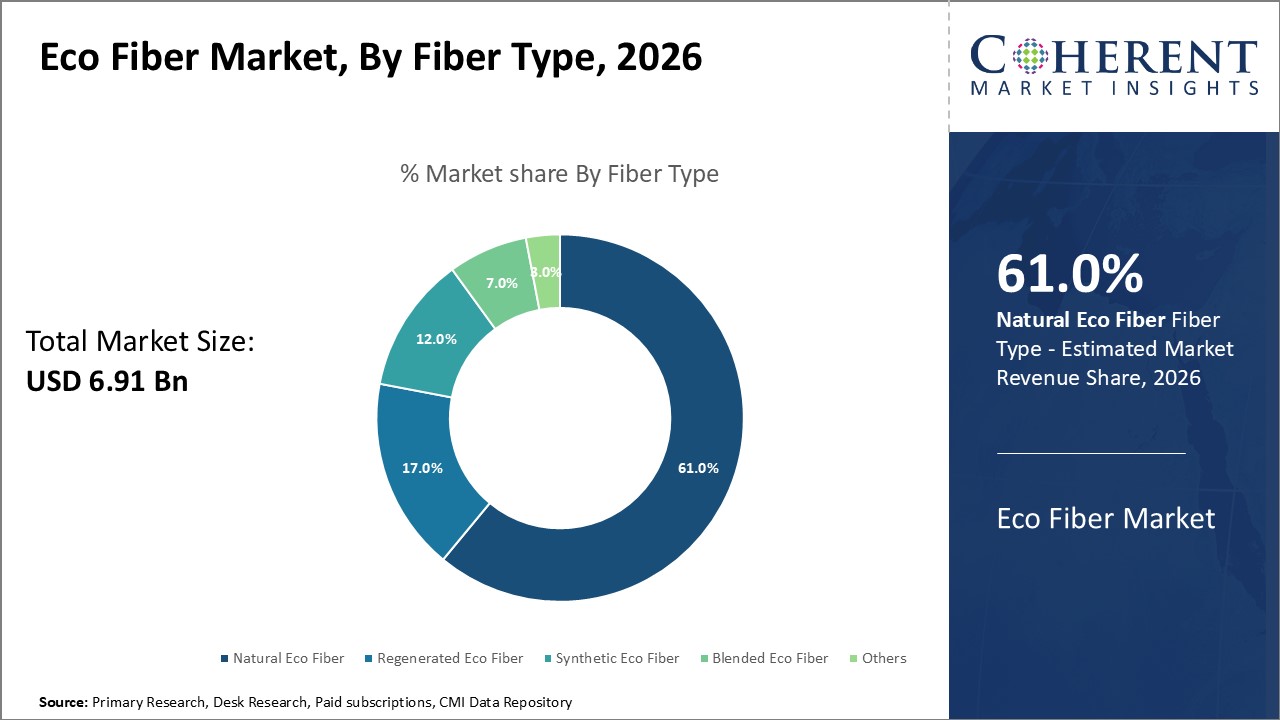
Eco Fiber Market Insights, By Fiber Type
Natural Eco Fiber holds a 61% market share in fiber type term. Natural eco fibers, such hemp, jute, and bamboo, are popular because of their remarkable sustainability, biodegradability, and appeal to consumers who want organic products. Their robust use in packaging and textiles supports consistent demand growth bolstered by growing industry changes to renewable source materials.
Eco Fiber Market Insights, By Application
In terms of Application, Apparel & Textiles dominate owing to the rising consumer demand for sustainable and biodegradable products, accounting for the largest market share globally. Innovations in eco fiber fabrics have opened avenues in casual wear, workwear, and performance clothing. Consumers and brands increasingly prioritize organic, recycled, and biodegradable fibers such as organic cotton, hemp, bamboo, and TENCEL, integrating them into apparel and fashion products.
Eco Fiber Market Insights, By Product Form
In terms of Product Form, Staple Fiber commands the largest market share as they are widely used in spun yarns for apparel and industrial textiles due to their versatility. The shift towards circular economy practices and closed-loop production, along with heightened consumer preferences for sustainable and transparent fiber origins, is driving innovation in staple fiber development.
Eco Fiber Market Trends
The Eco Fiber Market has recently witnessed a decisive shift towards hybrid eco fibers combining natural and synthetic components to optimize performance and sustainability.
Notably, 2026 saw a 21% increase in hybrid fiber usage in performance sportswear, reflecting the industry's pursuit of balancing durability with environmental impact.
Another emergent trend is the integration of blockchain technology for traceability, enabling companies to verify fiber origin and sustainability claims transparently.
This enhances consumer trust and aligns with increasing corporate responsibility mandates.
Additionally, circular economy initiatives have gained momentum, with leading companies adopting fiber recycling programs that have already reclaimed over 50,000 tons of eco fibers globally in 2025.
Eco Fiber Market Insights, By Geography
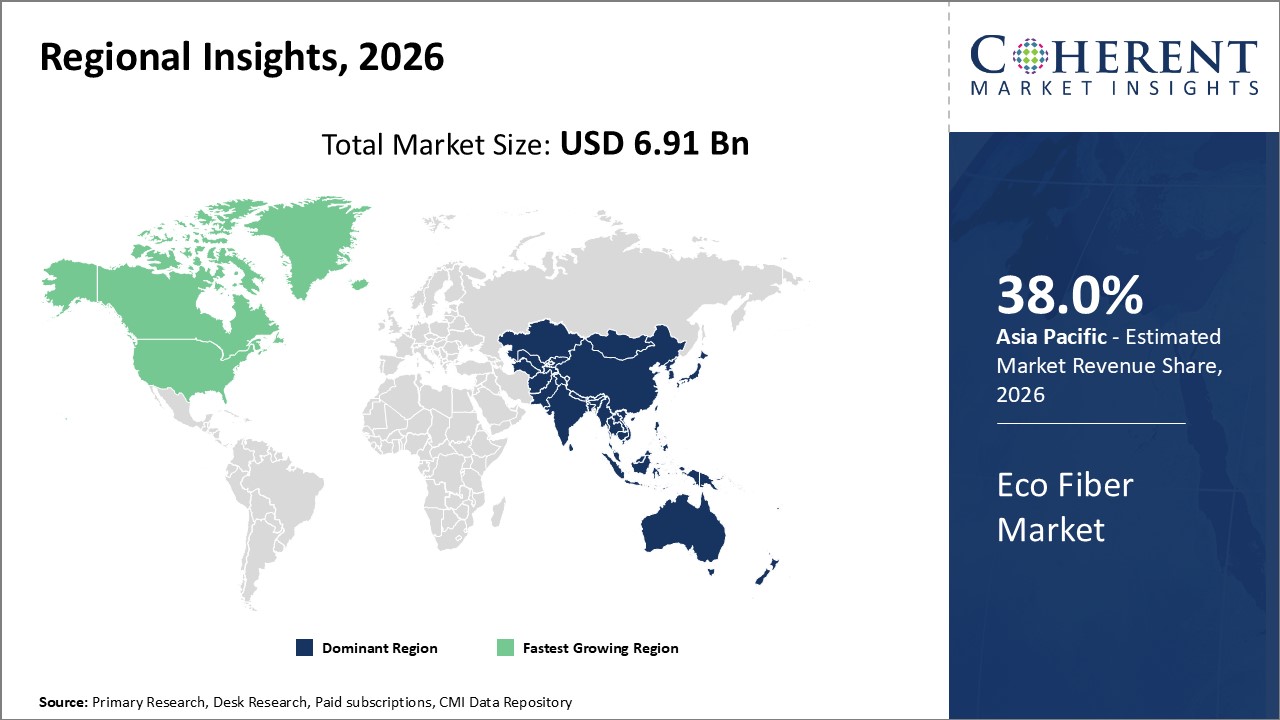
Asia Pacific Eco Fiber Market Analysis and Trends
In Asia Pacific, the dominance in the Eco Fiber Market is marked by rapid industrialization, especially in countries like China and India. This region accounts for over 38% of the global market share due to favorable government policies promoting sustainability, abundant raw materials like bamboo and hemp, and expanding textile manufacturing hubs. Nations such as Japan and South Korea contribute with advanced eco fiber processing technologies. The robust industry ecosystem, combined with growing domestic demand and export opportunities, reinforces Asia Pacific’s critical role.
North America Eco Fiber Market Analysis and Trends
North America, on the other hand, is growing at the quickest rate, with a predicted CAGR of over 10%. This increase is mostly due to regulatory pressure and fiber technology advancement. Leading producers of eco fibers with an emphasis on packaging and automotive applications are present in the US market, and their incorporation into lightweight composites and biodegradable packaging solutions will guarantee company expansion. Ongoing expansion is sparked by sustainable efforts supported by manufacturer investments and federal assistance.
Eco Fiber Market Outlook for Key Countries
Market Analysis and Trends for Eco Fiber in the United States
The USA plays a pivotal role in shaping the Eco Fiber Market through significant technological advancements and aggressive sustainability mandates. By early 2026, U.S.-based companies reported a 24% increase in eco fiber production, fueled by demand from automotive OEMs integrating eco fibers into interior components. The government’s focus on reducing carbon emissions has facilitated tax incentives encouraging manufacturers to incorporate eco fibers, bolstered by partnerships between industrial and research entities focused on developing innovative biodegradable composites.
Market Analysis and Trends for Eco Fiber in the China
China’s eco fiber market benefits from its vast raw material base and scale of textile manufacturing operations. The country accounted for approximately 22% of global eco fiber revenue in 2025, driven by increasing exports of sustainable textiles and increased local government incentives focused on green industries. Major domestic players have invested in capacity expansion and improved processing methods, aiming to capture a greater share of both domestic demand and international markets. Initiatives addressing environmental regulations and supply chain sustainability significantly contribute to business growth prospects.
Analyst Opinion
The surge in demand for biodegradable and renewable raw materials is a critical driver. In 2025, Asia Pacific's production of bio-based fibers increased by 18%, reflecting manufacturers’ shifting preferences towards sustainable inputs. This shift demonstrates that supply-side dynamics significantly influence industry expansion by boosting low-impact fiber availability.
Pricing strategies remain a pivotal factor influencing market dynamics. The average price per kilogram of eco fiber has melded competitiveness and premium positioning in 2026, with sustainable fibers commanding up to 13% higher price points compared to conventional fibers. This pricing differential emphasizes consumer willingness to invest in eco-conscious alternatives, boosting market revenue.
Import and export patterns highlight emerging demand hubs, notably in Europe, where eco fiber imports surged 14% in 2025 due to stringent government sustainability mandates. This indicates how macroeconomic policies and trade flows catalyze regional market growth and alter competitive landscapes.
Diverse usage scenarios across end-user industries—ranging from automotive lightweighting components to eco-friendly wearable textiles—are expanding the market scope. For instance, eco fiber adoption in automotive composites grew by 23% in 2026, driven by environmental regulations and material performance needs, underscoring multiple vertical growth opportunities.
- Current Industry Events of 2026
- Market Size Estimation
- Regional Breakdown
- Competitive Landscape
- Customer Intelligence
- Segmental Analysis
- Pricing Analysis
- Key Market Drivers, Challenges & Future Trends
- Customized Insights Section
Market Scope
| Report Coverage | Details | ||
|---|---|---|---|
| Base Year: | 2025 | Market Size in 2026: | USD 6.91 billion |
| Historical Data for: | 2020 To 2024 | Forecast Period: | 2026 To 2033 |
| Forecast Period 2026 to 2033 CAGR: | 9.7% | 2033 Value Projection: | USD 13.16 billion |
| Geographies covered: |
| ||
| Segments covered: |
| ||
| Companies covered: | EcoFibers Inc., GreenTex Solutions, NaturWeave Ltd., BioFiber Corp., SustainFabrics Global, EcoBlend Materials, PureNature Fibers, FiberGreen International, EnviroWeave Technologies, EarthSoft Textiles | ||
| Growth Drivers: |
| ||
Eco Fiber Market Growth factors
The proliferation of global sustainability regulations compels industries to adopt eco fibers, with countries like Germany and the U.S. implementing strict environmental policies, propelling market growth.
Consumer consciousness around sustainable fashion, heightened by 17% growth in eco-friendly apparel sales in 2026, acts as a major catalyst encouraging adoption. Technological advancements in eco fiber processing have improved fiber strength and versatility, supporting entry into traditionally difficult application segments such as automotive interiors. Lastly, expanding infrastructure investments in emerging economies in Asia Pacific have enhanced production capacities, fueling supply and supporting revenue growth within the market.
Eco Fiber Market Development
In February 2026, Polyplastics introduced PLASTRON LFT (Long Fiber-Reinforced Thermoplastic) RA627P, an environmentally friendly composite of long cellulose fiber and polypropylene (PP) resin that offers excellent damping, high impact strength, low density, and high specific rigidity for a variety of applications, such as industrial component housings and audio components (speaker diaphragms).
In April 2026, In a promising step toward a more sustainable future for racquet sports, HEAD has introduced the BOOM RAW tennis racquet, demonstrating their continued innovation. In the limited-edition and highly unique BOOM RAW racquet, all of the carbon fibers are bio-circular carbon fibers, and it gives the same explosive power as the standard, in-line BOOM racquet, along with the same pleasure, feel, and ease of play.
In November 2025, The establishment of a joint venture between Jones Family of Companies Inc. and ECO Fiber Inc. to broaden their product options in the market for sustainable cold chain packaging is an exciting announcement. This new endeavor combines the skills of the Jones Family of Companies' nearly 90 years of textile knowledge and dedication to sustainability with ECO Fiber's proficiency in packaging solutions. Together, they are starting a new business called ECO Fiber Packaging, which will offer creative, environmentally friendly cold chain packaging options to satisfy the changing demands of the sector.
Key Players
EcoFibers Inc.
GreenTex Solutions
NaturWeave Ltd.
BioFiber Corp.
SustainFabrics Global
EcoBlend Materials
PureNature Fibers
FiberGreen International
EnviroWeave Technologies
EarthSoft Textiles
One of the leading market players' competitive tactics is EcoFibers Inc., which recently invested USD 120 million to boost the capacity of biopolymer fiber manufacturing in Asia Pacific, leading to a 26% increase in output in just six months. In a similar vein, GreenTex Solutions has implemented cutting-edge closed-loop recycling techniques, which have improved sustainability and cost effectiveness by lowering raw material waste by 31%. By forming strategic alliances with automakers, NaturWeave Ltd. increased their market share in eco-fiber composites by 19% by 2025.
Eco Fiber Market Future Outlook
The future outlook of the Eco Fiber Market will be promising, driven by growing consumer awareness about environmental sustainability and the increasing demand for eco-friendly and biodegradable materials. By 2030, more than 65–71% of consumers will prefer sustainable textile products over conventional ones. Technological advancements will make the production processes more efficient and cost-effective, which will support wider adoption across various industries such as fashion, home furnishings, automotive, and medical textiles. Governments worldwide will enforce stricter regulations and encourage green initiatives, which will further fuel market growth at an expected CAGR of 8–11%.
The shift towards circular economies and recycling initiatives will accelerate the use of recycled and bio-based fibers. By 2030, recycled fibers will account for nearly 40–45% of global eco fiber consumption, compared to around 25% today. Regional markets, particularly in Asia-Pacific and North America, will lead growth due to favorable policies, rising consumer preferences, and expanding manufacturing hubs.
Innovations in fiber quality and properties will continue to meet performance standards and will enhance market penetration, positioning eco fibers as a mainstream alternative to synthetic fibers in the near future. By 2030, eco fibers will likely replace 30–36% of synthetic fiber usage in textiles. Challenges like higher costs compared to conventional fibers will gradually be offset by economies of scale and increased investment (expected to rise by 15–21% annually) in sustainable textile technologies. Overall, the market will experience robust expansion, contributing significantly to a more sustainable textile industry and a greener economy.
Historical Development
In May 2019, Aditya Birla Group's Grasim Industries announced the expansion of its specialty fiber business, which was expected to increase the company’s capacity by 41% in the next two years. This expansion was further expected to help the company in catering to its customer’s increasing demand.
On 25th April 2019, Aditya Birla Group’s Cellulose, the pulp and fibre business of India, launched a plantable tag for its eco-enhanced variant Livaeco. This new launch was expected to attract customers due to the adaptation of eco-friendly practices throughout the manufacturing process.
In December 2014, FlexForm Technologies announced the formation of FlexForm Korea Ltd. for acquiring and expanding the company’s production lines in Jeonju City and in Cheonan, in South Korea. The company started its manufacturing in 2015. This expansion helped the company in fulfilling the customer’s demands in South Korea in a shorter span of time.
Sources
Primary Research interviews:
Apparel & fashion brands adopting sustainable fibers
Retailers promoting eco-friendly clothing
Sustainability experts & consultants
Databases:
Scopus
ScienceDirect
PubMed (for biobased material research)
Magazines:
Eco Textile News
Fibre2Fashion
Apparel Resources
Journals:
Sustainability (MDPI)
Journal of Natural Fibers
Textile Research Journal
Newspapers:
The New York Times (Sustainable Business coverage)
Financial Times (Luxury & Sustainability coverage)
Business Standard
Associations:
Sustainable Apparel Coalition
Better Cotton Initiative (BCI)
International Cotton Advisory Committee (ICAC)
Get access to 250+ pages report
Every segment, forecast, competitor profile and data table behind the analysis above — available for instant download.
- ESOMAR Member
- ISO 9001:2015 Certified
- D-U-N-S Registered
- GDPR & CCPA Compliant
Missing comfort of reading report in your local language? Find your preferred language:
Transform your Strategy with Exclusive Trending Reports
Frequently Asked Questions
The market is predominantly led by companies such as EcoFibers Inc., GreenTex Solutions, NaturWeave Ltd., and BioFiber Corp., focusing on sustainability-driven innovations and strategic expansions.
The market size is expected to grow from USD 6.91 billion in 2026 to USD 13.16 billion by 2033, reflecting a CAGR of 9.7%.
The apparel & textiles sector remains the most significant end-user segment, driven by growing consumer demand for eco-friendly fabrics and sustainable fashion.
Emerging trends indicate a shift toward hybrid fibers, blockchain-enabled transparency, and circular economy initiatives, all fostering enhanced sustainability and traceability.
Competitive strategies focus on capacity expansions, technological innovation, and strategic collaborations, while challenges include raw material sourcing and cost management.
Companies leverage investments in production capacity, eco-innovation, vertical integration, and sustainable supply chain practices to gain market share and expand geographical reach.