

Cellulose Films Market Size and Share Analysis- Growth Trends and Forecasts (2026-2033)
The cellulose films market size is anticipated to grow at a CAGR of 6.9% with USD 4,900 Mn in 2026 and is expected to reach USD 7,800 Mn in 2033. The primary drivers are largely defined by the growing demand for biodegradable, compostable, and plastic-free packaging materials. Some of the other factors are rising regulatory pressure on single-use plastics, increasing food and beverage packaging demand, and growing consumer preference for sustainable wrapping films. UNEP reported that 19–23 Mn tonnes of plastic waste leak into aquatic ecosystems every year, supporting demand for alternatives such as cellulose films.
Key Takeaways
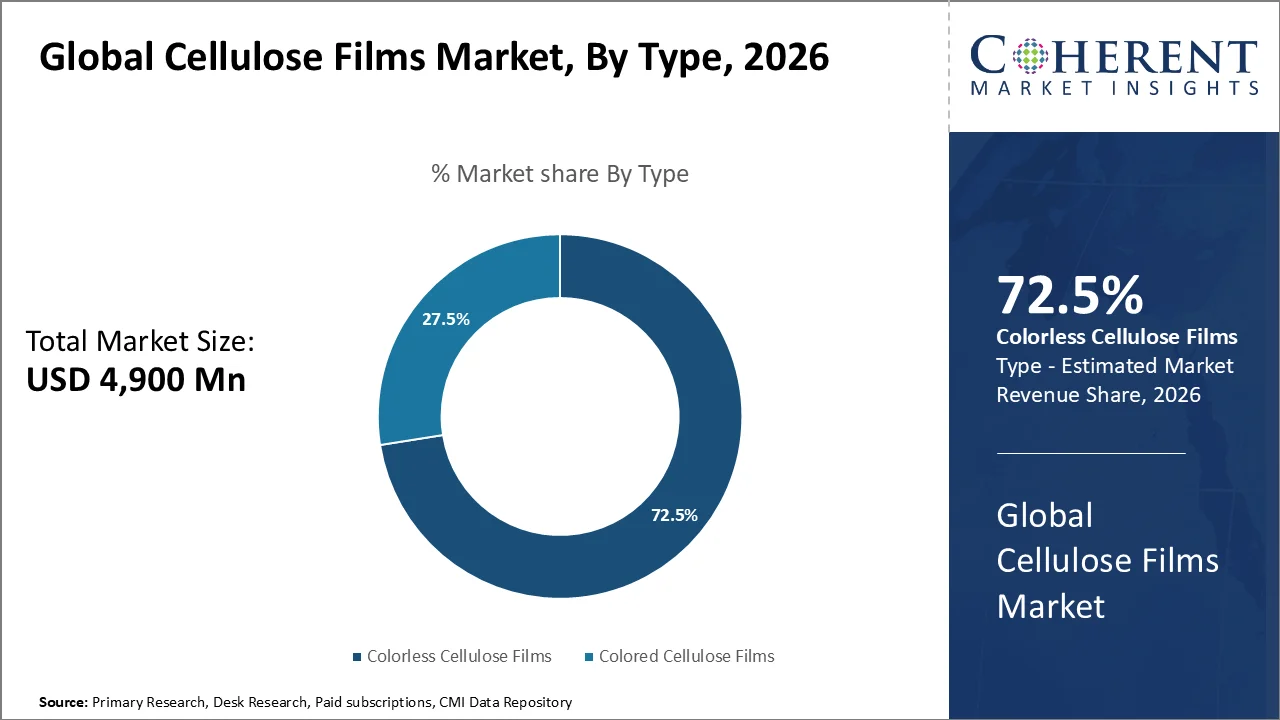
- The colorless cellulose films segment is likely to dominate the market with 72.5% in 2026. The segment’s growth is owing to its clear visibility, premium product display, food-contact suitability, and wider use in transparent wraps, labels, and flexible packaging. EPA states that containers and packaging generated 82.2 Mn tons of U.S. municipal solid waste, equal to 28.1% of total generation.
- The wrapping films segment is set to lead with 35.9% in 2026. The segment’s growth is owing to the rising shift from petroleum-based plastic wraps toward biodegradable and compostable wrapping solutions. The European Commission states that 40% of plastics used in the EU are used in packaging, supporting demand for sustainable wrapping film substitutes.
- The packaging segment is set to lead with 31.5% in 2026. The segment’s growth is owing to the increasing use of cellulose films in food packs, personal care packs, labels, tapes, and consumer goods packaging. Eurostat reported that the EU generated 83.4 Mn tonnes of packaging waste in 2022, equal to 186.5 kg per inhabitant.
- The food & beverages segment is set to lead with 34.5% in 2026. The segment’s growth is owing to the higher use of cellulose films in bakery, confectionery, fresh produce, snacks, dry foods, and ready-to-eat food USDA ERS reported that total U.S. food spending reached USD 2.58 trillion in 2024, supporting large-scale food packaging demand.
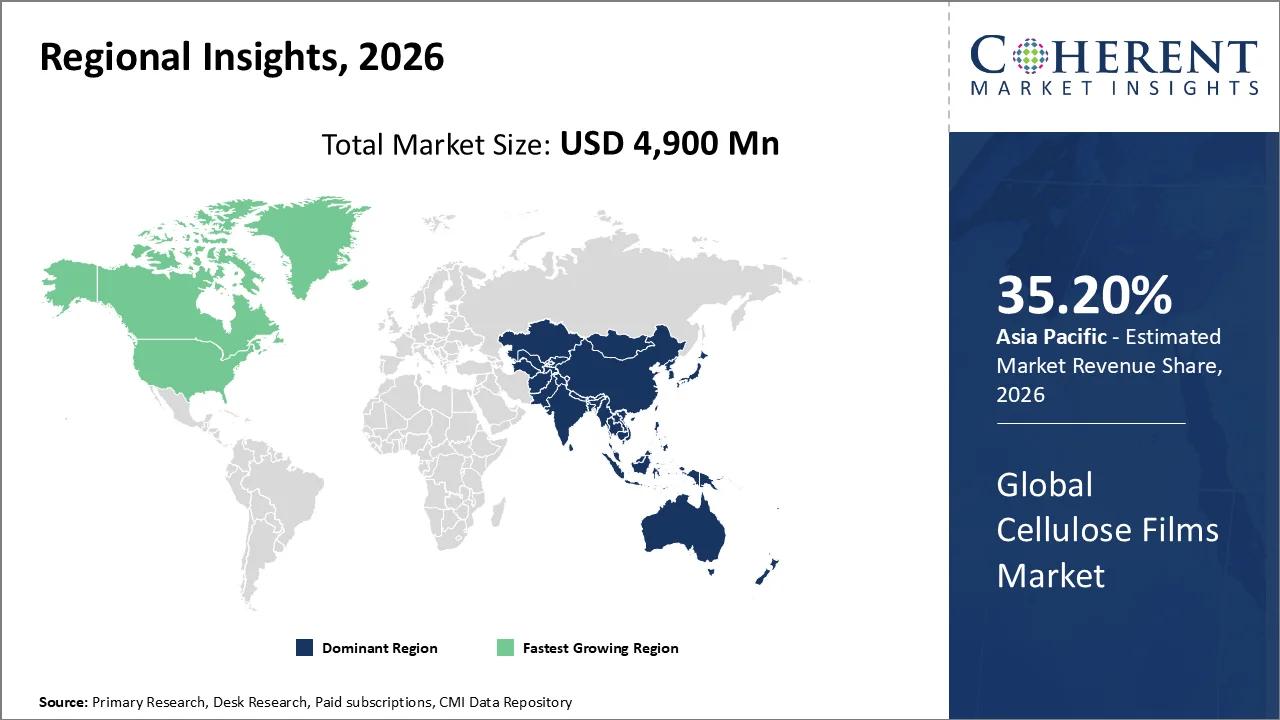
- Asia Pacific is expected to acquire the prominent share of 35.20% in 2026. The region’s growth is owing to the high demand for sustainable food packaging solutions, particularly in countries with large populations along with growing awareness of environmental issues like China and India. India’s PIB reported in March 2026 that the EPR portal had 60,128 registered producers, importers, and brand owners and 3,012 plastic waste processors, thereby strengthening sustainable packaging adoption.
Segmental Insights
Why is Colorless Cellulose Films Acquiring the Largest Share?
On the basis of type, the colorless cellulose films segment is projected to account for the largest cellulose films market share of 72.5% in 2026. The segment’s growth is owing to the increasing regulatory pressure to reduce plastic waste and the growing demand for sustainable alternatives. The films offer high transparency and clarity. This makes them ideal for applications in food, pharmaceutical, and retail packaging, thus aligning with the global sustainability initiatives.
The EU Single-Use Plastics Directive (Directive (EU) 2019/904) restricts specific single-use plastic products and encourages the use of biodegradable alternatives like cellulose-based films. The European Union, for instance, reported that 79.7 million tonnes of packaging waste were generated in 2023, thereby highlighting the need for material substitution. In addition, India's Plastic Waste Management (Amendment) Rules are pushing for the adoption of biopolymer and cellulose films over conventional plastic materials.
In November 2023, YUTOECO introduced the plant-based ECO Lucent Membrane, a transparent film made from 100% cellulose substrate. The new solution provides a sustainable and visible alternative to traditional plastic packaging, thereby addressing the visibility issue in molded pulp packaging.
- Current Industry Events of 2026
- Market Size Estimation
- Regional Breakdown
- Competitive Landscape
- Customer Intelligence
- Segmental Analysis
- Pricing Analysis
- Key Market Drivers, Challenges & Future Trends
- Customized Insights Section
Wrapping Films hold the Largest Market Share
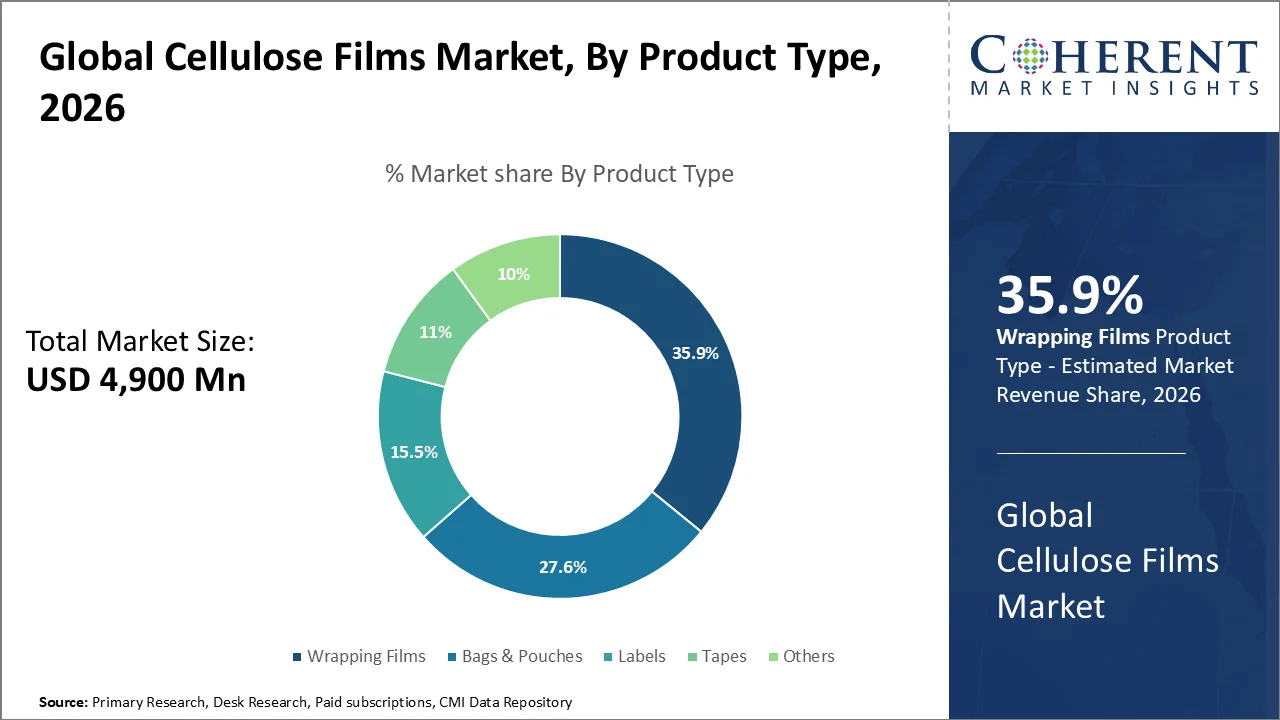
On the basis of product type, the wrapping films segment lead with a major 35.9% share in 2026. The segment’s growth is owing to the increasing demand for transparent, printable, grease-resistant, and biodegradable wrapping solutions, particularly in the food, confectionery, bakery, fresh produce, and personal-care packaging sectors. These applications favor wrapping films over conventional plastic wraps due to their sustainability and functional properties.
The regulatory acceptance of wrapping films is also contributing to the segment’s growth. For instance, the 21 CFR 177.1200 regulation from the US FDA permits the use of cellophane, a regenerated cellulose film, for food packaging under specific conditions.
In May 2026, Parkside expanded its compostable packaging range with new metallized wrapping films. These cellulose-based films deliver home compostability, enhanced barrier performance, and a lighter structure. This helps in addressing challenges like low barrier properties and reliance on industrial composting. The films are mainly designed to compost in approximately 26 weeks and provide improved shelf-life for snacks as well as powders.
Plastic-waste Reduction is Transforming the Cellulose Films Market in the US
The cellulose films market, particularly in packaging, has gained substantial attention in the United Sates. This is because the regulators and industry stakeholders are intensifying efforts to curb single-use plastics and reduce landfill waste. According to ASTM standards overseen by the Committee D20.96, biodegradable polymers like cellulose films must meet defined test methods to qualify for “biodegradable” labels in both aerobic as well as anaerobic conditions.
The recent U.S. demand data shows that green packaging films were valued at approximately USD 5 million in 2025. The forecasts are projecting growth with businesses aligning their practices with eco-friendly targets and regulatory compliance timelines, particularly in the food and consumer goods sectors. The consumer brands and packaging converters are integrating cellulose-based biodegradable films to cater to the state waste-reduction requirements along with corporate sustainability commitments.
In May 2025, Colorcon teamed up with ASHA Cellulose to strengthen advanced barrier membrane and film formulation technologies. This collaboration is expected to benefit cellulose film applications in both packaging as well as pharmaceutical sectors.
Compostable Cellulose Films: A Major Breakthrough in the Market
Compostable cellulose films are becoming a major breakthrough because they address flexible-packaging waste while retaining transparency, printability, and food-contact suitability.
EPA reported that plastic packaging recycling rates in the United States were only about 13 percent, with the majority of plastic packaging not being recycled, and much of it still ending up in landfills or incineration. This leads to a strong need for other solutions like biodegradable cellulose wrapping films, labels, and pouches. This is owing to their ability to provide environmentally-friendly option to help reduce plastic waste.
In Europe, the European Commission states that packaging waste is over 180 kg per person annually and secures one-third of municipal waste. This prompts stricter packaging rules and stronger demand for recyclable or compostable formats.
For instance, in 2025, Futamura announced a £15 million investment at its Wigton site. The firm's NatureFlex cellulose films are derived from wood pulp. The films are certified for home as well as industrial composting, thus improving low-carbon production and scale readiness for compostable flexible packaging in food, personal care, and specialty label applications.
Current Events and Their Impact on the Cellulose Films Market
Current Event | Description and its Impact |
UK Extended Producer Responsibility (EPR) for Packaging Fees |
|
U.S. FDA Food-Contact Permission for Cellophane under 21 CFR 177.1200
|
|
Cellulose Films Market Trends
- The rising demand for sustainable flexible packaging is increasing the use of cellulose films as alternatives to fossil-based plastic films in wraps, pouches, labels, tapes, and lidding applications. The OECD states that plastics production and use reached 435 million tonnes in 2020 and may rise by 70% by 2040 without stronger action, thereby strengthening the demand for bio-based film solutions.
- The regulatory pressure is speeding up the adoption of recyclable, compostable, and renewable film materials. As of 2026, the EU Packaging and Packaging Waste Regulation will generally apply from 12 August 2026 and aims to make all packaging recyclable in an economically viable way by 2030.
- The food and beverage brands are adopting cellulose films for transparent wrapping, bakery packs, confectionery wraps, snack pouches, and fresh produce bags owing to their clarity, printability, grease resistance, and barrier performance. Futamura’s NatureFlex cellulose films are used across bags, labels, tapes, twistwrap, overwrap, pouches, and lidding formats.
- The high-barrier compostable film innovation is improving the performance of cellulose-based and compostable packaging. In September 2025, TIPA expanded its portfolio with four high-barrier film and laminate products for snacks, nutraceuticals, powders, coffee, tea, and sachets. They offer moisture and oxygen barrier properties while running on conventional packaging machinery.
- Consumer-facing sustainability claims, compostability certification, and clear disposal labelling are becoming the main purchasing factors. The European Commission states that packaging uses large quantities of primary raw materials, while 40% of plastics used in the EU are in packaging and half of marine litter is from packaging, strengthening demand for cellulose films in circular packaging systems.
Regional Insights
Asia Pacific Dominates Owing to the Strong Push Toward Compostable Flexible Packaging
The Asia Pacific region accounts for 35.20% of the market share in 2026. The region’s growth is owing to the strong push toward compostable flexible packaging, rising packaged food consumption, and regulatory pressure on plastic films.
In India, official data reported plastic waste generation of 41,36,188 tonnes per annum in 2022-23, keeping brand owners under pressure to replace petroleum-based wrapping and lidding films with renewable cellulose-based alternatives. In Australia, the government plastics data showed 4.0 million tonnes of plastic products and packaging placed on the market in 2023-24, while 3.2 million tonnes reached end-of-life and 1.2 million tonnes, or 39%, came from packaging. This propels the demand for cellulose films in food wraps, sachets, labels, as well as compostable lidding.
In May 2025, Futamura teamed up with Biopap and launched a fully compostable cellulose film solution for foodservice packaging. The collaboration combines Futamura's NatureFlex regenerated cellulose film with Biopap's compostable food trays, thus creating functional, renewable, and high-performance packaging. The launch highlights the increasing use of cellulose films in North America.
North America Cellulose Films Market Trends
North America is expected to witness strong growth in Cellulose Films Market over the forecast period. The region’s growth is owing to the rising demand for sustainable packaging. In the U.S., regulatory frameworks like California’s Plastic Pollution Prevention Act are encouraging the shift to recyclable and compostable packaging, which benefits cellulose film adoption. The United States EPA reported that packaging waste accounted for about 28.1% of municipal solid waste in 2021, thus highlighting the need for alternatives like cellulose films.
In Canada, the federal government’s focus on minimizing plastic waste is contributing to a wider acceptance of compostable materials. Nearly 44% of composting facilities in Canada now accept uncoated fiber packaging such as cellulose films.
In April 2026, Futamura teamed up with Biopap and launched a fully compostable cellulose film solution for foodservice packaging. The collaboration combines Futamura's NatureFlex regenerated cellulose film with Biopap's compostable food trays, thus creating functional, renewable, and high-performance packaging. The launch highlights the increasing use of cellulose films in North America.
Need for Sustainable Packaging Alternatives is Accelerating the Cellulose Films Market in China
The demand for cellulose films is witnessing strong growth in China. The firms are seeking sustainable packaging alternatives to petroleum-based products. According to the State Post Bureau, China processed 174.5 billion courier parcels in 2024, thereby marking a 21% increase from the previous year. This surge in e-commerce packaging creates a substantial opportunity for cellulose films to replace plastic wraps as well as liners.
In addition, China’s stringent plastic-control policies, set to restrict non-degradable packaging by 2025, are also boosting cellulose film adoption. In April 2025, Shaoxing Kede and YUYAMA Manufacturing announced a strategic partnership to promote eco-friendly materials in packaging, thereby highlighting cellulose films’ role in food and retail sectors.
United States Cellulose Films Market Trends
In the United States, sustainable packaging alternatives like cellulose films are gaining traction. The policymakers and industries are responding to mounting waste challenges. According to the U.S. Plastics Pact’s 2023. This underscore limited recycling infrastructure and propels demand for biodegradable films derived from renewable cellulose.
In November 2025, the researchers at the Georgia Institute of Technology secured funding, including support from Mars Inc., to develop and commercialize a biodegradable cellulose‑based packaging film that matches traditional plastics in barrier performance. This strengthens industry commitment to sustainable film alternatives.
Who are the Major Companies in Cellulose Films Industry
Some of the major key players in cellulose films market are Eastman Chemical, Futamura Group, Innovia Films, FkuR, Sateri, Celanese Corporation, China Lucky Film Corp., Chengdu Huaming Cellophane Co., Ltd, Ningbo Jiangdong Credit, Shaoxing Chunming Cellulose Film Co., Weifang Henglian Films Co, Zhejiang Koray New Material Co., Ltd., INTERPLEX INDIA PRIVATE LIMITED, IPI GmbH, and Rengo Co., Ltd.
Key News
- In November 2025, the Films for Future (F3) project, a collaboration between VTT Technical Research Centre of Finland, LUT University, and 34 industrial partners, aims to eliminate packaging waste with sustainable cellulose-based coatings. Launched in 2022 and funded by the EU’s ERDF programme, the project is developing a cellulose-based film alternative to replace plastic films used in packaging, promoting sustainability in the packaging industry.
- In September 2025, CelluForce, a leader in cellulose nanocrystals (CNC), launched CelluShield™, a bio-sourced barrier coating for flexible packaging. This innovative solution enables sustainable, recyclable packaging while maintaining high barrier performance, ensuring extended shelf life and product protection.
- In September 2023, Futamura, a global leader in sustainable cellulose films, casings, and non-wovens, opened a state-of-the-art cellulose film production line at its European manufacturing plant in Wigton, England.
Market Report Scope
Cellulose Films Market Report Coverage
| Report Coverage | Details | ||
|---|---|---|---|
| Base Year: | 2025 | Market Size in 2026: | USD 4,900 Mn |
| Historical Data for: | 2020 To 2024 | Forecast Period: | 2026 To 2033 |
| Forecast Period 2026 to 2033 CAGR: | 6.9% | 2033 Value Projection: | USD 7,800 Mn |
| Geographies covered: |
| ||
| Segments covered: |
| ||
| Companies covered: | Eastman Chemical, Futamura Group, Innovia Films, FkuR, Sateri, Celanese Corporation, China Lucky Film Corp., Chengdu Huaming Cellophane Co., Ltd, Ningbo Jiangdong Credit, Shaoxing Chunming Cellulose Film Co., Weifang Henglian Films Co, Zhejiang Koray New Material Co., Ltd., INTERPLEX INDIA PRIVATE LIMITED, IPI GmbH, and Rengo Co., Ltd. | ||
| Growth Drivers: |
| ||
| Restraints & Challenges: |
| ||
Analyst Opinion
- Cellulose films demand is driven by sustainable flexible packaging, not only by conventional plastic replacement. UNEP reports that 19–23 million tonnes of plastic waste leaks into aquatic ecosystems every year, creating pressure on brands to shift toward compostable, bio-based, and transparent films for food, personal care, and retail packaging.
- Packaging regulation is becoming a major product reformulation driver. The European Commission states that the Packaging and Packaging Waste Regulation entered into force on 11 February 2025 and will generally apply from 12 August 2026. This pushes packaging producers toward recyclable, reusable, and lower-waste formats, thereby directly supporting the use of cellulose films.
- Cellulose films have a stronger food-packaging positioning advantage as compared to many fossil-based films. The US eCFR states that cellophane, made from regenerated cellulose, may be safely used for food packaging under prescribed conditions. This regulatory recognition supports use in confectionery, bakery, snacks, fresh produce, and specialty packaging.
Speak to the analyst
Want personalized insights?
Take the findings above to one of our principal consultants, or have the report rebuilt around the segments, geographies and competitors you actually track.
Market Segmentation
- By Type (Revenue, USD Mn, 2021-2033)
- Colorless Cellulose Films
- Colored Cellulose Films
- By Product Type (Revenue, USD Mn, 2021-2033)
- Bags & Pouches
- Labels
- Tapes
- Wrapping Films
- Others
- By Application (Revenue, USD Mn, 2021-2033)
- Packaging
- Mulch Films
- Containers
- Adhesives
- Textile Sizing Agents
- Others
- By End-Use (Revenue, USD Mn, 2021-2033)
- Food & Beverages
- Personal Care
- Pharmaceutical
- Paints & Coatings
- Building & Construction
- Others
- By Region (Revenue, USD Mn, 2021-2033)
- North America
- U.S.
- Canada
- Latin America
- Brazil
- Mexico
- Argentina
- Rest of Latin America
- Europe
- Germany
- U.K.
- France
- Italy
- Spain
- Russia
- Rest of Europe
- Asia Pacific
- China
- India
- Japan
- Australia
- South Korea
- ASEAN
- Rest of Asia Pacific
- Middle East
- GCC
- Israel
- Rest of Middle East
- Africa
- South Africa
- Central Africa
- North Africa
- North America
Sources
Primary Research Interviews
- Cellulose Film Manufacturers
- Packaging Film Converters
- Biodegradable Packaging Material Suppliers
- Food & Beverage Packaging Companies
- Pharmaceutical Packaging Companies
- Personal Care & Cosmetic Packaging Manufacturers
- Sustainable Packaging Consultants
- Retail and FMCG Procurement Managers
- Others
Databases
- Bloomberg Terminal
- Thomson Reuters Eikon
- UN Comtrade Database
- ITC Trade Map
- Others
Magazines
- Packaging Europe
- Packaging World
- Flexible Packaging Magazine
- Plastics Today
- Bioplastics Magazine
- Chemical Engineering Magazine
- Others
Journals
- Carbohydrate Polymers
- Cellulose Journal
- Journal of Applied Polymer Science
- Polymer Degradation and Stability
- International Journal of Biological Macromolecules
- Journal of Polymers and the Environment
- Others
Newspapers
- Financial Times
- The Wall Street Journal
- Reuters
- Bloomberg News
- The Economic Times
- Business Standard
- Others
Associations
- Flexible Packaging Association
- European Bioplastics Association
- Sustainable Packaging Coalition
- Biodegradable Products Institute
- Confederation of Paper Industries
- Association of Plastic Recyclers
- Others
Public Domain Sources
- U.S. Environmental Protection Agency
- European Commission – Environment Directorate-General
- Food and Drug Administration
- World Bank Open Data
- UN Comtrade Database
- OECD Data
- FAOSTAT
- Others
Proprietary Elements
- CMI Data Analytics Tool
- Proprietary CMI Existing Repository of Information for the Last 10 Years
Get access to 250+ pages report
Every segment, forecast, competitor profile and data table behind the analysis above — available for instant download.
- ESOMAR Member
- ISO 9001:2015 Certified
- D-U-N-S Registered
- GDPR & CCPA Compliant
Missing comfort of reading report in your local language? Find your preferred language:
Transform your Strategy with Exclusive Trending Reports
Frequently Asked Questions
The Cellulose Films Market is expected to reach USD 7,800 Mn in 2033.
Major players operating in the global Cellulose Films Market include Eastman Chemical, Futamura Group, Innovia Films, FkuR, Sateri, Celanese Corporation, China Lucky Film Corp., Chengdu Huaming Cellophane Co., Ltd, Ningbo Jiangdong Credit, Shaoxing Chunming Cellulose Film Co., Weifang Henglian Films Co, Zhejiang Koray New Material Co., Ltd., INTERPLEX INDIA PRIVATE LIMITED, IPI GmbH, and Rengo Co., Ltd.
The high production costs compared to conventional plastics, limited moisture barrier properties, and stiff competition from other bio-based alternatives are the key factors hampering growth of the market.
The strict environmental regulations against single-use plastics, consumer demand for eco-friendly products, and technological improvements in film barrier properties and compostability is boosting the demand for Cellulose Films.
The Cellulose Films Market is anticipated to grow at a CAGR of 6.9% between 2026 and 2033.
Among regions, Asia Pacific is expected to account for a largest market share in the global Cellulose Films Market over the forecast period.
Cellulose films are mainly used in food packaging, confectionery packaging, bakery packaging, fresh produce wrapping, cosmetics packaging, pharmaceutical packaging, household products, and industrial packaging.