

Flexible Packaging Market Size and Trends - 2026 to 2033
The global flexible packaging market is estimated to be valued at USD 332.47 Bn in 2026 and is expected to reach USD 490.09 Bn by 2033, growing at a compound annual growth rate (CAGR) of 5.7% from 2026 to 2033.
Key Takeaways
- Based on Material, the Plastic segment is expected to lead the market with 38.3% share in 2026, due to its affordability, versatility, and broad industrial applicability.
- Based on Product Type, the Stand-Up Pouches segment is expected to hold 32.8% share on 2026, driven by space efficiency, cost savings, and strong shelf appeal.
- Based on Application, the Food & Beverages segment is projected to account for 38% share in 2026, driven by diverse, evolving packaging needs and lifestyle shifts.
- Based on Region, North America is set to lead the global flexible packaging market with 36% share in 2026. While, Asia Pacific is anticipated to be the fastest growing region.
Market Overview
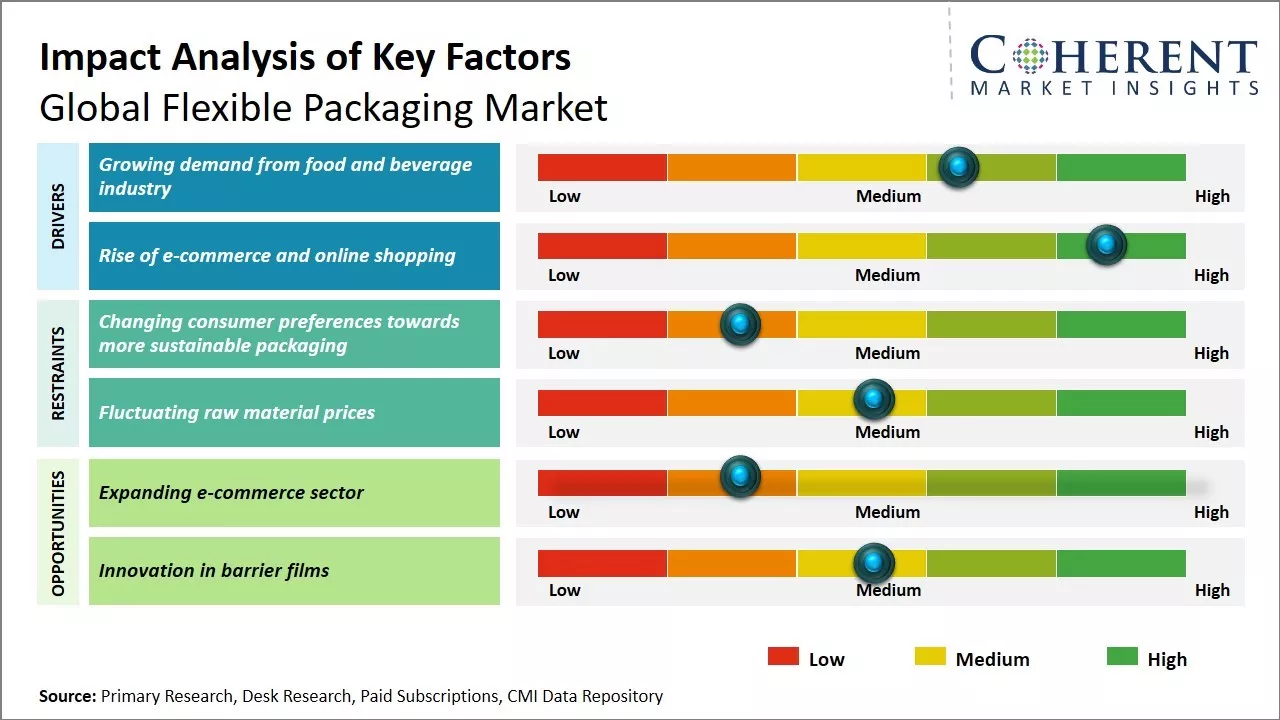
The increasing demand for flexible packaging from the food & beverage industry is the major factor driving the market growth. Flexible packaging provides advantages like durability, lightweight, and reusability. Moreover, flexible packaging produces less waste and uses fewer resources compared to rigid packaging. Rising environmental concerns are increasing the demand for flexible packaging as it is recyclable and produces less garbage. The growing e-commerce industry globally is another factor fueling the growth of the flexible packaging market. However, the availability of substitutes like molded fiber packaging and paper bags may hinder the market growth of flexible packaging.
Current Events and their Impact on the Flexible Packaging Market
Current Event | Description and its Impact |
Extended Producer Responsibility Regulatory Framework Implementation and Multi-Jurisdictional Compliance Architecture |
|
Sustainability Imperatives, Circular Economy Transition, and Material Innovation Acceleration |
|
Smart Packaging in Flexible Packaging Market
Smart packaging is transforming the flexible packaging market in 2025 by integrating intelligence, sustainability, and functionality to meet evolving consumer and industry demands.
In the flexible packaging sector, smart packaging refers to solutions that incorporate features like sensors, indicators, QR codes, and responsive materials to enhance product safety, traceability, and user engagement. These technologies are increasingly used in food, pharmaceuticals, and personal care products to monitor freshness, detect tampering, and provide real-time information to consumers. For instance, time-temperature indicators help ensure cold chain integrity, while interactive packaging with scannable codes offers transparency and brand storytelling.
The rise of e-commerce and regulatory pressures has accelerated the adoption of smart packaging, especially in flexible formats like pouches and films, which are lightweight and adaptable. Additionally, the push for sustainability has led to innovations in bio-based sensors and recyclable smart labels, aligning with circular economy goals. Brands are leveraging these advancements to reduce waste, improve supply chain efficiency, and enhance consumer trust.
As flexible packaging continues to dominate due to its convenience and cost-effectiveness, smart packaging is no longer a niche innovation but a strategic imperative. It bridges the gap between digital and physical experiences, making packaging not just a container, but a communicative and protective tool in the product lifecycle.
For instance, in October 2025, SmartSolve launched Purenil-0, the world’s first plastic-free, 100% bio-based, and flushable packaging substrate. Designed for zero-waste flexible packaging, Purenil-0 offers water-soluble and compostable properties, making it ideal for sustainable applications. This innovation marks a major step toward smart, eco-friendly packaging solutions that align with circular economy goals and consumer demand for green alternatives.
- Current Industry Events of 2026
- Market Size Estimation
- Regional Breakdown
- Competitive Landscape
- Customer Intelligence
- Segmental Analysis
- Pricing Analysis
- Key Market Drivers, Challenges & Future Trends
- Customized Insights Section
Segmental Insights
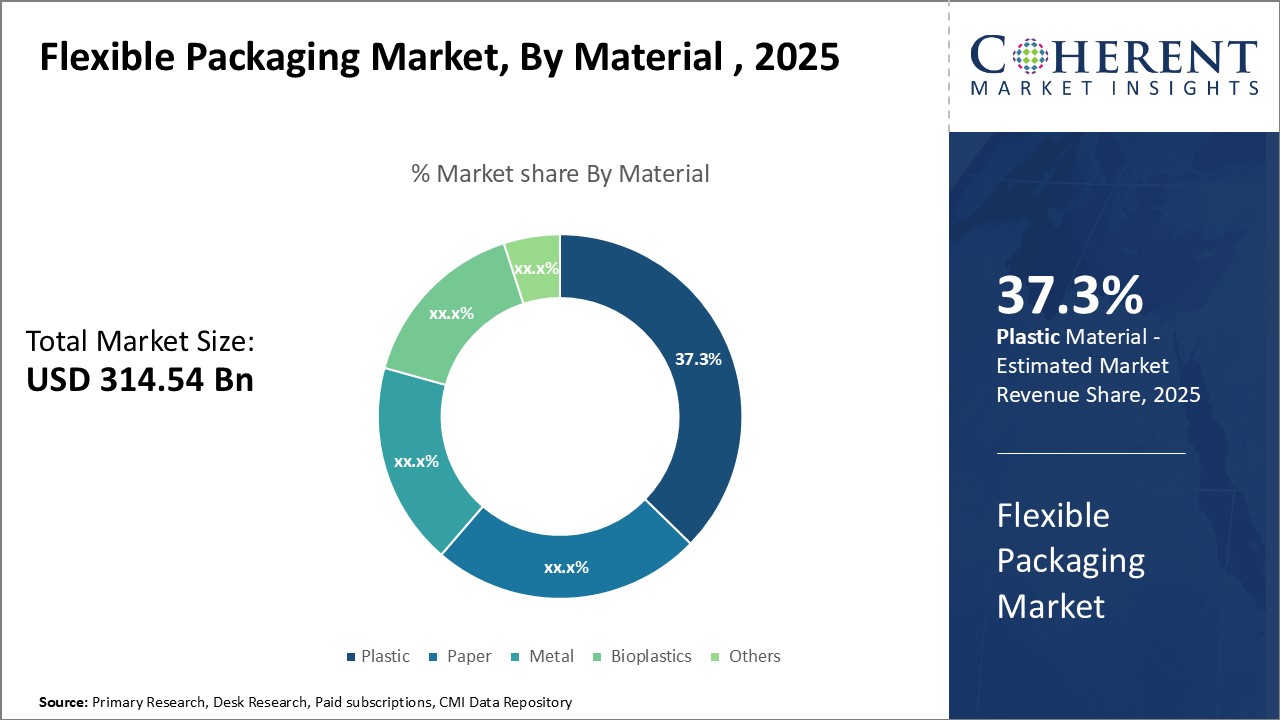
Flexible Packaging Market Insights, By Material: Plastic Dominates Due To Its Affordability, Versatility, And Broad Industrial Applicability
In terms of material, plastic contributes 38.3% of the market share in 2026 of the market owning to its affordability and variety of applications. Being a versatile material, plastic can be easily molded into various forms and shapes. This allows flexible plastic packaging to protect a wide range of products across industries.
From food and beverages to pharmaceuticals and personal care, plastic packaging fulfills the needs of numerous ends uses effectively. The affordability of plastic makes it an attractive solution for both manufacturers and consumers. Compared to other materials like paper and metal, plastic has a lower raw material and production cost. This cost-efficiency enables companies to package their goods at reasonable prices without major impact on profit margins.
Lower packaging costs are eventually passed on to consumers in the form of affordable prices. Affordability facilitates greater product accessibility, growing plastic's applicability. Plastic materials like polyethylene (PE), polypropylene (PP), and polyethylene terephthalate (PET) offer advantages like durability, printability, and moisture resistance. Their barrier properties protect the products from external factors like humidity and contamination.
Plastic resins also give packaging designers creative freedom to develop custom container shapes, sizes, and graphics as per brand needs. This drives brand differentiation and marketing on shelves. The development of bio-plastic variants has further augmented plastic's versatility. Bio-plastics derived from renewable plant-based sources bring the same functionality with lower eco-footprint. Their biodegradability addresses sustainability concerns regarding plastic waste. Such innovations will aid plastic's continued dominance in the packaging spectrum.
For instance, in September 2025, TIPA unveiled a breakthrough in compostable packaging, introducing a transparent laminate that mimics conventional plastic while remaining fully compostable. This innovation enables high-performance, eco-friendly flexible packaging for food and fashion applications, aligning with global sustainability goals and regulatory shifts. The development marks a significant step toward replacing petroleum-based films with biodegradable alternatives.
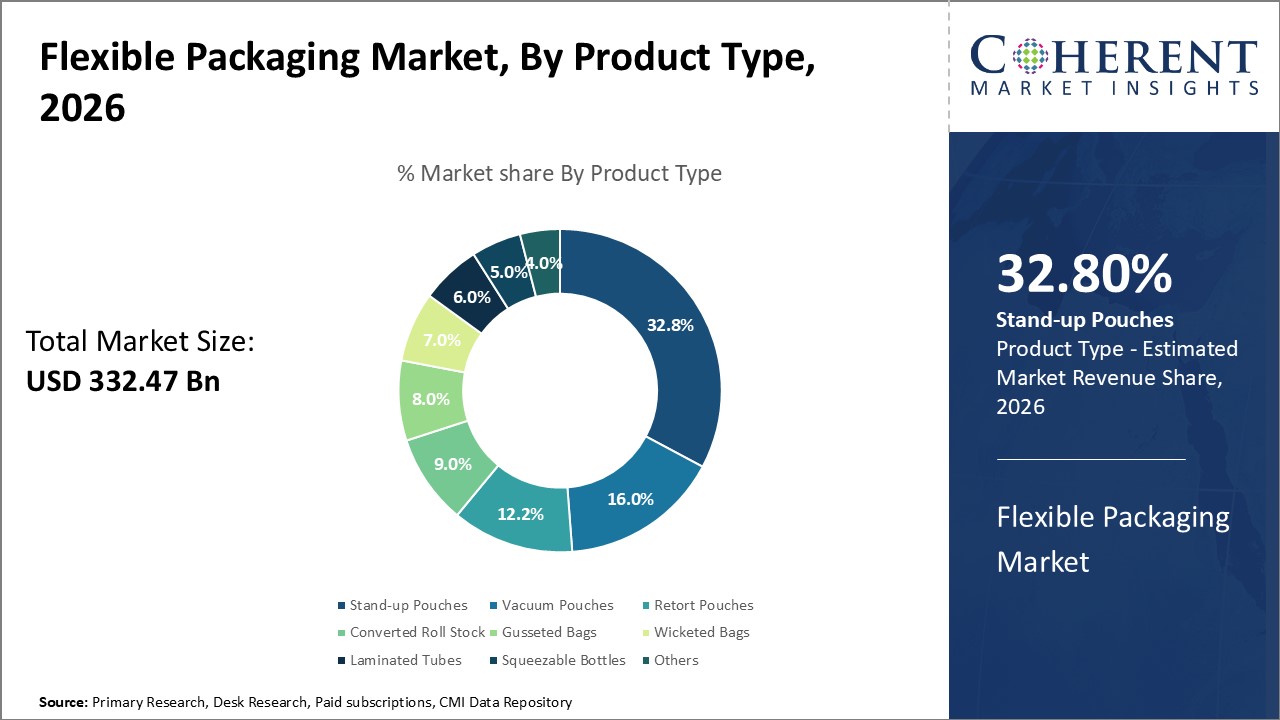
Flexible Packaging Market Insights, By Product Type: Stand-Up Pouches Lead Is Driven by Space Efficiency, Cost Savings, And Strong Shelf Appeal
In terms of product type, stand-up pouches segment contributes 32.8% of the market share in 2026. Stand-up pouches maximize space utilization due to their three-dimensional shape. More product can be packed in lesser space, improving load per truck or shipping container. This directly cuts transportation and logistics costs. Being self-standing, stand-up pouches do not require extra packaging material like boxes. Their peel-open feature provides easy access to contents without additional utensils like boxes. This enhances consumer convenience during use.
Stand-up pouches are ideally suited for powders, liquids and snacks which are accessed regularly. From a manufacturing point of view, stand-up pouches require less raw material compared to rigid alternatives. Their use of laminated web rolls and form-fill-seal technology makes production highly automated with better speeds. This reduces per piece costs. Stand-up pouches are recyclable and optionally come with re-sealable zippers or pouring fits depending on product needs.
Brands recognize the shelf-popping visibility provided by stand-up pouches due to their upright showcase format. Vibrant graphics and customer messaging can be leveraged for strong on-shelf appeal and impulse buying. Top brands across food, pet care, and other segments are switching to stand-up pouches for their competitive edge in busy retail aisles.
For instance, in February 2025, Mondi and Proquimia launched paper-based stand-up pouches for dishwashing tablets, replacing traditional plastic packaging with recyclable fiber-based alternatives. The innovation supports sustainability goals while maintaining product protection and shelf appeal. This marks a significant advancement in eco-friendly flexible packaging for home care products, aligning with growing consumer demand and regulatory pressure for recyclable materials.
Flexible Packaging Market Insights, By Application: Food & Beverage Is Driven by Diverse, Evolving Packaging Needs and Lifestyle Shifts
In terms of application, the food & beverage segment contributes 38% share of the market in 2026 owing to extensive packaging needs. As lifestyles evolve with changing consumer demands, the packaging format preferences are also undergoing rapid change. Flexible pouches and bags fit the bill perfectly. From snacks to frozen meals and pet food, flexible packaging variations like stand-up pouches, spiral wound bags, and flow-wraps pack diversity. Their barrier properties protect contents across the fresh, frozen, and perishable categories.
Beverage manufacturers leverage flexible packs for point-of-sale shipment and store displays. Pouches and aseptic bags enable the transport of liquids while occupying less space than glass or rigid containers. Shelf-stable formats keep products fresh. Customizable bag-in-box solutions benefit food service players. Flexible laminates and coextrusions meet regulatory standards for direct food contact.
Rising health-consciousness is shifting diets towards portable packaged products with transparent labeling. Flexible pouches cater to this lifestyle need through functional attributes like re-closability, dip-spoon inserts, and dispensing nozzles. Their applications in nutraceuticals, vitamins, and meal replacement supplements also see strong growth.
The growing frozen food segment looks up to flexible laminates barrier properties against moisture, oxygen, and light. This helps extend the shelf-life of ready-to-cook meals, vegetables, and snacks without refrigerator needed at point-of-sale or consumption. Given the diverse packaging demand, the food and beverage industry will continue powering the flexible packaging market.
For instance, in June 2025, UFlex Ltd launched a single-pellet rPET solution for food and beverage packaging, streamlining production of sustainable flexible packaging. The innovation combines recycled content with food-grade compliance, reducing complexity for converters and supporting circular economy goals. This marks a significant step toward scalable, eco-friendly packaging in high-volume consumer segments.
Regional Insights
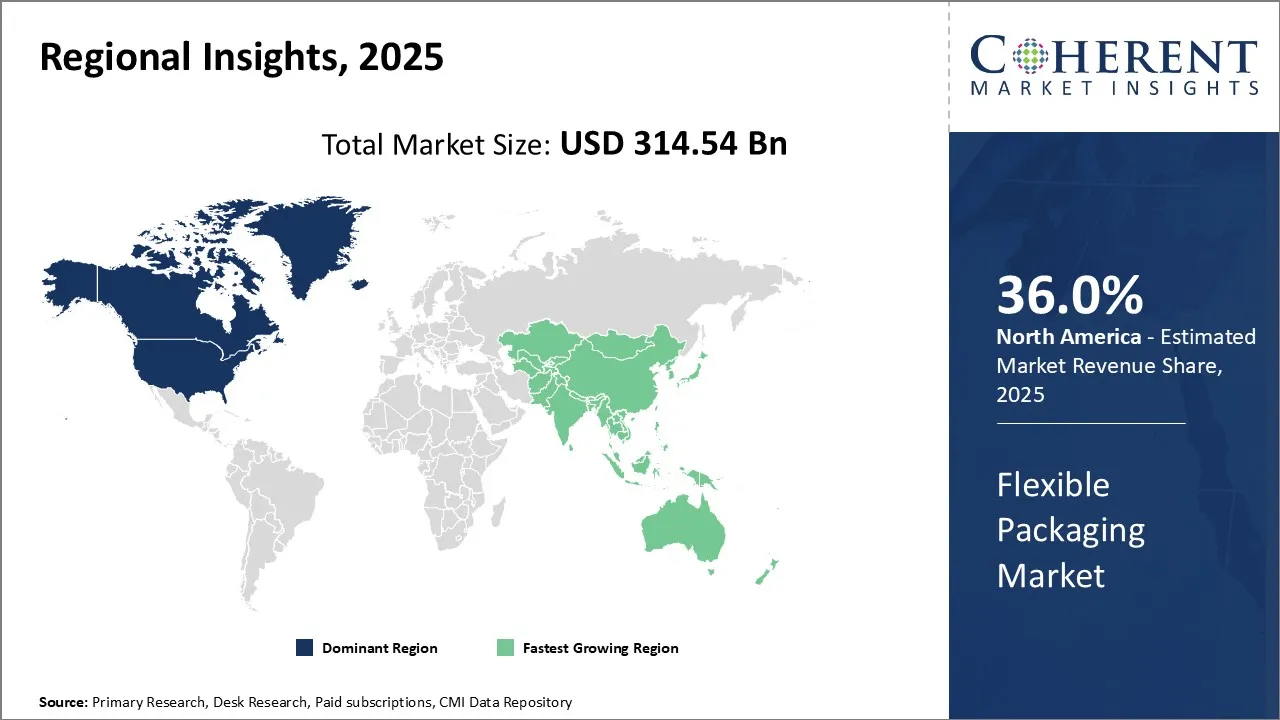
North America Flexible Packaging Market Analysis & Trends
North America remains the leading region in the global flexible packaging market with 36.0% of the market share in 2026, driven by strong demand from various end-use industries such as food and beverages, pharmaceuticals, personal care, and cosmetics. The flexible packaging industry has a significant presence in the U.S. owing to well-established manufacturing facilities of major players and availability of cutting-edge technologies. Additionally, growing consumption of packaged and processed food have accelerated the uptake of flexible plastic films and pouches in the food industry. Moreover, the U.S. is a leading exporter of flexible packages to other countries due to stringent waste management regulations, which mandate the use of lightweight and recyclable packaging materials.
For instance, in August 2026, ProAmpac commercialized a high-performance recyclable packaging solution for chunk cheese, expanding its ProActive Recyclable® portfolio. Designed for food safety and shelf life, the mono-material polyethylene structure offers moisture and oxygen barriers while supporting sustainability goals. This innovation enhances flexible packaging options for dairy products, aligning with growing demand for recyclable food-grade materials in the U.S. market.
Asia Pacific Flexible Packaging Market Analysis & Trends
Asia Pacific has emerged as the fastest growing regional market for flexible packaging over the past few years. Rapid industrialization and rising disposable incomes have augmented the demand for packaged goods across nations such as India and China. The expanding middle-class population is inclined toward packaged foods and beverages, which has spurred flexible packaging consumption. Domestic manufacturers are continuously enhancing their production capabilities through the acquisition of new machinery and equipment. Local players are engaged in import substitution to establish a robust supply chain within the region. In addition, the growing import and export of goods within Asia Pacific and from other regions has augmented the demand for flexible packages used in industrial packaging. Emerging economies offer attractive growth opportunities to flexible packaging companies given their aggressive market expansion strategies.
For instance, in September 2026, Borouge, Siegwerk, and TPN Food Packaging launched a fully recyclable mono-material packaging solution for food applications. Combining Borouge’s polyethylene with Siegwerk’s recyclable inks and coatings, the innovation supports circular economy goals and enhances sustainability in flexible packaging. This collaboration marks a significant step toward scalable, eco-friendly packaging in the food industry.
Flexible Packaging Market Outlook Country-Wise
Flexible Packaging Market Trends
The U.S. flexible packaging market is booming in 2026 due to rising e-commerce, demand for lightweight and sustainable materials, and regulatory pressure for recyclable solutions. Innovations in bioplastics and mono-materials, coupled with consumer preference for convenience and eco-friendly packaging, are driving growth across food, beverage, and personal care sectors.
For instance, in August 2026, A coalition of major U.S. brands launched the Flexible Film Initiative to advance recycling of post-consumer flexible packaging. Led by Nestlé, PepsiCo, Mars, and others, the non-profit aims to build a scalable, circular system through demonstration projects and policy development. The initiative addresses sustainability challenges in food and consumer goods packaging.
China Flexible Packaging Market Trends
China’s flexible packaging market is growing in 2026 due to rising demand for convenient, lightweight, and sustainable packaging across food, beverage, and pharmaceutical sectors. Urbanization, e-commerce expansion, and government regulations promoting recyclable materials are driving innovation in mono-materials, compostables, and barrier films, making flexible formats increasingly preferred by manufacturers and consumers alike.
For instance, in October 2026, Henkel launched Recyclab in China, a pioneering initiative to create a sustainable packaging ecosystem. Focused on recyclable solutions, Recyclab promotes innovation in mono-materials and eco-friendly adhesives for flexible packaging. The program supports circular economy goals and aligns with China’s push for greener consumer goods packaging across food, personal care, and household sectors.
Market Report Scope
Flexible Packaging Market Report Coverage
| Report Coverage | Details | ||
|---|---|---|---|
| Base Year: | 2025 | Market Size in 2026: | USD 332.47 Bn |
| Historical Data for: | 2020 To 2024 | Forecast Period: | 2026 To 2033 |
| Forecast Period 2026 to 2033 CAGR: | 5.7% | 2033 Value Projection: | USD 490.09 Bn |
| Geographies covered: |
| ||
| Segments covered: |
| ||
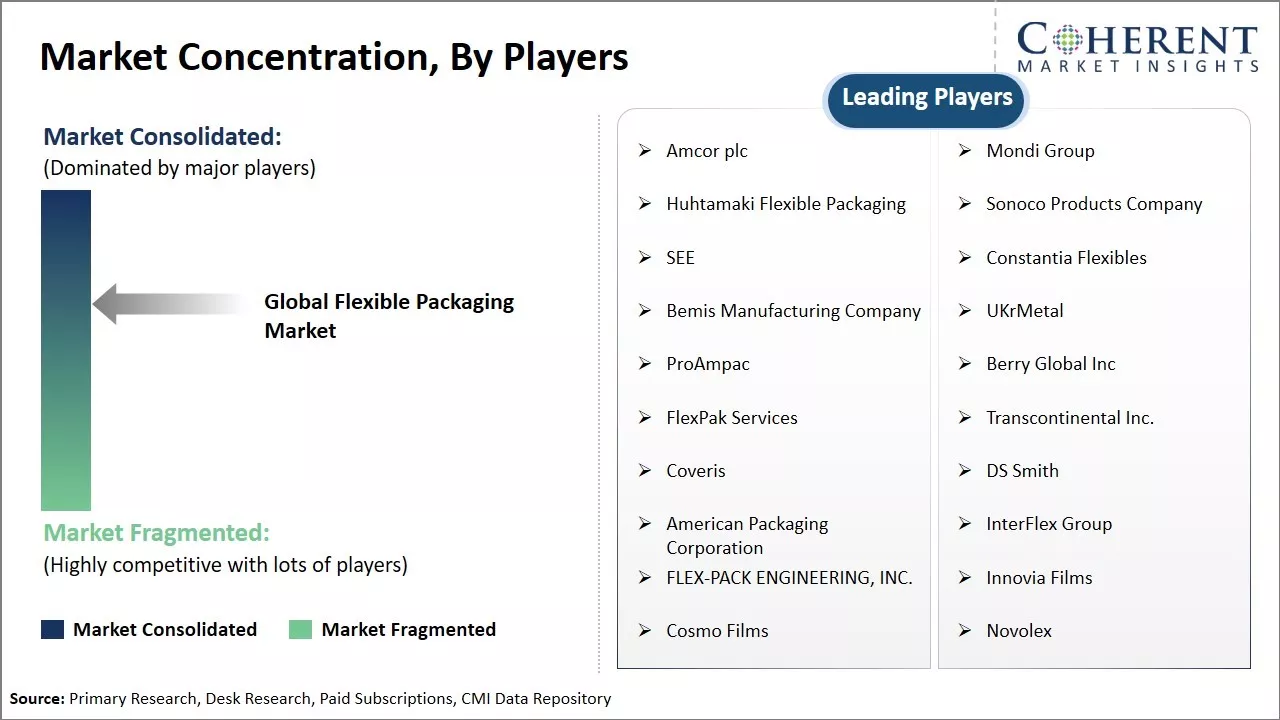
| Companies covered: | Amcor plc, Mondi Group, Huhtamaki Flexible Packaging, Sonoco Products Company, SEE, Constantia Flexibles, Bemis Manufacturing Company, UKrMetal, ProAmpac, Berry Global Inc, FlexPak Services, Transcontinental Inc., Coveris, DS Smith, American Packaging Corporation, InterFlex Group, FLEX-PACK ENGINEERING, INC., Innovia Films, Cosmo Films, and Novolex | ||
| Growth Drivers: |
| ||
| Restraints & Challenges: |
| ||
Flexible Packaging Market Driver
Growing demand from the food and beverage industry
The food and beverage industry is increasingly adopting flexible packaging formats for their products. Flexible packaging is highly suitable for the food and beverage industry as it protects products from damage, provides longer shelf life, and enhances product appeal through colorful printing options. Flexible formats like stand-up pouches, shrink films, and wraps are lightweight, easy to transport, and use less material. They provide similar or better protection compared to rigid packaging formats. This makes flexible packaging an economical and sustainable solution for food manufacturers and retailers. Given the growing demand for packaged and ready-to-eat foods across regions, flexible packaging manufacturers are continuously innovating their product offerings to cater to the changing needs of food companies. Stand-up pouches are being introduced for various powdered mixes and snacks owing to their strong barrier properties and ability to stand independently on shelves. Retort packaging which can withstand high temperatures is gaining popularity for ready meals. Multilayer films are utilized for fresh meat, seafood, and bakery items to increase shelf life. Companies are also incorporating advanced digital printing on flexible films to replicate the designs of rigid jars and enhance the package appeal. Thus, evolving packaging needs as well as increased consumption of packaged foods and beverages is expected to drive significant demand for flexible packaging formats in the coming years.
Market Concentration and Competitive Landscape
Rise of e-commerce and online shopping
The proliferation of e-commerce and rise of online shopping platforms across the world has opened significant opportunities for the flexible packaging market. While rigid packaging remains suitable for durable goods, flexible packaging formats are highly preferable for shipping and delivering varied products through online channels. Flexible pouches, bags, and wraps provide effective protection to products during transportation while ensuring minimum shipping costs due to optimum space utilization and lightweight nature. Their sealing ability also prevents damage and product spillage compared to rigid containers. Flexible packaging manufacturers are thus developing formats and materials customized for secure delivery of apparel, cosmetics, stationery and other consumer goods via online shopping. Specialty mailing bags, vinyl woven bags, zipper pouches, and kraft paper wraps with reinforced edges are some innovations witnessed. Digital printing facilitated personalized designing of packaging according to merchant and delivery brand identity. Flexible packaging plays a pivotal role in enhancing the unboxing experience for online customers and building merchant credibility. Their sustainable credentials also align well with the green priorities of e-tailers and logistics companies.
Flexible Packaging Market Opportunities
Expanding e-commerce sector
The expanding e-commerce sector fuels the demand for effective packaging solutions for shipping products. Growth in industries like food and beverages, pharmaceuticals, and personal care drives the need for packaged goods. Flexible packaging offers advantages over rigid alternatives in terms of cost effectiveness and ability to extend product shelf life.
Analyst Opinion (Expert Opinion)
The flexible packaging market value is undergoing a structural shift driven by stringent recyclability regulations and material innovation. Regulatory frameworks such as the EU Packaging and Packaging Waste Regulation (PPWR), mandating 65% packaging recycling by 2030, are accelerating the move toward circular, mono-material solutions. Polyethylene and polypropylene-based mono-material pouches are gaining traction as they meet recycling requirements without compromising barrier strength or machinability. For instance, Amcor’s AmLite HeatFlex recyclable retort pouch demonstrates lifecycle carbon savings versus traditional multi-material formats.
Global consumer goods leaders like Nestlé and Unilever are enforcing supplier standards tied to recyclable formats and investing in recycling infrastructure, thereby creating a pull-effect across the supply chain. Plastic-based structures still dominate over 60% of flexible packaging, underscoring the urgency to redesign legacy formats for compliance and sustainability. Firms prioritizing recyclable mono-material films and integrated recycling partnerships are likely to capture long-term advantage, while laggards risk exclusion from major retail supply chains.
Ultimately, commercial success now depends on proving both performance and circularity. Companies integrating design innovation, recycling collaborations, and lifecycle cost transparency will secure stronger brand partnerships and regulatory alignment, defining the next competitive frontier of the global flexible packaging market.
Speak to the analyst
Want personalized insights?
Take the findings above to one of our principal consultants, or have the report rebuilt around the segments, geographies and competitors you actually track.
Flexible Packaging Industry News
- In September 2025, CelluForce unveiled a breakthrough barrier technology for flexible packaging using nanocrystalline cellulose (NCC). This renewable material enhances moisture and oxygen resistance, extending shelf life and improving product protection. Designed for food, cosmetics, and pharmaceuticals, the innovation supports sustainable packaging goals by replacing synthetic barriers with biodegradable alternatives, advancing eco-friendly solutions in the industry.
- In January 2024, Snickers introduced a novel product packaged in mono material flexible packaging. This initiative reflects its dedication to sustainability and its efforts to minimize their ecological footprint. Mono material packaging refers to packaging made from a single type of material, which simplifies the recycling process and enhances recyclability.
- In 2023, Pakka, a packaging company made a significant contribution to sustainable packaging in India by launching the country's first compostable flexible packaging. This innovative step showcases Pakka's commitment to environmental responsibility and its endeavor to address the growing concerns regarding plastic waste.
Market Segmentation
- Material Insights (Revenue, USD Bn & KT, 2026 - 2033)
- Plastic
- Paper
- Metal
- Bioplastics
- Others
- Product Type Insights (Revenue, USD Bn & KT, 2026 - 2033)
- Stand-up Pouches
- Vacuum Pouches
- Retort Pouches
- Converted Roll Stock
- Gusseted Bags
- Wicketed Bags
- Laminated Tubes
- Squeezable Bottles
- Others
- Application Insights (Revenue, USD Bn & KT, 2026 - 2033)
- Food & Beverage
- Pharmaceutical
- Cosmetics
- Others
- Regional Insights (Revenue, USD Bn & KT, 2026 - 2033)
- North America
- U.S.
- Canada
- Latin America
- Brazil
- Argentina
- Mexico
- Rest of Latin America
- Europe
- Germany
- U.K.
- Spain
- France
- Italy
- Russia
- Rest of Europe
- Asia Pacific
- China
- India
- Japan
- Australia
- South Korea
- ASEAN
- Rest of Asia Pacific
- Middle East & Africa
- GCC Countries
- Israel
- Rest of Middle East & Africa
- Key Players Insights (Revenue, USD Bn, 2021 - 2033)
- Amcor plc
- Mondi Group
- Huhtamaki Flexible Packaging
- Sonoco Products Company
- SEE
- Constantia Flexibles
- Bemis Manufacturing Company
- UKrMetal
- ProAmpac
- Berry Global Inc
- FlexPak Services
- Transcontinental Inc.
- Coveris
- DS Smith
- American Packaging Corporation
- InterFlex Group
- FLEX-PACK ENGINEERING, INC.
- Innovia Films
- Cosmo Films
- Novolex
Sources
Primary Research Interviews from the following stakeholders
Stakeholders
- Interviews with packaging converters, film manufacturers, resin suppliers, printing and lamination equipment providers, FMCG brand packaging heads, and sustainability officers across major regional markets.
Specific stakeholders
- Packaging innovation and R&D heads at leading FMCG and food companies (e.g., Nestlé, Unilever, PepsiCo, Mondelez)
- Sourcing and procurement managers at pharmaceutical and healthcare firms (e.g., Pfizer, GSK, Dr. Reddy’s)
- Operations and production managers at flexible packaging converters and film extrusion companies (e.g., Amcor, Uflex, Berry Global)
- Sustainability and circular economy lead at packaging associations and brand-owner alliances (e.g., Ellen MacArthur Foundation, Alliance to End Plastic Waste)
- Print technology engineers and lamination process specialists at equipment manufacturers (e.g., Bobst, Windmöller & Hölscher)
- Procurement and innovation officers from e-commerce and retail companies focusing on sustainable packaging solutions (e.g., Amazon, Walmart, Flipkart)
- Procurement and quality control teams in the food processing, beverage, and dairy sectors (e.g., Danone, Coca-Cola, Arla Foods)
Databases
- United Nations Comtrade Database
- World Trade Organization (WTO) Trade Statistics
- Eurostat – Packaging Waste and Material Flow Database
- U.S. Census Bureau – Packaging and Plastics Product Data
- China Customs Statistics
- Directorate General of Commercial Intelligence and Statistics (DGCIS), India
- Japan External Trade Organization (JETRO)
- Korea Customs Service Data Portal
- Food and Drug Administration (FDA) – Packaging and Food Contact Materials Section
- Indian Ministry of Commerce & Industry – Plastic and Packaging Export Data
- Environment Agency (UK) – Packaging Recovery and Recycling Data
Magazines
- Packaging World
- FlexPack Voice
- Plastics Today
- Flexible Packaging Magazine
- Packaging Europe
- Food & Beverage Packaging
- PrintWeek (Packaging Section)
- Packaging News
- Converters Expo Insights
- Recycling International (Packaging Section)
Journals
- Journal of Applied Polymer Science
- Polymer Testing (Elsevier)
- Packaging Technology and Science (Wiley)
- Journal of Cleaner Production
- Resources, Conservation & Recycling (Elsevier)
- International Journal of Life Cycle Assessment
- Journal of Food Engineering (Packaging Section)
- Progress in Organic Coatings (Barrier and Lamination Materials Section)
Newspapers
- The Wall Street Journal – Manufacturing & Consumer Goods
- The Economic Times – Industry & Plastics Packaging
- Business Standard – Chemicals & Packaging
- Financial Times – Sustainability & Supply Chain Reports
- Nikkei Asia – Materials & Packaging Value Chain
- The Hindu Business Line – Manufacturing & Packaging
- South China Morning Post – Plastics and Packaging Industry
- The Guardian – Environment and Circular Packaging
Associations
- Flexible Packaging Association (FPA)
- Plastics Industry Association (PLASTICS)
- European Flexible Packaging Association (Flexible Packaging Europe – FPE)
- Indian Flexible Packaging & Folding Carton Manufacturers Association (IFCA)
- Sustainable Packaging Coalition (SPC)
- American Institute for Packaging and the Environment (AMERIPEN)
- Packaging Industry Association of India (PIAI)
- British Plastics Federation (BPF) – Packaging Group
- European Bioplastics Association (EUBP)
- All India Plastics Manufacturers’ Association (AIPMA)
- National Association for PET Container Resources (NAPCOR)
Public Domain Sources
- Ministry of Environment, Forest and Climate Change (MoEFCC), India – Plastic Waste Rules
- U.S. Environmental Protection Agency (EPA) – Sustainable Materials Management Reports
- European Environment Agency (EEA) – Packaging Waste Statistics
- Ministry of Economy, Trade and Industry (METI), Japan – Plastic Recycling Policy Data
- Organisation for Economic Co-operation and Development (OECD) – Packaging Circularity Reports
- Central Pollution Control Board (CPCB), India – Extended Producer Responsibility (EPR) Data
- European Commission – Packaging and Packaging Waste Directive Reports
- United Nations Environment Programme (UNEP) – Global Plastics and Packaging Reports
- Reserve Bank of India (RBI) – Industrial Output & Chemical Sector Reports
- Department for Promotion of Industry and Internal Trade (DPIIT), India – Packaging Sector Initiatives
Proprietary Elements
- CMI Data Analytics Tool
- Proprietary CMI Existing Repository of information for last 8 years
Get access to 250+ pages report
Every segment, forecast, competitor profile and data table behind the analysis above — available for instant download.
- ESOMAR Member
- ISO 9001:2015 Certified
- D-U-N-S Registered
- GDPR & CCPA Compliant
Missing comfort of reading report in your local language? Find your preferred language:
Transform your Strategy with Exclusive Trending Reports
Frequently Asked Questions
The Flexible Packaging Market is estimated to be valued at USD 332.47 Bn in 2026, and is expected to reach USD 490.09 Bn by 2033.
The CAGR of the Flexible Packaging Market is projected to be 5.7% from 2026 to 2033.
Growing demand from food and beverage industry and rise of e-commerce and online shopping are the major factors driving the growth of the global flexible packaging market.
Changing consumer preferences towards more sustainable packaging and fluctuating raw material prices are the major factors hampering the growth of the global flexible packaging market.
In terms of material, plastic is estimated to dominate the market revenue share in 2026.
Amcor plc, Mondi Group, Huhtamaki Flexible Packaging, Sonoco Products Company, SEE, Constantia Flexibles, Bemis Manufacturing Company, UKrMetal, ProAmpac, Berry Global Inc, FlexPak Services, Transcontinental Inc., Coveris, DS Smith, American Packaging Corporation, InterFlex Group, FLEX-PACK ENGINEERING, INC., Innovia Films, Cosmo Films, and Novolex are the major players.
North America is expected to lead the global flexible packaging market.