

Textile and Apparel Market Analysis & Forecast: 2026-2033
Global textile and apparel market is estimated to be valued at USD 2,358,190.0 Mn in 2026 and is expected to reach USD 3,107,397.0 Mn by 2033, exhibiting a compound annual growth rate (CAGR) of 4.2% from 2026 to 2033.
Key Takeaways
- Based on Material Type, Synthetic fibres dominated the market with 68.9% share, owing to durability, cost-effectiveness, and versatility across clothing, technical textiles, and industrial fabrics.
- Based on Application, the Clothing Textiles segment led the market with a 43.7% share in 2026, supported by rising demand for ready-to-wear garments, fashion apparel, and functional clothing.
- Based on Distribution Channel, offline sales are expected to dominate the market in 2026, primarily driven by strong consumer preference for in-store product experience, immediate product availability, and the wide presence of supermarkets, hypermarkets, and brand outlets.
- Based on Region, Asia Pacific is expected to dominate with a 38.9% share in 2026, driven by strong domestic consumption, export demand, and government initiatives like MITRA and PLI in India, whereas North America held 20.8% share, supported by demand for premium apparel and technical textiles.
Market Overview
The textile and apparel market is witnessing strong growth, driven by rising demand for ready-to-wear garments, sustainable fashion, and functional clothing. Expanding applications in technical textiles, industrial fabrics, and home textiles are fuelling market adoption. North America holds a notable share due to premium apparel demand, while Asia Pacific leads with strong domestic consumption, export opportunities, and supportive government initiatives. Innovations in sustainable fibres, e-commerce channels, and infrastructure development are expected to further propel global market growth.
Current Events and Its Impact on textile and apparel market
Current Events | Description and its impact |
Sustainable & Eco-Friendly Textile Production |
|
AI-Driven Process Optimization in Textile Manufacturing |
|
Rising Demand for Technical & Functional Apparel |
|
Import-Export Analysis of Textile and apparel
Asia-Pacific remains the significant exporter in the global textile and apparel industry. In 2024, Bangladesh's garment exports reached $50 billion, marking an 8.3% increase, positioning it as a major exporter of ready-made garments. Vietnam’s garment and textile exports totaled $24.4 billion with a notable 8.1% year-on-year increase. Meanwhile, India’s exports during April–October FY 2024–25 amounted to $21.36 billion, growing by 7%, with ready-made garments (RMG) making up 41% of that total.
India’s imports for the same period stood at $5.425 billion, down 1%, with man-made textiles accounting for 34%. The region’s trade is fuelled by robust demand from markets like North America and Europe, while evolving trade dynamics, e-commerce growth, and shifting supply chain strategies continue to reshape the landscape.
- Current Industry Events of 2026
- Market Size Estimation
- Regional Breakdown
- Competitive Landscape
- Customer Intelligence
- Segmental Analysis
- Pricing Analysis
- Key Market Drivers, Challenges & Future Trends
- Customized Insights Section
Segmental Insights
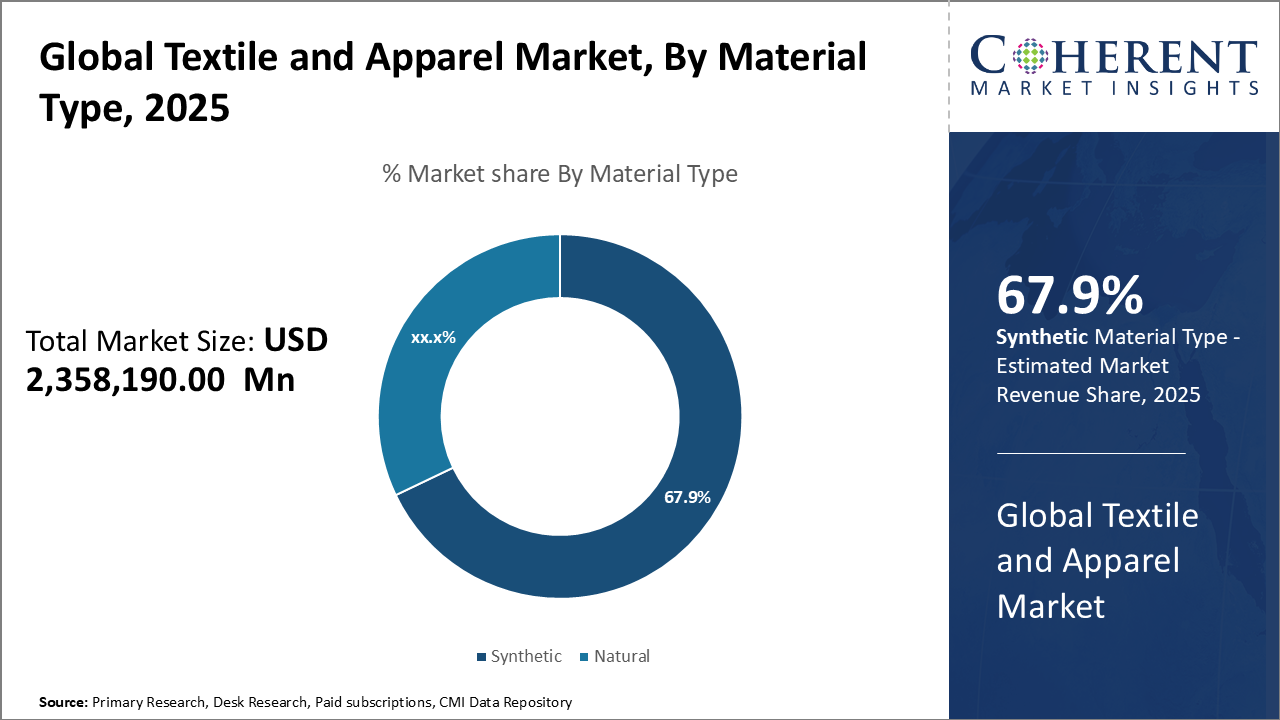
Textile and Apparel Market, by Material Type: Synthetic Fibres Dominate Owing to Durability, Cost-Effectiveness, and Versatility.
By material type, synthetic fibres held the largest share of 68.9% in 2026, driven by polyester, nylon, and blended fibres. These materials are widely used across clothing, technical textiles, and industrial fabrics due to their high durability, low maintenance, and cost-efficiency. Synthetic fibres are increasingly adopted in active wear, sportswear, and protective clothing, reflecting the growing preference for functional and performance-driven apparel. In May 2026, Indorama Ventures expanded its deja portfolio to include PET fibres and filament yarns made solely from discarded textile waste and lower carbon bio-fibres. The new products were first presented at the Textiles Recycling Expo in Brussels, highlighting the company's efforts to boost sustainability in the textile industry.
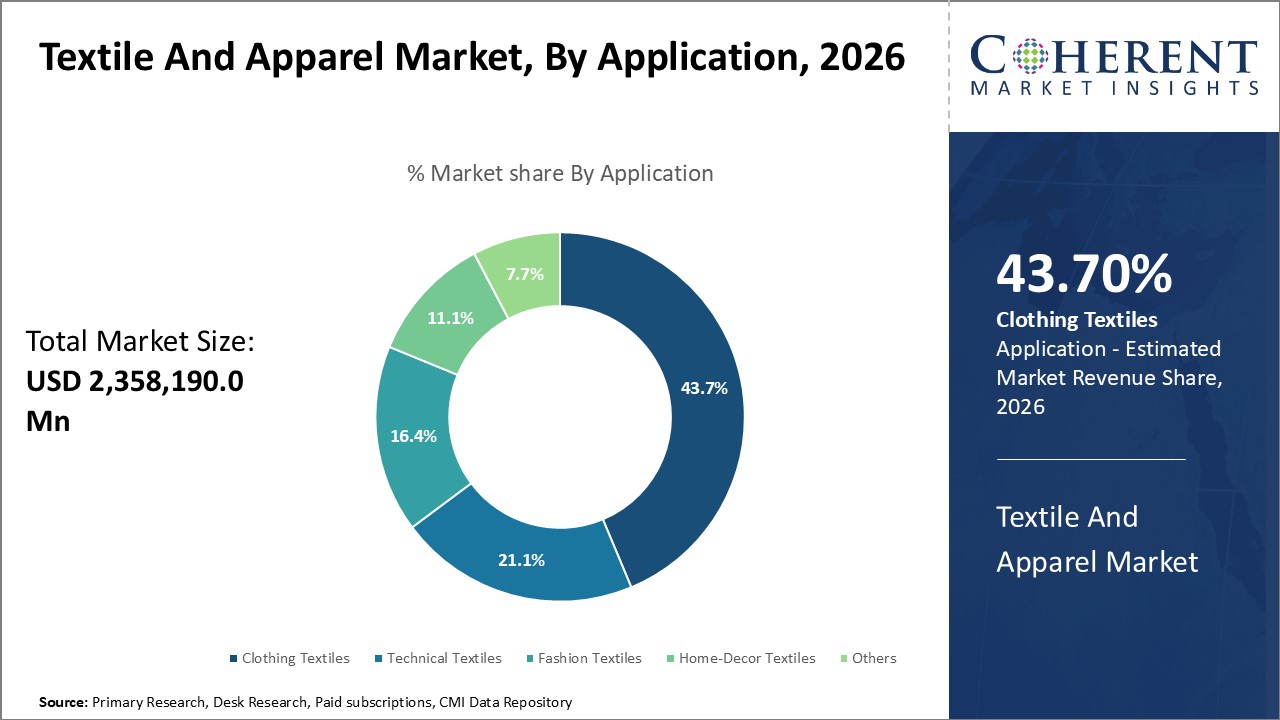
Textile and Apparel Market, by Application: Clothing Textiles Lead Market, Supported by Rising Demand for Fashion and Functional Apparel.
By application, the clothing textiles segment dominated with a 43.7% share in 2026, fuelled by demand for ready-to-wear garments, fashion apparel, and functional clothing such as sports and protective wear. Growth is driven by urbanization, changing consumer lifestyles, and increasing disposable income, particularly in emerging economies. The segment benefits from both domestic consumption and export demand, reinforcing its position as the key driver of the textile and apparel market.
In January 2026, Lenzing Group expanded its LENZING Lyocell Fill portfolio within the TENCEL™ family, introduced a finer fibre variant tailored for filling applications in home textiles and apparel. These fibres offer improved thermal comfort, moisture control, and form-keeping properties, while being produced with comparably lower greenhouse gas emissions, providing an alternative to fossil-based materials.
Textile and Apparel Market, by Distribution Channel: Offline Sales Dominate Owing to Strong Consumer Preference for In-store Experience.
Based on distribution channel, the offline sales segment is expected to dominate the market in 2026, driven by consumers’ preference for physical product experience, immediate product availability, and personalized customer service. Supermarkets, hypermarkets, brand outlets, and department stores remain key retail formats that provide wide product accessibility and brand visibility. The offline segment continues to benefit from established retail infrastructure and consumer trust, particularly in emerging markets where traditional retail channels hold strong influence.
In May 2025, Canada Goose introduced VIP lounges across select global stores, featuring curated displays, Canadian art, and immersive cold rooms to enhance the in-store shopping experience. The luxury apparel brand reported a 7% rise in quarterly revenue to approximately $385 million, with direct-to-consumer sales climbing nearly 16%. Executives emphasized that longer in-store browsing times are directly linked to higher conversion rates.
Regional Insights
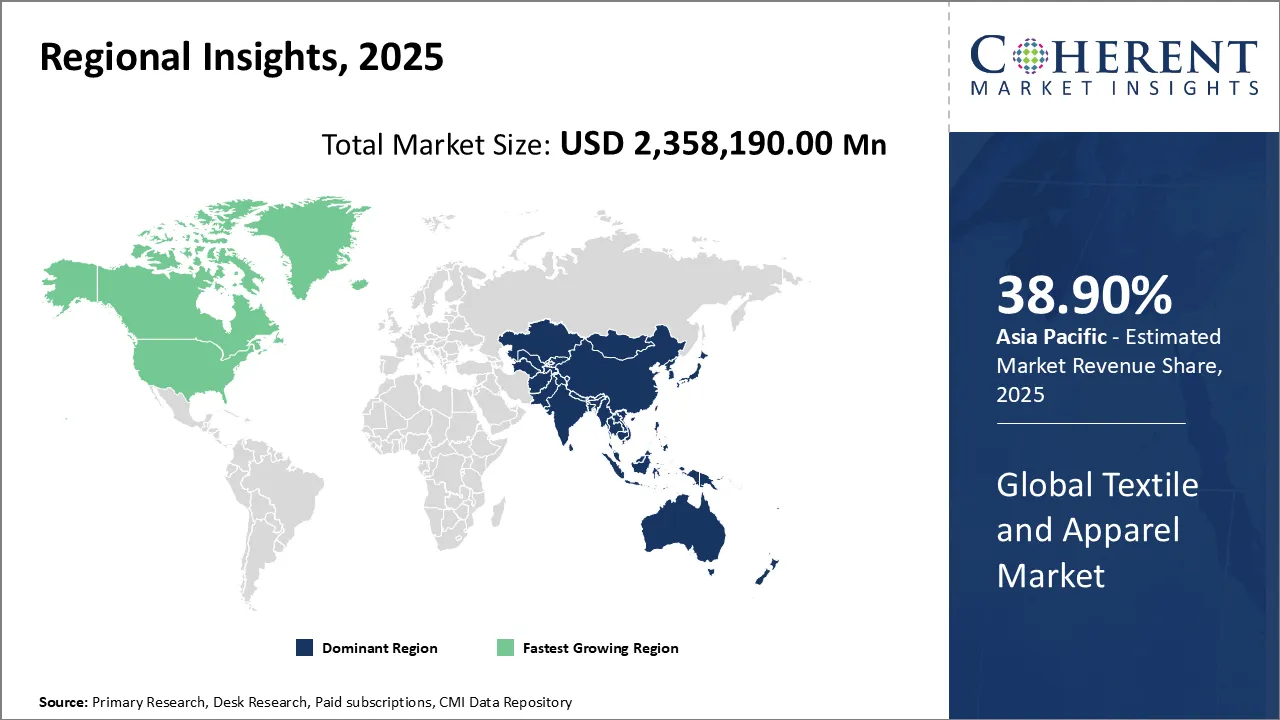
Asia Pacific Textile and Apparel Market Trends
Asia Pacific is expected to dominate the global textile and apparel market, accounting for 38.9% share in 2026. Regional growth is supported by strong domestic consumption, large-scale export demand, and favourable government initiatives such as India’s MITRA and PLI schemes, which are driving innovation and manufacturing competitiveness. China continues to lead with extensive textile production capacity, advanced manufacturing technologies, and strong global export performance. India, Japan, and Southeast Asian countries are witnessing robust expansion in technical textiles, sportswear, and sustainable apparel. Rising disposable income, urbanization, and the rapid growth of e-commerce channels further reinforce Asia Pacific’s position as the fastest-growing and largest regional contributor to the textile and apparel market.
In August 2026, India temporarily removed the 11% import duty on cotton from August 19 to September 30, aiming to alleviate challenges faced by its garment industry amid increased U.S. tariffs on garment exports . This move is expected to stabilize domestic cotton prices and enhance the competitiveness of Indian textiles in global markets.
North America Textile and Apparel Market Trends
North America accounted for 20.8% of the global textile and apparel market in 2026, with the United States driving regional demand. Growth is underpinned by strong consumer purchasing power, advanced retail and distribution infrastructure, and rising demand for premium apparel and technical textiles. The U.S. leads with innovations in sustainable, performance-oriented, and smart textiles, while Canada is witnessing increasing adoption in home décor, active wear, and sports textiles. High investment in sustainable fashion, coupled with a focus on advanced textile applications, creates significant opportunities for continued regional expansion. In February 2026, Ralph Lauren raised its annual revenue forecast, driven by strong demand from younger shoppers for its spring collection, including dresses, floral dinner jackets, and Polo shirts, boosting its shares by 15%. The company’s investments in brands like Polo and Purple Label attracted high-spending younger consumers in North America .
Textile and Apparel Market Dominating Countries
United States Textile and Apparel Market Analysis and Trend
The United States holds a leading position in the North American textile and apparel market, supported by strong consumer purchasing power, advanced retail and distribution infrastructure, and robust demand for premium and technical textiles. The country leads in sustainable, performance-oriented, and smart textiles, reflecting growing focus on eco-friendly fabrics, innovation, and high-performance applications. Backed by technological advancements, R&D, and strong industry participation, the U.S. continues to shape regional and global textile and apparel trends. In August 2026, Gildan Activewear announced plans to acquire Hanesbrands for $2.2 billion, aiming to strengthen its position in the basic apparel market. The merger is expected to close by late 2026 or early 2026 and could yield over $200 million in cost synergies within three years.
India Textile and Apparel Market Analysis and Trend
India is emerging as a key market in the Asia Pacific textile and apparel sector, driven by rapid urbanization, infrastructure expansion, and growth in technical, sports, and sustainable textiles. Favourable government policies, such as Make in India and production-linked incentive (PLI) schemes, coupled with rising domestic consumption and expanding e-commerce channels, are accelerating market adoption. Increasing demand for cost-effective, high-quality, and eco-friendly fabrics positions India as one of the fastest-growing contributors to the global textile and apparel market. In September 2026, Uttar Pradesh announced to host the third Uttar Pradesh International Trade Show (UPITS-2026) in Greater Noida from September 25 to 29, where over 500 international buyers from nearly 80 countries are expected to attend. Organized by the state government, the event will feature products from 17 sectors, including agriculture, textiles, handicrafts, leather, and IT. The showcase aims to provide a global platform for "Made in UP" brands and strengthen exports.
Market Report Scope
Textile and Apparel Market Report Coverage
| Report Coverage | Details | ||
|---|---|---|---|
| Base Year: | 2025 | Market Size in 2026: | USD 2,358,190.0 Mn |
| Historical Data for: | 2020 To 2024 | Forecast Period: | 2026 To 2033 |
| Forecast Period 2026 to 2033 CAGR: | 4.2% | 2033 Value Projection: | USD 3,107,397.0 Mn |
| Geographies covered: |
| ||
| Segments covered: |
| ||
| Companies covered: | Albany International Corp, BSL Ltd., CTA Apparels, Hanesbrands Inc., Himatsingka Seide | ||
| Growth Drivers: |
| ||
| Restraints & Challenges: |
| ||
Market Dynamics
Textile and Apparel Market: Growth Drivers
- Higher Urbanization and Onset of the Mobile-First Consumer
Higher urbanization globally has hastened the emergence of a mobile-first consumer behaviour and attitude. With an increased number of individuals residing in densely populated urban areas, on-the-go lifestyles are now the norm. Fast-paced cities translate to customers now depending on their smart devices not only for day-to-day communications but also for all their needs, ranging from shopping, payment, and so much more. This paradigm change to a mobile-first strategy has hugely transformed the textile and apparel sector.
Historically famous for its physical stores, archaic inventory management, and reluctance to embrace technology, the industry is now undergoing a digital revolution at a fast clip, driven by changing consumer tastes and behaviours. The whole shopping and buying experience is now smartphone-optimized with features such as virtual and augmented reality to virtually try the outfits, mobile payment, and even doorstep delivery to consumers on the move.
Key Developments
- In August 2025, Guess Inc. announced plans to go private through a $1.4 billion deal, involving its co-founders Maurice and Paul Marciano, CEO Carlos Alberini, and Reebok-owner Authentic Brands. The transaction includes the acquisition of 51% of Guess’ intellectual property by Authentic Brands, while existing shareholders retain the remaining ownership. The move aims to strengthen the company’s strategic positioning in the designer apparel market and facilitate long-term growth initiatives.
- In August 2025, Albany International Corp. completed the acquisition of Heimbach Group for €132 million in cash, along with an assumed net debt of €22 million. Based in Düren, Germany, Heimbach supplies paper machine clothing and high-tech textiles to various industries.
- In August 2025, OETI partnered with Austrian designer Julia Deiger, founder of the sustainable label DeLin, to launch the INSPECTED QUALITY “Regionally Produced” label under the EU-funded TEX-DAN project. The certification highlights fully Austria-based production using natural, durable materials, backed by OETI’s independent verification and transparent guidelines. The initiative aims to promote circular economy models, enhance consumer trust, and strengthen sustainable, locally rooted textile production across the Danube region.
- In August 2025, Lulus Fashion Lounge Holdings, Inc. launched its new brand campaign, “The Fall It List,” celebrating women’s confidence and personal style across life’s occasions. The collection features bold prints, silky fabrics, and modern formalwear priced between $49 and $138. Supported by billboards in cities like LA and NYC, influencer activations, and experiential events, the campaign underscores Lulus’ strategy to expand brand visibility, attract new audiences, and strengthen its position in the attainable luxury women’s fashion market.
Analyst Opinion
- The textile and apparel market is undergoing a strategic transformation, driven less by cyclical demand and more by innovations in sustainable fabrics, technical textiles, and digital retail strategies. The current trajectory reflects a shift toward eco-friendly, performance-oriented, and smart textiles, which are increasingly demanded across fashion, sports, home décor, and industrial applications.
- A notable trend is the rise of mobile-first consumers and e-commerce adoption, which has accelerated demand for fast-fashion, personalized clothing, and on-demand production. For instance, mobile-driven sales in North America and Asia-Pacific have grown by over 30% in the past five years, particularly in premium apparel and lifestyle segments. Technical textiles are seeing robust demand for sportswear, protective clothing, and industrial fabrics, driven by innovation in performance materials and enhanced durability.
- In home décor and industrial applications, textiles are increasingly replacing traditional materials due to superior functionality, design flexibility, and sustainability. This substitution is performance-led rather than cost-led, highlighting market preference for long-lasting, eco-conscious, and high-quality fabrics.
Speak to the analyst
Want personalized insights?
Take the findings above to one of our principal consultants, or have the report rebuilt around the segments, geographies and competitors you actually track.
Market Segmentation
- By Material Type (Revenue, USD Mn, 2021 - 2033)
- Natural
- Cotton
- Silk
- Others (Wool, etc.)
- Synthetic
- Nylon
- Polyester
- Others (Blended Fibers, etc.)
- Natural
- By Application (Revenue, USD Mn, 2021 - 2033)
- Clothing Textiles
- Technical Textiles
- Fashion Textiles
- Home-Decor Textiles
- Others (Sports Textile, Industrial Textile, etc.)
- By Distribution Channel (Revenue, USD Mn, 2021 - 2033)
- Online
- Brand Websites
- Third-party E-commerce Platforms
- Offline
- Supermarkets
- Hypermarkets
- Brand Outlets
- Department Stores
- Online
- By Region (Revenue, USD Mn, 2021 - 2033)
- North America
- U.S.
- Canada
- Latin America
- Brazil
- Argentina
- Mexico
- Rest of Latin America
- Europe
- Germany
- U.K.
- Spain
- France
- Italy
- Russia
- Rest of Europe
- Asia Pacific
- China
- India
- Japan
- Australia
- South Korea
- ASEAN
- Rest of Asia Pacific
- Middle East
- GCC Countries
- Israel
- Rest of Middle East
- Africa
- South Africa
- North Africa
- Central Africa
- North America
- Company Profiles
- Albany International Corp.
- BSL Ltd.
- CTA Apparels.
- Hanesbrands Inc.
- Himatsingka Seide
Sources
The Stakeholders Consulted
- Textile manufacturing plant managers and production supervisors
- Suppliers of yarns, fabrics, dyes, and textile machinery
- Industry consultants specializing in fashion, textiles, and sustainable fabrics
- Regulatory bodies and compliance advisors in textiles and apparel
- Research institutions focused on textile technology, material science, and fashion innovation
- Government agencies overseeing industrial development, export promotion, and trade in textiles
- End-users across sectors such as apparel, home décor, technical textiles, and industrial fabrics
Databases
- U.S. International Trade Commission (USITC) – Textile & Apparel Trade Data
- Eurostat – Textile Production and Trade Statistics
- Ministry of Textiles (India) – Textile Industry Statistics
- World Bank Open Data – Manufacturing & Trade Metrics
- UN Comtrade Database – Global Textile and Apparel Trade
- ScienceDirect, SpringerLink – Textile Science and Apparel Technology Journals
Magazines & Trade Publications
- Textile World Magazine
- Fibre2Fashion – Industry News & Analysis
- Apparel Resources
- Just Style – Global Apparel Market Insights
- Textile Today – Technology & Sustainability Section
Scientific and Industry Journals
- Journal of Textile Science & Engineering
- Textile Research Journal
- International Journal of Clothing Science and Technology
- Journal of Industrial Textiles
- Clothing and Textiles Research Journal
Newspapers & Media Outlets
- The Wall Street Journal – Apparel & Retail
- Bloomberg – Textile and Fashion Industry News
- Reuters – Global Manufacturing and Apparel Markets
- The Economic Times – Textile & Apparel Sector
- Business Standard – Fashion & Textile Technology
Associations and Regulatory Bodies
- International Textile Manufacturers Federation (ITMF)
- American Apparel & Footwear Association (AAFA)
- Bureau of Indian Standards (BIS) – Textile Regulations
- European Apparel and Textile Confederation (EURATEX)
- National Institute of Fashion Technology (NIFT), India
Public Domain Sources
- U.S. Department of Commerce – Textile & Apparel Industry Reports
- European Commission – Textile Trade & Industrial Statistics
- World Bank – Global Manufacturing & Export Reports
- International Labour Organization (ILO) – Textile and Garment Workforce Statistics
- United Nations Industrial Development Organization (UNIDO) – Textile Manufacturing Data
Proprietary Research Elements
- Proprietary CMI Repository of Textile and Apparel Market Data (covering past 8 years), CMI Expert Interviews and Transcripts (focused on textile production, sustainability, and fashion industry trends).
Get access to 250+ pages report
Every segment, forecast, competitor profile and data table behind the analysis above — available for instant download.
- ESOMAR Member
- ISO 9001:2015 Certified
- D-U-N-S Registered
- GDPR & CCPA Compliant
Missing comfort of reading report in your local language? Find your preferred language:
Transform your Strategy with Exclusive Trending Reports
Frequently Asked Questions
The Textile and Apparel Market size is estimated to be valued at USD 2,358,190.0 Mn in 2026, and is expected to reach USD 3,107,397.0 Mn by 2033.
The CAGR of the global Market is projected to be 4.2% from 2026 to 2033.
Global population growth and rising income levels and increased urbanization and emergence of the mobile-first consumer are the major factors driving the growth of global textile and apparel market.
Presence of large number of small players & availability of low-cost alterNAtives and impacts of climate change are the major factors hampering the growth of global market.
In terms of material type, synthetic segment is estimated to dominate the market in 2026.
Albany InterNAtioNAl Corp, BSL Ltd., CTA Apparels, Hanesbrands Inc., Himatsingka Seide
Asia Pacific is expected to lead the global textile and apparel industry.