

Biodegradable Mulch Film Market Size and Forecast — 2026 - 2033
The Global Biodegradable Mulch Film Market size is estimated to be valued at USD 237 million in 2026 and is expected to reach USD 552 million by 2033, exhibiting a compound annual growth rate (CAGR) of 12.8% from 2026 to 2033.
Overview
Biodegradable mulch films are eco-friendly agricultural products designed to replace conventional plastic mulches. Made from materials such as starch blends, polylactic acid (PLA), and polybutylene adipate terephthalate (PBAT), these films help conserve soil moisture, regulate temperature, and suppress weed growth. They naturally decompose into water, carbon dioxide, and biomass, reducing environmental impact and disposal costs. Available in various thicknesses, colors, and crop-specific formulations, they cater to diverse farming needs including fruits, vegetables, and horticulture. Increasing demand for sustainable farming practices and stricter regulations on plastic use are driving innovation and adoption of biodegradable mulch film products globally.
Key Takeaways
The Polylactic Acid (PLA) material segment dominates the market share at 38%, owing to its superior biodegradability and mechanical properties that align well with agricultural applications.
In terms of crop type, the fruits and vegetables segment is expected to hold the largest share of the market in 2026, as it enhances the soil moisture retention capabilities and control the growth of weeds.
In terms of application, agriculture (vegetable & crop cultivation) accounts for the majority business growth, propelled by government-driven adoption programs and organic farming trends.
North America holds a significant market share, largely driven by supportive regulatory frameworks and advanced farming technology penetration.
Asia Pacific exhibits the fastest CAGR due to increasing agricultural mechanization and rising awareness around sustainable farming practices, especially in China and India.
Biodegradable Mulch Film Market Segmentation Analysis
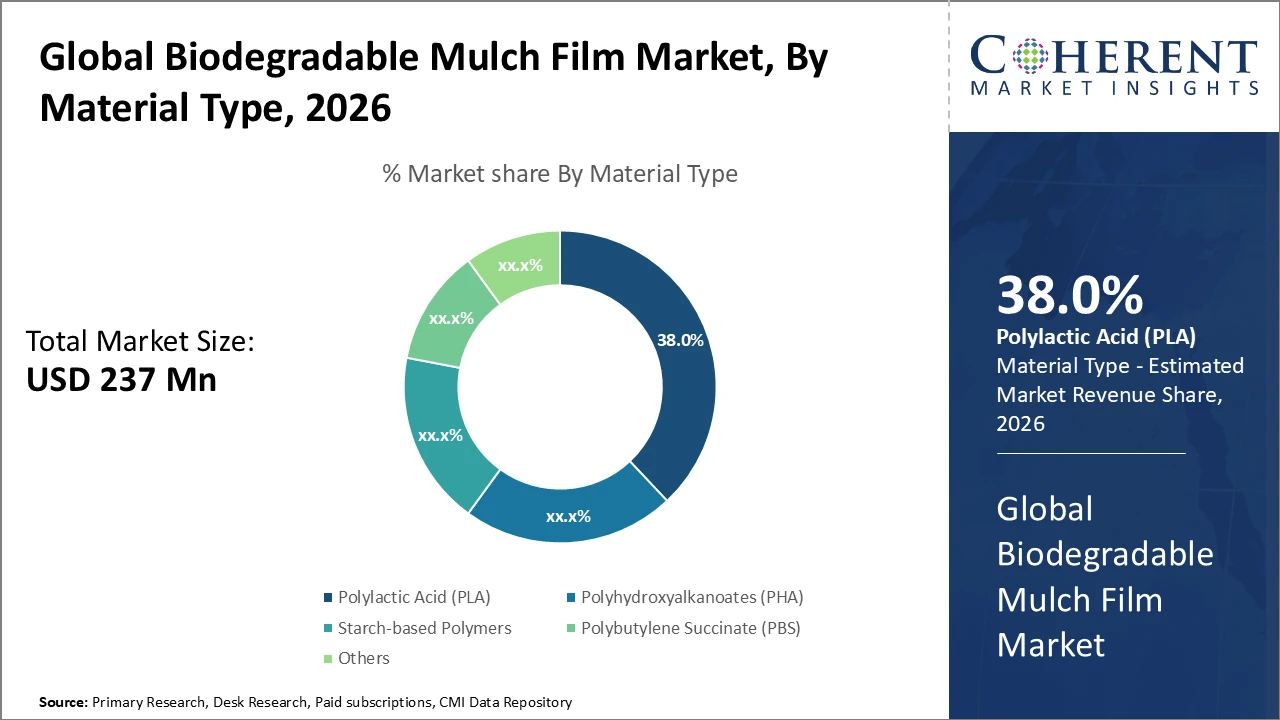
Biodegradable Mulch Film Market Insights, By Material Type
Polylactic Acid (PLA) dominates the market with a 38% share due to its strong biodegradability, durability, and regulatory acceptance across Europe and North America. It supports efficient soil integration without leaving harmful residues, making it ideal for fruit and vegetable cultivation.
Polyhydroxyalkanoates (PHA) represent the fastest-growing segment, driven by superior biodegradability across varied climates and composting compatibility. Starch-based polymers show steady growth due to their affordability and simple production processes.
Meanwhile, Polybutylene Succinate (PBS) and other materials serve niche roles, offering tailored solutions for specific agricultural conditions and specialized environmental requirements, supporting broader adoption of biodegradable mulch films.
Biodegradable Mulch Film Market Insights, By Crop Type
Fruits and vegetables dominate the market due to strong demand for mulch films that enhance soil moisture retention and effectively control weed growth in high-value crops.
The fastest-growing segment is flowers and ornamentals, driven by rising sustainability initiatives in commercial floriculture and landscaping industries. Field crops are also witnessing increased adoption, supported by the need for biodegradable films suitable for long-term use cycles and improved residue management, particularly in regions promoting organic farming.
The others segment includes niche crop applications, where growing interest in localized and innovative biodegradable film solutions is creating new growth opportunities in specialized agricultural practices.
Biodegradable Mulch Film Market Insights, By Application
Agriculture (vegetable and crop cultivation) is the dominant segment, driven by widespread use in both staple and high-value crops. Its growth is supported by technological advancements that enhance film durability while preserving biodegradability.
Landscaping is the fastest-growing segment, fuelled by rising demand for sustainable ground cover solutions in urban development and public green spaces. Horticulture shows steady expansion as ornamental plant growers increasingly adopt eco-friendly materials.
The others segment, though smaller, includes specialized applications such as erosion control films, contributing to broader market diversification and supporting the overall adoption of biodegradable mulch films across varied end-use scenarios.
Biodegradable Mulch Film Market Trends
The biodegradable mulch film market is shifting toward high-performance bio-based polymers that offer efficient degradation along with improved agronomic benefits such as moisture retention and weed control.
Innovations in multi-layer film structures are enabling customized degradation rates aligned with crop cycles, as seen in pilot projects conducted in the United States and Germany in 2025.
Stringent regulations on plastic residue in soil are accelerating adoption, particularly in Europe where several countries mandated biodegradable films starting in 2024.
North America maintains a leading position due to strong regulatory support and advanced farming infrastructure, with the United States contributing over 30% of the market share in 2026.
The Asia Pacific region is the fastest-growing market, recording a CAGR above 14% driven by agricultural reforms, subsidies for sustainable inputs, and rising environmental awareness in China and India.
Regional and global players are actively developing climate- and crop-specific biodegradable formulations, strengthening market expansion and competitiveness.
Biodegradable Mulch Film Market Insights, By Geography
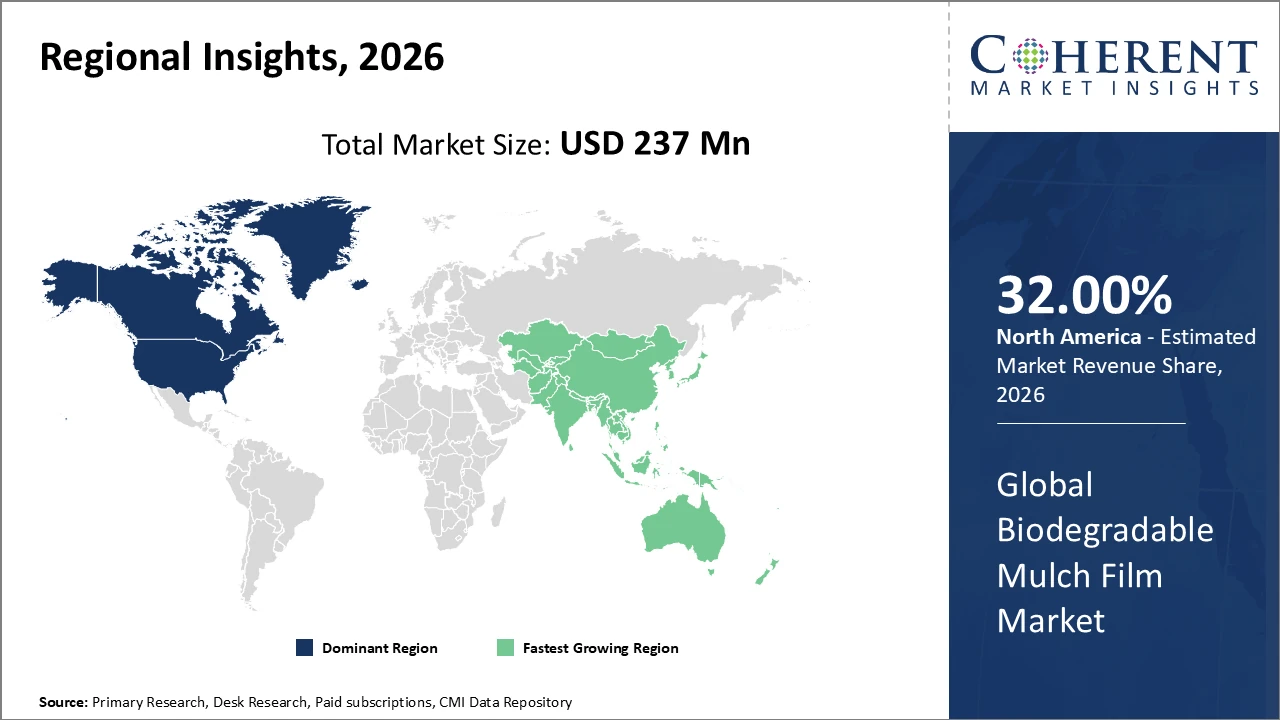
North America Biodegradable Mulch Film Market Analysis and Trends
In North America, the biodegradable mulch film market is driven by strong regulatory frameworks aimed at reducing single-use plastic use and encouraging sustainable alternatives. The United States plays a key role, with strict policies on agricultural plastic waste management accelerating adoption. Increased investments by leading companies in expanding production capacity and advancing film technologies have strengthened market growth. Additionally, the rising popularity of organic farming practices is boosting demand for environmentally friendly mulch solutions. These factors collectively enhance regional market revenue, positioning North America as a leading contributor to the global biodegradable mulch film market.
Asia Pacific Biodegradable Mulch Film Market Analysis and Trends
The Asia Pacific region is experiencing the fastest growth in the biodegradable mulch film market, driven by rising adoption across emerging economies with extensive agricultural activities. China plays a crucial role, with strong government initiatives supporting sustainable farming and increasing awareness about environmental impacts boosting product demand. In India, rapid adoption is observed in vegetable and crop cultivation, supported by subsidy programs and the development of locally adapted biodegradable film solutions. These factors collectively contribute to a higher compound annual growth rate compared to other regions, positioning Asia Pacific as a key growth engine in the global biodegradable mulch film market.
Biodegradable Mulch Film Market Outlook for Key Countries
USA Biodegradable Mulch Film Market Analysis and Trends
The USA remains a key market for biodegradable mulch films, driven by government policies promoting sustainable farming practices and reducing plastic waste. Leading companies such as NatureWorks LLC and BASF SE have expanded production capacities to meet growing demand from large-scale fruit and vegetable farming sectors. The use of advanced bio-based PLA films with improved durability and controlled degradation supports higher crop yields while ensuring environmental compliance. These developments strengthen the country’s leadership in the global market, contributing to increased revenue generation and influencing industry trends toward eco-friendly agricultural solutions.
Germany Biodegradable Mulch Film Market Analysis and Trends
Germany’s biodegradable mulch film market is growing steadily, driven by stringent environmental regulations and government initiatives promoting sustainable agriculture. Farmers increasingly adopt biodegradable films to reduce plastic residue in soils, improve crop yields, and comply with EU directives on agricultural plastic waste. Advanced PLA and PHA films are gaining popularity due to their efficient degradation and high mechanical strength, suitable for vegetables, fruits, and specialty crops. Technological innovations in multi-layer and compostable films support tailored crop-cycle requirements. Rising consumer demand for organic produce and environmental awareness further bolster market growth, positioning Germany as a key contributor to Europe’s biodegradable mulch film industry.
Analyst Opinion
Increasing demand for sustainable agriculture practices is driving the growth of biodegradable mulch films. Rising disposal costs of conventional plastic mulch and stricter government regulations in countries like the USA and China have boosted reliance on biodegradable alternatives. For example, California’s 2025 mandate on biodegradable film usage increased market revenue by over 15% compared to the previous year.
Expansion of production capacities by key market players has significantly contributed to market growth. Investments in bio-based polymer manufacturing facilities in 2024 raised global production volumes by around 18%, enhancing supply chain stability and reducing price volatility.
Biodegradable mulch film usage is diversifying beyond traditional agriculture into landscaping and horticulture. Commercial flower farming demand increased imports in Europe by 12% in 2026, reflecting broader market adoption and improved product adaptability.
Technological advancements in film formulation have enhanced price competitiveness, boosting adoption. Starch-based biodegradable films introduced in 2025 offered up to 20% cost savings over earlier versions, driving higher penetration among mid-scale farmers and supporting overall market expansion.
- Current Industry Events of 2026
- Market Size Estimation
- Regional Breakdown
- Competitive Landscape
- Customer Intelligence
- Segmental Analysis
- Pricing Analysis
- Key Market Drivers, Challenges & Future Trends
- Customized Insights Section
Market Scope
| Report Coverage | Details | ||
|---|---|---|---|
| Base Year: | 2025 | Market Size in 2026: | USD 237 million |
| Historical Data for: | 2020 To 2024 | Forecast Period: | 2026 To 2033 |
| Forecast Period 2026 to 2033 CAGR: | 12.8% | 2033 Value Projection: | USD 552 million |
| Geographies covered: |
| ||
| Segments covered: |
| ||
| Companies covered: | NatureWorks LLC, BASFE SE, Green Film Ltd., Corbion NV, Danisco A/S, Metabolix Inc., RWDC Industries, Biome Bioplastics, Taghleef Industries, Novamont | ||
| Growth Drivers: |
| ||
Biodegradable Mulch Film Market Growth Factors
Key drivers of the biodegradable mulch film market include growing regulatory pressure to phase out conventional plastic mulches, particularly in Europe and North America, leading to a 17% rise in adoption in 2026. Biodegradability requirements in agricultural plastic waste management have accelerated industry-wide shifts toward sustainable alternatives. Advances in polymer technology have produced films with improved mechanical strength and controlled degradation, meeting diverse crop-specific requirements. Rising consumer demand for organic and sustainably grown produce motivates farmers to adopt these films. Additionally, expanding applications in landscaping, erosion control, and horticulture offer new growth opportunities, further supporting market expansion and revenue generation.
Biodegradable Mulch Film Market Development
In 2025, NatureWorks LLC expanded its production capacity for PLA-based biodegradable mulch films in the United States, aiming to meet growing demand from large-scale vegetable and fruit farms. The company introduced advanced multi-layer films with improved mechanical strength and controlled degradation rates, enabling farmers to optimize crop cycles while ensuring compliance with environmental regulations. This development strengthened NatureWorks’ market presence and contributed to higher adoption of eco-friendly mulch films across North America.
Meanwhile, BASF SE launched a new line of PHA-based biodegradable films in Germany, targeting specialty crops and horticulture applications. These films offered faster biodegradation in diverse climatic conditions, aligning with stringent EU regulations on agricultural plastic waste. Pilot programs conducted in 2025 demonstrated enhanced soil integration and reduced residue, encouraging broader adoption among European farmers and supporting sustainable agriculture initiatives in the region.
Key Players
Leading Companies of the Market
NatureWorks LLC
BASF SE
Corbion NV
RWDC Industries
Danisco A/S
Green Film Ltd.
Novamont
Taghleef Industries
Biome Bioplastics
Biobest Group NV
Several market players have pursued strategic partnerships and technological collaborations to advance biodegradable film formulations. In 2025, BASF collaborated with agricultural firms to develop next-generation compostable films, achieving a 10% improvement in product durability and strengthening its market share across Europe. Similarly, NatureWorks LLC engaged in joint ventures in North America to expand PLA production capacity, resulting in a 25% reduction in unit costs by 2026. These initiatives enhanced competitive positioning, combining innovation with cost efficiency, and enabled both companies to meet growing demand for sustainable mulch films while reinforcing their leadership in the global biodegradable mulch film market.
Biodegradable Mulch Film Market Future Outlook
The biodegradable mulch film market is poised for robust growth, driven by increasing emphasis on sustainable agriculture, stringent environmental regulations, and rising demand for organic produce. Technological advancements in bio-based polymers, including PLA, PHA, and starch-based films, are expected to enhance durability, controlled degradation, and crop-specific performance. Expanding applications beyond traditional farming into landscaping, horticulture, and erosion control will create additional revenue streams. Emerging economies in Asia Pacific are likely to witness accelerated adoption due to government subsidies and environmental awareness. Overall, the market is set to grow steadily, with innovation, regulatory support, and sustainability trends shaping its future trajectory.
Biodegradable Mulch Film Market Historical Analysis
The biodegradable mulch film market has experienced steady growth over the past decade, driven by rising environmental concerns and regulatory pressure to reduce plastic waste in agriculture. Early adoption began in Europe and North America, where governments implemented strict guidelines on single-use plastics, prompting farmers to switch to sustainable alternatives. Initial market offerings focused on starch-based and PLA films, which gradually evolved to include PHA and multi-layer formulations with improved durability and crop-specific performance. Growing awareness of organic farming and sustainable agricultural practices further supported demand. By 2025, widespread adoption and technological advancements laid the foundation for significant global market expansion.
Sources
Primary Research Interviews:
Executives and operations managers at biodegradable mulch film manufacturing plants
Agricultural scientists and crop management specialists
Technology providers for bio-based polymer production and film extrusion
Databases:
Bloomberg Terminal
Thomson Reuters Eikon
IHS Markit
Euromonitor International
S&P Global Market Intelligence
Others
Magazines:
AgriBusiness Global – Sustainable Farming and Mulch Film Innovations
BioCycle – Compostable Materials and Biodegradable Film Updates
Plastics Today – Bioplastics and Film Manufacturing Developments
HortiDaily – Horticulture and Biodegradable Film Applications
Journals:
Journal of Polymers and the Environment – Biodegradable Film Applications and Performance
Journal of Cleaner Production – Sustainable Agricultural Practices
Industrial Crops and Products – Bio-Based Mulch Film Research
Journal of Agricultural and Food Chemistry – Crop Management and Mulch Film Impact
Newspapers:
The Wall Street Journal – Agricultural Technology and Sustainable Materials
Financial Times – Green Agriculture and Eco-Friendly Products
The Guardian – Environmental Regulations and Biodegradable Materials
Agri-Pulse – Trends in Sustainable Farming Inputs
Associations:
Biodegradable Products Institute (BPI) – Certification and Standards for Compostable Films
European Bioplastics – Biopolymer and Film Market Insights
International Federation of Organic Agriculture Movements (IFOAM) – Organic Agriculture Trends
Get access to 250+ pages report
Every segment, forecast, competitor profile and data table behind the analysis above — available for instant download.
- ESOMAR Member
- ISO 9001:2015 Certified
- D-U-N-S Registered
- GDPR & CCPA Compliant
Missing comfort of reading report in your local language? Find your preferred language:
Transform your Strategy with Exclusive Trending Reports
Frequently Asked Questions
The market is predominantly led by companies such as NatureWorks LLC, BASF SE, and Novamont S.p.A., which have strengthened their positions through innovation and strategic partnerships.
The market size is projected to grow from USD 237 million in 2026 to USD 552 million by 2033, reflecting a strong compound annual growth rate (CAGR) of 12.8% from 2026 to 2033.
The agriculture segment, especially vegetable and crop cultivation, presents the largest growth avenue, supported by increased organic farming initiatives and government subsidies.
Market development will focus on enhanced bio-based polymer formulations, compliance with stricter environmental regulations, and incorporation into diverse applications like landscaping and horticulture.
Competitive dynamics revolve around technological innovation, production scale-up, and cost optimization, while challenges include raw material price volatility and the need for region-specific biodegradable standards.
Leading companies invest in strategic collaborations, joint ventures for production capacity expansion, and target sector-specific product customization to capture wider market revenue and share.