

Itaconic Acid Market Size and Share Analysis: (2026-2033)
The Itaconic Acid Market size is anticipated to grow at a CAGR of 7.8% with USD 128 Million in 2026 and is expected to reach USD 216.54 Million in 2033. The primary drivers are largely defined by the increasing demand for biodegradable and bio-based chemicals in polymers, coatings, adhesives, and synthetic latex applications. Some of the other factors are the growing regulatory focus on reducing petrochemical dependence, rising investments in sustainable materials, and expanding use of renewable platform chemicals in industrial manufacturing.
Key Takeaways
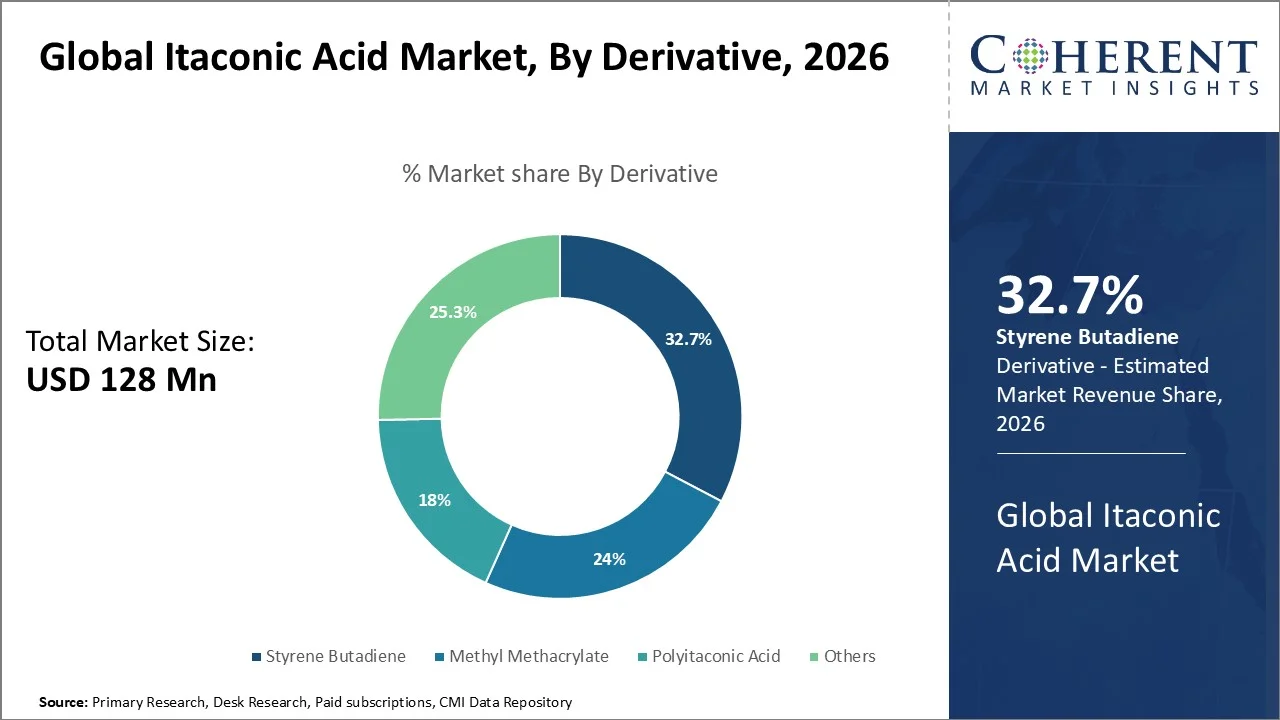
- The styrene butadiene segment is likely to dominate the market with 32.7% in 2026. The segment’s growth is owing to its extensive use in high-performance rubber and latex applications, providing superior technical properties and aligning with sustainability trends.
- The SBR latex segment is set to lead with 28.1% in 2026. The segment’s growth is owing to its critical role as a functional monomer that enhances carboxylated SBR latex formulations. Integrating itaconic acid drastically improves binding strength, substrate adhesion, and the overall mechanical, shear, and freeze-thaw stability of the liquid compound.
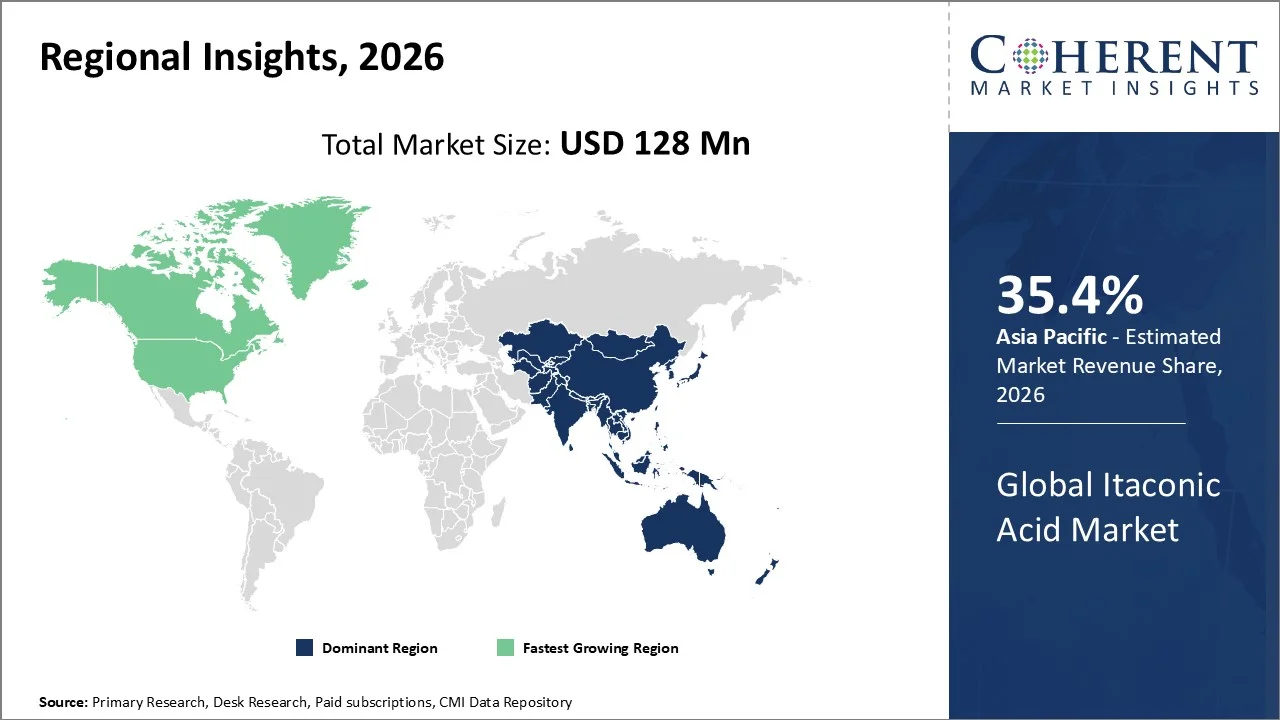
- Asia Pacific is expected to acquire the prominent share of 35.4% in 2026. The region’s growth is owing to region’s robust manufacturing ecosystem for bio-based chemicals and strong government support for green chemistry initiatives, for example, China's sustainable chemical production policies.
Segmental Insights
Why is Styrene Butadiene Acquiring the Largest Share?
On the basis of derivative, the styrene butadiene segment is projected to account for the largest Itaconic Acid Market share of 32.7% in 2026. The segment’s growth is owing to its essential role as a co-monomer in synthetic rubber production.
In 2022, global synthetic rubber production was estimated at around 15.2 million metric tons, with styrene-butadiene rubber (SBR) contributing approximately 42% of this total output. The high share highlights the widespread industrial importance, especially in applications requiring both durability as well as elasticity. The tire and automotive industries are the leading consumers of SBR-based materials. This is owing to their reliance on high performance rubber for manufacturing tires, seals, and other components, thereby propelling sustained demand growth.
In addition, the supportive policy initiatives like the USDA’s Bioproduct Pilot Program, funded under the Bipartisan Infrastructure Law, have allocated USD 10 million over fiscal years 2022 and 2023 to promote the scale-up of sustainable bioproduct manufacturing, including bio-based platform chemicals like itaconic acid. Collectively, these factors reinforce the continued dominance of the styrene-butadiene segment in the itaconic acid market landscape.
- Current Industry Events of 2026
- Market Size Estimation
- Regional Breakdown
- Competitive Landscape
- Customer Intelligence
- Segmental Analysis
- Pricing Analysis
- Key Market Drivers, Challenges & Future Trends
- Customized Insights Section
SBR Latex hold the Largest Market Share
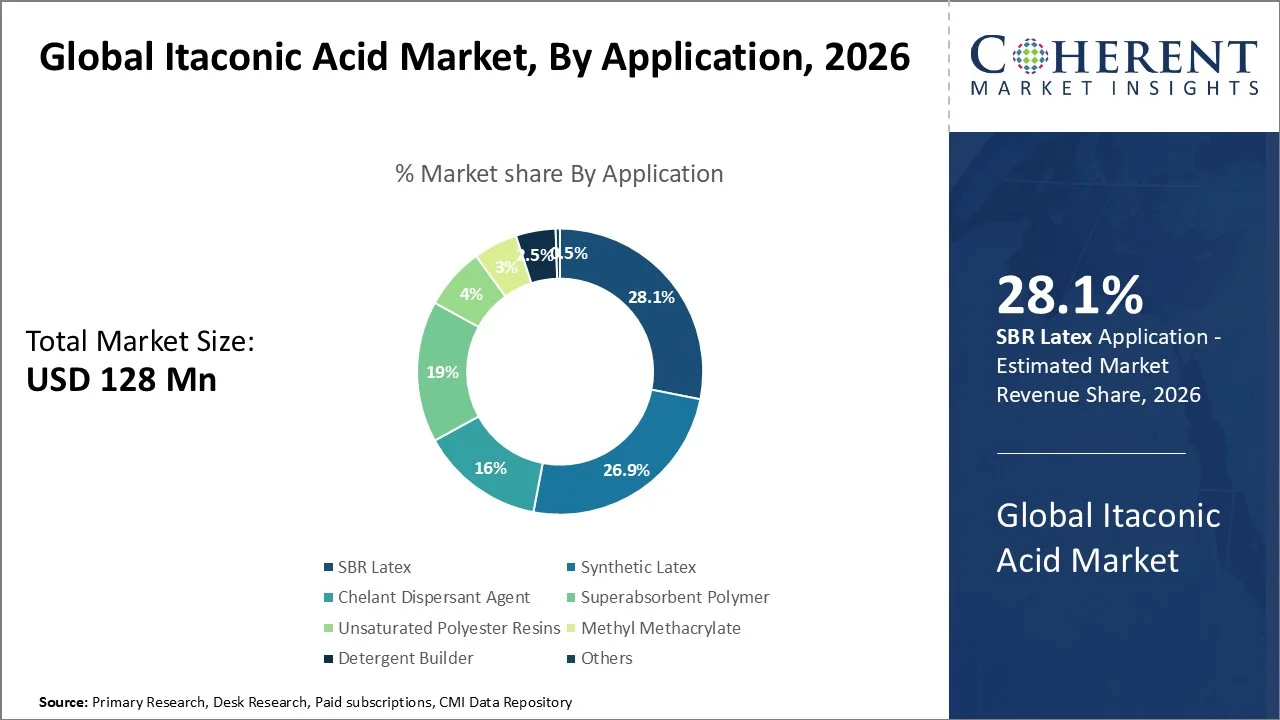
On the basis of application, the SBR latex segment lead with a major 28.1% share in 2026. The segment’s growth is owing to its role as a bio-based platform chemical identified by the U.S. Department of Energy (DOE). The DOE classifies itaconic acid amongst the top 12 bio-based platform chemicals derived from biomass. This strengthens its strategic use in polymer as well as SBR latex systems where styrene-butadiene modifications are critical for performance enhancement.
In addition, the DOE-funded research programs under the Bioenergy Technologies Office (BETO) confirm that industrial microbial fermentation routes for itaconic acid are actively being advanced to improve scalable production for polymer and rubber applications. This includes lignin-to-itaconic acid bioconversion pathways demonstrating integration into sustainable polymer feedstocks.
From a scientific development perspective, the engineered microbial systems (e.g., Pseudomonas putida) have achieved up to 56% mol/mol yield in lignin-based itaconic acid production, thus validating its industrial relevance for downstream styrene-butadiene applications
Market Drivers
Expansion into Sustainable Bio-Based Polymers is Transforming the Itaconic Acid Market in the US
The U.S. Itaconic Acid Market is experiencing accelerated adoption. This is driven by federal sustainability mandates and industrial bioeconomy initiatives promoting renewable monomer substitution in polymer manufacturing.
According to the U.S. Department of Energy, USD 6 million in federal funding (2025) was allocated to advance biofuel and biomass-based chemical conversion technologies, thereby directly supporting downstream platforms which enable bio-based monomer integration like itaconic acid in resin systems.
In parallel, the National Science Foundation reported USD 9.8 million in polymer innovation funding (2025) in five research programs focused on AI-enabled sustainable polymer discovery and low-waste manufacturing. This strengthens the demand for bio-derived building blocks including itaconic acid derivatives.
In July 2025, Itaconix plc launched BIO Asterix, a line of plant-based functional building blocks for polymeric binders in paints and coatings, and adhesives. BIO*Asterix products are specialty derivatives of itaconic acid. These products can replace fossil-based acrylates, methacrylates, or styrene monomers in resins and composites, thus supporting decarbonization efforts.
Advanced Continuous Fermentation and Purification Technologies: A Major Breakthrough in Itaconic Acid Market
The advanced continuous fermentation and purification technologies are substantially reshaping the itaconic acid market by improving yield, sustainability, and downstream efficiency.
The recent bioprocess studies report that continuous bioreactor systems using engineered autotrophic yeast can produce approximately 12 g/L of itaconic acid from carbon dioxide. In addition, the waste-to-chemical fermentation using agricultural residues like waste potatoes has demonstrated production levels of up to 32 g/L, thus enhancing both feedstock flexibility as well as cost efficiency.
In 2026, an integrated continuous purification development combining solvent extraction and salting-out recovery achieved about 80.5 percent product recovery from fermentation broth, reducing energy consumption and losses. These advancements facilitate scalable industrial adoption of bio-based itaconic acid production aligned with sustainable chemical manufacturing trends.
The continual process integration and intensified purification are expected to improve commercial viability and reduce operational costs, thereby strengthening the role of itaconic acid as a key bio-based platform chemical in the global industrial applications over the forthcoming years globally.
Current Events and Their Impact on the Itaconic Acid Market
Current Event | Description and its Impact |
India’s BioE3 Policy to Promote Bio‑Based Chemicals |
|
EU Chemicals Regulatory Outlook and Bioeconomy Strategy |
|
Bio‑Based Chemicals Priority in Global Industrial Policies
|
|
Itaconic Acid Market Trends
- The rising demand for bio-based chemicals as part of global sustainability efforts is propelling the growth of itaconic acid, particularly in the production of biodegradable polymers and resins.
- The increasing adoption in water treatment and personal care applications is booting the itaconic acid demand. Itaconic acid is used as a dispersant in water treatment and as a humectant in personal care formulations.
- The strategic investments and collaborations are enhancing production capacity as well as advancing the bio-based production processes for itaconic acid. The leading players are focusing on cost reduction and scalability through innovative bio-refining technologies.
- The itaconic acid’s application in green materials is expanding with the governments around the world promoting renewable chemicals. Along with regulatory frameworks favoring bio-based alternatives to traditional petrochemical products.
- The global bio-based chemicals market is expected to grow substantially, with itaconic acid positioning itself as a top player in various industries like coatings, adhesives, and plastics. By 2026, the bio-based chemicals are projected to contribute approximately 90 million tonnes to the global chemical production.
- In the U.S., the BioPreferred Program has certified more than 10,000 bio-based products, thereby encouraging the use of sustainable chemicals like itaconic acid in manufacturing processes.
Regional Insights
Asia Pacific Dominates Owing to the Shift Toward Bio-based Platform Chemicals
The Asia Pacific region accounts for 35.4% of the itaconic acid market share in 2026. The region’s growth is owing to the shift of manufacturing sector toward bio-based platform chemicals, including itaconic acid. It is extensively used as a sustainable intermediate in polymers, resins, latex, plastics, as well as detergents.
According to data from the National Institutes of Health, the Asia Pacific region leads the global consumption and accounts for 54% of the total worldwide demand. This strong consumption base is directly linked to the region’s integrated industrial ecosystem, with commercial itaconic acid production remaining highly concentrated in China and nearby manufacturing hubs.
The public research institutions have accelerated development through targeted fermentation and bioprocessing investments to optimize this critical bio-based itaconic acid supply pipeline. The regional metabolic engineering researchers have partnered with institutional bioreactor facilities to scale up industrial fermentation processes for itaconic acid production. This collaboration expanded the production capacity of recombinant fungal strains by 71.4%, improving chemical yield and supporting localized feedstock processing.
These continuous advancements strengthen Asia Pacific’s position as the leading regional hub for sustainable Itaconic Acid manufacturing, while creating strong commercial growth opportunities across polymer, latex, resin, plastic, and detergent industries.
North America Itaconic Acid Market Trends
North America is expected to witness strong growth in Itaconic Acid Market over the forecast period. The region’s growth is owing to bio-based chemical manufacturing policies and microbial fermentation advancements.
According to the U.S. Department of Energy’s platform chemical classification, itaconic acid is listed among the top 12 biomass-derived chemicals, supporting its strategic relevance for sustainable polymer and resin production in industrial applications.
The U.S. Environmental Protection Agency (EPA), along with the FDA and the USDA, in a May 2024 biotechnology regulatory coordination plan, highlighted streamlined oversight for genetically engineered microorganisms, directly impacting fermentation-based production pathways used for itaconic acid manufacturing in North America.
In April 2024, Itaconix introduced two new plant-based ingredients for household detergents. One is Itaconix TSI 422 which improves dishwashing detergents by providing better scale inhibition as well as compact dosing. Other is Itaconix ONZ 405, a powder version, which delivers quick odor neutralization and scale inhibition for powder laundry additives and plastic-free detergents.
Government Policy and Innovation is Accelerating the Itaconic Acid Market in China
China is a major player in accelerating the growth of the global itaconic acid market. The country serves as a central hub for the production of bio-based intermediates, thereby propelling innovation and increasing the production capacity for itaconic acid across the world.
This large-scale production capability aligns closely with the Petrochemical and Chemical Industry Steady Growth Plan issued by China’s Ministry of Industry and Information Technology. It aims to achieve more than 90% of domestic self-sufficiency in advanced new materials and bio-based polymers by the year 2026.
The Beijing University of Chemical Technology in China has unveiled a bio-based itaconate-butadiene material. The project, led by Liqun Zhang, started in 2008. After 13 years of research, the team successfully developed a high-performance, bio-based itaconate-butadiene rubber.
United States Itaconic Acid Market Trends
The U.S. Itaconic Acid Market is set to witness considerable growth. The growth is driven by stricter chemical regulatory oversight and advancements in bio-based manufacturing technologies.
Who are the Major Companies in Itaconic Acid Industry
Some of the major key players in Itaconic Acid Market are Itaconix Corporation, Jinan Huaming Biochemistry Co. Ltd., Qingdao Langyatai Group Co. Ltd., Zhejiang Guoguang Biochemistry Co., Ltd., Alpha Chemika, Chengdu Jinkai Biology Engineering Co., Ltd., Ronas Chemicals Ind. Co., Ltd., Iwata Chemical Co., Ltd., Shandong Kaison Biochemical Co., Ltd., Aekyung Petrochemical Co. Ltd., Spectrum Chemical Manufacturing Corp., FUJIFILM Wakao Pure Chemical Corporation, Ultimate Chem India Pvt. Ltd., Choice Oraganochem Lip., and Alfa Aesar.
Key News
- In February 2023, Fieldfisher advised Itaconix PLC on a £10.5 million fundraising effort to support new product development. The AIM-quoted company, based in New Hampshire, US, converts itaconic acid into specialty polymers for the cleaning and personal care industries. Itaconix supplies sustainable consumer product ingredients to over 140 brands.
- In February 2023, Itaconix raised USD 12.7 million by selling approximately 200 million discounted shares to investors. The company operates its factory and main offices in Stratham, New Hampshire, where it converts itaconic acid into specialty polymers for the cleaning and personal care industries.
Market Report Scope
Itaconic Acid Market Report Coverage
| Report Coverage | Details | ||
|---|---|---|---|
| Base Year: | 2025 | Market Size in 2026: | USD 128 Mn |
| Historical Data for: | 2020 To 2024 | Forecast Period: | 2026 To 2033 |
| Forecast Period 2026 to 2033 CAGR: | 7.8% | 2033 Value Projection: | USD 216.54 Mn |
| Geographies covered: |
| ||
| Segments covered: |
| ||
| Companies covered: | Itaconix Corporation, Jinan Huaming Biochemistry Co. Ltd., Qingdao Langyatai Group Co. Ltd., Zhejiang Guoguang Biochemistry Co., Ltd., Alpha Chemika, Chengdu Jinkai Biology Engineering Co., Ltd., Ronas Chemicals Ind. Co., Ltd., Iwata Chemical Co., Ltd., Shandong Kaison Biochemical Co., Ltd., Aekyung Petrochemical Co. Ltd., Spectrum Chemical Manufacturing Corp., FUJIFILM Wakao Pure Chemical Corporation, Ultimate Chem India Pvt. Ltd., Choice Oraganochem Lip., and Alfa Aesar. | ||
| Growth Drivers: |
| ||
| Restraints & Challenges: |
| ||
Analyst Opinion
- The itaconic acid market is poised for growth due to increasing support from global bio‑economy policies. For example, the European Union's Bioeconomy Strategy and Action Plan is fostering the adoption of bio‑based chemicals, like itaconic acid, to reduce reliance on fossil‑derived products. Similarly, India's BioE3 Policy is placing a greater focus on the promotion of bio‑based chemicals and biopolymers, with specific attention to itaconic acid. This policy shift, alongside the increased public funding as well as strategic support, is propelling the demand for itaconic acids.
- India's bio‑economy, valued at around USD 10 billion in 2014, is expected to reach over USD 130 billion by 2024 and USD 300 billion by 2030. This substantial growth is owing to government efforts under the BioE3 Policy. This speeds up the use of bio‑based chemicals like itaconic acid in various sectors. These innovations indicate a long‑term structural shift in the economy, directly benefitting the market.
- The Bioeconomy Investment Deployment Group established by the EU aims to provide financial support for bio‑based technologies. This facilitates the large‑scale production of bio‑based chemicals including itaconic acid. These efforts align with the EU's broader Circular Economy Action Plan, which is expected to unlock substantial market opportunities for itaconic acid in both established as well as emerging markets.
Speak to the analyst
Want personalized insights?
Take the findings above to one of our principal consultants, or have the report rebuilt around the segments, geographies and competitors you actually track.
Market Segmentation
- By Derivative (Revenue, USD Mn, 2021-2033)
- Styrene Butadiene
- Methyl Methacrylate
- Polyitaconic Acid
- Others
- By Application (Revenue, USD Mn, 2021-2033)
- SBR Latex
- Synthetic Latex
- Chillant Dispersant Agent
- Superabsorbent Polymer
- Unsaturated Polyester Resins
- Methyl Methacrylate
- Detergent Builder
- Others
- By Region (Revenue, USD Mn, 2021-2033)
- North America
- U.S.
- Canada
- Latin America
- Brazil
- Mexico
- Argentina
- Rest of Latin America
- Europe
- Germany
- U.K.
- France
- Italy
- Spain
- Russia
- Rest of Europe
- Asia Pacific
- China
- India
- Japan
- Australia
- South Korea
- ASEAN
- Rest of Asia Pacific
- Middle East
- GCC
- Israel
- Rest of Middle East
- Africa
- South Africa
- Central Africa
- North Africa
- North America
- Key Players
- Itaconix Corporation
- Jinan Huaming Biochemistry Co. Ltd.
- Qingdao Langyatai Group Co. Ltd.
- Zhejiang Guoguang Biochemistry Co., Ltd.
- Alpha Chemika
- Chengdu Jinkai Biology Engineering Co., Ltd.
- Ronas Chemicals Ind. Co., Ltd.
- Iwata Chemical Co., Ltd.
- Shandong Kaison Biochemical Co., Ltd.
- Aekyung Petrochemical Co. Ltd.
- Spectrum Chemical Manufacturing Corp.
- FUJIFILM Wakao Pure Chemical Corporation
- Ultimate Chem India Pvt. Ltd.
- Choice Oraganochem Lip.
- Alfa Aesar
Sources
Primary Research Interviews
- Itaconic Acid Manufacturers
- Chemical Processing Experts
- Industrial Chemical Suppliers
- Polymer & Resin Producers
- Biotechnologists in Chemical Synthesis
- Others
Databases
- Bloomberg Terminal
- Thomson Reuters Eikon
- IHS Markit
- Euromonitor International
- S&P Global Market Intelligence
- Others
Magazines
- Chemical Engineering Magazine
- Green Chemistry Bulletin
- Polymer Science and Engineering Journal
- Industry Today
- Others
Journals
- Journal of Industrial and Engineering Chemistry
- Biotechnology Progress
- Applied Microbiology and Biotechnology
- Journal of Chemical Technology and Biotechnology
- Others
Newspapers
- Financial Times
- The Wall Street Journal
- Reuters
- Bloomberg News
- Others
Associations
- American Chemical Society (ACS)
- Society of Chemical Engineers (SCE)
- Bio-based Products Industry Alliance (BPIA)
- European Chemical Industry Council (CEFIC)
- Others
Public Domain Sources
- U.S. Department of Energy (DOE) – Office of Energy Efficiency & Renewable Energy
- International Energy Agency (IEA)
- European Commission – Chemicals Directorate
- World Bank Open Data
- National Renewable Energy Laboratory (NREL)
- Others
Proprietary Elements
- CMI Data Analytics Tool
- Proprietary CMI Existing Repository of Information for the Last 10 Years
Get access to 250+ pages report
Every segment, forecast, competitor profile and data table behind the analysis above — available for instant download.
- ESOMAR Member
- ISO 9001:2015 Certified
- D-U-N-S Registered
- GDPR & CCPA Compliant
Missing comfort of reading report in your local language? Find your preferred language:
Transform your Strategy with Exclusive Trending Reports
Frequently Asked Questions
The Itaconic Acid Market is expected to reach USD 216.54 million in 2033.
Major players operating in the global Itaconic Acid Market include Itaconix Corporation, Jinan Huaming Biochemistry Co. Ltd., Qingdao Langyatai Group Co. Ltd., Zhejiang Guoguang Biochemistry Co., Ltd., Alpha Chemika, Chengdu Jinkai Biology Engineering Co., Ltd., Ronas Chemicals Ind. Co., Ltd., Iwata Chemical Co., Ltd., Shandong Kaison Biochemical Co., Ltd., Aekyung Petrochemical Co. Ltd., Spectrum Chemical Manufacturing Corp., FUJIFILM Wakao Pure Chemical Corporation, Ultimate Chem India Pvt. Ltd., Choice Oraganochem Lip., and Alfa Aesar.
The high production costs (20–30% higher than alternatives), intense competition from cheaper, conventional petrochemical alternatives, and technical limitations in fermentation efficiency are the key factors hampering growth of the market.
The surging demand for bio-based, sustainable chemicals and polymers to replace petroleum-based alternatives is boosting the demand for Itaconic Acid.
The Itaconic Acid Market is anticipated to grow at a CAGR of 7.8% between 2026 and 2033.
Among regions, Asia Pacific is expected to account for a largest market share in the global Itaconic Acid Market over the forecast period.