

Glutamic Acid Market Size and Share Analysis- Growth Trends and Forecasts (2026-2033)
The glutamic acid market size is anticipated to grow at a CAGR of 6.05% with USD 12.27 Bn in 2026 and is expected to reach USD 18.50 Bn in 2033. The primary drivers are largely defined by the growing demand for processed and convenience food products. Some of the other factors are the rising use of glutamic acid in seasonings, soups, snacks, and ready-to-eat meals, along with its growing application in animal feed and pharmaceutical formulations. In addition, USDA FAS reported in March 2026 that India’s food processing sector grew from USD 355 Bn in 2024 to an expected USD 535 Bn by FY 2026, which is also propelling the market growth.
Key Takeaways
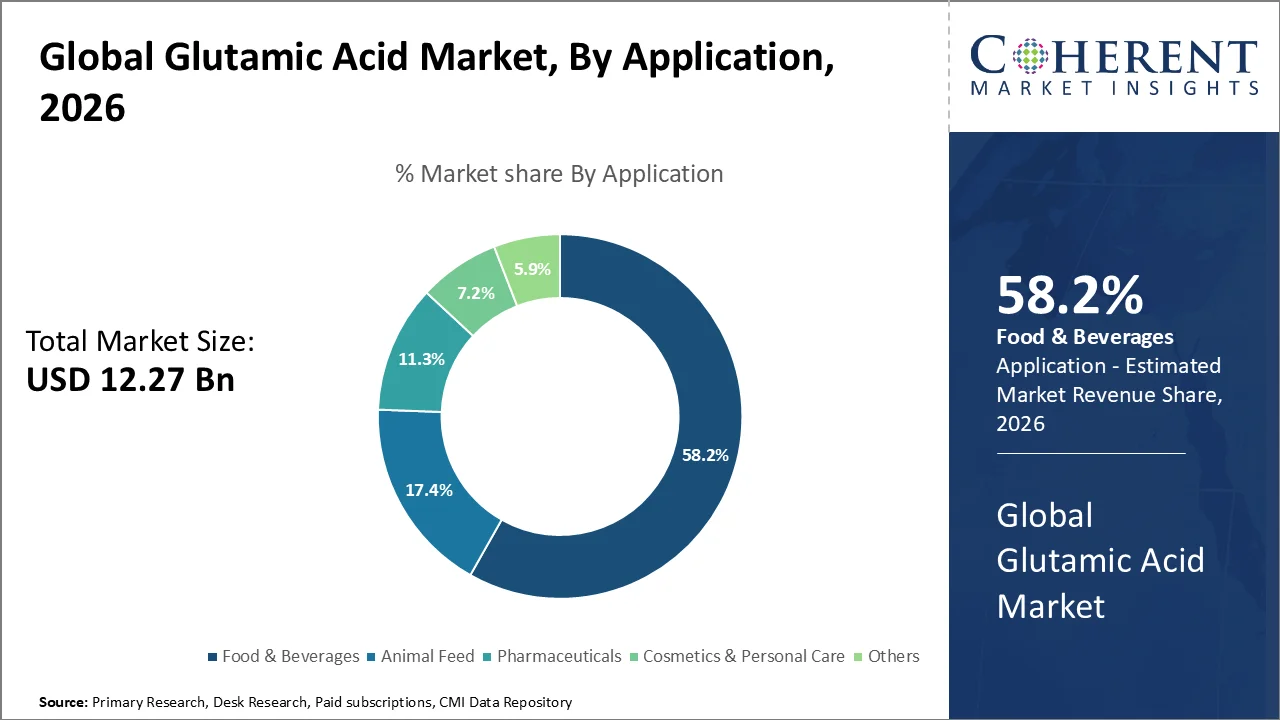
- Food & beverages is set to lead with 58.2% in 2026. The segment’s growth is owing to the rising demand for processed foods, seasonings, soups, snacks, and ready-to-eat meals where glutamic acid is used as a flavor-enhancing ingredient. The growing consumption of packaged and convenience food products is also facilitating its use in food manufacturing. In addition, the APEDA reported that India’s processed food exports reached USD 7,886.62 million in 2024–25, thereby supporting the demand for glutamic acid in food manufacturing applications.
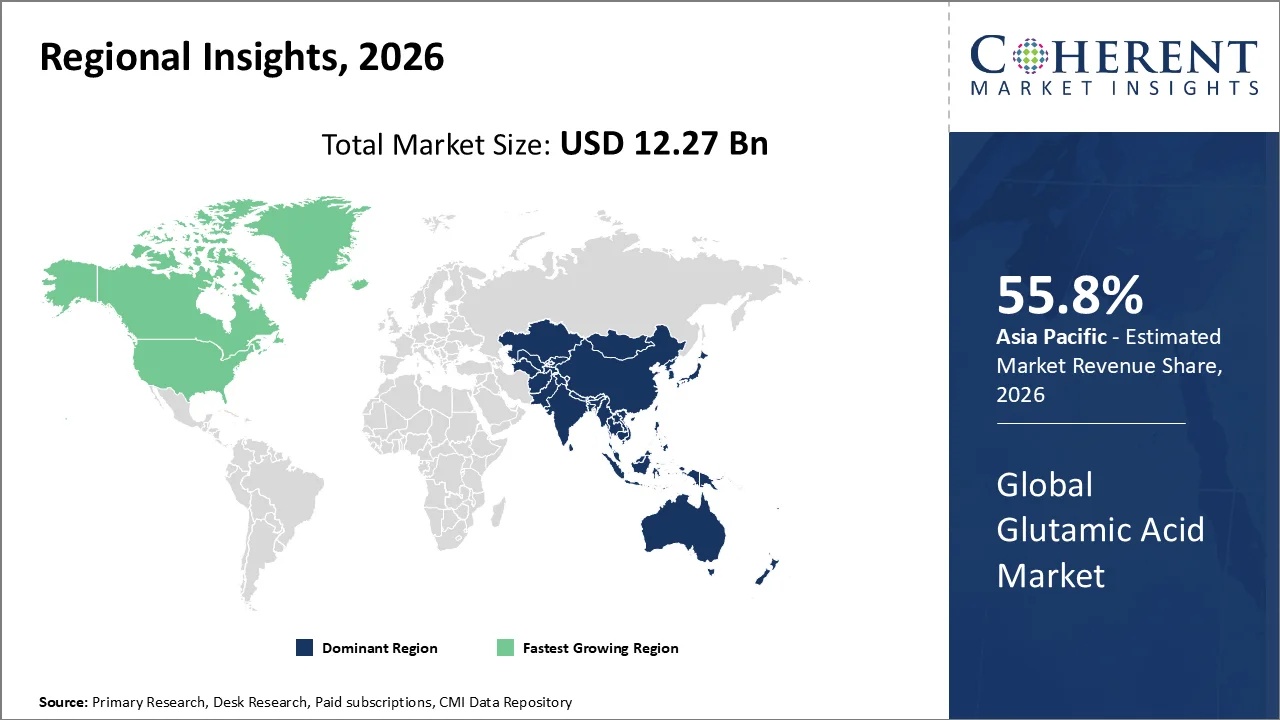
- Asia Pacific is expected to acquire the prominent share of 55.8% in 2026. This is due to region’s strong food processing base, large population, and high consumption of packaged foods, sauces, noodles, and savory snacks. FAO reported that about 23% of Asia Pacific’s population faced food insecurity in 2022, supporting the need for affordable processed and fortified food products.
Segmental Insights
Why is Food & Beverages Acquiring the Largest Share?
Food & beverages is projected to account for the largest glutamic acid market share of 58.2% in 2026. The segment’s growth is owing to its strong use of glutamic acid in the form of monosodium glutamate. It enhances savory taste in packaged foods, sauces, soups, seasoning blends, snacks, ready meals, and foodservice preparations.
The U.S. FDA states that MSG is the sodium salt of glutamic acid and is used as a food ingredient to improve flavor. The demand is also linked with the strong foodservice consumption. The USDA ERS reported that the U.S. food-away-from-home spending increased from USD 1.45 trillion in 2023 to USD 1.52 trillion in 2024.
In India, the PIB reported that registered food processing units employed 2.23 million workers. While the unregistered food processing segment supported 4.68 million workers, thereby indicating a large food processing base that supports the use of glutamic acid-based ingredients.
In August 2025, Ajinomoto Co., Inc. announced an investment of PHP 9.1 billion, or JPY 23.8 billion, to build a new factory in Central Luzon, Philippines. The plant will produce flavored seasonings and breading mixes. This expansion supports the growing demand for MSG-based seasonings. MSG is the sodium salt of glutamic acid and is widely used to improve the savory taste of food products
- Current Industry Events of 2026
- Market Size Estimation
- Regional Breakdown
- Competitive Landscape
- Customer Intelligence
- Segmental Analysis
- Pricing Analysis
- Key Market Drivers, Challenges & Future Trends
- Customized Insights Section
Growth Drivers
Growth in Processed Food, Foodservice, and Convenience Consumption is Transforming the Glutamic Acid Market in the US
Growth in processed food, foodservice, and convenience consumption is transforming the U.S. glutamic acid market because glutamic acid and its sodium salt, monosodium glutamate, are widely used to improve savory taste in packaged foods, soups, sauces, broths, snacks, seasonings, and prepared meals. The U.S. FDA states that MSG is the sodium salt of glutamic acid and that its use in food is generally recognized as safe, which facilitates its continued application in regulated food formulations.
The demand is also tied up with the changing eating patterns, as the USDA reported that the total U.S. food spending reached USD 2.58 trillion in 2024, while food-away-from-home accounted for a record 58.9% of the total food spending. In addition, the CDC/NHANES data showed that people aged one year and above obtained 55.0% of their calories from ultra-processed foods during August 2021 to August 2023.
In 2025, DIME launched MSG-based everyday seasonings in the U.S., thereby reflecting renewed consumer-facing interest in glutamate-based umami ingredients.
Current Events and Their Impact on the Glutamic Acid Market
Current Event | Description and its Impact |
U.S. FDA Phase II Voluntary Sodium Reduction Targets |
|
China GB 2760-2024 Food Additives Standard |
|
EU and Global Antimicrobial Reduction Policies in Livestock |
|
Glutamic Acid Market Trends
- The rising need for processed and ready-to-eat foods is increasing the use of glutamic acid. This is mainly through monosodium glutamate (MSG), as a flavor enhancer. In 2026, the USDA reported that China had more than 100,000 registered food processing companies, while its food service sector reached USD 812 billion in 2025. This facilitates the high demand for savory seasonings, sauces, soups, snacks, as well as ready-to-eat foods.
- The increasing consumption of meat and animal-based food products is increasing the use of amino acids in animal nutrition. According to the OECD-FAO Agricultural Outlook 2025–2034, the global meat consumption is projected to rise by 47.9 million tons over the next decade. This increases the demand for glutamic acid in feed formulations, as amino acids help in improving palatability, protein balance, and feed efficiency in livestock as well as poultry production.
- Fermentation-based production is becoming a major trend in the glutamic acid market. The manufacturers focus on plant-based and scalable production methods. The firm, Ajinomoto, states that MSG is produced through fermentation of plant-based raw materials like sugar cane, sugar beets, cassava, or corn. This trend supports low-cost, large-scale production while matching food manufacturers’ choice for ingredients made through fermentation.
- The regulatory acceptance is also propelling the demand for glutamic acid-based additives. The US FDA considers MSG to be generally recognized as safe (GRAS), while EFSA has established a group acceptable daily intake of 30 mg/kg body weight per day for glutamic acid and glutamates. These safety evaluations help food manufacturers continue using glutamates in regulated food applications.
Regional Insights
Asia Pacific Dominates Owing to the High Use in MSG
The Asia Pacific region accounts for 55.8% of the market share in 2026. The region’s growth is owing to the high use of glutamic acid in MSG, which is widely used in instant noodles, sauces, soups, snacks, and ready meals.
In China, the National Bureau of Statistics reported that total grain output reached 706.50 million tons in 2024, supporting raw material availability for fermentation-based amino acids. China also reported 70.7% capacity utilization in food manufacturing in Q4 2024, indicating steady downstream demand from processed food industries.
The region also benefits from product and process innovation. In October 2025, Ajinomoto filed patent infringement suits in China and Japan related to its monosodium glutamate manufacturing process, showing continued technology protection and competitive focus in Asia Pacific.
North America Glutamic Acid Market Trends
North America is expected to witness strong growth in glutamic acid market over the forecast period. The region’s growth is owing to the rising use of glutamic acid-based ingredients in processed foods, snacks, sauces, soups, seasonings, ready meals, and foodservice formulations.
The U.S. FDA states that MSG is the sodium salt of glutamic acid and is generally recognized as safe for food use, supporting its regulated use as a flavor enhancer. The glutamic acid market growth is also supported by the large U.S. food manufacturing base, as U.S. Census Bureau data showed that food manufacturing recorded one of the largest manufacturing shipment values at USD 827.1 billion in 2020, indicating strong demand potential for flavor-enhancing ingredients.
USDA ERS also states that its food availability system tracks more than 200 food commodities moving through U.S. marketing channels, reflecting the broad scale of food supply where seasoning and taste-enhancement systems are used. Sodium-reduction reformulation is another factor, as glutamate-based solutions help maintain savory taste while reducing salt levels.
Strong Demand from Food Processing is Accelerating the Glutamic Acid Demand in China
China’s glutamic acid market is growing due to strong demand from food processing, seasonings, convenience foods, and animal nutrition. The National Bureau of Statistics reported that China’s processing of food from agricultural and sideline products increased by 6.1% year-on-year in 2024. This supports the higher use of glutamic acid-based ingredients like monosodium glutamate.
The market is also benefiting from fermentation technology upgrades. In 2024, Meihua Holdings reported that it completed production-strain upgrades for glutamic acid and glutamine, which improved fermentation efficiency and product competitiveness in China’s amino acid industry.
United States Glutamic Acid Market Trends
The United States glutamic acid market is supported by continued use of glutamic acid-based ingredients in processed foods, seasoning blends, sauces, soups, snacks, and foodservice products.
FDA states that MSG is the sodium salt of glutamic acid and considers added MSG in foods generally recognized as safe. A different official demand indicator comes from CDC/NCHS NHANES data, which showed that adults in the US consumed 53.0% of daily calories from ultra-processed foods during August 2021–August 2023. This supports demand for taste-enhancement ingredients used in convenience foods.
In June 2025, Ajinomoto Health & Nutrition North America launched Salt Answer and Palate Perfect for sodium reduction and taste enhancement.
Who are the Major Companies in Glutamic Acid Industry
Some of the major key players in glutamic acid market are IRIS BIOTECH GMBH, Ajinomoto Co., Inc., Akzo Nobel N.V., Evonik Industries AG, KYOWA HAKKO BIO CO., LTD., Sichuan Tongsheng Amino acid Co., Ltd, Ningxia Eppen Biotech Co., Ltd, Global Bio-chem Technology Group Company Limited., Otto Chemie Pvt. Ltd., and Hefei TNJ Chemical Industry Co., Ltd.
Key News
- In April 2025, BASF Care Chemicals launched Trilon G chelating agent in Florham Park, New Jersey. The product uses GLDA (glutamic acid diacetate) chemistry and strengthens BASF’s chelating agent portfolio, which already includes MGDA and EDTA. This launch strengthens the rising demand for more sustainable chelating solutions.
- In April 2025, China’s Fufeng Group has started construction of an industrial park in Kazakhstan’s Zhambyl region. The project involves an investment of USD 800 million and is planned to process 1 million tonnes of corn annually. It will produce lysine, monosodium glutamate, xanthan gum, and feed amino acids.
Market Report Scope
Glutamic Acid Market Report Coverage
| Report Coverage | Details | ||
|---|---|---|---|
| Base Year: | 2025 | Market Size in 2026: | USD 12.27 Bn |
| Historical Data for: | 2020 To 2024 | Forecast Period: | 2026 To 2033 |
| Forecast Period 2026 to 2033 CAGR: | 6.05% | 2033 Value Projection: | USD 18.50 Bn |
| Geographies covered: |
| ||
| Segments covered: |
| ||
| Companies covered: | IRIS BIOTECH GMBH, Ajinomoto Co., Inc., Akzo Nobel N.V., Evonik Industries AG, KYOWA HAKKO BIO CO., LTD., Sichuan Tongsheng Amino acid Co., Ltd, Ningxia Eppen Biotech Co., Ltd, Global Bio-chem Technology Group Company Limited., Otto Chemie Pvt. Ltd., and Hefei TNJ Chemical Industry Co., Ltd. | ||
| Growth Drivers: |
| ||
| Restraints & Challenges: |
| ||
Analyst Opinion
- Glutamic acid demand is mainly driven by everyday food consumption rather than only chemical-sector growth. Its major commercial use is linked to MSG and flavor enhancement. The FDA states that MSG is the sodium salt of glutamic acid and is generally recognized as safe for food use. The processed food exports in India reached USD 7,886.62 million in 2024–25, which results in increased demand for taste enhancers in packaged as well as processed food products.
- The food processing expansion is creating a strong growth base for the glutamic acid market. In India, the share of processed food in agri-food exports increased from 13.7% in 2014–15 to 20.4% in 2024–25. This reflects the rising production of value-added food products, where glutamic acid-based ingredients are used to improve savory taste, mouthfeel, and formulation consistency.
- The animal nutrition is also propelling the growth in the glutamic acid market. OECD-FAO estimated that global meat production reached 365 million tons in 2024, increasing by 1.3%, mainly due to higher poultry output. This growth supports higher feed production and demand for amino-acid-based nutrition, where glutamic acid is used in feed and animal nutrition formulations.
Speak to the analyst
Want personalized insights?
Take the findings above to one of our principal consultants, or have the report rebuilt around the segments, geographies and competitors you actually track.
Market Segmentation
- By Application (Revenue, USD Bn, 2021-2033)
- Food & Beverages
- Cosmetics & Personal Care
- Pharmaceuticals
- Animal Feed
- Others
- By Region (Revenue, USD Bn, 2021-2033)
- North America
- U.S.
- Canada
- Latin America
- Brazil
- Mexico
- Argentina
- Rest of Latin America
- Europe
- Germany
- U.K.
- France
- Italy
- Spain
- Russia
- Rest of Europe
- Asia Pacific
- China
- India
- Japan
- Australia
- South Korea
- ASEAN
- Rest of Asia Pacific
- Middle East
- GCC
- Israel
- Rest of Middle East
- Africa
- South Africa
- Central Africa
- North Africa
- North America
Sources
Primary Research Interviews
- Glutamic Acid Manufacturers
- Amino Acid Producers
- Food Additive and Flavor Enhancer Manufacturers
- Monosodium Glutamate (MSG) Producers
- Pharmaceutical and Nutraceutical Ingredient Suppliers
- Animal Feed Additive Manufacturers
- Fermentation Technology Providers
- Food & Beverage Product Formulators
- Industrial Biotechnology Consultants
- Others
Databases
- Bloomberg Terminal
- Thomson Reuters Eikon
- Euromonitor International
- UN Comtrade Database
- FAOSTAT
- World Bank Open Data
- Others
Magazines
- Food Business News
- Food Engineering Magazine
- Chemical Engineering Magazine
- Nutraceuticals World
- Food Ingredients First
- Feed & Additive Magazine
- Others
Journals
- Journal of Agricultural and Food Chemistry
- Amino Acids Journal
- Food Chemistry
- Biotechnology and Bioengineering
- Applied Microbiology and Biotechnology
- Journal of Industrial Microbiology & Biotechnology
- Others
Newspapers
- Financial Times
- The Wall Street Journal
- Reuters
- Bloomberg News
- Nikkei Asia
- The Economic Times
- Others
Associations
- International Glutamate Information Service
- International Food Additives Council
- Institute of Food Technologists
- European Food Safety Authority
- U.S. Food and Drug Administration
- Food Safety and Standards Authority of India
- Others
Public Domain Sources
- U.S. Food and Drug Administration
- European Food Safety Authority
- Food and Agriculture Organization
- World Health Organization
- Codex Alimentarius Commission
- UN Comtrade Database
- World Bank Open Data
- OECD Data
- Others
Proprietary Elements
- CMI Data Analytics Tool
- Proprietary CMI Existing Repository of Information for the Last 10 Years
Get access to 250+ pages report
Every segment, forecast, competitor profile and data table behind the analysis above — available for instant download.
- ESOMAR Member
- ISO 9001:2015 Certified
- D-U-N-S Registered
- GDPR & CCPA Compliant
Missing comfort of reading report in your local language? Find your preferred language:
Transform your Strategy with Exclusive Trending Reports
Frequently Asked Questions
The Glutamic Acid Market is expected to reach USD 18.50 Bn in 2033.
Major players operating in the global Glutamic Acid Market include IRIS BIOTECH GMBH, Ajinomoto Co., Inc., Akzo Nobel N.V., Evonik Industries AG, KYOWA HAKKO BIO CO., LTD., Sichuan Tongsheng Amino acid Co., Ltd, Ningxia Eppen Biotech Co., Ltd, Global Bio-chem Technology Group Company Limited., Otto Chemie Pvt. Ltd., and Hefei TNJ Chemical Industry Co., Ltd.
The health concerns related to excessive consumption, volatility in raw material prices, and stringent regulatory scrutiny are the key factors hampering growth of the market.
The advanced fermentation technologies, rising health consciousness, and demand for plant-based, sustainable food ingredients is boosting the demand for Glutamic Acid.
The Glutamic Acid Market is anticipated to grow at a CAGR of 6.05% between 2026 and 2033.
Among regions, Asia Pacific is expected to account for a largest market share in the global Glutamic Acid Market over the forecast period.
China is the dominant global producer of glutamic acid, accounting for approximately 68% to 80% of total production volume. Key production also comes from Brazil, Indonesia, Thailand, and France.