

Bio-butanol Market Size and Forecast — 2026-2033
Overview
Bio-butanol is an alcohol used as a fuel or organic solvent. This solvent is prepared by fermenting sugar, starch or cellulosic feedstock such as wheat, sugar beet, corn, straw, and wood. Bio-butanol is used as a substitute to crude oil. They have higher octane number, larger flammability limits, higher flash point, and higher heat of vaporization, makes it a good fuel option. Bio-butanol easily blends with gasoline due to its low vapor pressure. It has the potential to generate energy equivalent to gasoline and is non-corrosive in nature, due to which it is considered to be of greater advantage than bio-ethanol.
Bio-butanol is also used as a cleaner, adhesives, jet fuel, synthetic rubber, solvent in paints, bio-based plastics, and fibers. They are also expected to meet 20% of the demand for fuel, globally. Growing demand for clean energy, is the main factor boosting demand for bio-butanol.
Bio-butanol exhibit polymer chain formation and blending properties, due to which it finds its application in products such as acrylates, acetates, glycol ethers, solvents, and plasticizers.
Bio-butanol Market Size and Forecast – 2026 – 2033
The Bio-butanol Market size is estimated to be valued at USD 4.49 billion in 2026 and is expected to reach USD 8.47 billion by 2033, exhibiting a compound annual growth rate (CAGR) of 9.5% from 2026 to 2033.
Key Takeaways
In the feedstock segment, corn leads with a significant 47% industry share backed by well-established supply chains, while sugarcane presents rapid growth owing to its high fermentable sugar content.
Fuel/additive applications dominate with 39% market share, driven by tightening global emissions regulations and automotive sector demand.
North America commands the largest market share with over 40%, attributed to established biorefineries and government incentives. Meanwhile, Asia Pacific exhibits the fastest growth, registering a CAGR exceeding 11%, powered by emerging economies such as India and China ramping up renewable energy adoption.
Bio-butanol Market – Segmentation Analysis
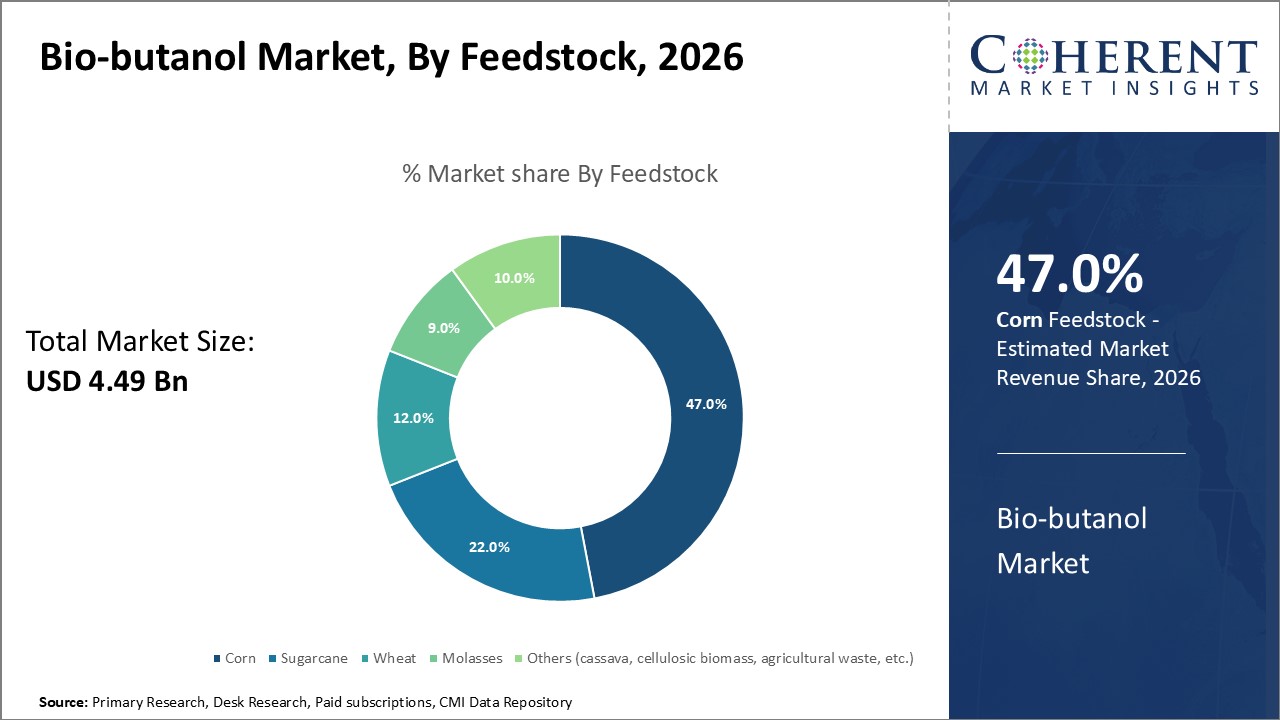
Bio-butanol Market Insights, By Feedstock
In terms of feedstock, the bio-butanol market is segmented into Corn, Sugarcane, Wheat, Molasses, and Others, among this Corn dominates the market share with 46%. Corn’s dominance is a result of its abundant availability and established processing infrastructure, primarily in North America, ensuring stable feedstock supply and competitive pricing.
Bio-butanol Market Insights, By Application
In terms of application, the market is segmented into Solvent, Fuel/Additive, Chemical Intermediate, and Others, with Fuel/Additive accounting for 38% market share, dominating the segment. This dominance stems from bio-butanol’s compatibility with existing fuel infrastructure and its role in reducing vehicular emissions, particularly in North America and Europe.
Bio-butanol Market Insights, By End-use Industry
In terms of end-use industry, the market segments into Automotive, Pharmaceuticals, Agrochemicals, Cosmetics, and Others, with the Agrochemicals segment dominating at 35% market share due to bio-butanol’s critical role as a carrier solvent and intermediate in pesticides and herbicides production.
Bio-butanol Market Insights, By Geography
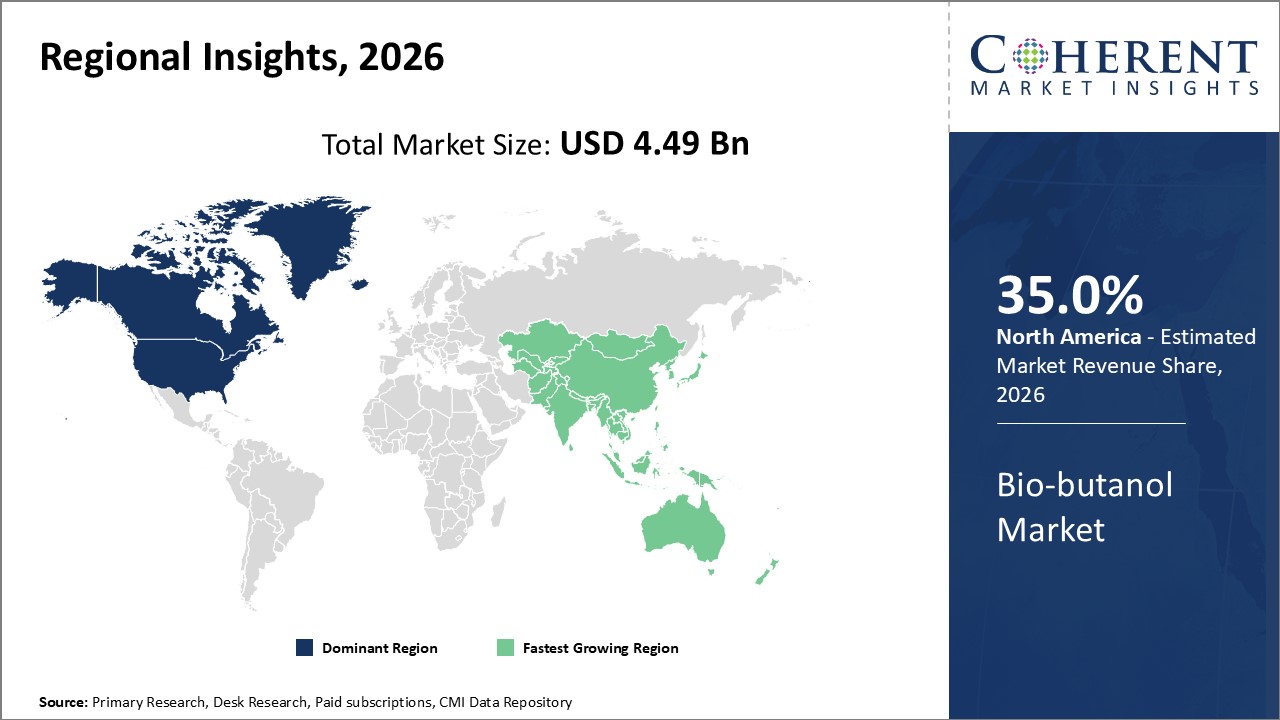
North America Bio-butanol Market Analysis and Trends
In North America, the dominance in the bio-butanol market is supported by an advanced industrial base and strong regulatory frameworks encouraging biofuel use. The U.S. houses multiple large-scale plants, with companies like Gevo leading fuel additive integration. The matured supply chain ecosystem and consumer sustainability preferences contribute to North America commanding 40%+ market share.
Asia Pacific Bio-butanol Market Analysis and Trends
Meanwhile, Asia Pacific exhibits the fastest growth, primarily driven by countries like India and China increasing bio-butanol imports by 12% in 2026. Governmental policies focused on reducing carbon emissions and substituting fossil fuels underpin this growth, alongside rising demand in automotive and chemical sectors.
Bio-butanol Market Outlook for Key Countries
United States Bio-butanol Market Analysis and Trends
The U.S. remains a pivotal market for bio-butanol, with policies like the Renewable Fuel Standard (RFS) amplifying demand for biofuels in transportation. Leading players such as Gevo have invested heavily in scaling bio-butanol plants, facilitating a reported 20% production increase in 2025. The robust presence of biorefineries and macroeconomic focus on reducing carbon footprints underscore the USA’s key role in driving market revenue and growth.
India Bio-butanol Market Analysis and Trends
India’s bio-butanol market is evolving rapidly due to mounting government incentives aimed at sustainable transportation fuels and chemical solvents. Imports surged by 15% in 2026 to meet industrial demands, and local players are actively investing in feedstock diversification, primarily sugarcane and molasses. The growing agrochemical and pharmaceutical sectors also contribute significantly to India’s expanding bio-butanol market share.
Analyst Opinion
Bio-butanol production capacity expansion in North America is a key supply-side indicator propelling market growth. In 2025, several facilities increased capacity by over 20%, indicating robust upstream integration. The U.S. Energy Information Administration reported a 15% surge in bio-butanol production volumes in 2025 compared to the previous year.
Demand-side diversification, particularly from automotive and coatings industries, is driving adoption rates. Bio-butanol’s compatibility with existing fuel infrastructure led to an 19% rise in its application as a gasoline additive in 2026, as per recent regulatory filings.
Pricing dynamics influenced by feedstock availability—mainly agricultural residues—are crucial for market expansion. Fluctuations in corn and sugarcane prices impacted bio-butanol production costs by around 8% in 2025, according to commodity trade analytics.
Export trends highlight increasing cross-border bio-butanol trade, with Asia Pacific emerging as a significant importer. Trade data shows a 12% growth in imports by India and China in 2026, boosted by supportive renewable energy frameworks.
- Current Industry Events of 2026
- Market Size Estimation
- Regional Breakdown
- Competitive Landscape
- Customer Intelligence
- Segmental Analysis
- Pricing Analysis
- Key Market Drivers, Challenges & Future Trends
- Customized Insights Section
Market Scope
| Report Coverage | Details | ||
|---|---|---|---|
| Base Year: | 2025 | Market Size in 2026: | USD 4.49 billion |
| Historical Data for: | 2020 To 2024 | Forecast Period: | 2026 To 2033 |
| Forecast Period 2026 to 2033 CAGR: | 9.5% | 2033 Value Projection: | USD 8.47 billion |
| Geographies covered: |
| ||
| Segments covered: |
| ||
| Companies covered: | Gevo, Inc., Butamax Advanced Biofuels LLC, Green Biologics Ltd., BASF SE, Jubilant Life Sciences, Kuraray Co., Ltd., DuPont Industrial Biosciences, Cobalt Biofuels Inc., Navin Fluorine International Limited, Archer Daniels Midland Company | ||
| Growth Drivers: |
| ||
Growth factors
Bio-butanol market growth is fundamentally supported by the following drivers: rapid adoption of bio-based solvents in the pharmaceutical industry due to purity and sustainability demands; escalating fuel additive requirements to meet stringent emissions norms globally; advancements in biotechnology enhancing feedstock conversion efficiency, reducing production costs; the rising use of bio-butanol in green packaging to replace conventional petroleum-based materials; and increased investments in infrastructure for biofuel blending, particularly in North America and Asia Pacific.
The renewable fuel policies in the U.S. propelled bio-butanol consumption, with a reported 25% rise in fuel blending applications in 2026, while advances in enzyme technology reduced production time by 15%, leading to enhanced market revenue.
Bio-butanol Market Development
In December 2025, Godavari Biorefineries Limited (GBL) has signed a strategic international license agreement with Catalyxx Inc. Through this deal, GBL gains the sole right to utilize Catalyxx's cutting-edge technology for turning ethanol into biobutanol and other higher alcohols. As part of its sustainability and decarbonization goal, GBL plans to build a new facility that will produce 15,000 metric tons of biobutanol and higher alcohols annually.
Market Trends
The industry is transitioning toward second-generation feedstocks like lignocellulosic biomass, triggered by sustainability mandates and feedstock price volatility. For instance, 2026 saw a 10% uptick in bio-butanol derived from non-food feedstocks, highlighting a market shift to reduce food vs. fuel conflicts. Advanced fermentation technologies integrating genetically modified microorganisms are enhancing yield and purity, evident from pilot projects in Europe showing up to 30% higher conversion efficiency. Additionally, growing end-user preference for bio-butanol as a green solvent over traditional petrochemical solvents underscores evolving industry standards.
Key Players
Gevo, Inc.
Butamax Advanced Biofuels LLC
Green Biologics Ltd.
BASF SE
Jubilant Life Sciences
Kuraray Co., Ltd.
DuPont Industrial Biosciences
Cobalt Biofuels Inc.
Navin Fluorine International Limited
Archer Daniels Midland Company
Competitive strategies observed include Gevo’s strategic partnerships for joint ventures in renewable fuel projects, which expanded its market footprint in North America, contributing to a 23% revenue increase in 2025. BASF SE adopted an innovation-driven approach focusing on high-purity bio-butanol for specialty chemicals, culminating in multiple product launches in 2026 that enhanced its industry share in Europe.
Bio-butanol Market Future Outlook
The Bio-butanol market is projected to experience robust growth in the coming years, driven by increasing demand for renewable and sustainable fuels. This growth is fueled by environmental concerns, stringent regulations pushing for cleaner fuels, and the advantages of bio-butanol as an advanced biofuel and low-carbon alternative that can be used as a direct substitute for petroleum-based butanol in various applications.
Bio-butanol’s use in industries such as paints, coatings, adhesives, and biofuels continues to expand, especially in regions like Asia-Pacific and Europe where government policies strongly promote sustainable energy solutions. Technological advancements and rising investments in production efficiency are also expected to bolster market growth. Despite challenges such as raw material supply constraints and production costs, the bio-butanol market outlook remains positive, with increasing adoption in transportation, chemical manufacturing, and power generation sectors anticipated to drive future demand.
Historical Analysis
In July 2018, SilicoLife (which designed optimized microorganisms and novel pathways for industrial biotechnology applications) was awarded with SME instrument phase 1 grant for commercial evaluation of its BUTANOVA technology, a biological process for production of butanol. SME Instrument was a grant provided by the European Commission under the European Innovation Council pilot. The major objective of the new grant was to evaluate the new technology and a marketing strategy for the new cost-competitive alternative for production of bio-butanol.
In June 2018, Kreussler Inc. (a manufacturer of textile care products) in partnership with Green Biologics Ltd. (a bio-based chemical manufacturer) launched a new bio-based dry-cleaning solvent SYSTEMK4. Green Biologics used its patented fermentation process to convert corn into bio-butanol that was used to produce SOLVONK4, the main solvent in the SYSTEMK4 dry-cleaning solvent.
In 2017, Butamax Advanced Biofuels LLC (a JV between BP and DuPont) acquired Nesika Energy, LLC (a manufacturer of bio-ethanol). Butamax started production of bio-butanol at Nesika’s manufacturing facility located in Kansas (U.S.). The new facility helped Butamax to expand its production capacity of bio-butanol.
Sources
Primary Research interviews:
Chemical industry experts
R&D scientists in biofuels
Supply chain managers in chemical & energy sectors
Databases:
ScienceDirect
Wiley Online Library
ProQuest
Magazines:
Ethanol Producer Magazine
Renewable Energy World
Chemical Week
Journals:
Journal of Industrial Microbiology & Biotechnology
Bioresource Technology
Renewable & Sustainable Energy Reviews
Newspapers:
The Hindu Business Line
Business Standard
The Wall Street Journal (Energy)
Associations:
Advanced Biofuels Association (ABFA)
International Energy Agency (IEA) Bioenergy
Biotechnology Innovation Organization (BIO)
World Bioenergy Association (WBA)
Get access to 250+ pages report
Every segment, forecast, competitor profile and data table behind the analysis above — available for instant download.
- ESOMAR Member
- ISO 9001:2015 Certified
- D-U-N-S Registered
- GDPR & CCPA Compliant
Missing comfort of reading report in your local language? Find your preferred language:
Transform your Strategy with Exclusive Trending Reports
Frequently Asked Questions
The market is led by Gevo, Inc. , BASF SE, and Green Biologics Ltd., which have expanded capacities and strategic partnerships shaping industry growth.
The market is expected to reach USD 8.47 billion by 2033 from USD 4.49 billion in 2026, growing at a CAGR of 9.5%.
The automotive sector, mainly for fuel additives, alongside pharmaceuticals and agrochemicals, presents the largest growth prospects due to regulatory support and demand for sustainable solutions.
Market trends indicate a shift toward second-generation feedstocks, biotechnological innovations improving yields, and expanding export-import dynamics particularly in Asia Pacific.
The landscape is characterized by increasing collaborations, capacity expansions, and innovation focus; challenges persist around feedstock availability and production cost volatility.
Strategies include joint ventures, technological licensing, and downstream integration targeting both fuel and specialty chemical applications to maximize market presence.