

India Alcohol Market Analysis & Forecast
India Alcohol Market is estimated to be valued at USD 64.86 Bn in 2026 and is expected to reach USD 110.44 Bn in 2033, exhibiting a compound annual growth rate (CAGR) of 7.9% from 2026 to 2033.
Key Takeaways
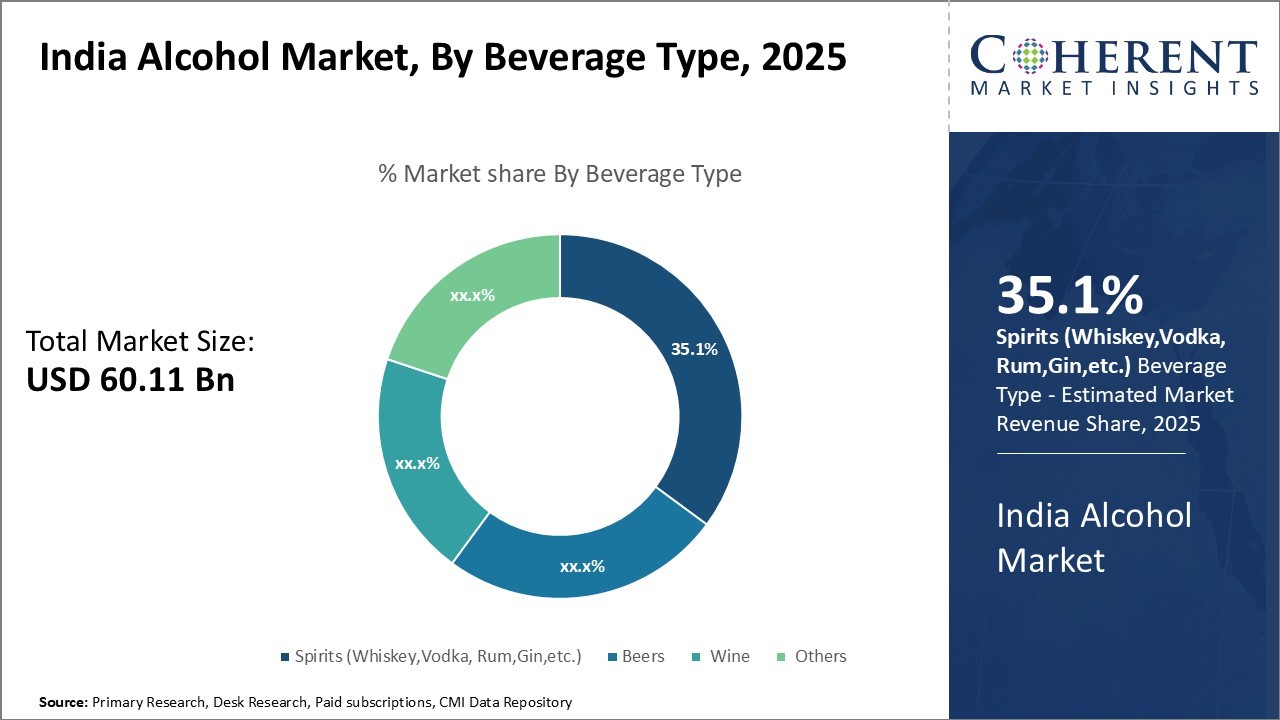
- According to Beverage Type, The Spirits (Whisky, Vodka, Rum, Gin, Etc.) Category is anticipated to account for the largest share of 36.1% for the India Alcohol market in 2026.
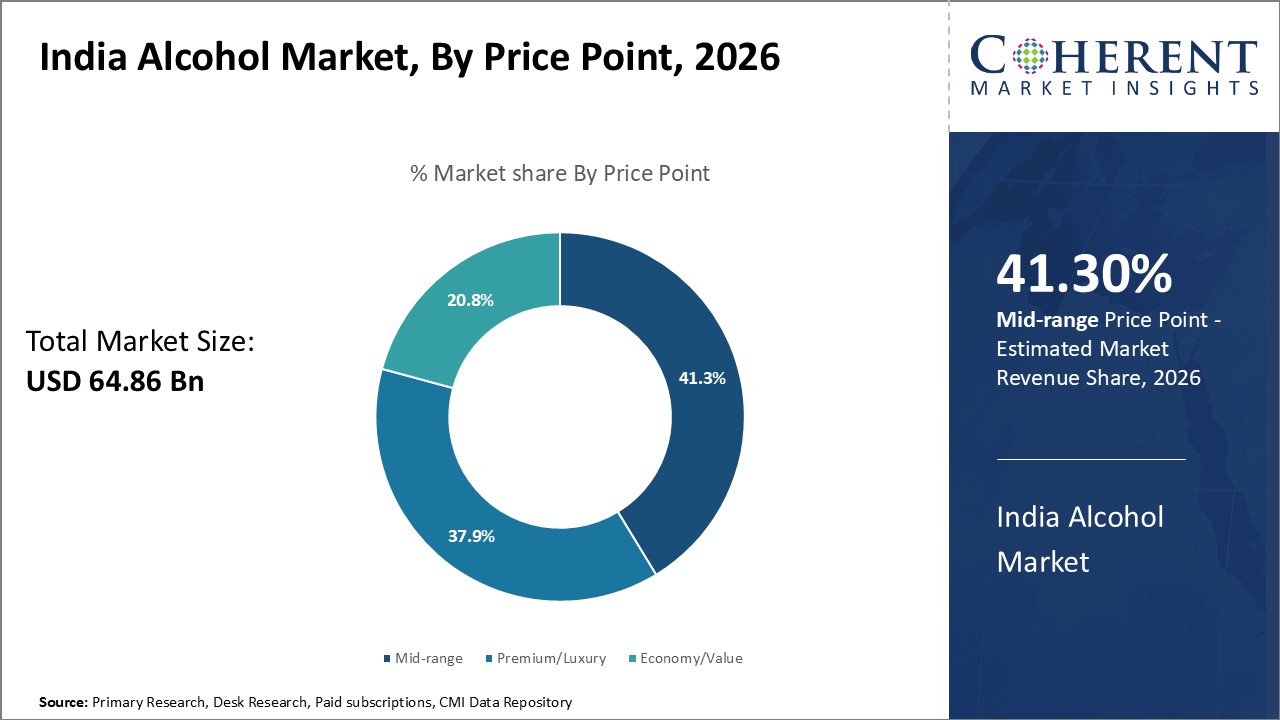
- According to Price Point, The Mid-Range Segment is anticipated to hold 41.3% share of the India Alcohol market in 2026.
- According to Distribution Channel, Supermarkets And Hypermarkets Category holds major share of 35% in 2026 for India Alcohol Market.
Market Overview
The India Alcohol Market Size is among the fastest growing in the world which is fueled by changing customer preferences, increased disposable incomes, and quick urbanization. The India alcohol market has been witnessing significant growth over the past few years. Factors such as rising disposable incomes, changing lifestyle, and social drinking habits have been driving the market growth. While the consumption of beer and spirits has increased substantially, India made foreign liquor (IMFL) continues to dominate the market. However, there is a rising popularity of the craft beer and premium whisky segments. The growing acceptance of women drinking alcohol particularly in urban areas is another factor that will support the market expansion in the coming years.
Current Events and Its Impact on the India Alcohol Market
Event | Description and Impact |
Stricter Alcohol Advertising Regulations |
|
State-Level Excise Policy Reforms & Collaboration |
|
Pricing Analysis
Pricing in the Indian alcohol market is heavily influenced by the costs of raw materials, packaging, labor, transportation, and regulatory factors. Over the past year, there has been a significant increase in production costs across the supply chain.
Key raw materials such as Extra Neutral Alcohol (ENA), malt spirit, and grains (notably non-basmati rice and barley) have seen price volatility, with non-basmati rice prices rising by 20–25% in early FY2025 before softening mid-year. Barley prices have remained relatively stable. Packaging material costs, especially glass bottles, have declined recently due to corrections in soda ash prices, providing some relief to manufacturers
- Current Industry Events of 2026
- Market Size Estimation
- Regional Breakdown
- Competitive Landscape
- Customer Intelligence
- Segmental Analysis
- Pricing Analysis
- Key Market Drivers, Challenges & Future Trends
- Customized Insights Section
Organic and Natural Flavor in Alcohol
- There is a growing trend in India toward alcoholic beverages featuring organic and natural flavors, driven by younger, urban consumers seeking unique, high-quality, and health-conscious drinking experiences.
- Craft distilleries are increasingly using real fruits, botanicals, and indigenous spices to create innovative flavor profiles that resonate with the demand for authenticity and purity.
- The broader organic beverages market in India is expanding rapidly, with health and wellness concerns pushing consumers toward clean-label, chemical-free, and sustainably sourced products.
Segmental Insights
India Alcohol Market Insights, By Beverage Type
In terms of beverage type, spirits (whisky, vodka, rum, gin, etc.) is expected to contribute 36.1% share of the market in 2026, owing to a growing preference for premiumization among young India adults. As disposable incomes in the country continue rising, more consumers - especially those in metropolitan areas - are willing to spend extra on higher quality spirits over other beverages.
Beer and wine remain niche in India compared to spirits due to cultural preferences as well as limited availability in many areas until recently. For instance, the average age of the India population is reducing significantly, with over 60% now under the age of 35. This young population has grown up with increasing exposure to global mixology trends through social media and travel. They are fueling the demand for premium international spirit brands and cocktails served at bars and restaurants in major cities.
Products like premium Scotch whisky and American/European vodka are in high demand due to their perceived status value. Local craft distilleries are also emerging to tap into this growing consumer base interested in unique tasting experiences. Brands are targeting younger India drinkers through innovative packaging, flavor extensions, and savvy digital marketing campaigns.
Ready-to-drink cocktail mixes and premixed spirits are gaining ground due to their convenience. The experimentation with different flavors also allows consumers to sample a variety of products without committing to an entire bottle, thus driving higher volumes overall. As India society continues to modernize at a rapid pace, the trend of premiumization in spirits is expected to persist well into the future.
India Alcohol Market Insights, By Price Point
When considering price point, the mid-range segment is expected to contribute 41.3% share to the India alcohol market in 2026, primarily due to its accessible price levels for mass consumption. Economy/value brands dominate bottled beer sales and some hard liquor categories as well. However, mid-range brands achieve the sweet spot of offering good quality at competitive price points that a wider consumer base can comfortably afford to buy regularly or for at-home socializing occasions.
With average disposable incomes still moderate compared to developed markets, mid-range brands allow the bulk of consumers living in Tier 2/3 cities to indulge in alcohol without going over their budgets. These products serve as affordable social drinks that families and friends can share together during festivals and get-togethers. Due to their scale, mid-range companies are able to invest substantially in Pan-India distribution networks spanning urban and rural areas.
Aggressive retail activation promotions are also run by these brands to stay top-of-mind amid fierce competition. Some blend premiumization into their portfolios through superior expressions at higher tiers to appeal to upwardly mobile customers as well. With over 70% of India still classified as middle or lower-income consumers, mid-range brands will maintain their stronghold.
India Alcohol Market Insights, By Distribution Channel
When considering price point, the mid-range segment is expected to contribute 41.3% share to the India alcohol market in 2026, primarily due to its accessible price levels for mass consumption. Economy/value brands dominate bottled beer sales and some hard liquor categories as well. However, mid-range brands achieve the sweet spot of offering good quality at competitive price points that a wider consumer base can comfortably afford to buy regularly or for at-home socializing occasions.
With average disposable incomes still moderate compared to developed markets, mid-range brands allow the bulk of consumers living in Tier 2/3 cities to indulge in alcohol without going over their budgets. These products serve as affordable social drinks that families and friends can share together during festivals and get-togethers.
Due to their scale, mid-range companies are able to invest substantially in Pan-India distribution networks spanning urban and rural areas. Aggressive retail activation promotions are also run by these brands to stay top-of-mind amid fierce competition. Some blend premiumization into their portfolios through superior expressions at higher tiers to appeal to upwardly mobile customers as well. With over 70% of India still classified as middle or lower-income consumers, mid-range brands will maintain their stronghold.
Market Report Scope
India Alcohol Market Report Coverage
| Report Coverage | Details | ||
|---|---|---|---|
| Base Year: | 2025 | Market Size in 2026: | USD 64.86 Bn |
| Historical Data for: | 2020 To 2024 | Forecast Period: | 2026 To 2033 |
| Forecast Period 2026 to 2033 CAGR: | 7.9% | 2033 Value Projection: | USD 110.44 Bn |
| Segments covered: |
| ||
| Companies covered: | United Spirits Limited, Tilaknagar Industries Ltd, United Breweries Limited, Jagatjit Industries, Mohan Meakin, Globus Spirits, Allied Blenders and Distillers Pvt., SAB Millier, Radico Khaitan Limited, Khemani Group, SOM Distilleries and Breweries, Carlsberg A/S, Som Distilleries And Breweries Limited, Khoday India, Amrut Distilleries, Amber Distilleries Limited, Carlsberg India, Raj Innotech, Anheuser-Bush InBev SA/NV, and White Rhino Brewing Co. | ||
| Growth Drivers: |
| ||
| Restraints & Challenges: |
| ||
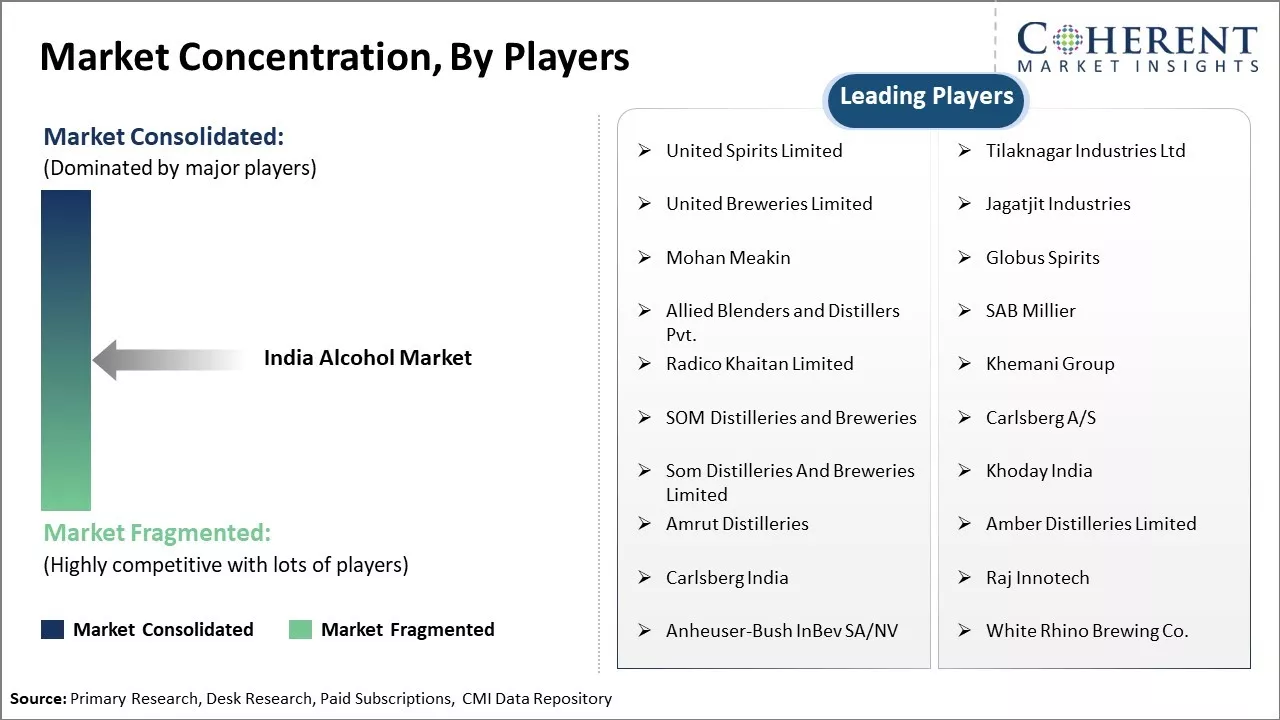
Market Concentration and Competitive Landscape
India Alcohol Market: Growth Drivers
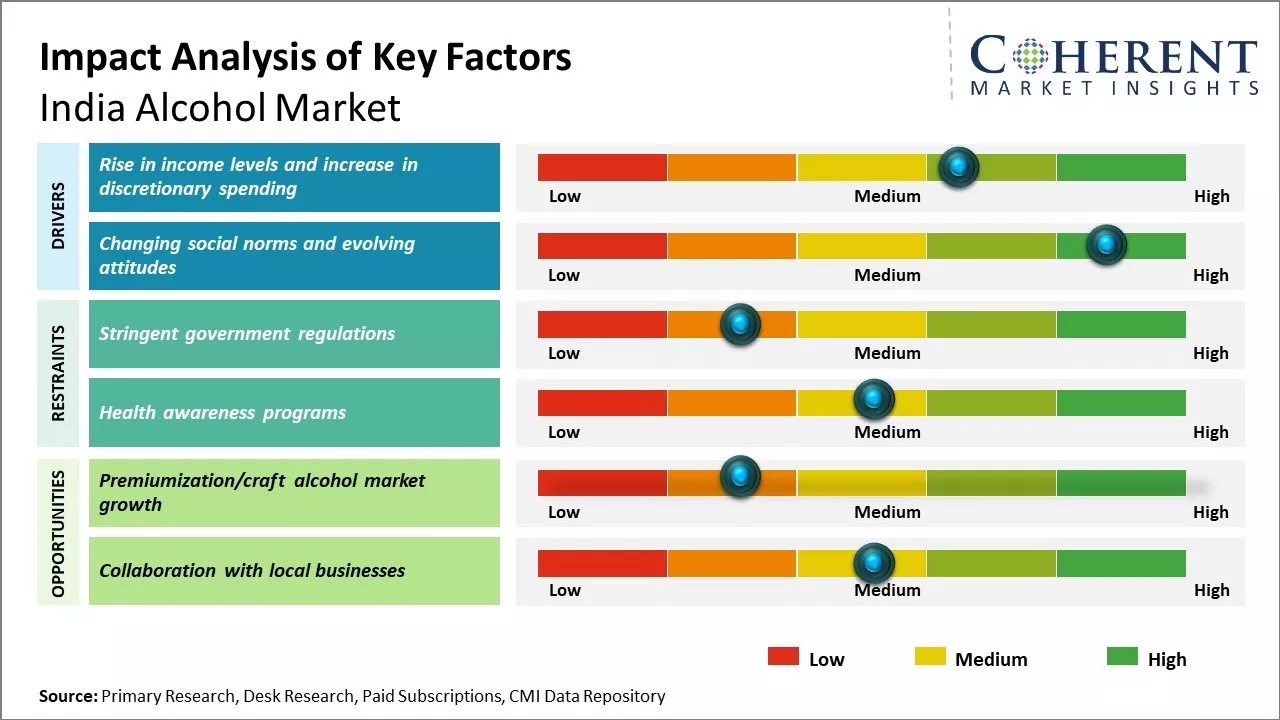
- Rise in income levels and increase in discretionary spending
With India's economy growing at a rapid pace over the past decade, personal incomes have risen substantially. According to recent estimates, the average annual household income in India increased from around US$1,100 in 2010 to nearly US$1,800 in 2020. This rise has been fueled by robust job creation in sunrise industries and service sectors. As incomes increased, so has the amount of discretionary spending power with individuals.
Alcohol happens to be one of those luxury/leisure goods whose demand increases along with the rise in discretionary incomes. Young urban Indias today have more exposure to global lifestyle and are willing to spend on premium alcoholic drinks when dining out or socializing with friends. They see alcohol consumption as a sign of social status.
Alcohol manufacturers have cleverly targeted this segment through innovative products, premium branding, and attractive packaging. Aggressive marketing campaigns on digital platforms have also increased visibility.
Overall, the growing middle-class population with higher spending power has enhanced the addressable market for premium alcohol brands. However, much of the increased income is still being spent in the lower-priced alcohol segment as well which also aids the overall category growth.
- Changing social norms and evolving attitudes
Society and culture play a big role in shaping consumption behaviors. India society is known to have deep-rooted conservative views when it comes to alcohol consumption historically. However, over the past decade, social attitudes have started evolving at a fast pace, especially in urban areas.
Young Indians today have more exposure to global culture through easy access to media and internet. They are comfortable socializing over drinks and do not necessarily see alcohol as a vice anymore. Even in smaller towns and cities, people have become more open-minded about casual drinking. Changing mindsets have made alcohol more acceptable as a means of socialization, relaxation, and enjoyment rather than just inebriation.
Alcohol companies promoting a moderate drinking lifestyle through their branding and responsible consumption campaigns have also helped mold positive social perceptions. Greater social acceptability of alcohol coupled with consumers' desire to socialize more freely is working in favor of the market.
India Alcohol Market: Trends
Social standards, demographic shifts, and changing consumer tastes are all having an impact on the dynamically changing Indian alcohol market. With urban and younger consumers increasingly seeking out premium, artisan, and foreign spirits, premiumization is a prominent trend that is propelling strong development in the premium and super-premium segments.
Demand for distinctive flavors, origin tales, and artisanal craftsmanship has increased as a result of consumers' increased ability to explore options beyond budget-friendly, mass-market options due to rising disposable incomes and the growing middle class.
India Alcohol Market: Opportunities
- Premiumization/craft alcohol market growth
The Indian alcohol market has seen significant changes over the past few years with the rising popularity of premium and craft alcohol. Consumers are increasingly seeking unique drinking experiences and are willing to pay more for higher quality drinks that are produced using traditional or novel methods. This premiumization trend provides excellent opportunities for growth in the Indian market.
More Indian consumers, especially millennials and Gen Z, are exploring craft beers, wines & spirits and cocktails. They want artisanal products that have an interesting story and flavor profile. Traditional liquors like fenny and daru are also seeing renewed interest from urban populations who want to experiment with indigenous drinks.
Several small craft brands have emerged who are handcrafting unique products using organic ingredients, innovative recipes, or reviving legacy techniques. For example, breweries in certain northeastern states are infusing beers with indigenous herbs and spices. Similarly, distilleries in Maharashtra, Goa and Sikkim are crafting novel single malts, gins and organic country liquors.
India Alcohol Market: Key Developments
- May 2025, Riding the wave of Indian spirits being appreciated across the world, homegrown liquor company Radico Khaitan has made a bold statement in the premium spirits market with the twin launch of Morpheus Super Premium Whisky and TRIKĀL Indian Single Malt. The new whiskies suggest that the company is determined to build on the luxury whiskies segment.
- In December 2024, DIAGEO India announce the launch of its India Rare Spirits, it redefines the luxury whisky ownership through personalized craftmanship.
Analyst Opinion
- The India alcohol market continues to demonstrate strong growth potential driven by increasing disposable incomes and consumption among younger demographics. However, stringent regulations and socio-cultural factors still restrain the market in many parts of the country. The growing culture of social drinking and vibrant nightlife in urban centers provide opportunities to introduce premium and innovative products.
- Rural consumption is expected to see a gradual increase as development reaches tier 2 and 3 cities with rising economic opportunities. Furthermore, easing restrictions on foreign investment and partnership with local players may help international spirits and beer companies expand their footprint in India.
- Online alcohol sales also emerge as a promising avenue to address the distribution challenges in India’s vast geography through seamless digital interfaces.
Speak to the analyst
Want personalized insights?
Take the findings above to one of our principal consultants, or have the report rebuilt around the segments, geographies and competitors you actually track.
Market Segmentation
- By Beverage Type (Revenue, USD Bn, 2021 - 2033)
- Beer
- Spirits (Whisky, Vodka, Rum, Gin, etc.)
- Wine
- Others
- By Price Point (Revenue, USD Bn, 2021 - 2033)
- Premium/Luxury
- Mid-range
- Economy/Value
- By Distribution Channel (Revenue, USD Bn, 2021 - 2033)
- Supermarkets and Hypermarkets
- Specialty Liquor Stores
- Online Platforms
- Bar and Restaurants
- Company Profiles
- United Spirits Limited
- Tilaknagar Industries Ltd.
- United Breweries Limited
- Jagatjit Industries
- Mohan Meakin
- Globus Spirits
- Allied Blenders and Distillers Pvt.
- SAB Millier
- Radico Khaitan Limited
- Khemani Group
- SOM Distilleries and Breweries
- Carlsberg A/S
- Som Distilleries And Breweries Limited
- Khoday India
- Amrut Distilleries
- Amber Distilleries Limited
- Carlsberg India
- Raj Innotech
- Anheuser-Bush InBev SA/NV
- White Rhino Brewing Co.
Sources
Primary Research interviews
- Excise Department Officials (state-level)
- Alcohol distributors and wholesalers
- Liquor store owners (retailers)
- Hotel and bar managers
Databases
- CMIE Prowess
- Tracxn
- PitchBook
- Venture Intelligence
- GlobalData India
Magazines
- Spiritz Magazine
- Ambrosia Magazine
- The Spirits Business (India section)
- Brewer World
- Food & Beverage Business Review
- Hospitality Talk
Journals
- International Journal of Hospitality Management (India-focused articles)
- Indian Journal of Marketing
- Indian Journal of Economics and Business
- South Asian Journal of Business and Management Cases
Newspapers
- The Economic Times
- Business Standard
- Mint (Livemint)
- The Hindu Business Line
- Financial Express
- Times of India (Business section)
Associations
- Confederation of Indian Alcoholic Beverage Companies (CIABC)
- All India Brewers’ Association (AIBA)
- Indian Alcohol Policy Alliance (IAPA)
- Indian Distillers’ Association (IDA)
- Indian Beverage Association (IBA)
Proprietary Elements
- CMI Data Analytics Tool, Proprietary CMI Existing Repository of information for last 8 years
Get access to 250+ pages report
Every segment, forecast, competitor profile and data table behind the analysis above — available for instant download.
- ESOMAR Member
- ISO 9001:2015 Certified
- D-U-N-S Registered
- GDPR & CCPA Compliant
Missing comfort of reading report in your local language? Find your preferred language:
Transform your Strategy with Exclusive Trending Reports
Frequently Asked Questions
The India Alcohol Market size is estimated to be valued at USD 64.86 Bn in 2026, and is expected to reach USD 110.44 Bn by 2033.
The CAGR of the India Market is projected to be 7.9% from 2026 to 2033.
Rise in income levels and increase in discretionary spending and changing social norms and evolving attitudes are the major factors driving the growth of the India market.
Stringent government regulations and health awareness programs are the major factors hampering the growth of the India market.
In terms of beverage type, spirits (whisky, vodka, rum, gin, etc.) is estimated to dominate the market revenue share in 2026.
United Spirits Limited, Tilaknagar Industries Ltd, United Breweries Limited, Jagatjit Industries, Mohan Meakin, Globus Spirits, Allied Blenders and Distillers Pvt., SAB Millier, Radico Khaitan Limited, Khemani Group, SOM Distilleries and Breweries, Carlsberg A/S, Som Distilleries And Breweries Limited, Khoday India, Amrut Distilleries, Amber Distilleries Limited, Carlsberg India, Raj Innotech, Anheuser-Bush InBev SA/NV, and White Rhino Brewing Co. are the major players.