

Bioethanol Market Size and Forecast — 2026 - 2033
The Global Bioethanol Market is projected to be valued at approximately USD 68.5 billion in 2026 and is anticipated to grow to around USD 115.4 billion by 2033, registering a compound annual growth rate (CAGR) of 7.6% during the forecast period from 2026 to 2033.
Overview
The Bioethanol market products primarily include fuel-grade ethanol used as a renewable transportation fuel blended with gasoline, such as E10, E20, and E85. It is produced from feedstocks like corn, sugarcane, wheat, and other biomass sources. Key product segments include first-generation ethanol derived from food crops and second-generation (cellulosic) ethanol produced from agricultural residues, wood, and waste materials. Industrial ethanol is used in chemicals, pharmaceuticals, and cosmetics, while beverage ethanol serves alcoholic drink production. Additionally, denatured ethanol is widely used for industrial applications. Advancements focus on sustainable, low-carbon bioethanol solutions and high-efficiency production technologies across global markets and industries worldwide.
Key Takeaways
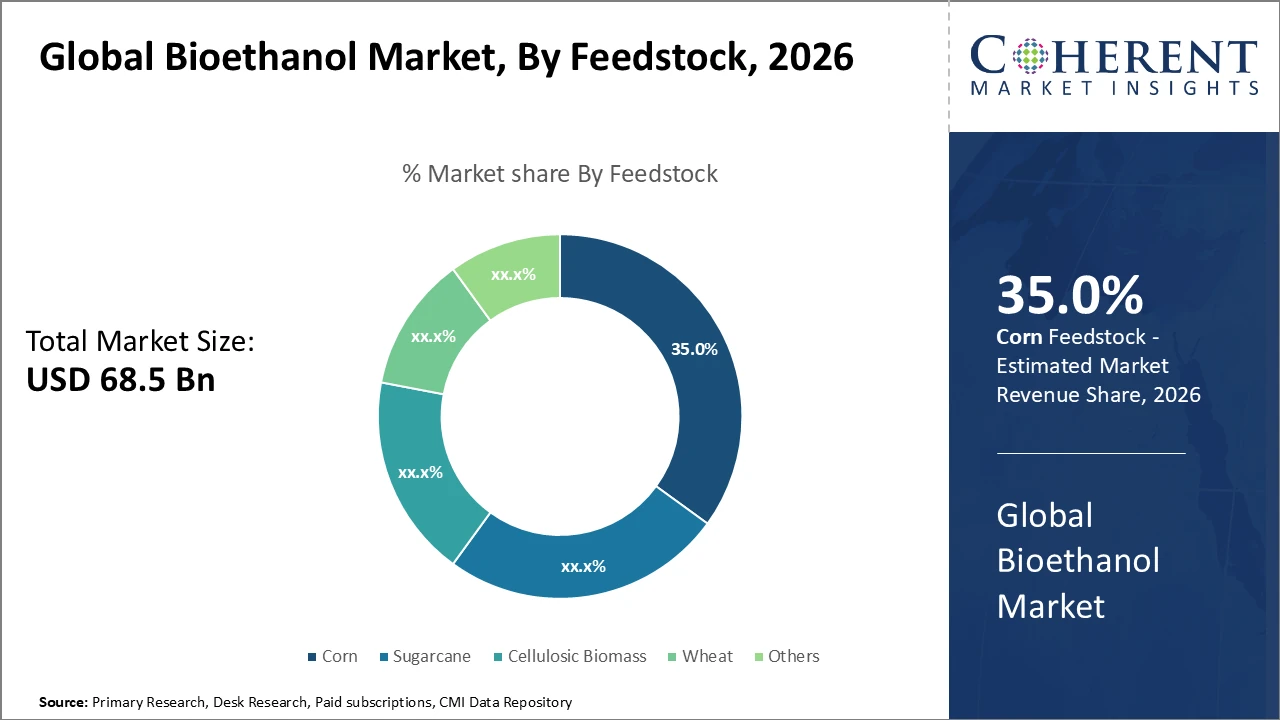
• In the feedstock segment, corn dominates with a 35% market share
due to its wide availability and cost-effectiveness, while cellulosic
biomass is the fastest growing owing to sustainability trends.
• Fuel application accounts for two-thirds of the market revenue, driven
by policy mandates and expanding supply chains.
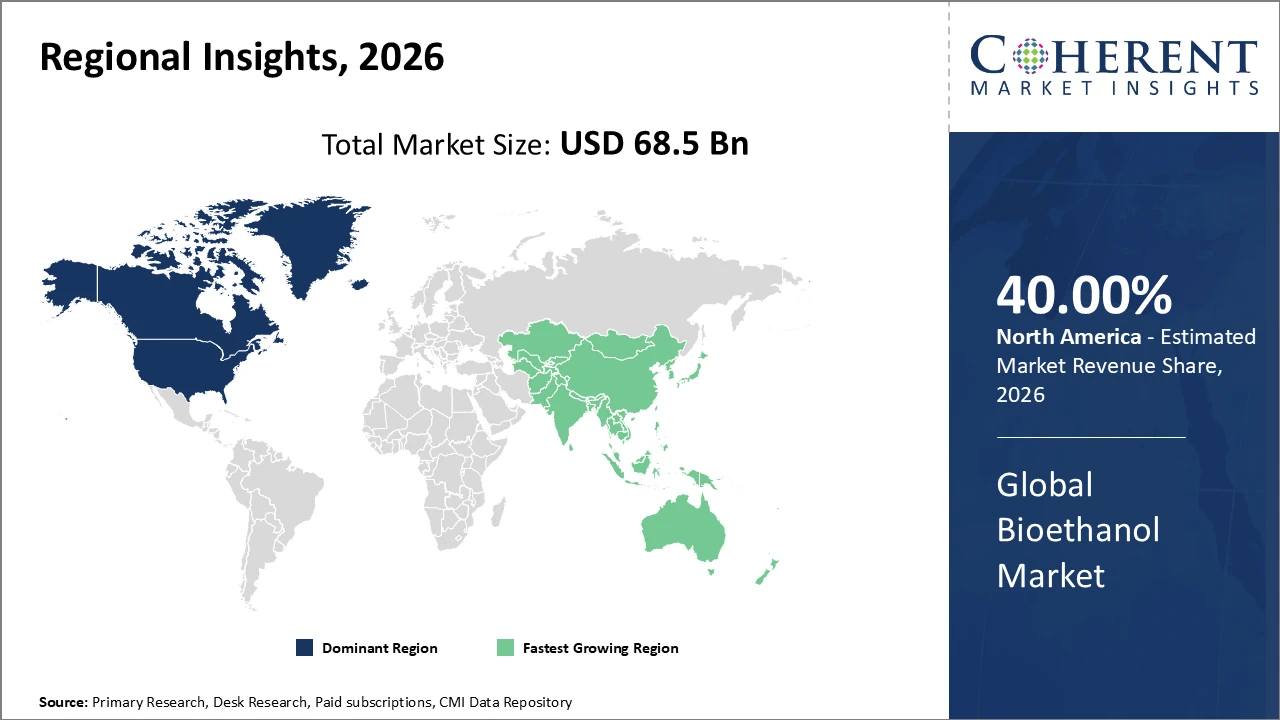
• North America holds the largest market share primarily due to strong
infrastructure and export capabilities.
• Asia Pacific is the fastest-growing region with growth rates exceeding
9%, propelled by increasing renewable energy adoption and policy
reforms.
Bioethanol Market Segmentation Analysis
Bioethanol Market Insights, By Feedstock
Corn dominates the bioethanol feedstock market with a 35% share, driven by its extensive cultivation and cost advantage, particularly in North America, where it serves as the primary raw material for ethanol production. Cellulosic biomass is the fastest-growing subsegment due to environmental regulations promoting sustainable fuels and advancements in conversion technologies that enable the use of agricultural residues and wood chips. Sugarcane remains a significant feedstock, especially in Latin America, supported by high yield per hectare and suitable climatic conditions. Wheat and other minor feedstocks contribute steadily but account for a smaller share of global ethanol production overall.
Bioethanol Market Insights, By Application
The fuel segment commands around 67% of the bioethanol market share, driven by global mandates requiring ethanol blending with gasoline and the rising demand for cleaner, renewable transportation fuels. Strong policy support and expanding biofuel infrastructure further reinforce its dominance. The pharmaceuticals segment is the fastest growing, fueled by increasing use of bioethanol in sanitizers, disinfectants, and medical-grade solvents, particularly in Europe and Asia Pacific following recent health crises. Industrial solvents, beverages, and other applications hold smaller yet stable shares, contributing to market diversification and providing additional revenue streams across chemical, food, and healthcare industries globally.
Bioethanol Market Insights, By Production Process
Dry milling dominates the bioethanol production process due to its lower capital investment, simpler operations, and greater flexibility, making it the preferred method among producers, particularly in the United States. Cellulosic ethanol production is the fastest-growing segment, supported by technological innovations that reduce processing costs and its strong sustainability benefits through the use of agricultural waste and non-food biomass. Wet milling is used in large-scale facilities and produces valuable coproducts such as gluten and starch, but it accounts for a smaller share due to higher complexity and cost. Emerging enzymatic and biochemical methods are also gaining traction in advanced bioethanol production.
Bioethanol Market Trends
•The bioethanol market trend increasingly emphasizes sustainability
and feedstock innovation, with a strong shift toward cleaner production
methods.
• The adoption of cellulosic bioethanol is rising, as it uses non-food
biomass and supports more sustainable fuel production.
• Cellulosic bioethanol production capacity increased by 30% in 2026 due
to the integration of next-generation bioprocessing technologies that
reduced costs by 15%.
• Asia Pacific is transitioning from a largely import-dependent region
to an emerging producer, driven by government incentives and rising
transport fuel demand.
• China and India’s biofuel blending targets introduced in 2025 have
accelerated domestic investments and strengthened regional market
growth.
Bioethanol Market Insights, By Geography
North America Bioethanol Market Analysis and Trends
North America dominates the bioethanol market with around 40% share, supported by its well-established production infrastructure and extensive corn cultivation that ensures a steady feedstock supply. The region also benefits from strong export capabilities to Latin America and Asia Pacific, strengthening its global market position. Supportive regulatory frameworks, including renewable fuel standards, continue to drive consistent demand and long-term growth in the sector. Leading industry players such as Archer Daniels Midland and Green Plains Inc. further reinforce regional leadership through continuous technological advancements, capacity expansions, and investments in efficient and sustainable bioethanol production processes across key manufacturing facilities.
Asia Pacific Bioethanol Market Analysis and Trends
Asia Pacific is the fastest-growing region in the bioethanol market, registering a CAGR exceeding 9%. Growth is driven by government mandates promoting ethanol blending, increasing transportation fuel demand, and rising adoption of flex-fuel vehicles across key economies. Improved logistics infrastructure and expanding investments from local companies, along with substantial imports, are supporting rapid market expansion. Rising environmental awareness and supportive policy frameworks are further strengthening market development. Countries such as India, China, and Indonesia are playing a major role, with evolving trade policies and strong renewable energy initiatives accelerating production capacity and consumption of bioethanol across the region.
Bioethanol Market Outlook for Key Countries
USA Bioethanol Market Analysis and Trends
The USA’s bioethanol market remains a global leader, with production exceeding 15 billion gallons in 2026, primarily supported by extensive corn cultivation and advanced processing technologies. Strong federal and state incentives, along with Renewable Fuel Standard (RFS) mandates, continue to drive production growth and market revenues. Major industry players such as Archer Daniels Midland have invested over USD 500 million in capacity expansions and technological upgrades over the past two years, significantly enhancing output efficiency. As a result, the United States maintains its position as a key global exporter of bioethanol to regions including Asia and Latin America, ensuring sustained competitiveness.
Germany Bioethanol Market Analysis and Trends
The Germany bioethanol market is a mature and highly regulated segment of Europe’s renewable fuel industry, supported by strong government policies and blending mandates such as E10 fuel adoption. Demand is primarily driven by the Biofuel Quota Act and the country’s commitment to reducing greenhouse gas emissions. Germany relies on efficient feedstock utilization, including grains and sugar beets, supported by advanced biorefinery infrastructure. A key trend is the growing shift toward sustainable and second-generation bioethanol, particularly cellulosic ethanol derived from agricultural residues. Industrial applications in chemicals and pharmaceuticals are expanding, while innovation and decarbonization goals continue to shape long-term market growth.
Analyst Opinion
• The bioethanol market trend increasingly emphasizes sustainability
and innovation in feedstock utilization.
• The adoption of cellulosic bioethanol is rising, as it uses non-food
biomass and supports a shift toward greener fuel production.
• Production capacity of cellulosic bioethanol increased by 30% in 2026
due to the integration of next-generation bioprocessing
technologies.
• These technological advancements have reduced production costs by
approximately 15%, improving commercial viability.
• Asia Pacific is transitioning from a largely import-dependent region
to an emerging producer due to supportive government incentives and
rising fuel demand.
• China and India’s biofuel blending targets introduced in 2025 have
accelerated domestic investments in the sector.
• These developments are collectively driving stronger market growth and
regional expansion globally.
- Current Industry Events of 2026
- Market Size Estimation
- Regional Breakdown
- Competitive Landscape
- Customer Intelligence
- Segmental Analysis
- Pricing Analysis
- Key Market Drivers, Challenges & Future Trends
- Customized Insights Section
Market Scope
| Report Coverage | Details | ||
|---|---|---|---|
| Base Year: | 2025 | Market Size in 2026: | USD 68.5 billion |
| Historical Data for: | 2020 To 2024 | Forecast Period: | 2026 To 2033 |
| Forecast Period 2026 to 2033 CAGR: | 7.6% | 2033 Value Projection: | USD 115.4 billion |
| Geographies covered: |
| ||
| Segments covered: |
| ||
| Companies covered: | Green Plains Inc., Biosev SA, Tereos, Cosan SA, Enerkem Inc., POET, LLC, Pacific Ethanol Inc., Cargill, Incorporated, Flint Hills Resources, Raizen Energia SA | ||
| Growth Drivers: |
| ||
Bioethanol Market Growth Factors
Rising regulatory frameworks focused on carbon footprint reduction are significantly driving bioethanol adoption, with more than 70 countries implementing biofuel blending mandates as of 2026. The expansion of flex-fuel vehicle fleets, especially in Latin America and Asia Pacific, is supporting steady demand growth and strengthening global market revenues. Technological advancements in production, particularly cellulosic bioethanol processes, are improving yield efficiency and reducing costs. In 2025, cellulosic bioethanol output increased by 25%, further expanding market potential. Additionally, growing concerns over fossil fuel depletion and energy security are encouraging increased investments in bioethanol infrastructure, fostering sustained global market growth and competitiveness.
Bioethanol Market Development
In April 2026, Sumitomo Forestry and Rengo launched a joint venture to produce bioethanol from wood biomass for sustainable aviation fuel.
Key Players
Leading Companies of the Market
Green Plains Inc.
Cosan SA
POET, LLC
Biosev SA
Enerkem Inc.
Tereos
Cargill, Incorporated
Flint Hills Resources
Pacific Ethanol Inc.
Raizen Energia SA
Several market companies are increasingly adopting forward integration strategies to strengthen supply chain control and improve operational efficiency. For instance, Archer Daniels Midland Company invested in advanced fermentation technologies in 2025, resulting in an 18% increase in production efficiency and enhancing its competitiveness in global bioethanol markets. Similarly, Raízen Energia implemented collaborative initiatives with automotive manufacturers in Brazil, which led to a 10% rise in the adoption of bioethanol fuel blends. These strategic moves have helped key players consolidate their market positions, optimize distribution networks, and expand their share across major regional markets, reinforcing long-term industry growth and stability.
Bioethanol Market Future Outlook
The bioethanol market future outlook is highly positive, driven by rising global demand for renewable fuels and strong policy support for decarbonization. Increasing adoption of blending mandates, expansion of flex-fuel vehicles, and growing investments in sustainable energy infrastructure are expected to fuel steady growth. Technological advancements in second-generation and cellulosic bioethanol will enhance production efficiency and reduce dependence on food-based feedstocks. Emerging economies in Asia Pacific and Latin America are likely to become key growth engines due to rising energy needs and supportive regulations. Overall, the market is expected to evolve toward low-carbon, diversified, and innovation-driven fuel solutions.
Bioethanol Market Historical Analysis
The historical analysis of the bioethanol market shows steady growth driven by increasing demand for renewable energy and supportive government policies over the past decades. Early development was led by Brazil and the United States, focusing on sugarcane and corn-based ethanol production. The introduction of blending mandates such as E10 and E20 significantly boosted global consumption. Over time, concerns about fossil fuel dependence and greenhouse gas emissions accelerated adoption across Europe and Asia. Technological improvements in fermentation and distillation enhanced production efficiency. In recent years, the market has expanded further with the emergence of cellulosic ethanol and advanced biofuel technologies.
Sources
Primary Research Interviews:
Biofuel plant managers, ethanol production engineers, and refinery operators focusing on bioethanol manufacturing efficiency, feedstock utilization, and blending operations
Energy policy experts, renewable fuel consultants, and sustainability analysts involved in ethanol blending mandates, carbon reduction programs, and biofuel adoption strategies
Executives from bioethanol companies, R&D heads, and process engineers working on fermentation technologies, cellulosic ethanol development, and next-generation biofuels
Databases:
IEA (International Energy Agency) – Renewable fuel outlook, blending mandates, and global ethanol consumption data
Magazines:
Biofuels Digest – Global bioethanol industry news, project updates, and technology developments
Renewable Energy World – Biofuel policy updates, market trends, and sustainability insights
Ethanol Producer Magazine – Production innovations, plant operations, and feedstock developments
Journals:
Biomass and Bioenergy – Research on ethanol production technologies and feedstock efficiency
Renewable and Sustainable Energy Reviews – Studies on biofuel policies and sustainability impact
Bioresource Technology – Advances in cellulosic ethanol and biomass conversion processes
Energy Policy – Analysis of government regulations and biofuel adoption impacts
Newspapers:
The Wall Street Journal – Energy market investments and biofuel industry developments
Financial Times – Renewable energy transition and global biofuel trade dynamics
Reuters Energy – Bioethanol production updates, policy changes, and market movements
Bloomberg – Energy sector analysis, ethanol pricing trends, and company performance
Associations:
Renewable Fuels Association (RFA) – U.S. ethanol industry standards, advocacy, and market data
International Energy Agency Bioenergy (IEA Bioenergy) – Global biofuel research and policy guidance
European Renewable Ethanol Association (ePURE) – EU ethanol market insights and regulatory updates
Get access to 250+ pages report
Every segment, forecast, competitor profile and data table behind the analysis above — available for instant download.
- ESOMAR Member
- ISO 9001:2015 Certified
- D-U-N-S Registered
- GDPR & CCPA Compliant
Missing comfort of reading report in your local language? Find your preferred language:
Transform your Strategy with Exclusive Trending Reports
Frequently Asked Questions
The market is dominated by companies such as Green Plains Inc., POET, LLC, and Raízen Energia S.A., which collectively hold significant production capacities and technological advancements.
The Bioethanol Market size is expected to grow from USD 68.5 billion in 2026 to USD 115.4 billion by 2033, at a CAGR of 7.6%, reflecting continuous demand and technological progress.
The fuel segment, particularly transport fuel blending, holds the largest growth opportunity due to increasing regulatory mandates and vehicle fleet expansions globally.
Emerging feedstocks like cellulosic biomass and regional penetration in Asia Pacific will drive market shifts, alongside advances in bioethanol processing technologies enhancing efficiency and sustainability.
Competition is intense with companies adopting integration and expansion strategies, yet challenges remain in feedstock price volatility and infrastructural constraints in emerging markets.
Strategic partnerships for supply chain optimization, technological innovation in fermentation processes, and geographic expansion into Asia Pacific and Latin America are commonly pursued strategies.