

Global Ready Meals Market Size and Forecast – 2026 - 2033
The Global Ready Meals Market is estimated to be valued at USD 171.04 Bn in 2026 and is expected to reach USD 248.80 Bn by 2033, exhibiting a compound annual growth rate (CAGR) of 5.5% from 2026 to 2033.
Key Takeaways of the Ready Meals Market
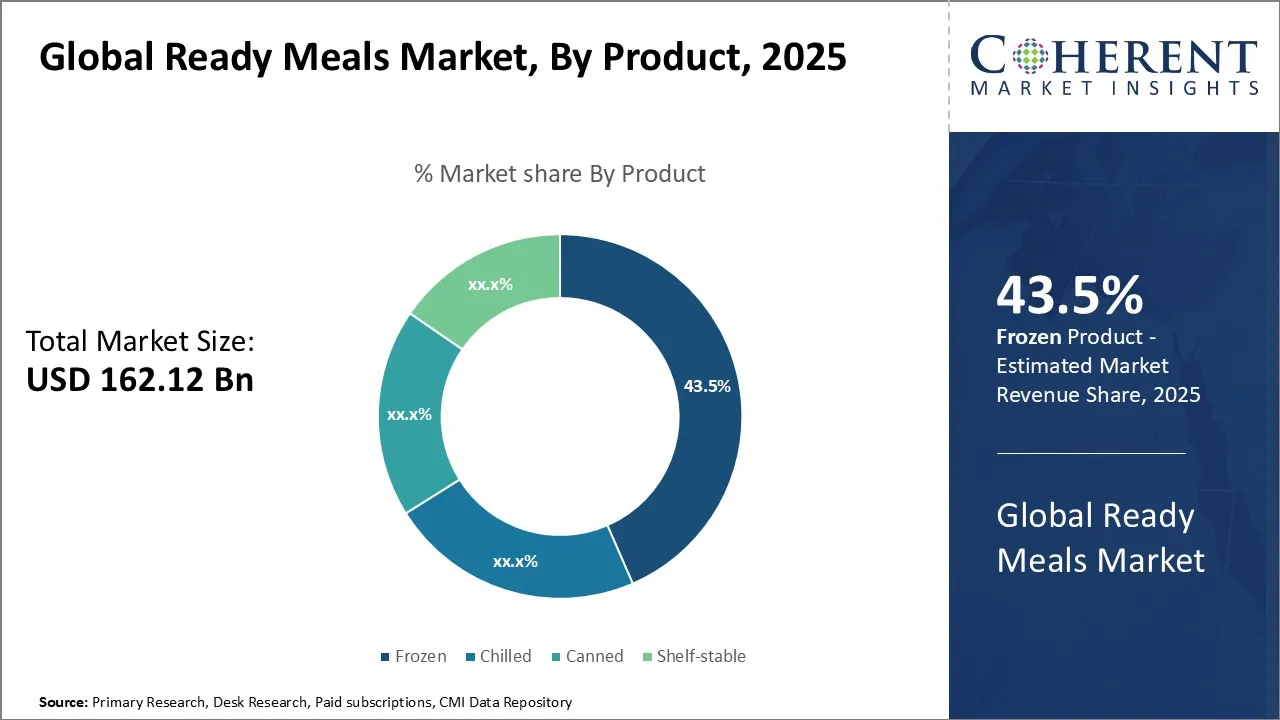
- The frozen segment is expected to hold a commanding 44.5% market share in 2026, driven by key factors tied to evolving consumer lifestyles and advancements in technology
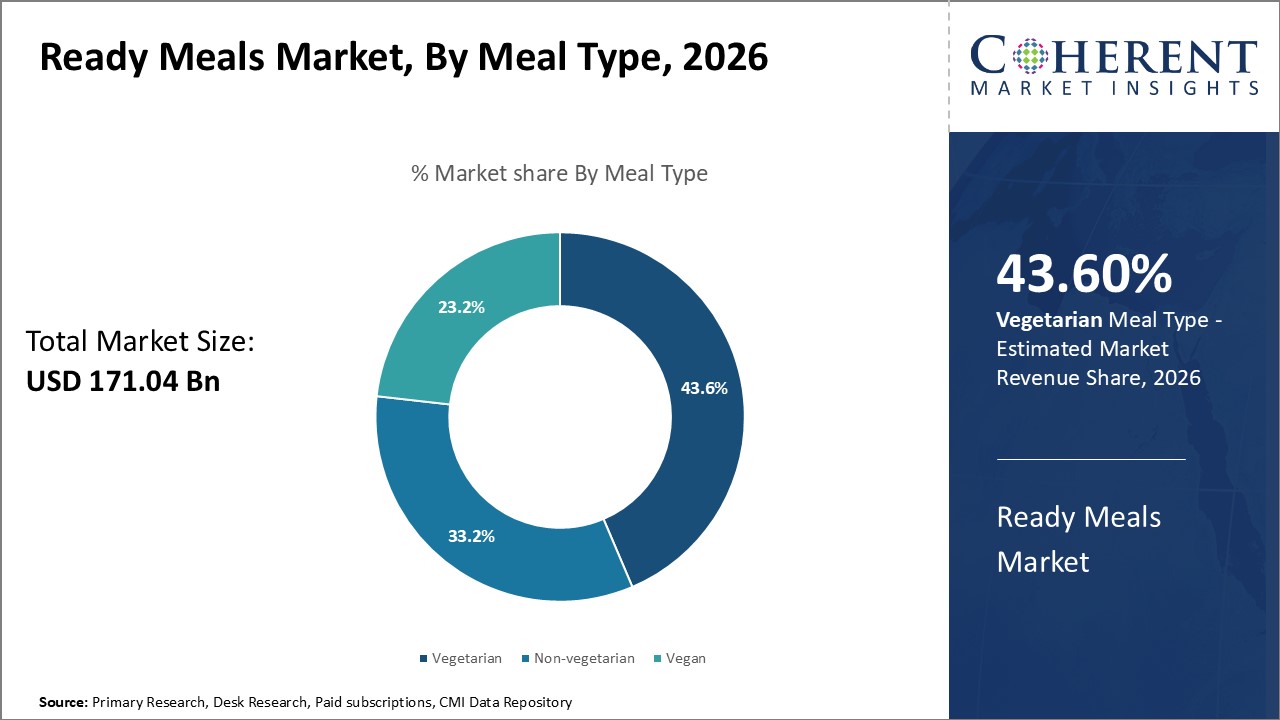
- The vegetarian segment is projected to capture a 43.6% market share in 2026, fueled by growing consumer emphasis on health, wellness, and environmental sustainability.
- Supermarkets/hypermarkets segment is expected to account for 39.3% of the market, driven by consumer preferences, retail strengths, and economic factors.
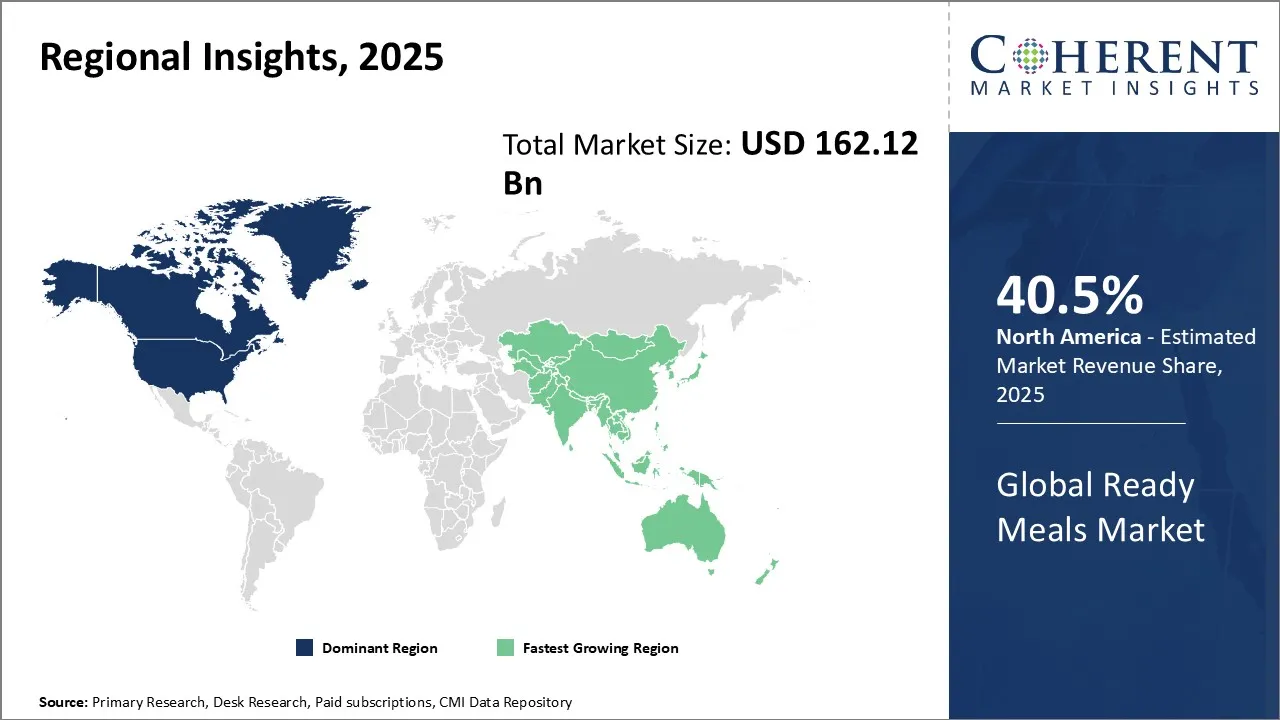
- North America is set to lead the global ready meal market in 2026 with a 40. 5% share, driven by busy lifestyles, increasing urbanization, strong retail distribution, and increasing demand for convenient and clean‑label food options. Asia Pacific, with a 14.5% share in 2026, will be the fastest-growing region, propelled by rapid urbanization, rising disposable incomes, dual-income households, modern retail expansion, e-commerce penetration, and rising consumer interest in convenient, nutritious meals.
Market Overview
A prominent trend in the ready meals market is the growing consumer shift towards nutritious and clean-label products. There is a heightened focus on organic, gluten-free, and plant-based ready meal options, reflecting rising health consciousness among consumers. Additionally, technological advancements in meal preservation and smart packaging, next generation packaging are enhancing product shelf life and convenience. The integration of online food delivery services further fuels market growth by increasing accessibility and variety, making ready meals a preferred choice for modern consumers seeking quick, hassle-free dining solutions.
Current Events and Its Impact
Current Events | Description and its impact |
Technological Advancements in Processing and Packaging |
|
Growth of E-commerce and Meal Delivery Services |
|
Segmental Insights
- Current Industry Events of 2026
- Market Size Estimation
- Regional Breakdown
- Competitive Landscape
- Customer Intelligence
- Segmental Analysis
- Pricing Analysis
- Key Market Drivers, Challenges & Future Trends
- Customized Insights Section
Ready Meals Market Insights, By Product – The Frozen Segment Leads the Market, Driven by Consumer Lifestyle Trends and Technological Innovations
The frozen segment is expected to command 44.5% share of the market in 2026, due to several key drivers rooted in consumer lifestyle trends and technological advancements. The foremost factor is convenience. Frozen ready meals offer consumers the ability to store food for extended periods without spoilage, allowing for quick preparation with minimal effort. This appeals greatly to busy professionals, students, and families who seek time-saving meal options without sacrificing variety or quality.
For example, brands like Amy’s Kitchen have leveraged innovative freezing technologies to preserve the nutritional quality and taste of their meals, making them popular among urban consumers with hectic schedules. Additionally, the rise of smart freezers and microwave ovens with preset cooking modes tailored for frozen meals has further simplified meal preparation, boosting the frozen segment’s appeal.
Ready Meals Market Insights, By Meal Type – The Vegetarian Segment is Driving Growth, Led by Rising Health, Ethical, and Sustainability Concerns
Vegetarian segment is projected to hold 43.6% market share in 2026, driven by increasing consumer focus on health, wellness, and environmental sustainability. As more consumers embrace plant-based diets, vegetarian ready meals are gaining traction as an accessible, convenient way to maintain these eating habits without the need for extensive cooking skills or ingredient sourcing.
Health consciousness is a dominant force fueling demand for vegetarian ready meals. Many consumers associate plant-based options with lower risks of chronic illnesses such as heart disease, diabetes, and obesity, prompting them to seek out vegetarian meals that are nutrient-dense and free from animal fats. This perception encourages both habitual vegetarians and flexitarians to incorporate ready-to-eat vegetarian meals into their weekly diets.
Ready Meals Market Insights, By Distribution Channel - Supermarkets and Hypermarkets Remain the Dominant Distribution Channel, Shaping Consumer Access and Product Choice
Supermarkets and hypermarkets segment is projected to contribute 39.3% share of the market in 2026, a position supported by several intersecting factors related to consumer shopping habits, retailer capabilities, and market economics. Their dominance in the global ready meals market is largely due to their ability to offer extensive product variety combined with one-stop shopping convenience, critical for today’s busy consumers.
One key driver is the centralized nature of these large-format retail outlets, which allows consumers to conveniently buy ready meals alongside their regular grocery shopping. This synergy eliminates extra trips, saving time and effort, which appeals especially to working professionals and time-starved households. Ready meals benefit as an impulse or planned purchase within this all-encompassing shopping environment.
Regional Insights
North America Ready Meals Market Analysis and Trends
The North America region is projected to lead the market with a 40.5% share in 2026, due to its advanced food processing industry, strong logistics, and high consumer demand for convenient meals. Strict food safety regulations ensure quality and trust. The region’s multicultural population drives diverse ready meal options. Key companies like Kraft Heinz and Campbell Soup invest in innovation and sustainability. Extensive retail channels, including supermarkets and e-commerce, support wide market reach, solidifying North America’s dominant position.
Asia Pacific Ready Meals Market Analysis and Trends
The Asia Pacific region is expected to exhibit the fastest growth in the market contributing 14.5% share in 2026, due to rapid urbanization, increasing disposable income, and shifting consumer lifestyles favoring convenience foods. The expansion of modern retail formats, such as hypermarkets and e-commerce platforms, enhances product reach and visibility. Governments across countries like China, India, Japan, and South Korea are increasingly encouraging food safety standards and supporting local food manufacturing innovations.
Rising awareness of health and nutrition is paving the way for premium and variety-rich ready meal offerings. Domestic companies like CJ CheilJedang in South Korea, Tingyi Holding Corp in China, and MTR Foods in India are key contributors, alongside multinational corporations penetrating the region through strategic partnerships and local production, reflecting an evolving and dynamic market ecosystem.
Global Ready Meals Market Outlook for Key Countries
U.S. Ready Meals Market Trends
The U.S. ready meals market is driven by health-conscious, on-the-go consumers with busy lifestyles. Leading companies like Conagra Brands, Kraft Heinz, and Hormel Foods are expanding offerings to include organic, plant-based, and ethnic options. Strong cold chain logistics and wide retail distribution enhance product availability. Innovations in packaging and online ordering boost market reach. Reflecting these trends, Nestlé announced a USD 150 million investment in 2024 to expand its South Carolina facility with a new single-serve frozen meal production line, highlighting demand for convenient, portion-controlled meals.
Germany Ready Meals Market Trends
Germany ready meals market demonstrates stability supported by a sophisticated retail ecosystem and high consumer awareness about food quality and sustainability. Companies like Frosta AG and Nestlé have a stronghold, developing innovative and eco-friendly ready meal products aligned with stringent European food regulations. Government initiatives focusing on reducing food waste and promoting healthier diets positively influence product development and marketing strategies. Germany's emphasis on local sourcing and organic produce further enriches the market’s appeal to conscientious consumers.
China Ready Meals Market Trends
China’s rapidly growing urban population and changing dietary habits underpin the expanding ready meals market. Domestic manufacturers, including Tingyi Holding Corp and COFCO Corporation, lead innovation in convenient, nutritious, and culturally tailored ready meals. The government supports modernization of food manufacturing processes and encourages food safety compliance, which boosts consumer confidence. The surge in online grocery shopping and delivery platforms has also transformed market accessibility, allowing brands to tap into a vast and diverse consumer base. Foreign companies increasingly collaborate with local partners to customize offerings suited to Chinese tastes.
India Ready Meals Market Trends
India ready meals market growth is driven by a young population, increasing urbanization, and rising workforce participation among women, creating demand for convenience food solutions. Companies like MTR Foods, ITC Limited, and Haldiram's play a critical role in delivering ready meals that cater to traditional flavor profiles while introducing convenience. Government efforts to improve food processing infrastructure and quality standards enhance the overall market environment. The surge in organized retail formats and e-commerce platforms further accelerates product availability, particularly among millennials and working professionals.
U.K. Ready Meals Market Trends
The U.K. ready meals market combines consumer demand for convenience with a rising focus on healthier and sustainable eating. Major players such as Premier Foods, Marks & Spencer, and Bakkavor have innovated to include ready meals with organic, free-from, and plant-based options, reflecting changing health trends. The U.K. government’s regulations on food labeling and nutrition encourage transparency and product reformulation. The integration of ready meals into online grocery channels and meal kit subscriptions enhances market reach and consumer engagement, positioning the U.K. as a progressive market that balances convenience and health priorities.
Critical Factors Impacting Consumer Preferences
- Consumer preferences in the ready meals market are shaped by several critical factors, each reflecting broader shifts in lifestyle, health awareness, and economic circumstances. The most influential driver is convenience, as urbanization and fast-paced routines leave consumers with less time to cook, making ready meals an attractive solution for quick, hassle-free dining. Taste and quality are equally important; consumers expect ready meals to deliver flavors and freshness comparable to home-cooked food, with many now seeking gourmet or global flavors that offer variety and indulgence.
- Health considerations are rising in prominence, with a growing segment of consumers willing to pay a premium for meals perceived as healthier, featuring clean labels, reduced preservatives, and options tailored to dietary needs such as vegan, gluten-free, or low-calorie diets. Affordability and value for money are increasingly scrutinized, especially in the context of inflation and cost-of-living pressures, prompting consumers to weigh the price of ready meals against dining out or cooking from scratch.
- Availability and accessibility—both in-store and through online channels—also play a significant role, as consumers expect a wide range of choices that are easy to purchase and prepare. Finally, sustainability and packaging innovations are influencing preferences, with eco-friendly, microwave-safe, and biodegradable packaging becoming important differentiators as environmental awareness grows. Together, these factors underscore a market where convenience, health, taste, affordability, and sustainability converge to shape consumer choices in ready meals.
Market Players, Key Development, and Competitive Intelligence
Key Developments
- In January 2025, SPAR Gran Canaria launched a new ‘Fresh To Go’ range of 40-50 ready meals in collaboration with Helamore, enhancing customer convenience. This new food-to-go offering is now available in over 55 SPAR Supermarkets across Gran Canaria.
- In June 2023, Unilever, the British multinational consumer goods company, announced its acquisition of Yasso, a premium frozen Greek yogurt brand in North America, aiming to strengthen its yogurt portfolio.
- In April 2023, Nestlé, the Swiss multinational food and beverage conglomerate, announced the formation of a joint venture with PAI in Europe to compete in the frozen pizza market, a highly competitive category.
Top Strategies Followed by Global Ready Meals Market Players
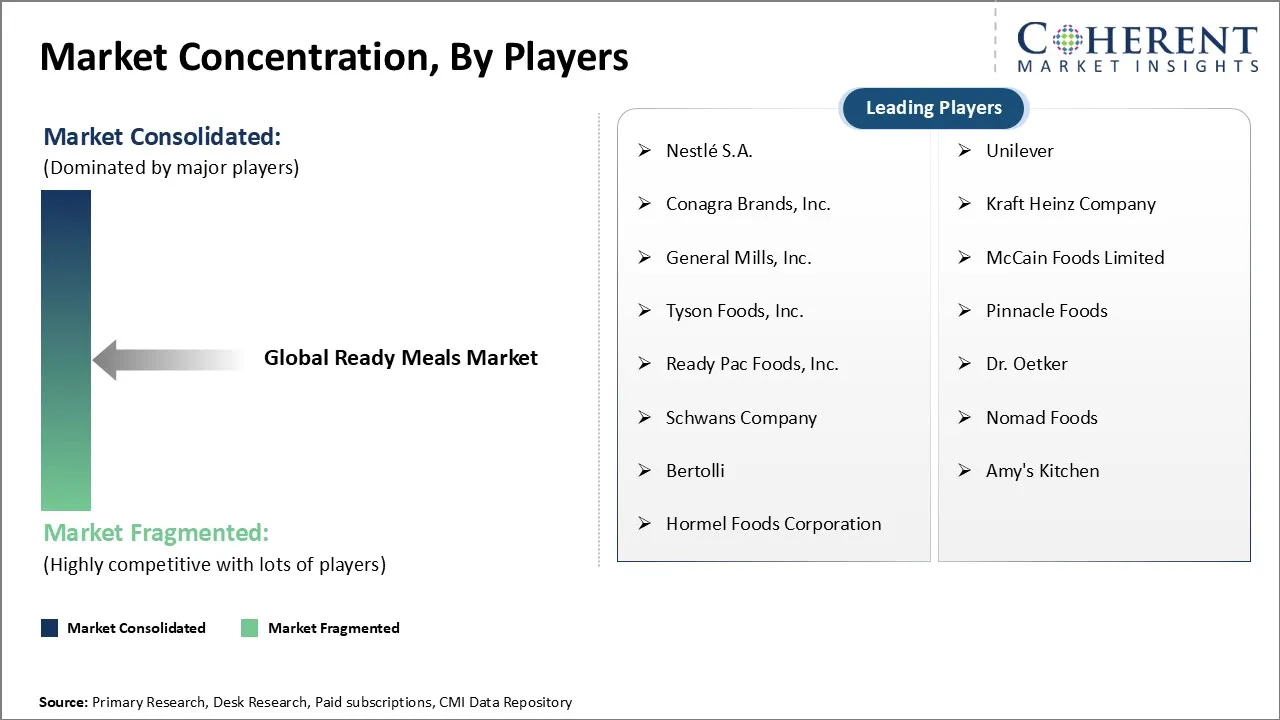
- Established players, often multinational corporations, such as Nestlé, Kraft Heinz, and Unilever, focus heavily on innovation as the cornerstone of their market dominance. These companies invest substantial resources into research and development (R&D) to create high-performance ready meals that meet evolving consumer preferences such as health-consciousness, convenience, and sustainability.
- For example, Nestlé has developed plant-based ready meals under its Garden Gourmet brand to cater to the growing demand for vegan and vegetarian options. Beyond product innovation, these giants strategically collaborate with major industry stakeholders and original equipment manufacturers (OEMs) to strengthen their supply chain efficiency and product quality.
- Mid-level players in the ready meals sector adopt a different but equally targeted strategy, focusing primarily on cost-effective solutions that strike a balance between quality and affordability. By catering to price-sensitive consumer segments, these companies capture significant market share among budget-conscious customers who seek convenience without compromising too much on taste or nutritional value. To compete with larger players, mid-sized firms actively engage in collaborations that can amplify their production capabilities and technological know-how.
- For example, U.K.-based mid-sized ready meal company Charlie Bigham’s focuses on providing premium-quality meals at affordable prices, targeting customers who want a higher-quality alternative to typical budget brands. To optimize production and reduce costs, Charlie Bigham’s has partnered with co-manufacturers and uses contract manufacturing facilities.
- Small-scale players, although limited by resources, distinguish themselves through agility and innovation within niche segments of the ready meals market. These companies often focus on specialized product features such as organic ingredients, dietary-specific meals (e.g., keto, vegan, gluten-free), or regional authenticity that resonate strongly with particular consumer groups.
- For instance, the U.S.-based company Saffron Road specializes in ready meals that emphasize organic, Halal-certified, and globally inspired flavors. By targeting consumers seeking authentic ethnic cuisines combined with clean-label ingredients, Saffron Road has carved out a loyal following despite operating at a smaller scale compared to industry giants.
Market Report Scope
Ready Meals Market Report Coverage
| Report Coverage | Details | ||
|---|---|---|---|
| Base Year: | 2025 | Market Size in 2026: | USD 171.04 Bn |
| Historical Data for: | 2020 To 2024 | Forecast Period: | 2026 To 2033 |
| Forecast Period 2026 to 2033 CAGR: | 5.5% | 2033 Value Projection: | USD 248.80 Bn |
| Geographies covered: |
| ||
| Segments covered: |
| ||
| Companies covered: | Nestlé S.A., Unilever, Conagra Brands, Inc., Kraft Heinz Company, General Mills, Inc., McCain Foods Limited, Tyson Foods, Inc., Pinnacle Foods, Ready Pac Foods, Inc., Dr. Oetker, Schwans Company, Nomad Foods, Bertolli, Amy's Kitchen, and Hormel Foods Corporation | ||
| Growth Drivers: |
| ||
| Restraints & Challenges: |
| ||
Market Dynamics
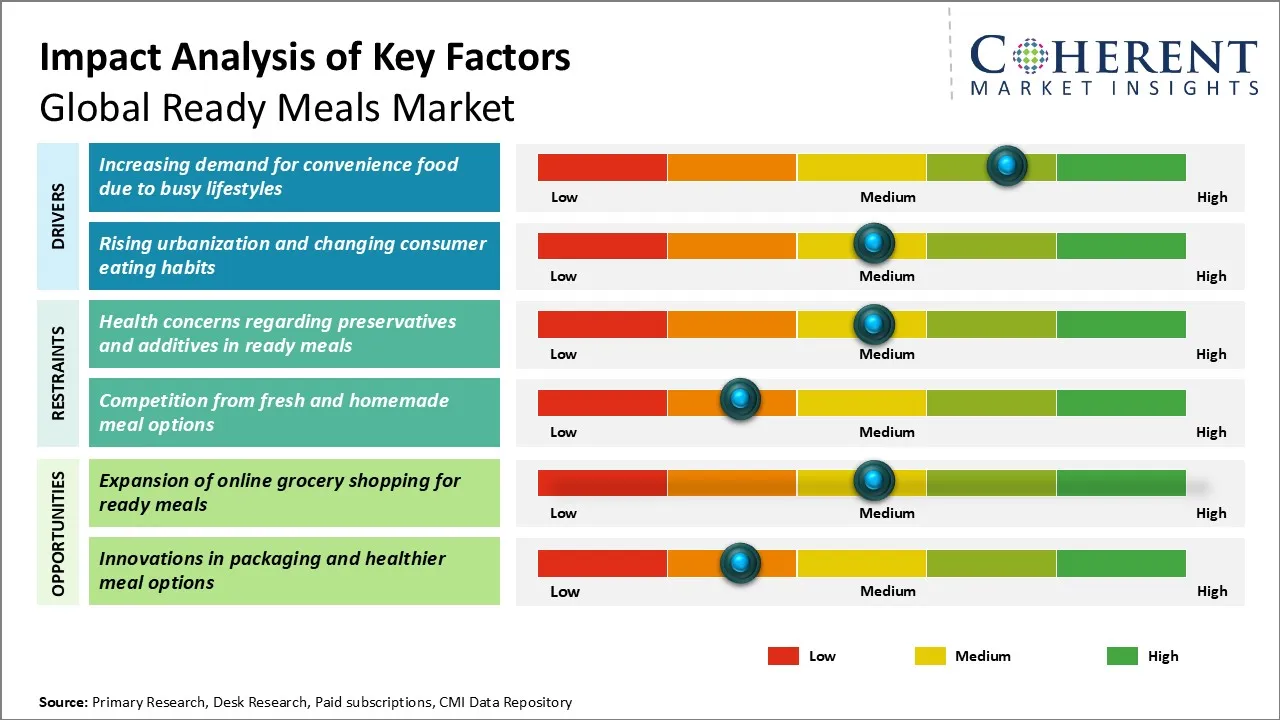
Ready Meals Market Driver - Increasing Demand for Convenience Food Due to Busy Lifestyles
The accelerating pace of modern life has significantly contributed to the surge in demand for convenience foods, positioning ready meals as an increasingly preferred choice among consumers worldwide. With more individuals juggling professional commitments, family responsibilities, and social engagements, the need for quick, hassle-free meal solutions has become paramount. Ready meals offer the distinct advantage of saving valuable time on meal preparation without compromising on taste or nutritional value, making them particularly attractive to working professionals, students, and urban dwellers.
For instance, working professionals often face long hours and tight schedules, leaving little time for cooking. This has led to a noticeable increase in sales of ready-to-eat meals from major retailers like Tesco and Walmart, which report consistent growth in their ready meal segments.
Ready Meals Market Opportunity - Expansion of Online Grocery Shopping for Ready Meals
The rapid growth of online grocery shopping presents a significant opportunity for the global ready meals market, driven by evolving consumer preferences and technological advancements. Increasing internet penetration, smartphone adoption, and improved logistics infrastructure have facilitated greater accessibility to e-commerce platforms, enabling consumers to conveniently browse, order, and receive ready meals at their doorstep. This shift is particularly pronounced among urban populations and younger demographics, who prioritize time-saving solutions and seek variety in meal choices without compromising convenience or quality.
For example, platforms like Amazon Fresh and Instacart in the U.S. have reported significant year-over-year increases in ready meal orders, especially from millennials and Gen Z consumers who prefer digital shopping experiences.
Analyst Opinion (Expert Opinion)
- The global ready meals market is on an impressive growth trajectory, driven by evolving consumer lifestyles that prioritize convenience without compromising on quality. Brands like HelloFresh and Lean Cuisine are leading the charge by innovating with healthier, gourmet options that cater to diverse dietary preferences. Recent conferences, such as the SIAL Paris (2023) and the Food & Beverage Innovation Forum (2022), have highlighted significant trends, including the rise of plant-based ready meals and the integration of clean label practices.
- Presentations showcased successful case studies where companies have leveraged technology to enhance freshness and flavor while ensuring quick preparation times. Additionally, the increasing emphasis on sustainability has prompted many players to adopt eco-friendly packaging solutions and responsibly sourced ingredients. As consumer demand for nutritious, ready-to-eat options continues to rise, the market is well-positioned for robust expansion. The combination of innovation, strategic marketing, and a focus on health and sustainability will drive the ready meals sector forward, making it a key player in the food industry landscape in the coming years.
Speak to the analyst
Want personalized insights?
Take the findings above to one of our principal consultants, or have the report rebuilt around the segments, geographies and competitors you actually track.
Market Segmentation
- Product Insights (Revenue, USD Bn, 2021 - 2033)
- Frozen
- Chilled
- Canned
- Shelf-stable
- Meal Type Insights (Revenue, USD Bn, 2021 - 2033)
- Vegetarian
- Non-vegetarian
- Vegan
- Distribution Channel Insights (Revenue, USD Bn, 2021 - 2033)
- Supermarkets/Hypermarkets
- Online Retail
- Convenience Stores
- Specialty Stores
- Regional Insights (Revenue, USD Bn, 2021 - 2033)
- North America
- U.S.
- Canada
- Latin America
- Brazil
- Argentina
- Mexico
- Rest of Latin America
- Europe
- Germany
- U.K.
- Spain
- France
- Italy
- Russia
- Rest of Europe
- Asia Pacific
- China
- India
- Japan
- Australia
- South Korea
- ASEAN
- Rest of Asia Pacific
- Middle East
- GCC Countries
- Israel
- Rest of Middle East
- Africa
- South Africa
- North Africa
- Central Africa
- North America
- Key Players Insights
- Nestle S.A.
- Unilever
- Conagra Brands, Inc.
- Kraft Heinz Company
- General Mills, Inc.
- McCain Foods Limited
- Tyson Foods, Inc.
- Pinnacle Foods
- Ready Pac Foods, Inc.
- Oetker
- Schwans Company
- Nomad Foods
- Bertolli
- Amy's Kitchen
- Hormel Foods Corporation
Sources
Primary Research Interviews
- Product Development Manager – Leading Ready Meals Manufacturer
- Supply Chain Director – Major Retailer of Ready Meals
- Marketing Head – Well-Known Frozen and Chilled Ready Meal Brand
- Quality Assurance Manager – Food Safety and Certification Body
Stakeholders
- Manufacturers (Frozen, Chilled, Shelf-stable Ready Meals)
- End-use Sectors:
- Retail Grocery Chains
- Foodservice and Hospitality (Cafes, Restaurants, Catering)
- Convenience Stores and Online Food Delivery Platforms
- Regulatory & Certification Bodies (Food Safety and Quality)
- E-commerce Platforms and Retailers
- Technology Integration Players: AI-based demand forecasting and packaging innovation providers
Databases
- UN Comtrade Database
- India Import Export (EXIM) Database
- Nielsen Retail Sales Data (Ready Meals Category)
Magazines
- Food Business News – Trends in Ready Meals and Convenience Foods
- Frozen & Refrigerated Buyer – Innovations in Frozen Ready Meals
- Convenience Store News – Growth of On-the-Go Ready Meals
- Prepared Foods Magazine – Market updates and product innovation in ready meals
- The Grocer – Retail insights into ready meals consumption
Journals
- Journal of Food Science & Technology – Processing and Preservation of Ready Meals
- International Journal of Gastronomy and Food Science – Consumer Preferences for Ready Meals
- Food Control – Food Safety and Quality in Ready Meal Production
- Journal of Food Engineering – Packaging and Shelf Life of Ready Meals
Newspapers
- The Financial Times – Market growth and investment trends in ready meals
- The Guardian – Changing consumer habits around convenience foods
- Asia Food Journal – Growth of ready meals in Asia-Pacific markets
Associations
- Food Marketing Institute (FMI)
- National Frozen & Refrigerated Foods Association (NFRA)
- International Association for Food Protection (IAFP)
- Grocery Manufacturers Association (GMA)
- European Frozen Food Association (EFFA)
Public Domain Sources
- U.S. FDA – Guidelines and regulations for ready meals and processed foods
- European Commission – Food safety and labeling regulations for convenience foods
- World Health Organization – Nutrition guidelines related to processed and ready meals
Proprietary Elements
- CMI Data Analytics Tool, Proprietary CMI Existing Repository of information for last 8 years.
Get access to 250+ pages report
Every segment, forecast, competitor profile and data table behind the analysis above — available for instant download.
- ESOMAR Member
- ISO 9001:2015 Certified
- D-U-N-S Registered
- GDPR & CCPA Compliant
Missing comfort of reading report in your local language? Find your preferred language:
Transform your Strategy with Exclusive Trending Reports
Frequently Asked Questions
The global ready meals market is estimated to be valued at USD 171.04 Bn in 2026 and is expected to reach USD 248.80 Bn by 2033.
Yes, there are ready meals designed for special diets such as gluten-free, vegan, keto, and allergen-free.
Young adults (18-34) and middle-aged adults (35-54) buy ready meals the most due to their busy lifestyles.
The CAGR of the global ready meals market is projected to be 5.5% from 2026 to 2033.
In terms of product, frozen is estimated to dominate the market revenue share in 2026.
Health concerns regarding preservatives and additives in ready meals and competition from fresh and homemade meal options are the major factors hampering the growth of the global ready meals market.
Increasing demand for convenience food due to busy lifestyles and rising urbanization and changing consumer eating habits are the major factors driving the growth of the global ready meals market.