

Next Generation Packaging Market Size and Forecast – 2026-2033
Next Generation Packaging Market is estimated to be valued at USD 67.49 Bn in 2026 and is expected to reach USD 110.52 Bn in 2033, exhibiting a compound annual growth rate (CAGR) of 7.3% from 2026 to 2033.
Key Takeaways
- Based on Packaging Type, Active Packaging segment is expected to command the largest share in the global next generation packaging market in 2026, owing to its extended product quality and shelf-life property.
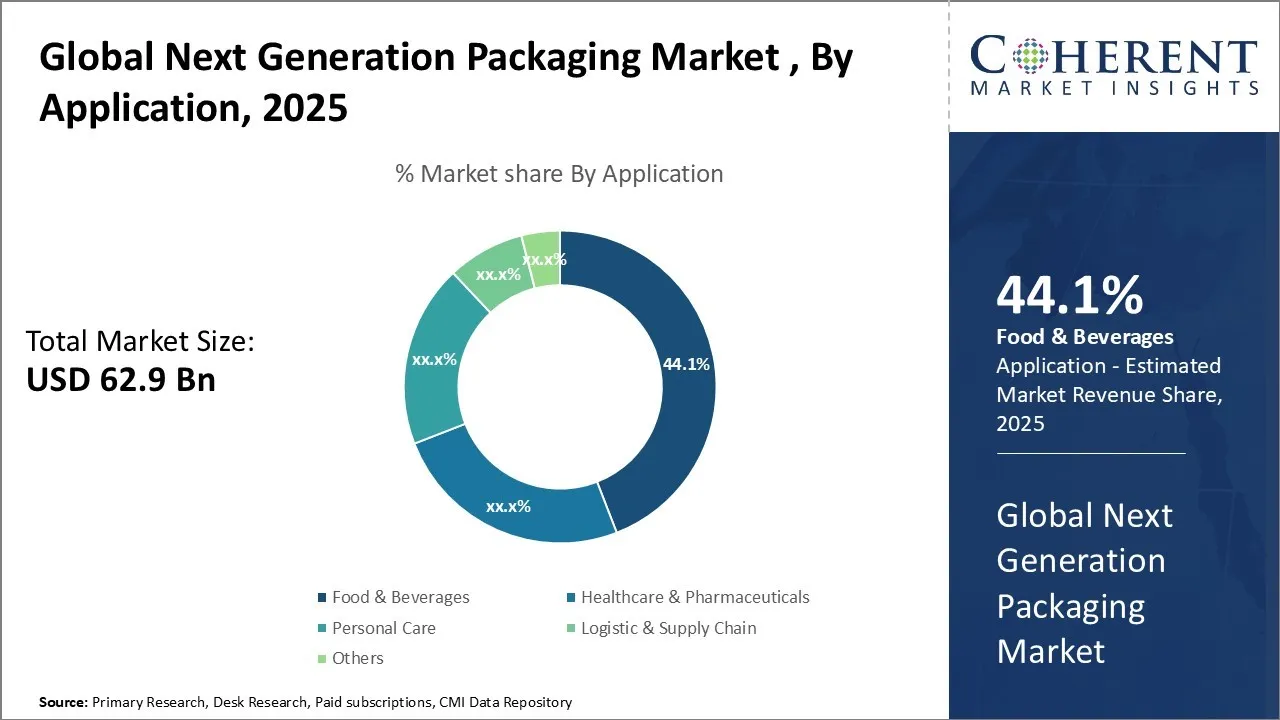
- Based on Application, the Food and Beverages segment are leading indication for market, accounting for approximately 45% of the market share in 2026 due to its direct impact on product safety, and environmental sustainability.
- Based on Region, North America is expected to lead with a share of 34.1% in 2026, owing to its robust e-commerce sector and focus on sustainability and innovation, while Europe is expected to grow at the fastest rate in forecast period credited to strong regulatory framework towards innovative and eco-friendly solutions.
Market Overview
Next generation packaging consists of evolution beyond traditional packaging, focusing on sustainability, efficiency, and functionality. Next generation packaging is designed by embedding technologies such as traceability, condition monitoring, and active material, along with recyclable, reusable or biodegradable packaging material. This approach emphasis on creating more sustainable, convenient and effective packaging, which also protects products while reducing environmental impacts.
Under next-generation solutions, smart packaging is effectively transforming the product containment, with technologies such as QR codes, sensors, and RFID chips. With this techniques packaging becomes interactive tool to engage with customers directly.
For instance, when a fresh produce is transported, the freshness can be monitored through sensors, ensuring products arrive in optimal condition. This provides real-time information to both businesses and consumers.
Current Events and their Impact on the Next Generation Packaging Market
Current Events | Description and their Impact |
Regulatory Shifts in the European Union |
|
Smart Packaging Adoption Surge |
|
Role of Artificial Intelligence (AI) in Next Generation Packaging Market
Integration of artificial intelligence into next generation packaging is helping the packaging and paper industry by optimizing design, reducing material waste, and streamlining the production with cost-effective approach. AI-driven material optimizing that reduces waste without sacrificing durability. Generative AI is a breakthrough technology that utilizes advanced algorithms to create, design and optimize new content by learning pattern from wide data.
In January 2025, Sunny, an oil brand in the United Arab Emirates (UAE) owned by IFFCO, collaborated with global connected packaging leader Appetite Creative to introduce an innovative AI-powered interactive smart packaging experience aimed at enhancing convenience in the kitchen.
- Current Industry Events of 2026
- Market Size Estimation
- Regional Breakdown
- Competitive Landscape
- Customer Intelligence
- Segmental Analysis
- Pricing Analysis
- Key Market Drivers, Challenges & Future Trends
- Customized Insights Section
Segmental Analysis
Next Generation Packaging Market Insights- By Packaging Type- Active Packaging- Maintaining and Extending Product Quality
The Active packaging segment is expected to contribute largest share of 45.1% of the market in 2026, due its ability to maintain and extending product quality and shelf life. Active packaging involves incorporating functional additives into packaging systems that can release or absorb substance to protect that product or its environment. Active packaging system includes oxygen scavengers, moisture absorbs, antibacterial agents and ethylene absorbers. The future of active packaging is expected to have exciting innovation towards controlled release of antimicrobials from packaging materials.
In February 2025, researchers from Chalmers University of technology packaged canned tuna infused in the water-based solution of amino acid cysteine, said it removes up to 35% of accumulated mercury. The University aims to address the concerns over accumulation of toxic mercury mentioned by World Health Organization (WHO). It says that exposure can damage the central nervous system, with foetuses and young children being particularly sensitive to the effects, further propelling the next generation packaging market share.
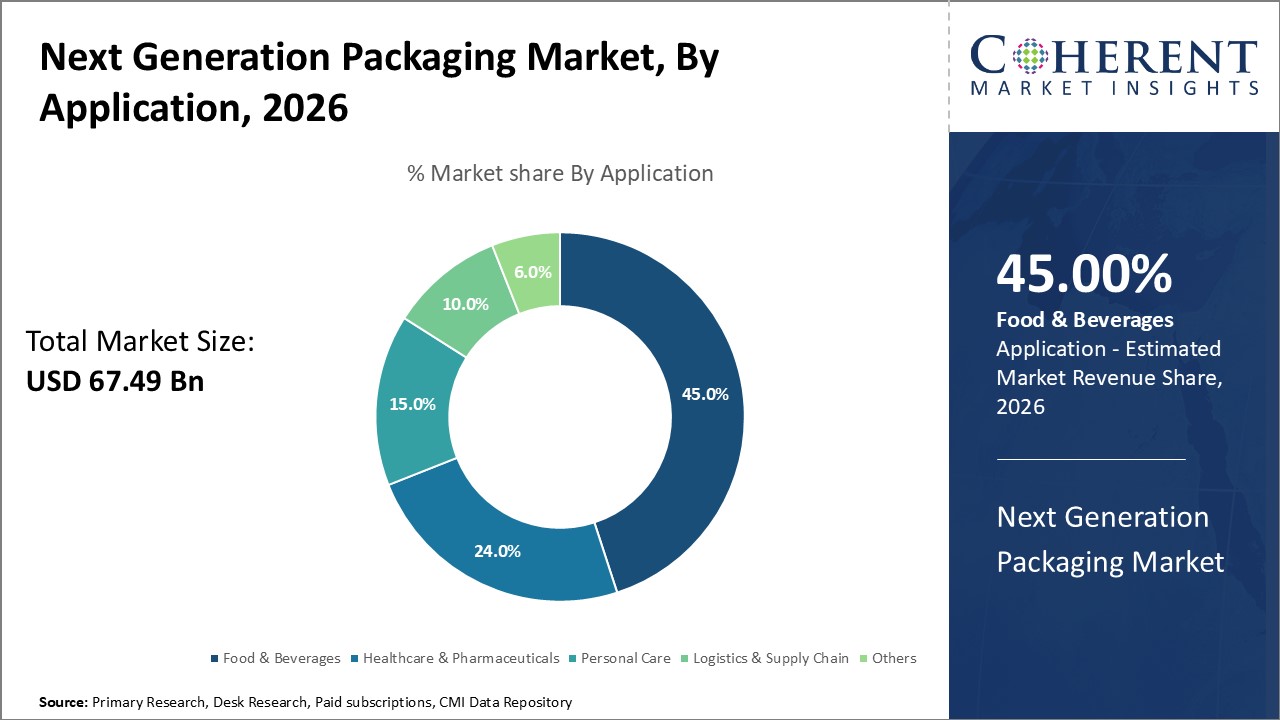
Next Generation Packaging Market Insights- By Application- Direct Impact on Product Safety, and Environmental Sustainability.
Food & beverages segment dominates the global next-generation packaging market in 2026 with around 45% of market share in terms of revenue. The high demand of next generation packaging in food and beverages is observed due to the growing focus on sustainability, reducing waste, and extending shelf life, with a shift towards biodegradable, reusable, and smart packaging solutions. This includes edible films, innovative materials like algae and fungi, and advanced sensors to track food freshness and extend shelf life, all while minimizing environmental impact.
The next generation packaging food and beverages companies are developing innovative solution to repurpose food waste into value-added products such as upcycled snacks, beverages and ingredients contributing to a better sustainable food system. For instance, in May 2025, researchers at Australia’s Food and Beverage Accelerator (FaBA) have developed a roadmap to help Australian food and beverage businesses shift towards more eco-friendly packaging.
Regional Insights
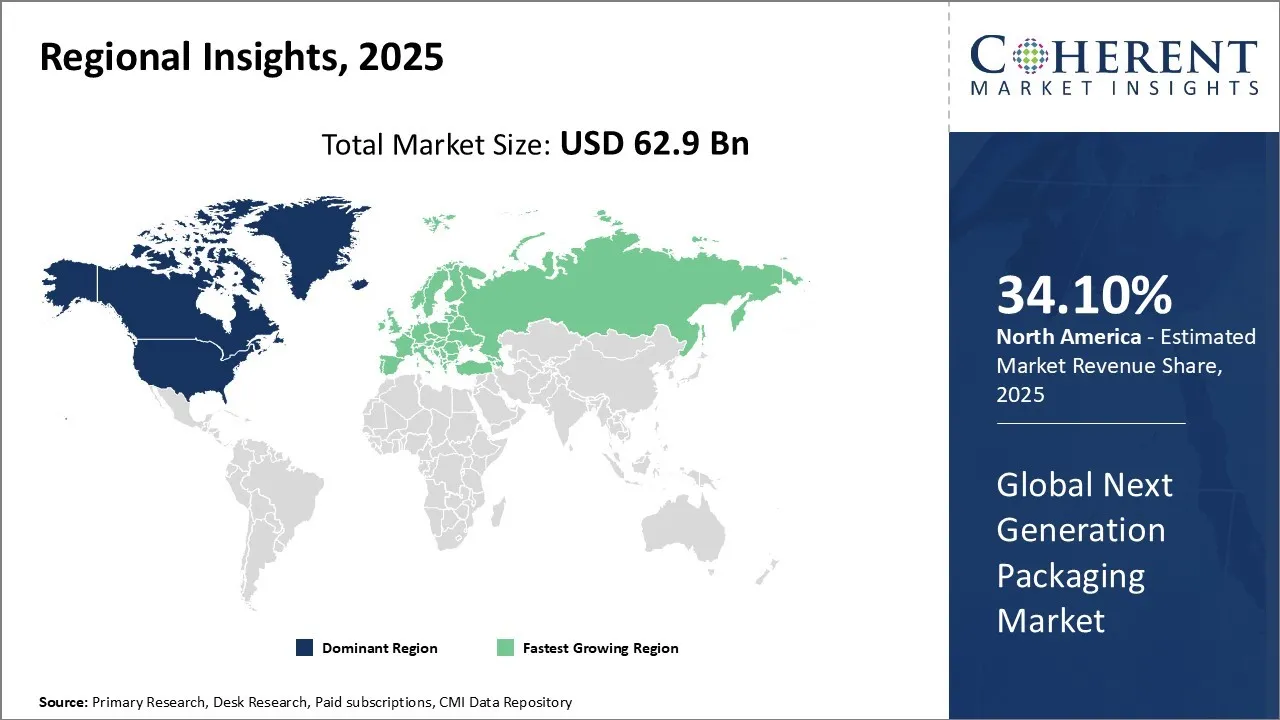
North America Next Generation Packaging Market Analysis and Trends
North America region dominated the market in 2026, accounting for a 34.10% share in terms of value. The predominating factor driving North America is the high level of technological innovation, stringent regulatory framework and rapidly evolving consumer preferences. North America is a global hub for innovations, commonly observed in packaging firms, food and beverages, pharmaceutical manufacturers and technology companies. Along with that, there is strong push for the region towards sustainability and circular economy, which is driven by government policy and consumer activism. In states such as California, New York, and Washington, there is enforcement for Extended Producer Responsibility (EPR) laws, requiring companies to manage packaging waste and fund recycling system.
In January 2026, the Department of Commerce introduced CHIPS National Advanced Packaging Manufacturing Program (NAPMP), for $1.4 billion in award funding to bolster U.S. leadership in advanced packaging and enable new technologies to be validated and transitioned at scale to U.S. manufacturing, further positively influencing the next generation packaging market forecast.
Europe Next Generation Packaging Market Analysis and Trends
Europe is expected to exhibit the fastest growing share of the market in 2026. Europe is expected to have progressive environmental policies, strong regulatory framework and rising consumer demand that priorities sustainability. The European Union (EU) applies targets for circularity and carbon neutrality, the region is fostering innovation in smart, active, and sustainable packaging technologies across multiple industries.
The EU Packaging and Packaging Waste Regulation (PPWR) mandates that all packaging must be recyclable or reusable by 2030. Several countries like Germany, France, Netherlands have introduced Extended Producer Responsibility (EPR) schemes and plastic taxes, pushing companies to invest in innovative packaging formats. Through regulations that catalyzes large-scale R&D in biodegradable materials, mono-material structures, and reusable packaging systems.
In January 2026, Amazon started to pack and deliver groceries for customers in Spain using bio-based bags made from vegetable materials produced in Europe, including corn starch and vegetable oils, which can one day be recycled into new bags.
Next Generation Packaging Market Outlook for Key Countries
The United States Next Generation Packaging Market Analysis and Trends
The United States is a leading state in the global next generation packaging, driven by technological innovation, increasing sustainability commitments, and evolving regulatory and consumer pressure. The country is a leader in both smart (intelligent and active) packaging adoption and the development of eco-friendly materials and circular systems. The U.S. Intelligent packaging technologies includes RFID tags, smart sensors, QR/NFC-enabled labels, and temperature indicators which are widely used in Pharmaceuticals, food and e-commerce field. For example, Huhtamaki has introduced a groundbreaking recyclable ice cream packaging solution in the US, crafted from 95% renewable biobased materials. Additionally, a connected packaging QR code offers consumers detailed information about sustainability.
Germany Next Generation Packaging Market Analysis and Trends
Germany stands at the lead of the next generation packaging in Europe. Germany is driven by a powerful combination of engineered excellence, sustainability leadership, and strict regulatory. As Europe has a largest economy and a key exporter of food, pharmaceuticals, and consumer goods, Germany plays a pivotal role in shaping packaging innovation, particularly in sustainable, smart, and active solutions. The growing demand for sustainable packaging is also acting as one of the key factors propelling the next generation packaging market growth in Germany. Surveys show that over 75% of German consumers are willing to pay more for sustainable packaging.
Global Next Generation Packaging Market Growth Drivers
The Growing Demand for Advanced Packaging
As technology develops, manufacturers are concentrating on providing small electronic devices in numerous industry verticals, including consumer electronics, healthcare, automotive, and semiconductor IC production. In order to accomplish precise patterning on wafers and chips, these businesses are reducing integrated circuits. Additionally, the market for medical devices is witnessing a spike in demand for Nano-sized robotic surgery equipment due to the sophistication and improvements in wearable and personalized healthcare gadgets. Small electrical devices are becoming more popular, thus designers must use smart packaging instead of more conventional techniques. The semiconductor industry is seeing development in miniaturized electrical devices because of the rising need for high-performance electronics. Apart from this, the escalating demand for eco-friendly packaging in pharmaceutical industry is also enhancing the industry’s growth. In December 2024, LOG Pharma Primary Packaging announced to launch new Barrier Eco Line at Pharmapack Europe in Paris. This eco-friendly packaging solution reduces production costs while offering superior moisture and oxygen protection for pharmaceuticals, built on LOG’s expertise in pharma-grade polymers and advanced technology. This is further proliferating the next generation packaging market demand.
Global Next Generation Packaging Market Restraints
High Cost to Limit Market Growth for Advanced Packaging
Advanced semiconductor packing methods are more costly than conventional semiconductor packaging methods. At some stages, it becomes too costly to develop and manufacture semiconductors for each subsequent node. Furthermore, wafer production costs are significantly higher as a result of the complexity of the ICs. As more chips and integrated circuits are packed with intricate designs, the cost of sophisticated packaging increases, limiting its adoption. The semiconductor industry finds advanced packaging to be especially practical because of its many benefits, which include simpler and bigger interconnections for chips and wafers as well as the capacity to integrate heterogeneously. However, because these qualities are so easily accessible, advanced packaging is more expensive than ordinary packaging, which makes it challenging for small enterprises to adopt.
Global Next Generation Packaging Market Opportunity
Sustainability as a Key Feature
The future of packaging market is expected to witness a transformation by sustainability demand, technological innovation, and evolving design trends. These features are primarily driven by consumer preferences and regulatory pressures.
Sustainability in next generation packaging landscape is undergoing a fundamental shift through emerging innovations, policies, and consumer preferences. The environmental concern is intensified particularly around plastic waste and carbon emission, and resource depletion. To deal with these concerns, there is a rising adoption of biodegradable compostable material which are made from material seaweed-based films, mushroom-derived packaging and PLA (polylactic acid). For instance, U.S. Plastic pact is setting ambitious target, to make 100% of plastic packaging in U.S. to be reusable, recyclable or compostable by 2025. This is further anticipated to propel the next generation packaging market share.
Market Report Scope
Next Generation Packaging Market Report Coverage
| Report Coverage | Details | ||
|---|---|---|---|
| Base Year: | 2025 | Market Size in 2026: | USD 67.49 Bn |
| Historical Data for: | 2020 To 2024 | Forecast Period: | 2026 To 2033 |
| Forecast Period 2026 to 2033 CAGR: | 7.3% | 2033 Value Projection: | USD 110.52 Bn |
| Geographies covered: |
| ||
| Segments covered: |
| ||
| Companies covered: | Amcor Limited, WestRock Company, Sonoco Products Company, Sealed Air Corporation, Stora Enso Oyj, Bemis Company, Inc., MULTIVAC, WS Packaging Group, Inc., Active Packaging Ltd., and ULMA Packaging, S.Coop | ||
| Growth Drivers: |
| ||
| Restraints & Challenges: |
| ||
Key Development
- In April 2025, Stora Enso, a Finnish packaging company has introduced Perfrma Nova, a next-generation folding boxboard (FBB) for consumer packaging. The material is intended for use in a range of consumer packaging sectors, including dry, chilled, and frozen foods, as well as confectionery.
- In February 2025, CCL Label introduced the next-generation EcoFloat shrink sleeves in Southeast Asia, made from recycling-friendly polyolefin (PO) material. These sleeves offer up to 73% shrinkage to fit various packaging shapes and automatically detach during the recycling process.
- In February 2025, Clemson FRESH opened a new Compostable Packaging Research and Design Center to drive the development of sustainable, next-generation packaging. The facility was established with $690,000 in funding from the South Carolina Department of Commerce and Clemson University.
- In February 2025, Innovia Films unveiled its next-generation shrink sleeve, crafted from recycling-friendly polyolefin (PO) material. The sleeve provides up to 73% shrinkage to accommodate various packaging shapes and automatically detaches during the recycling process.
Analyst Opinion (Expert Opinion)
- Smart packaging is becoming increasingly popular—whether through QR codes, NFC chips, or augmented reality integration—but the hype around this trend often overlooks an uncomfortable reality: consumers don't care enough to pay a premium for 'smart' packaging unless it offers significant, tangible value. The next-gen packaging market is being sold the idea of connectivity, transparency, and personalization, but those technologies won’t be uniformly adopted.
- Personalized packaging is no longer optional, it’s a demand. However, the industry must tread carefully. As consumer desires for uniqueness increase, brands are going all-in on mass customization. Packaging is not just functional anymore; it has become a critical brand differentiator. According to Coherent Market Insights, 38% of consumers are willing to pay more for a personalized product, and packaging plays a big part in that equation.
- Looking ahead, the future of next-generation packaging is likely to be defined by industry consolidation. Smaller players and startups, which have historically driven innovation, will find it increasingly difficult to compete with the heavyweights who can absorb the costs of R&D, scale up production, and navigate complex regulatory landscapes. As of 2023, 4 companies control 80% of the global packaging market: Amcor, Sealed Air, Ball Corporation, and Smurfit Kappa.
Speak to the analyst
Want personalized insights?
Take the findings above to one of our principal consultants, or have the report rebuilt around the segments, geographies and competitors you actually track.
Market Segmentation:
- By Packaging Type (Revenue, USD Bn, 2021 - 2033)
- Active Packaging
- Intelligent Packaging
- By Application (Revenue, USD Bn, 2021 - 2033)
- Food & Beverages
- Healthcare & Pharmaceuticals
- Personal Care
- Logistics & Supply Chain
- By Region (Revenue, USD Bn, 2021 - 2033)
- North America
- U.S.
- Canada
- Latin America
- Brazil
- Mexico
- Rest of Latin America
- Europe
- U.K.
- France
- Germany
- Russia
- Rest of Europe
- Asia Pacific
- China
- India
- Japan
- Australia
- Rest of Asia Pacific
- Middle East & Africa
- South Africa
- Rest of Middle East & Africa
- North America
- Key Companies
- Amcor Limited
- WestRock Company
- Sonoco Products Company
- Sealed Air Corporation
- Stora Enso Oyj
- Bemis Company, Inc.
- MULTIVAC
- WS Packaging Group, Inc.
- Active Packaging Ltd.
- ULMA Packaging
- S. Coop
Sources
Primary Research Interviews from the following stakeholders:
Stakeholders:
- Interviews with packaging technologists, materials scientists, supply chain experts, sustainability officers, and product development engineers specializing in smart and active packaging technologies.
- Specific stakeholders:
- Packaging R&D directors at leading food, pharmaceutical, and consumer goods manufacturers
- Sustainability and innovation officers at multinational packaging companies
- Engineers and developers of intelligent sensors, RFID, and printed electronics
- Quality assurance managers and regulatory compliance officers
- Cold chain logistics coordinators and retail packaging buyers
Databases:
- ScienceDirect
- IEEE Xplore
- U.S. Patent and Trademark Office (USPTO)
- FDA Packaging Guidance Documents
- Statista Packaging Database
- Scopus
Magazines:
- Packaging World
- Food & Beverage Packaging
- Plastics Today
- RFID Journal
- Packaging Digest
Journals:
- Journal of Packaging Technology and Research
- Packaging Technology and Science
- International Journal of Food Packaging
- Sensors and Actuators B: Chemical
- Materials Today
- Journal of Food Engineering
Newspapers:
- The New York Times
- Financial Times
- The Guardian
- Bloomberg
- Reuters
Associations:
- Institute of Packaging Professionals (IoPP)
- Active & Intelligent Packaging Industry Association (AIPIA)
- Sustainable Packaging Coalition (SPC)
- Flexible Packaging Association (FPA)
- World Packaging Organisation (WPO)
- The Consumer Goods Forum
Public Domain Sources:
- U.S. Food and Drug Administration (FDA)
- U.S. Environmental Protection Agency (EPA)
- U.S. Department of Agriculture (USDA)
- European Food Safety Authority (EFSA)
- World Health Organization (WHO)
- U.S. Department of Commerce
- National Institute of Standards and Technology (NIST)
Proprietary Elements:
- CMI Data Analytics Tool, and Proprietary CMI Existing Repository of information for last 8 years
*Definition: Next-generation packaging is an advanced packaging solution that offers various benefits in terms of product quality information and traceability. It helps in tracking and monitoring the product during the entire supply chain process from shipments to delivery of the product to the location. This ensures the safe delivery of the product to the consumer while preventing damages of the packaged materials. Food & beverages, personal care, healthcare & pharmaceuticals, and logistics are some of the major end users of next-generation packaging.
Get access to 250+ pages report
Every segment, forecast, competitor profile and data table behind the analysis above — available for instant download.
- ESOMAR Member
- ISO 9001:2015 Certified
- D-U-N-S Registered
- GDPR & CCPA Compliant
Missing comfort of reading report in your local language? Find your preferred language:
Transform your Strategy with Exclusive Trending Reports
Frequently Asked Questions
The Next Generation Packaging Market is estimated to be valued at USD 67.49 Bn in 2026, and is expected to reach USD 110.52 Bn by 2033.
The CAGR of the Next Generation Packaging Market is projected to be 7.3% from 2026 to 2033.
Increasing device miniaturization demand will drive up demand for advanced packaging and improved system performances and advanced packaging optimization to accelerate the advanced packaging market growth
Advancement in technology by major player supported by favorable government policies which is expected to favor market growth over the forecast period.
High cost to limit market growth for advanced packaging
Amcor Limited, WestRock Company, Sonoco Products Company, Sealed Air Corporation, Stora Enso Oyj, Bemis Company, Inc., MULTIVAC, WS Packaging Group, Inc., Active Packaging Ltd., and ULMA Packaging, S.Coop.