

Monosodium Glutamate Market Size and Forecast — 2026-2033
The Global Monosodium Glutamate Market size is estimated to be valued at USD 2.44 billion in 2026 and is expected to reach USD 3.4 billion by 2033, exhibiting a compound annual growth rate (CAGR) of 6.0% from 2026 to 2033.
Overview
Monosodium Glutamate is the sodium salt of glutamic acid and functions as a flavor enhancer widely used in food processing. MSG delivers the umami taste, intensifying savory flavor profiles in snacks, instant foods, soups, seasonings, and meat-based products. It is produced via fermentation of natural substrates like sugarcane molasses or starch and is valued for its purity, stability, and safety. MSG is highly soluble, easy to blend, and effective at low doses, making it a cost-efficient additive for improving taste without significantly altering nutrition or appearance. It remains regulated globally as a safe food ingredient when consumed within acceptable limits.
Key Takeaways
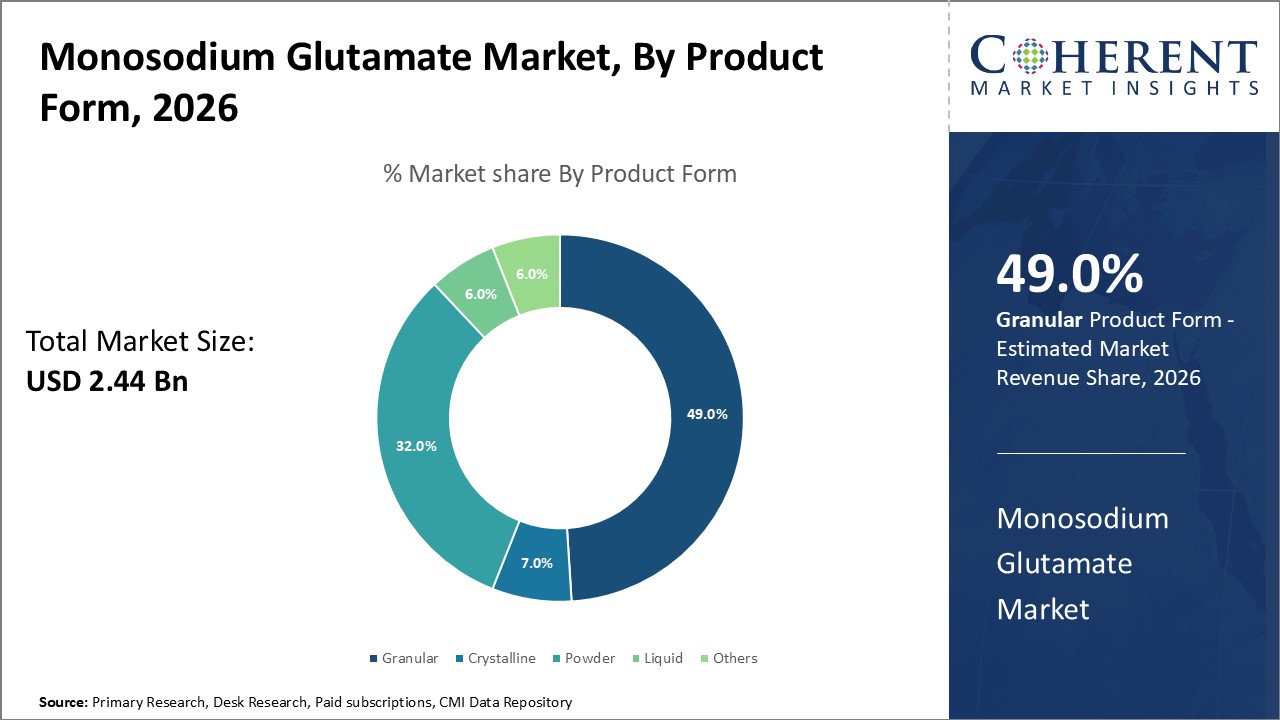
The granulated product form segment dominates the Monosodium Glutamate Market with a commanding 49% industry share, attributed to its ease of application and stability across diverse food matrices.
Among application segments, processed food leads, capturing over 41% market revenue by meeting extensive industrial and consumer demand.
In distribution channels, supermarkets and hypermarkets retain primacy due to their wide consumer reach and product variety offerings.
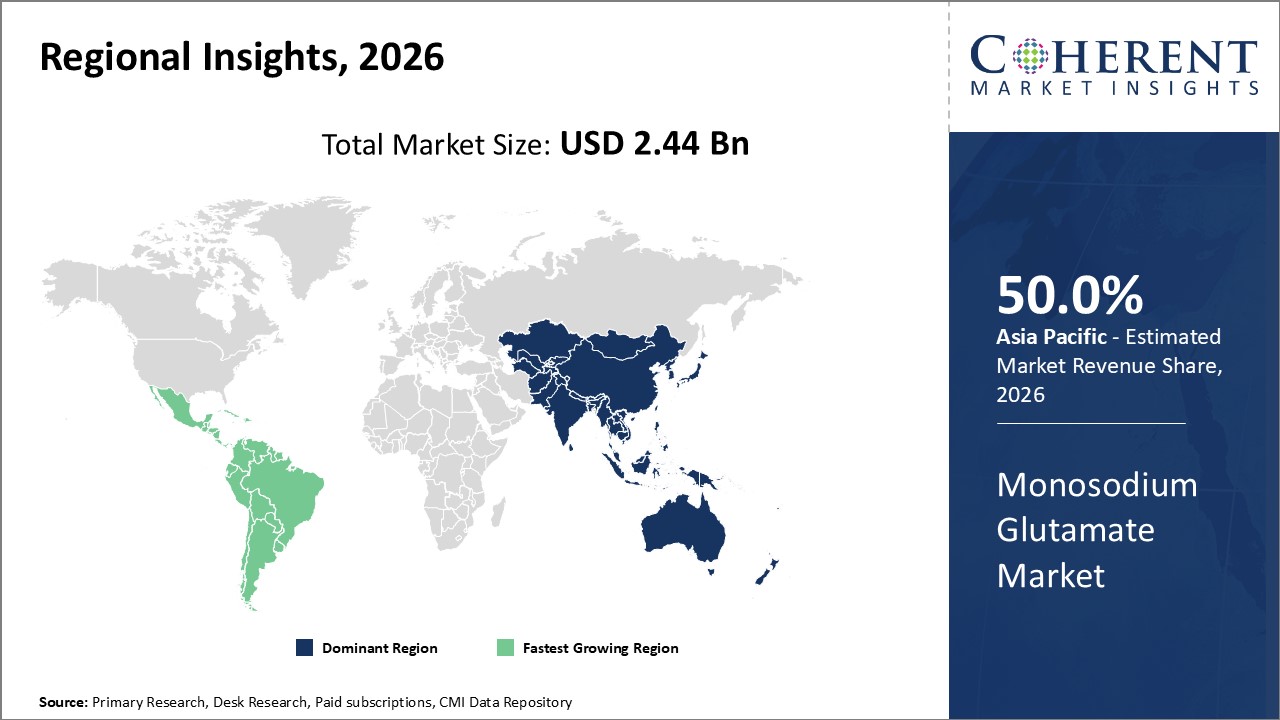
Regionally, Asia Pacific represents the leading market share, contributing over 50% to global monosodium glutamate revenue, owing to entrenched culinary traditions favoring MSG and vast industrial capabilities.
Meanwhile, the fastest-growing region is Latin America, expanding at a CAGR exceeding 7%, driven by rising urbanization and increased packaged food consumption.
North America’s market shows steady growth with heightened clean label trends and strict regulatory compliance influencing product innovations.
Monosodium Glutamate Market Segmentation Analysis
Monosodium Glutamate Market Insights, By Product Type
The Granular segment dominates the market share at 49%, primarily due to its stability, ease of dispersal in food products, and widespread industrial adoption. Granular MSG’s ability to blend uniformly with seasoning systems has made it a preferred choice in food processing industries worldwide. The fastest-growing subsegment is Liquid MSG, which offers advantages in automated food manufacturing processes and has seen adoption growth rates exceeding 10% annually due to increased utilization in sauces and soups. Crystalline and Powder forms maintain steady demand due to their specific application in seasoning blends and dry mixes.
Monosodium Glutamate Market Insights, By Application
Processed Food leads the segment with the maximum market share, driven by mass production and increasing demand for flavor enhancement in meat products, dairy, and soups. This segment offers stable revenue streams across all regions. The fastest-growing subsegment is Ready Meals, expanding rapidly due to the rise in convenience food consumption, especially in urban areas. Seasonings & Sauces represent a mature segment with consistent demand, while Snacks & Savory Products are witnessing innovation-led growth targeting younger demographics. Others include pharmaceutical and pet food uses that contribute moderately to volume.
Monosodium Glutamate Market Insights, By Distribution Channel
Supermarkets and Hypermarkets dominate, capturing a broad consumer reach and enabling large-scale product penetration, particularly in North America and Europe. Food Service is the fastest-growing channel, proliferating through increased demand in restaurants and catering sectors, integrating MSG for authentic flavor profiles. Online Retail is emerging quickly, reflecting digital transformation in food ingredient procurement, while Convenience Stores maintain steady sales in urban centers. The Others segment comprises specialty food distributors and institutional buyers with niche requirements.
Monosodium Glutamate Market Trends
The Monosodium Glutamate Market is witnessing significant evolution as health-conscious consumers increasingly demand clean-label and non-GMO MSG products, leading to the launch of numerous formulations emphasizing natural ingredients.
Additionally, product development for plant-based and meat substitute industries is gaining momentum due to the surge in vegan diets, with companies like Ajinomoto and Meihua developing specialized MSG blends that enhance flavor profiles without compromising health values.
Blockchain technology adoption in supply chains enhances transparency, addressing growing concerns over food safety and traceability, boosted by regulatory agencies worldwide.
Monosodium Glutamate Market Insights, By Geography
Asia Pacific Monosodium Glutamate Market Analysis and Trends
Asia Pacific dominates the Monosodium Glutamate Market with over 50% market share, primarily driven by traditional culinary practices and substantial local production capacity in China and India. The strong presence of major manufacturers, along with supportive governmental agricultural policies, enhances business growth and encourages robust market revenue in this region.
Latin America Monosodium Glutamate Market Analysis and Trends
Latin America exhibits the fastest growth with a CAGR of over 7%, fueled by rapid urbanization, rising disposable incomes, and growing consumption of processed and packaged foods, particularly in Brazil and Mexico. The expansion of retail infrastructure and imports of MSG products bolster its market growth.
Monosodium Glutamate Market Outlook for Key Countries
USA Monosodium Glutamate Market Analysis and Trends
The USA remains a critical market driven by increasing demand for flavor enhancers in processed foods and burgeoning clean-label trends. Leading companies like CJ CheilJedang have expanded their US footprint through strategic acquisitions and product innovations targeting health-conscious consumers. In 2025, imports of MSG rose by 6%, reflecting robust market growth supported by consumers' inclination towards savory taste enhancement combined with stringent sodium regulations promoting alternative formulations.
China Monosodium Glutamate Market Analysis and Trends
China is the world’s largest producer and consumer of monosodium glutamate, with established industrial ecosystems and a strong export orientation. The dominance of Ajinomoto and regional players leveraging low-cost raw materials and advanced manufacturing contributed to a 12% production increase in 2025. Domestic market expansion is supported by rising processed food consumption and export growth, earning China a formidable position in the global MSG market.
Analyst Opinion
Increasing Production Capacity: In recent years, manufacturers have significantly scaled production capabilities to meet soaring global demand, with reported capacity increments of over 13% between 2023 and 2025 in leading industrial hubs. For instance, East Asian production facilities expanded output, supporting a stable supply-demand balance, contributing to overall market growth, and bolstering market share amongst industry participants.
Pricing Dynamics Impacting Demand: MSG pricing has exhibited stable fluctuations, influenced by raw material costs and regional trade environments. In 2025, price reductions in glutamic acid feedstock led to a 5.2% decline in MSG prices in Southeast Asian markets, boosting import volumes and consumption in food processing, particularly in ready-to-eat and frozen meal sectors.
Diversified End-Use Application Demand: The demand across diverse food segments such as processed meat, instant noodles, and canned soups accounted for over 60% of market revenue in 2025. Geographic expansion in emerging economies further amplified MSG usage, with countries in Asia Pacific and Latin America reporting a 7% year-on-year growth in culinary applications.
Export Growth Trends: Export volumes from dominant producing countries increased by 16% in 2025, evidencing strong international demand dynamics. This export surge has been facilitated by improved logistics and trade agreements, significantly influencing market revenue and expansion trajectories that underpin the market forecast.
- Current Industry Events of 2026
- Market Size Estimation
- Regional Breakdown
- Competitive Landscape
- Customer Intelligence
- Segmental Analysis
- Pricing Analysis
- Key Market Drivers, Challenges & Future Trends
- Customized Insights Section
Market Scope
| Report Coverage | Details | ||
|---|---|---|---|
| Base Year: | 2025 | Market Size in 2026: | USD 2.44 billion |
| Historical Data for: | 2020 To 2024 | Forecast Period: | 2026 To 2033 |
| Forecast Period 2026 to 2033 CAGR: | 6.0% | 2033 Value Projection: | USD 3.4 billion |
| Geographies covered: |
| ||
| Segments covered: |
| ||
| Companies covered: | Changyuan Group Limited, Jinghua Pharmaceutical Group, Huachengfood Co., Ltd., Yihai Kerry Arawana Holdings Co., Ltd., BoldFoods LLC, Hebei Xinhe Food Additive Co., Ltd., Shandong Yuanlian, Ltd., Huaian Chengda Biochemical Co., Ltd., Tofte Foods AS, Wuhu Chenmi Food Ingredients Co., Ltd. | ||
| Growth Drivers: |
| ||
Monosodium Glutamate Market Growth Factors
Strong growth in the global packaged food industry continues to underpin the drive for monosodium glutamate, as processed food consumption rose by over 9% from 2023 to 2025, elevating MSG usage in flavor enhancement applications. Rising consumer preference for savory taste profiles in emerging markets like India and Southeast Asia has notably expanded the consumer base for monosodium glutamate, with these regions reporting adoption increases exceeding 10% annually. Supportive agrarian policies facilitating glutamic acid feedstock production, especially in China and Brazil, have reduced input costs, thus reinforcing stable market prices. Additionally, advancements in production technology have enhanced MSG purity and environmental sustainability, appealing to conscientious consumers and manufacturers alike, consequently fueling market growth and expanding market revenue.
Monosodium Glutamate Market Development
In 2023, Meihua Holdings launched a low-sodium MSG variant in Europe, offering approximately 30% reduced sodium content while maintaining flavor performance. The launch was aimed at supporting food manufacturers’ reformulation efforts in response to rising consumer demand for cleaner, lower-sodium seasonings across the EU market.
In 2023, Ajinomoto expanded its MSG production capacity in Thailand by an additional 120,000 metric tons annually, strengthening its regional supply chain and supporting rising export demand. The expansion enhanced Ajinomoto’s leadership in high-purity amino acid-based seasonings, enabling improved supply stability across Southeast Asia and global markets.
Key Players
Leading Companies of the Market
Changyuan Group Limited
Jinghua Pharmaceutical Group
Huachengfood Co., Ltd.
Yihai Kerry Arawana Holdings Co., Ltd.
BoldFoods LLC
Hebei Xinhe Food Additive Co., Ltd.
Huaian Chengda Biochemical Co., Ltd.
Tofte Foods AS
Wuhu Chenmi Food Ingredients Co., Ltd.
Competitive strategies adopted by leading companies include extensive vertical integration to optimize supply chains, as seen with Ajinomoto’s investments in raw material sourcing, which enhanced quality control and cost efficiency, leading to improved market share in the Asia Pacific. Furthermore, Meihua Holdings implemented innovative R&D efforts with new MSG variants targeting clean label trends, resulting in an 9% increase in revenue from specialty products between 2023 and 2025. Strategic mergers and partnerships, such as CJ CheilJedang’s collaboration with local distributors, expanded regional footprint and reinforced competitive positioning in North America.
Monosodium Glutamate Market Future Outlook
Going forward, demand for MSG is expected to remain strong as global consumption of convenience foods, savory snacks, and fast-food offerings continues to grow. Rising urbanization, changing dietary patterns, and increased popularity of Asian cuisines worldwide will further boost usage. Manufacturers are increasingly refining fermentation processes to improve purity and cost efficiency, while new applications in plant-based foods and low-sodium formulations are gaining momentum. As food companies emphasize flavor optimization and cost-effective taste enhancement, MSG will continue playing a major role in global food manufacturing.
Monosodium Glutamate Market Historical Analysis
Historically, the MSG market grew alongside the global expansion of processed foods, ready-to-eat meals, snacks, and flavor-enhanced seasonings. The fermentation-based manufacturing process has improved significantly over the past decades, enabling cost-efficient large-scale production from sugarcane, tapioca, and starch feedstocks. Despite intermittent safety controversies, regulatory reviews consistently affirmed MSG’s safety, restoring consumer confidence and enabling market recovery. Asia-Pacific, particularly China, Vietnam, and Indonesia, became major production centers due to strong demand in traditional cuisines and growing processed food industries. The compound's ability to enhance umami taste helped drive widespread adoption in foodservice and industrial food processing.
Sources
Primary Research Interviews:
Food Technologists
Flavor Scientists
Seasoning Manufacturers
Fermentation Experts
Foodservice Procurement Heads
Databases:
FAO Food Ingredients Statistics
UN Comtrade Additives
FDA Food Ingredient Databases
Magazines:
Food Processing Magazine
Food Navigator
Food Business News
Ingredients Network
Beverage & Food World
Journals:
Journal of Food Science
Food Chemistry
International Journal of Gastronomy and Food Science
Journal of Nutrition
Food Hydrocolloids
Newspapers:
The Hindu (Food Industry)
The Economic Times (FMCG)
The Wall Street Journal (Food Business)
Associations:
FAO
Codex Alimentarius
American Society for Nutrition
Food Additives & Ingredients Association
Get access to 250+ pages report
Every segment, forecast, competitor profile and data table behind the analysis above — available for instant download.
- ESOMAR Member
- ISO 9001:2015 Certified
- D-U-N-S Registered
- GDPR & CCPA Compliant
Missing comfort of reading report in your local language? Find your preferred language:
Transform your Strategy with Exclusive Trending Reports
Frequently Asked Questions
Leading players include Ajinomoto Co., Meihua Holdings Group, and CJ CheilJedang Corp., which collectively influence over 35% of the global market share.
The market is projected to grow from USD 2.44 billion in 2026 to USD 3.4 billion by 2033, with a CAGR of 6.0% reflecting steady market revenue expansion.
Processed food remains the largest application sector, driven by increased demand for ready meals, snacks, and seasonings across emerging and developed economies.
Emerging trends such as clean-label MSG, integration in plant-based foods, and supply chain digitization are poised to reshape market dynamics significantly.
The market is highly competitive with consolidation among key players, yet challenges such as regulatory scrutiny on sodium content and rising consumer health awareness persist.
Strategies include vertical integration, product innovation focusing on natural and clean-label variants, regional partnerships, and targeted marketing campaigns addressing consumer trends.