

Food Service Equipment Market Size and Trends: 2026 to 2035
Food Service Equipment Market is estimated to be valued at USD 42.40 Bn in 2026 and is expected to reach USD 63.34 Bn in 2033, exhibiting a compound annual growth rate (CAGR) of 5.9% from 2026 to 2033.
Key Takeaways
- Based on end-use, full-service restaurants & hotels will have a 73% share in the market in 2026 owing to the growth of luxury hotels, fine dining restaurants, and hospitality infrastructure globally.
- Based on product type, the cooking equipment segment is projected to account for 32.10% of the share in 2026 driven by growing demand for effective kitchen performance and innovative technologies for food preparation.
- Based on Region, North America will dominate the food service equipment market globally with 33% share in 2026.
Market Overview
Growing need for commercial kitchens to have more efficient and cost-effective appliances that are easier to clean and maintain is key factor augmenting food service equipment market growth. Additionally, the rapid westernization of eating traditions is encouraging restaurants to offer more diverse cuisines and boosting demand for foodservice equipment that can prepare these meals quickly and easily.
Current Events and Its Impact on the Food Service Equipment Market
Current Events | Description and its impact |
Global Supply Chain Disruptions and Raw Material Inflation |
|
Energy Crisis and Sustainability Regulations |
|
Role of AI (Artificial Intelligence) in Food Service Equipment Market
AI is transforming food service equipment by boosting efficiency, consistency and operational control. Smart systems can predict demand, automate cooking processes and adjust equipment settings in real time to reduce waste and energy use. Voice and chat-based AI streamline ordering, reservations and customer enquiries, while integrated sensors monitor equipment health to prevent downtime. In kitchens, AI-driven appliances ensure precise temperatures, portioning and timing, improving food quality and safety. These technologies also provide analytics that help operators optimize workflows, staffing and inventory. Overall, AI enhances speed, accuracy and reliability across both front- and back-of-house operations.
In December 2025, Alayic—created by three founders with expertise in AI and automation—launched a voice-driven system that handles orders, reservations, and customer enquiries. The platform includes a countertop terminal that prints orders and sends them straight to kitchen staff, streamlining communication between front and back of house. It offers built-in features like personalized greetings, customizable voice profiles, analytics, and priority support, with optional add-ons for deeper customization.
- Current Industry Events of 2026
- Market Size Estimation
- Regional Breakdown
- Competitive Landscape
- Customer Intelligence
- Segmental Analysis
- Pricing Analysis
- Key Market Drivers, Challenges & Future Trends
- Customized Insights Section
Segmental Insights
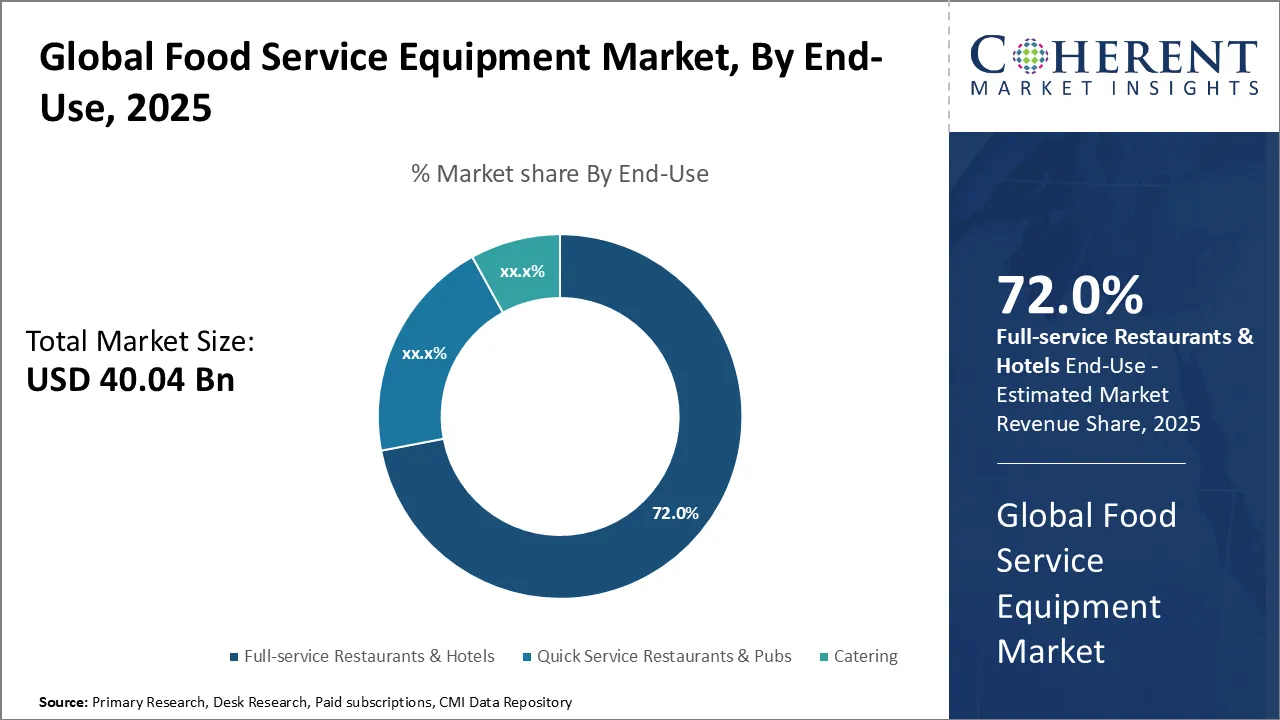
Food Service Equipment Market Insights, By End-Use: Full-Service Restaurants & Hotels Lead Due to Growing Luxury Hospitality Infrastructure
By end-use, the full-service restaurants & hotels segment accounts for a market share of 73% in 2026, driven by a rise in the number of luxury hotels, fine-dining restaurants, and increasing hospitality infrastructure around the world. Full-service establishments necessitate high-capacity, robust, and multi-capability kitchen equipment, as their customers' expectations are continuously rising.
The objective of luxury hotels and high-end restaurants is to achieve operational efficiency, consistency in food served, and maintenance of hygiene standards. These push the adoption of advanced technologies in the kitchens. From high-capacity ovens to intelligent storage units, full-service kitchens are increasingly dependent on modular and connected equipment for optimizing space utilization and workflow.
In January 2025, Hoshizaki introduced its AI-Integrated Smart Dishwasher, which can automatically adjust the water usage and cycle duration depending on the load size and the level of soil, saving up to 35% in water and energy consumption.
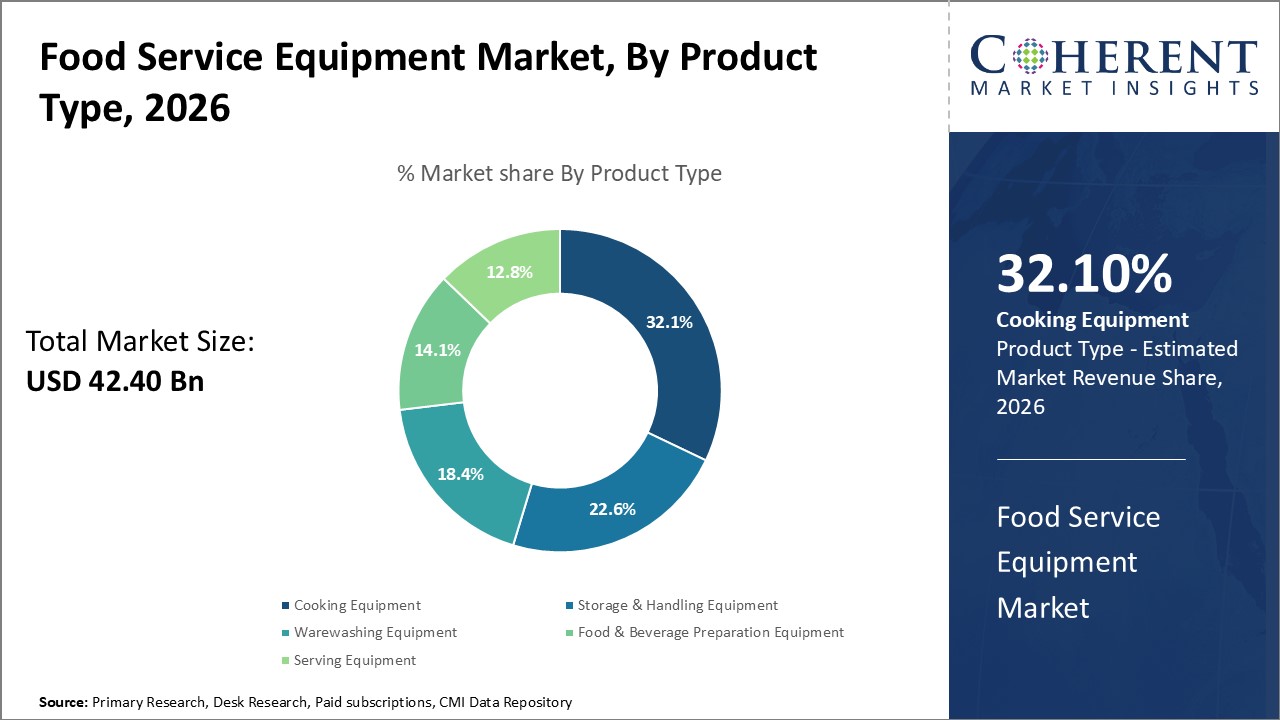
Food Service Equipment Market Insights, By Product Type: Cooking Equipment Leads Due to High Demand for Efficiency and Advanced Technologies
By product type, the cooking equipment segment contributes 32.10% of the market share in 2026. Cooking equipment, comprising ovens, ranges, grills, fryers, and automated prep stations, is at the heart of commercial kitchen operations, as these directly influence food quality and preparation speed, and thus have a bearing on operational efficiency.
The restaurants and hotels are now using energy-efficient appliances that reduce the amount of electricity consumption, heat loss, and have low negative impacts on the environment. Programmable cooking cycles, ovens with more than one function, and induction cooktops allow precise temperature control, consistency, and speed of service.
For instance, in July 2025, Vulcan introduced a next-generation multi-purpose cooking range capable of automated recipe execution and IoT connectivity, allowing large-scale kitchens to enhance consistency and productivity while minimizing energy waste.
Regional Insights
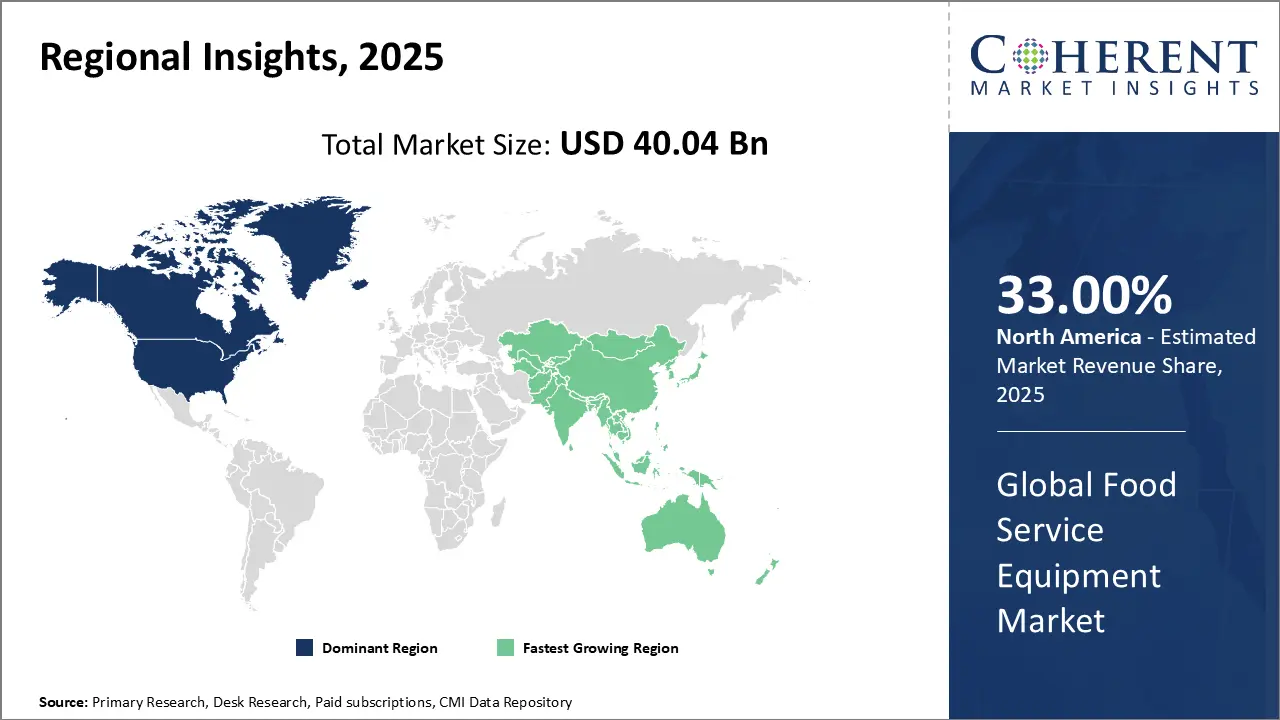
North America Food Service Equipment Market Analysis & Trends
North America should account for 33% of the global food service equipment market share in 2026, driven by strong demand from full-service restaurants, hotels, quick-service outlets, and catering services. The region maintains a well-established commercial kitchen infrastructure, on the back of technologically advanced equipment manufacturing and a mature hospitality sector. Furthermore, increasing consumer expectations pertaining to the quality, hygiene, and speed of service have accelerated the adoption of energy-efficient, multifunctional, and smart kitchen equipment.
For instance, in March 2026, ITW Food Equipment Group showcased its latest heavy-duty mixers and advanced dishwashers at the NAFEM Show 2026, highlighting innovations aimed at energy efficiency and productivity in commercial kitchens.
Asia Pacific Food Service Equipment Market Analysis & Trends
Asia Pacific is expected to be the fastest-growing region in the global food service equipment market over the next few years. Increased disposable incomes, rapid urbanization, and a consequent growing middle-class population have resulted in the growth of full-service restaurants, quick-service chains, hotels, and catering services in countries like China, India, Japan, and Southeast Asian countries. In order to meet emerging market demand, domestic producers and international players are increasing production levels with new, modern kitchen equipment that is also energy-efficient and multi-functional.
For instance, in July 2026, Hoshizaki introduced connected refrigeration and warewashing solutions in Asia Pacific, enabling commercial kitchens to monitor energy consumption, optimize workflow, and improve operational efficiency.
Food Service Equipment Market Outlook Country-Wise
U.S. Food Service Equipment Market Trends
The growing demand from full-service restaurants, hotels, quick-service outlets, and catering services is driving the strong growth of the U.S. food service equipment market in 2026. Innovations in energy-efficient cooking appliances, automated food preparation tools, and smart warewashing and refrigeration systems drive operational efficiency and sustainability in commercial kitchens. A trend toward IoT-enabled equipment, modular kitchen designs, and multifunctional devices assists operators in driving down energy consumption, labor costs, and food waste while maintaining high standards of hygiene and customer satisfaction.
For instance, in April 2026, Traulsen announced a transition to its product lineup from aluminum to full stainless‑steel interior and exterior finishes, aiming to enhance durability and quality of its commercial refrigeration equipment.
China Food Service Equipment Market Trends
China’s food service equipment market is expanding rapidly in 2026 due to increasing urbanization, rising disposable incomes, and the growth of full-service restaurants, quick-service chains, hotels, and catering services. The adoption of smart cooking, storage, and warewashing equipment to optimize workflow, reduce energy consumption, and raise overall operational efficiency is accelerating. Innovation within multi-functional and connected kitchen solutions will further be driven by sustainability trends and government policies that encourage energy-efficient appliances.
Market Report Scope
Food Service Equipment Market Report Coverage
| Report Coverage | Details | ||
|---|---|---|---|
| Base Year: | 2025 | Market Size in 2026: | USD 42.40 Bn |
| Historical Data for: | 2020 To 2024 | Forecast Period: | 2026 To 2033 |
| Forecast Period 2026 to 2033 CAGR: | 5.9% | 2033 Value Projection: | USD 63.34 Bn |
| Geographies covered: |
| ||
| Segments covered: |
| ||
| Companies covered: | ALI GROUP S.R.L. A SOCIO UNICO, ALTO-SHAAM, INC., AMBRO MANUFACTURING CO. INC., COMSTOCK-CASTLE STOVE CO., INC., DOVER CORPORATION, and DUKE MANUFACTURING CO. INC. | ||
| Growth Drivers: |
| ||
| Restraints & Challenges: |
| ||
Food Service Equipment Market Drivers
Rapid growth of food service industry to fuel market growth
Growth of business-related travel and rising number of food joints such as hotels & restaurants are key factors fueling growth of the food service equipment market. Key factors such as According to the National Restaurant Association’s Restaurant Performance Index, the U.S. restaurant industry is expected to reach USD 863 billion in 2019 with over 1 million restaurants operating in the U.S. Cross-border investments, experiments & innovations in varieties of cuisines, and growth in travel & tourism industry are anticipated to provide lucrative opportunities for the market expansion.
Growing preference for quick-service restaurants to foster market growth
Growing demand for quick and convenient meals is one of the major factors driving the global food service equipment market growth. With increasing working population and changing lifestyle, people are looking for faster ways to prepare food and drink. This is driving the growth of food delivery services and takeaway restaurants, which in turn, is fueling the growth of food service equipment market.
Food Service Equipment Market Opportunities
Launch of new product due to ongoing technological advancement is expected to provide significant market growth opportunities. Manufacturers in the food service equipment market are introducing new and advanced equipment to increase their sales. For instance, in May 2018, Vollrath Company, LLC launched a line of single countertop granita machines that can be used to make a variety of high margin cold and frozen beverages including ice tea or coffee, smoothies, iced frappe, and more. The company’s machine features a compact design, easy operation, and minimal maintenance costs.
Analyst Opinion (Expert Opinion)
The food service equipment market is entering a transformational phase, propelled by the convergence of automation, sustainability, and intelligent operations. Regulatory pressures, especially in the EU and APAC regions, have also contributed to the adoption of energy-efficient and water-saving appliances.
Global chains are already implementing procurement standards emphasizing energy efficiency and IoT readiness, such as Marriott, Hilton, and McDonald's; this creates a pull-effect across the equipment supply chain. Manufacturers focusing on predictive maintenance, modular layouts, and multifunctional appliances gain in traction; Vulcan's multi-purpose cooking ranges with automated recipe execution epitomize how operational consistency and energy reduction are functioning in tandem.
Ultimately, market leadership will depend not only on the functionality of products but also on demonstrable considerations of operational efficiency, regulatory alignment, and environmental impact. Vendors that incorporate intelligent, connected systems with sustainability credentials and lifecycle performance transparency will earn preferred adoption from leading food service operators and define the next competitive frontier in the global food service equipment market.
Speak to the analyst
Want personalized insights?
Take the findings above to one of our principal consultants, or have the report rebuilt around the segments, geographies and competitors you actually track.
Food Service Equipment Industry News
- In November 2025, ALI Group announced internal leadership changes, appointing new executives to key roles including global commercial strategy and financial operations.
- In September 2025, Alto‑Shaam announced that it will “showcase pioneering multi‑cook ovens and advanced hot holding solutions” at HOST Milano 2025, a major international foodservice equipment shows.
- In October 2025, Dover Corporation (which serves as a key player in food‑service equipment markets among others) announced expansion of a manufacturing campus in Virginia, a move likely aimed at boosting production capacity, possibly including food‑service equipment lines.
Market Segmentation
- End Use Insights (Revenue, USD Bn & KT, 2026 - 2033)
- Full-service Restaurants & Hotels
- Quick Service Restaurants & Pubs
- Catering
- Product Type Insights (Revenue, USD Bn & KT, 2026 - 2033)
- Cooking Equipment
- Storage & Handling Equipment
- Ware Washing Equipment
- Food & Beverage Preparation Equipment
- Serving Equipment
- Regional Insights (Revenue, USD Bn & KT, 2026 - 2033)
- North America
- U.S.
- Canada
- Latin America
- Brazil
- Argentina
- Mexico
- Rest of Latin America
- Europe
- Germany
- U.K.
- Spain
- France
- Italy
- Russia
- Rest of Europe
- Asia Pacific
- China
- India
- Japan
- Australia
- South Korea
- ASEAN
- Rest of Asia Pacific
- Middle East & Africa
- GCC Countries
- Israel
- Rest of Middle East & Africa
- North America
- Key Players Insights (Revenue, USD Bn, 2021 - 2033)
- ALI GROUP S.R.L. A SOCIO UNICO
- ALTO-SHAAM, INC.
- CAMBRO MANUFACTURING CO. INC.
- COMSTOCK-CASTLE STOVE CO., INC
- DOVER CORPORATION
- DUKE MANUFACTURING CO. INC.
Sources
Primary Research Interviews from the following stakeholders
Stakeholders
- Interviews with commercial kitchen operators, food service equipment manufacturers, distributors, hospitality chains, and sustainability officers across major regional markets.
Specific stakeholders
- R&D and product innovation heads at leading food service equipment companies (e.g., Alto-Shaam, Ali Group, Duke Manufacturing, Comstock-Castle Stove).
- Operations and procurement managers at full-service restaurants, quick-service restaurants, hotels, and catering chains (e.g., Marriott, Hilton, McDonald’s, Yum! Brands).
- Sustainability and energy-efficiency leads at commercial kitchen associations and industry alliances (e.g., National Association of Food Equipment Manufacturers – NAFEM).
- Engineering and process specialists in cooking, refrigeration, and warewashing equipment manufacturing.
- Procurement and quality control teams in institutional food services and large-scale catering operations.
- Innovation officers at IoT and automation solution providers for commercial kitchens.
Databases
- United Nations Comtrade Database
- World Trade Organization (WTO) Trade Statistics
- Eurostat – Industrial Equipment & Energy Use Database
- U.S. Census Bureau – Manufacturing & Food Service Equipment Data
- China Customs Statistics
- Directorate General of Commercial Intelligence and Statistics (DGCIS), India
- Japan External Trade Organization (JETRO)
- Korea Customs Service Data Portal
- Food and Drug Administration (FDA) – Food Contact & Safety Standards
- Indian Ministry of Commerce & Industry – Industrial Equipment Export Data
- Environment Agency (UK) – Energy & Sustainability Reports
Magazines
- Food Service Equipment & Supplies (FES) Magazine
- Restaurant Hospitality
- Foodservice Equipment & Supplies Magazine (FES)
- Kitchen & Bath Design News – Commercial Kitchen Section
- Foodservice Director
- Hospitality Technology – Equipment and Automation Section
- Commercial Kitchen Insights
- Hotel & Restaurant Equipment News
Journals
- International Journal of Hospitality Management (Equipment & Operations Section)
- Journal of Foodservice Business Research
- Food Engineering & Technology Journal
- Journal of Cleaner Production – Sustainable Kitchen Operations
- Energy Efficiency Journal – Industrial & Commercial Appliances
- Journal of Applied Thermal Engineering – Cooking Equipment Studies
Newspapers
- The Wall Street Journal – Manufacturing & Hospitality
- The Economic Times – Hospitality & Equipment
- Business Standard – Commercial Kitchen & Hospitality Equipment
- Financial Times – Sustainability & Industrial Innovation
- Nikkei Asia – Hospitality & Food Service Equipment Sector
- The Hindu Business Line – Manufacturing & Food Service
- South China Morning Post – Hospitality & Industrial Equipment
- The Guardian – Environment, Energy, and Industrial Appliances
Associations
- National Association of Food Equipment Manufacturers (NAFEM)
- American Hotel & Lodging Association (AHLA) – Equipment Committees
- European Hospitality Equipment Association (EHEA)
- Indian Association of Food Service Operators (IAFSO)
- Sustainable Hospitality Alliance (SHA)
- British Hospitality Association – Kitchen Equipment Committee
- American Institute of Baking (AIB) – Commercial Equipment Section
- Hotel & Restaurant Equipment Manufacturers Association – Asia Pacific
Public Domain Sources
- U.S. Environmental Protection Agency (EPA) – Energy & Water Efficiency Reports
- European Environment Agency (EEA) – Industrial Equipment Sustainability Statistics
- Ministry of Environment, Forest and Climate Change (MoEFCC), India – Energy Efficiency Guidelines
- Ministry of Economy, Trade and Industry (METI), Japan – Commercial Equipment Policy Data
- Organisation for Economic Co-operation and Development (OECD) – Energy & Equipment Circularity Reports
- Central Pollution Control Board (CPCB), India – Industrial Equipment Environmental Compliance
- European Commission – Eco-Design & Energy Labeling Regulations
- United Nations Environment Programme (UNEP) – Sustainable Industrial Equipment Reports
- Reserve Bank of India (RBI) – Industrial Output & Manufacturing Reports
- Department for Promotion of Industry and Internal Trade (DPIIT), India – Food Service Equipment Sector Initiatives
Proprietary Elements
- CMI Data Analytics Tool
- Proprietary CMI Existing Repository of information for last 8 years
Definition: Food service equipment includes any type of machinery used in restaurants or commercial kitchens for cooking, storing and preparing food. These equipment can include anything from small appliances to ovens, grills and other large industrial machines.
Get access to 250+ pages report
Every segment, forecast, competitor profile and data table behind the analysis above — available for instant download.
- ESOMAR Member
- ISO 9001:2015 Certified
- D-U-N-S Registered
- GDPR & CCPA Compliant
Missing comfort of reading report in your local language? Find your preferred language:
Transform your Strategy with Exclusive Trending Reports
Frequently Asked Questions
The Food Service Equipment Market is estimated to be valued at USD 42.40 Bn in 2026, and is expected to reach USD 63.34 Bn by 2033.
The CAGR of the Food Service Equipment Market is projected to be 5.9% from 2026 to 2033.
Rapid growth of food service industry and growing preference for quick-service restaurants are fuelling the growth of market.
The Full-service Restaurants & Hotels segment is the leading component segment in the market.
High capital investment for kitchen equipment is the major factors restraining growth of the market.
ALI GROUP S.R.L. A SOCIO UNICO, ALTO-SHAAM, INC., AMBRO MANUFACTURING CO. INC., COMSTOCK-CASTLE STOVE CO., INC., DOVER CORPORATION, and DUKE MANUFACTURING CO. INC.