

Sorbitol Market Size and Forecast – 2026 to 2033
The sorbitol market is estimated to be valued at USD 2.17 Bn in 2026 and is expected to reach USD 3.52 Bn by 2033, growing at a compound annual growth rate (CAGR) of 7.2% from 2026 to 2033.
Key Takeaways:
- By Product Type, Liquid acquired the prominent share of 76.5% in 2026 owing to the increasing demand from the food and beverage industry.
- By Application, Diabetic & Dietetic Food & Beverage hold the largest share of 40.6% in 2026 owing to the growing global prevalence of diabetes and obesity.
- By End-Use Industry, Food dominates the overall market with an estimated share of 42.5% in 2026 owing to the rising demand for low-calorie sweeteners.
- By Region, North America captures the largest share of 41.9% in 2026 on account of expanding pharmaceutical and personal care applications.
Market Overview
The global sorbitol market is anticipated to grow moderately over the forecast period. One of the major drivers responsible for the growth of sorbitol globally includes their increasing applications in various industries such as food & beverages, pharmaceuticals, cosmetics, and others. Sorbitol is extensively used in food products such as candy, baked goods, chewing gum, jam, and jelly. In the pharmaceuticals industry, sorbitol acts as a stabilizing and bulking agent in liquid dosage forms and directly compressed tablets. Moreover, rising consumer preference for low-calorie, sugar-free food & beverages has further augmented the demand for sorbitol in recent years.
Current Events and their Impact
Current Events | Description and its impact |
Economic & Environmental Factors |
|
Sector-Specific Demand Drivers |
|
Regional Production Dynamics |
|
End-user Feedback and Unmet Needs in the Sorbitol Market
- Demand for Natural and Clean-label Products: A growing number of end customers are looking for sorbitol that comes from organic, natural, or non-GMO sources. Customers are favoring products that follow clean-label trends and are growing more aware of ingredient transparency.
- Improved Taste and Sensory Profiles: Despite being a common sweetener, some end users claim that sorbitol's sweetness level and aftertaste are inferior to those of erythritol or stevia. In order to create a more palatable sensory experience without sacrificing its functional advantages, this feedback emphasizes the necessity for better taste-masking technology or sorbitol mixing with other sweeteners.
- Digestive Tolerance Issues: In order to increase the usability of sorbitol in sensitive populations and boost consumer acceptance generally, many manufacturers and consumers search for methods to lessen these adverse effects or create formulations that minimize digestive irritation.
- Sustainable and Eco-friendly Production: Both manufacturers and end users are becoming increasingly concerned about sustainability. An unmet demand exists for sorbitol made with renewable feedstocks, green chemical principles, and environmentally friendly processes.
- Current Industry Events of 2026
- Market Size Estimation
- Regional Breakdown
- Competitive Landscape
- Customer Intelligence
- Segmental Analysis
- Pricing Analysis
- Key Market Drivers, Challenges & Future Trends
- Customized Insights Section
Segmental Analysis
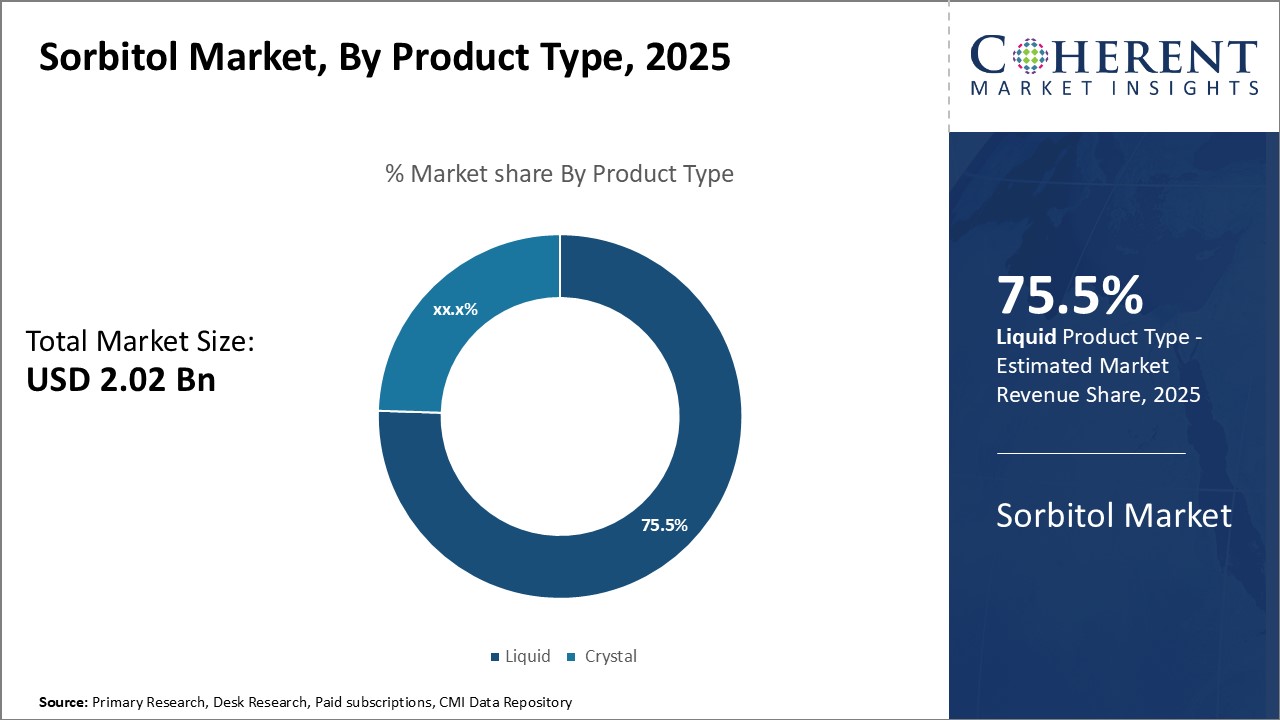
Sorbitol Market Insights, by Product Type
Liquid contributes the highest share of the market owing to its Growing Consumer Awareness of Functional Ingredients.
Liquid Sorbitol dominates the overall market with a share of 76.5%. Liquid sorbitol dissolves readily in water without leaving any crystalline residue, making it very convenient to use in beverage formulations. It does not require complex blending equipment and can be directly added to formulations during production. This simplifies production processes for beverage manufacturers and lowers costs associated with equipment and labor. Liquid sorbitol also better masks unwanted tastes and provides superior mouthfeel in beverages compared to the crystalline form. Its uniform consistency allows for precise dosing and quality control. Thanks to such handling advantages, liquid Sorbitol has found wide use in drink concentrates and syrups where uniform solubility and absence of grittiness are important quality factors. Food processors also prefer liquid Sorbitol for candy coatings and fillings due to its complete solubility. For instance, NEOSORB® liquid products are sugar-free, low-calorie bulk sweeteners that offer various functional benefits in confectionery, bakery, and seafood applications.
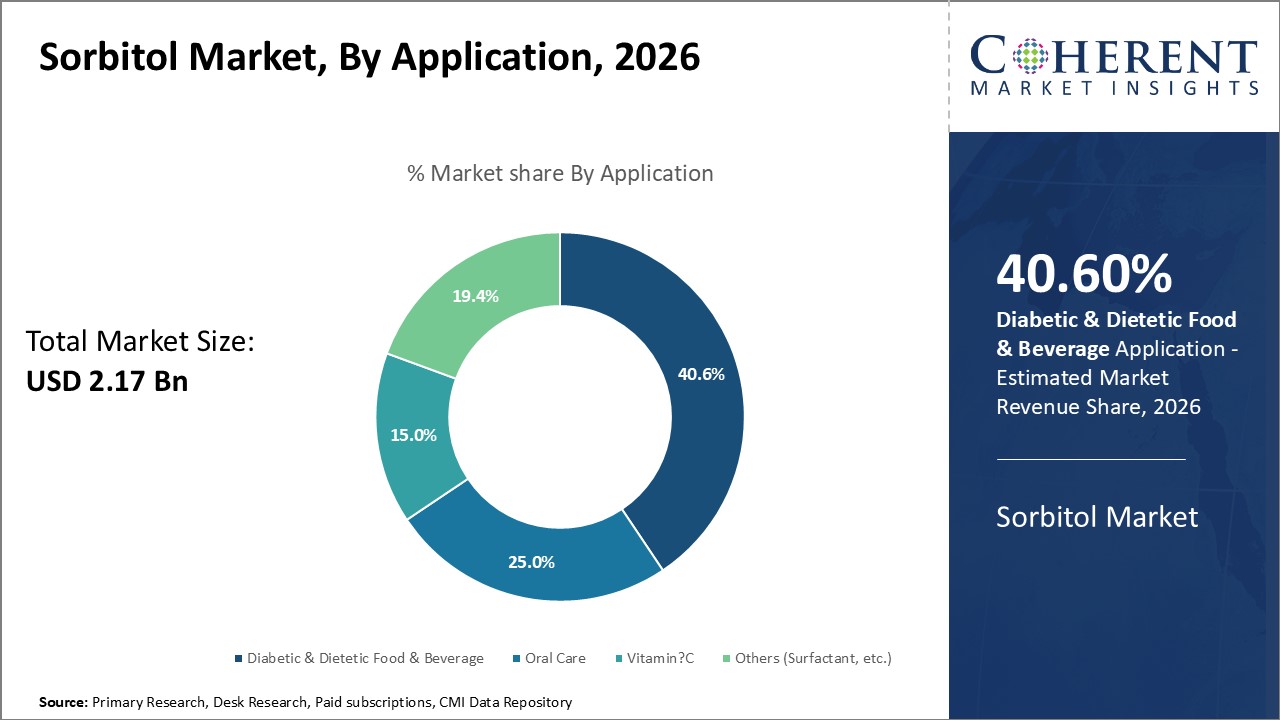
Sorbitol Market Insights, by Application
Diabetic & Dietetic Food & Beverage Holds the largest share of the market as Rising Demand for Functional and Sugar-Free Beverages.
Sorbitol is widely used as a low-calorie sugar substitute in various food products targeted for diabetics and health-conscious individuals. It has only about 60 percent as many calories as sugar but provides similar bulk, texture, and flavor to foods. Additionally, sorbitol does not spike blood glucose levels unlike normal sugars. This makes it an ideal sweetener for dietetic foods and beverages. Moreover, with the increase in lifestyle-related diseases, consumers are actively seeking healthier food options. This surge in demand for low-sugar, low-glycemic foods and beverages has boosted the sorbitol intake. Its use in yogurts, nutrition bars, baked goods, sugar-free chewing gums and hard candies has grown significantly. Furthermore, sorbitol acts as a moisturizer and humectant, improving shelf-life and freshness of baked goods and snacks. Also, the Food and Drug Administration (FDA) acknowledges that sugar alcohols such as sorbitol can be beneficial for oral health. This recognition is supported by a study indicating that sorbitol may lower the risk of cavities compared to regular sugar, though its effect is not as strong as that of other sugar alcohols. This is further accelerating the sorbitol market demand.
Sorbitol Market Insights, by End-Use Industry
Food captures the largest share of the market owing to Growing Popularity of Functional and Processed Foods
Sorbitol is also widely used as a sweetener, thickener, stabilizer and texturizer across various food applications such as chewing gum bases, candies, jams, jellies, marmalades, frozen desserts, dairy products, and others. Significantly, with growing food safety issues, industrial producers prefer Sorbitol for standardization and quality assurance purposes. Being a crystalline powder, it can be easily incorporated into formulas without variation. Furthermore, strict norms against sugar additions have uplifted sorbitol's prominence. Driven by regulatory tailwinds, clean label trends and multifunctional profile, sorbitol intake from the food industry will continue to expand robustly over the coming years. For Instances, Symrise launched a new prune juice concentrate from its diana foodTM line at Vitafoods that comes with a minimum sorbitol guarantee.
Regional Insights
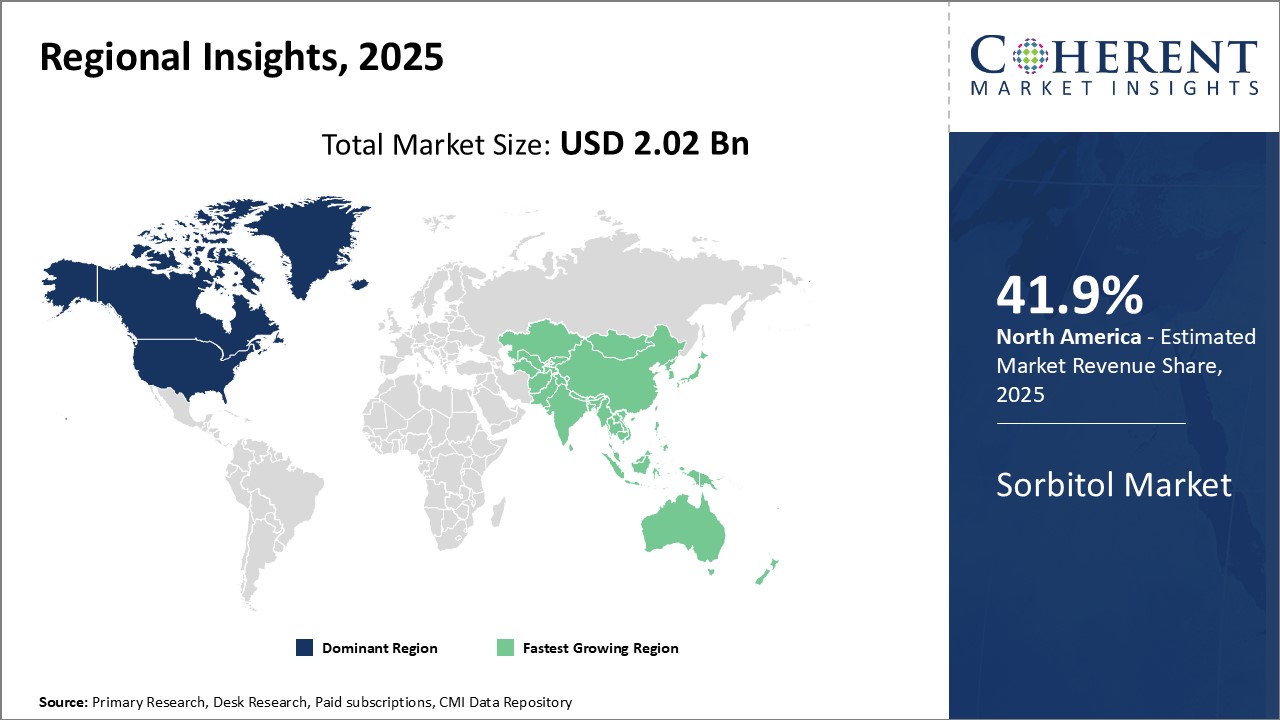
North America Sorbitol Market Trends
North America dominates the overall sorbitol market growth with a share of 41.9% due to the rising customer demand for sugar-free and low-calorie goods. The region generated almost 0.45 million metric tons of sorbitol in 2024, which accounted for almost 20% of the world market. With a substantial contribution to both production and consumption, the US dominates the regional market. Taking advantage of the United States' status as a major maize grower, sorbitol is mostly made from corn. This dependence on maize guarantees a steady and economical supply chain for the manufacturing of sorbitol.
Asia Pacific Sorbitol Market Trends
The demand for sorbitol in the Asia Pacific region is expanding significantly due to rising demand from a variety of industries. A common low-calorie food sweetener and humectant is sorbitol, a sugar alcohol made from glucose. It is used in the cosmetics, pharmaceutical, and food and beverage sectors. Sorbitol is used in the food industry in items like diet drinks, chewing gum, and sugar-free confectionery. It is used in medicines as a non-cariogenic excipient in soft gels, pills, and syrups. For example, Gulshan Polyols is among India’s largest producers of Sorbitol (D-Glucitol), with an annual manufacturing capacity of 72,000 metric tons.
United States Sorbitol Market Trends
The market for sorbitol in the US is expanding steadily due to rising demand from a variety of industries. With more than 80% of the market in 2020, liquid sorbitol is the market leader, while crystalline sorbitol is the category with the quickest rate of growth due to its use in sugar-free confections and dental care products. The United States is a major producer and user of sorbitol; in 2024, production reached 394,000 tons, albeit slightly less than the year before. Applications for sorbitol include the food and beverage sector, medicines, and personal care items, where it functions as a stabilizer, humectant, and sweetener.
India Sorbitol Market Trends
The market for sorbitol in India is expanding steadily due to rising demand from a variety of industries. The market was estimated to be worth 185.0 kilo tons in 2024 and is expected to grow to 224.7 kilo tons by 2033. The pharmaceutical industry is the biggest user of sorbitol, and the market is distinguished by a wide variety of uses. Other important uses include industrial surfactants, toothpaste, food & confections, and cosmetics and toiletries. The sorbitol business is growing thanks to the nation's plentiful maize supply, which offers a reliable and affordable raw material for manufacturing. For instance, Clariant introduced high-performing pharmaceutical ingredients to support the development of secure and efficient medications. By offering a wider range of solutions for the industry's expanding technologies, such as the injectables segment, Clariant expands its track record of success in assisting the development and manufacturing of pharmaceuticals.
Market Concentration and Competitive Landscape
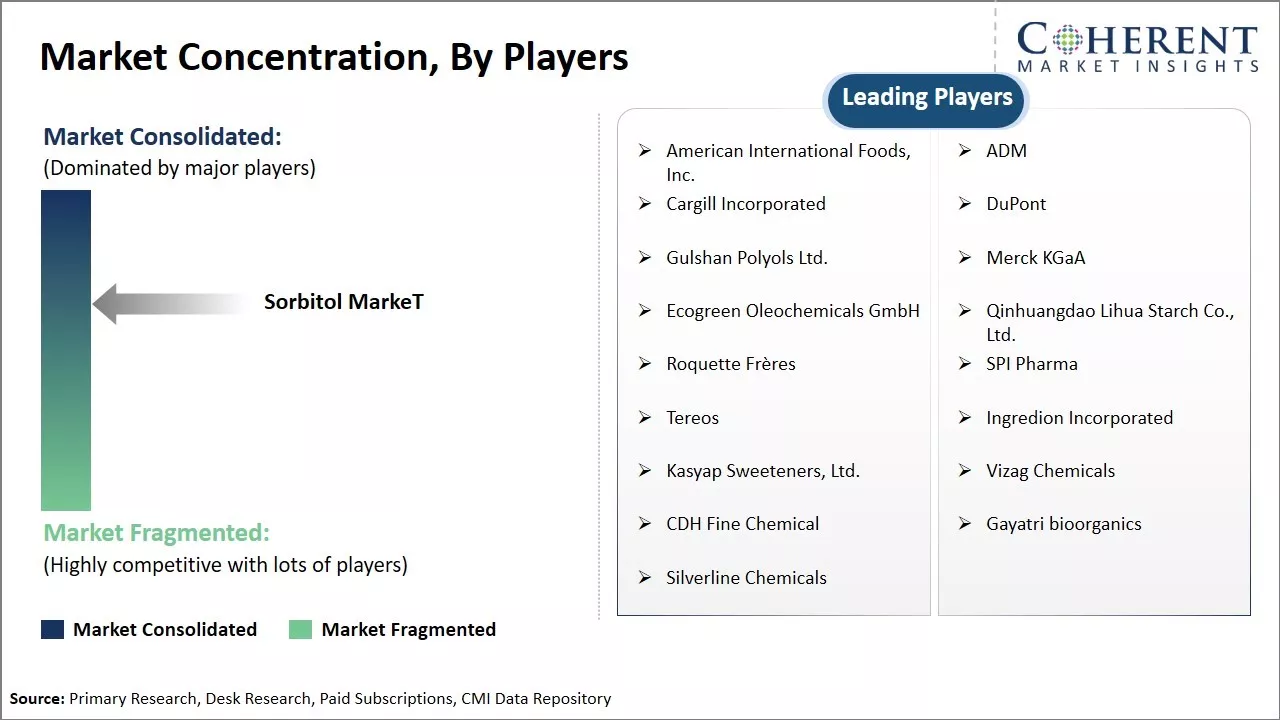
Sorbitol Market News
- In January 2025, Iran's sorbitol plant resumed its operations.
- In May 2024, Omnia Europe SA, a specialty starch and derivatives manufacturer with headquarters in Constanta, Romania, and operations in the Food, Feed, and Bioindustrial market segments worldwide, announced strategic investments in diversifying its product and solutions portfolio.
- In March 2022, Sunar Mısır expanded of its polyol portfolio with the introduction of Sunsorb® Sorbitol Powder, made possible by a high-tech production facility investment in Turkey.
Market Report Scope
Sorbitol Market Report Coverage
| Report Coverage | Details | ||
|---|---|---|---|
| Base Year: | 2025 | Market Size in 2026: | USD 2.17 Bn |
| Historical Data for: | 2020 To 2024 | Forecast Period: | 2026 To 2033 |
| Forecast Period 2026 to 2033 CAGR: | 7.2% | 2033 Value Projection: | USD 3.52 Bn |
| Geographies covered: |
| ||
| Segments covered: |
| ||
| Companies covered: | American International Foods, Inc., ADM, Cargill Incorporated, DuPont, Gulshan Polyols Ltd., Merck KGaA, Ecogreen Oleochemicals GmbH, Qinhuangdao Lihua Starch Co., Ltd., Roquette Frères, SPI Pharma, Tereos, Ingredion Incorporated, Kasyap Sweeteners, Ltd., Vizag Chemicals, CDH Fine Chemical, Gayatri bioorganics, and Silverline Chemica | ||
| Growth Drivers: |
| ||
| Restraints & Challenges: |
| ||
Sorbitol Market Trend
Expanding Applications in the Food and Beverage Industry
In food processing, sorbitol is frequently used as a texturizer, humectant, and sweetener. A wide range of items, such as baked goods, confections, frozen sweets, and diabetic-friendly foods, benefit from its ability to retain moisture, extend shelf life, and improve mouthfeel. It is a common ingredient in functional and health-conscious food products because of its low-calorie content and capacity to stabilize products. The industry is expanding due in part to the growing demand for convenience and processed meals in emerging nations.
Increased Use in Pharmaceutical Formulations
Sorbitol consumption in the pharmaceutical sector has grown significantly. Because of its sweetness and chemical stability, it is employed as an excipient in liquid pharmaceuticals, particularly syrups. Vitamin supplements, chewable tablets, and lozenges all include sorbitol, which also has laxative properties. It is particularly useful in pharmaceutical products aimed at customers who are sensitive to sugar because of its non-cariogenic nature and compatibility with diabetic therapies.
Sorbitol Market Opportunities
Rising Demand for Diabetic-Friendly and Low-Calorie Food Products
The rising incidence of diabetes and obesity worldwide, which is driving up demand for low-calorie and sugar-free food items, presents one of the biggest prospects. Because it has a lower glycemic index than other sugar alcohols, sorbitol is ideal for diabetic food compositions. Sorbitol is a promising choice for food and beverage producers wishing to expand their product lines as more consumers look for healthier substitutes for conventional sugar, particularly in functional foods, desserts, beverages, and snacks.
Expansion in Functional and Nutraceutical Product Segments
Growing health consciousness is driving exponential growth in the functional foods and nutraceuticals market. Sugar-free vitamins, fiber-enriched snacks, and dietary supplements are all made with sorbitol. Its useful qualities as a sweetener, stabilizer, and humectant improve the caliber of goods with a health focus. Sorbitol is becoming a more viable option for functional product portfolios worldwide as consumers place a greater emphasis on immunity, digestive health, and general well-being.
Analyst Opinion (Expert Opinion)
- The global market for sorbitol is at a turning point, influenced more by structural and regulatory changes than just consumer preferences. Even though sorbitol is sometimes grouped together with polyols, its strategic and economic significance is often overlooked, particularly when taking into account supply chain interruptions, changing labeling regulations, and the need for sustainable inputs.
- The low-calorie content of sorbitol is no longer the only factor contributing to its growth in the food and pharmaceutical industries; formulation flexibility and regulatory compliance are also important factors. For example, in the EU, global food and beverage firms like Nestlé and Mondelez have redesigned their current product lines in response to EFSA's 2023 advice that limits added sugar intake to less than 10% of daily calories, increasing reliance on sugar alcohols like sorbitol.
- Sorbitol is becoming a non-negotiable excipient in pharmaceuticals, particularly in medicine formulations for children and the elderly where taste masking and liquid suspension stability are essential. According to a 2022 study by the American Pharmacists Association, sorbitol is currently a major carrier in more than 60% of pediatric cough syrups sold in the United States.
- Cost challenges and the volatility of raw materials, particularly corn and tapioca starch, continue to be a hurdle from a manufacturing perspective. The price of agro-commodities has a significant impact on the production of sorbitol. For instance, global grain prices rose by more than 25% as a result of the Ukraine crisis in 2022, which reduced profits for producers such as Roquette and Gulshan Polyols. However, especially in Asia, this volatility has sped up vertical integration tactics.
Speak to the analyst
Want personalized insights?
Take the findings above to one of our principal consultants, or have the report rebuilt around the segments, geographies and competitors you actually track.
Market Segmentation
- Product Type Insights (Revenue, USD Bn & KT, 2021 - 2033)
- Liquid
- Crystal
- Application Insights (Revenue, USD Bn & KT, 2021 - 2033)
- Oral Care
- Vitamin C
- Diabetic & Dietetic Food & Beverage
- Others (Surfactant, etc.)
- End-use Industry Insights (Revenue, USD Bn & KT, 2021 - 2033)
- Personal Care
- Chemical
- Food
- Others (Pharmaceuticals, etc.)
- Regional Insights (Revenue, USD Bn & KT, 2021 - 2033)
- North America
- U.S.
- Canada
- Latin America
- Brazil
- Argentina
- Mexico
- Rest of Latin America
- Europe
- Germany
- U.K.
- Spain
- France
- Italy
- Russia
- Rest of Europe
- Asia Pacific
- China
- India
- Japan
- Australia
- South Korea
- ASEAN
- Rest of Asia Pacific
- Middle East & Africa
- GCC Countries
- Israel
- Rest of Middle East & Africa
- Key Players Insights (Revenue, USD Bn, 2021 - 2033)
- American International Foods, Inc.
- ADM
- Cargill Incorporated
- DuPont
- Gulshan Polyols Ltd.
- Merck KGaA
- Ecogreen Oleochemicals GmbH
- Qinhuangdao Lihua Starch Co., Ltd.
- Roquette Frères
- SPI Pharma
- Tereos
- Ingredion Incorporated
- Kasyap Sweeteners, Ltd.
- Vizag Chemicals
- CDH Fine Chemical
- Gayatri bioorganics
- Silverline Chemicals
Sources
Primary Research Interviews:
- Procurement Managers at FMCG companies using polyols
- Product Development Heads from pharmaceutical firms
- R&D Managers at personal care manufacturers
- Plant Heads from sorbitol-producing chemical companies in India, China, and the U.S.
- Regulatory Affairs Experts focusing on food safety and excipient approvals
- Export Managers from starch derivative processing units
Databases:
- UN Comtrade Database (for import-export data on sugar alcohols)
- FAOSTAT (for agricultural raw material and corn production statistics)
- Global Product Classification (GPC) by GS1
- U.S. FDA Inactive Ingredients Database (IID)
- EU Open Data Portal for food additives and excipients
Magazines:
- Food & Beverage Insider
- Pharmaceutical Technology
- Personal Care and Cosmetics Industry Magazine
- Industrial Biotechnology
- Nutrition Insight
Journals:
- Food Chemistry (Elsevier)
- International Journal of Pharmaceutics
- Carbohydrate Polymers
- Journal of Functional Foods
- Journal of Industrial and Engineering Chemistry
Newspapers:
- The Financial Times (for agri-commodity trends and supply chain news)
- The Economic Times (India) – for corporate activity and policy updates
- China Daily – for policy and production updates from leading sorbitol-exporting country
- The Japan Times – for consumer product reformulations and pharmaceutical news
- The Wall Street Journal – for global ingredient and sustainability-related business updates
Associations:
- International Food Additives Council (IFAC)
- European Food Safety Authority (EFSA)
- U.S. Food and Drug Administration (FDA)
- Indian Chemical Council (ICC)
- All India Food Processors’ Association (AIFPA)
- China Food Additives & Ingredients Association (CFAA)
Public Domain Sources:
- World Health Organization (WHO) technical documents on sugar substitutes
- Codex Alimentarius Standards for sweeteners and polyols
- European Commission’s Food Additive Database
- U.S. National Library of Medicine – PubChem entries on sorbitol
- Indian Ministry of Commerce – DGFT notifications and trade data
- Japan’s Ministry of Health, Labour and Welfare – excipient regulations
Proprietary Elements:
- CMI Data Analytics Tool, and Proprietary CMI Existing Repository of information for last 8 years
Get access to 250+ pages report
Every segment, forecast, competitor profile and data table behind the analysis above — available for instant download.
- ESOMAR Member
- ISO 9001:2015 Certified
- D-U-N-S Registered
- GDPR & CCPA Compliant
Missing comfort of reading report in your local language? Find your preferred language:
Transform your Strategy with Exclusive Trending Reports
Frequently Asked Questions
The Sorbitol Market is estimated to be valued at USD 2.17 Bn in 2026, and is expected to reach USD 3.52 Bn by 2033.
The CAGR of the Sorbitol Market is projected to be 7.2% from 2026 to 2033.
Expanding applications in dairy foods and bakery products and growing personal care industry propelling usage in oral care products are the major factor driving the growth of the sorbitol market.
Environmental regulations and availability of substitutes like maltitol and xylitol are the major factor hampering the growth of the sorbitol market.
In terms of product type, liquid is estimated to dominate the market revenue share in 2026.
American International Foods, Inc., ADM, Cargill Incorporated, DuPont, Gulshan Polyols Ltd., Merck KGaA, Ecogreen Oleochemicals GmbH, Qinhuangdao Lihua Starch Co., Ltd., Roquette Frères, SPI Pharma, Tereos, Ingredion Incorporated, Kasyap Sweeteners, Ltd., Vizag Chemicals, CDH Fine Chemical, Gayatri bioorganics, and Silverline Chemicals are the major players operating in the market.
North America is expected to lead the sorbitol market.