

Snack Products Market Size and Share Analysis - 2026 To 2033
The Snack Products Market size is anticipated to grow at a CAGR of 17.4%, from USD 25.01 Bn in 2026 to approximately USD 77.01 Bn by 2033. The key factors driving growth include rising consumer preference for ready-to-eat foods, increasing urbanization, change in eating habits, and consumption of snacking items between meals. Some of the other supporting factors include increased organized retail and e-commerce, product innovation, and increasing consumer preference for healthy, protein-enriched, low sugar, organic, and clean-label snack products. In the 2024 Snacking Spotlight Survey of the International Food Information Council, it was found that 56% of the U.S. consumers chose snacking items because of their hunger, while 35% chose them due to convenience.
Key Takeaways
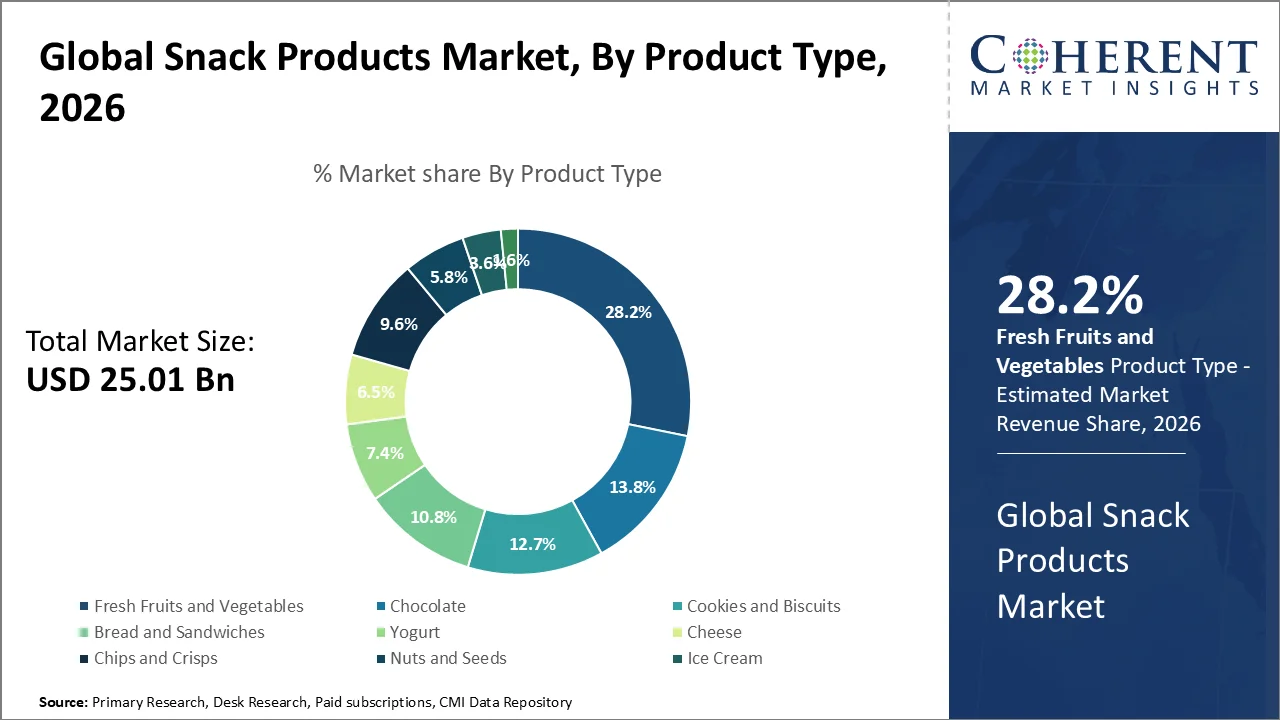
- The fresh fruits and vegetables segment is expected to lead the snacks products market with approximately 28.2% of market share by 2026. The growth of the segment is mainly driven by growing health consciousness, high demands for healthy and minimally processed snacks, higher preference for nutritious foods, and suitability of fresh products for frequent snacking. As per the International Fresh Produce Association's 2024 Consumer Tracker, 95% of U.S. consumers consumed equal or higher amounts of fruits and vegetables as compared to last year.
- Hypermarkets are estimated to dominate the distribution channel industry by accounting for about 31.4% share in 2026. The reasons for hypermarkets growth include the presence of wide ranges of packaging snack food items, affordable prices, discount offers, own brand items, and the availability of multiple product categories under one roof. According to the 2025 Voice of the Consumer Survey, supermarket shopping in store was the most preferred option as it accounted for 62% of daily/weekly grocery shopping done by consumers.
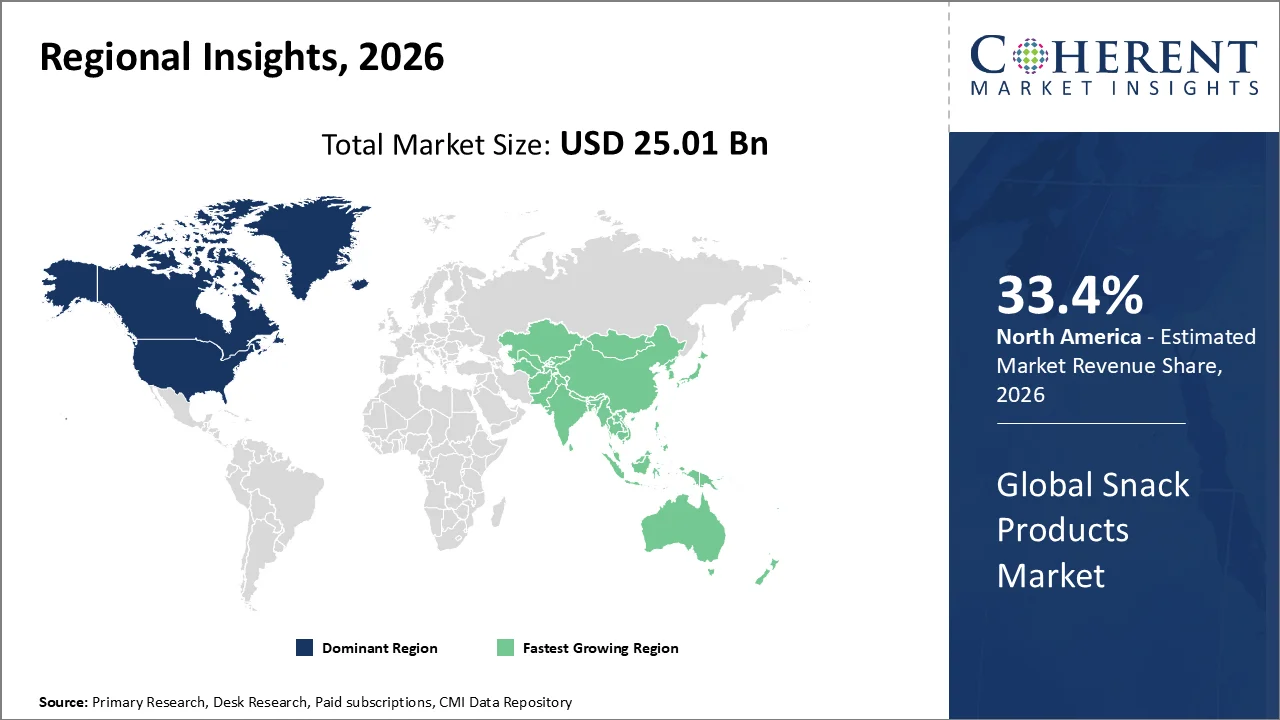
- North America is likely to dominate the snack products market with approximately 33.4% share in 2026. The region’s growth is attributable to frequent snack consumption, strong consumer purchasing power, the presence of major snack manufacturers, extensive supermarket and convenience-store networks, and continuous innovation in healthy, functional, premium, and on-the-go snack formats. SNAC International reported that the U.S. snack food industry’s sales increased by 4.8% to USD 156 Bn in 2025, while sales of snacks carrying low-sodium and organic claims increased by 12%.
Market Drivers
Growing Snackification and Meal Replacement are Expanding Consumption Occasions
The snack products market is growing because people tend to eat small snacks throughout the day instead of consuming regular meals. It is because of hectic working schedules, time spent on traveling, flexible working hours, and preference for portable food that people opt for fruit snacks, yogurt, cheese, nuts, sandwiches, and biscuits, among others.
Circana announced in June 2025 that snacks have constituted over 20% of food and beverages sales around the world, with consumers aged less than 40 years driving the demand for snacks in major markets. The September 2025 findings of Circana further indicated that the number of snacking instances in the United States during normal meal times was about 462, while snacking instances between meals were 789. This blurring line between meals and snacks is increasing the target market for filling snack foods.
Rising Protein and Clean-Label Demand is Accelerating Health-Focused Snacking
Consumers are increasingly seeking snack products that provide nutritional benefits beyond hunger satisfaction. Demand is shifting toward products containing protein, fibre, fruits, vegetables, nuts, seeds, natural cheese, yogurt, probiotics, and reduced levels of sugar, sodium, and artificial ingredients. This trend is encouraging manufacturers to reformulate established products and introduce functional and better-for-you alternatives.
Circana’s 2025 research found that 41% of U.S. adults were actively seeking to increase their protein intake. The study also showed that 28% avoided artificial sweeteners, while 25% avoided artificial colours and flavours. Supporting this trend, the National Association of Convenience Stores reported in April 2026 that U.S. sales of alternative snacks, including jerky, nuts, and seeds, increased by 7.9% in 2025, reflecting stronger demand for protein-oriented products.
Current Events and Their Impact on the Snack Products Market
Current Event | Description and its Impact |
U.S. FDA Accelerates the Phase-Out of FD&C Red No. 3 in Food Products (2025–2027) |
|
UK Implements Restrictions on Advertising Less Healthy Food and Drink Products (2026) |
|
- Current Industry Events of 2026
- Market Size Estimation
- Regional Breakdown
- Competitive Landscape
- Customer Intelligence
- Segmental Analysis
- Pricing Analysis
- Key Market Drivers, Challenges & Future Trends
- Customized Insights Section
Segmental Insights
Why are Fresh Fruits and Vegetables Acquiring the Largest Share?
On the basis of product type, the fresh fruits and vegetables segment is projected to account for the largest share of the snack products market, at approximately 28.2% in 2026. The segment’s growth is attributable to increasing demand for natural, nutrient-dense, minimally processed, and convenient snack options. Fresh fruits and vegetables can be consumed without extensive preparation and are increasingly offered in washed, sliced, portioned, and ready-to-eat formats, making them suitable for between-meal consumption.
According to the International Fresh Produce Association report of 2025 industry update, about 75% of consumers in the survey areas would prefer to select fruit as their choice of snack. In addition, close to 40% of the consumers preferred value-added fruit, which included fresh cut, pre-prepared fruits, among others.
In May 2026, NatureSweet expanded its snacking-tomato portfolio with the launch of Golden Cherubs, a golden grape tomato developed to provide a balance of sweetness and tangy flavour.
Hypermarkets Hold the Largest Market Share
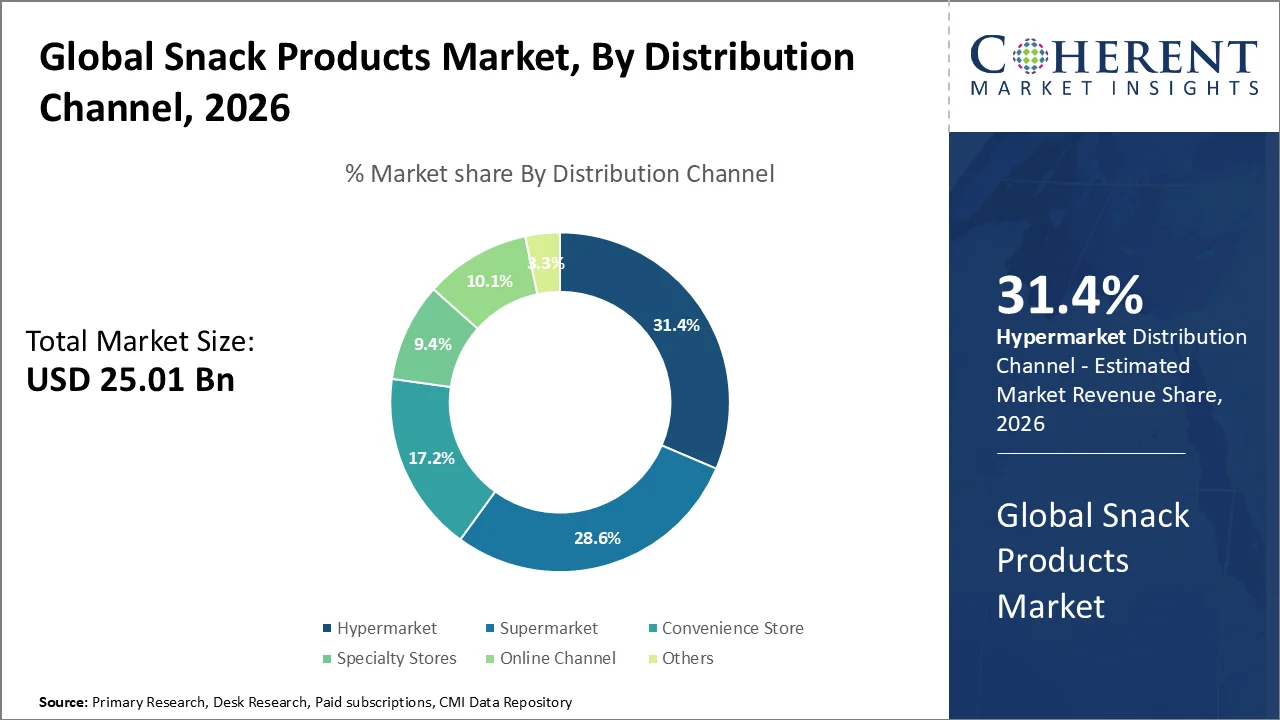
On the basis of distribution channel, the hypermarket segment is expected to lead the snack products market with approximately 31.4% share in 2026. The segment’s growth is attributable to the availability of multiple snack categories under one roof, competitive pricing, frequent promotions, private-label products, bulk-purchase options, and dedicated shelf space for fresh, refrigerated, frozen, and packaged snacks.
Walmart served approximately 280 million customers and members each week through more than 10,900 stores and e-commerce platforms across 19 countries. These extensive physical and omnichannel networks allow major retailers to provide broad snack assortments, maintain high product availability, and support both planned grocery purchases and impulse snack buying.
In February 2026, LuLu Retail launched its 33rd store at the Al Qurum Complex, Muscat. This hypermarket is spread across 33,000 square feet, selling fresh fruits and vegetables, foodstuffs, dairy items, frozen items, meat, fish, and grocery items.
Snack Products Market Trends
- Increasing preference for ingredients that are clean label, functional, and identifiable is compelling manufacturers to cut down on synthetic preservatives and introduce products containing fiber, proteins, vitamins, natural oils, and reduced sugar levels. The 2025 APAC IngredienTracker survey of Cargill revealed that more than 70% of consumers would review the labels of the ingredients before buying, whereas 58% of them would pay 10% more for high-quality ingredients.
- The growing preference for international flavors and multicultural snack ideas is making the launches of products based on gochujang, sweet chili, mango habanero, sriracha, hot honey, and other regional flavors very common. According to Conagra Brands, global snacks saw retail sales worth roughly $5.7 billion in the United States in 2025, having witnessed growth in volume by 22% in the previous three years.
- The increasing trend towards texture, premiumization, and multi-sensorial experience is driving innovation in crunchy coatings, filled biscuits, layered snacks, fruit inclusions, cheese flavors, and the contrasting soft and crispy formats. In Cargill’s study for 2025 indulgence in Southeast Asia, it was revealed that 82% of consumers appreciated highly sensorial food experience, and 79% would be ready to pay for unique textures.
Regional Insights
North America Dominates Owing to High Snack Consumption and an Established Retail Ecosystem
North America is expected to make up around 33.4% share of the snack products market by 2026. North America's dominance is due to the fact that consumers frequently indulge in snacking between meals, high penetration rate of supermarkets and convenience stores, purchasing power and availability of big brands offering chocolate, cookies, chips, nuts, cheese, yogurt, ice cream, and functional snacks.
According to the Hershey Company, net sales of North America Confectionery grew 8.3% to USD 2.49 billion for the first quarter of 2026. Net sales of North America Salty Snacks also rose by 26.0% to reach USD 350.1 million. This reflects the continued growth within both the sweet and savory snacks categories.
In March 2026, Hershey also introduced it’s ONE Hershey operating model, integrating its sweet, salty, and protein-snacking portfolios to expand distribution, improve retail execution, and strengthen cross-category innovation. The company’s portfolio includes more than 90 brands and generates over USD 11.2 billion in annual revenue, highlighting the scale of the regional snack-manufacturing base.
Asia Pacific Snack Products Market Trends
Asia Pacific is expected to be the fastest-growing regional market during 2026–2033. Regional growth is attributable to a large and increasingly urban population, rising disposable incomes, expanding modern retail and e-commerce channels, and strong consumer demand for locally inspired flavours, affordable packs, confectionery, biscuits, chips, fruit snacks, and dairy-based products.
In October 2025, PepsiCo acquired Australia-based Dowling AgriTech to strengthen its seed-potato supply chain and support potato-chip production across Asia Pacific. The acquisition is expected to improve raw-material security, agricultural innovation, and supply-chain resilience for PepsiCo’s regional savoury-snack portfolio.
High Household Penetration and Strong Branded Portfolios are Supporting the Snack Products Market in the United States
The U.S. snack products market is supported by frequent consumption, high household penetration, established supermarket and convenience-store networks, and the presence of major manufacturers across confectionery, biscuits, yogurt, cheese, fruit snacks, nuts, chips, and frozen snacks. Demand is also being shaped by smaller portions, premium flavours, functional ingredients, and products positioned for everyday treating and on-the-go consumption.
The National Confectioners Association reported that U.S. confectionery retail sales reached a record USD 55 billion in 2025, with 99.8% of households purchasing confectionery products at least once. Chocolate generated USD 28.4 billion, representing 51.7% of confectionery sales, while non-chocolate candy generated USD 22.5 billion.
China Snack Products Market Trends
China is expected to witness strong growth in the snack products market over the forecast period. The country’s growth is attributable to rising online food purchasing, expansion of supermarkets and convenience stores, increasing demand for convenient packaged foods, and strong consumer interest in local flavours, premium products, health-oriented snacks, and experience-led consumption.
In April 2026, PepsiCo opened China’s first Lay’s Potato Restaurant in Shanghai. The experiential outlet combines potato-based dishes, Lay’s flavours, brand collaborations, and limited-edition products to create new away-from-home consumption occasions.
Who are the Major Companies in Snack Products Industry
Some of the major key players in Snack Products Market are PepsiCo Inc., Mondelez International Inc., Kellogg Company, Lamb Weston Holdings Inc., McCain Foods Ltd., Intersnack Group, Calbee Inc., Aviko B.V. General Mills Inc., and McDonald’s Corporation.
Key News
- In June 2026, Mondelēz selected nine start-ups for its CoLab Tech 2026 accelerator programme. The programme focuses on sustainable packaging, next-generation ingredients, ingredient science, consumer experiences and production efficiency.
- In September 2025, Kellanova announced Cheez-It Crunch, with nationwide U.S. retail availability beginning in January 2026. The three-dimensional snack is available in Kick’n Nacho Cheese, Zesty Jalapeño Cheddar and Sharp White Cheddar flavours.
Market Report Scope
Snack Products Market Report Coverage
| Report Coverage | Details | ||
|---|---|---|---|
| Base Year: | 2025 | Market Size in 2026: | USD 25.01 Bn |
| Historical Data for: | 2020 To 2024 | Forecast Period: | 2026 To 2033 |
| Forecast Period 2026 to 2033 CAGR: | 17.4% | 2033 Value Projection: | USD 77.01 Bn |
| Geographies covered: |
| ||
| Segments covered: |
| ||
| Companies covered: | PepsiCo Inc., Mondelez International Inc., Kellogg Company, Lamb Weston Holdings Inc., McCain Foods Ltd., Intersnack Group, Calbee Inc., Aviko B.V. General Mills Inc., and McDonald’s Corporation. | ||
| Growth Drivers: |
| ||
| Restraints & Challenges: |
| ||
Analyst Opinion
- The snack products market is expected to remain resilient; however, future growth will increasingly depend on higher consumption volumes and new snacking occasions rather than price increases alone. Kantar reported that global spending on out-of-home snacks and non-alcoholic beverages increased by 7% in the second quarter of 2025, with out-of-home purchases contributing 40% of total category value. However, the number of units purchased declined by 3%, indicating that manufacturers must strengthen affordable pack sizes, meal-replacement formats, and everyday consumption propositions to maintain sustainable volume growth.
- Healthy snacking is evolving from being just a specialty product into an everyday purchase concern, thereby providing excellent prospects for healthy, protein-packed, low sugar content, fruit-based, and minimally processed foods. According to the Healthy Snacking Report of 2025, over 55 percent of Indian consumers preferred natural and preservative-free ingredients, whereas 52 percent liked resealable packaging more. This suggests that successful products will need to combine nutritional positioning with convenience, freshness, and attractive packaging rather than competing only on health claims.
- Competitive advantage in the snack products market will increasingly depend on continuous product innovation, targeted digital marketing, price-pack architecture, and operational efficiency. Deloitte’s 2025 Consumer Products Industry Outlook, based partly on a survey of 250 senior consumer-products executives, found that profitable growth leaders were prioritising portfolio innovation, more targeted demand generation, trade and pricing investments, and digital automation. Snack manufacturers applying these strategies will be better positioned to respond to changing flavour preferences, affordability pressures, and omnichannel purchasing behaviour.
Speak to the analyst
Want personalized insights?
Take the findings above to one of our principal consultants, or have the report rebuilt around the segments, geographies and competitors you actually track.
Market Segmentation
- By Product Type (Revenue, USD Bn, 2021-2033)
- Chocolate
- Fresh fruits and Vegetables
- Cookies and Biscuits
- Bread and Sandwiches
- Yogurt
- Cheese
- Chips and Crisps
- Nuts and Seeds
- Ice cream
- By Distribution Channel (Revenue, USD Bn, 2021-2033)
- Supermarket
- Hypermarket
- Convenience Store
- Specialty Stores
- Online Channel
- Others
- By Region (Revenue, USD Bn, 2021-2033)
- North America
- U.S.
- Canada
- Latin America
- Brazil
- Mexico
- Argentina
- Rest of Latin America
- Europe
- Germany
- U.K.
- France
- Italy
- Spain
- Russia
- Rest of Europe
- Asia Pacific
- China
- India
- Japan
- Australia
- South Korea
- ASEAN
- Rest of Asia Pacific
- Middle East
- GCC
- Israel
- Rest of Middle East
- Africa
- South Africa
- Central Africa
- North Africa
- North America
Sources
Primary Research Interviews
- Snack product manufacturers and brand owners
- Fresh fruit and vegetable snack producers
- Chocolate, biscuit, chips, dairy, and frozen-snack manufacturers
- Ingredient and flavour solution providers
- Packaging material and portion-pack suppliers
- Supermarket, hypermarket, and convenience-store procurement managers
- E-commerce grocery and quick-commerce platform representatives
- Distributors, wholesalers, and foodservice operators
- Food technologists, nutritionists, and product-development professionals
- Key opinion leaders in packaged foods and consumer nutrition
Databases
- World Bank
- Organisation for Economic Co-operation and Development (OECD)
- United Nations Comtrade Database
- FAOSTAT
- Eurostat
- U.S. Department of Agriculture (USDA)
- U.S. Census Bureau
- U.S. Bureau of Economic Analysis
- National Bureau of Statistics of China
- Food and Agriculture Organization of the United Nations
Magazines
- Food Business News
- Food Navigator
- Snack Food & Wholesale Bakery
- Progressive Grocer
- Convenience Store News
- Food Processing
- Bakery & Snacks
- Confectionery News
- Frozen & Refrigerated Buyer
- Store Brands
Journals
- Food Quality and Preference
- Appetite
- Foods
- Nutrients
- Journal of Food Products Marketing
- International Journal of Food Sciences and Nutrition
- British Food Journal
- Journal of Retailing and Consumer Services
- International Journal of Consumer Studies
- Food Research International
Newspapers
- The New York Times
- The Guardian
- The Wall Street Journal
- Financial Times
- The Economic Times
- Reuters
- Bloomberg
- China Daily
Associations
- SNAC International
- National Confectioners Association
- Food Industry Association
- International Fresh Produce Association
- National Association of Convenience Stores
- Private Label Manufacturers Association
- Consumer Brands Association
- International Dairy Foods Association
- International Association for Food Protection
- European Snacks Association
Public Domain Sources
- Company annual reports and investor presentations
- Company press releases and product-launch announcements
- U.S. Food and Drug Administration publications
- USDA food, retail, and nutrition databases
- European Food Safety Authority publications
- European Commission food-labelling and packaging regulations
- National food-consumption and household-expenditure surveys
- Retail sales and e-commerce statistics published by government agencies
- Import-export data for snack ingredients and finished products
- Publicly available supermarket and hypermarket expansion announcements
- Food safety, nutrition-labelling, advertising, and packaging regulations
- Patent databases such as WIPO, USPTO, and Google Patents
Proprietary Elements
- CMI Data Analytics Tool
- Proprietary CMI Existing Repository of Information for the Last 10 Years
Get access to 250+ pages report
Every segment, forecast, competitor profile and data table behind the analysis above — available for instant download.
- ESOMAR Member
- ISO 9001:2015 Certified
- D-U-N-S Registered
- GDPR & CCPA Compliant
Missing comfort of reading report in your local language? Find your preferred language:
Transform your Strategy with Exclusive Trending Reports
Frequently Asked Questions
The Snack Products Market is expected to increase from USD 25.01 Bn in 2026 to approximately USD 77.01 Bn by 2033.
Major players operating in the global Snack Products Market include PepsiCo Inc., Mondelēz International Inc., Kellogg Company, Lamb Weston Holdings Inc., McCain Foods Ltd., Intersnack Group, Calbee Inc., Aviko B.V., General Mills Inc., and McDonald’s Corporation.
Fluctuating raw-material prices and high packaging and transportation costs are among the key challenges hampering market growth.
The market is primarily driven by the increasing demand for convenient and ready-to-eat foods and the growing adoption of healthy and functional snacks. Expansion of organised retail and e-commerce, changing dietary habits, and rising demand for protein-rich, low-sugar, organic, and clean-label products are also supporting market growth.
The Snack Products Market is anticipated to grow at a CAGR of approximately 17.4% between 2026 and 2033.
North America is expected to dominate the global Snack Products Market, accounting for approximately 33.4% of the market in 2026. Its dominance is supported by frequent snack consumption, strong purchasing power, extensive retail infrastructure, and the presence of leading snack manufacturers.
Asia Pacific is expected to be the fastest-growing regional market during 2026–2033, driven by urbanisation, rising disposable incomes, expanding modern retail and e-commerce channels, and increasing demand for affordable and locally flavoured snack products.