

Plant-Based Milk Market Size and Trends - 2026 to 2033
Plant-based milk market is estimated to be valued at USD 23.00 Bn in 2026 and is expected to reach USD 38.36 Bn by 2033, exhibiting a compound annual growth rate (CAGR) of 7.6% from 2026 to 2033.
Key Takeaways
- Based on Product, the Almond Milk segment is projected to capture 25% share of the market in 2026, driven by health consciousness, low calories, and nutrient benefits.
- Based on Nature, the Organic segment is projected to account for 62.8% share of the market in 2026, driven by safety and ethical sourcing.
- Based on Flavor, the Unflavored segment is expected to hold 55.8% share in 2026, driven by versatility and health appeal.
- Based on Distribution Channel, the Offline segment is expected to lead the market with the largest share in 2026, driven by freshness, access, and comparison.
- Based on Region, Asia Pacific is set to lead the Plant-based milk market in 2026 with 42.7% share. While, Europe is anticipated to be the fastest growing region.
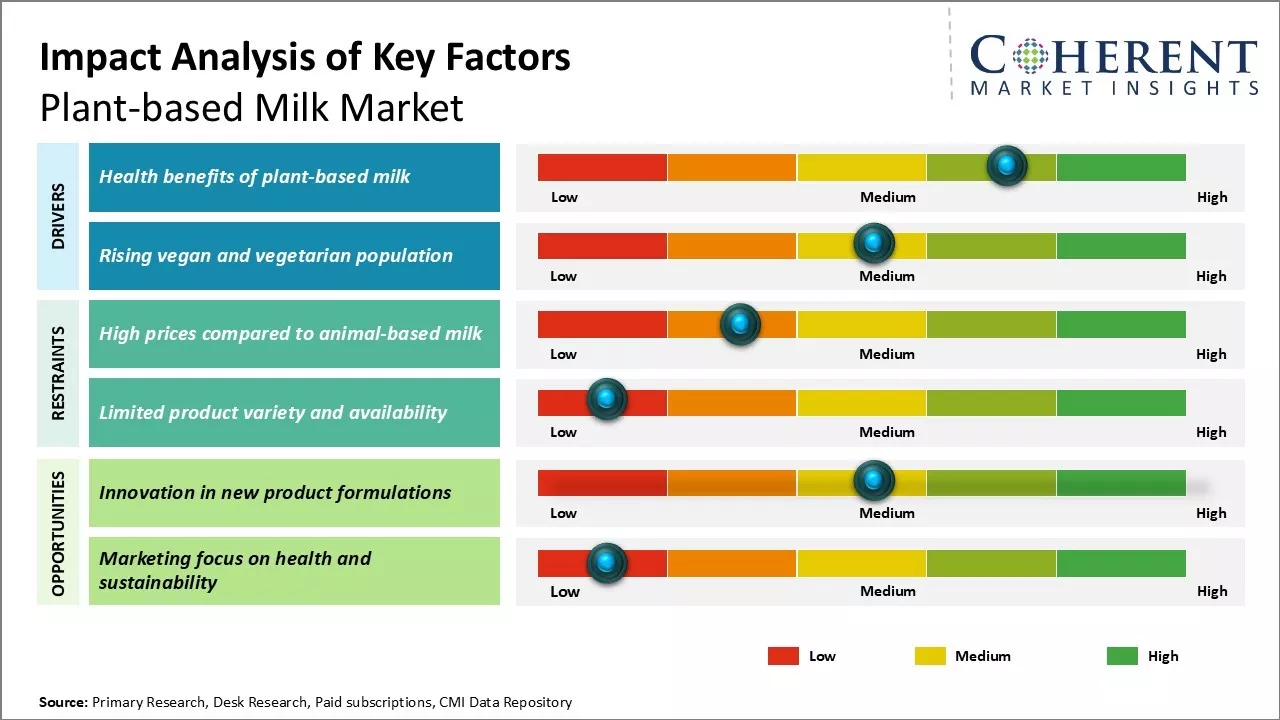
Market Overview
Plant-based milk market witnesses growth owing to rising health consciousness among consumers and increasing lactose intolerance. Various factors such as increasing vegan population, environmental concerns regarding dairy milk production, and rising availability of plant-based milk variants are driving the market growth. Moreover, growing awareness regarding the nutritional benefits of plant-based milk such as low cholesterol, lesser calories, and fat content compared to animal-based milk can also boost its demand.
Current Events and Its Impacts on the Plant-Based Milk Market
Current Event | Description and its Impact |
European Union Regulatory Framework Changes |
|
Technological Breakthroughs in Food Science |
|
Price Analysis
Region | Plant‑Based Milk Price (avg) | Cow’s Milk Price (avg) | Price Gap | Notes |
Europe (Germany) | €2.20–€2.80 per liter | €0.90–€1.20 per liter | ~2–3× higher | Plant‑based milk taxed at 19% VAT vs. 7% for cow’s milk |
United States | USD 3.50–4.00 per half‑gallon (almond); USD 4.50–5.00 (oat) | USD 2.50–3.00 per half‑gallon | ~30–60% higher | Oat milk premium due to coffee culture demand |
India | ₹180–₹250 per liter (almond/soy) | ₹50–₹70 per liter | ~3–4× higher | Premium positioning; import dependence for almonds/oats |
China | 30–50% higher than dairy | Local soy milk cheaper | ~1.3–1.5× higher | Imported oat milk positioned as premium |
UK (Retail chains) | £1.80–£2.20 per liter (oat/almond) | £0.90–£1.10 per liter | ~2× higher | Oat milk sales growing 3× faster than cow’s milk |
- Current Industry Events of 2026
- Market Size Estimation
- Regional Breakdown
- Competitive Landscape
- Customer Intelligence
- Segmental Analysis
- Pricing Analysis
- Key Market Drivers, Challenges & Future Trends
- Customized Insights Section
Segmental Insights
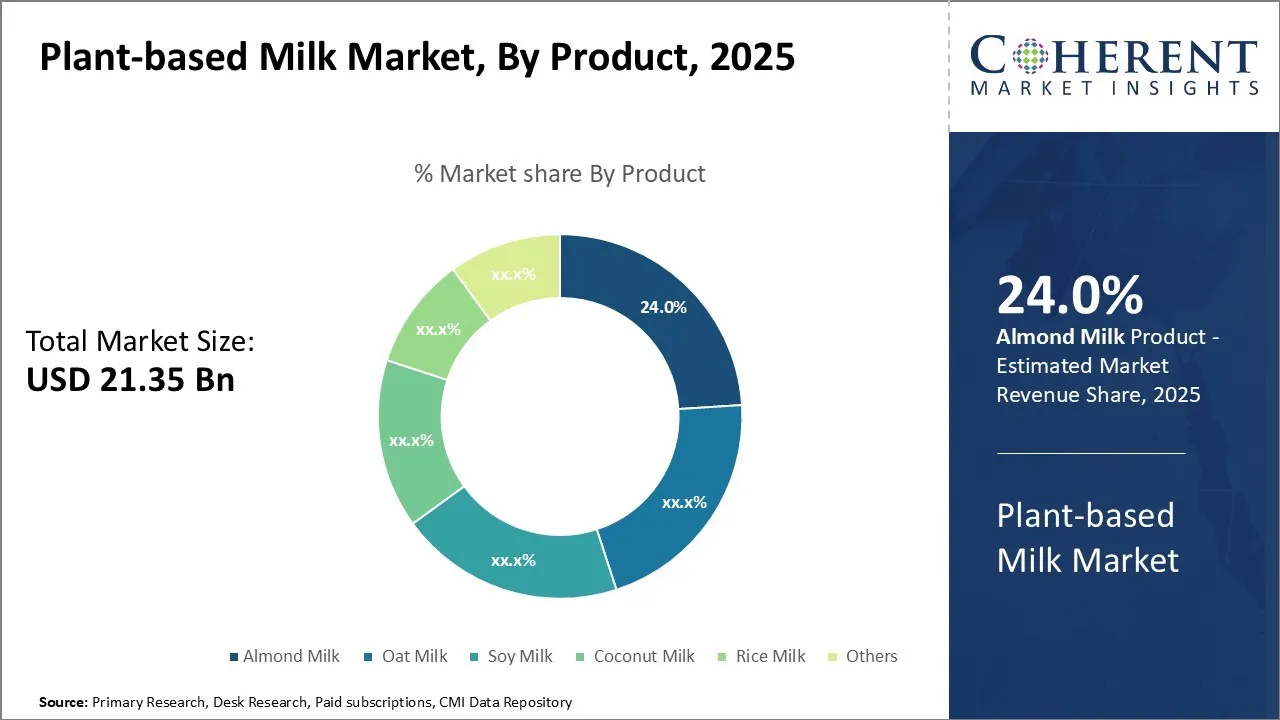
Plant-Based Milk Market Insights, By Product- Health-Conscious Consumers Fuels Almond Milk Demand
In terms of product, almond milk segment is estimated to contribute the highest market share of 25% in 2026, owing to rising health consciousness among consumers. Almond milk is preferred due to its low calorie and sugar content as compared to dairy milk, making it a popular choice for those looking to lose their weight or manage health conditions like diabetes. Nutritious composition of almonds, which are high in vitamin E and antioxidants, also boosts its demand.
For instance, in July 2025, MALK Organics introduced a new Vanilla Almond Milk that does not require to be refrigerated and is made with only four clean ingredients. Vegconomist wrote about the launch, which shows how committed the brand is to being open and honest about plant-based drinks. This new product gives people in the growing dairy-free market a convenient, preservative-free choice.
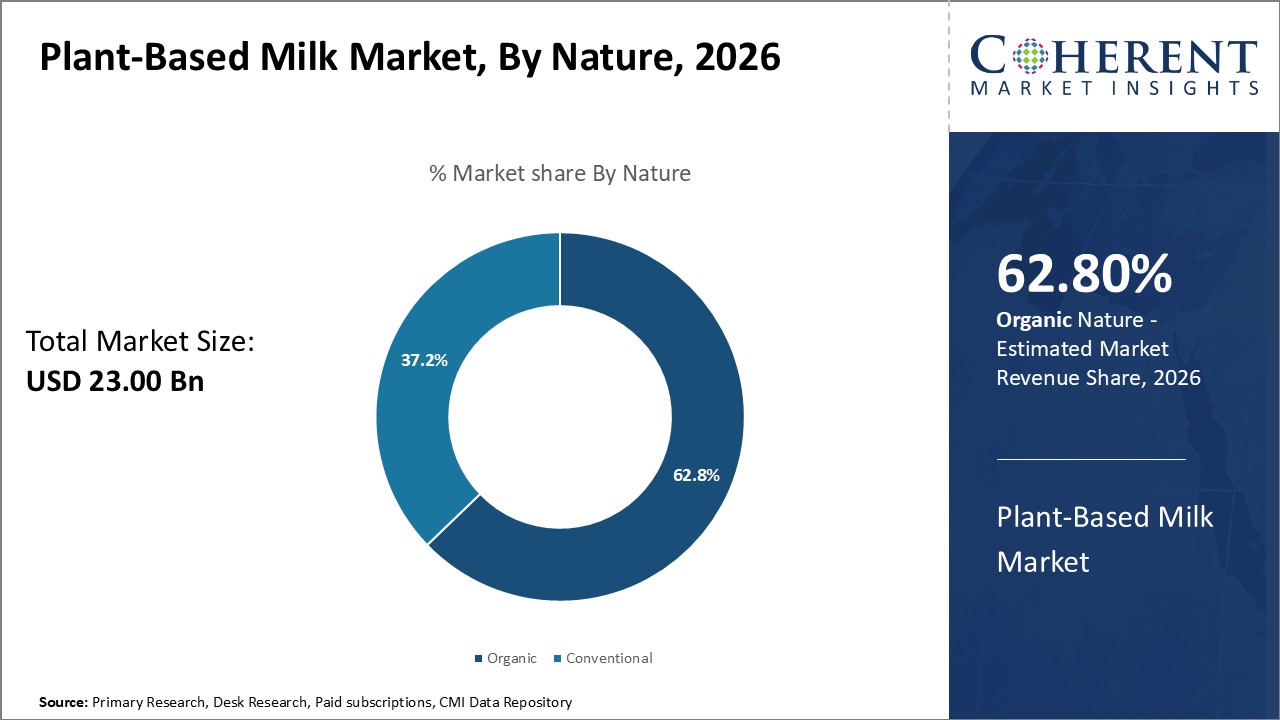
Plant-Based Milk Market Insights, By Nature- Organic Plant-based Milk Appeals to Ethical Shoppers
In terms of nature, organic segment is estimated to contribute the highest market share of 62.8% in 2026, due to increasing consumer demand for plant-based milk without using synthetic pesticides and fertilizers. As food safety and ethical sourcing become priority purchasing criteria, many shoppers perceive organic as the gold standard. Products bearing the USDA Organic seal signal that strict national standards for soil health, animal welfare and environmental protection were followed.
For instance, in December 2026, Ripple Foods has gotten greater resources to grow its line of organic pea-based milk and plant-based protein products. The company, which is known for making dairy alternatives that are good for the environment, wants to get a greater proportion of the growing plant-based market. This investment shows that more and more people want clean, organic, and eco-friendly milk options.
Plant-Based Milk Market Insights, By Flavor- Versatile Unflavored Milk Remains a Staple
In terms of flavor, unflavored segment is estimated to contribute the highest market share of 55.8% in 2026. Unflavored product gain popularity, owing to its versatility. As a basic versatile milk that can be used in many recipes and consumed on its own, unflavored represents a staple grocery item whose demand remains steady. Unaltered by additional sugars and ingredients, the natural flavor also appeals to health-conscious buyers wishing to avoid extra calories.
For instance, in May 2026, Eclipse Foods made a whole milk from plants that tastes and feels like dairy. The unflavored product is meant to give people a flexible option for drinking, cooking, and baking. This launch shows that the plant-based sector is becoming more innovative, offering options that are good for the environment without losing taste or function.
Plant-Based Milk Market Insights, By Distribution Channel - Offline Driven by Freshness, Access, And Comparison
In terms of distribution channel, the Offline segment is expected to lead the market with the largest share in 2026. Offline channels include supermarket, hypermarket, and convenience store. The shoppers prefer these offline shopping for immediate access, trusted freshness and the ability to compare options.
Regional Insights
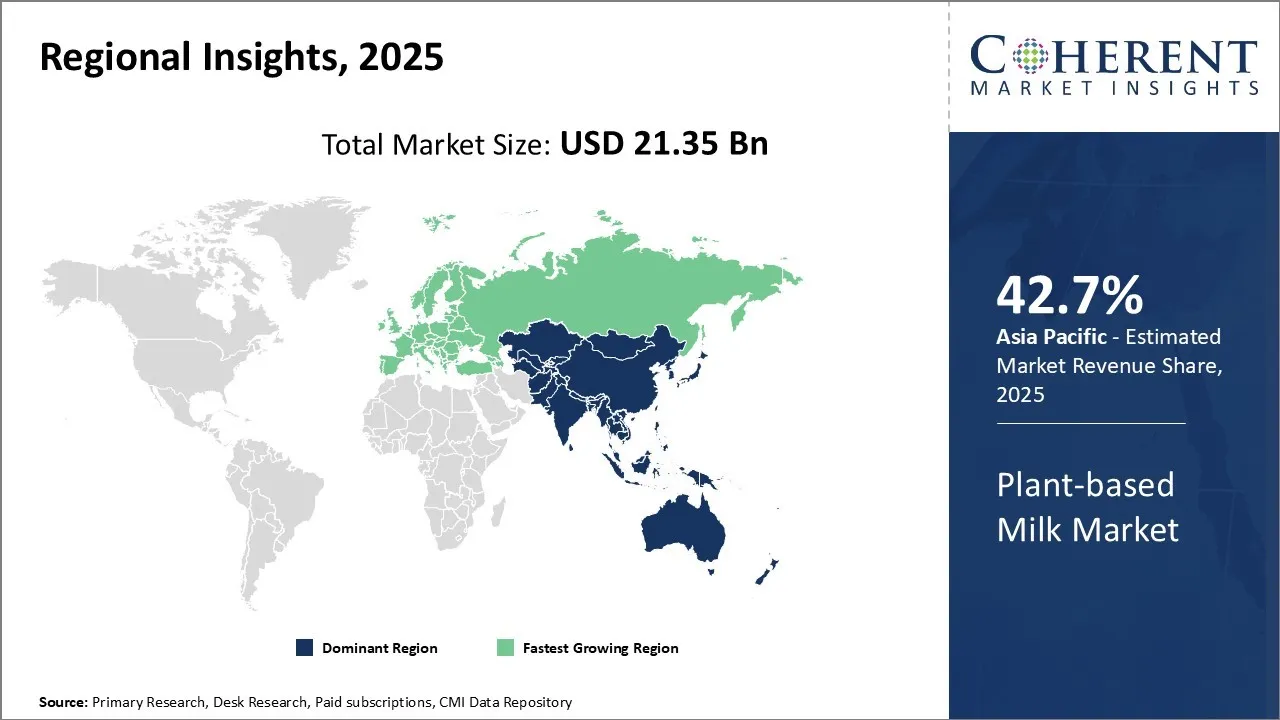
Asia Pacific Plant-Based Milk Market Analysis & Trends
Asia Pacific is projected to lead this market in 2026, with an estimated market share of 42.7%. Asia Pacific plant-based milk market growth can be attributed to robust consumer awareness about health and nutrition. Companies like Hain Celestial Group, Inc. Farms have established strong brands loyalty through sustained marketing campaigns emphasizing sustainability and eco-friendly options. Government incentives also support innovation in this niche category.
For Instance, in June 2026, Pure Mylk opened Malaysia's first plant-based beverage lab in Southeast Asia. The goal is to improve food technologies and dairy-free innovations. The facility will focus on making plant-based milk alternatives that are good for the environment and good for you. This will contribute to helping the region become a larger player in the global market for healthier, eco-friendly drinks.
Europe Plant-Based Milk Market Analysis & Trends
Europe region exhibits the fastest growth due to shifting lifestyle patterns among younger consumers. Popular alternatives such as oat, almond, and soy milk have witnessed huge adoption in diets. Local players have emerged to cater to regional taste preferences.
For instance, in June 2026, In the Netherlands, the Dutch supermarket chain Albert Heijn started selling hybrid dairy and plant-based milk blends. The launch shows that more and more people want eco-friendly and adaptable options that mix traditional dairy with plant-based ingredients. This new idea makes Europe a leader in changing milk consumption patterns toward healthier options.
Plant-based Milk Market Outlook for Key Countries
China Plant-based Milk Market Trends
China's market for plant-based milk is experiencing consolidation, with larger companies acquiring emerging brands. E-commerce has become a central distribution channel, especially for nutritious products aimed at health-conscious consumers in major cities. Alongside international players, domestic brands are also gaining ground, with soy milk remaining a popular staple.
For instance, in December 2026, Oatly performs very well in China's plant-based milk market, with sales up by almost 40% in August. The Swedish brand has made oat milk a popular choice for Chinese consumers by making products like turmeric and matcha oat milk more accessible and moving from coffee shops to stores.
Germany Plant-based Milk Market Trends
Germany stands out as one of the largest markets for plant-based milk in Europe, driven by supportive policies and a growing base of vegan and vegetarian consumers. The increasing popularity of almond, oat, and soy milk is notable, with oat milk particularly favored for its creamy texture.
France Plant-based Milk Market Trends
The French market for organic and plant-based products is characterized by a strong consumer preference for organic and natural options, driven by increasing awareness of sustainability and health benefits. For instance, according to data published by bioecoactual.com in May 2026, about 6.6% of household food consumption in France is organic, indicating a significant, albeit fluctuating, interest in organic foods.
Japan Plant-based Milk Market Trends
In Japan, plant-based milk remains a niche market but is steadily growing, especially among health-conscious consumers. Soy milk is the most popular choice and is frequently incorporated into traditional dishes. The market reflects a blend of traditional dietary habits and modern health trends, creating a distinctive dynamic.
For instance, in December 2026, The Asahi Group in Japan is making milk from yeast using precision fermentation. By programming yeast to make milk proteins, this new idea makes dairy alternatives that are animal-free and lactose-free but have the same nutrition as cow's milk. This breakthrough demonstrates that biotechnology can help make milk options that are good for the future and last a long time, in addition to traditional dairy and plant-based products.
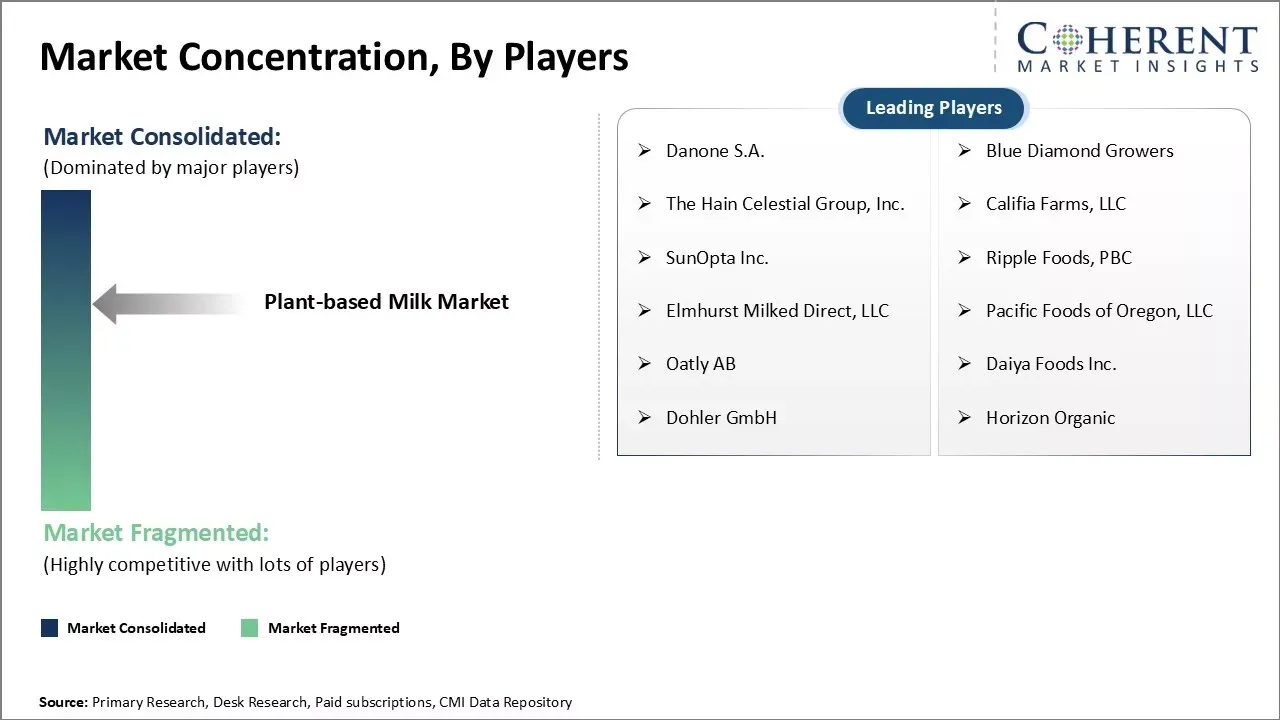
Market Concentration and Competitive Landscape
Market Report Scope
Plant-based Milk Market Report Coverage
| Report Coverage | Details | ||
|---|---|---|---|
| Base Year: | 2025 | Market Size in 2026: | USD 23.00 Bn |
| Historical Data for: | 2020 To 2024 | Forecast Period: | 2026 To 2033 |
| Forecast Period 2026 to 2033 CAGR: | 7.6% | 2033 Value Projection: | USD 38.36 Bn |
| Geographies covered: |
| ||
| Segments covered: |
| ||
| Companies covered: | Danone S.A., Blue Diamond Growers, The Hain Celestial Group, Inc., Califia Farms, LLC, SunOpta Inc., Ripple Foods, PBC, Elmhurst Milked Direct, LLC, Pacific Foods of Oregon, LLC, Oatly AB, Daiya Foods Inc., Dohler GmbH, and Horizon Organic | ||
| Growth Drivers: |
| ||
| Restraints & Challenges: |
| ||
Market Dynamics
Plant-based Milk Market Driver
Health benefits of plant-based milk
Major driver fueling the market growth include rising awareness about the health benefits associated with the consumption of plant-based milk over dairy milk. For instance, in July 2025, The UK’s SACN and COT reviewed plant‑based drinks, noting benefits like lactose‑free nutrition and lower saturated fat, but risks of nutrient gaps without fortification. Oat, soya, and almond drinks are most popular, consumed by 10% of adults. Guidance stresses fortified options, especially for children, to ensure balanced diets.
Plant-based Milk Market Opportunity
Innovation in new product formulations
Plant-based milk market presents a major opportunity for innovation in new product formulations that can appeal to an even wider consumer base. With more companies entering the market, there has been increase in R&D to replicate the taste, texture, and nutritional profile of cow's milk more closely through new formulations. Products enriched with calcium, vitamins, and other nutrients are also improving. There has been scope to innovatively use different plant bases beyond the usual soy, almond and coconut to launch unique varieties.
Top Strategies Followed by Plant-based Milk Market Players
- Established players focus heavily on R&D to innovate new products. Companies like Oatly and Blue Diamond invest over 10% of revenues annually to develop enhanced formulations, nutrient profiles and packaging. These also form strategic partnerships with food companies, cafes and restaurants to increase distribution and boost brand awareness. International expansion remains a top priority with major players opening new production plants worldwide every year.
- Mid-sized companies compete on cost while maintaining quality. Brands such as Kite Hill and Earth's Own ensure competitive pricing without compromising on taste. These frequently collaborate with local suppliers, co-packers and distributors to optimize manufacturing processes and logistics.
- Small-scale Players are carving out niches in specialized categories. For example, companies like Plenish focus on creating distinctive textures and flavors suited for cereal and baking. Other brands concentrate on meeting dietary needs with allergen-free or vegan products.
Emerging Startups in the Plant-based Milk Market
Innovative technologies are driving change in the dairy alternatives market. Startups like Perfect Day are pioneering animal-free dairy proteins using fermentation to create customized whey and casein, with the potential to transform the industry and lessen environmental impact.
Sustainability is at the core for several startups. For instance, Nut Pod’s oat milk comes in cartons made from recycled household materials, saving millions of plastic bottles each year, while Bolt Threads has created a packaging material from mycelium and agricultural by-products.
New companies are also addressing niche needs. Minor Figures, for example, offers specialty milk aimed at families with infants, designed to mimic the properties of breastmilk. Meanwhile, other brands collaborate with chefs and mixologists to develop unique ingredients for innovative recipes and culinary concepts.
Analyst Opinion (Expert Opinion)
The market for plant-based milk is moving from a category with numerous of new products to a more organized and competitive part of the larger non-dairy beverage market. Product functionality, taste parity with dairy, and nutritional positioning are becoming more important in shaping demand than just lifestyle-driven adoption. Almond milk is still the most popular type of milk in most major markets. Oat milk, on the other hand, has become very popular in foodservice and café settings on account of its texture, ability to foam, and neutral flavor.
North America and Europe are still the most established markets in terms of region, due to strong retail penetration and the growth of private-label brands. Urbanization, rising health awareness, and a long history of drinking plant-based drinks like soy are all helping Asia-Pacific become a high-potential region. E-commerce and modern grocery stores have made it easier for people to try and buy things again, especially younger people.
But the category has some structural problems that make things harder. As people compare plant-based milk more directly to lactose-free and value-added dairy alternatives, they are more sensitive to price. People are paying more attention to the nutrition of the food they buy, especially the amount of protein, sugar, and fortification. This has made manufacturers change the way they make products and make sure that people know that the nutrition is the same.
In general, future performance will depend on lowering costs, making unique formulations, and having a strong presence in foodservice channels, where repeat consumption and brand visibility are highest.
Speak to the analyst
Want personalized insights?
Take the findings above to one of our principal consultants, or have the report rebuilt around the segments, geographies and competitors you actually track.
Recent Developments
- In November 2025, Nestlé, based in Switzerland and is helping to move global plant-based milk innovation forward through its research and development projects. The business is making drinks based on oats, soy, rice, and almonds, as well as dairy-plant blends that are a mix of the two. These efforts are focused on Europe and North America, where there is a growing demand for sustainable, lactose-free alternatives.
- In October 2025, Wildfarmed and Minor Figures introduced regeneratively farmed plant milk to the UK. This combines sustainable farming with new ideas for dairy-free products. The launch uses grains grown using regenerative methods, which is better for the environment and gives people more options for plant-based drinks.
- In June 2025, Kraft Heinz has released its first plant-based dessert in the U.S.: Jell-O chocolate pudding made with oat milk. The new product is aimed at people who are allergic to dairy, are unable to digest lactose, or don't eat animal products.
Market Segmentation
- Product Insights (Revenue, USD Bn, 2021 - 2033)
- Almond Milk
- Oat Milk
- Soy Milk
- Coconut Milk
- Rice Milk
- Others
- Nature Insights (Revenue, USD Bn, 2021 - 2033)
- Organic
- Conventional
- Flavor Insights (Revenue, USD Bn, 2021 - 2033)
- Unflavored
- Flavored
- Distribution Channel Insights (Revenue, USD Bn, 2021 - 2033)
- Offline
- Online
- Others
- Regional Insights (Revenue, USD Bn, 2021 - 2033)
- North America
- U.S.
- Canada
- Latin America
- Brazil
- Argentina
- Mexico
- Rest of Latin America
- Europe
- Germany
- U.K.
- Spain
- France
- Italy
- Russia
- Rest of Europe
- Asia Pacific
- China
- India
- Japan
- Australia
- South Korea
- ASEAN
- Rest of Asia Pacific
- Middle East
- GCC Countries
- Israel
- Rest of Middle East
- Africa
- South Africa
- North Africa
- Central Africa
- Key Players Insights
- Danone S.A.
- Blue Diamond Growers
- The Hain Celestial Group, Inc.
- Califia Farms, LLC
- SunOpta Inc.
- Ripple Foods, PBC
- Elmhurst Milked Direct, LLC
- Pacific Foods of Oregon, LLC
- Oatly AB
- Daiya Foods Inc.
- Dohler GmbH
- Horizon Organic
Sources
Primary Research Interviews
- Plant-Based Milk Manufacturers (Almond, Soy, Oat, Coconut, Rice, Others)
- Dairy Alternative Product Developers & R&D Heads
- Ingredient Suppliers (Plant Proteins, Enzymes, Stabilizers)
- Food & Beverage Processing Equipment Providers
- Retail Buyers & Category Managers (Modern Trade & E-commerce)
- Nutritionists, Dietitians & Food Industry Consultants
- Others
Databases
- Bloomberg Terminal
- Thomson Reuters Eikon
- Euromonitor International
- Mintel Global New Products Database (GNPD)
- S&P Global Market Intelligence
- Statista
- Others
Magazines
- Dairy Foods Magazine
- Food Business News
- Beverage Industry Magazine
- Food Processing Magazine
- Plant Based Foods Association Publications
- Others
Journals
- Journal of Food Science
- Food Chemistry
- Journal of Dairy Science (Dairy Alternatives Section)
- Trends in Food Science & Technology
- International Journal of Food Sciences and Nutrition
- Others
Newspapers
- Financial Times
- The Wall Street Journal
- Reuters
- Bloomberg News
- The Guardian (Food & Sustainability Section)
- Others
Associations
- Plant Based Foods Association (PBFA)
- European Plant-based Foods Association (ENSA)
- Good Food Institute (GFI)
- International Food Information Council (IFIC)
- Food and Agriculture Organization (FAO)
- Others
Public Domain Sources
- Food and Agriculture Organization (FAO)
- U.S. Department of Agriculture (USDA)
- European Commission – Food Safety & Agriculture
- World Health Organization (WHO) Nutrition Databases
- National Institutes of Health (NIH) – Dietary Research
- Others
Proprietary Elements
- CMI Data Analytics Tool
- Proprietary CMI Existing Repository of Information for the Last 8 Years
Get access to 250+ pages report
Every segment, forecast, competitor profile and data table behind the analysis above — available for instant download.
- ESOMAR Member
- ISO 9001:2015 Certified
- D-U-N-S Registered
- GDPR & CCPA Compliant
Missing comfort of reading report in your local language? Find your preferred language:
Transform your Strategy with Exclusive Trending Reports
Frequently Asked Questions
The Plant-based Milk Market is estimated to be valued at USD 23.00 Bn in 2026, and is expected to reach USD 38.36 Bn by 2033.
The CAGR of the Plant-based Milk Market is projected to be 7.6% from 2026 to 2033.
Health benefits of plant-based milk and rising vegan and vegetarian population are the major factors driving the growth of plant-based milk market.
High prices compared to animal-based milk and limited product variety and availability are the major factors hampering the growth of plant-based milk market.
In terms of product, almond milk segment is estimated to dominate the market in 2026.
Danone S.A., Blue Diamond Growers, The Hain Celestial Group, Inc., Califia Farms, LLC, SunOpta Inc., Ripple Foods, PBC, Elmhurst Milked Direct, LLC, Pacific Foods of Oregon, LLC, Oatly AB, Daiya Foods Inc., Dohler GmbH, Horizon Organic are the major players.
Asia Pacific is expected to lead the plant-based milk market in 2026.