

Brandy Market Size and Forecast — 2026-2033
The Global Brandy Market size is estimated to be valued at USD 7.81 billion in 2026 and is expected to reach USD 10.8 billion by 2033, exhibiting a compound annual growth rate (CAGR) of 5.6% from 2026 to 2033.
Overview
Brandy is a distilled alcoholic beverage produced from fermented fruit juices, predominantly grapes. It undergoes distillation and aging in oak barrels, which impart flavor complexity, aroma depth, and color. Brandy varieties include VS, VSOP, XO, and specialty craft batches. Its uses range from premium sipping spirits to culinary applications such as desserts, sauces, and cocktails. The product’s characteristics depend heavily on aging duration, fruit source, and distillation method.
Key Takeaways
The aged brandy subsegment leads in market share and revenue generation due to consumer preference for premiumization and authenticity.
The Off-Trade distribution channel remains dominant, capturing the largest portion of market revenue through supermarkets and e-commerce platforms.
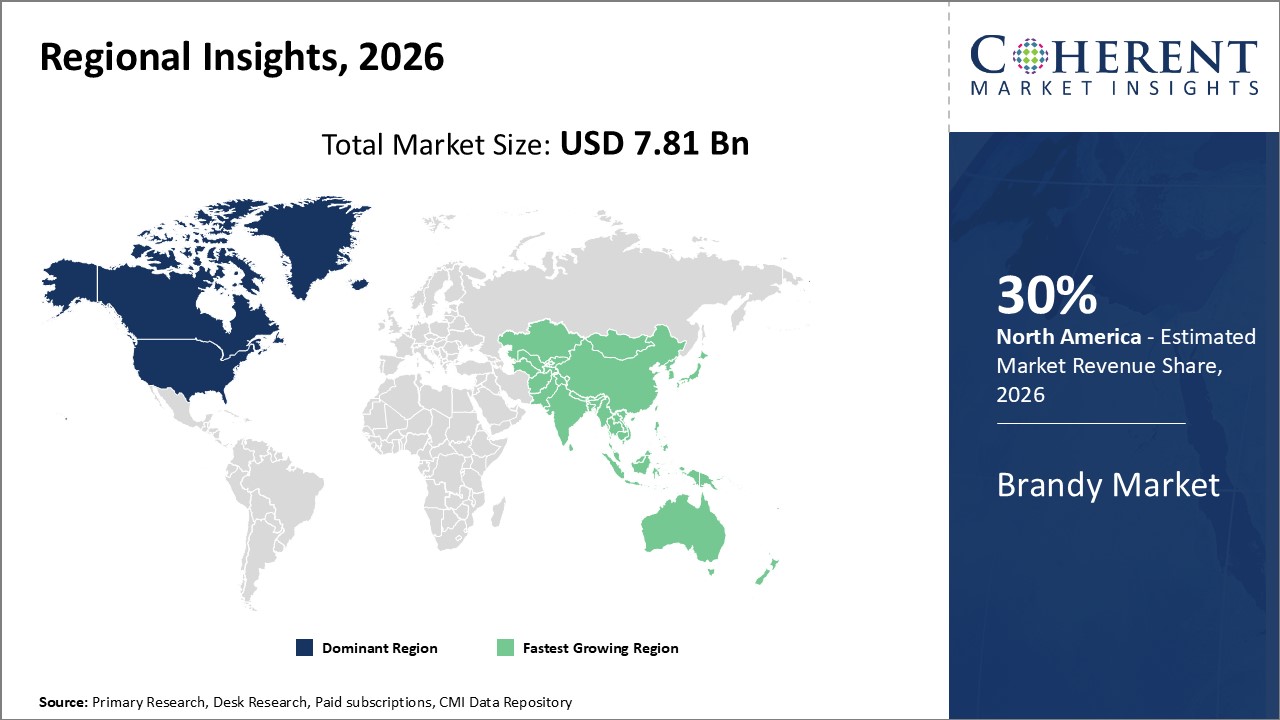
North America holds the largest market share at 30% owing to high per capita alcohol consumption and established distribution networks.
Asia Pacific is the fastest-growing region, driven by evolving consumer tastes and diminishing regulatory constraints, offering ample opportunities for market companies focused on brand diversification.
Brandy Market Segmentation Analysis
Brandy Market Insights, By Product Type
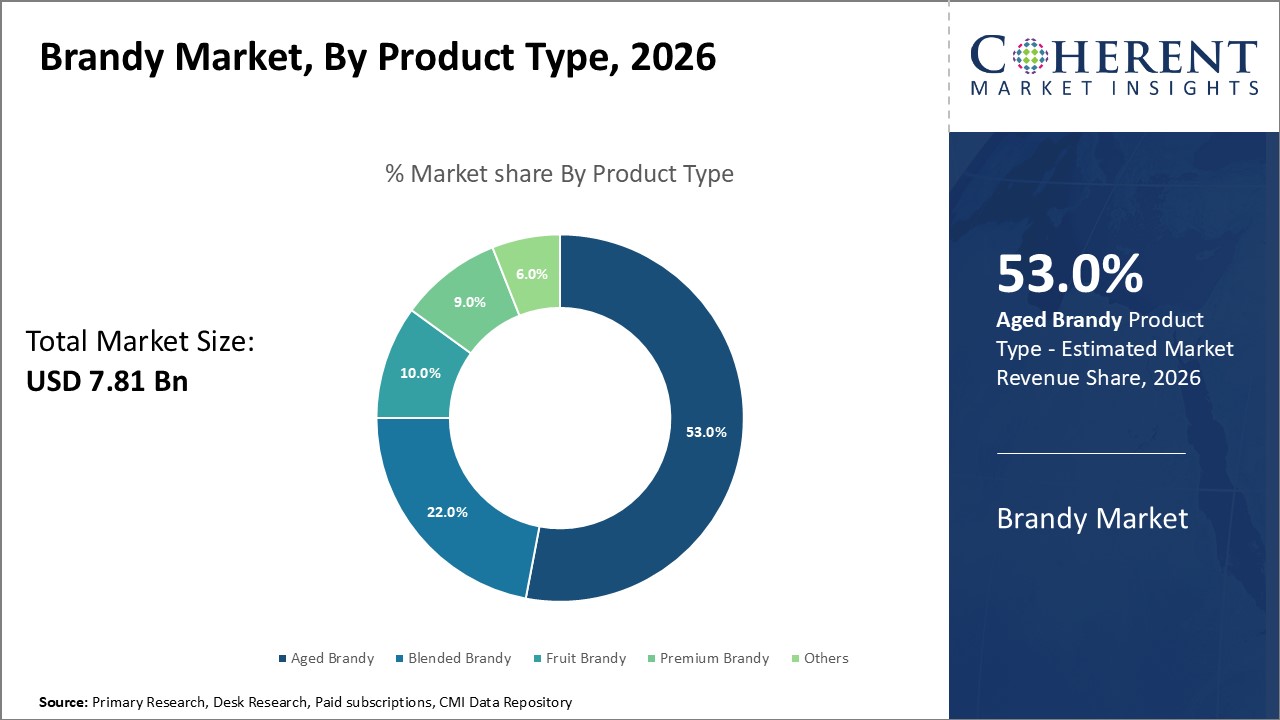
Aged Brandy commands leadership due to its rich flavor profile and premium positioning. Consumers increasingly favor aged variants for their authenticity and complexity, driving market companies to develop single-vineyard and organically aged products. The segment’s growth is supported by higher price points and lifestyle trends emphasizing quality over quantity. The fastest-growing subsegment within product types is Premium Brandy, propelled by demand from affluent urban consumers seeking exclusivity and innovation in limited-edition releases. Blended Brandy offers versatility and competitive pricing, catering to entry-level buyers, while Fruit Brandy appeals to niche consumers looking for unique flavor experiences.
Brandy Market Insights, By Distribution Channel
Off-Trade channels, including supermarkets and online retail platforms, dominate due to their accessibility and convenience, accounting for the largest share of market revenue. On-Trade remains critical for brand visibility and premium experience, particularly in metropolitan areas where cocktail bars and luxury hotels actively promote brandy consumption. Specialty Stores offer curated selections targeting connoisseurs, fostering brand loyalty and education. The fastest-growing channel is online retail within Off-Trade, reflecting a 30% YoY increase in sales driven by digital marketing and direct-to-consumer sales models, enhancing market reach.
Brandy Market Insights, By Price Range
Premium brandies outpace other segments by balancing exclusivity and accessibility, attracting consumers aspiring for upscale products without ultra-premium price tags. This segment’s success is linked to strong marketing narratives focused on craftsmanship and heritage. Ultra-Premium brandies, including limited editions and collector’s items, are the fastest-growing subsegment, expanding rapidly due to rising demand from affluent buyers and investors viewing rare spirits as alternative assets. Mid-Range offers affordable quality, catering to growing middle-class populations, while Economy brands serve mass market demand predominantly in developing regions, providing entry points for new consumers and volume-driven revenues.
Brandy Market Trends
Recent developments in the market underscore a pronounced shift toward premiumization and sustainability.
The rising consumer preference for aged and craft brandies is prominent in regions like Europe and North America, where authenticity and heritage command price premiums.
For example, France’s Cognac region continues to drive innovation by introducing organic and single-vineyard brandies, reported to have increased export volumes by 9% in 2025.
Digital transformation also reshapes purchase behaviors, with online sales platforms accounting for an increased share of market revenue globally due to enhanced consumer reach and convenience.
Brandy Market Insights, By Geography
North America Brandy Market Analysis and Trends
In North America, the Brandy market commands the largest share, driven primarily by established consumption behaviors and strong premium spirit penetration. The U.S. holds the lion’s share due to its sophisticated distribution infrastructure and cocktail culture that incentivizes brandy demand, demonstrated by a 9% increase in brandy imports and retail revenue in 2025. Growing interest in mixology among millennials and expanding on-trade channels further bolsters regional market revenue.
Asia Pacific Brandy Market Analysis and Trends
Meanwhile, the Asia Pacific exhibits the fastest growth in the market with a CAGR exceeding 7% from 2026 to 2033. Favorable government regulations, increasing urban population, and rising disposable incomes in countries like India and China intensify demand for premium spirits. The gradual relaxation of alcohol tariffs, coupled with aggressive marketing by international market players, has accelerated brand awareness and access, positioning Asia Pacific as a high-potential landscape for market growth.
Brandy Market Outlook for Key Countries
USA Brandy Market Analysis and Trends
The U.S. market thrives as a mature and diverse ecosystem with influential contributions from major companies like Brown-Forman and Rémy Cointreau. The expanding premium cocktail industry and growing consumer inclination toward luxury spirits have driven a surge in imports, with domestic consumption rising 8% in 2025. Additionally, innovative marketing approaches, including experiential events and digital engagement, have expanded the consumer base, making the U.S. a critical revenue hub driving overall market growth.
India Brandy Market Analysis and Trends
India’s market is propelled by shifting consumer preferences and increasing brand awareness, amplified by competitive pricing strategies and urbanization. Regulatory reforms easing import duties resulted in a 12% growth in premium brandy imports in 2025, while domestic producers focus on integrating traditional techniques with contemporary blending to attract aspirational consumers. Emerging urban centers and rising middle-class incomes underpin continued growth prospects, reinforced by targeted expansion of retail and on-trade outlets.
Analyst Opinion
The premium segment of the brandy market is witnessing significant growth, fueled by rising disposable income among millennials and Gen Z consumers in emerging economies. For instance, aged brandies priced above USD 50 grew by 16% in retail revenue in 2025, reflecting a shift toward luxury consumption patterns.
Production capacity enhancements in key brandy-producing countries like France and Spain have increased supply resilience. France expanded its distillation capacity by 8% in 2023, supporting growing exports that surged by 7% in 2025, meeting rising global demand without major price volatility.
Demand-side indicators reveal evolving use cases, with an uptick in brandy consumption in premium cocktail mixes, especially in North America. Import volumes of brandy to the U.S. rose by 9% in 2025, indicating a strengthening interest among younger drinkers, favoring mixology culture.
Pricing dynamics remain favorable despite global supply chain headwinds, as producers leverage value-added offerings. The average retail price of premium brandy variants rose by 5.2% worldwide in 2026, supported by consumer willingness to pay more for authenticity and craft heritage.
- Current Industry Events of 2026
- Market Size Estimation
- Regional Breakdown
- Competitive Landscape
- Customer Intelligence
- Segmental Analysis
- Pricing Analysis
- Key Market Drivers, Challenges & Future Trends
- Customized Insights Section
Market Scope
| Report Coverage | Details | ||
|---|---|---|---|
| Base Year: | 2025 | Market Size in 2026: | USD 7.81 billion |
| Historical Data for: | 2020 To 2024 | Forecast Period: | 2026 To 2033 |
| Forecast Period 2026 to 2033 CAGR: | 5.6% | 2033 Value Projection: | USD 10.8 billion |
| Geographies covered: |
| ||
| Segments covered: |
| ||
| Companies covered: | Rémy Cointreau, Martell Mumm Perrier-Jouët, Campari Group, Hennessy, Brown-Forman, Pernod Ricard, Bacardi Limited, Edrington Group, Sazerac Company, Asbach GmbH. | ||
| Growth Drivers: |
| ||
Brandy Market Growth Factors
Growth in the premium and aged brandy segments is propelled by rising urbanization and disposable incomes in emerging economies. The U.S. and China reported a 13% increase in brandy consumption in 2025, reflecting broader acceptance of premium alcoholic beverages. Regulatory relaxation in the Asia Pacific supports market expansion, with countries like India streamlining import duties, thus boosting brand diversity. Additionally, the rise of premium cocktail culture globally fuels demand for versatile spirit bases like brandy, as seen by the 19% increase in on-trade consumption in 2023.
Brandy Market Development
In 2026, Tilaknagar Industries expanded its premium whisky portfolio with the launch of Monarch Legacy in Karnataka, strengthening its presence in one of India’s fastest-growing IMFL markets. The new release is positioned in the semi-premium to premium whisky segment, reflecting rising consumer demand for smoother, higher-quality blends. Karnataka—known for its high per-capita alcohol consumption and strong retail infrastructure—serves as a strategic launchpad for scaling the brand nationally.
In 2026, Radico Khaitan introduced two new premium whiskies, further sharpening its focus on the rapidly expanding upper-premium and luxury IMFL categories in India. The launches build on the company’s recent premium successes, such as Rampur Indian Single Malt and Morpheus Brandy, and align with its strategy to strengthen its premium share in urban and metro markets. The new whiskies are crafted with an emphasis on refined flavor profiles, higher-aged components, and sophisticated packaging—all key attributes driving premium whisky consumption among young professionals and aspirational consumers. These additions reinforce Radico’s ambition to diversify its high-margin portfolio and expand its footprint in India’s fast-premiumizing spirits landscape.
Key Players
Leading Companies of the Market
Rémy Cointreau
Martell Mumm Perrier-Jouët
Campari Group
Hennessy
Brown-Forman
Pernod Ricard
Bacardi Limited
Edrington Group
Sazerac Company
Asbach GmbH
Competitive strategies emphasize collaboration with luxury hospitality chains to amplify brand presence. For instance, Martell’s exclusive co-branded cocktail experiences with premium hotels in the Asia Pacific increased brand interactions by 22% in 2025. Similarly, Rémy Cointreau pursued sustainability projects, improving supply chain transparency, resulting in a 14% uplift in consumer preference scores in North America.
Brandy Market Future Outlook
The brandy market is expected to grow steadily due to rising premiumization, cocktail culture expansion, and increasing global interest in craft spirits. Premium aged brandies will gain traction as consumers shift toward authentic, high-quality alcoholic beverages. Innovations in barrel aging, flavor infusions, and small-batch production will attract younger consumers. Asia-Pacific will continue to expand rapidly, while e-commerce and home mixology trends will create new sales channels. Sustainability in vineyards and distillation will become an emerging theme for global producers.
Brandy Market Historical Analysis
The brandy market has a long history rooted in traditional distillation practices and premium alcoholic beverage culture. Historically, demand grew through global expansion of European brandies such as Cognac and Armagnac. In the 20th century, brandy consumption diversified across mass-market and premium segments, driven by rising nightlife, gifting culture, and mixology trends. Emerging markets such as India, South Africa, and the Philippines became significant consumers due to established drinking cultures and the affordability of local brands. Over time, artisanal and craft distillers expanded offerings with unique fruit-based and barrel-aged variants.
Sources
Primary Research Interviews:
Master Distillers
Cooperage Experts
Vineyard Managers
Brand Owners
Spirit Distributors
Databases:
IWSR Drinks Market Analysis
UN Comtrade Spirits Data
Euromonitor Spirits Reports
OIV (International Organisation of Vine and Wine) Statistics
Magazines:
The Spirits Business
Whisky Advocate (brandy sections)
Drinks International
Distiller Magazine
Beverage Industry
Journals:
Food Chemistry (oenology sections)
Journal of Wine Research
International Journal of Food Science & Technology
Beverage Industry Journal
Journal of Agricultural and Food Chemistry
Newspapers:
Financial Times (Luxury & Food)
The New York Times (Food & Wine)
- The Guardian (Lifestyle)
Reuters (Commodity & Trade)
The Wall Street Journal (Food & Beverage)
Associations:
Bureau National Interprofessionnel du Cognac (BNIC)
International Wine & Spirits Record (IWSR)
Distillers’ Association
OIV
Local Appellation Councils
Get access to 250+ pages report
Every segment, forecast, competitor profile and data table behind the analysis above — available for instant download.
- ESOMAR Member
- ISO 9001:2015 Certified
- D-U-N-S Registered
- GDPR & CCPA Compliant
Missing comfort of reading report in your local language? Find your preferred language:
Transform your Strategy with Exclusive Trending Reports
Frequently Asked Questions
The Brandy market is predominantly led by companies such as Rémy Cointreau, Martell, Hennessy, Brown-Forman, and Pernod Ricard, which command significant market share and influence due to their extensive portfolios and global distribution networks.
The Brandy market size is projected to grow from USD 7.81 billion in 2026 to USD 10.8 billion by 2033, with a CAGR of 5.6%, attributed to premium segment expansion and rising consumer preference for artisanal spirits.
The market will witness growth through product innovation, digital sales platforms, and increased focus on sustainability, with small-batch craft brandies and eco-friendly packaging leading emerging trends.
The competitive landscape is characterized by brand consolidation and innovation-driven strategies, while challenges include stringent regulations and fluctuating raw material availability, impacting supply chains.
Market players prioritize strategic partnerships with premium hospitality, digital marketing initiatives, and sustainability certifications to boost brand equity and penetrate new demographics.