

IQF Fruits Market Analysis & Forecast: 2026-2033
IQF Fruits Market is estimated to be valued at USD 14.19 Bn in 2026 and is expected to reach USD 23.70 Bn in 2033, exhibiting a compound annual growth rate (CAGR) of 7.6% from 2026 to 2033.
Key Takeaways
- By Product Type, Strawberry segment is anticipated to dominate the IQF fruits market, accounting for approximately 59% of the global market share in 2026.
- North America is expected to lead the global IQF fruits market in 2026, capturing approximately 31% of the total revenue share.
Market Overview
The IQF Fruits Market is witnessing steady expansion, fuelled by growing consumer demand for preservative-free, convenient, and nutrient-retaining food options. Strawberries dominate the product category with a 44% share, reflecting their versatility in smoothies, desserts, and bakery applications. Rising health consciousness, technological advancements in freezing methods, and the clean-label movement are key drivers encouraging continued innovation and growth in the IQF fruits sector.
Current Events and its Impact on the IQF Fruits Market
Current Event | Description and its impact |
Technological Advancements in Freezing and Processing |
|
Strategic Collaborations and Regional Expansion |
|
Policy Shifts and Consumer Health Trends |
|
Pipeline Analysis – IQF Fruits Market
The IQF (Individually Quick Frozen) fruits market is experiencing an active development pipeline focused on expanding product portfolios, improving freezing technologies, and enhancing sustainability. Leading producers are investing in new IQF processing facilities and advanced cryogenic freezing systems to retain texture, flavour, and nutritional value of fruits.
Key innovations include clean-label IQF products, organic-certified lines, and packaging designed for extended shelf life with minimal environmental impact. Companies such as Dole, SunOpta, and Capricorn Food Products are launching exotic fruit blends and single-serve packaging formats to cater to the growing demand from health-conscious consumers and foodservice providers.
Additionally, supply chain advancements, including block chain-based traceability and energy-efficient cold storage, are being integrated to support operational efficiency. Geographic expansion into emerging markets such as Asia-Pacific and Latin America is also underway, driven by rising disposable incomes and urban dietary shifts. Overall, the pipeline is strongly aligned with health, convenience, and sustainability trends.
- Current Industry Events of 2026
- Market Size Estimation
- Regional Breakdown
- Competitive Landscape
- Customer Intelligence
- Segmental Analysis
- Pricing Analysis
- Key Market Drivers, Challenges & Future Trends
- Customized Insights Section
Demand for Organic and Clean-Label Food Options – IQF Fruits Market
The growing consumer shift toward healthier lifestyles is significantly driving the demand for organic and clean-label food options in the IQF fruits market. Consumers are increasingly seeking transparency in ingredient sourcing and production methods, leading to a strong preference for IQF fruits that are free from preservatives, artificial additives, and GMOs.
Organic IQF fruits sourced from pesticide-free and non-GMO farms are gaining popularity among health-conscious buyers, especially in North America and Europe. Clean-label trends are also influencing food manufacturers, prompting them to use IQF fruits as natural ingredients in smoothies, yogurt, baby food, and health bars.
Retailers and foodservice providers are responding by expanding their organic IQF product lines and promoting traceability and sustainability in supply chains. This demand is further supported by rising awareness of food safety, environmental impact, and the benefits of minimally processed foods, positioning organic and clean-label IQF fruits as key growth drivers in the global market.
IQF Fruits Market Trends
- Growing demand for convenience food
The growing demand for convenience food due to busy lifestyles along with the rising number of working women is projected to fuel the global IQF fruits market growth. IQF fruits do not require further preparation and portion of the fruits can be consumed and rest can be repacked using the same packaging for later consumption. This also minimizes wastage and ensures the optimal usage of fruits. All these factors are boosting the market growth of IQF fruits.
In February 2025, Trader Joe’s issued a voluntary recall of its Organic Acai Bowls due to potential plastic contamination found in the IQF fruit components. This quality control lapse underscores the critical need for robust supplier monitoring and traceability in the frozen fruit supply chain.
- Advantages such as preventing lumping of frozen fruits especially pulpy fruits
Advantages such as preventing the lumping of frozen fruits especially pulpy fruits are expected to augment the IQF fruits market growth. Moreover, it also preserves the crucial attributes of fruits such as texture, colour, and flavour. Thus, all these advantage offered by IQF fruits is shifting manufacturer preferences towards this technology from traditional preserving technology. This is expected to foster the market growth of IQF fruits.
In May 2025, Tru Fru introduced a new IQF snack product Frozen Bananas in Peanut Butter & Milk Chocolate across major retail chains including Target and Whole Foods. This product launch aligns with rising consumer demand for indulgent, yet health-conscious frozen snack options.
Opportunities in the IQF Fruits Market
- Rising Demand from Dairy and Beverage Industries in Emerging Economies
Growth in the logistic sector across developing regions such as India coupled with the rising per capita income of the populations is expected to serve major growth opportunities. The rising demand for frozen fruits from the dairy industry for preparing flavoured yogurt and beverages, such as milkshakes, smoothies, and energy drinks, is fuelling the market growth Also, the growing demand for healthy candies and jellies are further expected to augment the global IQF fruits market growth.
- Regulatory Support and Long Shelf Life Driving Global Adoption
Strict rules and regulations imposed by the government for reducing the use of artificial ingredients in food is expected to provide lucrative growth opportunities for the global IQF fruits market growth. IQF fruits are free from preservatives which are boosting their demand around the globe. Lack of fruit production across the Middle East and Africa region is boosting the demand for IQF fruits as these can be stored for 12 months.
Segmental Insights
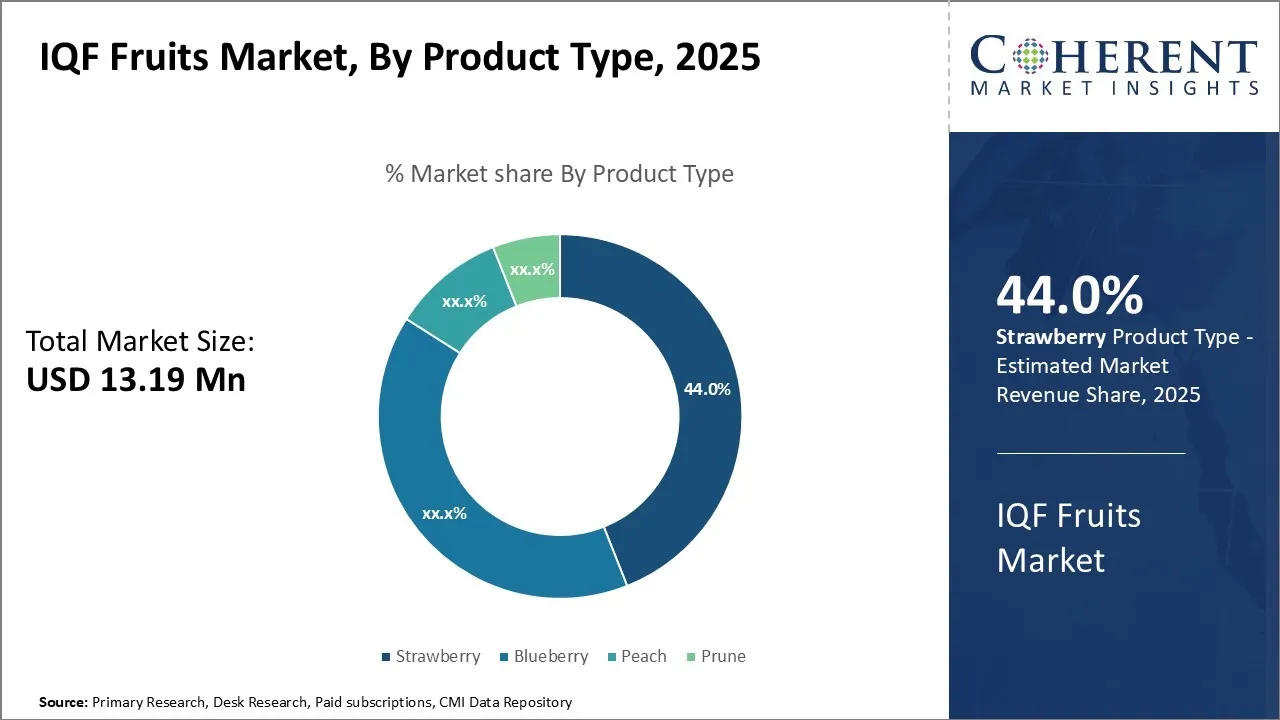
Global IQF Fruits Market Insights, By Product Type
Strawberries are anticipated to lead the global IQF fruits market in 2026, capturing approximately 59.0% of the total market share. This dominance is driven by the fruit’s consistent demand across key end-use segments including bakery, dairy, and beverage industries especially for applications like yogurts, pastries, and smoothies. Due to their high moisture and sugar content, strawberries are highly compatible with IQF processes, enabling them to retain texture, shape, and nutritional integrity even after freezing.
The shift toward clean-label and preservative-free food products further enhances the market appeal of IQF strawberries over traditional processed alternatives. Additionally, advances in freezing technologies such as cryogenic systems and fluidized bed freezing are improving production efficiency and quality, making IQF strawberries an economically viable option for both large-scale manufacturers and premium food brands.
An increasingly sophisticated IQF fruits market by distributor network including wholesalers, foodservice suppliers, e-commerce platforms, and specialty organic retailers is also playing a critical role in boosting the accessibility and availability of IQF strawberries across domestic and international markets. As the demand for healthy, convenient, and shelf-stable fruits continues to rise, strawberries are expected to maintain their dominant position in the market.
Regional Insights
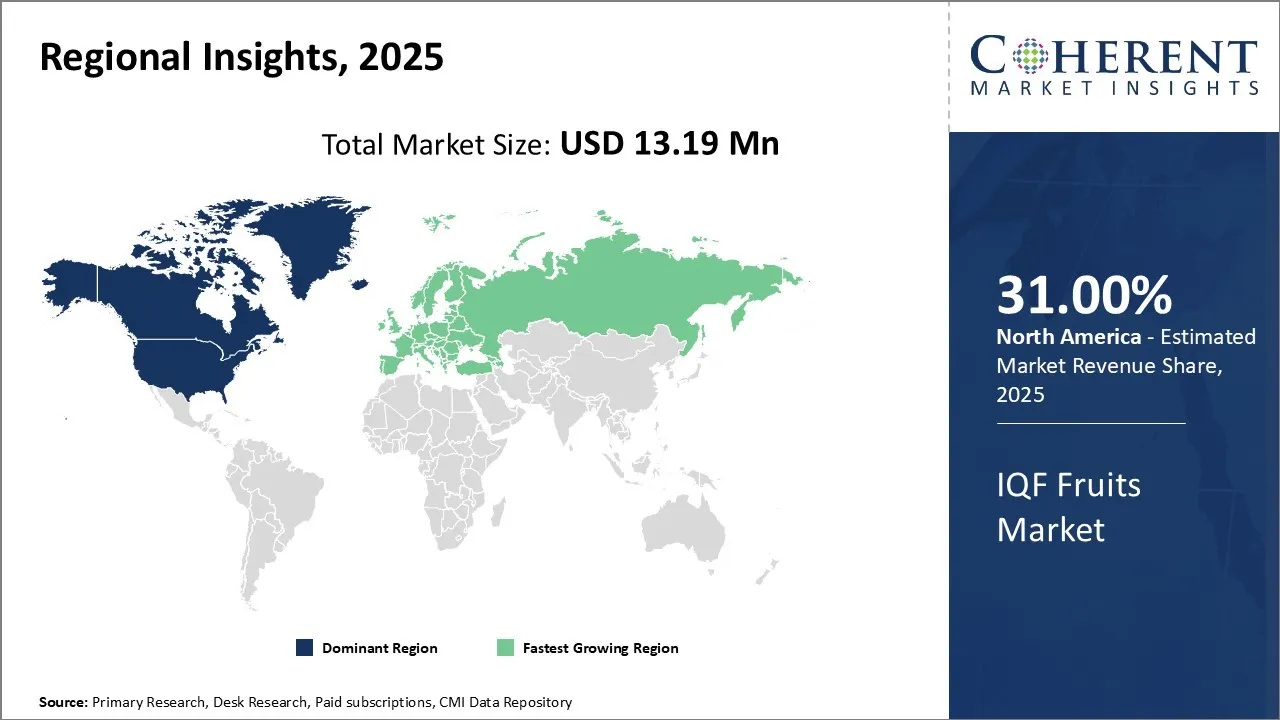
North America IQF Fruits Market Trends and Analysis
North America is expected to lead the global IQF fruits market in 2026, capturing approximately 31.00% of the total revenue share. This regional dominance is driven by high consumption of frozen fruits in ready-to-eat meals, beverages, and health-centric food products. The United States plays a critical role in this leadership, supported by strong retail distribution networks, a highly developed cold chain infrastructure, and a rising demand for clean-label and preservative-free food items.
The region benefits from the presence of major IQF fruit processors and global food manufacturers who are consistently innovating in terms of product variety, freezing techniques, and packaging solutions. Consumers in North America are increasingly opting for organic and sustainably sourced frozen fruits, aligning with broader trends in health and environmental awareness.
A key contributor to this momentum is the robust IQF fruits market growth rate by distributor network, with rapid expansion seen across retail chains, foodservice providers, online grocery platforms, and specialty organic outlets. These diversified distribution channels are enabling broader product availability and improved customer reach, thereby accelerating market penetration across urban and suburban regions.
With ongoing investments in logistics, food processing technology, and a growing inclination toward plant-based and functional foods, North America is well-positioned to sustain its leadership in the IQF fruits market through and beyond 2026.
IQF Fruits Market Dominating Countries
United States
The United States stands as the dominant player in the global IQF fruits market, significantly contributing to North America’s anticipated 31% revenue share by 2026. This leadership is driven by strong consumer demand for frozen fruits in ready-to-eat meals, smoothies, and wellness-focused food products. The country benefits from an advanced cold chain infrastructure, widespread retail penetration, and a high level of innovation among key market players such as Dole Food Company and SunOpta. A growing preference for organic and clean-label products, coupled with evolving health and sustainability trends, continues to drive expansion in the U.S. IQF fruits sector.
Canada
Canada plays a significant supporting role in the North American IQF fruits market. The country’s emphasis on healthy living and convenience foods has fuelled demand for frozen fruits in retail and foodservice sectors. With increasing investments in cold storage and processing capabilities, Canada is witnessing a rise in domestic production and consumption of IQF fruits. The push for organic certification and sustainable food practices further supports market growth.
Market Report Scope
IQF Fruits Market Report Coverage
| Report Coverage | Details | ||
|---|---|---|---|
| Base Year: | 2025 | Market Size in 2026: | USD 14.19 Bn |
| Historical Data for: | 2020 To 2024 | Forecast Period: | 2026 To 2033 |
| Forecast Period 2026 to 2033 CAGR: | 7.6% | 2033 Value Projection: | USD 23.70 Bn |
| Geographies covered: |
| ||
| Segments covered: |
| ||
| Companies covered: | Nestlé S.A., Parmalat S.p.A., Danone, Fonterra Co-operative Group Limited, FrieslandCampina N.V., Arla Foods, Dean Foods, Saputo, Inc., Coca-Cola Company, PepsiCo, Inc., Mondelez International, Inc., Hindustan Unilever Limited, and General Mills, Inc. | ||
| Growth Drivers: |
| ||
| Restraints & Challenges: |
| ||
Analyst Viewpoint – IQF Fruits Market
- The global IQF fruits market is set to experience sustained growth, driven by rising consumer demand for convenient, nutritious, and preservative-free food options. Analysts highlight North America as the leading region, fuelled by advanced cold chain logistics, widespread use of frozen fruits in ready-to-eat meals, and strong retail infrastructure supporting organic and clean-label offerings.
- Industry experts emphasize a growing shift toward health-centric food consumption patterns, particularly in urban populations. The trend toward plant-based diets, functional foods, and clean-label ingredients is accelerating the adoption of IQF fruits in a variety of applications such as smoothies, desserts, bakery, and dairy products. Technological advancements in individual quick freezing and sustainable packaging are further enhancing product quality and shelf life.
- Despite challenges such as raw material seasonality, high energy costs, and supply chain complexities, the long-term outlook remains highly positive. Continued investments in processing automation, cold storage, and organic certifications are expected to drive global market expansion.
IQF Fruits Market: Key Development
- In January 2025, OctoFrost completed its acquisition of Netherlands-based HiTec Food Systems, expanding its freezing and processing footprint across Sweden and the Netherlands. This merger enhances OctoFrost’s integrated capabilities across chilling, coating, and frying systems, strengthening its position in the IQF sector.
- In August 2024, (Duravant) released its COMPASS optical sorter, designed to detect and eliminate foreign material and defective fruit pieces on IQF lines in real-time a boost to quality control and food safety.
- In August 2024, Dirafrost (AGRANA group) continued strengthening its portfolio of IQF fruit products including cubes, slices, coated strawberries, fruit mixes, and smoothie-ready formats under its DIRA brand. The company emphasizes individual quick freezing within 10–15 minutes to preserve quality and offer versatile foodservice and retail solutions.
Market Segmentation
- Global IQF Fruits Market, By Product Type (Revenue, USD Bn, 2021 - 2033)
- Strawberry
- Peach
- Prune
- Blueberry
- Global IQF Fruits Market, By Region (Revenue, USD Bn, 2021 - 2033)
- North America
- U.S.
- Canada
- Latin America
- Brazil
- Mexico
- Argentina
- Rest of Latin America
- Western Europe
- Germany
- U.K.
- France
- Italy
- Spain
- Nordic
- BENELUX
- Rest of Western Europe
- Eastern Europe
- Russia
- Poland
- Rest of Eastern Europe
- APEJ
- China
- India
- ASEAN
- ANZ
- Rest of the APEJ
- Japan
- Middle East and Africa
- GCC
- South Africa
- Rest of Middle East and Africa
- North America
- Company Profiles
- Nestlé S.A.
- Parmalat S.p.A.
- Danone
- Fonterra Co-operative Group Limited
- FrieslandCampina N.V.
- Arla Foods
- Dean Foods
- Saputo, Inc.
- Coca-Cola Company
- PepsiCo, Inc.
Sources
The Stakeholders Consulted
- IQF fruit processors and cold chain logistics managers
- Manufacturers and suppliers of freezing and food preservation equipment
- Food safety and quality assurance professionals
- Importers and exporters of frozen fruits
- Supply chain managers from FMCG and retail companies
- Food & beverage product developers and R&D heads
- Agricultural cooperatives and horticultural associations
- Procurement heads from hotels, restaurants, and catering services (HORECA)
Databases Opened
- USDA (U.S. Department of Agriculture) – Fruits and Tree Nuts Yearbook & Agricultural Outlook
- APEDA (Agricultural and Processed Food Products Export Development Authority) – India Export Data
- Food and Agriculture Organization (FAO) – Global Fruit Yield and Cold Chain Infrastructure Statistics
- World Bank Open Data – Agribusiness Development and Trade Metrics
Magazines & Trade Publications
- Frozen Food Europe Magazine
- Food Processing Magazine
- Quick Frozen Foods International (QFFI)
- Refrigerated & Frozen Foods
- Fruit Growers News
- Global Cold Chain News
Scientific and Industry Journals
- Journal of Food Engineering
- LWT – Food Science and Technology
- Postharvest Biology and Technology
- International Journal of Refrigeration
- Journal of Agricultural and Food Chemistry
Newspapers & Media Outlets
- The Wall Street Journal – Food & Agribusiness
- Bloomberg – AgriTech and Supply Chain
- Reuters – Global Food and Beverage Markets
- The Economic Times – Agribusiness and Food Processing
- Business Standard – Cold Chain and Food Logistics
Associations and Regulatory Bodies
- Global Cold Chain Alliance (GCCA)
- International Institute of Refrigeration (IIR)
- USFDA – Frozen Food Regulations
- FSSAI (India) – Frozen Fruit and Cold Chain Guidelines
- European Food Safety Authority (EFSA)
- CODEX Alimentarius – International Food Standards
Public Domain Sources
- U.S. Census Bureau – Frozen Fruit Export Data
- European Commission – Agri-Food Trade Reports
- World Bank – Agrifood Processing Reports
- FAOStat – Fruit Production and Distribution Trends
- UNIDO – Food Industry Development Reports
Proprietary Research Elements
- In-house Data Analytics Tool – Market sizing, CAGR modeling, demand-supply scenarios
- Internal Repository of Historical IQF Fruits Market Data (past 8 years)
- Expert Interviews and Transcripts – Perspectives from food technologists, supply chain heads, and agricultural economists
- Custom Surveys and Industry Questionnaires – Distributed across fruit processors, distributors, and cold storage operators in North America, Europe, and Asia-Pacific
Get access to 250+ pages report
Every segment, forecast, competitor profile and data table behind the analysis above — available for instant download.
- ESOMAR Member
- ISO 9001:2015 Certified
- D-U-N-S Registered
- GDPR & CCPA Compliant
Missing comfort of reading report in your local language? Find your preferred language:
Transform your Strategy with Exclusive Trending Reports
Frequently Asked Questions
The IQF Fruits Market size is estimated to be valued at USD 14.19 Bn in 2026, and is expected to reach USD 23.70 Bn by 2033.
The CAGR of the IQF Fruits Market is projected to be 7.6% from 2026 to 2033.
The growing demand for natural flavors in the food and beverages industry is expected to drive the market growth during the forecast period.
Awareness about nutraceutical world is rising among consumers and that is the opportunity in the market.
Minimum shelf life of berries and High power and freight costs associated with frozen food technology is hampering the market growth.
The major players operating in the market include Nestlé S.A., Parmalat S.p.A., Danone, Fonterra Co-operative Group Limited, FrieslandCampina N.V., Arla Foods, Dean Foods, Saputo, Inc., Coca-Cola Company, PepsiCo, Inc., Mondelez International, Inc., Hindustan Unilever Limited, and General Mills, Inc.
IQF fruits differ from regular frozen fruits by being individually quick frozen, which preserves their shape, texture, and nutritional value without clumping together.