

Europe Malt Extract Market Size and Share Analysis - Growth Trends and Forecasts (2026 - 2033)
The Europe Malt Extract Market is anticipated to grow at a CAGR of 5.6% with USD 12.9 Bn in 2026 and is expected to reach USD 18.8 Bn in 2033. This high expansion is primarily driven by the escalating demand for malt extract in the food and beverage industry (EU produced 258 million tonnes of cereals, in 2024), particularly in bakery products, brewing, as well as confectionery. The versatility of malt extract, offering natural sweetness, enhanced flavor, as well as improved texture, makes it a sought-after ingredient for manufacturers seeking to reformulate products with cleaner labels and more appealing sensory profiles.
Key Takeaways
- Beverages is expected to account the largest share of 40% in 2026, alcoholic (beer, malt drinks) Largest global and European usage. Beer is the leading malt extract application across beverage industry. There are around 19,711 businesses in the Beer & Malt Production industry in Europe.
- Barley will dominate with 60% in 2026, the most conventional as well as highly adopted source for malt extract. In 2025, Barley production experienced some hike, reaching 51.9 million tonnes, compared to 50.3 million tonnes in 2024.
- Dry will dominate with 65% in 2026, the dry form (DME) is most relevant for longer supply chains along with many industrial applications. FAO (Food and Agriculture Organization, 2020) notes that spray-dried malt extracts have a shelf life of 18–24 months, whereas 6–12 months for liquid malt extracts, making them preferable for long-distance supply chains.
- Standard will dominate with 78% in 2026, In Europe, standard malt extract dominates as the bulk of consumption is in beer production, bakery, confectionery, etc., which rely on large-scale, commodity-grade malt extract. There are 214k businesses in the Bakery Goods Production industry in Europe.
- Western Europe is expected to acquire the dominant share of 60% in 2026, Western Europe has a substantial number well established breweries, including Germany, Belgium, the Netherlands, and the UK. In 2024, Austria had 361 breweries that made over 1,000 different beers. In 2025, Belgium’s craft beer Fou' Foune was rated the highest, with a score of 4.51 out of 5.
Segmental Insights
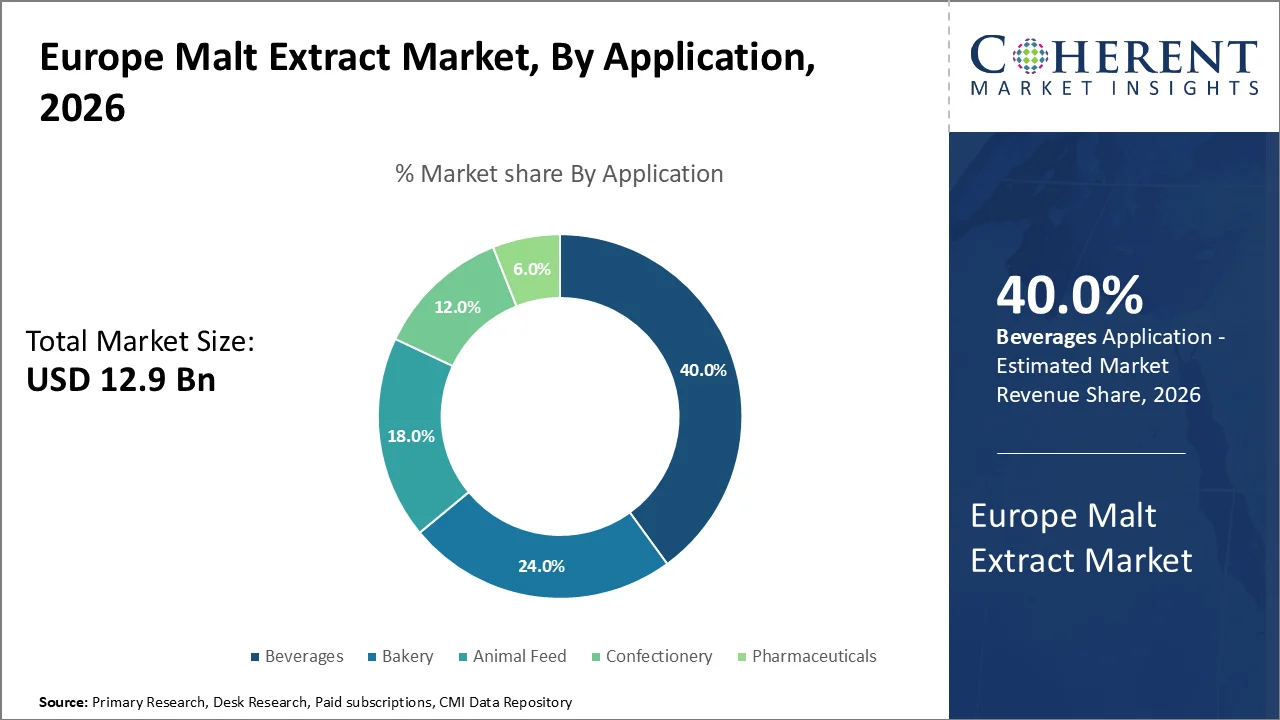
Why is Beverages Acquiring the Largest Market Share?
Beverages is projected to account for the largest share of application in 2026, representing approximately 40% of the total volume. The segment is dominating owing to its deep-rooted cultural heritage of brewing as well as the high demand for craft beverages across European nations. In Germany, official statistics show beer sales in 2025 at around 7.8 billion litres, down 6% year-on-year, last year there was a short decline.
However, the sector fueled by 11% in 2024. While Germany leads in production, the Netherlands is the EU's biggest exporter.
The position of the region as one of the world's largest beer-producing regions, with countries like Germany, Belgium, Czech Republic, the United Kingdom, etc., maintaining centuries-old brewing traditions that heavily rely on malt extract as a fundamental ingredient is another growth inducing factor.
The European Beer and Malt Association reports that European breweries consistently use malt extract not only for traditional beer production but also for developing innovative alcoholic beverages that cater to evolving consumer tastes.
- Current Industry Events of 2026
- Market Size Estimation
- Regional Breakdown
- Competitive Landscape
- Customer Intelligence
- Segmental Analysis
- Pricing Analysis
- Key Market Drivers, Challenges & Future Trends
- Customized Insights Section
Barley holds the Largest Market Share
Based on source, barley dominates the market, accounting for a significant 60% share in 2026, the segment is driven by its superior enzymatic properties, established agricultural infrastructure, along with its deep-rooted cultural preferences across European brewing as well as food manufacturing industries.
The EU produced the most barley in 2023, 48 million metric tons or 34% of the world's production. The EU also topped the list in 2021.
Having the right enzymes, especially diastase, that change starch into sugar during malting, is another reason this market is growing.
The European Brewery Convention says barley is very good for malt. It gives lots of extract, works well in fermentation, as well as tastes great for European beers.
Dry holds the Largest Market Share
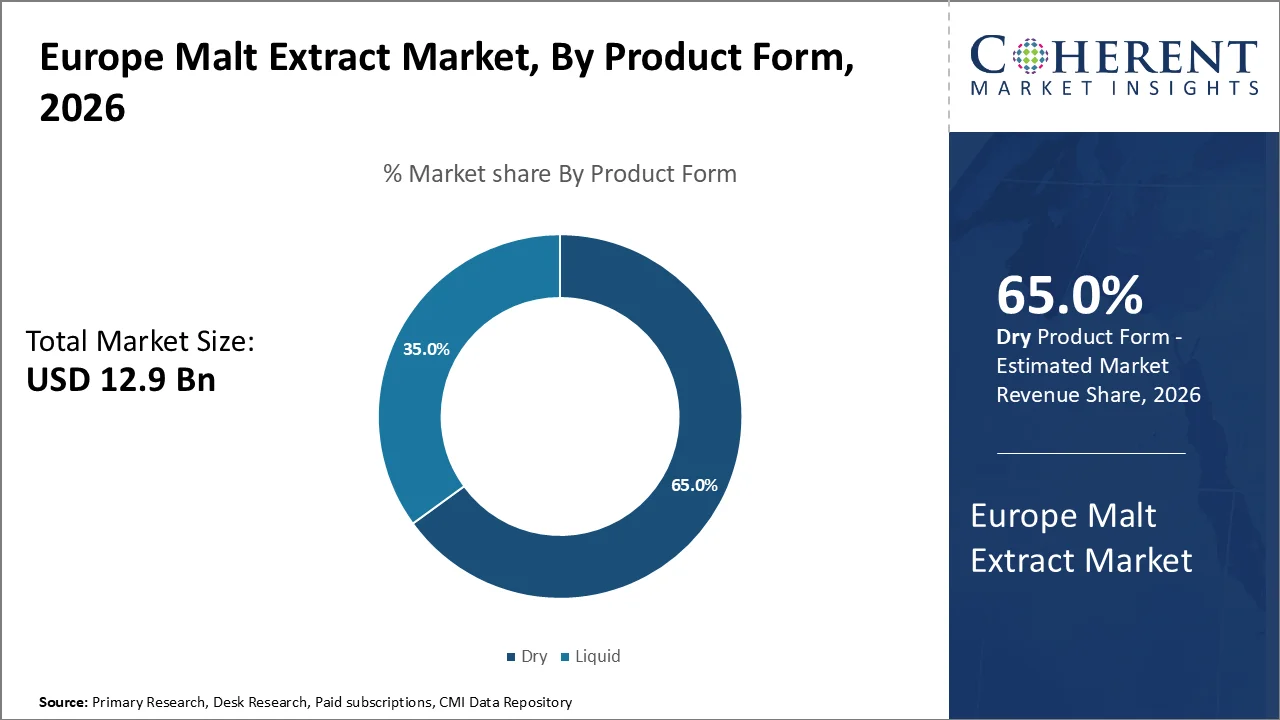
Based on product form, dry dominate the market, accounting for a significant 65% share in 2026, one of the factors propelling the growth of the market is it characterizes that are superior shelf stability, cost-effectiveness in transportation, and versatility across multiple industrial applications. Industrial bakeries in Germany and France report that over 80% of malt-based ingredients they purchase are in dry powder form, primarily due to longer shelf life.
The powder form offers exceptional storage convenience, requiring minimal warehouse space and maintaining product integrity for extended periods without refrigeration, making it particularly attractive for manufacturers operating across diverse European climates and regulatory environments.
Standard holds the Largest Market Share
Standard dominate the market, accounting for a significant 78% share in 2026, the widespread applications across multiple industries and established manufacturing infrastructure throughout European countries is one of the factors stimulating the growth of the segment.
Standard malt extract represents the conventional forms of malt extract that include liquid malt extract, dry malt extract, and malt extract syrup with standardized specifications that meet general industrial requirements.
Its extensive utilization in the brewing industry, which remains one of Europe's most significant beverage sectors is another growth inducing factor. The report records just over 9,700 active breweries across the EU, with the number of openings now mirrored by slightly more closures.
Major European breweries such as Heineken in the Netherlands, Carlsberg in Denmark, and Anheuser-Busch InBev's European operations rely heavily on standard malt extract for consistent beer production processes.
Membrane Filtration Technology is transforming the Europe Malt Extracts Industry
Membrane Filtration Technology utilizes special filters, like ultrafiltration as well as reverse osmosis, to make malt extract purer and stronger. This technology aid companies remove impurities and concentrate the extract more efficiently.
Many European companies are using it. For example, Muntons in the UK cut processing time by 40% and improved purity by 25%, Ireks in Germany increased yield by 30%, and Malteurop in France uses multi-stage systems in several plants. Overall, this technology makes better quality, saves water and energy, as well as makes products last longer.
Supercritical Fluid Extraction (SFE): A major breakthrough in Europe Malt Extracts
Supercritical Fluid Extraction (SFE) uses CO₂ to make malt extracts with better taste and healthy ingredients. It keeps sensitive parts safe and does not use chemicals.
Dohler in Germany makes premium malt for craft beer, and Kerry in Ireland invested €15 million to produce functional malt ingredients. The technology aid companies sell high-value products, earn 40–60% higher profits, and enter health-focused markets.
Current Events and Their Impact on the Europe Malt Extract Market
Current Event | Description and its Impact |
EU Sugar Reform and Sweetener Guidelines (2024–2025) |
|
EU Green Deal and Food Sustainability Initiatives (2025) |
|
Europe Malt Extract Market Trends
- Inclination towards clean label adoption, there is a high demand for natural, minimally processed malt extracts as consumers are looking for transparent ingredient lists. In Europe specifically, 35% of food and beverage launches carry clean label claims, with ethical-environment and organic leading at 13% penetration.
- Craft brewing renaissance as there is a surge in microbreweries as well as craft beer production fueling specialty malt extract consumption
- Focus on health & wellness has surged adoption of malt extract as a natural sweetener as well as nutritional supplement
- With sustainable sourcing there is a rising emphasis on environmentally responsible production methods and organic certifications
- Innovation in Product Formats: Development of liquid concentrates, spray-dried powders, and specialized enzymatic variants
Regional Insights
Western Europe Dominates Owing to its Well-Established Food and Beverage Industry
Western Europe account 60% market share in 2026, the growth of this region is attributed to its well-established food and beverage industry infrastructure, advanced brewing traditions, and sophisticated consumer preferences for premium malt-based products.
There are over 1,500 breweries in Germany - around 30 breweries producing more than 1 million hectolitres of beer and a large number of small and microbreweries. With over 6,500 different beer brands and well over 40 beer types today, there is a huge variety.
Moreover, the region is bolstered by its centuries-old brewing heritage in countries like Germany, Belgium, and the United Kingdom, where malt extract consumption is deeply ingrained in cultural practices.
Who are the Major Companies in Europe Malt Extracts Industry
Some of the major key players in Europe Malt Extract Market include, Axereal Group, Cargill, Incorporated, IREKS GmbH, Doehler Group SE, VIVESCIA Industries, Polttimo Oy, Malt Products Corporation, Malteries Soufflet SAS, Simpsons Malt Limited and Muntons Plc.
Key News
- In November 2025, Soufflet Malt is demonstrating the huge potential of malt-based ingredients in everything from hot beverages to low- and no-alcohol drinks, coffee alternatives, and cocoa replacement.
Market Report Scope
Europe Malt Extract Market Report Coverage
| Report Coverage | Details | ||
|---|---|---|---|
| Base Year: | 2025 | Market Size in 2026: | USD 12.9 Bn |
| Historical Data for: | 2020 To 2024 | Forecast Period: | 2026 To 2033 |
| Forecast Period 2026 to 2033 CAGR: | 5.6% | 2033 Value Projection: | USD 18.8 Bn |
| Geographies covered: |
| ||
| Segments covered: |
| ||
| Companies covered: | Axereal Group, Cargill, Incorporated, IREKS GmbH, Doehler Group SE, VIVESCIA Industries, Polttimo Oy, Malt Products Corporation, Malteries Soufflet SAS, Simpsons Malt Limited and Muntons Plc. | ||
| Growth Drivers: |
| ||
| Restraints & Challenges: |
| ||
Analyst Opinion
- Europe’s malt extract market is driven by real consumer demand for natural, clean-label, and functional ingredients, with 45% of Europeans in 2025 preferring natural sweeteners (Euromonitor).
- Craft beer and specialty beverages are booming, with 35,000+ new craft breweries in Europe by mid-2025, fueling demand for premium malt extracts and advanced processing like SFE and membrane filtration.
- Sustainability is key: EU Green Deal compliance and water/energy-efficient production reduce costs by up to 50%, favoring producers of dry malt extract and efficient membrane technologies.
Speak to the analyst
Want personalized insights?
Take the findings above to one of our principal consultants, or have the report rebuilt around the segments, geographies and competitors you actually track.
Market Segmentation
- By Application (Revenue, USD Bn, 2021-2033)
- Bakery
- Confectionary
- Beverages
- Alcoholic
- Non-Alcoholic
- Animal Feed
- Pharmaceuticals
- By Source (Revenue, USD Bn, 2021-2033)
- Barley
- Wheat
- Rice Rye
- By Product Form (Revenue, USD Bn, 2021-2033)
- Dry
- Liquid
- By Product Type (Revenue, USD Bn, 2021-2033)
- Standard
- Specialty
- Europe Malt Extract Market, By Region
- Western Europe
- Eastern Europe
Sources
Primary Research Interviews
- Malt Extract Manufacturers and Producers
- Food & Beverage Industry Executives
- Brewing Industry Representatives
- Distributors and Suppliers
- Others
Databases
- Eurostat (European Statistical Office)
- FAOSTAT (Food and Agriculture Organization)
- Others
Magazines
- Food & Beverage Magazine Europe
- Brewing & Distilling International
- Food Processing Europe
- Beverage Industry Magazine
- Others
Journals
- Journal of Food Science and Technology
- European Food Research and Technology
- Food Chemistry Journal
- Others
Newspapers
- Financial Times
- The Wall Street Journal Europe
- Food Navigator Europe
- Beverage Daily
- Others
Associations
- European Malt Association (EMA)
- European Brewery Convention (EBC)
- Food and Drink Europe (FoodDrinkEurope)
- European Food Safety Authority (EFSA)
- Others
Public Domain Sources
- European Commission Trade Statistics
- National Statistics Offices of EU Countries
- World Trade Organization (WTO) Reports
- European Food Safety Authority Publications
- Others
Proprietary Elements
- CMI Data Analytics Tool
- Proprietary CMI Existing Repository of information for last 10 years
Get access to 250+ pages report
Every segment, forecast, competitor profile and data table behind the analysis above — available for instant download.
- ESOMAR Member
- ISO 9001:2015 Certified
- D-U-N-S Registered
- GDPR & CCPA Compliant
Missing comfort of reading report in your local language? Find your preferred language:
Transform your Strategy with Exclusive Trending Reports
Frequently Asked Questions
The Europe Malt Extract Market is expected to reach USD 18.8 Bn in 2033.
Major players operating in the Europe Malt Extract Market include Axereal Group, Cargill, Incorporated, IREKS GmbH, Doehler Group SE, VIVESCIA Industries, Polttimo Oy, Malt Products Corporation, Malteries Soufflet SAS, Simpsons Malt Limited and Muntons Plc.
Seasonal variations lead to poor harvesting of the barley and wheat due to changing climatic conditions, is the factor restraining the growth of the market
Growing demand for diastatic malt extract is a major growth driving factor for the market.
The Europe Malt Extract Market is anticipated to grow at a CAGR of 5.6% between 2026 and 2033.
Among region, Western Europe region is expected to account for a largest market share in the Europe Malt Extract Market over the forecast period.
Malt extract is a nutrient-rich, natural sweetener derived from malted grains (usually barley) that provides sustained energy, aids digestion, and acts as a healthier alternative to refined sugar.