

Global Brewing Ingredients Market Size and Forecast – (2026-2033)
According to Coherent Market Insights, the global brewing ingredients market is estimated to be valued at USD 122.75 Bn in 2026 and is expected to reach USD 190.75 Bn by 2033, expanding at a compound annual growth rate (CAGR) of 6.5% from 2026 to 2033.
Key Takeaways of the Brewing Ingredients Market
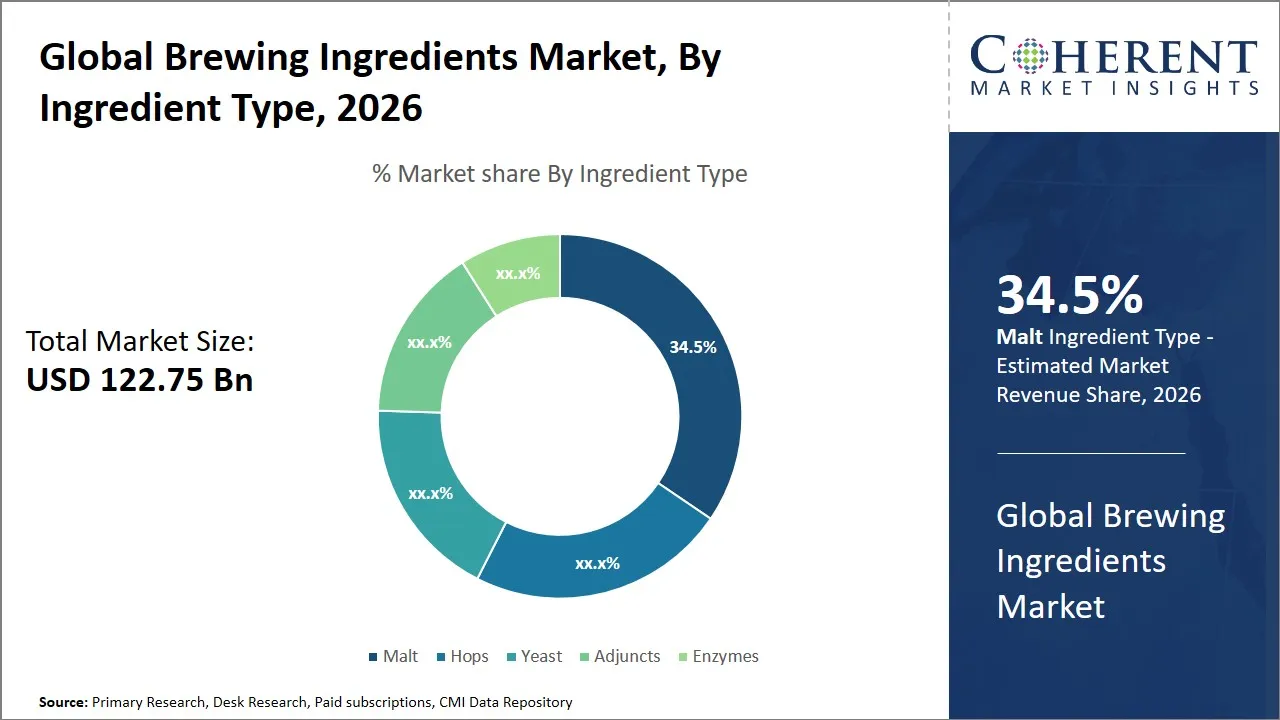
- The malt segment is estimated to account for 34.5 % of the brewing ingredients market share in 2026.
- The liquid segment is projected to command 56.8 % of the market share in 2026.
- The lager segment is expected to hold 46.8 % of the global brewing ingredients market share in 2026.
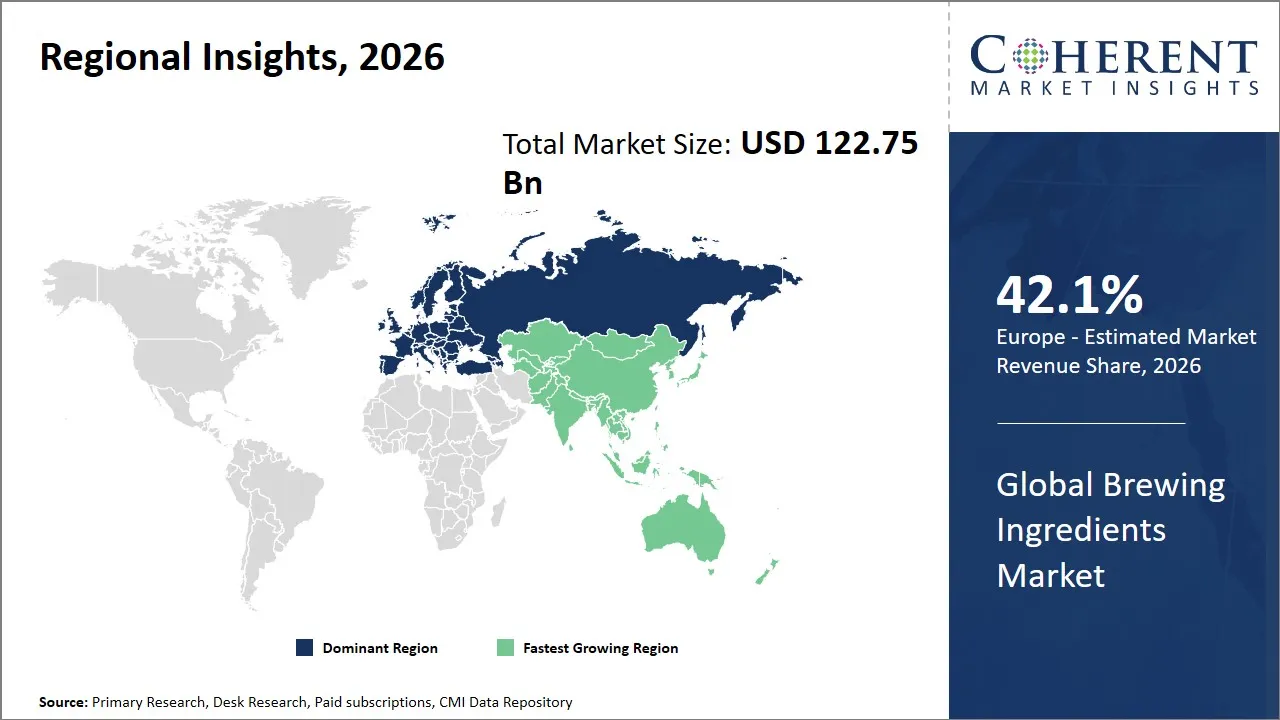
- Europe is projected to dominate the market, capturing a 42.1 % share in 2026.
- Asia Pacific is the fastest-growing region, contributing 21.3 % of the market share in 2026.
Market Overview
- Key trends in the brewing ingredients market include a rising focus on organic and sustainably sourced raw materials, reflecting growing environmental and health consciousness among consumers.
- Additionally, the adoption of novel ingredients such as exotic hops, specialty malts, and yeast strains is reshaping product formulations to cater to evolving taste profiles.
- The surge in beer processing across emerging markets and the emphasis on clean-label products highlight the market’s dynamic shift towards quality and authenticity, fostering sustained industry advancement.
Currents Events and Its Impact
Current Events | Description and its Impact |
U.S. hop acreage and production decline (2024–2025 USDA NASS updates) |
|
Malting barley quality stress from drought/heat in the U.K. (2025 harvest commentary) |
|
Segmental Insights
- Current Industry Events of 2026
- Market Size Estimation
- Regional Breakdown
- Competitive Landscape
- Customer Intelligence
- Segmental Analysis
- Pricing Analysis
- Key Market Drivers, Challenges & Future Trends
- Customized Insights Section
Why Does the Malt Dominates the Global Brewing Ingredients Market in 2026?
Malt segment is expected to contribute 34.5% of the global brewing ingredients market share in 2026, due to its basic contribution to the flavor, color, and body of beer. The brewing process could not be complete without malt since its major sources of fermentable sugars needed to sustain the work of the yeast are malted barley and other grains. This upward trend in the malt quality is driven by the continuous need of the brewer to create unique beer profiles and appeal to the consumers and with the rising popularity of craft beer in the global market. The effects of malts is not limited to fermentation since it is known to play a vital role in enzymatic conversion of starch that guarantees the highest level of extractive capability of fermentable substances, which is reflected into an efficient brewing process and desirable sensory qualities.
For example, Anheuser-Busch InBev continues to rely heavily on barley malt innovation across its flagship and craft-style portfolios, including Budweiser and Goose Island. The company works closely with maltsters and barley breeding programs to secure consistent malt quality, underlining malt’s central role even in highly optimized, large-scale brewing operations.
Liquid Segment Enhance the Efficiency and Purity in Brewing Processes
The liquid segment is projected to hold 56.8% of the brewing ingredients market share in 2026. Liquid brewing components, in particular liquid brewing yeast cultures, hop extracts and enzyme solutions provide the brewer with a higher degree of dosage and rapid integration into the brewing process, which both increases operations efficiencies and product consistency. This is especially important in large commercial breweries where it is essential to ensure that the consistency is batch to batch to ensure the reliability of brands and consumer satisfaction.
Strains of liquid yeast, including, liquid yeast strains have increasingly been used in favor of dry strains in professional brewing setups due to their abilities to offer better cell health and fermentation capability, which translates to purer fermentation profiles and repeatable attenuation. Equally, more precise additions of bitterness and aroma can be performed using liquid hop extracts, reducing wastage and giving brewers the chance to more precisely control the hop character than may be possible with whole hops or hop pellets. Liquid enzymes and adjuncts are also pre-prepared which makes brewing processes more simplified and minimizes the time and chances of contamination.
Lager Segment Dominates the Global Brewing Ingredients Market
Lager segment is anticipated to capture 46.8% of the market share in 2026. Lager’s popularity as a crisp, clean, and refreshing beer has sustained its position as the dominant beer style in many global markets, influencing the demand for specific brewing ingredients optimized for lager production. The fact that the lager is a crisp, clean, and refreshing beer has made it the leading style of beer in most markets of the world and has also impacted upon the demand of certain brewing ingredients that have been develop to produce lagers. The longer and lower temperature fermentation of lagers require yeast strains, malt compositions, and blends of adjunct that allow such fermentation, and the reason why solutions to ingredients must be customized.
Regional Insights
Europe Brewing Ingredients Market Analysis and Trends
The Europe region is projected to lead the market with a 42.1% share in 2026. The area enjoys rigid quality control laws and friendly government policies that promote eco-friendly farming and research in the production of brews. Germany, Belgium and Czech Republic have long brewing traditions which supports the existence of many craft and large-scale breweries that create the stable demand on the high-quality brewing products and ingredients, including malted barley, hops, yeast, and other adjuncts.
The location of the suppliers of raw materials near the breweries also boosts the efficiencies of the logistics and cost-effectiveness to the further development of the leading position of Europe. The major stakeholders such as Malteurop, Barth Haas Group, and Lallemand Inc. have contributed a lot by emphasizing the quality of ingredients and Research and Development programs that are geared towards consumers who are specialized in craft and specialty beers.
Asia Pacific Brewing Ingredients Market Analysis and Trends
The Asia Pacific region is expected to exhibit the fastest growth in the market contributing 21.3% share in 2026, as a result of the increasing consumer disposable income, urbanization and the fast-evolving culture of craft beer, particularly in such countries as China, India, Japan and South Korea. The young population and increased consumption of international trends in beverage production have brought up the thirst to drink various and high-quality brewing components that have catalyzed the thirst of innovation and expansion.
The promotion of modernization of agriculture by the government, as well as the trade liberalization policies, have increased the local supply of fine malt and hops, and the import policy has been made more favorable to specialty ingredient trade. Furthermore, the rapid growth of microbreweries and taps has made custom strains of yeast and other fermentable adjuncts increasingly significant. COFCO Tunhe, Kalsec Inc., and Chr. Hansen A/S are prominent firms that have contributed to the development of the ingredient availability, brewer support programs in the region that enables the rapid growth of the market.
Global Brewing Ingredients Market Outlook for Key Countries
Is Germany Setting the Benchmark for Quality and Innovation in the Brewing Ingredients Market?
The brewing ingredients market of Germany has been strongly connected with its well-established traditions of beer and its beer purity law which has a huge impact on the standards of ingredients. Malt production and hops are also concentrated in the country, several companies such as Barth Haas Group are the best in terms of innovation in hop products and supply chains.
The well-developed infrastructure of Germanys promotes craft brewing in combination with mass brewing giants such as AnheuserBusch InBev, which guarantees the stable demand of high-quality malts, as well as advanced yeast strains and naturally extracted flavors. The high quality of the brewing ingredients locally is also supported by government incentives used in encouraging sustainability in agriculture.
Is the U.S. Craft Beer Boom Reshaping the Brewing Ingredients Market?
U.S. brewing ingredients market of brewing ingredients remains the best in the consumption of craft beer, thus pushing the need to have a variety and innovative brewing ingredients. The vibrant craft beer sector has prompted ingredient producers to create new varieties of malt, hops of specialty and strain specific yeast to meet the experimental strategies of brewers.
The firms like Briess Malt & Ingredients Co. and Lallemand Inc. have a solid presence in the market since they sustain the innovation of products and technical expertise. The business climate encourages entrepreneurship in the brewing business, which is underpinned by policies that encourage small and medium industries to support the infrastructure of ingredient suppliers and diversifying the product line.
China Brewing Ingredients Market Trends
The market of brewing ingredients in China is fast developing in accordance with the growing popularity of beer consumption and the increase in the level of interest to the premium and craft beer within the market. The local manufacturers such as COFCO Tunhe have expanded the production capacity of malt and this has minimized the importation. The supply chain has been enhanced with government assistance on agricultural growth and trade policies to export and import farm ingredients. The MNI suppliers of ingredients are also working closely with Chinese brewers to bring in newer strains of yeast and new varieties of hops which will respond to the change towards quality beers. This synergistic atmosphere is helpful in the transition of the country to more advanced brewing space.
Belgium Brewing Ingredients Market Trends
The variety of beer that is famous throughout the entire world is the indicator of the paramount importance of Belgium in the market of brewing ingredients. The artisanal and traditional parts of the beer market are facilitated by the focus of the country on unique yeast strains and special malts. The local firms and co-operatives have been very active in ingredient innovation and conservation of local brewing processes.
Malteurop and Lallemand Inc. firms provide special ingredients that are unique to the eclectic style of beer that is common in Belgium and enhances the reputation of that country in terms of quality and craftsmanship in brewing. The government policies ensure good conditions to the craft breweries and sustainable production.
India Brewing Ingredients Market Trends
The brewing ingredients market in India is growing faster as a result of the growing population of middle-class and new craft beer culture in city centers. The governments that have become more engaged in modernization of agriculture have resulted in better domestic supply of barley and hops, but the imports are still important to supply specialty ingredients. Suppliers of brewing ingredients such as Kalsec Inc. and Chr. Hansen A/S are strategic in their participation with local brewers to launch fermentation boosters, hop extracts and natural flavors in response to emerging taste trends. The improved logistics of the cold chain and the facilitating trade policies also add to the availability of the ingredients and build a bright environment of brewing activities that are gradually emerging in the country.
Ingredient Cost-in-Use vs Pricing Elasticity — Brewing Ingredients Market
Beer Segment | Malt Cost Share in Total Beer Cost (%) | Typical Malt Price Change Impact | Cost Pass-Through to Beer Price |
Mass Lager | 8–10% | +10% malt price → +0.8–1.0% total cost | Low (0–30%) |
Premium Lager | 9–12% | +10% malt price → +0.9–1.2% total cost | Moderate (30–60%) |
Craft Beer | 12–15% | +10% malt price → +1.2–1.5% total cost | High (60–90%) |
Market Players, Key Development, and Competitive Intelligence
Key Developments
- In July 2024, AB Biotek, a subsidiary of AB Mauri, expanded its product portfolio by launching a dry yeast range under its premium brand, Pinnacle. The company launched this product for industrial and craft brewers.
- In March 2024, Far Yeast Brewing Co., Ltd., one of the key brewing products manufacturing companies, renewed its standard brands “Far Yeast Tokyo Series” and “Far Yeast Genryu Series” and relaunched its “Far Yeast Series.” These yeast products are developed for brewing applications.
- In November 2023, Malteries Soufflet, one of the leading players in the malt industry, acquired a 100% share of United Malt Group Limited (United Malt), another key malt manufacturing company, for approximately USD 994.46 million. The acquisition assisted Malteries to strengthen its presence in the global craft brewery sector.
Top Strategies Followed by Global Brewing Ingredients Market Players
Player Type | Strategic Focus | Example |
Established Market Leaders | Heavy investment in R&D and innovation | For example, Chr. Hansen has created proprietary cultures of yeast and Bacteria to control flavors and ensure reliability in processes, and DSM has extended its enzyme and yeast solutions to allow brewers to maximize yield and minimize variability in processes. Fermentation aids and processing solutions used to streamline efficiency and scalability are supported by BASF to brewing. |
Mid-Level Players | Cost-effective solutions with balanced quality | Lallemand offers a wide range of reliable brewing yeasts at affordable prices, whereas Angel Yeast utilizes scale and efficiency in its operations to offer both industrial and craft brewers in new markets. |
Small-Scale Players | Niche specialization & innovative variants | For instance, White Labs, which specializes in highly-specific yeast strains preferred by craft brewers looking to experiment with new styles, and Simpsons Malt, which uses high-end malts and heritage malts as a way of differentiating their brews in terms of flavor and authenticity. |
Market Report Scope
Global Brewing Ingredients Market Report Coverage
| Report Coverage | Details | ||
|---|---|---|---|
| Base Year: | 2025 | Market Size in 2026: | USD 122.75 Bn |
| Historical Data for: | 2020 To 2024 | Forecast Period: | 2025 To 2032 |
| Forecast Period 2026 to 2033 CAGR: | 6.5% | 2033 Value Projection: | USD 190.75 Bn |
| Geographies covered: |
| ||
| Segments covered: |
| ||
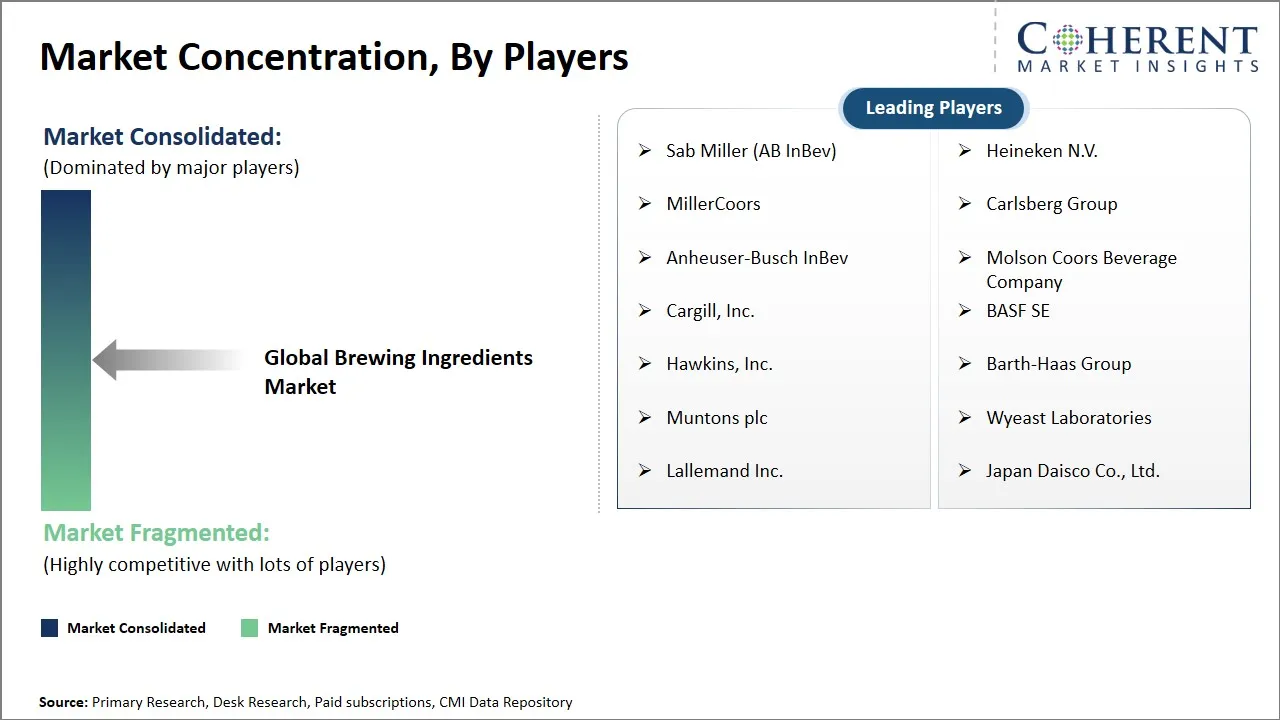
| Companies covered: | Sab Miller (AB InBev), Heineken N.V., MillerCoors, Carlsberg Group, Anheuser-Busch InBev, Molson Coors Beverage Company, Cargill, Inc., BASF SE, Hawkins, Inc., Barth-Haas Group, Muntons plc, Wyeast Laboratories, Lallemand Inc., and Japan Daisco Co., Ltd. | ||
| Growth Drivers: |
| ||
| Restraints & Challenges: |
| ||
Brewing Ingredients Market Dynamics
Brewing Ingredients Market Driver - Rising Demand for Craft Beers and Innovative Flavor Profiles
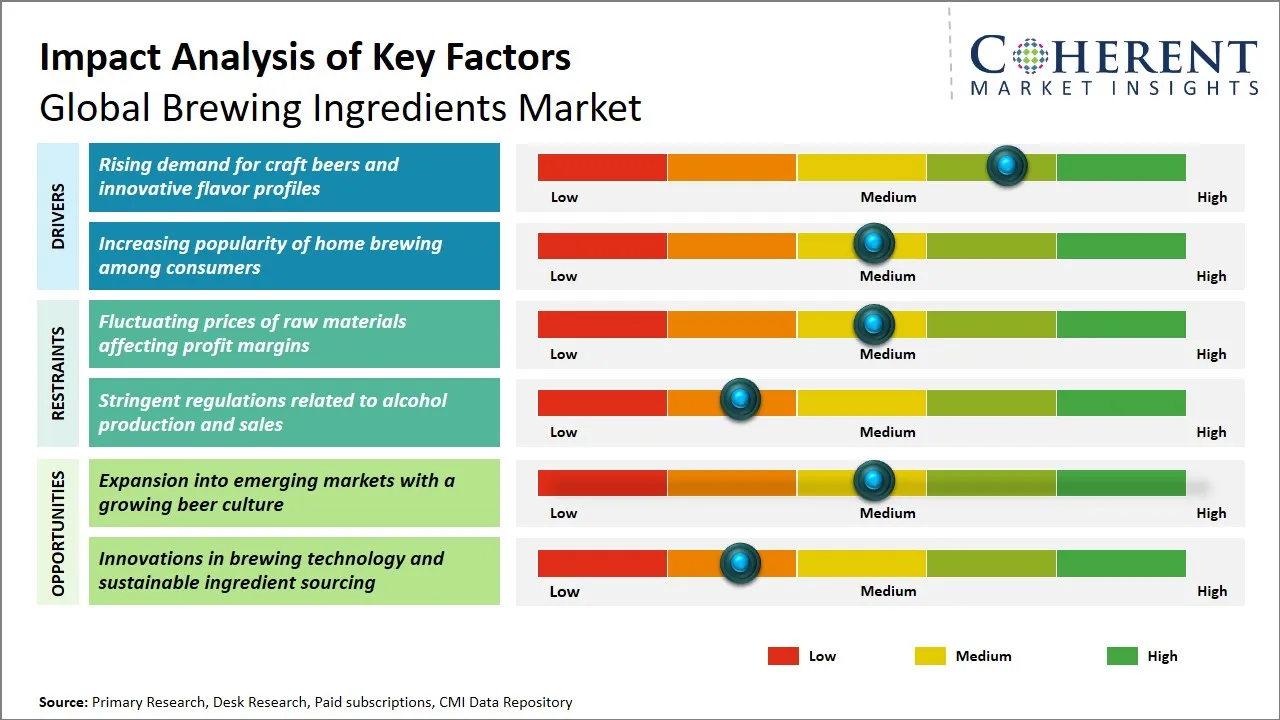
The rise in consumer trend towards craft beers has largely impacted the industry dynamics of the brewing ingredients market in the world leading to a sharp rise in demand of differentiated and high-quality raw materials. The brewers, particularly in the craft sector are in constant endeavor of developing various and novel flavor models to suit the changing palate and also to be able to differentiate their products in a progressive competitive environment. This movement promotes the use of specialty malt ingredient, exotic hops and unusual adjuncts including fruits, spices and botanicals which provide unique aromas and complex flavors to the final production. Also, the focus on small-scale, craft production processes helps explore the different combinations of ingredients, compelling suppliers to innovate and introduce a wider range of ingredient portfolios.
For an example, in the U.S. and European markets, Craft brewers have since used specialty malts more often, e.g., chocolate, caramel and smoked malts, as the means to generate differentiated styles, such as stouts, porters, and barrel-aged ales.
Brewing Ingredients Market Opportunity - Expansion into Emerging Markets with a Growing Beer Culture
The global brewing ingredients market is an excellent opportunity with growth in the emerging markets where the beer culture is firmly forming. Disposable incomes, urbanization, and changing consumer preferences towards alcoholic beverages, especially craft and premium beers are being experienced in countries all over the Asian Pacific, Latin America and Africa. This dynamic environment is compelling the need to seek a wide range of and quality brewing raw materials including specialty malts, new hops and adjuncts that add flavor and appeal to more sophisticated market consumers.
As an illustration, microbreweries in large cities are now sourcing imported specialty malts, aroma-rich types of hops and high-tech strains of yeasts to brew high quality and experimental forms of beer that match the changing consumer preferences.
Analyst Opinion (Expert Opinion)
- The brewing ingredients market is undergoing transformative growth, driven by the increasing demand for craft beers and innovative brews that cater to diverse consumer tastes. Insights from the Beer Ingredients Conference (2023) and the International Craft Brewers Conference (2022) emphasized key trends, with suppliers like BASF and Givaudan leading the charge in developing specialized ingredients that enhance flavor profiles and brewing efficiency.
- BASF’s recent introduction of a yeast strain engineered for high-temperature fermentation illustrates a commitment to innovation that meets the evolving needs of brewers seeking efficiency and unique taste experiences. Discussions at these conferences highlighted the critical importance of sourcing sustainable ingredients, aligning with the growing consumer demand for transparency and eco-friendly practices in the brewing process. However, challenges such as fluctuating raw material prices and the need for consistent quality were frequently cited as barriers to growth.
- Companies that invest in R&D to create versatile, high-quality ingredients while engaging effectively with brewers will likely capture significant market opportunities. Ultimately, the growth of the brewing ingredients market will depend on its ability to adapt to consumer trends and continuously innovate in response to the dynamic landscape of the brewing industry.
Speak to the analyst
Want personalized insights?
Take the findings above to one of our principal consultants, or have the report rebuilt around the segments, geographies and competitors you actually track.
Market Segmentation
- Ingredient Type Insights (Revenue, USD Bn, 2021 - 2033)
- Malt
- Hops
- Yeast
- Adjuncts
- Enzymes
- Form Insights (Revenue, USD Bn, 2021 - 2033)
- Liquid
- Dry
- Beer Type Insights (Revenue, USD Bn, 2021 - 2033)
- Lager
- Ale
- Stout
- Others
- Brewery Size Insights (Revenue, USD Bn, 2021 - 2033)
- Craft Breweries
- Microbreweries
- Industrial Breweries
- Regional Insights (Revenue, USD Bn, 2021 - 2033)
- North America
- U.S.
- Canada
- Latin America
- Brazil
- Argentina
- Mexico
- Rest of Latin America
- Europe
- Germany
- U.K.
- Spain
- France
- Italy
- Russia
- Rest of Europe
- Asia Pacific
- China
- India
- Japan
- Australia
- South Korea
- ASEAN
- Rest of Asia Pacific
- Middle East
- GCC Countries
- Israel
- Rest of Middle East
- Africa
- South Africa
- North Africa
- Central Africa
- North America
- Key Players Insights
- Sab Miller (AB InBev)
- Heineken N.V.
- MillerCoors
- Carlsberg Group
- Anheuser-Busch InBev
- Molson Coors Beverage Company
- Cargill, Inc.
- BASF SE
- Hawkins, Inc.
- Barth-Haas Group
- Muntons plc
- Wyeast Laboratories
- Lallemand Inc.
- Japan Daisco Co., Ltd.
Sources
Primary Research Interviews
- CEO – Leading Barium Carbonate Producer (e.g., Solvay or Chemical Products Corp equivalent)
- Supply Chain Director – Major Barium Chemicals Distributor
- Production Lead – Specialty Barium Compounds Manufacturer
- Sustainability Officer – Barium Mineral Certification Authority
Stakeholders
- Manufacturers
- End-use Sectors:
- Glass Industry (Flat Glass, Container Glass)
- Ceramics & Tiles Producers
- Oil & Gas Drilling (Barite Derivatives)
- Regulatory & Certification Bodies (e.g., EPA for barium compounds, REACH compliance in EU)
- E-commerce Platforms and Retailers (Alibaba, Industrial Suppliers, Sigma-Aldrich)
- Technology Integration Players: Advanced ceramics and frit producers using barium carbonate
Databases
- UN Comtrade Database
- India Import Export (EXIM) Database
- USGS Mineral Commodity Summaries (Barium)
- Eurostat Trade Statistics for Chemicals
Magazines
- Chemical Processing Magazine – Trends in barium chemicals supply
- Glass International – Barium in glass manufacturing innovations
- Ceramics World Review – Applications in ceramic glazes
- Industrial Minerals – Market dynamics for barium carbonate
- Oil & Gas Journal – Barite and barium use in drilling fluids
Journals
- Journal of Materials Science – Barium carbonate in ceramics durability
- Resources Policy – Global barium supply chain analysis
- Journal of Hazardous Materials – Environmental impact of barium processing
- Chemical Engineering Journal – Synthesis and purification techniques
- Minerals Engineering – Extraction and refining of barium ores
Newspapers
- The Wall Street Journal – Global chemical demand for barium compounds
- The Guardian – Sustainability in mining barium carbonate
- Business Standard (India) – Barium chemical imports and Asia market growth
- Chemical Week – Supply disruptions in barium production
- Reuters – Price volatility in industrial minerals like barium
Associations
- International Barite Association
- Barium Chemicals Producers Group
- Glass Packaging Institute
- Tile Council of North America
- European Chemical Industry Council (Cefic)
- Green Chemistry Institute
Public Domain Sources
- EPA – Guidelines for barium compounds handling
- European Commission – REACH regulations on barium carbonate
- World Health Organization – Safety standards for barium exposure
- USGS – Barium statistics and trade assessments
- OECD – Chemical trade and sustainability reports for barium
Proprietary Elements
- CMI Data Analytics Tool
- Proprietary CMI Existing Repository of information for last 8 years.
Get access to 250+ pages report
Every segment, forecast, competitor profile and data table behind the analysis above — available for instant download.
- ESOMAR Member
- ISO 9001:2015 Certified
- D-U-N-S Registered
- GDPR & CCPA Compliant
Missing comfort of reading report in your local language? Find your preferred language:
Transform your Strategy with Exclusive Trending Reports
Frequently Asked Questions
The global brewing ingredients market is estimated to be valued at USD 122.75 Bn in 2026 and is expected to reach USD 190.75 Bn by 2033.
The CAGR of global brewing ingredients market is projected to be 6.5% from 2026 to 2033.
Rising demand for craft beers and innovative flavor profiles and increasing popularity of home brewing among consumers are the major factors driving the growth of the global brewing ingredients market.
Fluctuating prices of raw materials affecting profit margins and stringent regulations related to alcohol production and sales are the major factors hampering the growth of the global brewing ingredients market.
In terms of ingredient type, malt is estimated to dominate the market revenue share in 2026.
Sab Miller (AB InBev), Heineken N.V., MillerCoors, Carlsberg Group, Anheuser-Busch InBev, Molson Coors Beverage Company, Cargill, Inc., BASF SE, Hawkins, Inc., Barth-Haas Group, Muntons plc, Wyeast Laboratories, Lallemand Inc., and Japan Daisco Co., Ltd. are the major players.
Europe is expected to lead the global brewing ingredients market in 2026.