

Global Beer Processing Market Size and Forecast – 2026 to 2033
According to Coherent Market Insights, the global beer processing market is estimated to be valued at USD 802.34 Bn in 2026 and is expected to reach USD 1,062.95 Bn by 2033, registering a compound annual growth rate (CAGR) of 4.1% from 2026 to 2033.
Key Takeaways of the Beer Processing Market
- The ale and stout segment is expected to lead the global beer processing market, capturing a 38.5 % share in 2026.
- The macrobrewery segment is projected to lead the beer processing market, holding a 42.7 % share in 2026.
- The super-premium segment is estimated to capture a 45.8 % of the beer processing market share in 2026.
- The Asia Pacific region is expected to dominate the market, holding a 39.6 % share in 2026.
- The Europe region is anticipated to experience the fastest market growth, accounting for a 19.3 % share in 2026.
Market Overview
- A prominent trend in the beer processing market is the adoption of sustainable and energy-efficient processing techniques, as manufacturers strive to reduce environmental impacts and operational costs.
- Additionally, the integration of retail automation and digitalization in brewing processes is transforming the sector, enabling real-time monitoring and quality control.
- There is also a growing emphasis on developing specialty and flavored beers that cater to evolving consumer preferences, further driving market innovation and expansion.
Current Events and Its Impact
Current Events | Description and its Impact |
Surge in Non‑Alcoholic & Low‑Alcohol Beer Demand |
|
Supply Chain & Raw Material Pressures |
|
Segmental Insights
- Current Industry Events of 2026
- Market Size Estimation
- Regional Breakdown
- Competitive Landscape
- Customer Intelligence
- Segmental Analysis
- Pricing Analysis
- Key Market Drivers, Challenges & Future Trends
- Customized Insights Section
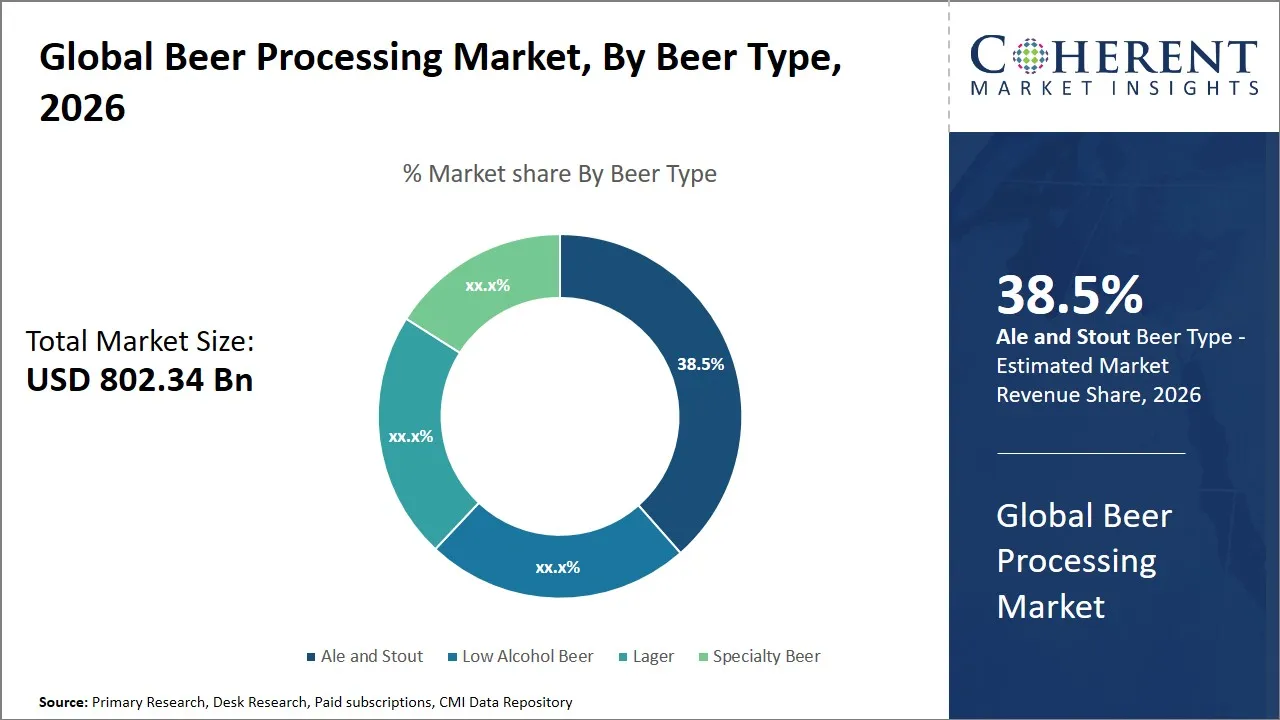
Why Does Ale and Stout Dominate the Global Beer Processing Market?
Ale and stout segment is expected to dominate the global beer processing market with 38.5% share in 2026, because their taste is more unique and nuanced, and the segment is more culturally relevant as more consumers want to experience authenticity and depth in their beverage consumption. In contrast to the lighter types of beer, ales and stouts have strong, full-bodied flavors with malty sweetness, roasted flavors as well as creamy texture that is palatable to a developing palate. This market has the advantage of an upsurge in demand by beer lovers who value the old brewing methods and exotic combinations of flavor.
An example of ale's rising popularity is the explosion of India Pale Ales (IPAs), particularly the "Hazy IPA" variety. Breweries such as Stone Brewing (USA) and BrewDog (Scotland) have capitalized on the surge in demand for this style, offering unique, limited-edition versions with exotic ingredients like tropical fruits, spices, and local hops.
Macrobrewery Dominates the Global Beer Processing Market
Macrobrewery segment is projected to dominate the beer processing market with 42.7% share in 2026, due to their large production scale, well established distribution channel and strong brand name that attracts a wide consumer base across the entire world. The large-scale brewing business is economical in terms of economies of scale so that they are able to make beer at less cost per unit with no compromise on quality in the various geographical markets. Such operational efficiency enables macrobreweries to offer popular beers at a low price without compromising the taste which is an important element in attracting mainstream buyers.
Another factor that enhances the market power of macrobreweries is the fact that they can create innovation in the already developed products and invest a lot in marketing and advertisement campaign that improves brand loyalty. Their international presence allows them extensive availability whereby their brands are a staple on the retail shelves, bars, and restaurants in different markets. This widespread presence assures consumers to lean towards well-known and trusted beers in particular in the area where craft and microbreweries have not yet led to substantial popularity.
Why is the Super-Premium Segment Dominating the Beer Processing Market?
The super-premium segment in the beer processing market is set to command 45.8% share in 2026, driven by a notable shift in consumer mindset that prioritizes quality, innovation, and exclusivity over mere affordability. Consumers are becoming more discriminating and do not see beer as a mere casual drink, but as a lifestyle one that defines their sophistication and taste. This category encompasses the beers that present high-quality ingredients, special brews, special edition, and high-quality packaging or design, which warrants them a premium price and differentiates them with the mainstream or discounted ones.
The rise of the super-premium segment is closely connected to the shifting demographics, specifically, the millennials and high-income urban consumers that represent cohorts that demonstrate the desire to be adventurous in their tastes and craftsmanship. These consumers are after authenticity and can afford to pay extra in order to obtain a unique sensory experience on the products being sold that are usually associated with the artisanal or heritage brewing tradition. Another positive effect of the segment is the emergence of specialty beer formats like barrel-aged beers, single-origin craft brews, and small-batch releases that create scarcity and exclusivity by products and engage with consumers and encourage rebuys.
Regional Insights
Asia Pacific Beer Processing Market Analysis and Trends
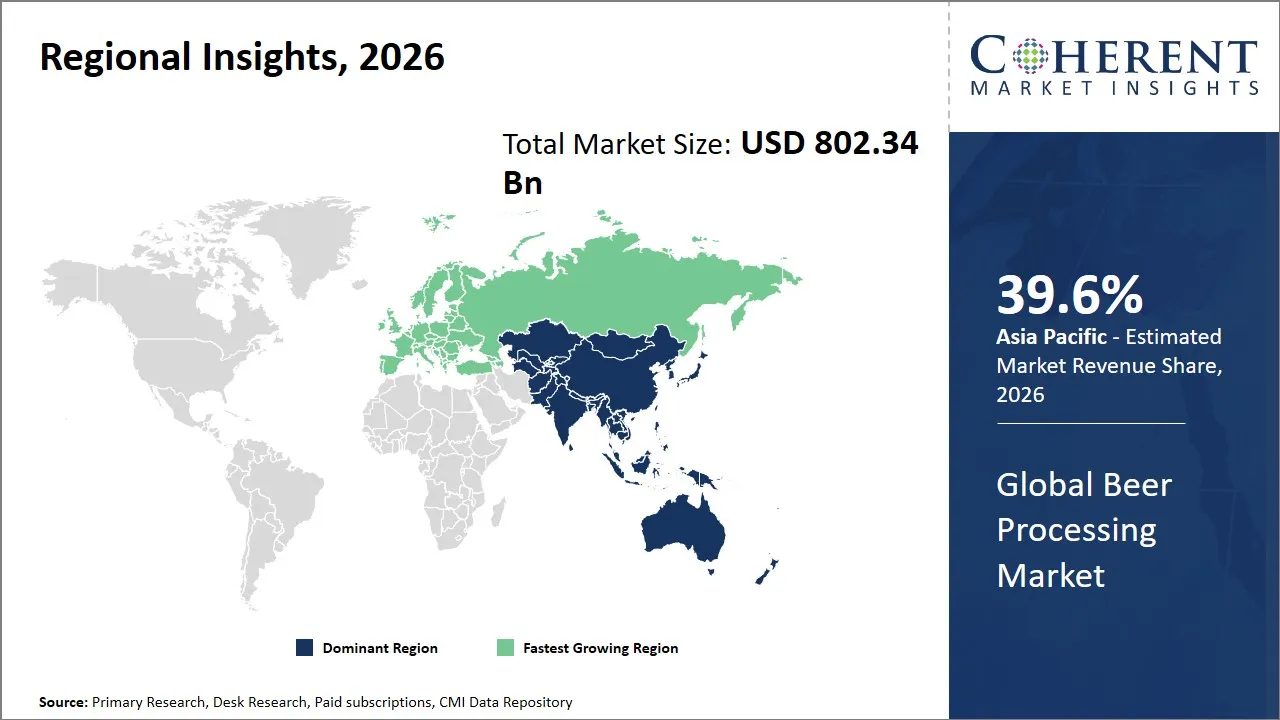
The Asia Pacific region is projected to lead the market with a 39.6% share in 2026. The beer consumption is on the rise in China, India, Vietnam and Thailand due to the rapid urbanization, growing middle-class status, as well as growing disposable incomes. The new yet developing beer market is drawing the large investments in the modern processing technologies to suit the new customer tastes regarding quality and variety.
Various Asia Pacific countries are slowly experiencing a shift in policies by the government in their favor, in terms of foreign direct investment and moving towards relaxing the barriers against alcohol production, and distribution. In addition, the increasing number of international brewers such as SABMiller (currently a subsidiary of AB InBev) and Tsingtao Brewery, as well as, strong local actors, are driving the need towards the admitted processing equipment and packaging solutions. Market growth is also being enhanced by trade dynamics such as higher exports of intra-regional trade and the availability of new e-commerce.
Europe Beer Processing Market Analysis and Trends
The Europe region is expected to exhibit the fastest growth in the market contributing 19.3% share in 2026, due to the fact that the beer industry is well established with a mature manufacturing ecosystem and solid infrastructural framework that support the industry. Europe boasts of several well-known breweries and makers of processing equipment that have become the first to introduce technological change to the beer production industry. The area also enjoys good regulatory policies that facilitate good quality and food safety practices which facilitates easy operations and consumer confidence.
Furthermore, the incentives of the government towards sustainable brewing operation create innovation in the processing technologies including computerization and power-efficient systems. Some of the oldest and largest breweries in the world are found in countries such as Germany, Belgium and the U.K. including Anheuser-Busch InBev (based in Belgium), Heineken (based in Netherlands) and Carlsberg (based in Denmark) that play a very significant designation in the region. The developed supply chains and the favorable trade agreements in the European Union, which make easy movement of raw materials and finished products, also help to strengthen the dominance of Europe.
Global Beer Processing Market Outlook for Key Countries
Germany Beer Processing Market Trends
The beer processing market in Germany is a leader in the market because of the brewing tradition and strict quality standards like the German Beer Purity Law. The varied brewery scene in the country where multinational corporations such as Anheuser-Busch InBev are coexisting with various artisanal breweries promotes experimental approaches to the processing technologies. German firms are at the forefront in the advancement of high accuracy filtration and fermentation machines, which have an added effect on improving the consistency and shelf life of products. The adoption of sustainable energy through breweries is also being supported by the government, which is affecting the upgrade of the equipment making Germany a pioneer in technologies in beer processing.
Why is China’s Beer Processing Market Expanding with Modernization and Premium Demand?
China’s beer processing market is changing at an alarming rate to cater to the largest beer drinking population in the world. Modernization by major market participants like China Resources Snow Breweries and Tsingtao Brewery has further strengthened the market expansion as they are installing and spending a lot of money on automated bottling lines and quality control systems. The growing demand of beer variants by consumers who prefer premium drinks is motivating breweries to revert to sophisticated conditioning and flavor stabilization methods.
This growth is also supported by the gradual liberalization of alcohol manufacturing policies and the development of infrastructure made by the governments. Furthermore, the increased penetration of e-commerce increases the distribution channels forcing the processing firms to develop packaging with longer shelf lives.
Why is the U.S. Beer Processing Market Leading in Innovation and Sustainability?
The U.S. has a large stake in beer processing because it has a mature and competitive brewing industry with major players in the industry such as Anheuser-Busch and Molson Coors. Craft beer boom has contributed to diversification of the processing needs where many small-mid breweries are making investments in more elastic and small-lot processing equipment.
Strict FDA laws concerning product safety and labeling policies stimulate businesses to adopt the latest monitoring and traceability systems into the processing chain. Additionally, the modernization of equipment is stimulated by the innovation of sustainable practices which include water recycling and energy-efficient brewing which are allowed by federal and state incentives.
India Beer Processing Market Trends
India’s market for beer processing is defined by the quick growth and the rising level of awareness of the consumers concerning the quality and variety of beer. Major Indian brewers such as the United Breweries and Royal challenge are embracing new technologies in processing with the aim of enhancing efficiency in the production process and the uniformity of the products offered. The changing regulatory landscape of the governments is making it easier to do business involving craft breweries and foreign investments and also increasing technological use in the brewing and packaging processes.
Also, the expanding hospitality industry and urbanization of Indias city are driving demand to different beer forms, which is stressing processors to come up with scalable and hygienic processing solutions. Notably, the localization of beer processing equipment production in the country through the Make in India initiatives is encouraged.
Brazil Beer Processing Market Trends
The beer processing market in Brazil is still experiencing a significant change in the processing of beer by its major players like Ambev and Grupo Petropolis. Developments that are being made to be able to meet international standards of quality and lower the costs of operation are the investments made in the process automation and quality assurance systems.
The processing technology environment in Brazil’s is improved by the government support in modernization of food and beverage industries and trade agreements among the countries of Mercosur. Also, the increased consumption of premium beer and the demand of the export are promoting the introduction of flexible and efficient processing equipment that can manage a variety of product portfolio.
Yield Loss & Beer Waste Mapping and Cost Breakdown per HL Across Processing Stages
Processing Stage | Yield Loss (%) | Cost per HL (USD) | Key Wastes & Losses |
Raw Material Handling | 2.0% | 10.00 | Spoilage, incorrect measurements, excess handling loss |
Milling & Mashing | 3.5% | 5.50 | Poor extraction, excess moisture |
Filtration & Clarification | 1.5% | 4.00 | Losses in dead yeast and residual solids |
Storage & Distribution | 1.0% | 2.50 | Spoilage due to temperature fluctuations |
Market Players, Key Development, and Competitive Intelligence
Key Developments
- In September 2024, SOM Distilleries and Breweries Ltd. launched India’s first twist-cap beer, "Woodpecker Premium Beer." This innovation introduces a novel twist-style cap, offering unprecedented convenience and a unique drinking experience for consumers. By pioneering this packaging technology in India, SDBL is expected to strengthen its brand differentiation, drive consumer engagement, and capture market share in Karnataka—one of the company’s fastest-growing regions—while setting new standards for product innovation in the premium beer segment.
- In September 2024, International Flavors & Fragrances (IFF) announced the launch of DIAZYME NOLO, a breakthrough enzyme solution designed to enhance flavor, production efficiency, and output for no- and low-alcohol (NOLO) beverages. This solution enables breweries to meet rising consumer demand for NOLO beers without requiring significant capital investment, allowing manufacturers to expand their product portfolios cost-effectively. The introduction of DIAZYME NOLO is expected to accelerate the growth of the NOLO segment globally, improving competitiveness for breweries targeting health-conscious and mindful drinking consumers.
- In August 2024, an Indian craft brewer, backed by Japan’s Kirin Holdings Co., announced plans to construct a USD 70 million beer production facility and raise fresh funds ahead of a public listing projected for 2026. This strategic move aims to challenge established global brands by significantly expanding production capacity and strengthening distribution networks. The investment is expected to boost the craft beer market in India, improve product accessibility, and accelerate the penetration of premium and specialty beers among a growing consumer base
- In January 2024, ABB launched a new process automation solution specifically for the cold block stage of beer production. This innovation is designed to optimize production efficiency, reduce energy consumption, and enhance operational reliability. By automating critical stages of the brewing process, ABB’s solution enables breweries to increase throughput, improve product consistency, and lower production costs, thereby strengthening competitiveness in an increasingly technology-driven beer market.
Top Strategies Followed by Global Beer Processing Market Players
Player Type | Strategic Focus | Example |
Established Market Leaders | Heavy investment in R&D and innovation | Anheuser-Busch InBev, a leading beer company in the world, has been leading in developing high-performance solutions in beer processing. Their investments have resulted in innovations like the creation of smart brewing systems that are better at automation, better at consistency and low cost of operation. |
Mid-Level Players | Cost-effective solutions with balanced quality | Craft Brew Alliance is a middle player in the American beer industry that will provide affordable brewing technologies but remain good in terms of quality due to strategic collaboration with industry giants. |
Small-Scale Players | Niche specialization & innovative variants | Sierra Nevada Brewing Co. has embarked on a state of the art solar-powered brewing system, which saves on energy usage and environmental footprint. Beer Processing Market Driver - Adding Consumer Preference to Craft and Specialty Beers. |
Market Report Scope
Beer Processing Market Report Coverage
| Report Coverage | Details | ||
|---|---|---|---|
| Base Year: | 2025 | Market Size in 2026: | USD 802.34 Bn |
| Historical Data for: | 2020 To 2024 | Forecast Period: | 2026 To 2033 |
| Forecast Period 2026 to 2033 CAGR: | 4.1% | 2033 Value Projection: | USD 1,062.95 Bn |
| Geographies covered: |
| ||
| Segments covered: |
| ||
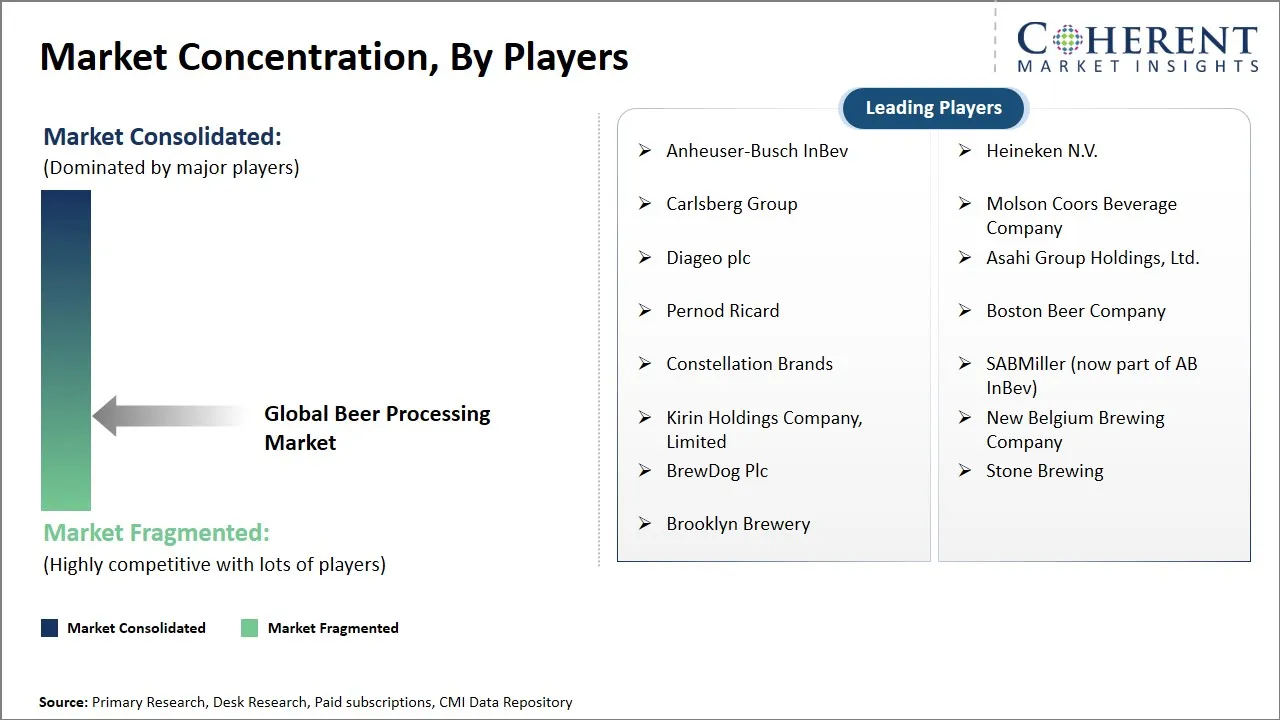
| Companies covered: | Anheuser-Busch InBev, Heineken N.V., Carlsberg Group, Molson Coors Beverage Company, Diageo plc, Asahi Group Holdings, Ltd., Pernod Ricard, Boston Beer Company, Constellation Brands, SABMiller (now part of AB InBev), Kirin Holdings Company, Limited, New Belgium Brewing Company, BrewDog Plc, Stone Brewing, and Brooklyn Brewery | ||
| Growth Drivers: |
| ||
| Restraints & Challenges: |
| ||
Beer Processing Market Dynamics
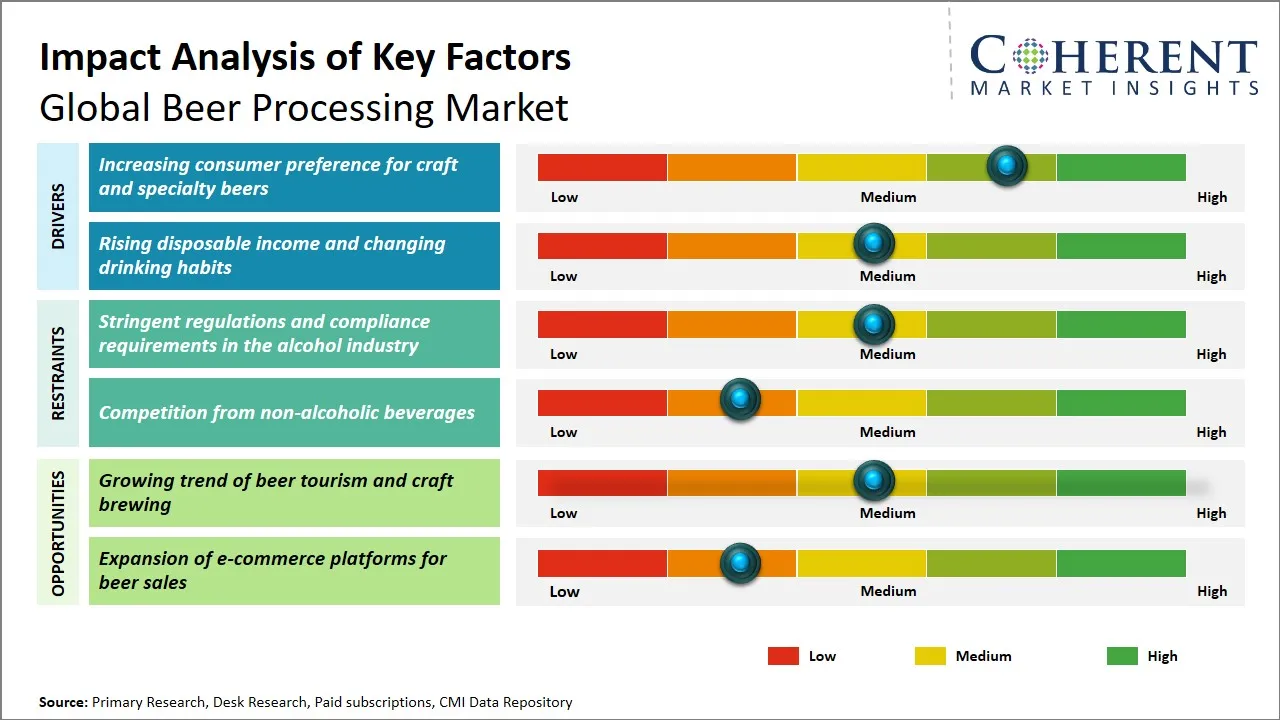
Beer Processing Market Driver - Increasing Consumer Preference for Craft and Specialty Beers
Increasing consumer preference for specialty and craft beers is playing a major role in shaping the beer processing market by creating individual and innovative brewing methods. With consumers growing increasingly daring in their taste choices, they have an increasing inclination towards exotic flavors, small-scale brewing techniques, and locally produced ingredients that define the craft beer as compared to mass-produced ones. This change motivates breweries to invest more in modern processing machinery to be flexible in working on much smaller batches, allowing them to experiment with new recipes and styles.
For instance, in 2023, the Brewers Association reported that U.S. craft beer sales grew by 8%, reaching a record value of USD 28.4 billion, accounting for 23.1% of the overall market. This increase highlights the rising consumer demand for unique, high-quality beers that align with the growing trend of craft brewing, as more consumers seek locally produced and innovative beer options.
Beer Processing Market Opportunity - Growing Trend of Beer Tourism and Craft Brewing
The increased popularity of beer tourism and the craft brewing sector is a major opportunity to the global beer processing market. With more consumers looking to experience something distinctive and genuine, the destinations with a rich history of brewing are drawing in more and more tourists who are interested in going to local breweries, tasting events, and beer festivals. This increase in the tourism of beer not only enhances the demand of a wide range of beer products of high quality but also leads to the necessity of innovative and flexible technologies of beer processing that can provide support to small and medium-sized craft beer manufactures. Craft brewery equipment, with their innovative flavors and limited-productions demand informative processing planting that will enable quick change in recipes and scale, promoting innovation and differentiation within the market.
For example, New Belgium Brewing Company is a nationally distributed brewery in the U.S. The brand produces Fat Tire Ale, Voodoo Ranger IPA, Mural Agua Fresca Cerveza, and La Folie Sour Brown Ale, among other regular and seasonal beer varieties. In order to sustain quality and innovativeness, they rely on state-of-the-art brewing equipment that encourages smaller yet more frequent batches and allow a greater amount of customization and flexibility.
Analyst Opinion (Expert Opinion)
- The beer processing market is experiencing dynamic growth, which is driven by the changing consumer tastes on craft beers and new brewing processes. The Brewers Association Conference (2023) and the Global Brewing Technology Expo (2022) have brought some enlightening perspectives, with such companies as AB InBev and Heineken being in the lead to integrate automation and sustainability in their brewing operations.
- The recent launch of a state-of-the-art brewing system by AB InBevs that increases the efficiency of fermentation is an instance of how the industry aims to maximize the production process without compromising the environmental standards. The topics of these conferences pointed out to the growing popularity and demand of natural and organic ingredients as attitudes of the consumer towards health and quality change.
- The certain obstacles like supply chain issues and regulatory obstacles were often cited as obstacles to expansion. Firms that invest in new technologies of processing and are targeting product diversification to meet niche markets will be drawing serious opportunities. Ultimately, the growth of the beer processing market will depend on its ability to adapt to consumer trends while maintaining quality and sustainability in an increasingly competitive landscape.
Speak to the analyst
Want personalized insights?
Take the findings above to one of our principal consultants, or have the report rebuilt around the segments, geographies and competitors you actually track.
Market Segmentation
- Beer Type Insights (Revenue, USD, 2021 - 2033)
- Ale and Stout
- Low Alcohol Beer
- Lager
- Specialty Beer
- Brewery Type Insights (Revenue, USD, 2021 - 2033)
- Macrobrewery
- Craft Brewery
- Microbrewery
- Brewpub
- Price Category Insights (Revenue, USD, 2021 - 2033)
- Super-premium
- Premium
- Mainstream
- Discount
- Distribution Channel Insights (Revenue, USD, 2021 - 2033)
- Off-Trade
- On-Trade
- Regional Insights (Revenue, USD, 2021 - 2033)
- North America
- U.S.
- Canada
- Latin America
- Brazil
- Argentina
- Mexico
- Rest of Latin America
- Europe
- Germany
- U.K.
- Spain
- France
- Italy
- Russia
- Rest of Europe
- Asia Pacific
- China
- India
- Japan
- Australia
- South Korea
- ASEAN
- Rest of Asia Pacific
- Middle East
- GCC Countries
- Israel
- Rest of Middle East
- Africa
- South Africa
- North Africa
- Central Africa
- North America
- Key Players Insights
- Anheuser-Busch InBev
- Heineken N.V.
- Carlsberg Group
- Molson Coors Beverage Company
- Diageo plc
- Asahi Group Holdings, Ltd.
- Pernod Ricard
- Boston Beer Company
- Constellation Brands
- SABMiller (now part of AB InBev)
- Kirin Holdings Company, Limited
- New Belgium Brewing Company
- BrewDog Plc
- Stone Brewing
- Brooklyn Brewery
Sources
Primary Research Interviews
- CEO – Leading Beer Processing Equipment Manufacturer (e.g., Krones Group or GEA Group equivalent)
- Supply Chain Director – Major Beer Ingredients Distributor (e.g., malt and hops suppliers)
- Production Lead – Craft Brewery Operator
- Sustainability Officer – Brewers Association Environmental Committee
Stakeholders
- Manufacturers
- End-use Sectors
- Macro Breweries (e.g., AB InBev, Heineken)
- Craft and Microbreweries
- Beer Distributors and Retailers
- Regulatory & Certification Bodies (e.g., FDA for beer safety, TTB in US, EU Food Safety Authority)
- E-commerce Platforms and Retailers (Alibaba Industrial, Sigma-Aldrich for brewing chemicals)
- Technology Integration Players: Advanced brewing equipment providers (Alfa Laval, Paul Mueller)
Databases
- UN Comtrade Database (HS Code 2203 for beer)
- India Import Export (EXIM) Database (beer imports/exports)
- USITC DataWeb (beer trade statistics)
- Eurostat Trade Statistics for Beverages
- World Bank WITS (beer commodity trade)
Magazines
- BrewUp Magazine – Trends in European beer processing [The Brewers of Europe]
- The New Brewer – Craft beer production innovations (Brewers Association)
- Beverage Industry Magazine – Beer market dynamics
- All About Beer – Global brewing supply chain
- Modern Brewery Age – Processing technology updates
Journals
- Journal of the American Society of Brewing Chemists – Beer fermentation and quality analysis
- Journal of Agricultural and Food Chemistry – Beer processing chemistry
- Journal of the Institute of Brewing – Brewing science and sustainability
- MBAA Technical Quarterly – Master Brewers Association technical papers
- Resources Policy – Beer supply chain economics
Newspapers
- The Wall Street Journal – Global beer market demand fluctuations
- The Guardian – Sustainability in brewing industry
- Business Standard (India) – Beer consumption and imports growth
- Bloomberg – Beer production disruptions and mergers
- Reuters – Craft beer trends and export volatility
Associations
- Brewers Association (US independent craft brewers)
- Brewers Association of India
- The Brewers of Europe (European brewing federation)
- Brewers Association of Canada
- Deutscher Brauer-Bund (German Brewers Federation)
- Belgian Brewers
- International Alliance of Brewers Associations
Public Domain Sources
- FDA – Guidelines for beer production and labeling
- European Commission – Food safety regulations for beer
- World Health Organization – Alcohol beverage safety standards
- USITC/USDA FAS – Beer trade and export assessments
- OECD – Beverage trade and sustainability reports
Proprietary Elements
- CMI Data Analytics Tool, Proprietary CMI Existing Repository of information for last 8 years.
Get access to 250+ pages report
Every segment, forecast, competitor profile and data table behind the analysis above — available for instant download.
- ESOMAR Member
- ISO 9001:2015 Certified
- D-U-N-S Registered
- GDPR & CCPA Compliant
Missing comfort of reading report in your local language? Find your preferred language:
Transform your Strategy with Exclusive Trending Reports
Frequently Asked Questions
The global beer processing market is estimated to be valued at USD 802.34 Bn in 2026 and is expected to reach USD 1,062.95 Bn by 2033.
The CAGR of global beer processing market is projected to be 4.1% from 2026 to 2033.
Increasing consumer preference for craft and specialty beers and rising disposable income and changing drinking habits are the major factors driving the growth of the global beer processing market.
Stringent regulations and compliance requirements in the alcohol industry and competition from non-alcoholic beverages are the major factors hampering the growth of the global beer processing market.
In terms of beer type, ale and stout is estimated to dominate the market revenue share in 2026.
Return on investment, scalability, energy efficiency, operator training, and quality control analytics.
Anheuser-Busch InBev, Heineken N.V., Carlsberg Group, Molson Coors Beverage Company, Diageo plc, Asahi Group Holdings, Ltd., Pernod Ricard, Boston Beer Company, Constellation Brands, SABMiller (now part of AB InBev), Kirin Holdings Company, Limited, New Belgium Brewing Company, BrewDog Plc, Stone Brewing, and Brooklyn Brewery are the major players.