

Organic Soy Lecithin Market Size and Trends
The global organic soy lecithin market is estimated to be valued at USD 71.4 Mn in 2026. The market is expected to reach USD 115.5 Mn by 2033, exhibiting a compound annual growth rate (CAGR) of 7.1% from 2026 to 2033.
Key Takeaways of the Organic Soy Lecithin Market
- Based on form, the liquid segment is expected to account for 61.8% of the market share in 2026, owing to its widespread usage in convenience foods and beverages.
- Based on type, the refined segment is expected to hold 62.2% share of the market in 2026 due to its superior purity, functional performance, and versatility across food, pharmaceutical, and personal care industries.
- Based on application, the food and beverages segment is expected to account for 41% of the market share in 2026.
- Based on region, North America is projected to lead the global market with 32.9% share in 2026, followed by the Asia Pacific region, which is expected to hold a 23.3% share
Market Overview
The organic soy lecithin market demand is witnessing steady growth, driven by rising demand for clean label and organic food products. Increasing health consciousness among consumers and growing preference for chemical-free products is driving the demand for organic soy lecithin. The versatile functional properties including emulsification, stabilization, and improved texture, make it a valuable additive across a wide range of food applications. These include baked goods, confectionery, plant-based dairy alternatives, sauces, and nutritional supplements.
In addition to food and beverages, it is also finding growing usage in personal care products, pharmaceuticals, and nutraceuticals due to its natural origin and clean profile. The market is also benefiting from regulatory support and certification schemes that promote organic farming and ingredient sourcing. The organic soy lecithin market is expanding steadily, underpinned by a strong push for health-focused, clean-label innovations, and is poised for further growth across multiple sectors in the coming years.
Current Events and their Impact on the Organic Soy Lecithin market
Current Event | Description and its Impact |
Regulatory Shifts in Key Markets |
|
Macroeconomic and Consumer Trends |
|
Export Import Analysis of Organic Soy Lecithin
Between October 2023 and September 2024 (TTM), the world imported 2,755 shipments of Soy Lecithin. These shipments came from 531 exporters and were purchased by 622 global buyers, reflecting a 7% decline compared to the previous twelve months. In September 2024 alone, global Soy Lecithin imports totaled 237 shipments, representing a 16% year-on-year increase compared to September 2023.
During the same timeframe, India exported 192 shipments of Soy Lecithin, involving 62 Indian exporters and 110 buyers. In September 2024, India shipped 7 Soy Lecithin exports.
- Current Industry Events of 2026
- Market Size Estimation
- Regional Breakdown
- Competitive Landscape
- Customer Intelligence
- Segmental Analysis
- Pricing Analysis
- Key Market Drivers, Challenges & Future Trends
- Customized Insights Section
Segmental Insights
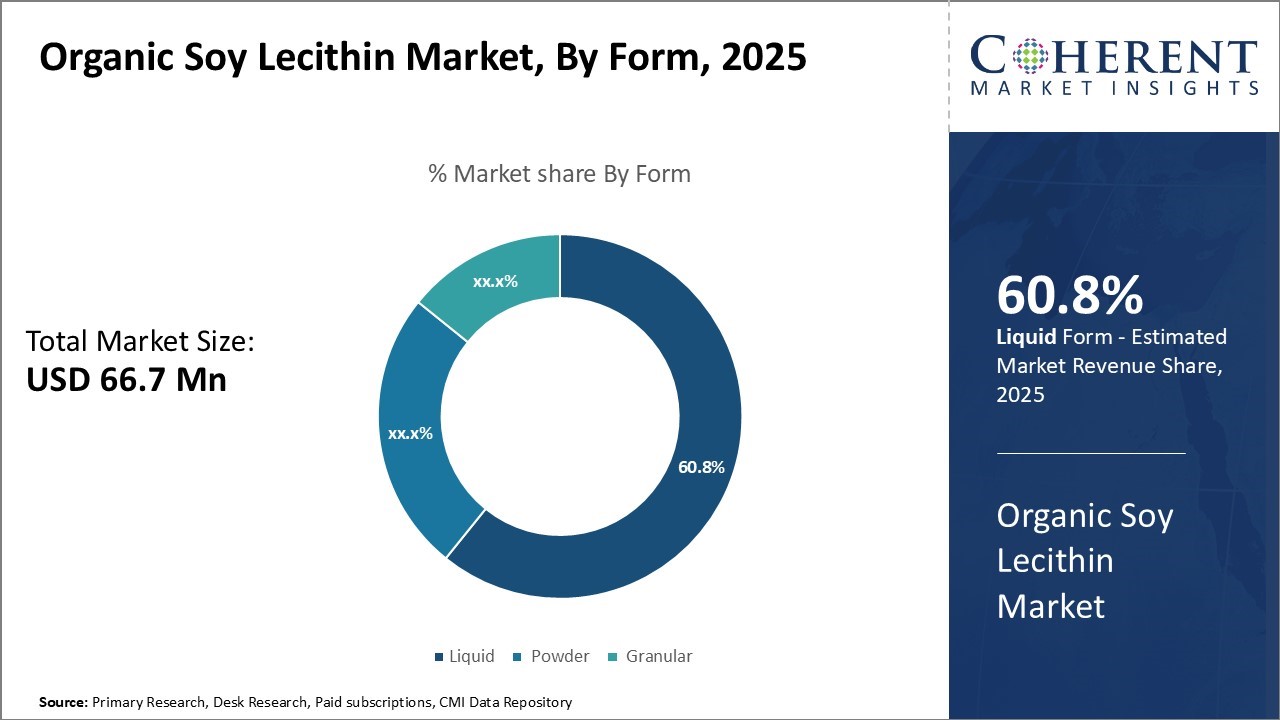
Organic Soy Lecithin Market Insights, By Form
Growing Popularity of Convenience Food Propels Liquid Organic Soy Lecithin Market Share
In terms of form, the liquid segment is expected to contribute 61.8% share of the market in 2026, owing to its widespread usage in convenience foods and beverages. As modern lifestyles become increasingly fast-paced, demand for ready-to-eat meals and packaged snacks is on the rise. Liquid soy lecithin, with its emulsifying and stabilizing properties, allows for smooth textures and long shelf lives in various processed food products. It is especially useful for mayonnaise, salad dressings, and sauces where a homogeneous mixture is required.
For instance, Orison Chemicals launched enzymatically modified soy lecithin oil, also known as Hydrolyzed Soy Lecithin (LeciOIL™Hy50), positioning it as a next-generation natural emulsifier for food, pharma, cosmetics and specialty industries. Its applications range from more stable chocolate and dressing formulations to enhanced drug delivery systems. With growing clean-label demand, this customizable lecithin offers a natural alternative to synthetic stabilizers, catering to evolving consumer and industrial requirements.
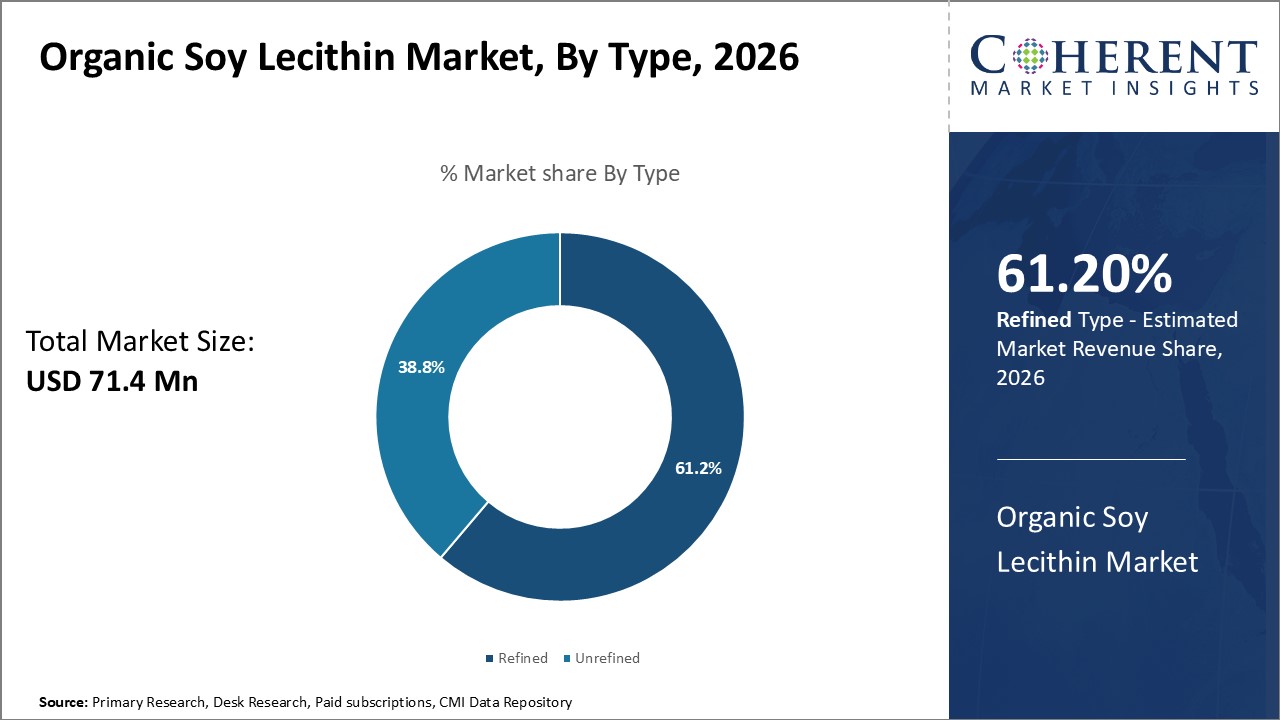
Organic Soy Lecithin Market Insights, By Type
Refined Organic Soy Lecithin Gains Popularity with Strict Labeling Requirements
In terms of type, the refined segment is expected to contribute 61.2% share of the market in 2026 due to its superior purity, functional performance, and versatility across food, pharmaceutical, and personal care industries. While unrefined soy lecithin has similar functionalities, regulations around product labeling are increasingly stringent. Refined organic soy lecithin undergoes further processing to remove impurities and bitter flavors, allowing manufacturers to formulate food items with clean, neutral profiles. This is important for products targeting mass markets with diverse consumer bases. Refined soy lecithin has steadily grown as a natural, clean-label emulsifier. Innovative extraction and heat-stable structures are broadening its role across clean-food, pharma, and industrial sectors. This is further propelling the organic soy lecithin market share.
Organic Soy Lecithin Market Insights, By Application Insights
Food and Beverages Sector Stimulates Organic Soy Lecithin Demand
In terms of application, the food and beverages segment are expected to contribute 41% share of the market in 2026. Organic soy lecithin works well as an emulsifier, stabilizer, and additive across diverse culinary applications. In baked goods and desserts, it yields smooth textures and spreads. Meat products leverage its water retention abilities. Dairy products and non-dairy beverages are enriched with a creamy mouthfeel from organic soy lecithin. The booming global processed food industry has increased the demand for functional and natural ingredients like organic soy lecithin. Food manufacturers are increasingly using organic soy lecithin in products like chocolates, dairy‑alternative spreads, baked goods, and snack coatings, valued for emulsification, texture enhancement, and shelf‑life extension.
Novastell has introduced a new line of lecithin granules designed for use in food and beverage products. The range includes Soycithin G97 IP, a classic soy-based lecithin that is non-GMO and fully traceable, and Suncithin G96, a sunflower-derived lecithin that is also non-GMO and free from allergens. Both options are plant-based.
Regional Insights
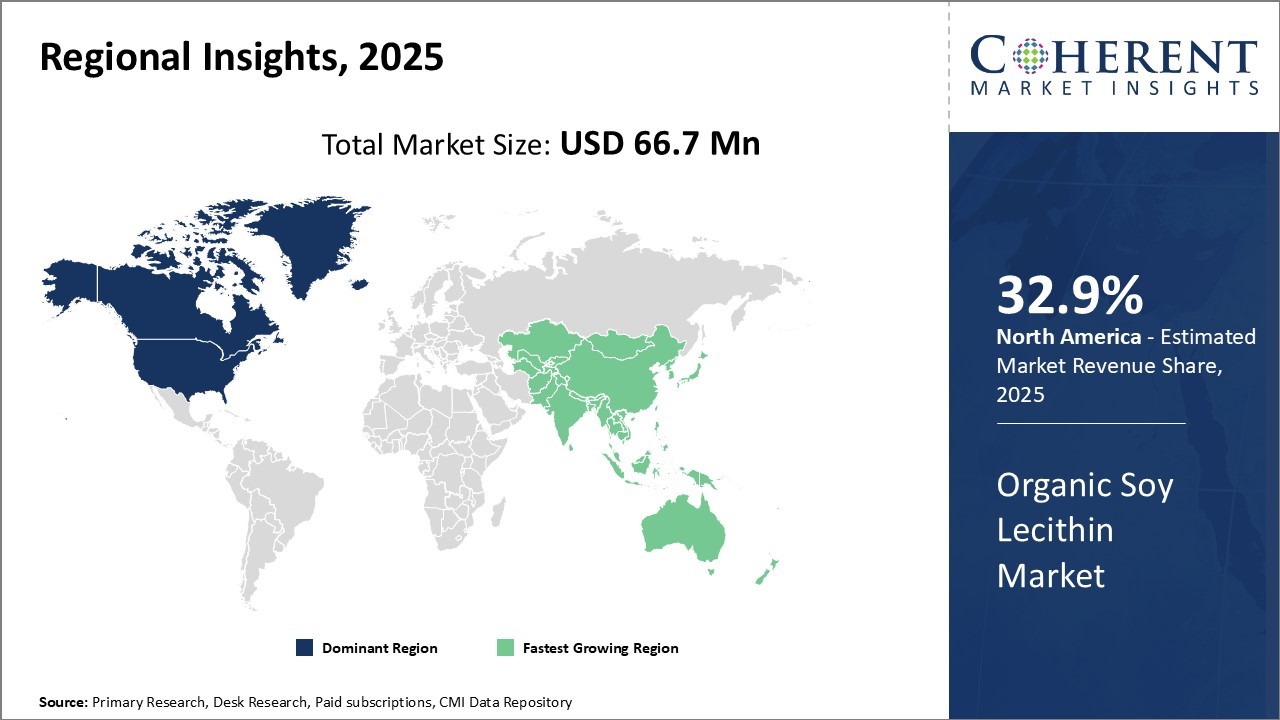
North America Organic Soy Lecithin Market Analysis & Trends
North America is anticipated to dominate the market, accounting for approximately 32.9% of the market share in 2026. This leadership is driven by a strong consumer inclination towards clean-label and organic products. The region's stringent regulations against Genetically Modified Organism (GMOs) and chemical additives in the food industry have prompted many companies to adopt organic ingredients. Additionally, government initiatives promoting organic farming have boosted supply in the market. Government-backed organic farming initiatives have further increased supply. For instance, Archer Daniels Midland (ADM) has exceeded its 2023 goal by implementing regenerative agriculture across 2.8 million acres, with a target of 5 million by 2026, boosting availability of non-GMO organic soybeans. This is further proliferating the organic soy lecithin market share.
Asia Pacific Organic Soy Lecithin Market Analysis & Trends
The Asia Pacific region is expected to be the fastest-growing market for organic soy lecithin in 2026, capturing around 23.3% of the global market share. This rapid growth is fueled by the expanding food and beverage industry in emerging economies. In China, regulators recently relaxed rules in GB 2760 to allow acetylated lecithin in 95% of processed foods, prompting companies like Tingyi to reformulate instant noodles using locally sourced lecithin to prevent oil separation upon rehydration. Increasing health awareness and higher disposable incomes have driven consumer demand for premium organic products.
In India, the Food Safety and Standards Authority mandated lecithin in fortified ghee, leading Adani Wilmar to set up 12 solvent-free extraction plants in Gujarat to meet new compliance and health-driven demand, With India and China ranking among the largest producers and consumers of soy globally, local businesses enjoy a competitive edge. These real-world initiatives in major APAC economies illustrate how rising health awareness, burgeoning middle-class incomes, and strong domestic production capabilities are converging to fuel growth in the organic soy lecithin market, positioning the region as a global leader in both supply and demand.
Organic Soy Lecithin Market Outlook for Key Countries
U.S. Organic Soy Lecithin Market Trends
The U.S. is a leading market for organic soy lecithin, driven by increasing consumer demand for clean label products and health-conscious ingredients. The market is projected to grow significantly, with a focus on innovative applications in food and beverages. One notable development is Cargill’s March 2023 launch of a new Non‑GMO Project‑certified soy lecithin line tailored for North American manufacturers aiming to simplify ingredient labels without sacrificing performance.
Additionally, Archer Daniels Midland (ADM) teamed up in 2024 with a plant-based snack maker to explore lecithin-infused fiber blends, demonstrating innovative functional uses beyond traditional emulsification. These examples highlight how major U.S. producers are not only scaling organic and non‑GMO lecithin supply but also partnering on creative applications, fueling further growth in the organic soy lecithin market as the industry responds to evolving consumer and product innovation trends.
China Organic Soy Lecithin Market Trends
China organic soy lecithin market is expanding rapidly due to rising health awareness and the growing demand for plant-based ingredients. The government is promoting organic farming practices, which is expected to boost the production and consumption of organic soy lecithin. Shandong Yuxin has recently expanded its production capacity to meet the growing demand for organic soy lecithin, both locally and globally. The company has also partnered with organic soybean farmers to ensure a steady supply chain. Meanwhile, China’s updated food safety standards (GB 2760) now permit acetylated lecithin in most processed foods, prompting leading brands like Tingyi to use it in instant noodles to ensure product stability. Together, public support, regulatory change, and targeted industry investments are fueling the organic soy lecithin sector across China.
Germany Organic Soy Lecithin Market Trends
Germany is a key player in the Europe organic soy lecithin market, driven by stringent regulations on food safety and a strong preference for organic products. In 2023, German households spent approximately €16 billion on organic food, marking a 5 % increase over the previous year. This momentum is reflected on retail shelves: major chains like Edeka and REWE, alongside discount grocers such as Aldi and Lidl, have expanded their private-label organic offerings—growing their share to around 40 % of the market.
The increasing availability of organic goods, paired with clear labeling under the EU Organic logo, has raised consumer trust and driven demand for organic ingredients like soy lecithin. For example, at the recent BioFach trade fair in Nuremberg, German exhibitors showcased new organic emulsifiers, including lecithin variants for the use in plant-based and clean-label snacks, highlighting domestic innovation in this area. As Germany aims to bring 30 % of its agricultural land into organic production by 2030, the stage is set for continued growth in organic soy lecithin, catalyzed by both regulatory frameworks and shifting consumer preferences.
Brazil Organic Soy Lecithin Market Trends
Brazil organic soy lecithin market is witnessing growth due to the country's large soybean production and increasing demand for organic food products. The government has been supporting organic agriculture initiatives, which is expected to enhance the market for organic soy lecithin. Cargill Agrícola S.A., the Brazilian arm of the global agribusiness giant Cargill, is a significant player in the organic soy lecithin market. Leveraging Brazil's abundant soybean resources, the company focuses on providing high-quality organic lecithin to meet domestic and international demand.
A recent Reuters report noted that Brazil is piloting EU-compliant shipments with full traceability documentation as part of new deforestation regulation efforts, demonstrating the country's readiness for international organic standards. These developments illustrate how Brazil’s agricultural scale, regulatory support, and corporate leadership, exemplified by Cargill are driving growth in the organic soy lecithin market.
India Organic Soy Lecithin Market Trends
India organic soy lecithin market is growing as awareness about health benefits and sustainable practices increases among consumers. The government is promoting organic farming through various initiatives, which is expected to drive the demand for organic soy lecithin. The market is anticipated to expand significantly, with a focus on food and pharmaceutical applications. The Indian government is actively promoting organic farming initiatives, such as the Paramparagat Krishi Vikas Yojana (PKVY) and Mission Organic Value Chain Development for North Eastern Region (MOVCDNER), which encourage organic farming practices through subsidies, training programs, and certification support.
Market Players, Key Development, and Competitive Intelligence
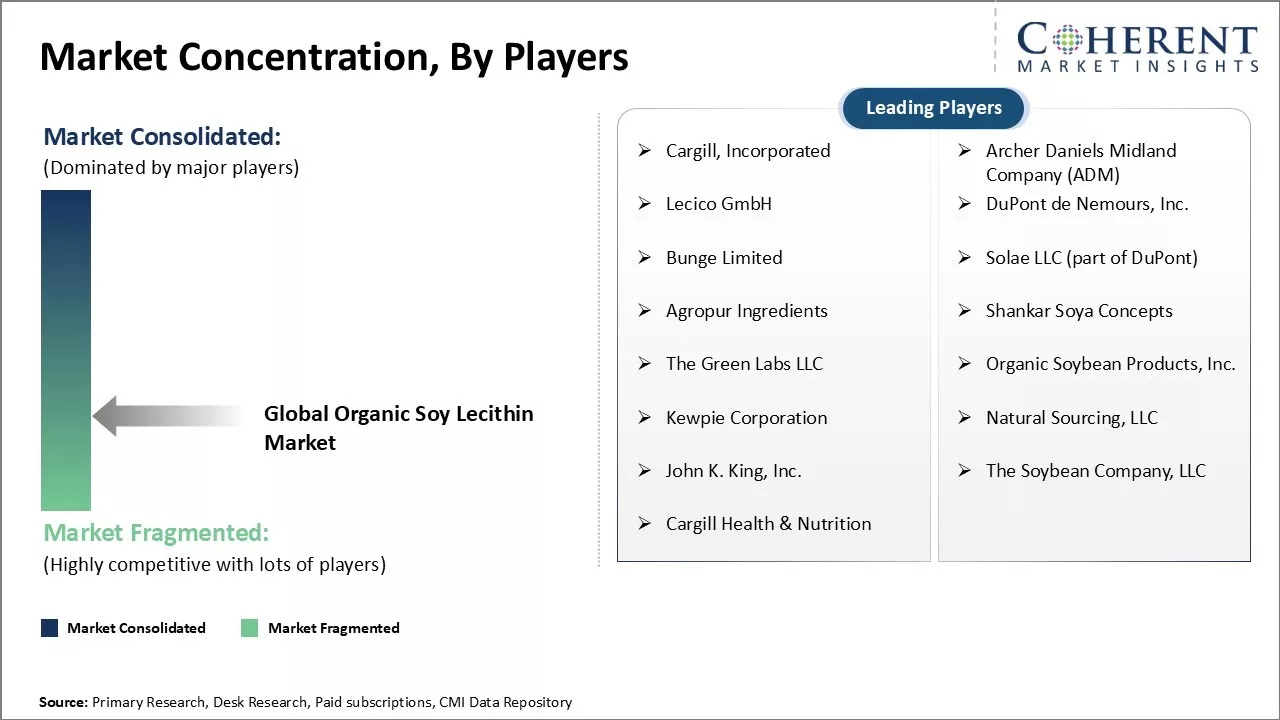
Key Developments
- In May 2025, Austrade Inc. introduced a new non‑GMO hydrolyzed sunflower lecithin powder aimed at functional‑beverage makers. The ingredient offers superior oil‑in‑water emulsification at reduced dosages, along with enhanced heat and acid stability which is ideal for plant‑based creamers, barista milks, protein drinks and it also comes with a neutral taste and color.
- In March 2025, ADM earned top honors at the 9th annual Best Ingredient Suppliers (BIS) Awards in São Paulo. The company received first place recognition for its natural extracts, including soy lecithin and plant-based proteins.
- In March 2025, Louis Dreyfus Company (LDC) expanded its plant-based ingredient portfolio at the Food Ingredients China exhibition by launching new plant-based Vitamin E products and expanding its lecithin range to include powdered lecithin from non-GMO soy, sunflower, and rapeseed, meeting rising demand in China.
- In September 2021, AAK, a specialty oils and fats company, acquired BIC Ingredients, the lecithin division of BIC International Holdings. Known for its innovative and sustainable solutions, AAK serves a diverse range of industries, including food, pharmaceuticals, and cosmetics. The acquisition of BIC Ingredients, which specializes in organic lecithins derived from sunflower, soy, rapeseed, and other sources, was a strategic move to enhance AAK’s portfolio of specialty lecithins.
Market Report Scope
Organic Soy Lecithin Market Report Coverage
| Report Coverage | Details | ||
|---|---|---|---|
| Base Year: | 2025 | Market Size in 2026: | USD 71.4 Mn |
| Historical Data for: | 2020 To 2024 | Forecast Period: | 2026 To 2033 |
| Forecast Period 2026 to 2033 CAGR: | 7.1% | 2033 Value Projection: | USD 115.5 Mn |
| Geographies covered: |
| ||
| Segments covered: |
| ||
| Companies covered: | Cargill, Incorporated, Archer Daniels Midland Company (ADM), Lecico GmbH, DuPont de Nemours, Inc., Bunge Limited, Solae LLC (part of DuPont), Agropur Ingredients, Shankar Soya Concepts, The Green Labs LLC, Organic Soybean Products, Inc., Kewpie Corporation, Natural Sourcing, LLC, John K. King, Inc., The Soybean Company, LLC, and Cargill Health & Nutrition | ||
| Growth Drivers: |
| ||
| Restraints & Challenges: |
| ||
Organic Soy Lecithin Market Driver
Growing demand for natural and organic food ingredients
The demand for natural and organic food products is growing rapidly across the global food industry. With increasing health concerns over chemical-based food additives and preservatives, consumers are seeking out food ingredients that are derived from natural plant sources. Organic soy lecithin perfectly fits this demand profile as it is extracted from certified organic non-GMO soybeans using only mechanical and natural processing methods without any chemical solvents. This growing preference for clean label products has seen most major food companies emphasizing the use of natural and organic ingredients in their reformulations.
In 2025, Ferrero partnered with Italian farming cooperatives to develop dedicated organic soybean cultivation, securing traceable and cost-effective organic lecithin supplies. Meanwhile, Friesland Campina in the Netherlands piloted blockchain tracking of organic lecithin procurement, improving supply chain transparency and cutting administrative overhead by 12%. These initiatives are classic examples of how the organic soy lecithin market growth is being backed by investments in sustainability, traceability, and clean-label innovation.
Increasing health awareness and preference for healthy fats
Consumers are increasingly recognizing the value of healthy fats, positioning organic soy lecithin as a desirable ingredient in clean-label nutrition. It is rich in phospholipids such as phosphatidylcholine and unsaturated fatty acids, linoleic and oleic acids enabling organic soy lecithin support for cardiovascular health, promotes cognitive function, and aids digestion. For example, a 2023 Health article highlighted lecithin supplements' role in managing cholesterol and improving gut health among ulcerative colitis patients. Food and beverage brands are capitalizing on these benefits: a new line of organic plant-based protein bars now prominently features organic soy lecithin on the label, marketed for its “heart‑healthy fats and clean emulsification.” As consumers demand transparency around functional nutrition, organic soy lecithin aligns perfectly with wellness trends, bolstering its market appeal.
Organic Soy Lecithin Market Opportunity
Expansion of the vegan and plant-based food sector
One of the major opportunities for the market is the rising demand due to the expansion of the vegan and plant-based food industry. In the recent years, there has been a significant surge in the number of people adopting vegan and flexitarian diets across the globe. The primary reasons include health, ethical, and environmental concerns related to animal-based food products. As a result, numerous food brands such as Annie’s Homegrown have launched a wide variety of vegan substitutes for meat, dairy, and other animal derived products. These formulations often rely on organic soy lecithin for its clean-label credibility and emulsifying properties. For example, many dairy-free chocolates and plant-based milk increasingly feature certified organic lecithin to improve texture while maintaining non-GMO status.
Meanwhile, regulatory shifts such as Europe’s deforestation regulation have led major food companies like Nestlé and Unilever to secure sustainably sourced lecithin, reinforcing traceability and boosting supply chain transparency. These developments reinforce positive organic soy lecithin market forecast outlooks by aligning ingredient innovation with evolving consumer preferences toward plant-based, sustainable foods.
Analyst Opinion (Expert Opinion)
The Organic Soy Lecithin market value is approaching a structural turning point, driven less by its legacy role as a natural emulsifier and more by its emerging strategic value in traceability, clean-label formulations, and regional supply security. The market is no longer reacting to consumer trends; it is beginning to shape them.
At the heart of this shift is the growing intolerance of non-GMO-sensitive markets, particularly in Europe and parts of Asia, towards conventional soy lecithin, which often lacks full supply chain transparency. In Germany, for instance, over 70% of organic food manufacturers now require lecithin inputs to be certified both organic and identity-preserved (IP), according to 2024 data from the German Federation of Organic Food Producers. This has had two consequences: it has elevated organic soy lecithin beyond a functional additive, and it has begun to realign upstream sourcing strategies, with European importers increasing direct procurement from Brazil and India.
India, notably, is fast becoming the fulcrum of high-purity organic lecithin production due to government-backed organic farming initiatives under the Paramparagat Krishi Vikas Yojana (PKVY). Here, lecithin is not merely a co-product but an export-viable commodity. Indian exporters are now reporting a 30–35% annual increase in organic lecithin shipments to Europe and Japan, largely due to compliance with both EU Regulation 2018/848 and JAS Organic standards. The momentum suggests that India’s position may soon rival that of traditional South American suppliers.
In the U.S., the market narrative is more fragmented but equally revealing. While mainstream adoption remains limited, niche segments such as organic nutraceuticals, infant formula, and allergen-free food production are increasingly substituting synthetic emulsifiers with organic soy lecithin to meet evolving regulatory pressures from the USDA National Organic Program (NOP). A 2023 USDA report found that 62% of new organic-certified bakery and cereal products used lecithin sourced from IP soy, up from 44% just two years prior.
Speak to the analyst
Want personalized insights?
Take the findings above to one of our principal consultants, or have the report rebuilt around the segments, geographies and competitors you actually track.
Market Segmentation
- Form Insights (Revenue, USD Mn, 2021 - 2033)
- Liquid
- Powder
- Granular
- Type Insights (Revenue, USD Mn, 2021 - 2033)
- Refined
- Unrefined
- Application Insights (Revenue, USD Mn, 2021 - 2033)
- Food and Beverages
- Animal Feed
- Cosmetics and Personal Care
- Pharmaceuticals
- Others
- Regional Insights (Revenue, USD Mn, 2021 - 2033)
- North America
- U.S.
- Canada
- Latin America
- Brazil
- Argentina
- Mexico
- Rest of Latin America
- Europe
- Germany
- U.K.
- Spain
- France
- Italy
- Russia
- Rest of Europe
- Asia Pacific
- China
- India
- Japan
- Australia
- South Korea
- ASEAN
- Rest of Asia Pacific
- Middle East
- GCC Countries
- Israel
- Rest of Middle East
- Africa
- South Africa
- North Africa
- Central Africa
- North America
- Key Players Insights
- Cargill, Incorporated
- Archer Daniels Midland Company (ADM)
- Lecico GmbH
- DuPont de Nemours, Inc.
- Bunge Limited
- Solae LLC (part of DuPont)
- Agropur Ingredients
- Shankar Soya Concepts
- The Green Labs LLC
- Organic Soybean Products, Inc.
- Kewpie Corporation
- Natural Sourcing, LLC
- John K. King, Inc.
- The Soybean Company, LLC
- Cargill Health & Nutrition
Sources
Primary Research Interviews from the following stakeholders
Stakeholders
- Interviews with food technologists, organic product manufacturers, procurement heads, regulatory compliance officers, R&D heads, and supply chain managers across food, nutraceutical, and personal care sectors.
Databases
- UN Comtrade Database
- USDA Foreign Agricultural Service (FAS)
- World Trade Organization (WTO) Trade Statistics
- Indian Ministry of Agriculture & Farmers Welfare – Organic Products Division
- China Customs Statistics – Organic Soybean Imports
- Eurostat – Agricultural Production and Organic Trade
- Brazil Ministry of Agriculture, Livestock and Food Supply (MAPA)
- Directorate General of Commercial Intelligence and Statistics (DGCIS), India
- Trade Map (International Trade Centre)
Magazines
- FoodNavigator
- Organic & Wellness News
- Nutraceutical Business Review
- Food Processing
- AgFunder News
- Natural Products Insider
- The Probiotic Report
- Food Safety Magazine
- Manufacturing Today – Food & Beverage Edition
Journals
- Journal of Food Science
- Journal of Agricultural and Food Chemistry
- International Journal of Food Science & Technology
- Food Hydrocolloids (Elsevier)
- Journal of Functional Foods
- Journal of Cleaner Production – Sustainable Agriculture Section
- Plant Foods for Human Nutrition
Newspapers
- The Hindu Business Line – Agri and Food Sector
- The Economic Times – Food Processing and Commodities
- Financial Times – Agribusiness Reports
- South China Morning Post – Agri Trade and Organic Trends
- Business Standard – Organic Industry and Agro Policy
- The Wall Street Journal – Agriculture & Supply Chain Reports
Associations
- Organic Trade Association (OTA)
- Indian Council of Food and Agriculture (ICFA)
- International Federation of Organic Agriculture Movements (IFOAM)
- Soyfoods Association of North America
- American Soybean Association
- Society of Chemical Industry (SCI) – Food Group
- Confederation of Indian Industry (CII) – Food and Agri Tech Wing
Public Domain Sources
- Ministry of Food Processing Industries (MoFPI), India
- USDA National Organic Program (NOP)
- APEDA – Agricultural and Processed Food Products Export Development Authority
- FSSAI – Food Safety and Standards Authority of India
- NITI Aayog – Reports on Organic Farming
- Indian Institute of Soybean Research
- European Commission – Organic Regulations and Compliance Portal
- Reserve Bank of India (RBI) – Commodity Reports
Proprietary Elements
- CMI Data Analytics Tool, and Proprietary CMI Existing Repository of information for last 8 years
Get access to 250+ pages report
Every segment, forecast, competitor profile and data table behind the analysis above — available for instant download.
- ESOMAR Member
- ISO 9001:2015 Certified
- D-U-N-S Registered
- GDPR & CCPA Compliant
Missing comfort of reading report in your local language? Find your preferred language:
Transform your Strategy with Exclusive Trending Reports
Frequently Asked Questions
The Organic Soy Lecithin Market is estimated to be valued at USD 71.4 Mn in 2026, and is expected to reach USD 115.5 Mn by 2033.
The CAGR of the Organic Soy Lecithin Market is projected to be 7.1% from 2026 to 2033.
Growing demand for natural and organic food ingredients and increasing health awareness and preference for healthy fats are the major factors driving the market growth of organic soy lecithin.
Fluctuating prices of raw soybeans affecting production costs and limited awareness of soy lecithin benefits among consumers are the major factors hampering the market growth of organic soy lecithin.
In terms of form, the liquid segment is estimated to dominate the market revenue share in 2026.
Cargill, Incorporated, Archer Daniels Midland Company (ADM), Lecico GmbH, DuPont de Nemours, Inc., Bunge Limited, Solae LLC (part of DuPont), Agropur Ingredients, Shankar Soya Concepts, The Green Labs LLC, Organic Soybean Products, Inc., Kewpie Corporation, Natural Sourcing, LLC, John K. King, Inc., The Soybean Company, LLC, and Cargill Health & Nutrition are the major players.
North America is expected to lead the global organic soy lecithin market in 2026.